Abstract
We discuss the generalized quantum Lyapunov exponents , defined from the growth rate of the powers of the square commutator. They may be related to an appropriately defined thermodynamic limit of the spectrum of the commutator, which plays the role of a large deviation function, obtained from the exponents via a Legendre transform. We show that such exponents obey a generalized bound to chaos due to the fluctuation–dissipation theorem, as already discussed in the literature. The bounds for larger q are actually stronger, placing a limit on the large deviations of chaotic properties. Our findings at infinite temperature are exemplified by a numerical study of the kicked top, a paradigmatic model of quantum chaos.
1. Introduction
Classical chaos is well understood from the sensitivity of the dynamics to respect small changes in the initial conditions, the so-called butterfly effect. This is quantified by the Lyapunov exponent, the rate at which nearby trajectories separate exponentially in time. In the past few years, there has been a lot of attention given to quantum chaos and in particular, on the quantum Lyapunov exponent , defined from the intermediate-time exponential growth of the following square-commutator:
where is a small parameter [1]. The interest in this object comes from the fact that obeys a bound:
This result, now known as the quantum bound to chaos, was proved within the high energy community [2], driven to the topic because maximal chaos is attained by models of black holes, including the Sachdev–Ye–Kitaev model (SYK) [3,4,5]. See also Refs. [6,7] for alternative derivations. The interest in these issues has later spread over different communities, from condensed matter to quantum information theory. Recently, the existence of the bound in Equation (2) was physically rationalized as a consequence of the fluctuation–dissipation theorem (FDT) [8,9] since the out of time-order correlators (OTOC) appearing in Equation (1) can be mapped into two-time correlation functions in a duplicated Hilbert space.
Actually, both classically and quantum mechanically, the Lyapunov exponent is a distributed quantity: different starting conditions—or different time intervals after the same starting condition—yield different exponents, and they are peaked on a ‘typical’ value and have large (and rare) deviations around, for example, when a classical trajectory grazes a regular region. If the distribution is not a delta function, it is referred to as ‘multifractal’ [10].
A possibility to study the full distribution of Lyapunov exponents is to introduce the generalized Lyapunov exponents (GLE) , defined from the moments of the distribution (This may lead to confusion. The Lyapunov exponents are classified as first (maximal), second, … according to whether they measure linear, area, and in general k-form expansions [11]. Each is also generalized according to the moment q considered. Here we are considering expansions of linear lengths, and all moments q of the ‘first, maximum, Lyapunov exponent’, thus for all q and ). It turns out that the quantum generalized exponents also satisfy themselves a bound, stated in Ref. [8], that generalizes Equation (2). These bounds are the subject of this paper. We have two motivations: Firstly, they put limitations on the chaotic properties of rare protocols, favoring high and low chaoticity, and also allow us to define a Lyapunov exponent for typical protocols, actually different from the usual one considered in quantum mechanics. Secondly, a system that approaches the bounds for all the will turn out to be mono-fractal, i.e, the large deviation function becomes peaked on a single value, a property we find intriguing.
The quantum generalized Lyapunov exponents are defined by considering the -th commutator between two operators at different times, and assuming that they scale exponentially with time as
where is a small parameter, two common examples are (the semiclassical limit) or (as in the SYK model), the latter being more relevant here as we shall be interested in thermodynamic models. The thermal average at inverse temperature may be defined in various ways, as we shall see below.
The rate now defines the quantum thermal generalized Lyapunov exponent of order q. The usual (quenched) Lyapunov exponent thus is
On the other hand, the grow rate of the square commutator actually corresponds to the GLE with : .
In the quantum realm, the exponential regime holds only at intermediate times, up to the so-called Ehrenfest time . In actual fact, only when is the Lyapunov regime unambiguously defined.
Different q-Lyapunovs are dominated by initial conditions having different expansion rates, with larger rates dominating the averages corresponding to larger q. Hence, one must allow for the dependence on the Ehrenfest time itself:
A crucial assumption we shall make here is that
Under these assumptions, we show that the following holds:
This bound was already stated in Ref. [8], without the identification of the rate as a quantum GLE and the relation to large deviations. We will also clarify some assumptions on which the derivation [8].
Because we are assuming that does not decrease, the bounds for larger q (but always of order one with respect to N) are more stringent. The meaning of this, as the classical discussion below will make clear, is that even rarely expanding conditions are bounded.
2. Classical Generalized Lyapunov Exponents
Let us briefly review the classical case [11]. Consider the infinitesimal separation between two trajectories at time t, starting at a point and :
The rate is a function of the initial condition . This quantity grows in time according to an asymptotic exponential law with if the system is chaotic, where is a function of time which reaches a finite limit at long times. A very long chaotic trajectory will have explored most of the phase space, and the exponential expansion will be sampled from all regions: the value then becomes essentially the same for all initial conditions. This fact is encompassed in the Oseledec theorem [12].
The fact that is a cumulative process over stretches of time with uncorrelated properties leads to the usual argument for the introduction of a large deviation principle, in this case for the probability of a Lyapunov value given a random initial condition:
where S is the large-deviation (Cramér) function. If the system is ergodic, the ensemble of initial conditions may be substituted by the ensemble of initial times along the same trajectory.
The typical Lyapunov exponent is given by
(note that ).
One can study the -th moments which, for long enough times, shall grow exponentially as
where
are called the generalized Lyapunov exponents (GLE) of order , and characterize the fluctuations of the dynamical system [10]; see also Ref. [13]. They are defined as annealed averages:
where we have evaluated the integral over large t using saddle point. The typical Lyapunov exponent is retrieved as the limit
The GLE is the Legendre transform of , via Equation (13). As such, also is a convex function of . As a consequence, one has that obeys two important properties:
- are an increasing function of the order q:
- The GLEs are always bounded by the linear behavior:
These equations are obtained via the property of convex differentiable functions : . For and , this yields Equation (16), while for and , one has Equation (15).
The equality in Equation (16) holds only if , namely if the Lyapunov exponent is the same and does not fluctuate, we have mono-fractality. Interestingly, this characterizes also random matrices of dimension D without any structure and with high connectivity, which satisfy [10]. Otherwise, the system is characterized by multifractal behavior. The higher the moments, the more important the contributions coming from the tales of the distribution. In particular, in the case of a distribution with a finite support, the limits
select the maximal and minimal expanding rates.
3. Quantum Generalized Lyapunov Exponents at Infinite Temperature
Our goal is to extend the definition of generalized Lyapunov exponents to the quantum domain to discuss the bound in Equation (7). Systems with a few degrees of freedom do not lend themselves to the implementation of bounds that depend on temperature, as the canonical ensemble is not particularly useful for them. However, we may understand some other features that are also valid in thermodynamic systems by studying infinite-temperature systems of this kind. In this section, we define the quantum generalized Lyapunov exponents at infinite temperature and discuss their “convexity” properties. We will see that it is straightforward to interpret the quantum GLE as a probe of the spectral properties of the square-commutator operator.
3.1. Properties of the Infinite Temperature Quantum GLE
Let us first analyze the infinite temperature -th commutator Equation (3) at infinite temperature:
where is given by the Hilbert space dimension. This object generalizes the infinite temperature square-commutator in Equation (1), which has been discussed in a variety of models, and it is particularly relevant for dynamical protocols where energy is not conserved (such as with periodic driving or in the open system’s scenario).
The infinite temperature quantum GLEs are then defined by the exponential growth at intermediate times:
We now show that obey the same properties as the classical ones (e.g., Equation (15)). Let us re-write Equation (18) as
where we defined the eigenvalues of the square-commutator operator, i.e.,
and we have made explicit a factor t so that may have a finite limit. Some properties of this operator have been studied on specific models, see, for example, Refs. [14,15]. If the expectation value of the square commutator grows exponentially (we consider only times before ), then it is convenient to write each eigenvalue as
By using , we can re-write Equation (18) as
where we have defined the distribution of the quantum local Lyapunov exponents
Equations (23) and (24) shows that the are moments since they can be written as an integral of times the powers of a function times a positive function . We can associate to the latter a convex Cramér function as in Equation (9), which gives the Legendre transform of . These relations imply the convexity of the quantum GLE at an infinite temperature, which results in the following:
- is an increasing function of q;
- The following inequality holds:where .
The equality holds in the absence of fluctuations in the spectrum of the square-commutator operator. Such mono-fractal behavior means that—for the appropriate time’s range—the square-commutator operator is close to a constant times the identity matrix.
3.2. A Semi-Classical Example: The Quantum Kicked Top
As an illustrative example, we study a driven model: the quantum kicked top. Since the energy is not conserved, this model is equivalent to a system at infinite temperature. We thus show that satisfies the properties of convexity and of large deviation theory. (In this section, we denote , for the sake of clarity.)
The model is described by the time-dependent Hamiltonian:
where are collective spin operators. Due to the collective nature of the interactions, for large N, the classical limit is approached. One can define an effective Planck constant:
that vanishes in the thermodynamic limit. The stroboscopic time-evolution operator (namely, the time-evolution operator over one period) reads as
We fix and . Changing the value of the kicking strength J, this model undergoes a transition between a regular regime and a chaotic one [16,17]. The dynamics of the square commutator (1) have been extensively explored [18,19,20,21,22].
We consider the strongly chaotic limit by choosing , and we look at the infinite temperature state with , with . We study the dynamics of the via exact numerical calculations, specifically via exact diagonalization. We compute the stroboscopic time-evolution of the -th commutator (3) using at times .
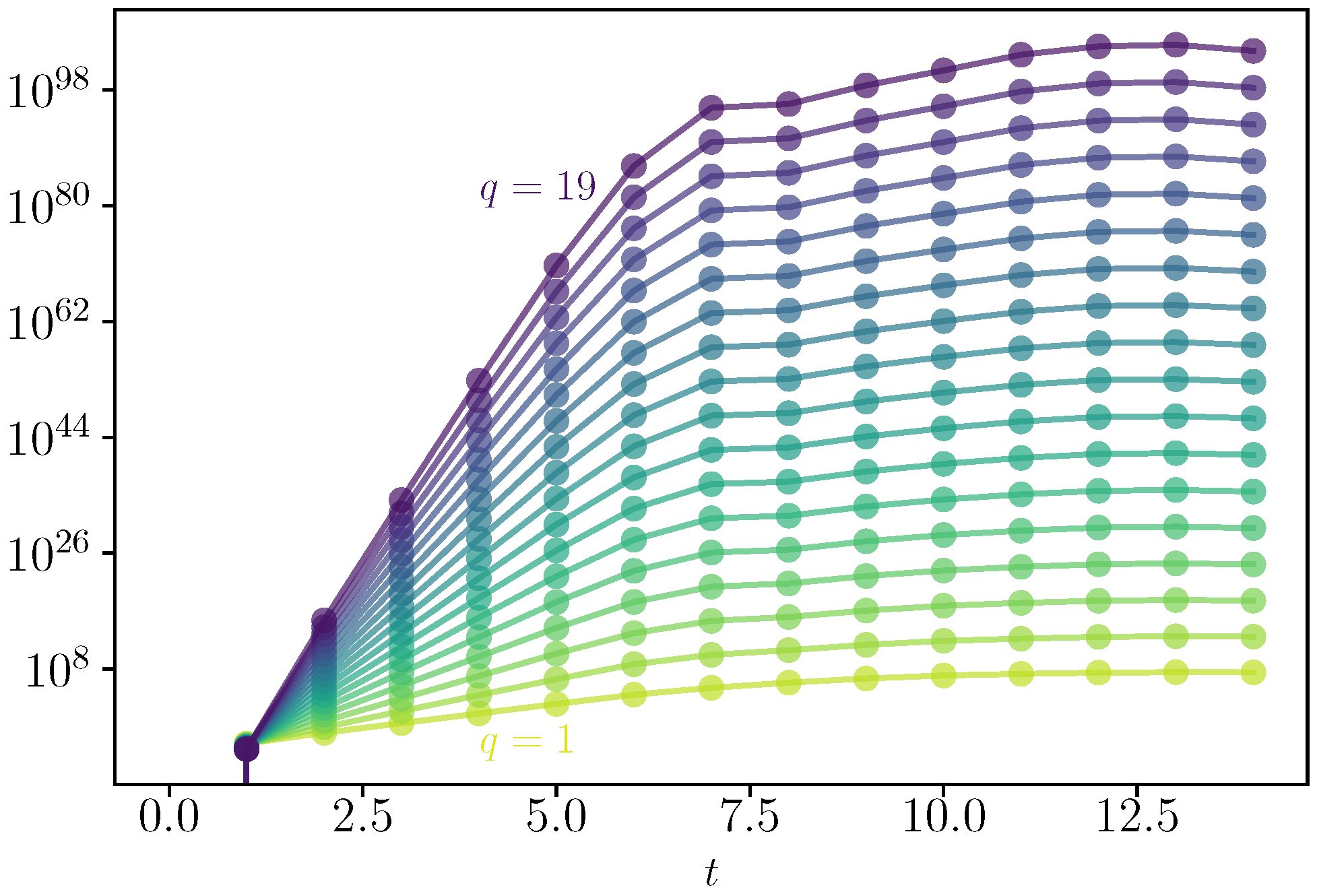
In Figure 1, we show the dynamics of for different values of . The correlators are rescaled by [with ] to emphasize the scaling of Equation (3). Each commutator grows exponentially before the Ehrenfest times with a different rate that corresponds to the quantum GLE . The value of is then fitted and plotted in Figure 2a, where we display its behavior as a function of q. It is a convex function of q that satisfies [cf. Equation (25)], being therefore multifractal. The typical Lyapunov exponent is computed as in Figure 2b, where is plotted as a function of q. The extrapolation to yields , which corresponds to the maximum Lyapunov exponent of the classical model in the chaotic phase , as computed via the Benettin et al. algorithm [23,24]; see, for example, the appendix of Ref. [22]. We also extract the maximal expanding rate [cf. Equation (17)] from the limit , signaling that the distribution of Lyapunov has finite support.
Figure 1.
Dynamics of in Equation (3) for different values of as a function of time for .
Figure 2.
Generalized Lyapunov exponents fitted from Figure 1. (Left) as a function of q, contrasted with the actual Lyapunov exponent and the maximal expanding rate , obtained by a fit of these data at large q. (Right) as a function of the moment q, from which we extract the maximal Lyapunov exponent .
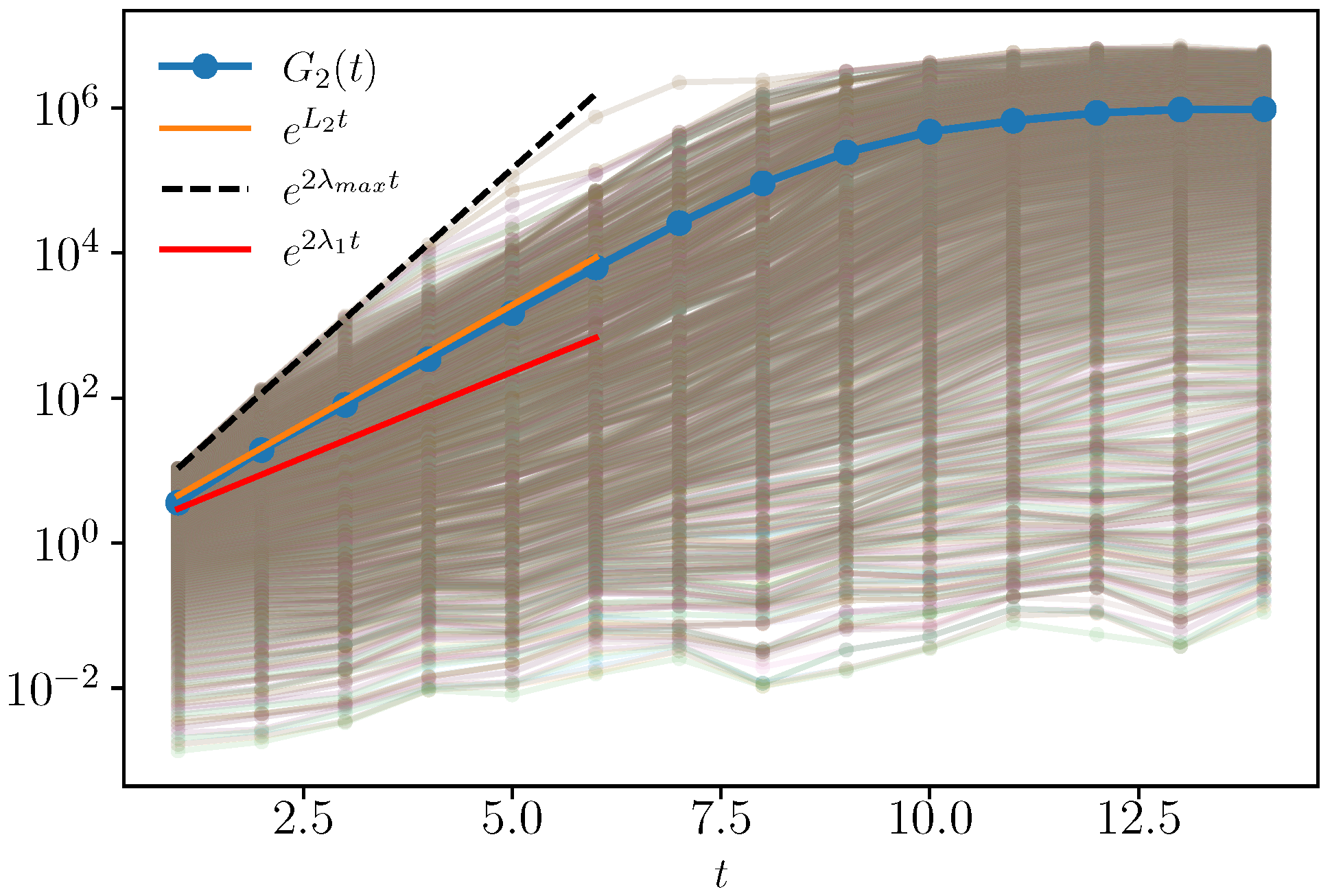
Figure 3 (shaded lines) shows the spectrum of the square commutator in Equation (21). Most of the eigenvalues grow exponentially in time before saturation and thus define some local Lyapunov exponents. We compare this behavior with the standard square-commutator expectation [cf. Equation (1)] (blue dots), which grows exponentially at a rate larger than the maximum Lyapunov . The figure also shows that as fitted and extracted in Figure 2 (the dashed black line) corresponds to the maximal expanding rate of the local Lyapunov exponents.
Figure 3.
Spectrum of the square commutator , compared with and the exponential growth with , with the maximal expansion rate and with for .
In Figure 4, we show that the local Lyapunov exponents are a large deviation. We consider the coefficients from Figure 3 (we divide everything by a constant factor). On the left, we plot their numerical distribution at different times , which shows that it converges to a distribution at large t. On the right, we plot , which shall correspond to the smooth convex “Cramer” function at large times; see Equation (9).
Figure 4.
Large deviation properties of the spectrum of the square-commutator for . (Left) Numerical distributions of with the eigenvalues of Equation (20) at different times . (Right) with the empirical distribution.
4. Thermal Quantum Generalized Exponents
It is useful to consider the different regularizations of the -th commutator as
with
Considering in Equations (29) and (30), we retrieve the standard regularized square commutators for which the bounds have been proved in Ref. [9]. In Section 4.2 below, we show that the multi-time correlation functions appearing in Equations (29) and (30) can be mapped as two-times functions in a replicated Hilbert space of copies. This allows one to rationalize the use of such regularizations—that might seem an artificial construction—as fixing the temperature of the different replicas to be the same.
These regularizations define the thermal average introduced in Equation (3), which defines thermal GLE . We consider the situation in which both of the q-th commutators grow exponentially in time as
which is valid only for an intermediate time regime
4.1. From Commutators to OTOCS
Consider the quantities of Equations (29) and (30). Expanding the commutators, we get a series of OTOC terms containing exactly k times:
of the form
where are powers of A and B respectively and some coefficients. With these notations, is a function of two times. Out-of-time-order correlators between k operators are sometimes referred to as k-OTOC; see Refs. [25,26,27,28]. We are here interested in understanding their structure in time for exponential growth. Following [2], we assume that there exists some dissipation time , after which two-point functions factorize as .
Each may grow at most as fast as the corresponding Lyapunov behavior, during the corresponding Ehrenfest time:
If we evaluate this term at times corresponding to a finite but small fraction of the corresponding Ehrenfest time , we conclude that all the terms with are of lower or equal order, because of the ordering of Ehrenfest times [cf. Equation (6)]. We thus conclude that
where the constants are different given the different regularizations.
4.2. Product Space, Fluctuation-Dissipation Theorem and Bound
In this section, we will show how the multi-time OTOC appearing in the generalized -th commutators has a simple interpretation as two-time correlation functions in a -replicated space, see [25]. Focusing on , in Ref. [9] we have stressed that bringing an OTOC into this representation for finite allows one to write the corresponding fluctuation-dissipation (FDT) relations as a usual KMS one. Here, we will demonstrate it for generic q.
Let us consider the following point out of time order correlator:
Now, we re-write it in terms of the spectral representation of the Hamiltonian as
where we introduced the operators that act in the -th replicated Hilbert space:
and the replicated Hamiltonian
We also define the cyclic shift operator that permutes cyclically states between the Hilbert spaces as
Notice that the operator is non-Hermitian, but we can define that is. also commutes with , and so that is Hermitian.
Let us re-write Equation (41) as
where in the second line, we simply used a different resolution of the identity and a reshuffling of the matrix elements (We use
).
Therefore, we can re-write Equation (40) as
which, besides a normalization, is a standard equilibrium expectation value of a two-time function at inverse temperature . This result naturally generalizes the one for four times OTOC, for which , as derived in Ref. [9].
4.2.1. Fluctuation–Dissipation in the Replicated Space
We may now write the extended KMS relations. We consider
where and are defined as usual from real and imaginary parts of and correspond to fluctuations and response functions, respectively. Instead, the (Whiteman) correlation function in the original space is
We remark that the Fourier transforms of the connected parts of , known as free cumulants, directly encode the energy shell correlations appearing in the eigenstate thermalization hypothesis [29,30].
The correlation functions defined in Equations (46)–(48) obey the FDT at a modified temperature [31]. In the frequency domain, the FDT reads
equivalent to the standard formulation . We are interested in correlations in the time domain; hence, at the fluctuation–dissipation theorem formulated in the time domain, the t-FDT [9]. In particular, we will use the following relations:
4.2.2. The Bound
At times small but comparable with , the previous arguments showed that the -OTOC are dominated by the regularized commutators [cf. Equations (38) and (39)]
when the behavior is exponential as . The t-FDT in Equation (52) implies
The positivity of these coefficients—that follows from the fact that the -th commutators are positive definite—requires that the GLE must be such that . We thus conclude
In the models where the Lyapunov depends on temperature [32,33,34], the cosine above in Equation (54) starts from zero at large temperature and is always in the first quadrant.
The bound on the -th OTOC rate was previously derived by Tsuji et al. in Ref. [8], by taking Equations (38) and (39) as a working assumption. In Section 4.1 above, we justified it using the ordering of the Ehrenfest times .
4.3. Distribution Functions
The generalized Lyapunov exponents are the moments of a Lyapunov distribution function, as we have seen in the classical case and for the quantum GLE at an infinite temperature. In the case of finite , the structure is more complex. This is due to the presence of dependent thermal matrices in the definition of the regularized powers of commutators in Equations (29) and (30).
Nevertheless, one may define the Legendre transform of the thermal GLE as
In analogy with the previous cases, we may interpret it as the Cramèr function of an associated large deviation function . As such, it shall obey similar properties as discussed above. In particular, the convexity of and corresponds with the ordering of the Ehrenfest times in Equation (6) assumed at the beginning. The latter is equivalent to the conditions that
It is thus clear that the quantum bound (55) constrains the larger q that are related with the rare large deviations.
5. Discussion and Conclusions
In this work, we studied the quantum generalized Lyapunov exponents that quantify the large deviations of the spectrum of an appropriate operator. First, we discussed their convexity properties at infinite temperatures, which we exemplified on the kicked top. At finite temperatures, the quantum fluctuation–dissipation theorem (KMS) imposes a bound on their value, thus generalizing the celebrated bound to chaos to multipoint correlations. These bounds set a limit on the large deviations of chaotic properties.
A fascinating point is the interpretation of saturating the bound (7) at every q, which implies a form of mono-fractality:
Classical examples of mono-fractal behavior, i.e., models for which every trajectory has the same Lyapunov exponent, are the backer map [35] and the free dynamics on the pseudosphere (the surface with constant negative curvature) [36]. What can we learn about the models that saturate the quantum bound (58)? A natural expectation is that the SYK model would lie in this class. In this case, it would be interesting to explore the meaning of such quantum mono-fractality in connection to the distinct properties of the model.
Author Contributions
Methodology, S.P. and J.K.; Investigation, S.P. and J.K.; Writing—review & editing, S.P. and J.K. All authors have read and agreed to the published version of the manuscript.
Funding
S.P. has received funding from the European Union’s Horizon Europe program under the Marie Sklodowska Curie Action VERMOUTH (Grant No. 101059865).
Data Availability Statement
Not applicable.
Conflicts of Interest
The authors declare no conflict of interest.
References
- Larkin, A.; Ovchinnikov, Y.N. Quasiclassical method in the theory of superconductivity. Sov. Phys. JETP 1969, 28, 1200–1205. [Google Scholar]
- Maldacena, J.; Shenker, S.H.; Stanford, D. A bound on chaos. J. High Energy Phys. 2016, 2016. [Google Scholar] [CrossRef]
- Sachdev, S.; Ye, J. Gapless spin-fluid ground state in a random quantum Heisenberg magnet. Phys. Rev. Lett. 1993, 70, 3339. [Google Scholar] [CrossRef]
- Kitaev, A. Talk Given at the Fundamental Physics Prize Symposium KITP, 07/04/2015. 2015. Available online: https://youtu.be/wFH1huu9Jcs (accessed on 20 January 2023).
- Chowdhury, D.; Georges, A.; Parcollet, O.; Sachdev, S. Sachdev-Ye-Kitaev models and beyond: Window into non-Fermi liquids. Rev. Mod. Phys. 2022, 94, 035004. [Google Scholar] [CrossRef]
- Murthy, C.; Srednicki, M. Bounds on Chaos from the Eigenstate Thermalization Hypothesis. Phys. Rev. Lett. 2019, 123. [Google Scholar] [CrossRef]
- Kundu, S. Subleading bounds on chaos. J. High Energy Phys. 2022, 2022, 1–28. [Google Scholar] [CrossRef]
- Tsuji, N.; Shitara, T.; Ueda, M. Bound on the exponential growth rate of out-of-time-ordered correlators. Phys. Rev. E 2018, 98. [Google Scholar] [CrossRef]
- Pappalardi, S.; Foini, L.; Kurchan, J. Quantum bounds and fluctuation-dissipation relations. Scipost Phys. 2022, 12, 130. [Google Scholar] [CrossRef]
- Crisanti, A.; Paladin, G.; Vulpiani, A. Generalized Lyapunov exponents in high-dimensional chaotic dynamics and products of large random matrices. J. Stat. Phys. 1988, 53, 583–601. [Google Scholar] [CrossRef]
- Vulpiani, A.; Cecconi, F.; Cencini, M. Chaos: From Simple Models to Complex Systems; World Scientific: Singapore, 2009; Volume 17. [Google Scholar] [CrossRef]
- Oledets, V.I. A multiplicative ergodic theorem. Characteristic Ljapunov, exponents of dynamical systems. Tr. Mosk. Mat. Obs. 1968, 19, 179–210. [Google Scholar]
- Benzi, R.; Paladin, G.; Parisi, G.; Vulpiani, A. On the multifractal nature of fully developed turbulence and chaotic systems. J. Phys. A 1984, 17, 3521. [Google Scholar] [CrossRef]
- Rozenbaum, E.B.; Ganeshan, S.; Galitski, V. Universal level statistics of the out-of-time-ordered operator. Phys. Rev. B 2019, 100, 035112. [Google Scholar] [CrossRef]
- Gharibyan, H.; Hanada, M.; Swingle, B.; Tezuka, M. Quantum Lyapunov spectrum. J. High Energy Phys. 2019, 2019, 82. [Google Scholar] [CrossRef]
- Haake, F. Quantum Signatures of Chaos; Springer: Berlin, Germany, 2010. [Google Scholar] [CrossRef]
- Haake, F.; Kuś, M.; Scharf, R. Classical and quantum chaos for a kicked top. Z. für Physik B Condens. Matter. 1987, 65, 381–395. [Google Scholar] [CrossRef]
- Pappalardi, S.; Russomanno, A.; Žunkovič, B.; Iemini, F.; Silva, A.; Fazio, R. Scrambling and entanglement spreading in long-range spin chains. Phys. Rev. B 2018, 98, 134303. [Google Scholar] [CrossRef]
- Seshadri, A.; Madhok, V.; Lakshminarayan, A. Tripartite mutual information, entanglement, and scrambling in permutation symmetric systems with an application to quantum chaos. Phys. Rev. E 2018, 98, 052205. [Google Scholar] [CrossRef]
- Pilatowsky-Cameo, S.; Chávez-Carlos, J.; Bastarrachea-Magnani, M.A.; Stránský, P.; Lerma-Hernández, S.; Santos, L.F.; Hirsch, J.G. Positive quantum Lyapunov exponents in experimental systems with a regular classical limit. Phys. Rev. E 2020, 101, 010202. [Google Scholar] [CrossRef]
- Sieberer, L.M.; Olsacher, T.; Elben, A.; Heyl, M.; Hauke, P.; Haake, F.; Zoller, P. Digital quantum simulation, Trotter errors, and quantum chaos of the kicked top. npj Quantum Inf. 2019, 5, 78. [Google Scholar] [CrossRef]
- Lerose, A.; Pappalardi, S. Bridging entanglement dynamics and chaos in semiclassical systems. Phys. Rev. A 2020, 102, 032404. [Google Scholar] [CrossRef]
- Benettin, G.; Galgani, L.; Giorgilli, A.; Strelcyn, J.M. Lyapunov Characteristic Exponents for smooth dynamical systems and for hamiltonian systems: A method for computing all of them. Part 1: Theory. Meccanica 1980, 15, 9–20. [Google Scholar] [CrossRef]
- Benettin, G.; Galgani, L.; Giorgilli, A.; Strelcyn, J.M. Lyapunov Characteristic Exponents for smooth dynamical systems and for hamiltonian systems: A method for computing all of them. Part 2: Numerical application. Meccanica 1980, 15, 21–30. [Google Scholar] [CrossRef]
- Roberts, D.A.; Yoshida, B. Chaos and complexity by design. J. High Energy Phys. 2017, 2017, 121. [Google Scholar] [CrossRef]
- Haehl, F.M.; Rozali, M. Effective field theory for chaotic CFTs. J. High Energy Phys. 2018, 2018, 118. [Google Scholar] [CrossRef]
- Haehl, F.M.; Rozali, M. Fine-Grained Chaos in AdS2 Gravity. Phys. Rev. Lett. 2018, 120, 121601. [Google Scholar] [CrossRef] [PubMed]
- Bhattacharyya, A.; Chemissany, W.; Haque, S.S.; Yan, B. Towards the web of quantum chaos diagnostics. Eur. Phys. J. C 2022, 82, 87. [Google Scholar] [CrossRef]
- Foini, L.; Kurchan, J. Eigenstate thermalization hypothesis and out of time order correlators. Phys. Rev. E 2019, 99, 042139. [Google Scholar] [CrossRef] [PubMed]
- Pappalardi, S.; Foini, L.; Kurchan, J. Eigenstate Thermalization Hypothesis and Free Probability. Phys. Rev. Lett. 2022, 129, 170603. [Google Scholar] [CrossRef]
- Tsuji, N.; Shitara, T.; Ueda, M. Out-of-time-order fluctuation-dissipation theorem. Phys. Rev. E 2018, 97, 012101. [Google Scholar] [CrossRef]
- Maldacena, J.; Stanford, D. Remarks on the Sachdev-Ye-Kitaev model. Phys. Rev. D 2016, 94, 106002. [Google Scholar] [CrossRef]
- Kurchan, J. Quantum Bound to Chaos and the Semiclassical Limit. J. Stat. Phys. 2018, 171, 965–979. [Google Scholar] [CrossRef]
- Pappalardi, S.; Kurchan, J. Low temperature quantum bounds on simple models. SciPost Phys. 2022, 13, 006. [Google Scholar] [CrossRef]
- Aizawa, Y. Global Aspects of the Dissipative Dynamical Systems. I: Statistical Identification and Fractal Properties of the Lorenz Chaos. Prog. Theor. Phys. 1982, 68, 64–84. [Google Scholar] [CrossRef]
- Balazs, N.; Voros, A. Chaos on the pseudosphere. Phys. Rep. 1986, 143, 109–240. [Google Scholar] [CrossRef]
Disclaimer/Publisher’s Note: The statements, opinions and data contained in all publications are solely those of the individual author(s) and contributor(s) and not of MDPI and/or the editor(s). MDPI and/or the editor(s) disclaim responsibility for any injury to people or property resulting from any ideas, methods, instructions or products referred to in the content. |
© 2023 by the authors. Licensee MDPI, Basel, Switzerland. This article is an open access article distributed under the terms and conditions of the Creative Commons Attribution (CC BY) license (https://creativecommons.org/licenses/by/4.0/).