


Abstract
Quantum coherence is the most distinguished feature of quantum mechanics. As an important resource, it is widely applied to quantum information technologies, including quantum algorithms, quantum computation, quantum key distribution, and quantum metrology, so it is important to develop tools for efficient estimation of the coherence. Bell state measurement plays an important role in quantum information processing. In particular, it can also, as a two-copy collective measurement, directly measure the quantum coherence of an unknown quantum state in the experiment, and does not need any optimization procedures, feedback, or complex mathematical calculations. In this paper, we analyze the performance of estimating quantum coherence with Bell state measurement for a qubit case from the perspective of semiparametric estimation and single-parameter estimation. The numerical results show that Bell state measurement is the optimal measurement for estimating several frequently-used coherence quantifiers, and it has been demonstrated in the perspective of the quantum limit of semiparametric estimation and Fisher information.
1. Introduction
Quantum entanglement is one of the most subtle and most widely exploited effects in the quantum world, which plays a central role as an essential resource in quantum information science [1]. Bell states are special cases of bipartite maximally entangled states [2] and have been widely studied and used. Bell state measurement (BSM) is itself entangling: it is the projection onto the basis of Bell states and plays crucial roles in many quantum information tasks such as quantum teleportation [3,4,5], quantum key distribution [6,7], quantum dense coding [8,9], entanglement swapping [10,11]. In recent years, to study quantum teleportation for complex quantum systems and develop high-efficiency quantum information networks [12,13], a high-dimensional Bell state measurement has been realized experimentally [14,15,16]. BSM mainly determines the efficiency of these quantum communication tasks; Therefore, BSM is of great significance in quantum information technology. Furthermore, BSM can also as a collective measurement performed on the two-copy state to achieve the direct measurement of quantum coherence [17].
Quantum coherence is a fundamental feature of the quantum system, which describes the superposition of quantum states. Since it has been quantified within the framework of resource theory, quantum coherence is a fundamental resource and is also closely related to quantum entanglement [18,19,20], such as detecting coherence to witness multipartite entanglement and the conversion between coherence and quantum correlations in bipartite and multipartite systems [21,22,23]. Like quantum entanglement, the application of quantum coherence in quantum information technology has also been widely studied [24]. In quantum algorithms, the success probability of quantum algorithms is also related to the coherence of quantum states [25]. In quantum channel discrimination, using the coherent state as the probe state can improve the success probability of discrimination [26]; in quantum communication, using coherence helps to quantify key rate in quantum key distribution [27], as well as applying it to quantum computation and quantum metrology [28]. Being a fundamental property of quantum systems, coherence plays an important role in nanoscale physics [29], transport theory [30], biological systems [31], and quantum thermodynamics [32]. Especially in quantum thermodynamics, coherence enables power outputs that greatly exceed the power of stochastic engines [33]. In addition, quantum coherence is also related to quantum foundations, such as the study of the wave-particle duality [34,35] and quantum uncertainty [36]; using coherence characterizes the wave nature of the quantons, and coherence can be interpreted as a manifestation of quantum uncertainty.
Having identified quantum coherence as a valuable feature of quantum systems and a fundamental quantum resource, it is important to develop methods for its rigorous quantification. While quantum coherence has been extensively studied and various quantifiers have been proposed [24], how to efficiently estimate coherence experimentally is still a challenge, which also limits the application of coherence in quantum information processing. Clearly, one can perform quantum state tomography and then use the derived density matrix of state to calculate the amount of coherence, but this method contains redundant information because the quantifier of coherence is not always related to complete information about the systems. Actually, there are also some strategies to estimate the coherence of unknown quantum states [37,38,39,40,41,42,43], such as using interference fringes [37], spectrum estimation [38,39], and using a numerical optimization algorithm to estimate the coherence based on limited experimental data [40]. Some of these methods only apply to the specific quantifiers of coherence, and most theoretical methods estimate upper and lower bounds for the coherence of unknown quantum states by mathematical calculations and numerical optimizations, which are not very accurate. However, BSM can, as a two-copy collective measurement, directly measure the quantum coherence of an unknown quantum state [17], and does not need any optimization procedures, feedback, or complex mathematical calculations. In this work, we adopt semiparametric estimation theory and single-parameter estimation to analyze the performance of estimating quantum coherence with Bell state measurement for the qubit, respectively. We find that BSM is the optimal measurement for estimating several frequently used coherence quantifiers, and we demonstrate it from the perspective of semiparametric estimation and Fisher information. In the framework of semiparametric estimation theory [44], the mean-square error of the estimation reaches the quantum limit. In the framework of single-parameter estimation, we use maximum likelihood estimation to process data, and the mean-square error of the estimation can reach the Cramér–Rao bound.
2. Estimation of Quantum Coherence with Quantum Semiparametric Estimation
Collective measurement scheme estimates the coherence of a quantum state by performing measurements on two-copy state , which provides a simple method to measure coherence, because the entire experiment can be performed in a single measurement setup, and other estimation methods (e.g., tomography) typically require to change the measurement setup many times. For single-qubit states with Bloch vector , a collective measurement in the maximally entangled basis and , i.e., BSM, which consists of four POVM elements
performed on a two-copy state . The corresponding outcome probabilities , and are denoted as
For an arbitrary coherence, measure of the qubit can be expressed as simple functions of . For example, the -norm of coherence and the relative entropy of coherence are defined as [45]
where is the von Neumann entropy, , and we consider coherence with respect to the basis . For single-qubit states , both quantities can be expressed as [46]
with the binary entropy and the Bloch vector length . According to Equation (2), and r can be expressed as and , respectively. Therefore, directly substituting the probability obtained from the experiment into Equations (5) and (6) can directly obtain the value of coherence.
Quantum semiparametric estimation theory is especially relevant to the estimation of a parameter that can be expressed as a function of . We suppose that an experimenter receives N quantum objects and estimates a parameter as a function of , and we let and Y be given observables. The theory can provide the fundamental limit to the precision of estimation for any measurement. For any measurement, the mean-square error of the estimation has a quantum limit given by [44]
Taking the estimating of the -norm of coherence as an example, according to Equation (5), for simplicity, we set as the parameter , and Y is expressed as . Here, is two-copy state. Using Equation (7), we can calculate the quantum limit of the mean-square error of estimating , and finally use the error transfer formula to obtain the bound of estimating .
Next, we numerically show the performance of estimating several frequently used coherence quantifiers with Bell state measurement from the perspective of semiparametric estimation. We consider a single-qubit state , with ranging from 0 to . Bell state measurement is performed on a two-copy state . The sample size N is set to 6000. The estimation precision quantifier is the mean squared error (MSE)
where is the actual coherence value for a specific quantifier `x’, and is the estimated value. Firstly, the BSM is performed N times on N identically prepared states, and outcome j occurs times. We simulate and generate experimental data ; here, . Next, probabilities are calculated, and we substitute the probability obtained from simulated experimental data into Equation (5) to estimate the -norm of coherence . The result of the numerical simulation is shown in Figure 1. As we see from the data shown in Figure 1, the mean squared errors reach the quantum limit obtained by Equation (7).
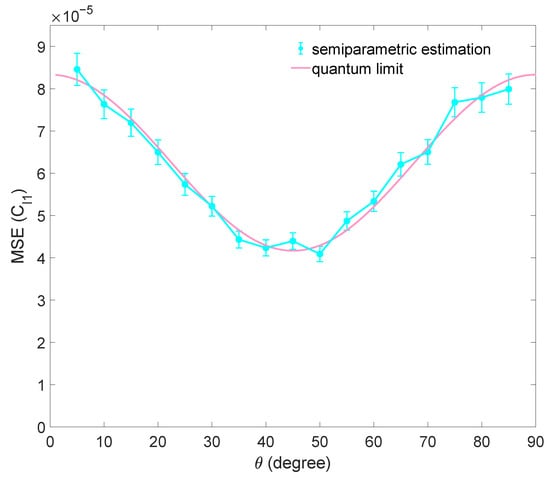
Figure 1.
The result of numerical simulation for estimating with BSM in semiparametric estimation. The mean squared error (MSE) for estimating of a family of qubit states is shown. The sample size is . Each data point is the average of 1000 repetitions, and the error bars denote the standard deviation. The quantum limit of the estimation is shown as a red curve.
Similarly, we also estimate other coherence quantifiers for the qubit states . In the qubit case, the geometric coherence is defined as [24]
where is the off-diagonal element of in the incoherent basis, and note that for all single-qubit states, we have . We substitute the estimated by semiparametric estimation into function expression Equation (9) to estimate and calculate the mean squared error. The bound of estimating is obtained by the bound of estimating and the error transfer formula. The numerical simulation result for estimating is shown in Figure 2. The mean squared errors of numerical simulation reach the quantum limit.
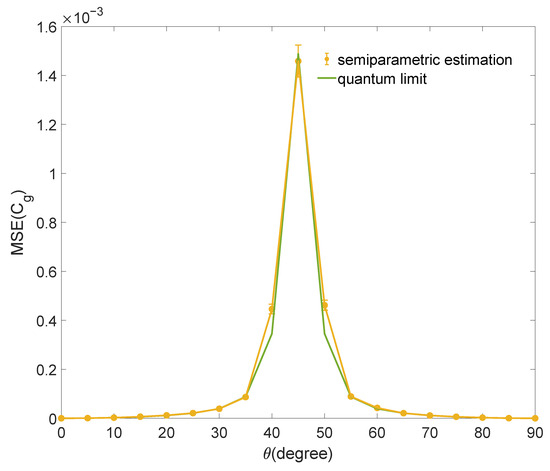
Figure 2.
The result of numerical simulation for estimating with the estimated by semiparametric estimation. The mean squared error (MSE) for estimating of a family of qubit states is shown. The sample size is . Each data point is the average of 1000 repetitions, and the error bars denote the standard deviation. The quantum limit of the estimation is shown as a green curve.
In addition, the coherence of formation also can be evaluated exactly. in the qubit case is expressed as [24]
Similarly, we substitute the estimated by semiparametric estimation into function expression Equation (10) to estimate and calculate the mean squared error. The bound of estimating is obtained by the bound of estimating and the error transfer formula. The result of the numerical simulation is shown in Figure 3.
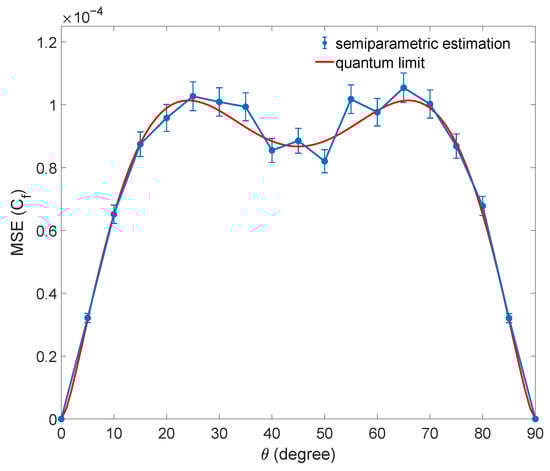
Figure 3.
The result of numerical simulation for estimating with the estimated by semiparametric estimation. The mean squared error (MSE) for estimating of a family of qubit states is shown. The sample size is . Each data point is the average of 1000 repetitions, and the error bars denote the standard deviation. The quantum limit of the estimation is shown as a red curve. Only the results of estimating are shown here, as these quantities and are the same as .
Comparing Equation (10) with the geometric coherence of Equation (9), it follows that
which holds for any single-qubit state. With this relation, we also use the result of to calculate and the corresponding quantum limit. Another important quantifier is the coherence cost , which is equal to the coherence of formation [24]. When the qubit is a pure state, , Equation (6) is written as , the relative entropy of coherence is equal to Equation (10) of coherence formation. Therefore, the simulation results of these coherence quantifiers are the same as the simulation results of .
3. Estimation of Quantum Coherence with a Single-Parameter Estimation
For the qubit states discussed in the simulation above, we can also analyze the performance of estimating coherence with Bell state measurement from the perspective of single-parameter estimation.
Firstly, we demonstrate that Bell state measurement is the optimal measurement for estimating several frequently used coherence quantifiers discussed above from the perspective of Fisher information. Fisher information is derived from statistics and used to quantify the estimation accuracy of parameters, such as the Cramér–Rao bound. It plays an important role in quantum information technology, especially in quantum metrology. We recall that quantum Fisher information of parameterized quantum states is defined as
where is a parameter to be estimated, and is the symmetric logarithmic derivative determined by . It can be calculated as [47]
by spectral decomposition . Quantum Fisher information sets a fundamental bound to the attainable optimal estimation precision. Using Equation (13), we can obtain the quantum Fisher information of this original state concerning the parameter is .
We suppose that with a series of measurement operators independent of the parameter, with , , performed on the state , the probability distribution is obtained as . Therefore, the measurement-induced Fisher information is defined as
which is the classical Fisher information of the measurement-induced probability distribution.
If the estimation of parameter is an unbiased estimator, the mean squared error is lower bounded by the Cramér–Rao bound [48]:
Quantum Fisher information (QFI) is the largest Fisher information (FI) upon optimizing the choice of measurement, i.e., . It can be easily evaluated that classical Fisher information of estimating parameter with BSM according to Equation (14) is
BSM-induced classical Fisher information reaches quantum Fisher information (), which implies BSM is optimal.
Similarly, by utilizing the functional relations between different quantifiers, the Fisher information and quantum Fisher information for and can be expressed as
where Equation (17)obtained using is a simple function of in the qubit detailed as Equation (11).
Next, we use numerical simulation to verify Equation (15). In the numerical simulation, maximum likelihood estimation (MLE) is used to process data. Maximum likelihood estimation is a method of estimating the parameters of an assumed probability distribution given some observed data. We consider measurement of the coherence of state with BSM composed of outcomes, and the probability of obtaining outcome j is . The quantifier of coherence to be estimated is then contained in the probability because is related to some parameters of the state . If the BSM is performed N times on N identically prepared quantum systems, outcome j occurs times with . Now, we aim to infer the quantifier of coherence from the measurement data . Maximum likelihood estimation searches for the that maximizes the likelihood function [48] are
where is the likelihood of observing the data D. The parameter we solve is used to maximize the value of the Likelihood function, which can be solved by derivation in mathematical problems. In practice, it is more convenient to work with the log-likelihood function, because the monotonically increasing nature of logarithmic functions ensures that they do not change the extreme points, and taking the logarithm facilitates our subsequent derivation.
We take as an example to demonstrate this method. We cnsider a single-qubit state and BSM performed on the two-copy state. The corresponding outcome probabilities are expressed as
where . SWe suppose BSM is performed N times on N identically prepared states, and the measurement data . According to Equation (19), we write the likelihood function as
We take the logarithm of Equation (21),
take the derivative of the above equation, let the derivative function equal to zero, and solve as
For the numerical simulation, the coherence of single-qubit states with ranging from 0 to are estimated. The sample size N is chosen to be 6000. We substitute the simulated measurement data into Equation (23) to obtain the and calculate the mean squared error. The result of the numerical simulation is shown in Figure 4. The mean squared error achieved by the maximum likelihood estimation reaches the Cramér–Rao bound .
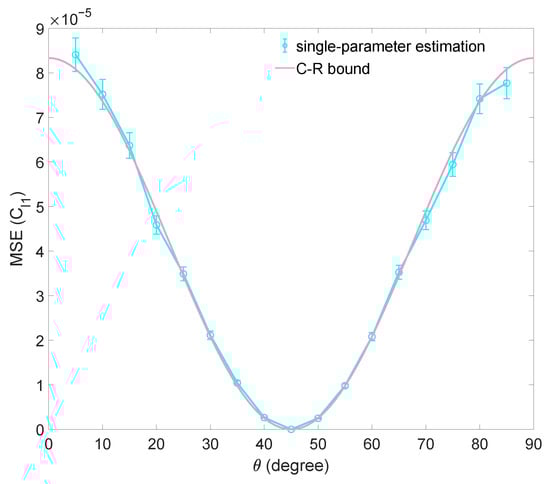
Figure 4.
The result of numerical simulation for estimating with BSM in single-parameter estimation. The mean squared error (MSE) for estimating of a family of qubit states using maximum likelihood estimation is shown. The sample size is . Each data point is the average of 1000 repetitions, and the error bars denote the standard deviation. The Cramér–Rao bound is shown as a red curve.
Similarly, we can also use maximum likelihood to estimate geometric coherence and coherence of formation. According to Equation (19) and the maximum likelihood estimation steps, the estimated value of geometric coherence is
which also can be obtained by the relation . The numerical simulation result for estimating is shown in Figure 5. The estimated value of geometric coherence can be obtained by relation Equation (11). The result of the numerical simulation is shown in Figure 6. Using the data processing method of the maximum likelihood estimation makes the mean squared error (MSE) for estimating and reach the Cramér–Rao bounds. Although in the framework of single-parameter estimation, BSM is also optimal for estimating coherence of the state , it is worth mentioning that collective measurements are unnecessary in general for single-parameter estimation.
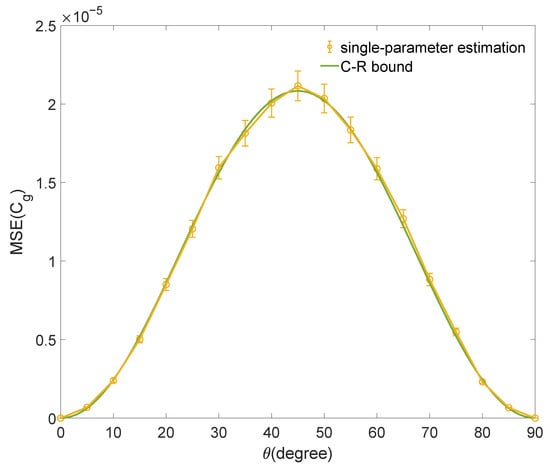
Figure 5.
The result of numerical simulation for estimating with BSM in single-parameter estimation. The mean squared error (MSE) for estimating of a family of qubit states using maximum likelihood estimation is shown. The sample size is . Each data point is the average of 1000 repetitions, and the error bars denote the standard deviation. The Cramér–Rao bound is shown as a green curve.
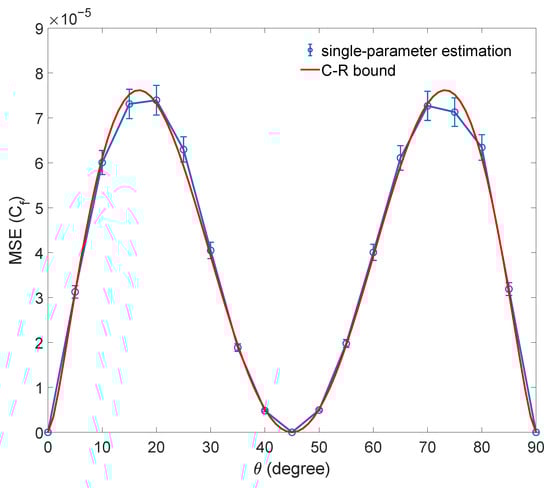
Figure 6.
The result of numerical simulation for estimating with BSM in single-parameter estimation. The mean squared error (MSE) for estimating of a family of qubit states using maximum likelihood estimation is shown. The sample size is . Each data point is the average of 1000 repetitions, and the error bars denote the standard deviation. The Cramér–Rao bound is shown as a red curve. The mean squared error (MSE) for estimating quantities and are the same as .
4. Conclusions
Quantum coherence is the most distinguished feature of quantum mechanics and plays a critical role in emerging quantum technologies. While different quantifiers of coherence have been proposed in the literature, their efficient estimation in today’s experiments remains a challenge. BSM as a collective measurement performed on the two-copy state can achieve the direct measurement for any coherence quantifier of a qubit. In this work, we analyze the performance of estimating quantum coherence with Bell state measurement for a qubit case from the perspective of semiparametric estimation and single-parameter estimation, respectively. Using Bell state measurement, the mean square error of the estimation reaches the quantum limit of semiparametric estimation theory. From the perspective of single-parameter estimation, we use maximum likelihood estimation to process data and the mean-square error can reach the Cramér–Rao bound. Our work provides an alternative method for direct measurement of coherence and highlights the application of BSM in quantum information processing.
Author Contributions
Conceptualization, Y.Y. and Y.N.; methodology, Y.Y., X.H. and S.G.; writing—original draft preparation, Y.Y.; writing—review and editing, Y.Y., Y.N. and S.G.; supervision, Y.N. and S.G. All authors have read and agreed to the published version of the manuscript.
Funding
This research was funded by the National Natural Science Foundation of China (Grant Nos. 12004113, 12034007), and the Natural Science Foundation of Shanghai (Grant Nos. 22ZR1418100, 21XD1400700).
Institutional Review Board Statement
Not applicable.
Informed Consent Statement
Not applicable.
Data Availability Statement
The data presented in this study are available on request from the corresponding author.
Acknowledgments
Yuan Yuan thanks Zhibo Hou for helpful discussions.
Conflicts of Interest
The authors declare no conflict of interest.
References
- Horodecki, R.; Horodecki, P.; Horodecki, M.; Horodecki, K. Quantum entanglement. Rev. Mod. Phys. 2009, 81, 865. [Google Scholar] [CrossRef]
- Braunstein, S.L.; Mann, A.; Revzen, M. Maximal violation of Bell inequalities for mixed states. Phys. Rev. Lett. 1992, 68, 3259. [Google Scholar] [CrossRef] [PubMed]
- Bennett, C.H.; Brassard, G.; Crépeau, C.; Jozsa, R.; Peres, A.; Wootters, W.K. Teleporting an unknown quantum state via dual classical and Einstein-Podolsky-Rosen channels. Phys. Rev. Lett. 1993, 70, 1895. [Google Scholar] [CrossRef] [PubMed]
- Bouwmeester, D.; Pan, J.W.; Mattle, K.; Eibl, M.; Weinfurter, H.; Zeilinger, A. Experimental quantum teleportation. Nature 1997, 390, 575–579. [Google Scholar] [CrossRef]
- Furusawa, A.; Sørensen, J.L.; Braunstein, S.L.; Fuchs, C.A.; Kimble, H.J.; Polzik, E.S. Unconditional quantum teleportation. Science 1998, 282, 706–709. [Google Scholar] [CrossRef] [PubMed]
- Shor, P.W.; Preskill, J. Simple proof of security of the BB84 quantum key distribution protocol. Phys. Rev. Lett. 2000, 85, 441. [Google Scholar] [CrossRef] [PubMed]
- Lo, H.K.; Curty, M.; Qi, B. Measurement-device-independent quantum key distribution. Phys. Rev. Lett. 2012, 108, 130503. [Google Scholar] [CrossRef]
- Mattle, K.; Weinfurter, H.; Kwiat, P.G.; Zeilinger, A. Dense coding in experimental quantum communication. Phys. Rev. Lett. 1996, 76, 4656. [Google Scholar] [CrossRef]
- Bennett, C.H.; Wiesner, S.J. Communication via one-and two-particle operators on Einstein-Podolsky-Rosen states. Phys. Rev. Lett. 1992, 69, 2881. [Google Scholar] [CrossRef]
- Pan, J.W.; Bouwmeester, D.; Weinfurter, H.; Zeilinger, A. Experimental entanglement swapping: Entangling photons that never interacted. Phys. Rev. Lett. 1998, 80, 3891. [Google Scholar] [CrossRef]
- Żukowski, M.; Zeilinger, A.; Horne, M.A.; Ekert, A.K. “Event-ready-detectors” Bell experiment via entanglement swapping. Phys. Rev. Lett. 1993, 71, 4287. [Google Scholar] [CrossRef] [PubMed]
- Cozzolino, D.; Da Lio, B.; Bacco, D.; Oxenløwe, L.K. High-dimensional quantum communication: Benefits, progress, and future challenges. Adv. Quantum Technol. 2019, 2, 1900038. [Google Scholar] [CrossRef]
- Yang, M.Y.; Zhao, P.; Zhou, L.; Zhong, W.; Sheng, Y.B. Feasible high-dimensional measurement-device-independent quantum key distribution. Laser Phys. Lett. 2021, 18, 075204. [Google Scholar] [CrossRef]
- Luo, Y.H.; Zhong, H.S.; Erhard, M.; Wang, X.L.; Peng, L.C.; Krenn, M.; Jiang, X.; Li, L.; Liu, N.L.; Lu, C.Y.; et al. Quantum teleportation in high dimensions. Phys. Rev. Lett. 2019, 123, 070505. [Google Scholar] [CrossRef] [PubMed]
- Hu, X.M.; Zhang, C.; Liu, B.H.; Cai, Y.; Ye, X.J.; Guo, Y.; Xing, W.B.; Huang, C.X.; Huang, Y.F.; Li, C.F.; et al. Experimental high-dimensional quantum teleportation. Phys. Rev. Lett. 2020, 125, 230501. [Google Scholar] [CrossRef]
- Hu, X.M.; Guo, Y.; Liu, B.H.; Huang, Y.F.; Li, C.F.; Guo, G.C. Beating the channel capacity limit for superdense coding with entangled ququarts. Sci. Adv. 2018, 4, eaat9304. [Google Scholar] [CrossRef]
- Yuan, Y.; Hou, Z.; Tang, J.F.; Streltsov, A.; Xiang, G.Y.; Li, C.F.; Guo, G.C. Direct estimation of quantum coherence by collective measurements. NPJ Quantum Inf. 2020, 6, 46. [Google Scholar] [CrossRef]
- Streltsov, A.; Singh, U.; Dhar, H.S.; Bera, M.N.; Adesso, G. Measuring quantum coherence with entanglement. Phys. Rev. Lett. 2015, 115, 020403. [Google Scholar] [CrossRef]
- Chitambar, E.; Hsieh, M.H. Relating the resource theories of entanglement and quantum coherence. Phys. Rev. Lett. 2016, 117, 020402. [Google Scholar] [CrossRef]
- Kalaga, J.K.; Leoński, W.; Szczȩśniak, R.; Peřina, J., Jr. Mixedness, Coherence and Entanglement in a Family of Three-Qubit States. Entropy 2022, 24, 324. [Google Scholar] [CrossRef]
- Ma, J.; Yadin, B.; Girolami, D.; Vedral, V.; Gu, M. Converting coherence to quantum correlations. Phys. Rev. Lett. 2016, 116, 160407. [Google Scholar] [CrossRef] [PubMed]
- Streltsov, A.; Rana, S.; Bera, M.N.; Lewenstein, M. Towards resource theory of coherence in distributed scenarios. Phys. Rev. X 2017, 7, 011024. [Google Scholar] [CrossRef]
- Wu, K.D.; Hou, Z.; Zhao, Y.Y.; Xiang, G.Y.; Li, C.F.; Guo, G.C.; Ma, J.; He, Q.Y.; Thompson, J.; Gu, M. Experimental cyclic interconversion between coherence and quantum correlations. Phys. Rev. Lett. 2018, 121, 050401. [Google Scholar] [CrossRef]
- Streltsov, A.; Adesso, G.; Plenio, M.B. Colloquium: Quantum coherence as a resource. Rev. Mod. Phys. 2017, 89, 041003. [Google Scholar] [CrossRef]
- Hillery, M. Coherence as a resource in decision problems: The Deutsch-Jozsa algorithm and a variation. Phys. Rev. A 2016, 93, 012111. [Google Scholar] [CrossRef]
- Napoli, C.; Bromley, T.R.; Cianciaruso, M.; Piani, M.; Johnston, N.; Adesso, G. Robustness of coherence: An operational and observable measure of quantum coherence. Phys. Rev. Lett. 2016, 116, 150502. [Google Scholar] [CrossRef] [PubMed]
- Ma, J.; Zhou, Y.; Yuan, X.; Ma, X. Operational interpretation of coherence in quantum key distribution. Phys. Rev. A 2019, 99, 062325. [Google Scholar] [CrossRef]
- Li, L.; Wang, Q.W.; Shen, S.Q.; Li, M. Quantum coherence measures based on Fisher information with applications. Phys. Rev. A 2021, 103, 012401. [Google Scholar] [CrossRef]
- Karlström, O.; Linke, H.; Karlström, G.; Wacker, A. Increasing thermoelectric performance using coherent transport. Phys. Rev. B 2011, 84, 113415. [Google Scholar] [CrossRef]
- Rebentrost, P.; Mohseni, M.; Aspuru-Guzik, A. Role of quantum coherence and environmental fluctuations in chromophoric energy transport. J. Phys. Chem. B 2009, 113, 9942–9947. [Google Scholar] [CrossRef]
- Romero, E.; Augulis, R.; Novoderezhkin, V.I.; Ferretti, M.; Thieme, J.; Zigmantas, D.; Van Grondelle, R. Quantum coherence in photosynthesis for efficient solar-energy conversion. Nat. Phys. 2014, 10, 676–682. [Google Scholar] [CrossRef] [PubMed]
- Gour, G. Role of quantum coherence in thermodynamics. PRX Quantum 2022, 3, 040323. [Google Scholar] [CrossRef]
- Uzdin, R.; Levy, A.; Kosloff, R. Equivalence of quantum heat machines, and quantum-thermodynamic signatures. Phys. Rev. X 2015, 5, 031044. [Google Scholar] [CrossRef]
- Bagan, E.; Bergou, J.A.; Cottrell, S.S.; Hillery, M. Relations between coherence and path information. Phys. Rev. Lett. 2016, 116, 160406. [Google Scholar] [CrossRef]
- Yuan, Y.; Hou, Z.; Zhao, Y.Y.; Zhong, H.S.; Xiang, G.Y.; Li, C.F.; Guo, G.C. Experimental demonstration of wave-particle duality relation based on coherence measure. Opt. Express 2018, 26, 4470–4478. [Google Scholar] [CrossRef]
- Sun, Y.; Luo, S. Coherence as uncertainty. Phys. Rev. A 2021, 103, 042423. [Google Scholar] [CrossRef]
- Wang, Y.T.; Tang, J.S.; Wei, Z.Y.; Yu, S.; Ke, Z.J.; Xu, X.Y.; Li, C.F.; Guo, G.C. Directly measuring the degree of quantum coherence using interference fringes. Phys. Rev. Lett. 2017, 118, 020403. [Google Scholar] [CrossRef]
- Ding, Q.M.; Fang, X.X.; Lu, H. The tightness of multipartite coherence from spectrum estimation. Entropy 2021, 23, 1519. [Google Scholar] [CrossRef]
- Yu, X.D.; Gühne, O. Detecting coherence via spectrum estimation. Phys. Rev. A 2019, 99, 062310. [Google Scholar] [CrossRef]
- Zhang, D.J.; Liu, C.; Yu, X.D.; Tong, D. Estimating coherence measures from limited experimental data available. Phys. Rev. Lett. 2018, 120, 170501. [Google Scholar] [CrossRef]
- Ma, Z.; Zhang, Z.; Dai, Y.; Dong, Y.; Zhang, C. Detecting and estimating coherence based on coherence witnesses. Phys. Rev. A 2021, 103, 012409. [Google Scholar] [CrossRef]
- Dai, Y.; Dong, Y.; Xu, Z.; You, W.; Zhang, C.; Gühne, O. Experimentally accessible lower bounds for genuine multipartite entanglement and coherence measures. Phys. Rev. Appl. 2020, 13, 054022. [Google Scholar] [CrossRef]
- Sun, L.L.; Yu, S. Universal method to estimate quantum coherence. Phys. Rev. A 2022, 106, 042428. [Google Scholar] [CrossRef]
- Tsang, M.; Albarelli, F.; Datta, A. Quantum semiparametric estimation. Phys. Rev. X 2020, 10, 031023. [Google Scholar] [CrossRef]
- Baumgratz, T.; Cramer, M.; Plenio, M.B. Quantifying coherence. Phys. Rev. Lett. 2014, 113, 140401. [Google Scholar] [CrossRef]
- Ren, H.; Lin, A.; He, S.; Hu, X. Quantitative coherence witness for finite dimensional states. Ann. Phys. 2017, 387, 281–289. [Google Scholar] [CrossRef]
- Chang, L.; Li, N.; Luo, S.; Song, H. Optimal extraction of information from two spins. Phys. Rev. A 2014, 89, 042110. [Google Scholar] [CrossRef]
- Len, Y.L. Multiparameter estimation for qubit states with collective measurements: A case study. New J. Phys. 2022, 24, 033037. [Google Scholar] [CrossRef]
Disclaimer/Publisher’s Note: The statements, opinions and data contained in all publications are solely those of the individual author(s) and contributor(s) and not of MDPI and/or the editor(s). MDPI and/or the editor(s) disclaim responsibility for any injury to people or property resulting from any ideas, methods, instructions or products referred to in the content. |
© 2023 by the authors. Licensee MDPI, Basel, Switzerland. This article is an open access article distributed under the terms and conditions of the Creative Commons Attribution (CC BY) license (https://creativecommons.org/licenses/by/4.0/).