1. Introduction
Rank-one non-normal deformations of the Gaussian and Circular Unitary Ensembles are a useful analytic tool for studying statistics of resonances in quantum scattering from a chaotic domain via a single channel [
1,
2]. As surveyed in [
2,
3], these random matrix ensembles are integrable in the sense that the joint probability density of their complex eigenvalues and, in some spectral scaling limits of interest, the eigenvalue correlation functions can be determined in a closed form. Such integrability, which also proves to be useful in other physics contexts, see, e.g., [
4], extends to a certain degree to the deformed
Gaussian and
circular ensembles [
5,
6], especially to the classical values
[
7,
8], but is lost if the underlying normal random matrix ensemble (Hermitian or unitary) is not integrable, as is the case with, e.g., finite rank non-Hermitian deformations of Wigner matrices [
9,
10,
11] or band matrices [
12]. Still, the latter matrices are found to share, in appropriate parameter ranges, some statistical characteristics of their complex eigenvalues and eigenvectors with their integrable counterparts.
In this paper, we aim to investigate complex eigenvalues with extreme imaginary parts for the rank-one non-Hermitian deformations of the Gaussian Unitary Ensemble (GUE) by exploiting the above-mentioned integrability. The latter feature gives access to the asymptotics of the eigenvalue density in the complex plane on mesoscopic scales and allows us to carry out a quantitative analysis of the separation of the eigenvalue outlier (which is known to exist in this model [
9,
10]) from the rest of the eigenvalues. Eigenvalue outliers in the complex plane have recently attracted renewed interest [
11,
13,
14,
15]. Our analysis refines and complements the existing knowledge about the outliers of nearly Hermitian matrices [
9,
10,
11] albeit for arguably the simplest model of its type. As we will demonstrate, despite the simplicity of the model, its extreme eigenvalues exhibit an interesting transition at a certain value of the deformation parameter, with rich critical behaviour which deserves to be studied in more detail.
The non-Hermitian matrices that we consider are of the form
where
H is a GUE matrix and
is a diagonal matrix with all diagonal entries being zero except the first one,
Denoting the matrix dimension by
N, we fix the global spectral scale by the condition that the expected value of
is
N. Then the joint probability density function (JDPF) of matrix elements of the GUE matrix
H is
With this normalisation, the limiting eigenvalue distribution of
H, as the matrix dimension is approaching infinity, is supported on the interval
, and, inside this interval, the eigenvalue density is
.
Note that due to the invariance of the JPDF (
3) with respect to unitary rotations
one may equivalently replace
in (
2) with any other rank-one Hermitian matrix. Without loss of generality we may also assume
to be positive. Then the eigenvalues
of matrices
J (
1)–(
3) are all in the upper half of the complex plane and for
N large they all, except possibly one outlier, lie just above the interval
of the real line. Whether such an outlier is present or not is determined by the value of
. For fixed values of
, almost surely, for
N sufficiently large,
all N eigenvalues lie within distance
from the real line, with
for every
[
9]. Furthermore, if
then the same is true of all but one eigenvalue. This outlier lies much higher in the complex plane: to leading order in
N, its imaginary part (the “height”) is
[
9,
10,
14]. For precise statements and proofs we refer the reader to [
9,
10] where these and similar facts were established for finite rank non-Hermitian deformations of real symmetric matrices with independent matrix entries.
For finite but large matrix dimensions, one would expect to find a transition region of infinitesimal width about the outlier threshold value which captures the emergence of the outlier from the sea of low lying eigenvalues. Questions about the scaling of with N and the corresponding characteristic height and distribution of the eigenvalues that lie farthest away from the real line are natural and interesting in this context. These are open questions in the mathematics and mathematical physics literature on the subject.
Apart from the mathematical curiosity, there is also motivation coming from physics. In the physics literature, the eigenvalues of
J are associated with the
zeroes of a scattering matrix in the complex energy plane, and their complex conjugates with the
poles of the same scattering matrix, known as “resonances”. The latter are obviously the eigenvalues of matrices (
1)–(
2) with
replaced by
. In that context the absolute value of the eigenvalue’s imaginary part is associated with the “resonance width”. The eigenvalues close to real axis are called “narrow resonances” and the outlier is called the “broad resonance”. The use of the Gaussian Unitary Ensemble for
H is justified by invoking the so-called Bohigas-Giannoni-Schmidt conjecture [
16] describing spectral statistics of highly excited energy levels of some classes of systems whose classical counterparts are chaotic. The resulting ensemble
J is then an important ingredient in characterising statistical properties of scattering matrices in systems with quantum chaos and no time-reversal invariance, see [
1] for description of the associated framework going back to the pioneering paper [
17]. In that framework, the phenomenon of the outlier separation and the simultaneous movement of the rest of the eigenvalues towards the real axis was first discussed, albeit at a heuristic level, already in early theoretical works [
18,
19], the latter work even establishing the correct asymptotic position of the outlier. Later on, this phenomenon got considerable attention under the name “resonance trapping” and eventually was observed in experiments [
20].
Very recently, Dubach and Erdős [
11] performed a detailed analysis of the eigenvalue trajectories, with respect to changing the parameter
, in the random matrix ensemble
in the settings when
H is assumed to be a Wigner matrix and
v a column vector of unit length. It turned out that the evolution of the eigenvalues is governed by a system of
deterministic first-order differential equations subject to random initial conditions, with the initial positions and velocities expressed in terms of the eigenvalues and eigenvectors of
H. In addition, under suitable conditions on the distribution of matrix entries of
H ensuring the validity of the uniform isotropic local law (Theorem 5 in [
11]), Dubach and Erdős proved that with high probability the eigenvalue outlier is distinctly separated from the rest of the eigenvalues for all
Moreover, if
, i.e., if
is asymptotically small, the outlier’s height is
and its real part is in the window of width
around the origin, whereas all other eigenvalues are no higher than
. In addition, with high probability, for all
no eigenvalue reaches the heights
These findings suggest that the width
of the transition region around
scales with as
for
N large. Naturally, for
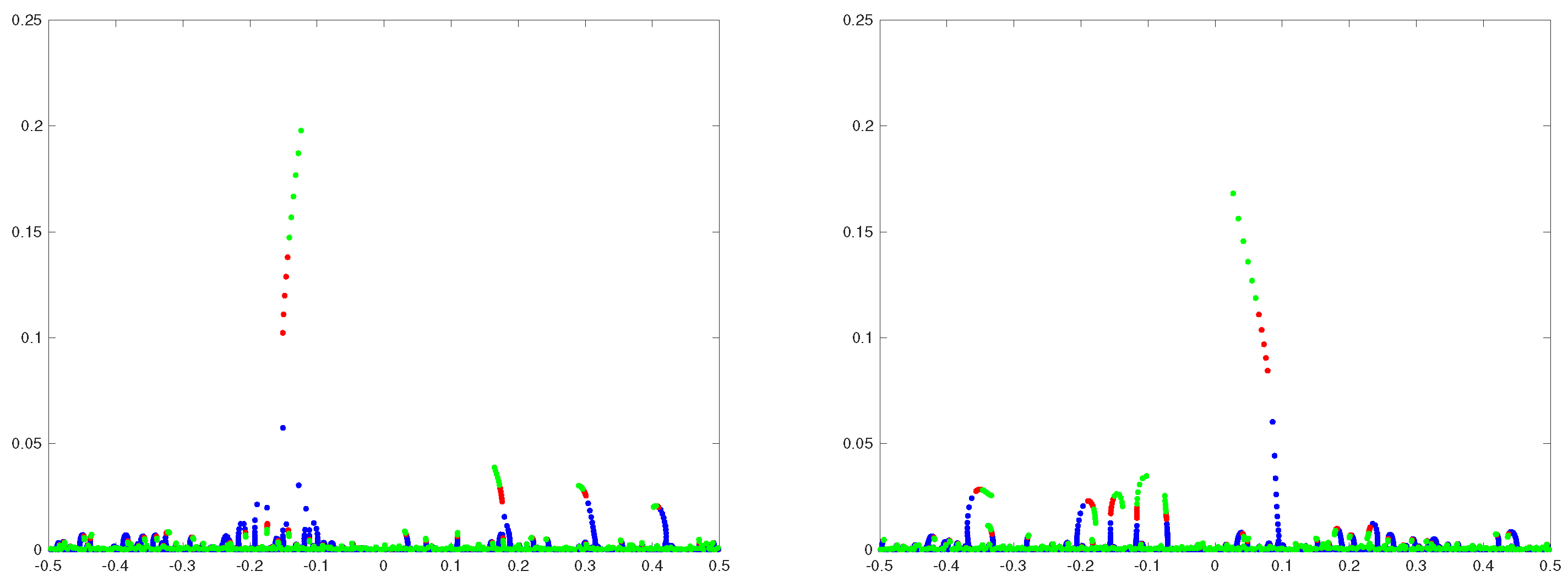
inside this region one would expect to find several eigenvalues, including the emerging “atypical” outlier, with imaginary parts on the critical scale (
6) much exceeding the height
of low lying eigenvalues, as illustrated in
Figure 1. One might call such eigenvalues “typical extremes” to emphasise atypicality of the emerging outlier.
To a large extent our paper is motivated by [
11] and aims to provide quantitative insights into this picture of the outlier emerging from the cloud of extreme eigenvalues. Whilst the approach of Dubach and Erdős is dynamical (fix matrix
H and study eigenvalue trajectories as the magnitude
of the deformation increases), our approach is statistical (fix a scale for
and count the number of eigenvalues on characterisitc spectral scales in the complex plane averaged over the distribution of
H which, for technical reasons, we assume to be GUE). Our present approach is limited to the expected values; analysing higher order moments is left as an interesting problem for future investigations. However, even with such a basic tool we are able to develop rather detailed quantitative understanding of the outlier separation and the associated restructuring transition in the spectra of matrices
J.
As such, the two approaches complement each other very well. For example, we prove that for
the expected number of eigenvalues whose height exceeds the level (
6) is asymptotically given by the integral
with density
This density is the average density of the extreme eigenvalues at height (
6). Together with findings in [
11] this result establishes that the width
of the transition region around
indeed scales with
. Similarly, we are able to determine the average density of extreme eigenvalues
of
J near the origin in the complex plane in the critical scaling regime when when
. As a function of coordinates
q and
m, this density, when appropriately rescaled, is given by
It can be verified that
, implying that the population of extreme eigenvalues at the critical height (
6) which generates the eventual outlier (as
is approaching infinity) is constrained to a narrow vertical strip of width
about the origin (the centre of the eigenvalue band of
H). Thus, our results both confirm and complement the analysis in [
11], and show that it indeed touched the optimal scales in
(
7), both along the real and imaginary axes.
We would like to conclude this section with a short description of the structure of our paper. In
Section 2 we develop quantitative heuristic analysis of the outlier separation. This analysis elucidates the emerging critical scaling in
and the critical spectral scalings in the complex plane and provides a useful background for rigorous calculations later on. This section also offers our outlook on the universality of the exponent
in (
7).
Section 3 contains the statement of our main results and discussion. In
Section 4 we express the expected density of eigenvalues of
J and the density of their imaginary parts at finite matrix dimensions in terms of, respectively, Hermite and Laguerre polynomials. These expressions are then used in
Section 5 and
Section 6 for asymptotic analysis of eigenvalue densities in various scaling limits. The two appendices contain derivations of technical auxiliary results.
2. Low Lying Eigenvalues and Their Extremes: A Heuristic Outlook
Before presenting our main results in the next Section, we would like to offer our quantitative heuristic insights into the outlier separation elucidating the emerging scalings and mechanisms behind them and providing a useful background for rigorous calculations later on.
With
standing for the eigenvalues of matrices
, the angular brackets
standing for averaging over the GUE matrix
H (
3), and
for the Dirac delta-function, the expected number of eigenvalues of
J in domain
D can be computed by integrating the mean eigenvalue density
over
D and multiplying the result by
N. For example, the expected number
of the eigenvalues of
J which lie above the line
in the complex plane is given by the integral
where
is the mean density of the imaginary parts
irrespective of the value of the real part,
Guided by the eigenvalue perturbation theory one can expect that the typical height
Y of the eigenvalues whose real part is close to a point
in the spectral bulk scales with the mean separation
between neighbouring real eigenvalues of the GUE matrix
H in the limit
. On a more formal level, introducing the scaled version of
[
21]
one finds that such scaled density is well-defined in the limit of large matrix dimensions [
1,
2,
21,
22]: for every
confirming that locally the typical height of low lying eigenvalues scales with
.
Globally, the typical height of low lying eigenvalues scales with
. Intuitively, this can be understood from the exact sum rule
which follows from the obvious relation
. On a more formal level, consider the expected fraction of the eigenvalues of
J which lie above the level
, and set
. In the limit
,
The integral in (
15) is the modified Bessel function
. Therefore,
From this,
The density
is the mean density of the scaled imaginary parts
in the limit of large matrix dimensions. Even though it describes low lying eigenvalues it contains some useful information about eigenvalues higher up in the complex plane.
As an example, consider the expected value of the sum of the imaginary parts of low lying eigenvalues. Using definition (
10), the sum rule (
13) implies that
Upon rescaling
, one could naively jump to the conclusion that
. However, by making use of (
17) and integral 6.623(3) in [
23], one actually finds that
Thus, if
then the imaginary parts of low lying eigenvalues indeed add up to
, in full agreement with the sum rule (
19), whereas if
they add up only to
. The sum rule deficit
is exactly the imaginary part of the outlier, and suggests that the rescaled limiting density of low lying eigenvalues,
, precisely misses the delta-functional mass
.
As another example, consider the asymptotic form of
when
. It is markedly different depending on whether
or not. In the later case, using in (
17) the asymptotic expansion for the modified Bessel function of large argument,
one finds an exponential decay, whilst in the former case the decay is algebraic:
It is instructive to return to the unscaled imaginary part
Y and take a closer look at the expected number of the eigenvalues of
J exceeding the level
in the limit
. It is evident from (
16) that
provided
. Extending this asymptotic relation to large values of
allows one to get insights, even if only heuristically, about the characteristic scale of the highest placed among the low lying eigenvalues. Along these lines, we define the
characteristic scale of the height of typical extreme eigenvalues as such level
that the expected number of eigenvalues with imaginary part exceeding
is of order of unity:
We add the word typical to exclude the atypical eigenvalue (the outlier) which is known to exist when
. Now, assuming
to be large (but still anticipating
) one can replace the Bessel function in (
21) by its corresponding asymptotic expression and approximate:
The condition in (
22) then leads to two essentially different scenarios depending on the value of
. Namely, for every fixed positive
the characteristic scale of the typical extreme values is, to leading order in
N,
. On the other hand, if
then the typical extreme values raise from the sea of low lying eigenvalues to a much higher height of
. This change of scale for extreme values is easy to trace back to the emerging power-law decay in the vicinity of
which is evident in (
20).
In fact, as evident from (
23), the typical extreme values scale as
not only at
, but also as long as
. Actually, by setting simultaneously
and
the asymptotic relation (
23) is converted into
an expression that is indeed of order of unity for all fixed values of
and
. Thus, the width of the transition region about
must scale with
. Combined with the existence of a distinct outlier at height
one may indeed see that our heuristic argument perfectly agrees with the conjecture of Dubach and Erdős about the critical scaling
where the separation of typical and atypical extreme values happens.
Before continuing our exposition of the heuristics behind the restructuring of the density of complex eigenvalues we would like to make two remarks.
Remark 1. To make further contact with the standard subject of extreme value statistics, it is useful to recourse to the classical theory of extreme values for i.i.d. sequences of random variables, a succinct albeit informal summary of which can be found in, e.g., [24]. In that case the probability law of extreme values is characterised by the tail behaviour of the “parent” probability density function (pdf) of
and is essentially universal in the limit . In our context, the pertinent case for comparison is that of non-negative continuous i.i.d. random variables with the parent distribution supported on the entire semi-axis . Then only two possibilities may arise. Those sequences which are characterised by the power-law decaying pdf ,
, as
have their extreme values scaling with and the distribution of their maximum, , after rescaling converges to the so-called Fréchet law in the limit . In contrast, if the parent pdf decays faster than any power, e.g., if ,
, then, to leading order, extreme values scale with , and the distribution of the largest value , converges, after a shift and further rescaling, to the so-called Gumbel law. Although, the imaginary parts of complex eigenvalues in the random matrix ensemble (
1)–(
3)
are not at all independent (as is evident from their JPDF (
51)
resulting in a non-trivial determinantal two-point and higher order correlation functions at the scale , see [22]), our scaling predictions for the typical extreme eigenvalues are in formal correspondence with the i.i.d. picture: a Gumbel-like scaling (with ) if
and a Fréchet-like scaling (with ) if . This is exactly as would have been implied in the i.i.d. picture by the tail behaviour of the mean eigenvalue densities in the two cases in (20). This fact naturally suggests to conjecture Gumbel statistics for the typical largest imaginary part (excluding possible outlier) for any , changing to a Fréchet-like law for , with a possible family of dependent nontrivial extreme value statistics in the crossover critical regime . Although we are not able to shed light on the distribution of typical extreme eigenvalues in the random matrix ensemble (
1)–(
3)
, we will discuss some results in that direction for a somewhat related model at the end of the next section. Remark 2. The phenomenon of resonance width restructuring with increasing the coupling to continuum (controlled in the present model by the parameter γ) and the emergence of the broad resonance has many features in common with the so-called super-radiant phenomena in optics. This is well known in the physics literature, see [
25]
and references therein. Here, we would like to point to a similarity of the spectral restructure in the random matrix ensemble (
1)–(
3)
to a process in a different physics context, the so-called “condensation transition” which occurs in models of mass transport when the globally conserved mass M exceeds a critical value, see, e.g., [
26]
for a review. In such a regime, the excess mass forms a localised in space condensate coexisting with a background fluid in which the remaining mass is evenly distributed over the rest of the system. A particularly simple case for analysing the condensation phenomenon is when the system has a stationary state such that probability of observing a configuration of masses factorises into the form
. In that context again the tail behaviour of the “parent” mass density plays important role. Although we would like to stress again that in our model the imaginary parts of the complex eigenvalues are not independent, the analogy with the condensation phenomenon is quite evident. Essentially the same heuristic analysis as in the above helps to clarify the numerically observed fact of the outlier emerging mostly close to the origin of the spectrum Re
z = 0. From this angle it is instructive to ask what should be the scale of extreme values for eigenvalues satisfying
, that are sampled in a window of a small widths
around the origin (still assuming typically many eigenvalues in the window, so that
). The total mean number of eigenvalues in the window
W whose imaginary parts exceed the level
Y (but still formally remain of the order of
) is now given by
For
the term
is exponentially suppressed, while the integral in
is dominated by
and with required accuracy yields the leading-order expression in the form:
Now, let us assume that both the width
W of the window and the parameter
scale with
N in this non-trivial way as
and again apply the same heuristic procedure to determine the scale of extreme values
in the window as
for given values of exponents
and
. A straightforward computation shows that the arising scale of extreme values very essentially depends on whether the parameter
satisfies
or
. In the former case we find
whereas in the latter case
One may say that as long as
the system is not fully in the well-developed “critical regime”, and the extreme value scale is growing with the window width, saturating at the Gumbel-like scale
. At the same time, as long as
exceeds the threshold value
, the typical extreme values reach the scale
as long as they are sampled in a window of width exceeding the scale
, thus containing
eigenvalues. This heuristics suggests that only eigenvalues satisfying
typically have a nonvanishing probability to reach to the maximum height in the complex plane, and eventually to generate an outlier as
increases. It would be also natural to expect the corresponding extreme eigenvalues to follow the Fréchet-type statistics for their imaginary parts, as opposed to the Gumbel statistics in the former case.
We would like to end our heuristic considerations with a brief heuristic outlook on the universality of the scaling factor
which is key to the correct description of the transition in question. As is evident from (
23) the exponent
is implied by the scaling law
in the limit
for the expected number of eigenvalues exceeding the level line
. Thus, to investigate the extent of universality of this exponent one needs to trace the origin of the scaling law (
30). This can be readily done by returning to the asymptotic relation (
14) and (
15) which was used to obtain (
30). On evaluating the integral in (
15) for large values of
by the Laplace method it becomes immediately apparent that the power
on the right-hand side in (
30) and, hence, the exponent in question stems from the quadratic shape of the limiting GUE eigenvalue density function
in the vicinity of its maximum. It is natural to conjecture that had one started from a random Hermitian matrix
H taken from the broad class of invariant ensembles characterised by joint probability density function
with a suitable potential
(or from the class of Wigner matrices with suitable conditions on the iid entries), the asymptotic expression (
12) for the scaled eigenvalue density
would retain its validity after replacing
in (
11) and (
12) by the corresponding limiting eigenvalue density of
H. For example, as was shown albeit not fully rigorously in [
27], such universality of the scaled eigenvalue density near the real line is exhibited by almost Hermitian random matrices which are morally similar to finite rank non-Hermitian deviations as in (
1) and (
2). Since asymptotic relation (
14) and (
15) is the immediate corollary of (
12), one then concludes that as long as the limiting eigenvalue density of
H has a single global parabolic-shaped maximum, an additive rank-one non-Hermitian deformation will demonstrate the same type of critical scaling for its extreme complex eigenvalues, and, most probably, after appropriate rescaling, the same type of critical behaviour of the density of imaginary parts as described in the next section. One can however imagine invariant ensembles where the mean eigenvalue density would have a non-parabolic behaviour close to the maximum point.
From this point of view, the noticed in [
11] resemblance of the
critical scaling in the present model and the edge scaling of extreme real eigenvalues of GUE, which, e.g., manifests itself in the so-called BBP [
28] transition under additive rank-one Hermitian perturbation of the GUE, looks to us purely coincidental. Indeed, the latter is known to have its origin in the square root behaviour of the mean density
at the spectral edges where
vanishes, and as such seems to have nothing to do with the behaviour of the same density close to its maximal point.
3. Main Results and Discussion
Our first result concerns the mean density of imaginary parts
(
10) in the large deviation regime
. We note that no eigenvalue of
J has imaginary part equal or greater than
. This is a consequence of the sum rule (
13). Therefore we only consider the range of values
.
Theorem 1. Consider the random matrix ensemble (
1)–(
3)
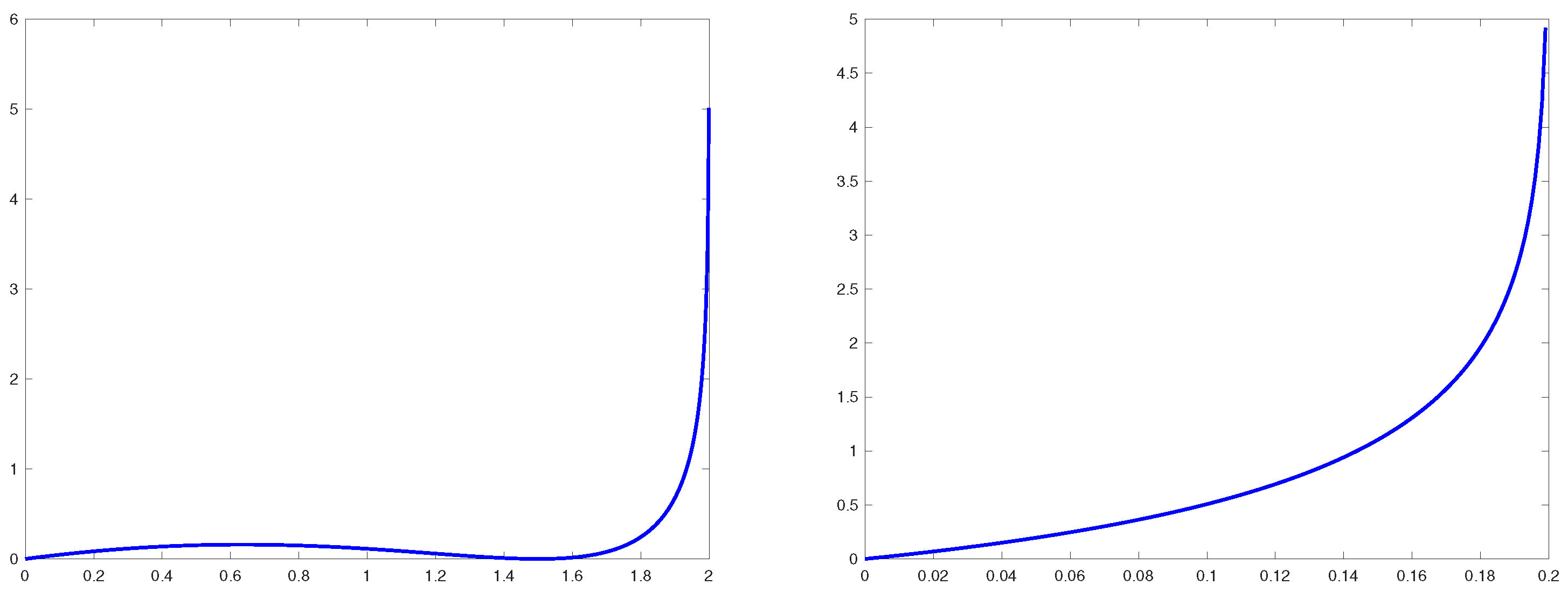
in the scaling regimeThen for every fixed and withandThe rate function is a smooth non-negative function of Y on the interval vanishing at . The rate function is monotone increasing on this interval if , whereas if then it has two local extrema: a local minimum at where it vanishes, and a local maximum at . By the way of discussion of the above Theorem a few remarks are in order.
Remark 3. The two distinct profiles of the rate function are illustrated in Figure 2. If, the pointwhere the Large Deviation Rate functionvanishes can be identified as the most probable value of the imaginary part in the region, converging in the limitto (the height of) the outlier, see next comment. At the same time, the other extremal point,, can be interpreted as the true boundary, along the imaginary axis in the complex plane, between the bulk of eigenvalues and the spectral outlier. This is because the pre-exponential factorin (
32)
vanishes at too. Hence, in the scaling limit (
31).
Remark 4. The Large Deviation approximation (
32)
for describes fluctuations of the imaginary part of the outlier around its most probable value . The law of these fluctuations in the limit can be easily determined from (
32)
. To this end, we first note that for N large the magnitude of fluctuations about scales with . Calculating the second derivative and rescaling the density correspondingly, one finds (in the limit ) thatThe integral of the rescaled density on the left-hand side over the entire range of values of u counts the expected number of eigenvalues in the -neighbourhood of . Evidently, this integral is approaching unity as , confirming that the rescaled density on the left-hand side in (
36)
describes the law of fluctuations of a single eigenvalue - the outlier. Thus, we recover one of the results of [
10]
where laws of outlier fluctuations were established in greater generality than our assumptions (
2) and (
3)
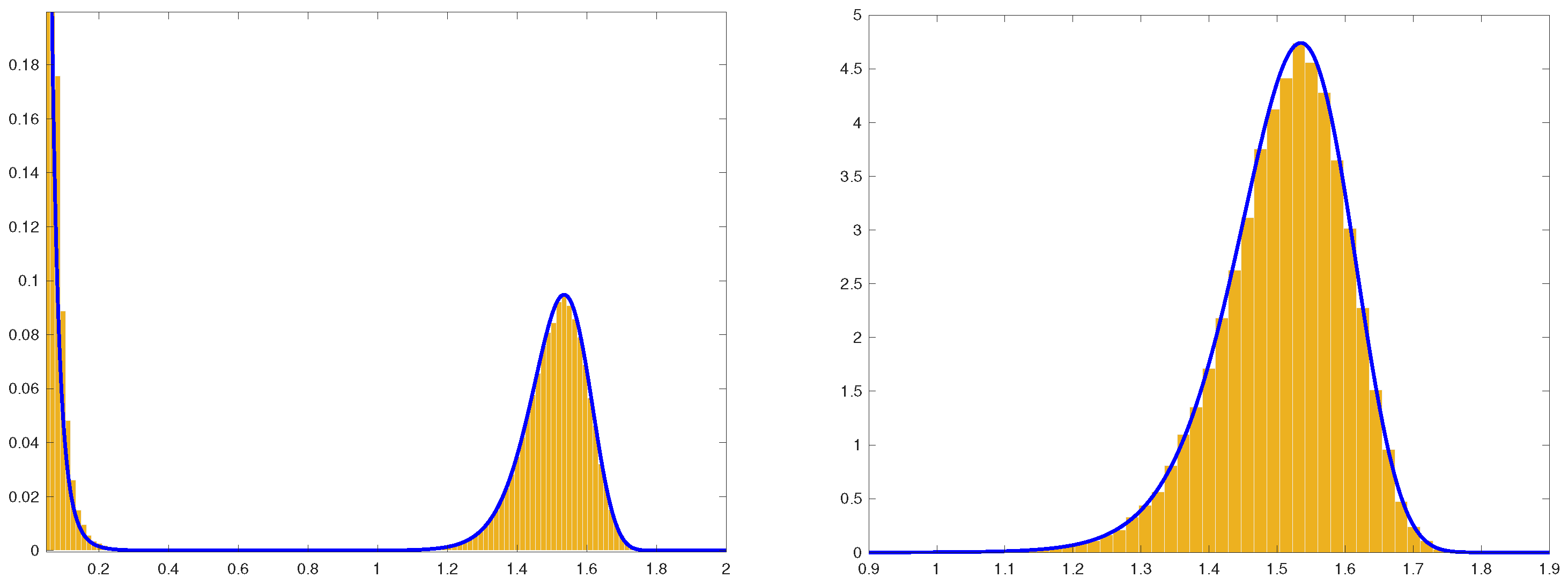
. We note that for finite but large values of N the functionprovides an approximation of the probability density function of the outlier in the interval , . In Figure 3, we plot histograms of the imaginary partsof the eigenvalues and of their maximal valuein the random matrix ensemble (
1)–(
3)
and make comparison with the corresponding Large Deviation approximations. Although the value of is only moderately large, one can observe a good agreement. Furthermore, one can observe that the large-N approximation (
37)
of the probability density of captures well the skewness of the distribution of for finite matrix dimensions. This skewness disappears in the limit , see Equation (
36).
Remark 5. Consider now the scales with . The expected number of eigenvalues with is given by the integralThe rescaled density in this integral can be found from (
32)–(
34)
:Evidently, if then, away from the boundary point , the integral in (
38)
vanishes in the limit . Therefore for every fixed and there are no eigenvalues of J whose imaginary part is scaling with . On the other hand, according to the heuristics of Section 2, one should expect finite numbers of eigenvalues whose imaginary part is scaling with . These would be the extremes of the eigenvalues with the typical imaginary part . By formally lettingin (
39)
one obtainsThis relation reproduces the leading order of the asymptotic form of the density of the rescaled imaginary parts in the region , see the top line in (
20)
. Thus, for a fixed value of Theorem 1 describes a crossover of the density of imaginary parts from the characteristic scale of low lying eigenvalues to larger scales, including which is the scale of the outlier. Whereas the picture described by Theorem 1 is quite complete for a fixed
, it is not detailed enough to accurately describe the typical extreme eigenvalues in the situation when the parameter
approaches its critical value
as
N is approaching infinity. For example, from the heuristics of
Section 2 we know that both the width of the transition region about
and the height of the typical extreme eigenvalues scale with
. The Large Deviation approximation (
32), if applied formally in the transition region parametrised by
, yields the following approximate expression for the rescaled density of imaginary parts:
Evidently, in the limit of small values of
m which corresponds to approaching the scale
from above, this expression does not reproduce the correct power
of algebraic decay (
20) characteristic of this scale when
. In contrast, the heuristics based on (
21), see the approximations in (
23) and (
24), do reproduce the correct power. Indeed, by taking the derivative in
m of the expression on the right-hand side in (
24), one gets
In the limit of small values of
m the expression on the right-hand side agrees with the bottom line in (
20). One can also arrive at (
41) by making the formal substitution
and
in (
20).
Our next Theorem is a refinement of Theorem 1 in that it provides an accurate description of the density of the typical extreme eigenvalues in the transition region between the sea of low lying eigenvalues and the eigenvalue outlier.
Theorem 2. Consider the random matrix ensemble (
1)–(
3)
in the scaling regimeThen, for every fixed and , This theorem confirms that the characteristic scale of the height of the typical extreme eigenvalues of matrix
J is
. Indeed, the expected number of eigenvalues with imaginary part exceeding the level
is given by
which is a finite number in the limit
.
Theorem 2 also describes the density
in the cross-over from the characteristic scale of low lying eigenvalues to the Large Deviation regime of Theorem 1. Indeed, for small values of
m the asymptotic expression (
43) matches the one in (
41), whilst in the limit of large values of
m it matches (
40).
The emerging outlier is captured by (
43) when
both m and
are large. Intuitively this is clear from the comparison of (
43) and (
40). On a more formal level, one can come to the same conclusion by analysing the limiting density of extreme values
Using Wolfram Mathematica one finds
where
Evidently,
for all
if
is negative. Therefore, if
(subcritical values of
) then the limiting density
is a monotonically decreasing function of
m on the entire interval
. One can interpret this profile as a population of extreme eigenvalues without an obvious “leader”. By continuity, this profile persevere for small positive
. Indeed, at
the polynomial
has three pairs of complex conjugated roots, none are real. Since the roots of polynomials depend continuously on its coefficients, there exists an
such that for all
the polynomial
in
m will still have no real roots and, hence, will take only negative values, implying that
is a monotonically decreasing function of
m. By computing the roots of
in variable
m, we can show that
.
Once
, the polynomial
in
m acquires real roots. In the limit of large positive
there are two real roots: to leading order these are
The larger root,
, is the point of local maximum of
, where
, and the smaller root,
, is the point of local minimum
, where
. In fact, in the limit
the larger root is transitioning into
, the most probable value of imaginary parts, and, hence, it can be interpreted as the emerging spectral outlier. At the same time, the smaller root is transitioning into the true boundary
between the sea of low lying eigenvalues and the outlier. This cross-over can be validated by noticing that in the scaling limit (
42)
and
.
Further insights into the restructuring of the spectrum of
J can be obtained by looking at the
-dependence of the expected number of the eigenvalues of
J with imaginary parts exceeding the level
. In the scaling limit (
42) this number converges to
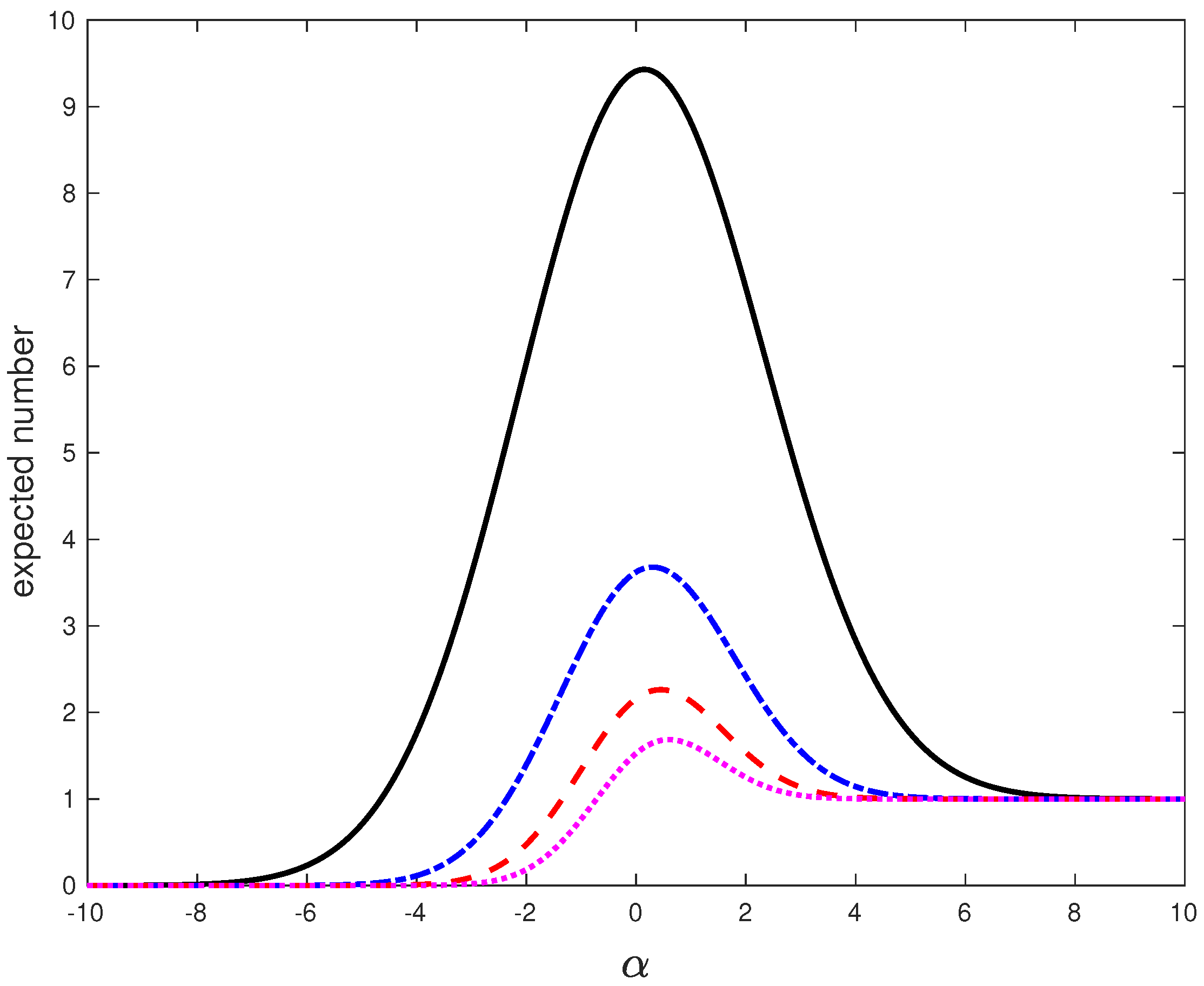
In
Figure 4, we plot
as function of
for several values of
m. One can observe that for any fixed
the population of the extreme eigenvalues of
J that exceed the level
is, on average, growing as
is approaching the critical value
from below. For
on the other side of
, this population peaks a some point and then it starts to decline as
increases further, to a single eigenvalue which is the outlier. All the other extreme eigenvalues are getting closer and closer to the real line with the increase of
. One can think of them as being trapped in the sea of low lying eigenvalues. This picture is consistent with the eigenvalue trajectories of
Figure 1 and provides a more quantitative description of the “resonance trapping” phenomenon [
20] in the framework of random matrix theory.
Our final result aims to clarify the length of the central part of the spectrum of
J supporting nontrivial scaling behaviour of the extreme eigenvalues in the vicinity of the separation transition. To this end, let us consider eigenvalues
of
J in the scaling regime when
On average, eigenvalue numbers in this regime can be counted using the rescaled density
where, as before, the angle brackets stand for the averaging over the GUE matrix
H in (
1) and
is the mean eigenvalue density (
8).
Theorem 3. Consider the random matrix ensemble (
1)–(
3)
in the scaling regime (
45).
Then, for every fixed ,
and , It is easy to see from (
46) that
. Thus, Theorem 3 confirms the heuristics of
Section 2 in that the population of extreme eigenvalues which generates the eventual outlier (as
is approaching infinity) is constrained to a narrow vertical strip of width
about the origin.
Our results demonstrate that despite being one of the simplest tools available, the mean eigenvalue density captures the eigenvalue and parameter scales associated with the spectral restructuring in the random matrix ensemble (
1)–(
3). However, it gives no information about finer details, such as the probability distribution of the extreme eigenvalues during the restructure. Calculating all the higher order eigenvalue correlation functions in the scaling regime (
45) would be a significant step towards describing such finer details. Unfortunately, the eigenvalue point process in the random matrix ensemble (
1)–(
3) is not determinantal at finite matrix dimensions and such a calculation is a considerably more difficult analytic task compared to the mean eigenvalue density.
At this point we want to mention that the probability distribution of extreme eigenvalues can be determined in a related but different random matrix ensemble exhibiting a spectral restructuring not unlike one in (
1)–(
3). This ensemble consists of subunitary matrices of the form
where the matrix
U is taken from the Circular Unitary Ensemble (CUE) of complex unitary matrices uniformly distributed over
with the Haar’s measure and
is a parameter. The ensemble was originally introduced in [
29] and various statistical aspects of their spectra and eigenvectors were addressed in [
2,
6,
30,
31] and most recently in [
15].
Obviously, if
then the matrix
is unitary and all of its eigenvalues lie on the unit circle
. If
and is fixed in the limit
then, typically, the eigenvalues of
lie at a distance
from the unit circle with the farthest away being at a distance
with probability close to one. On the other hand, for
one of the eigenvalues becomes identically zero, and the rest are distributed inside the unit circle in the same way as eigenvalues of the so-called “truncated” CUE [
32].
The similarity between the random matrix ensembles (
47) and (
1)–(
3) can be exemplified by analysing the mean density of the eigenvalue moduli
in the limit of large matrix dimensions
. One finds [
29] that for every fixed
whereas, on rescaling the radial density near the unit circle [
2,
32],
Equation (
48) is identical, with the obvious correspondence
to Equation (
12) considered at the centre of the GUE spectrum. In the limit of large values of
y,
The rescaled radial density has an exponentially light tail if
, and it is heavy-tailed if
which hints at markedly different behaviour of the extreme eigenvalues in the two cases. Reflecting on (
50), one can convince themselves that this change occurs in an infinitesimal region near
of width
. Such a scaling regime was earlier identified and analysed from a somewhat different angle in [
15]. The precise relation of our analysis to one in [
15] will be given in a separate paper [
33].
On setting
,
, one can investigate this transition region in much detail [
33]. For example, the smallest eigenvalue modulus of the subunitary matrices
,
converges in the limit
to a random variable
X whose cumulative probability distribution function is given by the series
This family of probability distributions interpolates between the Fréchet and Gumbel distributions and is different from the standard family of probability distributions that characterise the extreme values in long sequence of i.i.d. random variables. In the limit of small values of
t
whereas