You are currently viewing a new version of our website. To view the old version click .
Entropy
  • Article
  • Open Access

10 January 2023

ImputeGAN: Generative Adversarial Network for Multivariate Time Series Imputation

and
School of Computer Science and Engineering, University of Electronic Science and Technology of China, Chengdu 611731, China
*
Author to whom correspondence should be addressed.
This article belongs to the Topic Complex Data Analytics and Computing with Real-World Applications

Abstract

Since missing values in multivariate time series data are inevitable, many researchers have come up with methods to deal with the missing data. These include case deletion methods, statistics-based imputation methods, and machine learning-based imputation methods. However, these methods cannot handle temporal information, or the complementation results are unstable. We propose a model based on generative adversarial networks (GANs) and an iterative strategy based on the gradient of the complementary results to solve these problems. This ensures the generalizability of the model and the reasonableness of the complementation results. We conducted experiments on three large-scale datasets and compare them with traditional complementation methods. The experimental results show that imputeGAN outperforms traditional complementation methods in terms of accuracy of complementation.

1. Introduction

Time series data are widely available and useful in many fields, such as medicine [1], economics [2], and traffic forecasting [3]. The quality of the data largely determines the quality of downstream tasks. However, device failure and network connectivity problems inevitably occur during the use of IoT devices. This can bring about the problem of missing data. Obviously, the lack of data can have a significant impact on the subsequent analysis and utilization of the data [4]. The authors in [5] attempted to predict the groundwater level in a well field using artificial neural networks (ANNs) and support vector machines (SVMs). When used for the prediction of missing data, an ANN is not as effective as an SVM. However, when the missing data are found, an ANN predicts better than an SVM. When complete data are used, both ANN and SVM predict better than when incomplete data are used.
Complementary methods for missing data can be roughly divided into two categories, statistical and neural-network-based complementary methods. Statistical methods include mean value imputation [6], last value imputation [7], mode value imputation [8], K-nearest neighbor (KNN) algorithm-based imputation [9], and matrix factorization algorithm-based imputation [10]. In addition to this, there are many other approaches, including SSMLP [11], extensions to KNN [12], RENUVER [13], and Holoclean [14]. These methods are effective, but difficult to apply to multivariate time series data because good feature engineering is required for them to work, and feature engineering, in turn, requires experts to perform analysis. Therefore, these methods cannot be used for end-to-end models.
Neural-network-based complementation methods include recurrent neural network (RNN)-based complementation methods [15,16,17,18,19] and generative adversarial network (GAN)-based complementation methods [18,19,20]. Compared with statistical complementation methods, GAN-based complementation methods can effectively utilize the temporal information of data [18]. Compared with RNN-based complementation methods, GAN-based complementation can more adequately determine whether complementation results are close to the true results because GAN generates missing data via a generative method that are judged by a discriminator, while RNN completes the missing values by fitting. Whenever a complementary dataset of a GAN used for complementation is changed, it needs to be retrained. We ensured the generalizability of the GAN-based complementation method by designing a new complementation network architecture. An RNN network suffers from the problem that positions far from the current input do not have enough weight, which causes the initial input to fail to impact the output when the sequence is too long [21]. A transformer [22] solves this problem with positional embedding. The proposed informer [23] not only reduces the memory consumption and time consumption of transformers in long-term time series forecasting (LSTF), but it also improves the accuracy of forecasting. Moreover, the current GAN-based complementation method does not further iterate and optimize the complementation results. To overcome this problem, we propose a new iterative strategy to compare the strengths and weaknesses of the complementation results. The method first trains an autoencoder that is capable of converting the data into appropriate feature vectors on a small number of missing datasets. Afterwards, the missing data are fed into this autoencoder to obtain the feature vectors corresponding to the missing data. Then random vectors are generated, and a gradient descent method is used to make these random vectors correspond to the generated data as close as possible to the real data. Lastly, the vector that is closest to the real data is selected from these vectors as the complementary result. Experiments on real datasets demonstrate that our approach achieves a better imputation accuracy and better time consumption compared to those of other methods.
Our contributions can be summarized as follows:
  • We propose a GAN-based neural network for complementation that uses a generative approach to generate complementary data and judge them with a discriminator that can handle continuously missing data more effectively.
  • In contrast to other GAN-based methods of complementation, imputeGAN ensures that the complementation values are reasonable through an iterative strategy.
  • The generalizability of the model is ensured with a carefully designed training framework.

3. Preliminary

Generative Adversarial Networks (GANs). GANs [35] consist of generators and discriminators, and train generators that can generate data with the same distribution as that of the original data by gaming the discriminators with the generators. The role of the generator is to map the n-dimensional vector into the data in the sample space. The role of the discriminator is to determine whether the samples are from the original dataset or from the data generated by the generator. The loss function for GANs is as follows.
min G max D V ( D , G ) = E x p d a t a ( x ) [ log D ( X ) ] + E z p z ( z ) [ log ( 1 D ( G ( z ) ) ) ]
Equation (1) is divided into min G and max D . When training the discriminator, the corresponding loss function is shown in Equation (2).
max D V ( D , G ) = E x p d a t a ( x ) [ log D ( X ) ] + E z p z ( z ) [ log ( 1 D ( G ( z ) ) ) ]
The discriminator is expected to accurately determine the original input and the generator input, i.e., D ( X ) approximates to 1 and D ( G ( z ) ) approximates to 0, thus making Equation (2) converge to 0. Similarly, when training the generator, the corresponding loss function is shown in Equation (3).
min G V ( D , G ) = E x p d a t a ( x ) [ log D ( X ) ] + E z p z ( z ) [ log ( 1 D ( G ( z ) ) ) ]
It is expected that the trained discriminator is unable to determine the output of the generator, i.e., D ( G ( z ) ) approximates to 1, thus making Equation (3) converge to the minimal value. This game process is repeated until the ideal generator is trained.
Data Imputation. For d-dimensional time series data x being recorded at time t = ( t 1 , t 2 , , t n ) , they can be expressed as x = ( x 1 , x 2 , , x n ) R d × n . x i is the recorded value at time t i since the information of missing data locations is important for data imputation. We recorded this information with the corresponding mask m = { m 1 , m 2 , , m n } R d × n . If there is missing part in x t , the corresponding part is set to 0 and vice versa. Multivariate time series data X i and the mask matrix M i are shown in Equation (4).
X i = 1 / 3 / 5 / 7 8 / M i = 1 0 1 0 1 0 1 1 0
Our goal is to achieve the accurate prediction of multivariate long time series with incomplete data input.

4. Proposed Method

Our method completes the missing data by training an autoencoder on datasets with a small number of missing data, and completes the missing data on the basis of this autoencoder. The encoder is used to extract the corresponding feature vectors from the original data, and the decoder is used to recover the corresponding data on the basis of feature vectors. In the actual use of the model, we input the missing data into the encoder and randomly generate several vectors that are passed through the decoder to generate the time series data. We used the gradient descent method to iterate over these vectors to minimize the difference between the time series data generated by the decoder and the missing data. The vector with the smallest difference between the generated data and the missing data is selected, and the result of this vector generated by decoder is used as the complementary result of the missing data. Since the decoder is trained on a small number of missing datasets, we expect it to learn the variation patterns implied in the original data. We formally introduce the method in a later section.
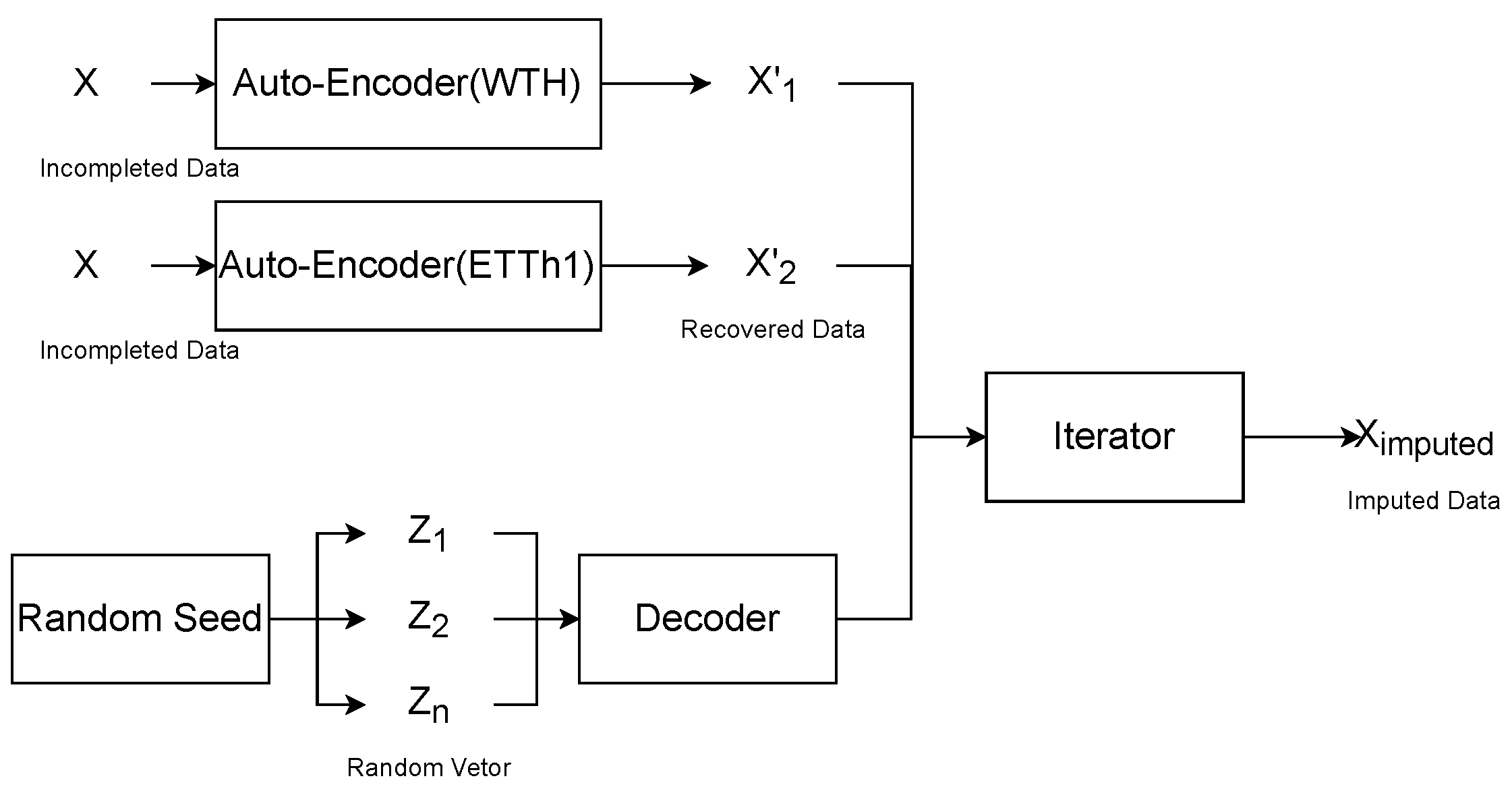
As shown in Figure 1, the corresponding self-encoders are first trained on different datasets. The encoder of the self-encoder extracts the feature vector of the input data and the decoder reduces the feature vector to the full vector. The randomly generated vectors are then decoded by the decoder as the input to participate in the iterations. The gradient of the input is updated using the gradient descent method, and the vector with the smallest difference from the recovered data is taken as the result of the recovery.
Figure 1. The overall architecture of the proposed imputation approach. The self-encoder can transform incomplete time series data into recovered data, and the randomly generated vectors are decoded into time series data by the decoder, and the difference values between these data are compared. The gradient descent method is used to iteratively update the random vector, and the random vector with the smallest difference between the generated and recovered data is taken as the feature vector of the complementary value, and the corresponding data are the complementary data.

4.1. Encoder Network Architecture

As mentioned before, the encoder needs to extract the corresponding feature vectors from the original time series data. We adopted the informer’s encoder as the encoder of the autoencoder. We trained multiple encoders on different datasets to ensure generalizability, and used multiple encoders to extract features from the same time series data when completing the data. By giving the feature vector enough initialization space, this ensures that the final iterated feature vector is as close to the true value as possible.
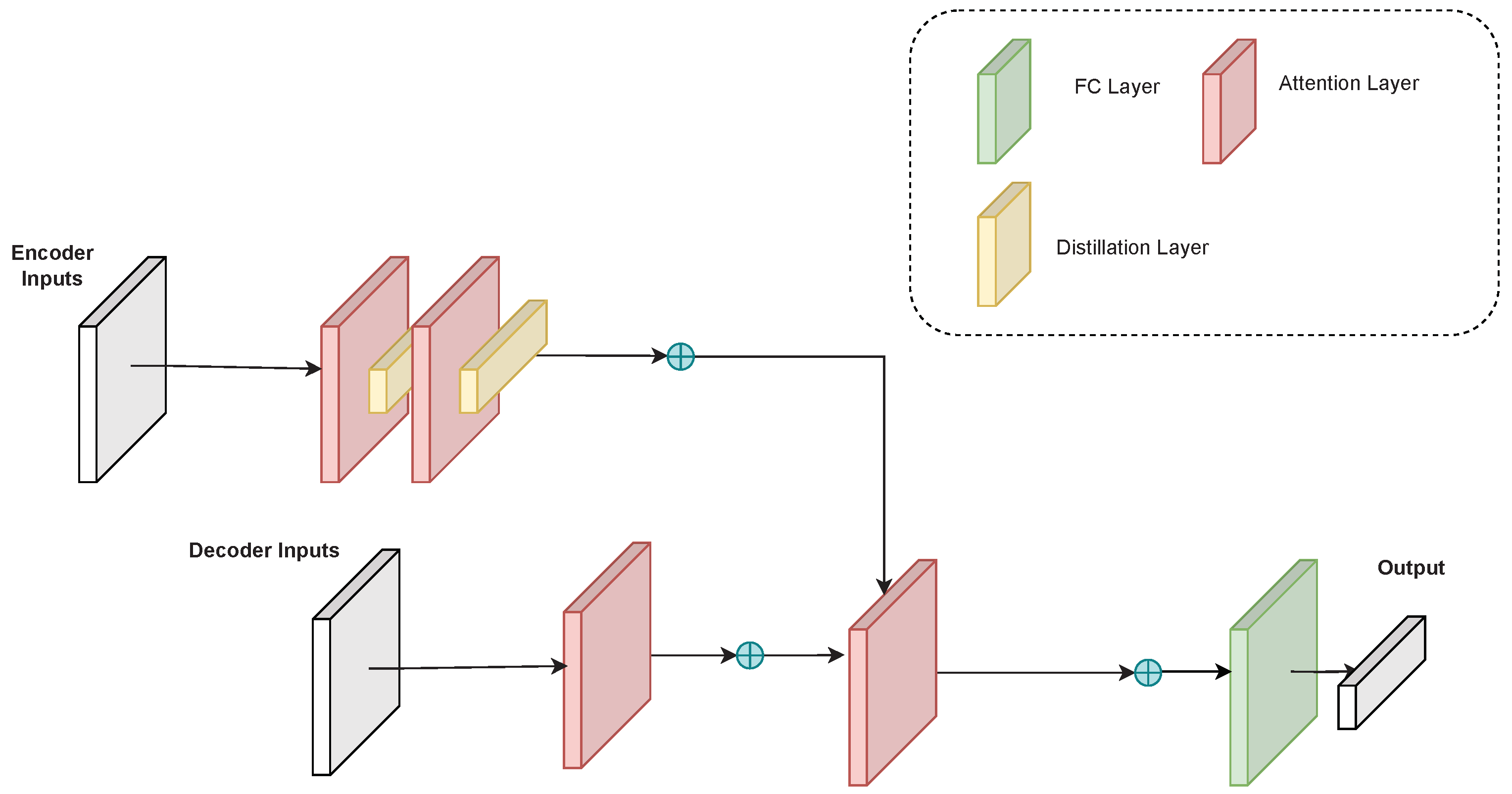
As shown in Figure 2, the encoder extracts the feature vectors from the input through the attention layer, removes the redundant information through the distillation layer and repeats the process several times. The encoder of the informer can be formulated as follows:
Z i _ e n c 0 = D i s t i l l i n g ( A t t n ( X i _ e n c ) )
Z i _ e n c j + 1 = D i s t i l l i n g ( A t t n ( Z i _ e n c j ) )
f e a t u r e s i _ e n c = Z i _ e n c l a s t
where X i _ e n c denotes the incomplete time series data.
Figure 2. Overall informer architecture. The encoder takes the incomplete time series input and compresses it into the corresponding feature vectors. The decoder takes the compressed feature vectors and outputs the time series data generated from the feature vectors.

4.2. Decoder Network Architecture

The role of the decoder is to recover the vector into time series data. Similar to the encoder, we also used the informer’s decoder as the decoder of the autoencoder. Since we had trained multiple encoders before, we have to train the corresponding multiple decoders. When complementing the data, the data recovered by the decoder are compared with the original data, and the data with the smallest gap are selected with the corresponding vector.
As shown in Figure 2, the decoder extracts the feature vector from the input through the attention layer and recovers the complementary data from the vector through the fully connected layer. The decoder of the informer can be formulated as follows:
Z i _ d e c 0 = A t t n ( X i _ d e c )
Z i _ d e c j + 1 = A t t n ( Z i _ d e c j )
o u t p u t s = F C ( A t t n ( f e a t u r e s i _ e n c , Z i _ d e c l a s t ) )
where X i _ d e c denotes the second half of X i _ e n c with an all-zero mask of imputation length.

4.3. Iteration Strategy

When the training of the encoder and decoder of the autoencoder is completed, we input the incomplete data X into encoder E to obtain the corresponding feature vector x and randomly generate the feature vector z with the same dimension as x. Multiple iterations were performed to find the vector z that minimizes the following equation.
min z G ( z ) X M 2 2
where M is the mask matrix identifying the missing data. Then, z was input into decoder D to obtain the corresponding time series data Z . By randomly selecting n initial vectors and performing L iterations of gradient descent, we were able to estimate z , satisfying the condition as much as possible.
As shown in Figure 3, n is the number of randomly selected vectors Z i 0 , the stochastic gradient descent method is used to iterate Z i for L times, so that the time series data generated by Z i have the smallest possible difference from X M . Then the vector Z i L with the smallest gap with X M among these n vectors is taken as the feature vector of the optimal imputation value. The formulation of iteration strategy as follows.
Z i j + 1 = Z i j + η i Z L ( X , Z ) | Z = Z i j
L ( X , Z ) = G ( Z ) X M 2 2
where η i denotes the learning rate.
Figure 3. Iterating through the n imputation results to find the optimal imputation result. The same missing data are recovered differently by different autoencoders, but their nonmissing parts are the same. By randomly generating vectors and iterating them, the decoded data of the random vector are rendered as consistent as possible with the nonmissing part of the recovered data. The result with the smallest difference between the decoded and recovered data in the nonmissing part is found as the result of the complementation.

4.4. Imputation Results

For each incomplete time series datum X, its complementary result is derived from the corresponding part of its reconstruction vector X . Thus it can be expressed by the following equation.
X i m p u t e d = X M + X ( 1 M )

4.5. Discussion

When GAN is used to fill in missing values in time series data, it simply maps random vectors to complete time series data. Therefore, the difference of random vectors can have a great impact on the generated results. Existing approaches ensure that the generated results are close to the true results by adding a penalty term to the loss function of the generator that measures the difference on the nonmissing values. In contrast, imputeGAN makes the complementary results more reasonable by iterating over the generator’s complementary results. The iterative process is described in Section 4.3.
Comparing the differences in the time efficiency of GANs is difficult because they have different parameter settings and training methods. In the case of E2GAN, for example, to ensure the effectiveness of the generator, the generator has to be trained several times for each training of the discriminator. In addition, the size of the dataset used for training has a significant impact on the training time. ImputeGAN uses multiple datasets in the training process in order to ensure the generalization of the model, which leads to its time disadvantage compared to other GAN-based methods.

5. Experimental Evaluation

In this section, we present the results of our proposed model run on real datasets and compare them with the baseline.

5.1. Datasets, Tasks, and Baseline

We evaluated our proposed model on four real datasets: two medical datasets, an electricity transformer temperature dataset, and a city weather dataset.
Electricity Transformer Temperature (ETT dataset was acquired at https://github.com/zhouhaoyi/ETDataset (accessed on 22 June 2022).) (ETT): The ETT dataset contains two years of data on oil temperature of power transformers in two counties in China and six other metrics.
KDD Cup 2018 Dataset (KDD CUP. Available on: http://www.kdd.org/kdd2018/ (accessed on 22 June 2022), 2018.) (KDD): contains weather data and air pollution data collected hourly from 30 January 2017 to 30 January 2018 for Beijing and London.
Electricity Consuming Load (ECL Dataset. Available on: https://archive.ics.uci.edu/ml/datasets/ElectricityLoadDiagrams20112014 (accessed on 22 June 2022).) (ECL): contains electricity consumption data for 321 clients from 2012 to 2014. The dataset has a time interval of hours and 1% missing data.
Weather Dataset (Weather Dataset. Available on: https://www.ncei.noaa.gov/data/local-climatological-data/ (accessed on 22 June 2022).) (Weather): contains weather data collected hourly from 2010 to 2013 for 1600 locations in the United States. The dataset has 5% missing data. A comparison of the datasets is shown in Table 2. The second column of Table 2 indicates the number of features of the time series data, the third column indicates how many moments of data were collected in total, the fourth column indicates the missing rate of the dataset, and the fifth column indicates the interval time of the time series data.
Table 2. Dataset details.
Downstream Task: After we had completed training on a dataset with a small number of missing data, we took the data in the test set, discarded 50% of it at random, and attempted to complete the dataset. The accuracy of our method was compared with the accuracy of the prediction method on the basis of the original dataset to measure the effectiveness of our method when used for prediction on the missing dataset.
The baseline models are as follows.
  • Statistical imputation methods: we filled in the missing values with the average [6] or the last observed value [7].
  • LSTnet [36]: uses a CNN and an RNN to predict time series data.
  • LSTMa [37]: adds an automatic search strategy to the encoder–decoder architecture.
  • Reformer [38]: improves transformer efficiency by locally sensitive hashing self-attention.
  • LogTrans [39]: the LogSparse transformer improves transformer efficiency by using a heuristic method.
  • Informer [23]: improves transformer efficiency with ProbSparse self-attention.

5.2. Implementation Details

In our experiments, the encoder stack of the informer in the generator contained a stack of three attention layers with two distillation layers. the decoder stack contained two attention layers. The dropout rate was fixed at 0.05. All datasets were normalized, and missing values were padded with 0. Then, 10% of the dataset was used as the validation set, and another 10% was taken as the test set. The optimizer was the ADAM optimizer.

5.3. Performance Comparison of Downstream Task

Table 3 shows the results of our proposed method compared with other prediction methods. Our method was used to complete the dataset with 50% of the data missing, the prediction method was used to predict the data on the basis of the original data, and the mean fill was used to fill the missing values on the basis of the mean value of the data at a certain time before. The first column of the table represents the dataset, the second column represents the step size used to fill or predict, the first row represents the method to fill or predict, and the second row represents the measure of the difference between the predicted or filled value and the actual value. The average column indicates that the fill method was based on the average of the data before the missing values. The M S E = 1 n i = 1 n ( y y ^ ) 2 and M A E = 1 n i = 1 n | y y ^ | are used to indicate the difference between the imputation values and the actual values. The smaller these values are, the better the imputation is. In the case of 50% missing data, the accuracy of our imputation method still does not lag too far behind.
Table 3. MSE and MAE results of imputation and prediction methods on five datasets.

5.4. Analysis

Influence of Missing Rate
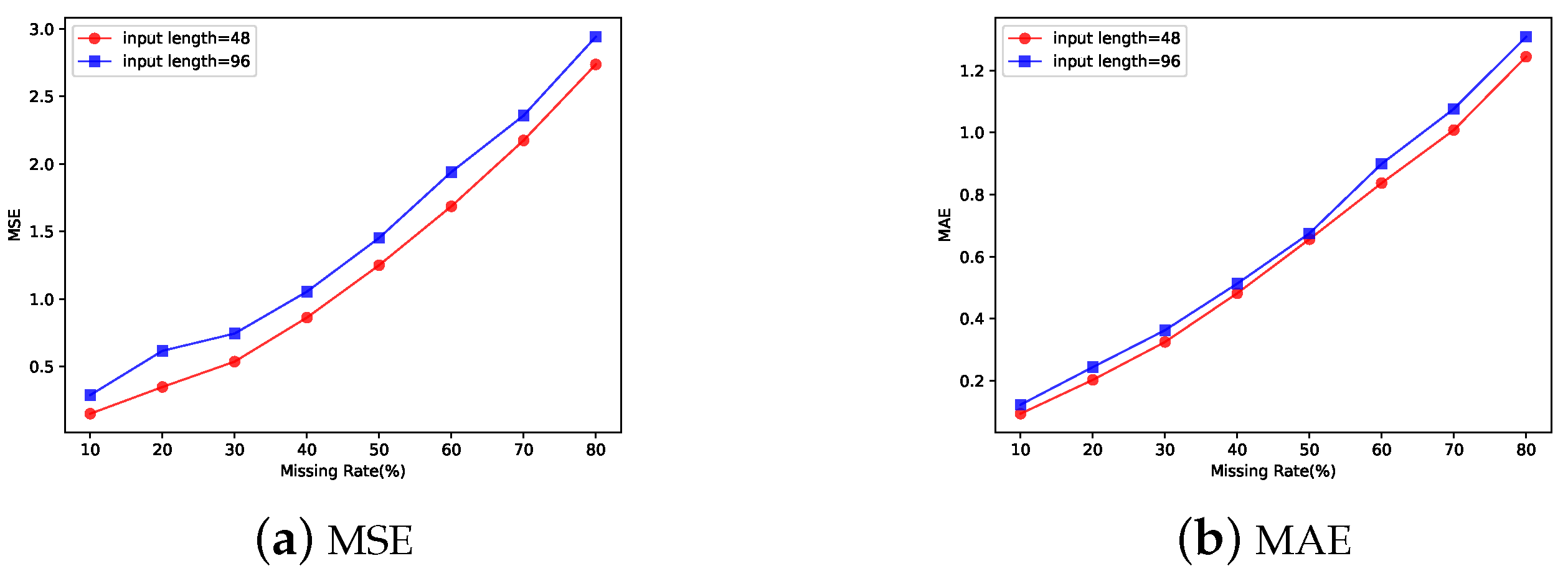
We also investigated the effect of the missing rate of the input time series data on the accuracy of the imputation.The results are shown in Figure 4. Figure 4a,b depict the effect of the missing rate of the data on the MSE versus MAE of the fill results when other conditions are held constant. They illustrate that the length of the input also affects the MSE and MAE of the imputation when the missing level is the same. As the missing rate of the dataset increases, the accuracy of the imputation decreases accordingly.
Figure 4. Influence of missing rate on the accuracy of the imputation. (a,b) The accuracy of complementation gradually decreased with the increase in missing data. In addition to this, increasing the length of the sequences used for completeness decreases the accuracy of completeness.
Influence of Datasets
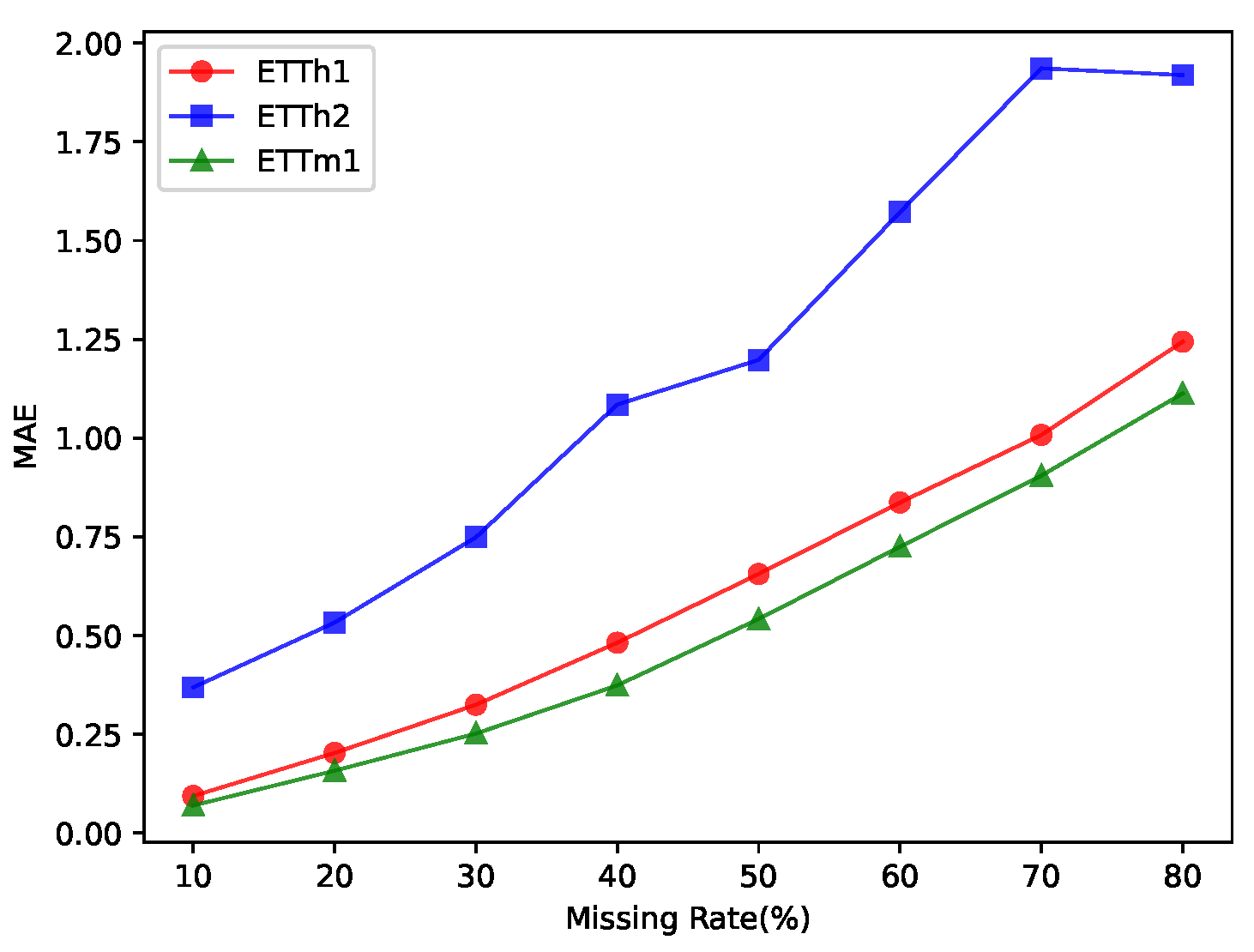
We also investigated the effect of the input time series data on the accuracy of the imputation. The results are shown in Figure 5, where the x axis indicates the missing rate of time series data, and labels indicate the name of the time series data. The accuracy of our method for completing was high when the original dataset was missing to a small extent, but when there was no sufficiently complete missing dataset, the accuracy of our method for completing suffered when it was used.
Figure 5. Influence of datasets on the accuracy of the imputation. The increase in the missing rate of the original dataset led to a decrease in the accuracy of data completion.
Ablation Study
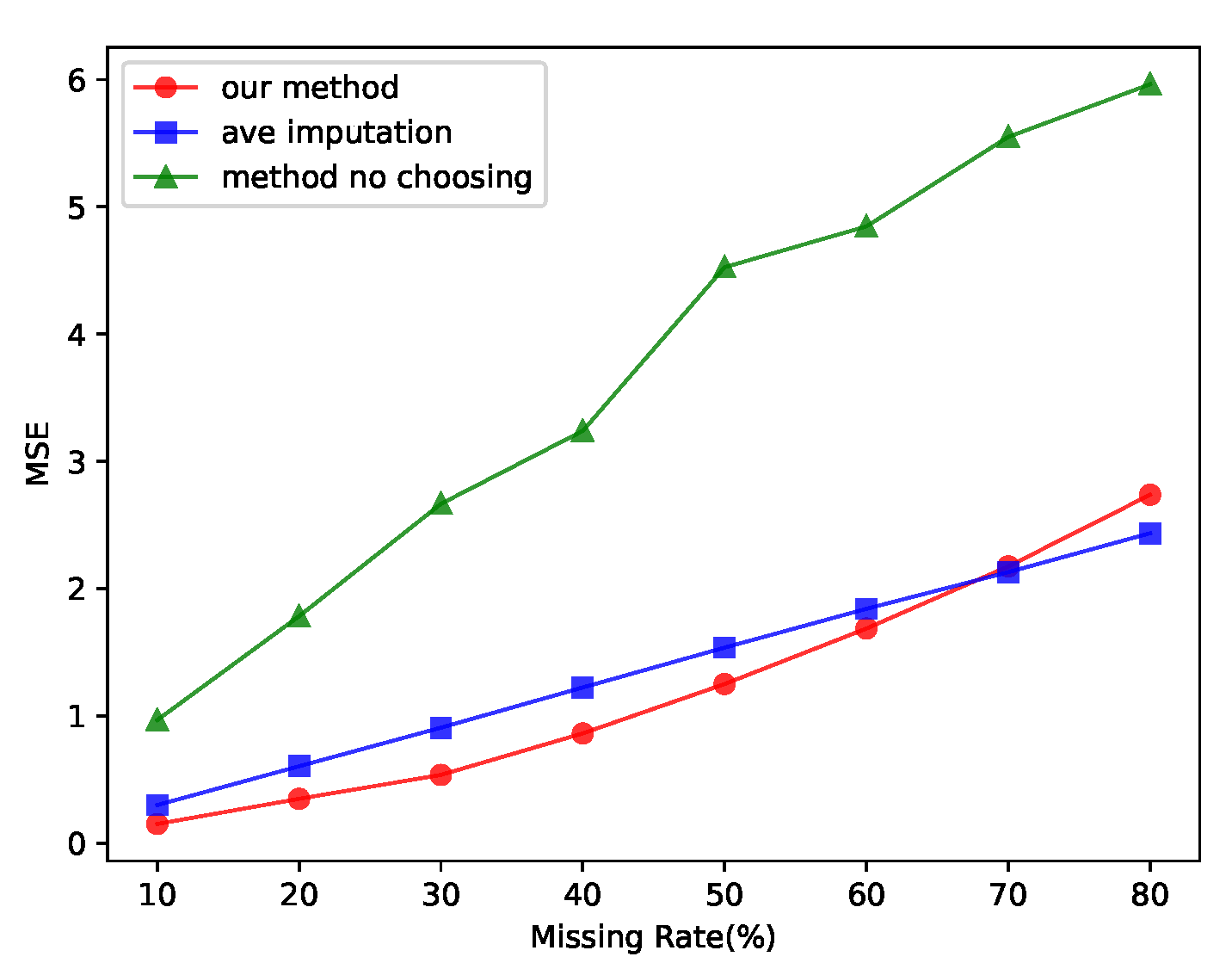
We tested our proposed method on the ETTh1 dataset and the method of filling the missing values with the mean value and the method of de-selection strategy for the results. The results of the tests are shown in Figure 6, in which the x axis shows the missing rate of the dataset, the line marked with our method shows the test results of our proposed method, the line marked with ave imputation shows the method of filling the missing values with the mean value, and the line marked with method-no-choosing shows our method with the selection strategy for the results removed. Only when the degree of missing data was extremely high did the method of filling with the average value work better than our proposed method.
Figure 6. Ablation study of our method without a discriminator and choosing strategy. Our method had better complementary results than those of the mean fill method in most cases.

6. Conclusions

In this paper, we proposed a GAN and informer-based model called imputeGAN for solving missing multidimensional time series data.The model was compared with traditional complementary methods and models used to predict time series data. Experimental results demonstrate that imputeGAN outperformed traditional methods in terms of accuracy. When performing downstream tasks such as time series data prediction, even with 50% of the original data missing, the accuracy of imputeGAN complementation was similar to that of models that perform prediction with complete data (e.g., LSTnet). We proposed a multidimensional time series data imputation model based on GAN and Informer. We proposed a new method for the selection and iteration of data complementation results, which makes the complementation results closer to the true values. By comparing imputation and downstream tasks on four real datasets, we confirmed that our new model had better imputation results than those of existing models.

Author Contributions

The two authors contributed equally. All authors have read and agreed to the published version of the manuscript.

Funding

This research received no external funding.

Institutional Review Board Statement

Not applicable.

Data Availability Statement

The code used in this article is available at https://github.com/ubikpkd/d-gan_informer. A reproduction of the code provides access to all of the data generated in this paper.

Conflicts of Interest

The authors declare no conflict of interest.

References

  1. de Jong, J.; Emon, M.A.; Wu, P.; Karki, R.; Sood, M.; Godard, P.; Ahmad, A.; Vrooman, H.; Hofmann-Apitius, M.; Fröhlich, H. Deep learning for clustering of multivariate clinical patient trajectories with missing values. GigaScience 2019, 8, giz134. [Google Scholar] [CrossRef] [PubMed]
  2. Azoff, E.M. Neural Network Time Series Forecasting of Financial Markets; John Wiley & Sons: New York, NY, USA, 1994. [Google Scholar]
  3. Lv, Y.; Duan, Y.; Kang, W.; Li, Z.; Wang, F.Y. Traffic Flow Prediction With Big Data: A Deep Learning Approach. IEEE Trans. Intell. Transp. Syst. 2015, 16, 865–873. [Google Scholar] [CrossRef]
  4. Berglund, M.; Raiko, T.; Honkala, M.; Kärkkäinen, L.; Vetek, A.; Karhunen, J.T. Bidirectional Recurrent Neural Networks as Generative Models. In Proceedings of the Advances in Neural Information Processing Systems; Curran Associates, Inc.: Red Hook, NY, USA, 2015; Volume 28. [Google Scholar]
  5. Gill, M.K.; Asefa, T.; Kaheil, Y.; McKee, M. Effect of missing data on performance of learning algorithms for hydrologic predictions: Implications to an imputation technique. Water Resour. Res. 2007, 43. [Google Scholar] [CrossRef]
  6. Kantardzic, M. Data Mining: Concepts, Models, Methods, and Algorithms; John Wiley & Sons: New York, NY, USA, 2011; Chapter 5; pp. 140–168. [Google Scholar]
  7. Amiri, M.; Jensen, R. Missing data imputation using fuzzy-rough methods. Neurocomputing 2016, 205, 152–164. [Google Scholar] [CrossRef]
  8. Purwar, A.; Singh, S.K. Hybrid prediction model with missing value imputation for medical data. Expert Syst. Appl. 2015, 42, 5621–5631. [Google Scholar] [CrossRef]
  9. Hudak, A.T.; Crookston, N.L.; Evans, J.S.; Hall, D.E.; Falkowski, M.J. Nearest neighbor imputation of species-level, plot-scale forest structure attributes from LiDAR data. Remote. Sens. Environ. 2008, 112, 2232–2245. [Google Scholar] [CrossRef]
  10. Acar, E.; Dunlavy, D.M.; Kolda, T.G.; Mørup, M. Scalable Tensor Factorizations with Missing Data. In Proceedings of the SDM10: 2010 SIAM International Conference on Data Mining, Columbus, Ohio, USA, 29 April–1 May 2010; pp. 701–712. [Google Scholar] [CrossRef]
  11. Huang, F.; Cao, Z.; Jiang, S.H.; Zhou, C.; Huang, J.; Guo, Z. Landslide susceptibility prediction based on a semi-supervised multiple-layer perceptron model. Landslides 2020, 17, 2919–2930. [Google Scholar] [CrossRef]
  12. Song, S.; Sun, Y.; Zhang, A.; Chen, L.; Wang, J. Enriching Data Imputation under Similarity Rule Constraints. IEEE Trans. Knowl. Data Eng. 2020, 32, 275–287. [Google Scholar] [CrossRef]
  13. Breve, B.; Caruccio, L.; Deufemia, V.; Polese, G. RENUVER: A Missing Value Imputation Algorithm based on Relaxed Functional Dependencies. In Proceedings of the EDBT, Edinburgh, UK, 29 March–1 April 2022. [Google Scholar]
  14. Rekatsinas, T.; Chu, X.; Ilyas, I.F.; Ré, C. HoloClean: Holistic Data Repairs with Probabilistic Inference. Proc. VLDB Endow. 2017, 10, 1190–1201. [Google Scholar] [CrossRef]
  15. Che, Z.; Purushotham, S.; Cho, K.; Sontag, D.A.; Liu, Y. Recurrent Neural Networks for Multivariate Time Series with Missing Values. Sci. Rep. 2018, 8, 6085. [Google Scholar] [CrossRef] [PubMed]
  16. Cao, W.; Wang, D.; Li, J.; Zhou, H.; Li, L.; Li, Y. BRITS: Bidirectional Recurrent Imputation for Time Series. In Proceedings of the Advances in Neural Information Processing Systems, Montréal, QC, Canada, 3–8 December 2018. [Google Scholar]
  17. Yoon, J.; Zame, W.R.; van der Schaar, M. Estimating Missing Data in Temporal Data Streams Using Multi-Directional Recurrent Neural Networks. IEEE Trans. Biomed. Eng. 2019, 66, 1477–1490. [Google Scholar] [CrossRef] [PubMed]
  18. Luo, Y.; Cai, X.; ZHANG, Y.; Xu, J.; xiaojie, Y. Multivariate Time Series Imputation with Generative Adversarial Networks. In Proceedings of the Advances in Neural Information Processing Systems; Curran Associates, Inc.: Red Hook, NY, USA, 2018; Volume 31. [Google Scholar]
  19. Luo, Y.; Zhang, Y.; Cai, X.; Yuan, X. E2GAN: End-to-End Generative Adversarial Network for Multivariate Time Series Imputation. In Proceedings of the Twenty-Eighth International Joint Conference on Artificial Intelligence, IJCAI-19, Macao, China, 10–16 August 2019; pp. 3094–3100. [Google Scholar] [CrossRef]
  20. Yoon, J.; Jordon, J.; van der Schaar, M. GAIN: Missing Data Imputation using Generative Adversarial Nets. In Proceedings of the 35th International Conference on Machine Learning, Stockholm, Sweden, 10–15 July 2018; pp. 5689–5698. [Google Scholar]
  21. Hochreiter, S.; Schmidhuber, J. Long Short-Term Memory. Neural Comput. 1997, 9, 1735–1780. [Google Scholar] [CrossRef] [PubMed]
  22. Vaswani, A.; Shazeer, N.; Parmar, N.; Uszkoreit, J.; Jones, L.; Gomez, A.N.; Kaiser, L.u.; Polosukhin, I. Attention is All you Need. In Proceedings of the Advances in Neural Information Processing Systems; Curran Associates, Inc.: Red Hook, NY, USA, 2017; Volume 30. [Google Scholar]
  23. Zhou, H.; Zhang, S.; Peng, J.; Zhang, S.; Li, J.; Xiong, H.; Zhang, W. Informer: Beyond Efficient Transformer for Long Sequence Time-Series Forecasting. Proc. AAAI Conf. Artif. Intell. 2021, 35, 11106–11115. [Google Scholar] [CrossRef]
  24. Schafer, J.; Graham, J. Missing data: Our view of the state of the art. Psychol. Methods 2002, 7, 147–177. [Google Scholar] [CrossRef] [PubMed]
  25. Torgo, L. Data Mining with R: Learning with Case Studies, 2nd ed.; Chapman and Hall/CRC: London, UK, 2017. [Google Scholar]
  26. Chen, C.W.S.; Chiu, L.M. Ordinal Time Series Forecasting of the Air Quality Index. Entropy 2021, 23, 1167. [Google Scholar] [CrossRef] [PubMed]
  27. Sportisse, A.; Boyer, C.; Josse, J. Imputation and low-rank estimation with Missing Non At Random data. Stat. Comput. 2018, 30, 1629–1643. [Google Scholar] [CrossRef]
  28. Tang, F.; Ishwaran, H. Random forest missing data algorithms. Stat. Anal. Data Min. ASA Data Sci. J. 2017, 10, 363–377. [Google Scholar] [CrossRef] [PubMed]
  29. Suo, Q.; Yao, L.; Xun, G.; Sun, J.; Zhang, A. Recurrent Imputation for Multivariate Time Series with Missing Values. In Proceedings of the 2019 IEEE International Conference on Healthcare Informatics (ICHI), Xi’an, China, 10–13 June 2019; pp. 1–3. [Google Scholar]
  30. Ariyo, A.A.; Adewumi, A.O.; Ayo, C.K. Stock Price Prediction Using the ARIMA Model. In Proceedings of the 2014 UKSim-AMSS 16th International Conference on Computer Modelling and Simulation, Cambridge, UK, 26–28 March 2014; pp. 106–112. [Google Scholar]
  31. Kalekar, P.S. Time series forecasting using holt-winters exponential smoothing. Kanwal Rekhi Sch. Inf. Technol. 2004, 4329008, 1–13. [Google Scholar]
  32. Samal, K.K.R.; Babu, K.S.; Das, S.K.; Acharaya, A. Time series based air pollution forecasting using SARIMA and prophet model. In Proceedings of the 2019 International Conference on Information Technology and Computer Communications, Singapore, 16–18 August 2019; pp. 80–85. [Google Scholar]
  33. Li, Y.; Yu, R.; Shahabi, C.; Liu, Y. Diffusion Convolutional Recurrent Neural Network: Data-Driven Traffic Forecasting. In Proceedings of the International Conference on Learning Representations (ICLR ’18), Vancouver, BC, Canada, 30 April–3 May 2018. [Google Scholar]
  34. Yu, F.; Koltun, V.; Funkhouser, T. Dilated Residual Networks. In Proceedings of the 2017 IEEE Conference on Computer Vision and Pattern Recognition (CVPR), Honolulu, HI, USA, 21–26 July 2017; pp. 636–644. [Google Scholar]
  35. Goodfellow, I.; Pouget-Abadie, J.; Mirza, M.; Xu, B.; Warde-Farley, D.; Ozair, S.; Courville, A.; Bengio, Y. Generative Adversarial Nets. In Proceedings of the Advances in Neural Information Processing Systems, Montreal, QC, Canada, 8–13 December 2014. [Google Scholar]
  36. Lai, G.; Chang, W.C.; Yang, Y.; Liu, H. Modeling Long- and Short-Term Temporal Patterns with Deep Neural Networks. arXiv 2018, arXiv:1703.07015. [Google Scholar]
  37. Bahdanau, D.; Cho, K.; Bengio, Y. Neural machine translation by jointly learning to align and translate. In Proceedings of the 3rd International Conference on Learning Representations, ICLR 2015, San Diego, CA, USA, 7–9 May 2015. [Google Scholar]
  38. Kitaev, N.; Kaiser, L.; Levskaya, A. Reformer: The Efficient Transformer. In Proceedings of the International Conference on Learning Representations, Addis Ababa, Ethiopia, 26–30 April 2020. [Google Scholar]
  39. Li, S.; Jin, X.; Xuan, Y.; Zhou, X.; Chen, W.; Wang, Y.X.; Yan, X. Enhancing the Locality and Breaking the Memory Bottleneck of Transformer on Time Series Forecasting. In Proceedings of the 33rd International Conference on Neural Information Processing Systems; Curran Associates Inc.: Red Hook, NY, USA, 2019. [Google Scholar]
Disclaimer/Publisher’s Note: The statements, opinions and data contained in all publications are solely those of the individual author(s) and contributor(s) and not of MDPI and/or the editor(s). MDPI and/or the editor(s) disclaim responsibility for any injury to people or property resulting from any ideas, methods, instructions or products referred to in the content.

Article Metrics

Citations

Article Access Statistics

Multiple requests from the same IP address are counted as one view.