


Abstract
We discuss novel many-fermions thermodynamics’ features. They refer to the energy cost associated to order-disorder changes. Our thermal quantum statistical scenario is controlled by suitable fermion-fermion interactions. We deal with two well-known quantum interactions that operate within an exactly solvable model. This model is able to adequately describe some aspects of fermion-dynamics, particularly level-crossings. We describe things via employment of Gibbs’ canonical ensemble strictures. We show that judicious manipulation of the energy cost associated to statistical order (disorder) variations generates useful information-quantifiers. The underlying idea is that changes in the degree of order are intimately linked to level-crossings energetic costs.
1. Introduction
This work explores new features in statistical mechanics. We will discuss novel many-fermions’ thermodynamics features. They refer to the energy cost associated to order-disorder changes whenever our thermal quantum statistical scenario is controlled by suitable fermion-fermion interactions. Let us start with the essential notion of entropy.
Entropy is intimately linked with the idea of disorder, as it is well known. Its order-counterpart (OC) has taken many forms in the literature, but here we will concentrate our attention on a special OC-notion called disequilibrium D (see Ref. [1] and references therein). This quantity D is the Euclidean distance in probability space between the actual probability distribution and the uniform one. Since the uniform distribution can be thought of as the most ”disordered one”, the larger D the larger the order-degree.
Based on the quantity D we will try to establish novel links between the notions of entropy, negentropy (simply , the negative of the entropy), statistical order, and free energy, in the context of the thermal description of many fermion systems. We will appeal to simple exactly solvable fermion models, that are particularly valuable in testing new notions referring to the intricacies of the quantum many body problem, without appealing to huge hamiltonian matrices [2]. It is widely accepted that the best way to understand a topic is first to grasp specific, well-chosen cases and then to worry afterward about how to generalize from this understanding. This is why it has been of great utility in fermionic theoretical research the application of the exactly solvable Lipkin Model (LM) [2,3,4,5]. The LM greatly clears the way for assessing the validity and/or usefulness of distinct approaches formulated so as to research the manifold features of the fermion many body problem [6].
1.1. Quasi Spin Operators and Exactly Solvable Models
We will use such models in this work. The celebrated, two energy-levels Lipkin model (LM) (containing N fermions) is centered on an SU2 algebra. Such algebra is generated by operators called quasi-spin ones. We will here work with LM-variants that have immediately accessible exact analytical solutions (LM instead requires numerical diagonalization). Our analytical solutions can then be compared with results that emerge from variegated sorts of approximate theoretical -fermions techniques. A relevant Casimir operator (CO) characterizes both the LM model [3] and our variants. The CO has attached to it different multiplets. Mostly the unperturbed ground state multiplet is the focus of attention [3]. Each level of our two energy ones is degenerate and accommodate fermions. We say that each of our two energy levels contains sites in the upper level and the dame number in the lower level. Each site that can be occupied or empty. Sister sites are those in the same position above (higher energy level) and below (lower energy level).
Cambiaggio and Plastino (CP) [1,7,8,9] proposed a simple Lipkin-model extension, from SU2 to SU2 × SU2, to del with the excited Lipkin-multiplets (or bands) and thus adequately face the pairing interaction responsible for superconductivity. The augmentation allowed for the formulation, in quasi-spin parlance, of a BCS-like enactment which permits, as promised above, to exactly mimic superconductivity, yielding exact analytic solutions. In the CP-model (CPM), the BCS-solution coincides with the exact solution. The CPM is indeed an extension of the Lipkin model to a layout containing a variable particle number. Superconductivity quite often arises in fermion systems [10,11,12].
Colloquially, some physicist usually speak of phase transitions when the actually mean level-crossings. We will also do this here where we wish to detailed study, in a statistical order-disorder context, the combination of the pairing interaction with a spin-flip force, which can be done if we juxtapose the CP model of the pairing interaction with the Plastino-Moskowski (PM) model of a spin-flip interaction [13,14]. These two models display, individually, phase transitions(PT). We wish to see how these different PT mutually interfere. Our exactly solvable juxtaposition (CP and PM models) presents rich enough quantum structural features to profitably delineate such competition layout. Some preliminary details of the competition were reported in Refs. [8,9]. Here we present a more detailed view focused on and order-disorder scenario, discussing mainly the energy costs incurred in phase transitions, a colloquial vocable often used for level-crossings.
1.2. Goal: Our Route
Here we wish to construct the route detailed below and address the issues the this building up will generate.
- The central and well established idea is that fermion-fermion interactions are capable of generating phase transitions (PT) in many-fermions systems. The details of the PT depend on the properties of the extant fermion-fermion interaction.
- We wish to connect phase transitions (or level crossings in a finite system) with changes in the degree of statistical (CDSO) order exhibited by our many fermion system.
- We wish to analyze the fact that CDSO are made at the expense of energy spending.
- We wish to associate a new statistical quantifier to this energy expense.
- We wish to ascertain that this new quantifier is a very good phase transition “detector”.
2. Statistical Order, Disorder, and Disequilibrium
Our system is described by an unperturbed Hamiltonian plus two different interaction terms: a short range force (pairing) () and a long range one (spin-flip) (). There are attractor-states for each of them [8,9]. We wish to show that a kind of order is associated to these special states. We will undertake a canonical ensemble analysis of our system, whose protagonist is our Hamiltonian
There exist two -attractors. We assert that they are endowed with “order” in this respect: every site is equally occupied. For the M attractor, each sister-pair of sites is singly occupied. We find the same number of nucleons in each of the two energy-levels. This last feature is also displayed by the CO attractor, but now each sister-pair is either doubly occupied or empty. For us, “disorder” is associated to an instance in which each of the two energy-levels displays different occupation numbers. Using statistical tools we will attempt to the interplay between our two different interactions and see how they influence the order degree.
The Hamiltonian (1) represents a scenario that prevails in many atomic nuclei, in which a long-range distance interaction (e.g., a quadrupole one) competes with a short range one, the pairing interaction. H mimics such picture. Its (H) pairing component has identical mathematical properties as those of the actual pairing force. H also displays a spin-flip interaction.
Statistical Order and Disequilibrium Quantifier D
That represented by D is a much employed concept (see for example Refs. [15,16,17,18,19,20,21]). Consider two opposite layouts: (i) perfect order or (ii) maximal randomness (no correlations at all) [15]. In between them variegated degrees of correlation may be found. In Ref. [15] a way such multiplicity was advanced. Since we are working in statistical fashion, with probability distributions (PD) as protagonists, we confidently state that maximum randomness or maximal disorder is represented by the uniform PD, The degree of order associated to a given PD is quantified by the distance of this PD (in probability space) to the uniform PD. This distance was called the disequilibrium D.
Great progress was made in Ref. [15] by proposing this measure D [16], that allow one to build up a sort of hierarchy. If there are privileged states among the accessible ones, their associated D value would reveal it. Multiplying D by the entropy S L. Ruiz, Mancini, and Calvet (LMC) [15] established one of today’s most used form for a statistical complexity C.
a functional of the probability distributions (PDs) that competently lays hold of complexity in the fashion that entropy does so with randomness [15]. D adopt the form, if one deals with N accessible states [15,21],
Here are the individual normalized probabilities () [15]. D acquires the maximum possible value for a fully ordered state and instead vanishes in the case of uniform . Of course, for the entropy we have . LMC’s scheme attracted great attention (Refs. [15,16,17,18,19,20,21] constitute just a small sample) and was employed in variegated environments for both the canonical, micro-canonical, and grand canonical Gibbs’ ensembles.
3. Details of the Two Interactions We Are to Confront in This Work
3.1. Present Hamiltonians: (1) Unperturbed , (2) Spin-Flip , and (3) Pairing Ones
One faces, as stated above
which is the juxtaposition of two distinct analytically solvable nucleon-nucleon interactions. Firstly, a spin-flip one advanced in Ref. [14] that represents either (1) spin-flip or, (2) forward scattering interactions [14]. The last term is the superconducting one [1,7] that mimics the pairing interactions that originates superconductivity [10]. The math background is that of the SU2 × SU2 group [8,9] involves N nucleons apportioned to -fold degenerate single-particle (sp) levels () separated by an energetic gap (we work here with -energy units). The system’s sp states are singled out by appeal to two quantum numbers: , with and . p is called a quasi-spin quantum number and is regarded as a “site” [3].
3.2. Quasi-Spin Language and the Pairing Operators
The so called SU2 quasi-spin operators were introduced in Ref. [3] in terms of creation and destruction operators
In Ref. [7] its authors introduced additional SU2 operators, angular momentum-like “pairing” operators
It is clear that generates and destroys a pair of particles giving zero contribution to the -value, or “coupled” to . The ensuing coupled particles do not contribute to the total value. Any J-operator will commute with all Q-operators, and vice versa (SU2 × SU2).
3.3. Eigenvalues of H
Here, the pertinent, complete orthonormal basis is that of the eigenvalues of , with eigenstates . Ref. [7] advanced an additional and quite useful quantum number denominated the quasi-spin seniority number
which tells the reader which is the number of “uncoupled” particles (not “paired" to ). Thus, is the number of “unpaired" particles in a Q-multiplet. As demonstrated in Ref. [7] we have
For the Lipkin model [3], , [7], equalities that will be verified in our subsequent proceedings. The unperturbed ground state (ugs) is the eigenvalue of our unperturbed Hamiltonian . For it one has [7]. This state belongs to the multiplet [see (15) below]. Returning to the spin-flip Hamiltonian note that it reads [8,9]
It is expressed via J, , and a coupling constant V. Of course, if , then . The pertinent eigen-states are denoted as . Thus we see that
Naturally, the -eigenvalues become [14]
The energy of the unperturbed () gs (ugs) ( reads
3.4. Phase Transitions or Level Crossings
The most important characteristic of is that, as V augments the system unveils phase-transitions (level crossings): the ground state (at ) stops being characterized by and proceeds to be identified by successively larger values until one sets foot on at [14]. Abusing language a bit we say that the ket is a kind of attractor for the system’s state if V is large enough (at ). This -attractor (we call it I) is set apart by the feature that all quasi-spin sites p are occupied by a single fermion.
If we add now the pairing interaction to the Hamiltonian via the interaction term . One has the the pairing Hamiltonian
which adds to a pairing contribution
exhibits its own phase transition (level crossing) at [7]. At such value the system turns out to be a superconductor [7]. , for large enough G, displays a second -“attractor” II state, the superconducting-one, identified also by (as the one for ) but in which half the sites display double -occupancy and the other half is empty.
4. Statistical Mechanics, Gibbs’ Canonical Ensemble, and H
We need first of all to recapitulate statistical tools introduced in Ref. [22]. For treating the ground state at , we have to concern ourselves just with the “band". If a manifold of states belonging to different bands are to be paid attention to. The associated degeneracy (computed in Ref. [22]) becomes, if stands for the inverse temperature ,
The partial partition function that runs only over M, let us call it , has the form [22]
while actual system’s true partition function Z reads
where the quantum numbers J and Q run over all the values permitted by the SU2 × SU2 structure [22], that is:
Of course, Z permits one to obtain all the thermodynamic information one might require.
Now we will slightly modify (25) in the fashion
So as to implement the J-Q sum we sum over and over J, with Q fixed at . We obey
Note that while . Finally, the partition function acquires the form
Following Ref. [3], we set . The level-energies are
and define so that our probabilities read
leading to a mean energy U
We are also interested in particular average energies like the mean pairing energy
and the mean spin-flip energy
Also, the free pairing energy
and the the free spin-flip energy
Remind that maximal randomness or total disorder is associated to the uniform distribution. In our context we have in such a case
where is here given by the binomial value for Our present and all important disequilibrium D becomes
For the entropy we find
Scheme of Our Algorithm
- Since our models are analytically solvable, we know the expressions for the exact energies . We also know the temperature T.
- Accordingly, we can construct our probability distribution (PD), whose elements are , with the inverse temperature
- Since we have the we can compute the entropy and the mean energy U, .
- With these quantities we compute the free energy .
- We also know the disequilibrium D, which is a simple function of the , given above in Equation (3).
5. Information Cost (in Free Energy), a New Statistical Quantifier
We pass now to describe the main innovation of this paper, a new statistical quantifier related to the disequilibrium D. We contemplate in this scenario two control parameters and . A perturbation in the control parameter, let us say from V to , will result in a change of the system’s associated degree of order (DOO). Inspired by Ref. [23], we introduce the order-efficiency of our interactions in the fashion
with Boltzmann’s constant. Our and are, respectively, the variations in disequilibrium and the work done on the system as a result of the change. Thus, represents the diminution (increase) in uncertainty (for our system’ state) that results from each unit of work done on the system. A small value of indicates that much work on the system is needed to modify the current order degree. Vice versa in the case of large . Of course, if is negative, it is the system itself that does the pertinent work. Such will be the case below. In quasi-static processes, for which we things happen slowly enough that the system effectively adjusts instantaneously to a new equilibrium state, it can be demonstrated following the parallel treatment given in Ref. [23] (for a different purpose) that
involving Helmholtz’ free energy F. X stands for either of our two coupling constants. We will always set . The derivatives can be performed analytically. The modification in F can be associated to the work done on the system [23]. On the other hand, we may regard as the work required (in varying X) so as to increment or diminish our information concerning the system. This represents an “information cost”. Alternatively, is the work needed to augment (decease) the degree of order in the system
Let us emphasize that
- If we see increasing statistical order,
- If we see increasing statistical disorder.
The Conjugate Extensive Counterpart of
Consider now the extensive quantity
where the intensive variable X stands for either G or V. Since the entropy S is
f would be a sort of “quasi-entropic” counterpart of X. We will ascertain below whether this counterpart has something useful to say about our present endeavor. We will call f the information cost of changing the value. Instead, signals an information “source”, a kind of negentropy that tells us which is the amount of energy involved in varying D when X changes. As always, negentropy is a measure of order (and so is our quasi-negentropy). The notion of negative entropy was advanced by Schrödinger in the book What is Life? [24]. Later, in 1974, Brillouin baptized the notion as negentropy [25]. Thus, we can associate to the extension of this notion from S to D.
6. Results Obtained with Our New Quantifier at Finite Temperature T
6.1. Detects the Superconductivity Transition: versus G Plots
We will work at (units for which ). Figure 1 displays versus G for . At a critical value of the pairing constant the phase transition occurs and is duly detected by . Note that is positive before the transition to superconductivity and slightly negative when the later becomes established. This entails, as expected, that the physics has radically changed. Of course, the critical G value is slightly varied from its value because of finite temperature effects.
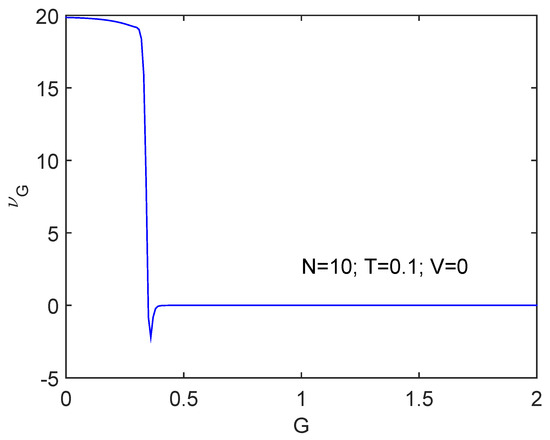
Figure 1.
We depict versus G for , , and (units for which ). There is a significant drop at the critical -value at which superconductivity becomes established. clearly detects the phase transition.
Figure 2 displays results for the same scenario but for , where at .
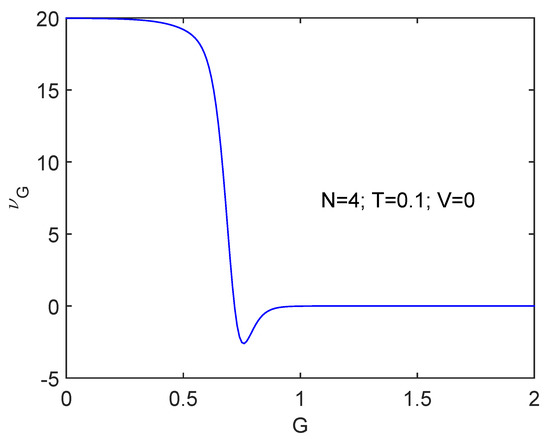
Figure 2.
Same as Figure 1 but for . Things proceed in a rather smoother fashion for that for .
The transition is more clearly seen as N augments.
6.2. Detects the Spin-Flip Transition: versus V Plots
We pass now to consider the spin-flip interaction in Figure 3 at , , and . Immediately we realize that a totally different scenario is being confronted. At the critical V value suddenly changes but its precedent value is re-established after the transition while V keeps growing. However, there emerges here a much stronger N-dependence than that for the pairing force, as illustrated by Figure 4 for . Here the aspect of things at the phase transition looks different in the two systems. first augments for and immediately after wards decreases. Opposite to the pairing case above, here the phase transition is displayed in a much more clear-cut fashion smaller N’s than for larger ones.
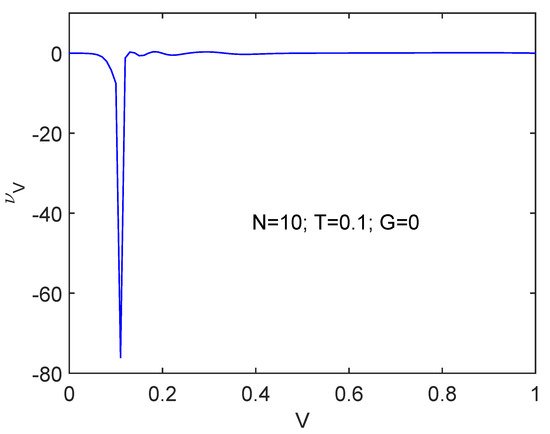
Figure 3.
Spin-flip interaction workings at , , and . We depict versus V. At the critical spin-flip coupling constant order suddenly augments, but after the transition, things return to the original stage as V keeps growing.
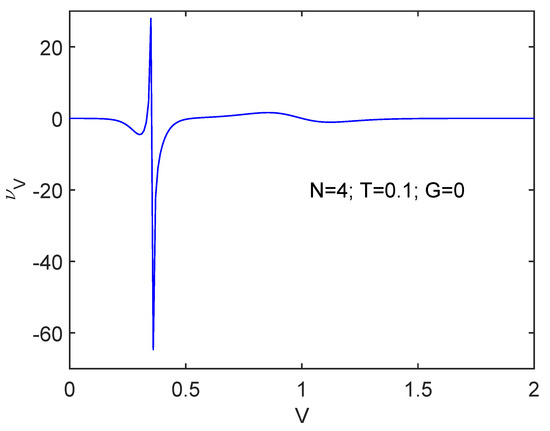
Figure 4.
Same as Figure 3 for . The transition region exhibits a much sharper definition though.
6.3. The Statistical Extensive Measure F
We start discussing the information cost f in Figure 1, where we depict versus G together with the free energy F. The behavior of F is of critical importance to decide whether we speak of order or of disorder. We know that decreases at the superconductivity transition. We also see in the graph that is negative. Thus, and order augments. Figure 5 and Figure 6 show that the quasi-negentropy grows at the phase transition.
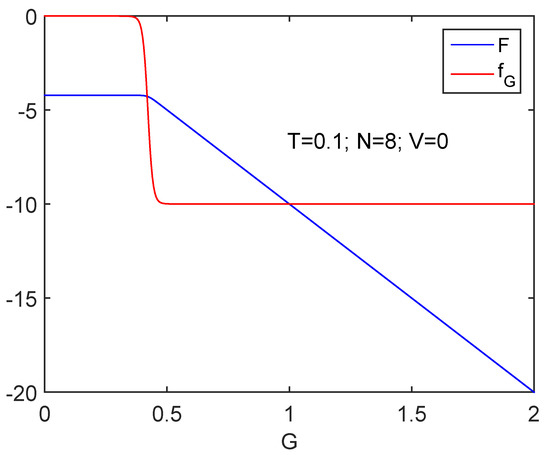
Figure 5.
Information cost for clearly detects the phase transition. As one should expect, at order grows (see text). The free energy F is also displayed. As G augments, work is done BY the system.
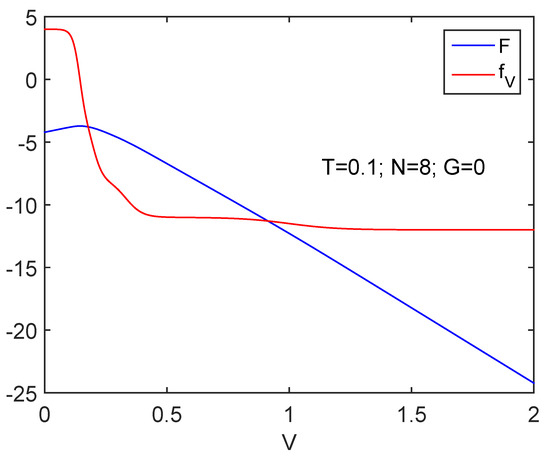
Figure 6.
Information cost (N=8) detects the spin-flip transition. The free energy F is also displayed. As V augments, work is done BY the system as V grows.
6.4. Three Dimensional Graphs
A more transparent illustration of the physics of order here analyzed is that provided by Figure 7 and Figure 8. The statistical disorder-induced role of the temperature T is clearly visible.
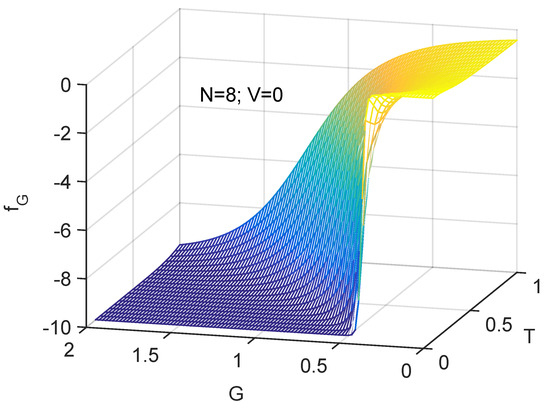
Figure 7.
Three dimensional plot. as a function of both T and G. One notes the competition between the two intensive quantities T and G. Clearly, statistical order grows with G and diminishes with T as one should expect.
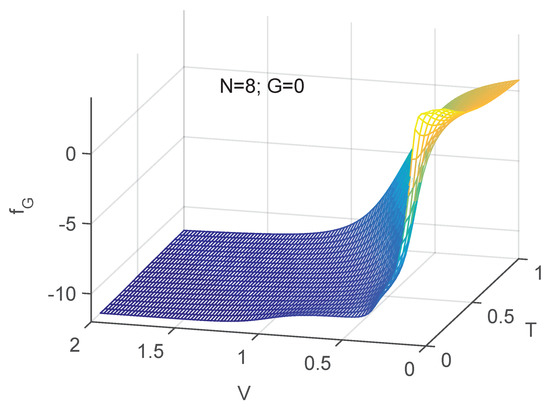
Figure 8.
Three dimensional plot. as a function of both T and V. One notes the competition between the two intensive quantities. Clearly, order grows with V and diminishes with T as one should expect.
7. Conclusions
In this work we have revisited the interplay statistical order-disorder, using the lens of a new statistical quantifier (and its conjugate ) that are a measure of energetic cost (in terms of free energy) of changes suffered by the order-disorder quantifier called the disequilibrium D.
If we change the sign of the extensive counterpart of called (the coupling constant X being either G or V), we have a quasi-negentropy. This brings together the notions of order and energy expense. We have studied the behavior of with regards to two competing interactions. These interactions are a spin-flip and a short-range ones Our layout is discussed using an exactly solvable model of the Lipkin-sort, that permits one to undertake exact treatments of the pertinent Hamiltonians.
We contrast the statistical order-disorder properties of these two kinds of interaction. They are indeed different, in particular in relation to their response to increases in temperature.
Thus, we can reasonably claim to have unveiled a new sort of differences, in order and energy cost, between pairing (short range) and multipole (long range) interactions.
Author Contributions
Investigation, F.P., A.P., G.L.F. and A.R.P.; Project administration, F.P. and A.P.; Writing—original draft, F.P., A.P. and A.R.P. All authors have read and agreed to the published version of the manuscript.
Funding
Research was partially supported by FONDECYT, grant 1181558 and by CONICET (Argentine Agency) Grant PIP0728.
Conflicts of Interest
The authors declare no conflict of interest.
References
- Pennini, F.; Plastino, A. Complexity and disequilibrium as telltales of superconductivity. Physica A 2018, 506, 828–834. [Google Scholar] [CrossRef]
- Cervia, M.J.; Balantekin, A.B.; Coppersmith, S.N.; Johnson, C.W.; Love, P.J.; Poole, C.; Robbins, K.; Saffman, M. Lipkin model on a quantum computer. arXiv 2021, arXiv:2011.04097. [Google Scholar] [CrossRef]
- Lipkin, H.J.; Meshkov, N.; Glick, A.J. Validity of many-body approximation methods for a solvable model: (I). Exact solutions and perturbation theory. Nucl. Phys. 1965, 62, 188–198. [Google Scholar] [CrossRef]
- Lerma, H.S.; Dukelsky, J. The Lipkin-Meshkov-Glick model from the perspective of the SU(1,1) Richardson-Gaudin models. J. Phys. Conf. Ser. 2014, 492, 012013. [Google Scholar] [CrossRef]
- Providencia, C.; da Providencia, J.; Tsue, Y.; Yamamura, M. The Lipkin Model in Many-Fermion System as an Example of the su(1,1) times su(1,1)-Algebraic Model. Prog. Theor. Phys. 2006, 116, 87–105. [Google Scholar] [CrossRef][Green Version]
- Nolting, W. Fundamentals of Many-Body Physics; Springer: Berlin/Heidelberg, Germany, 2009. [Google Scholar]
- Cambiaggio, M.C.; Plastino, A. Quasi spin pairing and the structure of the Lipkin Model. Z. Physik A 1978, 288, 153–159. [Google Scholar] [CrossRef]
- Plastino, A.R.; Ferri, G.L.; Plastino, A. Interaction between Different Kinds of Quantum Phase Transitions. Quantum Rep. 2021, 3, 253–261. [Google Scholar] [CrossRef]
- Plastino, A.; Plastino, A.R.; Ferri, G.L. Statistical thermal efficiency and quantum interactions. Springer Nat. J. Indian Inst. Sci. 2022, in press. [Google Scholar] [CrossRef]
- Ring, P.; Schuck, P. The Nuclear Many-Body Problem; Springer: Berlin/Heidelberg, Germany, 1980. [Google Scholar]
- De Llano, M.; Tolmachev, V.V. Multiple phases in a new statistical boson fermion model of superconductivity. Physica A 2003, 317, 546–564. [Google Scholar] [CrossRef]
- Uys, H.; Miller, H.G.; Khanna, F.C. Generalized statistics and high-Tc superconductivity. Phys. Lett. A 2001, 289, 264–272. [Google Scholar] [CrossRef]
- Plastino, A.; Ferri, G.L.; Plastino, A.R. Spectral explanation for statistical odd-even staggering in few fermions systems. Quantum Rep. 2021, 3, 166–172. [Google Scholar] [CrossRef]
- Plastino, A.; Moszkowski, S.M. Simplified model for illustrating Hartree-Fock in a Lipkin-model problem. Nuovo Cimento 1978, 47, 470–474. [Google Scholar] [CrossRef]
- López-Ruiz, R.; Mancini, H.L.; Calbet, X. A statistical measure of complexity. Phys. Lett. A 1995, 209, 321–326. [Google Scholar] [CrossRef]
- López-Ruiz, R. Complexity in some physical systems. Int. J. Bifurc. Chaos 2001, 11, 2669–2673. [Google Scholar] [CrossRef]
- Martin, M.T.; Plastino, A.; Rosso, O.A. Statistical complexity and disequilibrium. Phys. Lett. A 2003, 311, 126–132. [Google Scholar] [CrossRef]
- Rudnicki, L.; Toranzo, I.V.; Sánchez-Moreno, P.; Dehesa, J.S. Monotone measures of statistical complexity. Phys. Lett. A 2016, 380, 377–380. [Google Scholar] [CrossRef]
- López-Ruiz, R.; Mancini, H.; Calbet, X. A Statistical Measure of Complexity in Concepts and Recent Advances in Generalized Information Measures and Statistics; Kowalski, A., Rossignoli, R., Curado, E.M.C., Eds.; Bentham Science Books: New York, NY, USA, 2013; pp. 147–168. [Google Scholar]
- Martin, M.T.; Plastino, A.; Rosso, O.A. Generalized statistical complexity measures: Geometrical and analytical properties. Physica A 2006, 369, 439–462. [Google Scholar] [CrossRef]
- Pennnini, F.; Plastino, A. Disequilibrium, thermodynamic relations, and Renyi entropy. Phys. Lett. A 2017, 381, 212–215. [Google Scholar] [CrossRef]
- Rossignoli, R.; Plastino, A. Thermal effects and the interplay between pairing and shape deformations. Phys. Rev. C 1985, 32, 1040–1048. [Google Scholar] [CrossRef]
- Nigmatullin, R.; Prokopenko, M. Thermodynamic efficiency of interactions in self-organizing systems. Entropy 2021, 23, 757. [Google Scholar] [CrossRef]
- Schrödinger, E. What Is Life; Cambridge University Press: Cambridge, UK, 1944. [Google Scholar]
- Brillouin, L. Negentropy Principle of Information. J. Appl. Phys. 1953, 24, 1152–1163. [Google Scholar] [CrossRef]
Publisher’s Note: MDPI stays neutral with regard to jurisdictional claims in published maps and institutional affiliations. |
© 2022 by the authors. Licensee MDPI, Basel, Switzerland. This article is an open access article distributed under the terms and conditions of the Creative Commons Attribution (CC BY) license (https://creativecommons.org/licenses/by/4.0/).