


Abstract
Quantum coherence is known as an important resource in many quantum information tasks, which is a basis-dependent property of quantum states. In this paper, we discuss quantum incoherence based simultaneously on k bases using Matrix Theory Method. First, by defining a correlation function of two orthonormal bases e and f, we investigate the relationships between sets and of incoherent states with respect to e and f. We prove that if and only if the rank-one projective measurements generated by e and f are identical. We give a necessary and sufficient condition for the intersection to include a state except the maximally mixed state. Especially, if two bases e and f are mutually unbiased, then the intersection has only the maximally mixed state. Secondly, we introduce the concepts of strong incoherence and weak coherence of a quantum state with respect to a set of k bases and propose a measure for the weak coherence. In the two-qubit system, we prove that there exists a maximally coherent state with respect to when and it is not the case for .
1. Introduction
Quantum coherence is not only a feature of quantum systems which arise due to superposition principle, but also is a kind of fundamental resources in quantum information and computation [1,2,3,4,5,6,7,8]. The resource theory of coherence is formulated with respect to a distinguished basis of a Hilbert space, which defines free states as the states that are diagonal in this basis [3]. Several important quantifiers of quantum coherence have been introduced and assessed [9,10,11,12,13,14,15,16,17,18,19]. Recently, it is shown that quantum coherence can be useful resource in quantum computation [20,21,22,23,24], quantum metrology [25], quantum thermodynamics [26,27,28,29,30,31] and quantum biology [32,33,34].
Since the coherence of quantum states depends on the choice of the reference basis, it is natural to study the relationship among the coherence with respect to different bases. Cheng et al. [35] first studied the situation of two specific coherence measures under mutual unbiased basis (MUB): norm of coherence and relative entropy of coherence. They proposed the complementary relationship of the two coherence measures under any complete MUB set. Rastegin in [36] discussed the uncertainty relation for the geometric measure of coherence under MUBs. Sheng et al. [37] further studied the realization of quantum coherence through skewed information and the geometric measure under mutual unbiased bases. Recently, considered the standard coherence (SC), the partial coherence (PC) [38,39,40] and the block coherence (BC) [41,42] as variance of quantum states under some quantum channel , Zhang et al. [43] proposed the concept of channel-based coherence of quantum states, called -coherence, which contains the SC, PC and BC, but not contain the POVM-based coherence [44,45], and obtained some interesting results.
Usually, the coherence of an individual quantum state is discussed only when referring to a preferred basis. Considered sets of quantum states, Designolle et al. [46] introduced the concept of set coherence for characterizing the coherence of a set of quantum states in a basis-independent way. Followed a resource-theoretic approach, the authors of [46] defined the free sets of states as sets of groups of states such that there exists a choice of basis (equivalently, a unitary U) for which all states in the set become diagonal. Clearly, if and only if is a commutative family of states, i.e., for all .
Different from the discussions above, in this paper, we focus on the quantum incoherence based simultaneously on k bases; equivalently, the coherence of a quantum state with respect to a basis contained in a given set of k orthonormal bases. In Section 2, by defining the correlation function of two orthonormal bases e and f, we study the relationships between two sets of incoherent states with respect to e and f, and investigate the maximally coherent states with respect to e and f. In Section 3, we discuss the strong incoherence and the weak coherence of a state with respect to a set of k orthonormal bases and introduce a measure for the weak coherence. In Section 4, we give a summary of this paper.
2. Correlation Function of Two Bases and Quantum Coherence
Let us consider a quantum system X, which is described by a d-dimensional Hilbert space H and let I denote the identity operator on H. We use and to denote the sets of all linear operators and all density operators (mixed states) on H, respectively. In quantum information theory, a positive operator valued measure (POVM) is a set of operators on H with for all and In particular, if for all i, then the POVM becomes a projective measurement (PM). For a rank-one PM P, there exists an orthonormal basis such that . In this case, we denote . We use the notation or to denote the conjugate of a complex number z.
For the fixed orthonormal basis for H, denotes the set of incoherent states on H w.r.t. e, i.e., ones that have diagonal matrix representation under the basis e. A quantum operation on is said to be an incoherent operation [3] w.r.t e if it admits an incoherent Kraus decomposition, i.e.,
with
We use to denote the set of incoherent operations w.r.t e on .
According to Ref. [3], a coherence measure with respect to e, called an e-coherence measure, is a function satisfying the following four conditions.
(1) Faithfulness: for all ; if and only if .
(2) Monotonicity: for any .
(3) Strong monotonicity: , for all operators in such that with , and if ; if .
(4) Convexity: for any states and any probability distribution .
A usual -norm coherence measure [3] of a state with respect to a basis e is defined by
Clearly,
Especially, if and only if for all ; in that case, is called a maximally coherent state with respect to e.
From the review above, we find that quantum coherence relies on the choice of orthonormal bases. In what follows, we discuss the relationship between quantum coherence based on different reference bases. To do this, we let and be two orthonormal bases for H and define
called the correlation function between two bases e and f.
Recall that [35] two orthonormal bases e and f for H are said to be mutually unbiased if for all . Thus, when e and f for H are mutually unbiased, it holds that . More properties of the correlation function are given in the following theorem.
Theorem 1.
Let e and f be two orthonormal bases for H. Then
(1)
(2) if and only if if and only if .
(3) if and only if e and f are mutually unbiased bases.
Proof.
(1) Since we get for all . So,
This shows that Since and are two orthonormal bases for H, there exists a unitary matrix such that equivalently,
Hence, , and using the Cauchy inequality yields that
Consequently,
(2) We see from Equation (2) that if and only if for any i, there exists a unique such that and for all if and only if for any i, there exists a unique such that , which is equivalent to , i.e., .
(3) From the proof of (1), we see that if and only if , that is, e and f are mutually unbiased bases.
Suppose that e and f are mutually unbiased bases, then the coefficients in (3) satisfy for all Let . Then it can be written as with for all , . Using Equation (3) implies that
Since and , we see that
that is,
Since is a unitary matrix, we get for all , i.e., . Hence, .
□
Remark 1.
Suppose that , then there exists an i and such that and
Then and
Since for any , we get that This shows that there exists a state but . Similarly, there also exists a state but .
From Theorem 1 and Remark 1, we get relationships between and as shown by the following Figure 1.
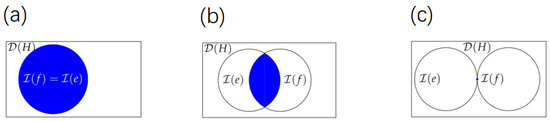
Figure 1.
Relationships between and , where subfigures (a–c) correspond to the cases that , and , respectively.
It is clear that for any bases e and f. Especially, if they are mutually unbiased. However, even though e and f are not a pair of mutually unbiased bases, it is possible that see the following example.
Example 1.
Let and be two orthonormal bases for with
Clearly, e and f are not a pair of mutually unbiased bases while .
This example leads us to study the relationship between two bases e and f for H such that
To do this, we let and be two bases for H and Since are the eigenvalues of , they can be rearranged as in decreasing order, say, . Thus, there exists a permutation matrix such that
Suppose that . Then
where . Using Equation (5) implies that
i.e.,
where
Since are also the eigenvalues of , they can be also rearranged as in decreasing order. So, there exists a permutation matrix such that
Thus,
Putting yields that
Thus, when , we see from Equation (10) that for ,
and so . Using Equation (10) again yields that for ,
and so , implying that . Thus,
where k means the number of different eigenvalues of and is an -doubly stochastic matrix, and denotes the multiplicity of the ith eigenvalue .
Conversely, suppose that there exist permutation matrices and such that is of the form (11) where . Since the matrix can be written as
where
we see from condition (11) that
This implies that the subspaces generated by and are equal and so
Clearly, .
As a conclusion, we arrive at the following.
Theorem 2.
Let , and be two orthonormal bases for H and set . Then there exists a state in if and only if there exist two permutation matrices and such that the matrix is block-diagonal for some .
Example 2.
Let and be two orthonormal bases for H such that
Then
It follows from Theorem 2 that there exists a state for example,
Remark 2.
From Theorem 2, we know that whether depends on the structure of the matrix C given by Equation (7). Since this, we call C the correlation matrix of the bases e and f and denote it by . Clearly, it can be written as the Hardamard product of the transition matrix from e to f and its conjugate matrix :
where
Theorem 2 also tells us that when for all , there do not exist permutation matrices and such that is block diagonal, so . Especially, for a pair of mutually unbiased bases e and f, when and , we have . Conversely, when is a maximally coherent state w.r.t. e, a question is: whether is also maximally coherent w.r.t. f. The follow example shows that the answer is negative.
Example 3.
Let and be a pair of mutually unbiased bases for where
choose
Then is maximally coherent with respect to f but is incoherent w.r.t. e, while for the state
we have
Therefore, is both maximally coherent w.r.t. e and f.
The following theorem shows that there must exist a maximally coherent state w.r.t. any two bases for .
Theorem 3.
Let and be two orthonormal bases for . Then there exists a state such that
Proof.
First, we observe that if and only if
and if and only if
Suppose that
then is a unitary matrix, which is given.
For a state of the form given by (14), then . We compute that
Thus, if and only if
if and only if
since .
Since U is a unitary matrix, it can be represented as
where , and s.t. . The last condition implies that for some integer n. Taking implies that and so there exists a real number such that second equation in (17) holds. Since , the first equation in (17) holds too. Hence,
This shows that the state defined by Equation (14) with satisfies
that is, □
3. Weak Coherence
In this section, we turn to discuss the weak coherence of quantum states. To this, we use to denote a set of k orthonormal bases for H, i.e.,
Definition 1.
We say that is strongly incoherent (S-incoherent) w.r.t. if ρ is incoherent w.r.t. any basis in . Otherwise, we say that ρ is weakly coherent (W-coherent) w.r.t. .
Denoted by the set of all S-incoherent states of H w.r.t. . Clearly,
Definition 2.
Let Φ be a quantum operation on . Then Φ is said to be an S-incoherent operation (SIO) w.r.t. (or -incoherent operation (IO)) if for all , that is, for each , Φ has a family of Kraus operators such that
Denoted by the set of all SIOs w.r.t. , then
Similar to the definition of the standard coherence measure, let us introduce the concept of a -coherence measure.
Definition 3.
A function is said to be a -coherence measure if the following four conditions are satisfied:
(1) Faithfulness: ; if and only if
(2) Monotonicity: for every and for every
(3) Strong monotonicity: for each for every and every with a family Kraus operators where and for , and for .
(4) Convexity: where and is a probability distribution.
The following theorem gives a method for constructing a -coherence measure from k-coherence measures
Theorem 4.
Let be -coherence measures. Then the function defined by
is a -coherence measure.
Proof.
(1) Let . Since for all we have Furthermore,
(2) Let For each , since is an -coherence measure and , we get
for all , and so
(3) Let , with families of Kraus operators . Put and for , and for . For each , since is an -coherence measure and , we get
This implies that for each ,
(4) Let and let be a probability distribution. Since is an -coherence measure, we have
for all , and therefore,
Using Definition 3 yields that the function defined by Equation (18) becomes a -coherence measure. □
Using Theorem 4 yields that the function defined by
is a -coherence measure. We see from property (1) that for all states of the system. A state is said to be maximally coherent w.r.t. if . Clearly, a state is maximally coherent if and only if it is maximally coherent w.r.t. each .
Remark 3.(1) ; Especially, if there exist two mutually unbiased bases in , then , that is, if and only if .
(2) Theorem 3 implies when and , there exists a maximally coherent state ρ w.r.t. , that is, .
(3) The following theorem means that when and is a complete set of mutually unbiased bases, there does not exist necessarily a maximally coherent state w.r.t. .
It was proved in [47] that the maximal number of mutually unbiased bases for H is if the dimension d of H is a prime-power. Thus, , i.e., there exists a complete set of three mutually unbiased bases for .
Theorem 5.
Let where be any orthonormal basis for , and with
Then and g are mutually unbiased bases pairwise for and for all states ρ of , that is, there does not exist a state ρ such that
Proof.
Obviously, and g are mutually unbiased bases pairwise for . Suppose that there exists a state such that Equation (20) holds, i.e.,
Then under the three bases, we have
where Since , we conclude from Equation (21) that . Substituting in Equation (23) with
and comparing the coefficient of in Equations (22) and (23), we find that
Similarly, substituting in Equation (24) with
and comparing the coefficient of in Equations (22) and (24), we find that
Combining Equations (25) and (26) yields that , a contradiction. □
4. Conclusions
In this paper, we have introduced a correlation function of two orthonormal bases e and f with the property that , and proved that if and only if the rank-one projective measurements generated by e and f are identical if and only if , where and denote the sets of incoherent states with respect to e and f, respectively. We have also shown that reaches the maximum if and only if the bases e and f are mutually unbiased; in that case, the intersection includes only the maximally mixed state. We have observed that even though two bases e and f are not mutually unbiased, may include only the maximally mixed state. We have obtained a necessary and sufficient condition for . We have introduced the concepts of strong incoherence and weak coherence of a quantum state w.r.t. a set of k orthonormal bases and proposed a measure for the weak coherence. In the two-qubit system, we have proved that there exists a maximally coherent state w.r.t. the measure when consists of any two bases and observed that there exist does not a maximally coherent state w.r.t. the measure when consists of some three mutually unbiased bases.
Author Contributions
The work of this paper was accomplished by P.W., Z.G. and H.C. Moreover, all authors have read the paper carefully and approved the research contents that were written in the final manuscript. All authors have read and agreed to the published version of the manuscript.
Funding
This work was supported by the National Natural Science Foundation of China (Nos. 11871318, 11771009, 12001480), the Fundamental Research Fund for the Central Universities (GK202007002, GK202103003) and the Special Plan for Young Top-notch Talent of Shaanxi Province (1503070117).
Institutional Review Board Statement
Not applicable.
Informed Consent Statement
Not applicable.
Data Availability Statement
Data are contained within the article.
Acknowledgments
The authors would like to thank the anonymous reviewers for their invaluable and constructive comments.
Conflicts of Interest
The authors declare no conflict of interest.
References
- Nielsen, M.A.; Chuang, I.L. Quantum Computation and Quantum Information. Contemrary Phys. 2011, 52, 604–605. [Google Scholar]
- Åberg, J. Quantifying superposition. arXiv 2006, arXiv:quant-ph/0612146. [Google Scholar]
- Baumgratz, T.; Cramer, M.; Plenio, M.B. Quantum coherence. Phys. Rev. Lett. 2014, 113, 140401. [Google Scholar] [CrossRef] [PubMed] [Green Version]
- Streltsov, A.; Adesso, G.; Plenio, M.B. Colloquium: Quantum coherence as a resource. Rev. Mod. Phys. 2017, 89, 041003. [Google Scholar] [CrossRef] [Green Version]
- Winter, A.; Yang, D. Operational resource theory of coherence. Phys. Rev. Lett. 2016, 116, 120404. [Google Scholar] [CrossRef] [Green Version]
- Hu, M.L.; Hu, X.Y.; Wang, J.C.; Peng, Y.; Zhang, Y.R.; Fan, H. Quantum coherence and geometric quantum discord. Phys. Rep. 2018, 762–764, 1–100. [Google Scholar] [CrossRef] [Green Version]
- Yang, C.; Guo, Z.H.; Zhang, C.Y.; Cao, H.X. Broadcasting coherence via incoherent operations. Linear Mult. Alg. 2021. [Google Scholar] [CrossRef]
- Guo, Z.H.; Cao, H.X. Creating quantum correlation from coherence via incoherent quantum operations. J. Phys. A Math. Theor. 2019, 52, 265301. [Google Scholar] [CrossRef]
- Girolami, D. Observable measure of quantum coherence in finite dimensional systems. Phys. Rev. Lett. 2014, 113, 170401. [Google Scholar] [CrossRef] [Green Version]
- Streltsov, A.; Singh, U.; Dhar, H.S.; Bera, M.N.; Adesso, G. Measuring quantum coherence with entanglement. Phys. Rev. Lett. 2015, 115, 020403. [Google Scholar] [CrossRef] [Green Version]
- Lostaglio, M.; Korzekwa, K.; Jennings, D.; Rudolph, T. Quantum coherence, time-translation symmetry, and thermodynamics. Phys. Rev. X 2015, 5, 021001. [Google Scholar] [CrossRef] [Green Version]
- Shao, L.H.; Xi, Z.J.; Fan, H.; Li, Y.M. Fidelity and trace-norm distances for quantifying coherence. Phys. Rev. A 2015, 91, 042120. [Google Scholar] [CrossRef] [Green Version]
- Pires, D.P.; Céleri, L.C.; Soares-Pinto, D.O. Geometric lower bound for a quantum coherence measure. Phys. Rev. A 2015, 91, 042330. [Google Scholar] [CrossRef] [Green Version]
- Yao, Y.; Xiao, X.; Ge, L.; Sun, C.P. Quantum coherence in multipartite systems. Phys. Rev. A 2015, 92, 022112. [Google Scholar] [CrossRef] [Green Version]
- Napoli, C.; Bromley, T.R.; Cianciaruso, M.; Piani, M.; Johnston, N.; Adesso, G. Robustness of coherence: An operational and observable measure of quantum coherence. Phys. Rev. Lett. 2016, 116, 150502. [Google Scholar] [CrossRef] [Green Version]
- Rana, S.; Parashar, P.; Lewenstein, M. Trace-distance measure of coherence. Phys. Rev. A 2016, 93, 012110. [Google Scholar] [CrossRef] [Green Version]
- Rastegin, A.E. Quantum-coherence quantifiers based on the Tsallis relative α entropies. Phys. Rev. A 2016, 93, 032136. [Google Scholar] [CrossRef] [Green Version]
- Luo, S.; Sun, Y. Quantum coherence versus quantum uncertainty. Phys. Rev. A 2017, 96, 022130. [Google Scholar] [CrossRef]
- Xi, Z.J.; Hu, M.L.; Li, Y.M.; Fan, H. Entropic cohering power in quantum operations. Quantum Inf. Proc. 2018, 17, 34. [Google Scholar] [CrossRef]
- Shi, H.L.; Liu, S.Y.; Wang, X.H.; Yang, W.L.; Yang, Z.Y.; Fan, H. Coherence depletion in the Grover quantum search algorithm. Phys. Rev. A 2017, 95, 032307. [Google Scholar] [CrossRef] [Green Version]
- Anand, N.; Pati, A.K. Coherence and entanglement monogamy in the discrete analogue of analog grover search. arXiv 2016, arXiv:1611.04542. [Google Scholar]
- Rastegin, A.E. On the role of dealing with quantum coherence in amplitude amplification. Quantum Inf. Proc. 2018, 17, 179. [Google Scholar] [CrossRef] [Green Version]
- Hillery, M. Coherence as a resource in decision problems: The Deutsch-Jozsa algorithm and a variation. Phys. Rev. A 2016, 93, 012111. [Google Scholar] [CrossRef] [Green Version]
- Matera, J.M.; Egloff, D.; Killoran, N.; Plenio, M.B. Coherent control of quantum systems as a resource theory. Quantum Sci. Technol. 2016, 1, 01LT01. [Google Scholar] [CrossRef] [Green Version]
- Giovannetti, V.; Lloyd, S.; Maccone, L. Advances in quantum metrology. Nat. Photonics 2011, 5, 222–229. [Google Scholar] [CrossRef]
- Rodríguez-Rosario, C.A.; Frauenheim, T.; Aspuru-Guzik, A. Thermodynamics of quantum coherence. arXiv 2013, arXiv:1308.1245. [Google Scholar]
- Lostaglio, M.; Jennings, D.; Rudolph, T. Description of quantum coherence in thermodynamic processes requires constraints beyond free energy. Nat. Commun. 2015, 6, 6383. [Google Scholar] [CrossRef] [Green Version]
- Brandáo, F.; Horodecki, M.; Ng, N.; Oppenheim, J.; Wehner, S. The second laws of quantum thermodynamics. Proc. Natl. Acad. Sci. USA 2015, 112, 3275. [Google Scholar] [CrossRef] [Green Version]
- Narasimhachar, V.; Gour, G. Low-temperature thermodynamics with quantum coherence. Nat. Commun. 2015, 6, 7689. [Google Scholar] [CrossRef]
- ၤwikliᑄski, P.; Studziński, M.; Horodecki, M.; Oppenheim, J. Limitations on the evolution of quantum coherences: Towards fully quantum second laws of thermodynamics. Phys. Rev. Lett. 2015, 115, 210403. [Google Scholar] [CrossRef] [Green Version]
- Misra, A.; Singh, U.; Bhattacharya, S.; Pati, A.K. Energy cost of creating quantum coherence. Phys. Rev. A 2016, 93, 052335. [Google Scholar] [CrossRef] [Green Version]
- Plenio, M.B.; Huelga, S.F. Dephasing-assisted transport: Quantum networks and biomolecules. New J. Phys. 2008, 10, 113019. [Google Scholar] [CrossRef]
- Lloyd, S. Quantum coherence in biological systems. J. Phys. Conf. Ser. 2011, 302, 012037. [Google Scholar] [CrossRef]
- Levi, F.; Mintert, F.A. quantitative theory of coherent delocalization. New J. Phys. 2014, 16, 033007. [Google Scholar] [CrossRef]
- Cheng, S.M.; Hall, M.J.W. Complementarity relations for quantum coherence. Phys. Rev. A 2015, 92, 042101. [Google Scholar] [CrossRef] [Green Version]
- Rastegin, A.E. Uncertainty relations for quantum coherence with respect to mutually unbiased bases. Front. Phys. 2017, 13, 130304. [Google Scholar] [CrossRef]
- Sheng, Y.H.; Zhang, J.; Tao, Y.H.; Fei, S.M. Applications of quantum coherence via skew information under mutually unbiased bases. Quantum Inf. Proc. 2021, 20, 82. [Google Scholar] [CrossRef]
- Luo, S.; Sun, Y. Partial coherence with application to the monotonicity problem of coherence involving skew information. Phys. Rev. A 2017, 96, 022136. [Google Scholar] [CrossRef]
- Kim, S.; Li, L.; Kumar, A.; Wu, J. Interrelation between partial coherence and quantum correlations. Phys. Rev. A 2018, 98, 022306. [Google Scholar] [CrossRef] [Green Version]
- Xiong, C.; Kumar, A.; Huang, M.; Das, S.; Sen, U.; Wu, J. Partial coherence and quantum correlation with fifidelity and affifinity distances. Phys. Rev. A 2019, 99, 032305. [Google Scholar] [CrossRef] [Green Version]
- Bischof, F.; Kampermann, H.; Bruß, D. Resource theory of coherence based on positive-operator-valued measures. Phys. Rev. Lett. 2019, 123, 110402. [Google Scholar] [CrossRef] [PubMed] [Green Version]
- Bischof, F.; Kampermann, H.; Bruß, D. Quantifying coherence with respect to general quantum measurements. Phys. Rev. A 2021, 103, 032429. [Google Scholar] [CrossRef]
- Zhang, C.Y.; Wang, P.; Bai, L.H.; Guo, Z.H.; Cao, H.X. Channel-based coherence of quantum states. Int. J. Quantum Inf. 2022. [Google Scholar] [CrossRef]
- Xu, J.W. Coherence of quantum channels. Phys. Rev. A 2019, 100, 052311. [Google Scholar] [CrossRef] [Green Version]
- Xu, J.W.; Shao, L.H.; Fei, S.M. Coherence measures with respect to general quantum measurements. Phys. Rev. A 2020, 102, 012411. [Google Scholar] [CrossRef]
- Designolle, S.; Uola, R.; Luoma, K.; Brunner, N. Set coherence: Basis-independent quantification of quantum coherence. Phys. Rev. Lett. 2021, 126, 220404. [Google Scholar] [CrossRef]
- Wootters, W.K.; Fields, B.D. Optimal state-determination by mutually unbiased measurements. Ann. Phys. 1989, 191, 363. [Google Scholar] [CrossRef]
Publisher’s Note: MDPI stays neutral with regard to jurisdictional claims in published maps and institutional affiliations. |
© 2022 by the authors. Licensee MDPI, Basel, Switzerland. This article is an open access article distributed under the terms and conditions of the Creative Commons Attribution (CC BY) license (https://creativecommons.org/licenses/by/4.0/).