1. Introduction
Among a wide range of multifaceted fundamental problems dealing with different aspects of dynamics of quantum systems, the importance of the problems related to the speed of evolution of a quantum state for quantum technologies such as quantum communications and quantum computations cannot be overestimated. In processes underlying these technologies, this speed generally determines how fast a given task can be processed.
The maximum speed of the evolution can be quantified using the quantum speed limit (QSL) time defined as the minimal time needed for a system to perform transition between predetermined initial and final (target) states. An important point is that quantum mechanics dictates QSL bounds for the minimal evolution time which is inversely related to the evolution speed. For the case of unitary evolution, the well-known Mandelstam–Tamm [
1,
2] and Margolus–Levitin [
3,
4,
5] inequalities provide general limits on the speed of dynamical evolution and set a dynamical intrinsic time scale. Interesting alternative geometric derivations for both inequalities are obtained from the statistical distance between quantum states in [
6].
In [
7], the geometric approach was used to generalize the inequalities to the case of nonunitary dynamics of open quantum systems. Following a similar general approach, where quantum speed limits are derived as upper bounds on the rate of change of a geometric measure of distinguishability, different expressions for generalized QSL bounds were also obtained in [
8,
9] using quantum Fisher information and the relative purity. The QSL inequality for open quantum systems using the trace norm was derived and interpreted in [
10]. More details on QSLs and their applications in the fields such as quantum metrology and optimal control theory can be found in, e.g., Ref. [
11] (see also references cited therein).
Recently, in Ref. [
12], the QSL approach was applied to solve the optimal control problem dealing with the minimum energetic cost required to implement a quantum gate. Speed limits on the informational measures such as the von Neumann entropy, maximal information, and coherence of quantum systems were introduced in [
13] where the speed limit on the maximal information is used to obtain the minimum time required to erase the information of quantum systems via some quantum processes of interest.
Quantum navigation is another important class of controlled quantum dynamics whereby the objective is to transport one quantum state into another in the shortest possible time under the influence of uncontrollable perturbations. Problems of this kind can be regarded as the quantum counterpart of the classical Zermelo navigation problem of finding the time-optimal control that takes a ship from one location to another, under the influence of external wind or currents [
14,
15,
16,
17]. Analysis of the evolution speed is a necessary step toward solving the quantum Zermelo problem.
For the last half of the decade, the evolution speed of two-level open quantum systems interacting with both Markovian and non-Markovian environments has been the subject of intense studies [
16,
18,
19,
20,
21]. A systematic analysis of the most common QSL bounds in the damped Jaynes–Cummings model was performed in [
22]. The problem of quantum metrology in the context of non-Markovian quantum evolution of a two-qubit system was explored in [
23].
As compared to the case of finite dimensional quantum systems, for bosonic multi-mode quantum systems representing a family of open continuous-variable systems, the problem of evolution speed has not yet received a proper attention. In this paper, we intend to fill the gap.
In a recent paper [
24], the evolution speed and various QSL times were computed for the special case of a single quantized cavity mode that undergoes Markovian dynamics. Obviously, in order to study the effects determined by dynamics of intermode correlations, we shall need to go beyond the scope of single-mode models. These effects are governed by the intermode interactions arising from both dynamic and environment mediated couplings.
For instance, when a two-mode boson system represents the polarization degrees of freedom of of a quantized radiation mode [
25], these couplings may have a profound effect on dynamics of the averages of the quantum Stokes operators that underlies the depolarization of quantum light propagating in a fiber [
26,
27,
28]. Note that a similar two-boson system was formulated in Ref. [
29] to model two cavity modes interacting with a single three-level atom.
As far as correlations are concerned, there is an extensive body of the literature dealing with dynamics of entanglement in open continuous-variable systems such as two coupled oscillators [
30,
31,
32,
33,
34,
35,
36,
37,
38,
39,
40,
41,
42,
43] (see also Refs. [
44,
45] for reviews). It turned out that the decay time of entanglement (the time of disentanglement) may be shorter than the time of decoherence and, under certain conditions, finite-time disentanglement commonly known as the “sudden death of entanglement” [
46,
47,
48,
49,
50,
51] may also take place in continuous-variable systems [
33,
39,
43].
In this paper, we explore how the evolution speed of multi-mode bosonic systems is influenced by the dynamical regimes dictated by the intermode couplings. The plan of this paper is as follows.
Section 2 begins with a brief discussion of QSL. We will introduce the fidelity of evolution and the Hilbert–Schmidt (HS) distance as measures of the distinguishability of quantum states applicable to the special case of a pure initial state [
24]. For the rates of change of both of these measures, the speed of evolution appears as the upper bound that defines the time-dependent QSL times. In
Section 2.1, our starting point is the Gorini–Kossakowski–Sudarshan–Lindblad (GKSL) master equation (the general form of quantum kinetic equations which preserves the complete positivity of the dynamics [
52,
53,
54]) for the multi-mode bosonic system interacting with the thermal bath and we, following Refs. [
43,
55], present its exact solution derived by solving the dynamical equation for the normally ordered characteristic function. In
Section 2.2, we deduce general formulas that characterize the temporal evolution of Gaussian states using the generalized two-point fidelity, the evolution speed and the covariance matrix. In
Section 3, general theoretical results are applied to the special case of a two-mode bosonic system which can be regarded as a model describing the propagation of quantized polarization modes in an optical fiber [
27]. For this system, the intermode interactions can be conveniently treated using a geometric representation based on the frequency and the relaxation rate vectors.
In
Section 4, we present a number of closed-form analytical relations for the cases where these vectors are either parallel or mutually orthogonal. For the case where the system is initially prepared in the two-mode squeezed state, different dynamical regimes are studied depending on the squeezing parameter and temperature. Analytical results are used to compute the disentanglement time and dynamics of the purity, the fidelity and the HS distance. Squeezing the parameter dependence of the coefficients characterizing long-time asymptotics of the QSL times is evaluated at different temperatures and relaxation rates. We also study how the orientation of the frequency and the relaxation rate vectors influence the maximum speed of evolution and dynamics of the entropy and the mutual information.
Finally, in
Section 5, we draw the results together and make some concluding remarks. Technical details on algebraic identities related to the Liouvillian superoperator and its conjugate are relegated to
Appendix A. In
Appendix B, a closed-form formula for the normally ordered characteristic function is used to obtain the expression for the kernel of the Green’s function describing the evolution of the Glauber–Sudarshan
P function.
2. General Approach
We consider an open multi-mode bosonic system initially prepared in a pure quantum state and then left to evolve under Markovian dynamics. One of the widely used measures of distinguishability between the initial state and the evolved one is the trace distance, , where and the dagger denotes Hermitian conjugation.
This distance satisfy the inequalities (see, e.g., the book [
56])
that involve the Uhlmann fidelity
. Clearly, the inequalities (
1) can also be regarded as relations linking the temporal evolution of the trace distance and dynamics of the Uhlmann fidelity that defines the geometric characteristics of density matrix operators such as the Bures distance and the Bures angle.
An important point is that in our case, the initial state
is pure state and the Uhlmann fidelity can be simplified to the form:
which is identical to the so-called
fidelity of evolution,
. A two-point generalization of this fidelity
reduces to the
purity and the fidelity of evolution
in the limiting cases with
and
,
, respectively. It will also be used to compute the
speed of evolution:
This speed determines the upper bound for the rate of change of the fidelity (
2)
where a dot stands for the derivative with respect to time, which is an immediate consequence of the well-known Cauchy–Schwarz inequality for the inner product of Hilbert–Schmidt operators:
where
is the Hilbert–Schmidt norm.
Interestingly, the
Hilbert–Schmidt (HS) distance,
, can also be used as a measure of distinguishability, and it is not difficult to show that the speed of evolution (
5) provides the upper bound for the magnitude of its rate of change
Since
and
, we have the time-dependent
quantum speed limit (QSL) times
which are associated with Equations (
8) and (
6) and lead to the QSL inequalities:
From Equation (
11), it might be concluded that the quantum speed limit imposed by
is tighter than the fidelity-based one (see Ref. [
24] for discussion). Clearly, all the above QSL times given by Equations (
9) and (
10) depend on the speed and the fidelity of evolution (see Equations (
5) and (
2)) along with the purity (see Equation (
4)).
In the remaining part of this section, our task is to provide general analytical expressions for these dynamical characteristics. More specifically, in
Section 2.1, we, following our previous studies [
43,
55], present an exactly solvable model of Lindblad dynamics and its solution in the form suitable for our purposes. Then, in
Section 2.2, we apply the results to deduce general relations for Gaussian states.
2.1. Master Equation and Characteristic Functions
The general form of the master equation
suggests that the temporal evolution of the density matrix
representing the state of an open quantum system is governed by the
Liouvillian superoperator,
. In this paper, we consider the thermal bath version of the Liouvillian superoperator describing the Lindblad dynamics of an
N-mode bosonic system in the Markovian approximation. This superoperator
is expressed in terms of two superoperators: the commutator
given by
and the the dissipator
given by
where the dagger denotes Hermitian conjugation;
(
) is the creation (annihilation) operator of the
nth mode;
and
stand for the commutator and the anticommutator, respectively;
(
) is the element of the
frequency (dissipation) matrix,
(
);
=
is the dimensionless
inverse temperature parameter, where
is the bare frequency,
ℏ is the reduced Planck constant,
is the Boltzmann constant and
T is the temperature of the environment. The frequency and dissipation matrices are both Hermitian:
and
. The dissipation matrix is also positive definite:
.
It is well known that averages of the displacement operators,
and
, given by
where
and an asterisk will indicate complex conjugation, define the
symmetrically and normally ordered characteristic functions,
and
, as follows
where
.
The well-known Fourier–Weyl formula (see, e.g., the books [
57,
58])
in combination with the orthogonality relations
can be used to obtain the identity
linking the HS scalar product of the density operators,
and
, and the inner product of their characteristic functions,
and
. In what follows, this identity will be employed to evaluate the purity and the evolution fidelity needed to characterize the speed of evolution.
The dynamics of the normally ordered characteristic function,
, is governed by the evolution equation
with the differential operator,
, determined by action of the conjugate of the Liouvillian superoperator,
, on the displacement operator,
(see
Appendix A for details). This operator is given by
where
is the mean number of thermal photons and is the relaxation matrix giving the rates of thermalization.
By using the method of characteristics to solve the initial value problem for the dynamical Equation (
24) with the initial condition
we can derive the following expression for the normally ordered characteristic function [
43,
55]:
where
is the identity
matrix. In
Appendix B, this result is used to deduce the expression for the kernel of the Green’s function that determines time dependence of the Glauber–Sudarshan
P function.
From Equation (
28), it is not difficult to obtain the relations
describing the temporal evolution of the symmetrically ordered characteristic function,
. This formula in combination with Equation (
23) will be utilized in our subsequent calculations.
2.2. Evolution Speed of Gaussian States
In this section, we concentrate on the special case where the initial state is Gaussian and its characteristic function is of the following form
By using Equation (
30), the time dependence of the characteristic function
is expressed in terms of the two matrices
where
is the transpose of
. Similar to
and
, the matrices
and
are Hermitian and symmetric, respectively.
The exponent on the right-hand side of Equation (
33) can be conveniently cast into the real-valued form
where
is replaced by
with
and
. Note that in Equation (
37), the subscripts “R” and “I” indicate the real and the imaginary parts of a matrix, respectively:
and
.
The
block-structure of the matrix (
37) with rearranged elements reads
where
is the permutation matrix, and it is closely related to the block structure of the covariance matrix,
, which is defined in terms of the quadrature operators (see, e.g., Refs. [
45,
57])
The relation linking the block matrices of
and
reads
where
is one of the Pauli matrices given by
Now, we pass on to computing of the generalized two-point fidelity given by Equation (
3). To this end, we substitute the characteristic functions of the form (
36) into the relation (
23). After performing the resulting Gaussian integral, we derive the identity
where
, giving the expressions for the purity (
4)
and for the fidelity of evolution (
2)
We are also in a position to evaluate the squared speed of evolution by substituting derivatives of the determinant that enters Equation (
42) with respect
and
into the relation
An alternative way to compute
is to evaluate the integral for the squared time derivative of the characteristic function
It leads to the following formula for the squared speed of evolution:
We conclude this section with the remark that the algebraic identities valid for a symmetric matrix
where
is the matrix of cofactors, which can be used to show that differentiating the two-point fidelity (
42) and computing traces that enter the last expression on the right-hand side of Equation (
47) yield identical results for the evolution speed. With the help of Equation (
43) giving the purity, the latter can be further simplified as follows:
4. Results
As we have seen, for the two-mode systems, dynamical and environment-mediated intermode interactions appear to be encoded into the frequency and the relaxation vectors,
and
. Thus, we can expect that temporal evolution will crucially depend on the orientation of these vectors. According to Refs. [
28,
43], the angle between
and
is one of the important factors determining dynamical regimes of depolarization and disentanglement. In order to understand the orientation-dependent effects, we begin with the simplest limiting case where
and
.
4.1. Dynamical Regimes at ‖ and ⊥
To be more specific, we assume that the vectors are oriented along the
axis,
, so that the matrices
and
are both diagonal. After evaluating the matrices
and
(see Equations (
57) and (
59))
we obtain the matrices
(see Equation (
37)) and
(see Equation (
62)). The latter is described by the
block matrices
that determine the block structure of the covariance matrix (
63).
The two-point fidelity (
42) can now be derived as an explicit function of
and
of the following form:
Then, the relations
give the purity (
43) and the fidelity of evolution (
44).
It is now rather straightforward to evaluate the derivatives (
45) of the fidelity (
72) with respect to
and
and deduce the following closed-form formula for the speed of evolution:
Since
and
, it is not difficult to obtain the symplectic eigenvalues (
64)
and the lowest eigenvalue for the partial transpose of the density matrix (
67)
In the long-time limit, all these eigenvalues approach the limiting value
that, similar to the steady-state density matrix:
, is determined by the inverse temperature parameter
. Hence, at non-vanishing temperatures with
, the regime of finite-time disentanglement takes place, and the disentanglement time can be found by solving Equation (
69).
At
, we have
and the simplified expression for
:
, gives the solution in the closed-form as follows
This result was originally reported in [
33].
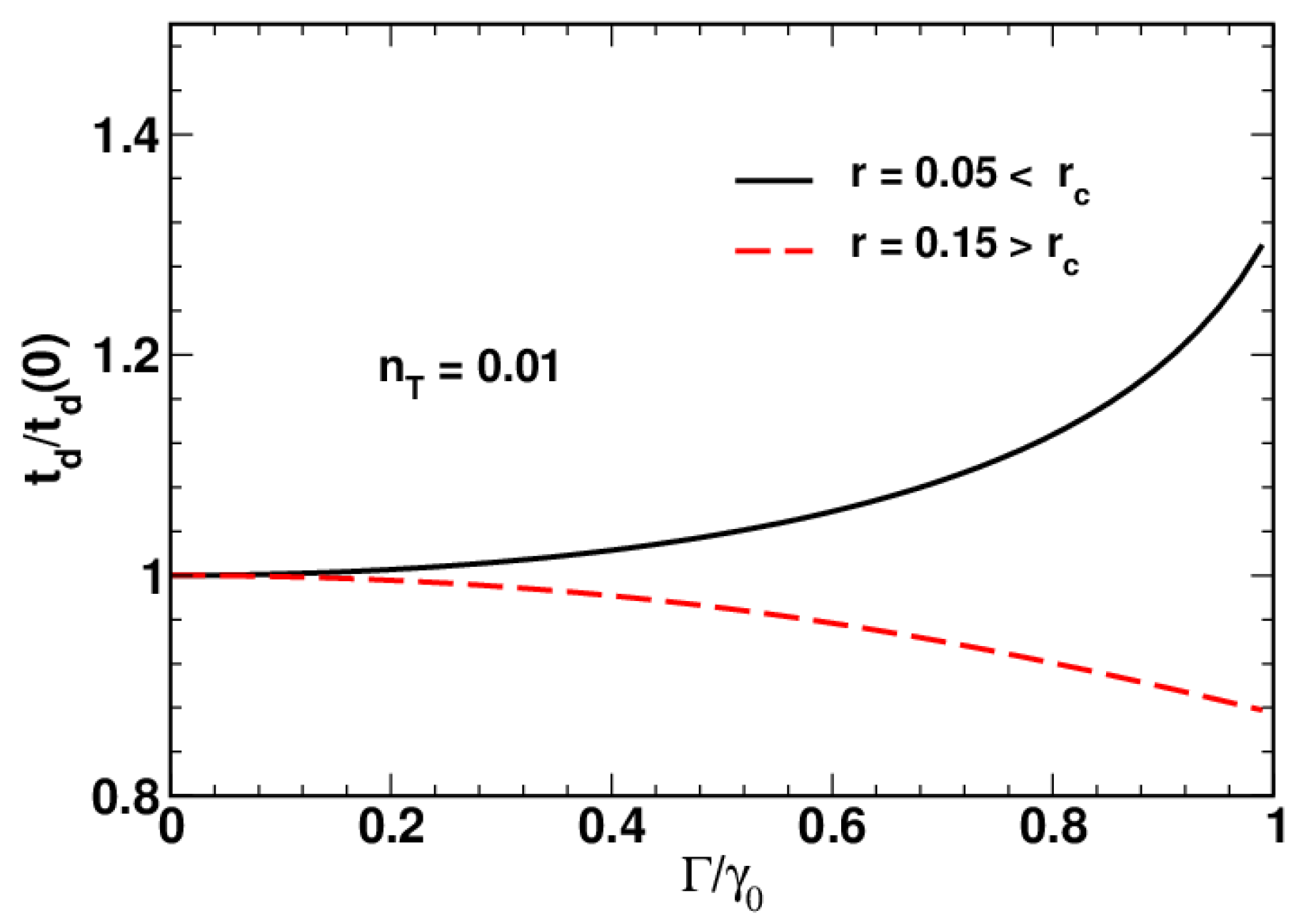
Figure 1 illustrates the behavior of the disentanglement time,
, as the relaxation rate,
, increases approaching its limiting value
. It can be seen that when the squeezing parameter
r is sufficiently high, the disentanglement time decreases with
, whereas an increase in
will reduce the time
provided the parameter
r is below its critical value,
.
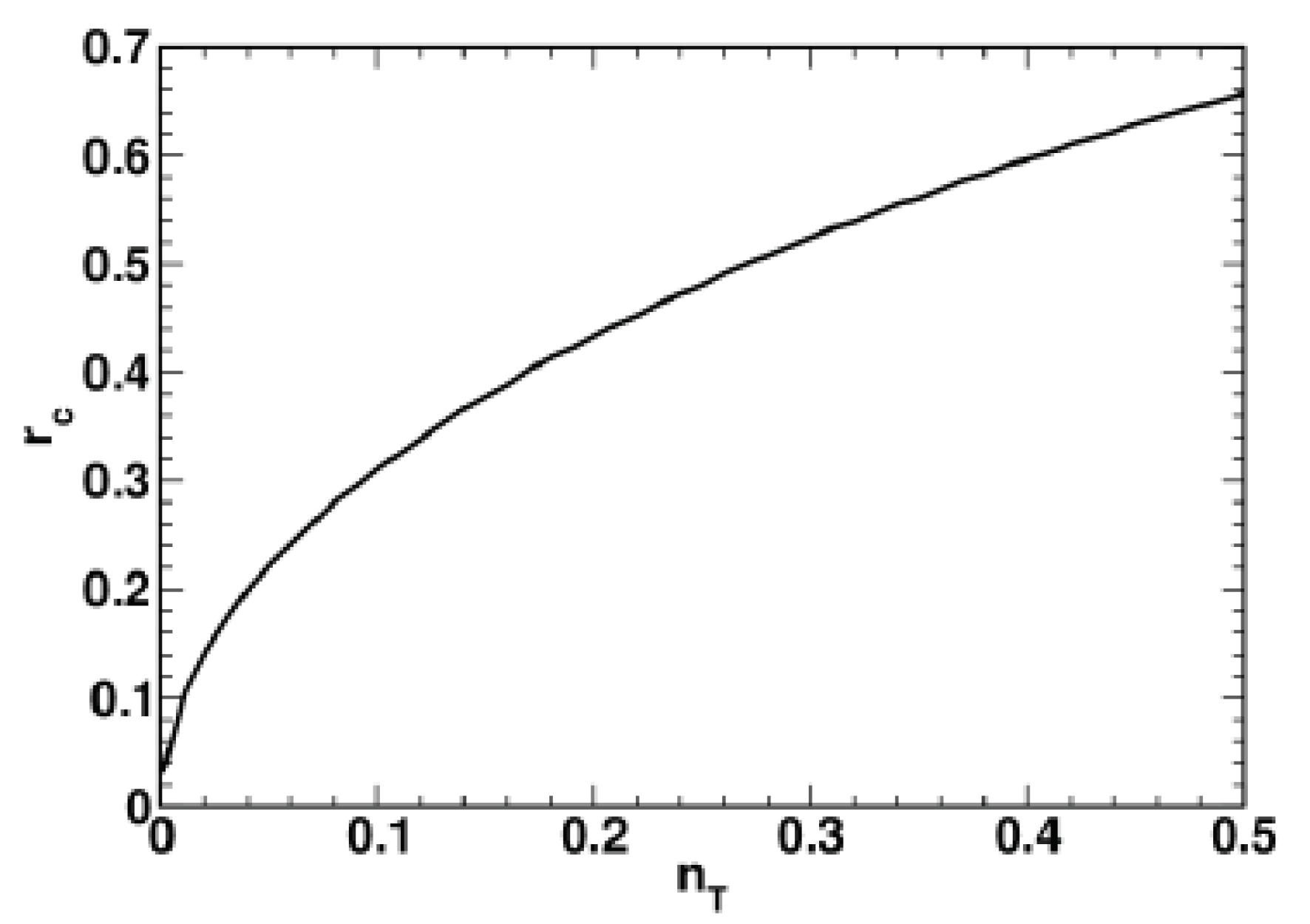
The critical value of the squeezing parameter,
, is plotted against the mean number of thermal photons,
, in
Figure 2. From the
vs.
curve depicted in
Figure 2, it can be inferred that the critical squeezing parameter grows with temperature.
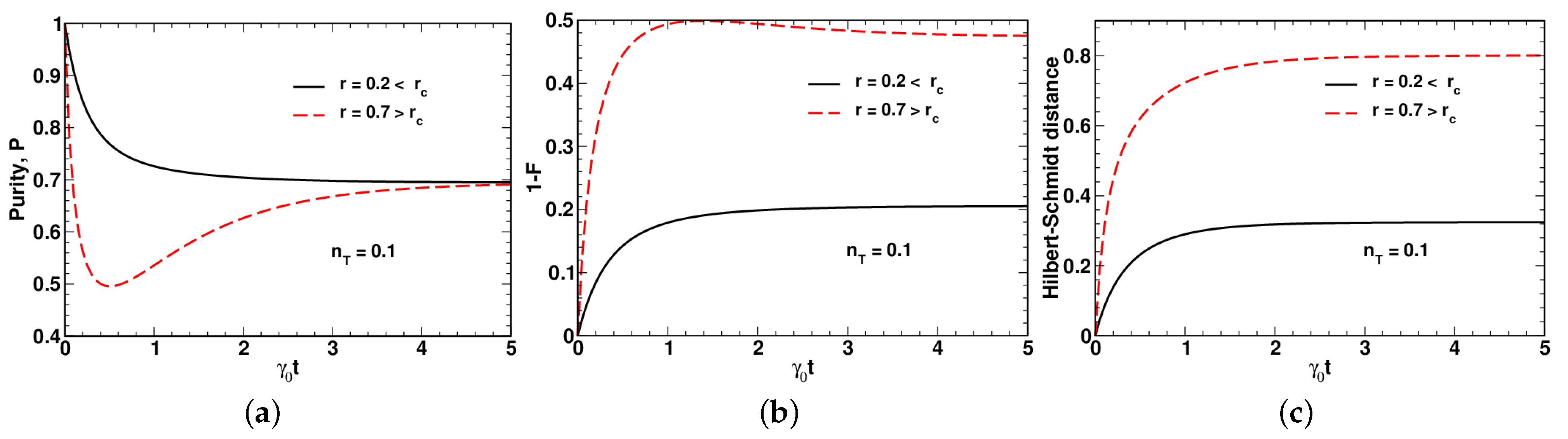
As is shown in
Figure 3a,b, the time dependencies of the purity (
43) and the fidelity of evolution (
44) (see also Equation (
73)) reveal non-monotonic behavior when the squeezing parameter exceeds the threshold
. By contrast,
Figure 3c shows that the HS distance is a monotonically increasing function of time that in the long-time limit with
, approaches its asymptotic value:
where
and
are the long-time asymptotics for the fidelity and the purity given by
The long-time behavior of the HS distance and the fidelity-based QSL times,
and
, (see Equations (
9) and (
10)), is determined by the coefficients
that might be called the QSL long-time asymptotic ratios. Typically, the evolution speed decays rapidly with time, and thus, the nonlinear corrections for the time dependence of QSL times are small. So, we concentrate on the QSL time ratios,
and
.
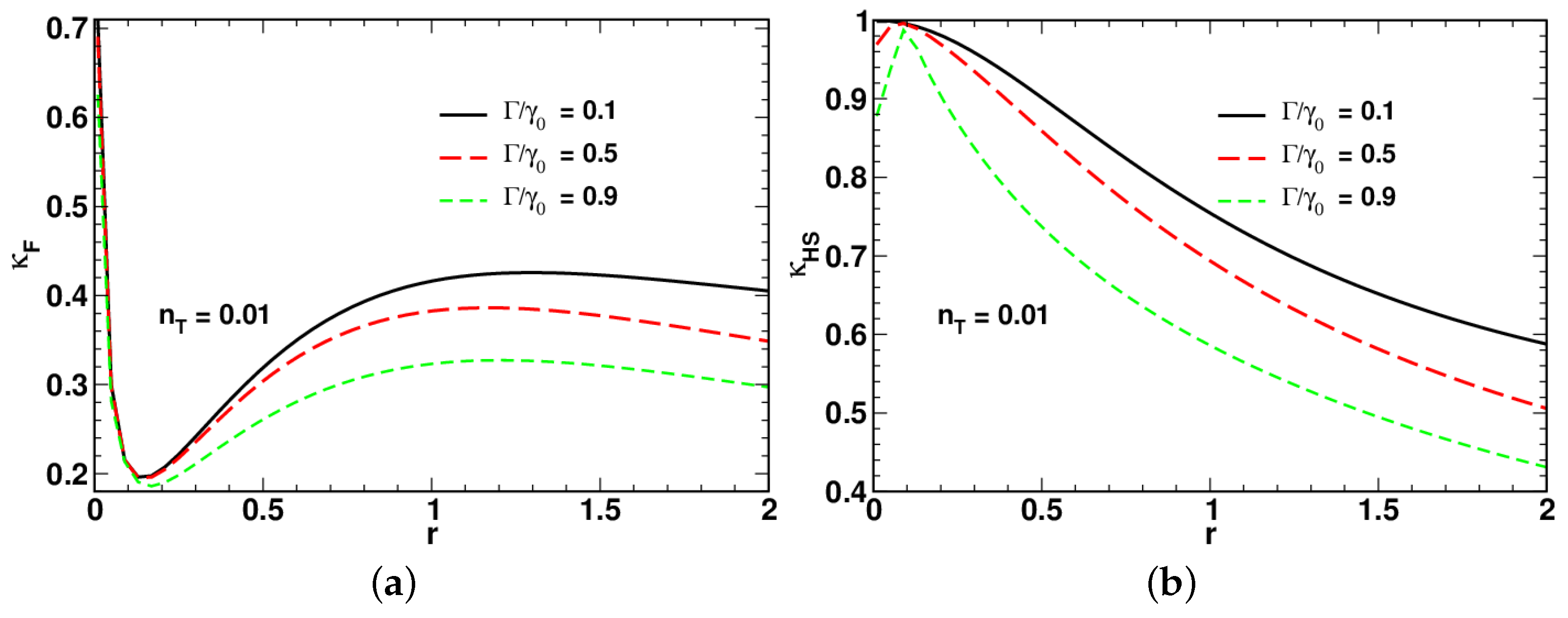
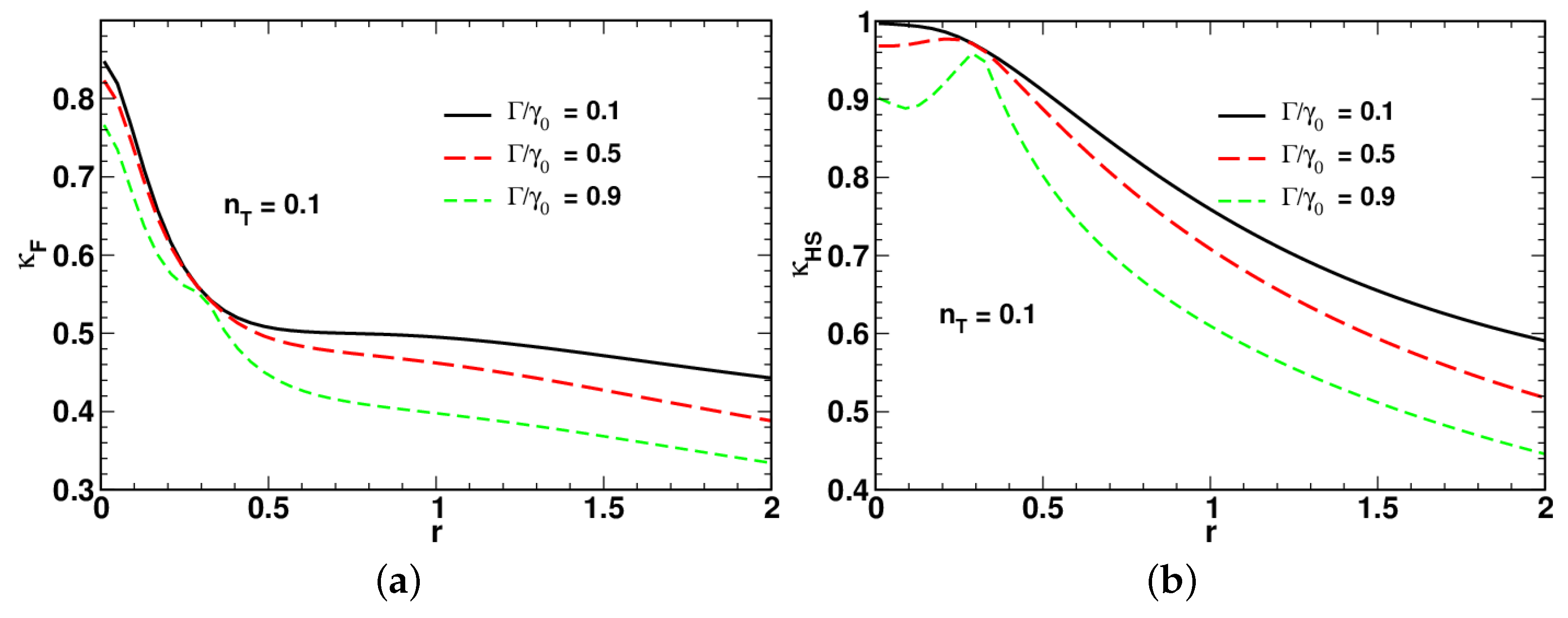
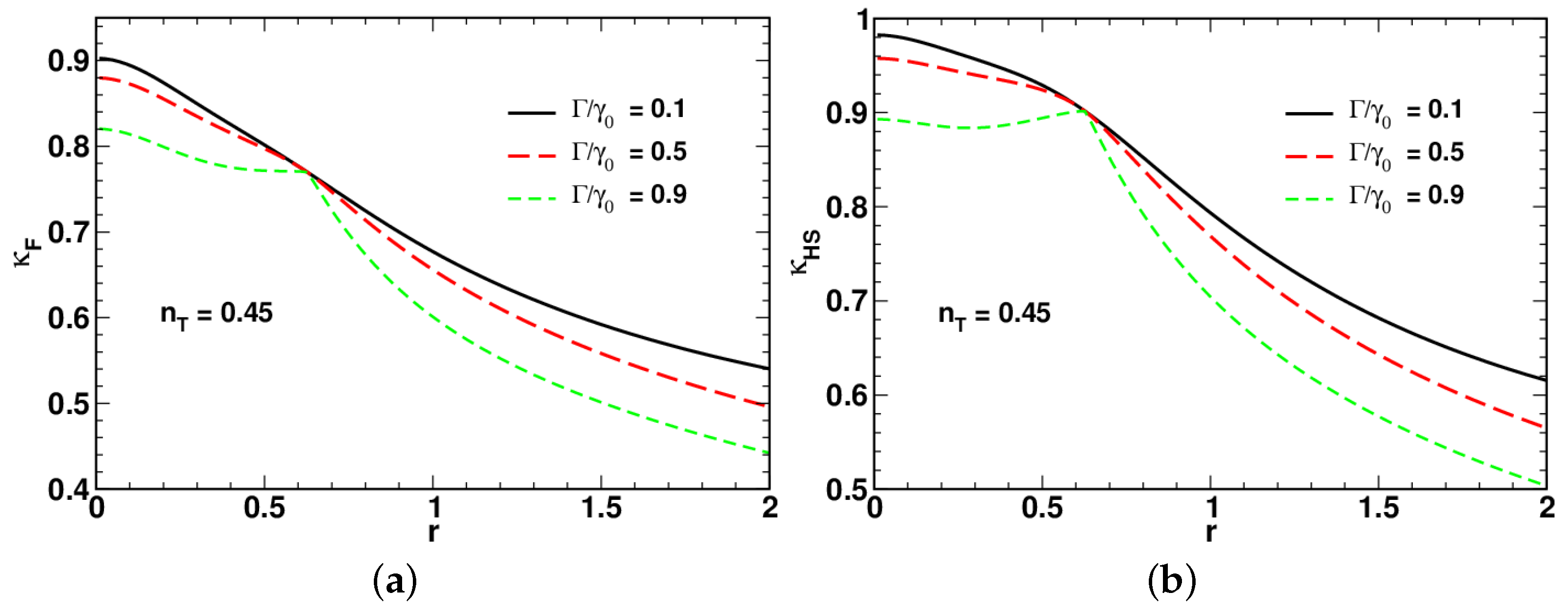
Figure 4,
Figure 5 and
Figure 6 present the results for dependencies of the long-time asymptotic ratios on the squeezing parameter computed at different values of the relaxation rate and the mean number of thermal photons.
Referring to
Figure 4, the low-temperature curves for the ratio of the fidelity-based QSL time plotted in
Figure 4a demonstrate non-monotonic behavior with a pronounced minimum. By contrast, the curves for the long-time ratio
shown in
Figure 4b, after reaching a local maximum in the low squeezing region, decline as the squeezing parameter
r increases.
In
Figure 4,
Figure 5 and
Figure 6, an increase in the relaxation rate
leads to reduction of both the ratios
and
. An additional effect of the relaxation rate is to enhance the non-monotonic behavior of
in the low squeezing region (see
Figure 5b).
A comparison between the results depicted in
Figure 4a and
Figure 5a shows that the minimum is suppressed at elevated temperature. Interestingly, as is shown in
Figure 6, in the vicinity of the high-temperature limit with
, the curves for
and
become remarkably similar. When the relaxation rate
is close to
, the shape of the squeezing parameter dependence of the long-time ratios reveals two dynamical regimes that take place in the well-separated low-squeezing and high-squeezing regions.
4.2. Dynamical Regimes at ⊥
We conclude our discussion of the dynamical regimes with remarks about another limiting case where the relaxation vector
is reoriented along the normal to the frequency vector
as follows
In this case, the matrix
(see Equation (
59)) can be cast into the form:
where, similar to the matrix
given by Equation (
57), the time-dependent part is solely determined by the matrix product
.
Therefore, it might be expected that the time dependence of
dictates the dynamical regimes. According to Equation (
82), similar to the simple
-symmetric two-level system studied in [
16], the value of
is either real or imaginary depending on the sign of the difference between
and
.
When
and
(
), the expression for
is
By contrast, in the opposite case with
and
(
), the result
describes an alternative regime associated with the presence of oscillations.
Finally, the critical regime that occurs when
and
is represented by the matrix
This expression implies the dissipative dynamics will start to slow down when the oscillatory regime is changed to the critical one.
4.3. Effects of Intermode Couplings
As it was mentioned above, the evolution speed typically evolves monotonically approaching zero and the speed evaluated at initial instant of time, , gives its maximum value. This value is one of the factors that influence the QSL times and dynamical regimes.
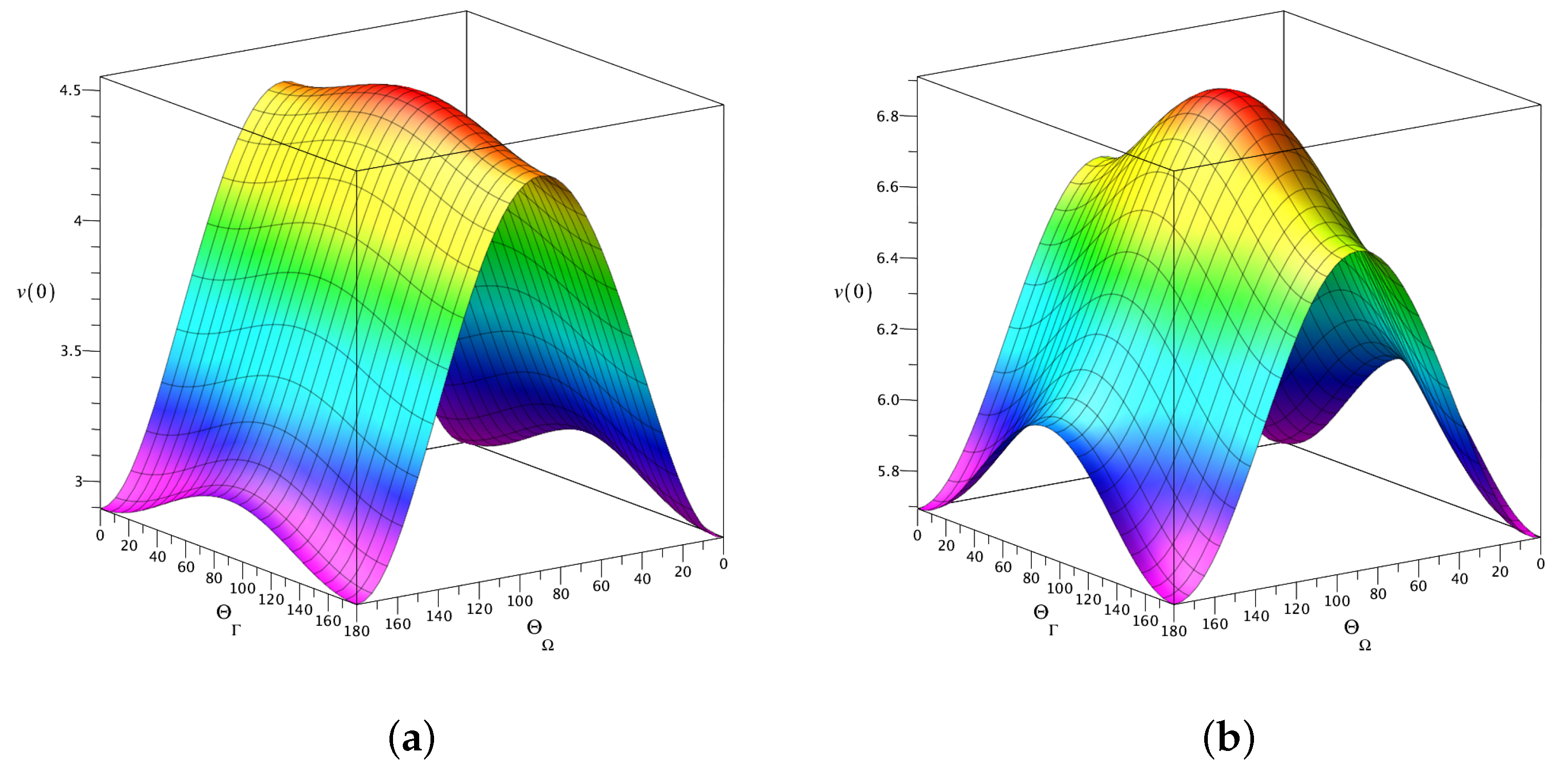
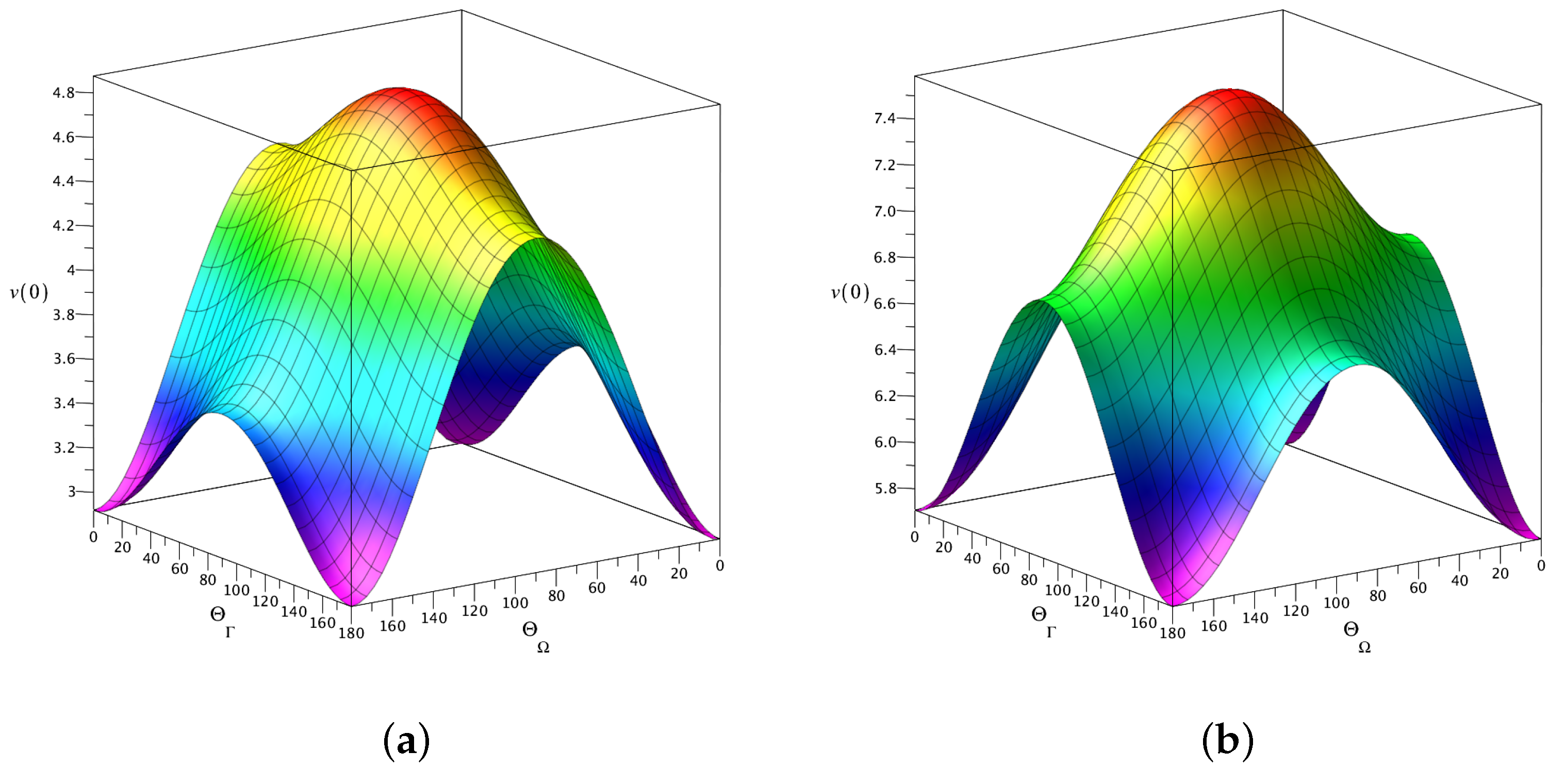
Figure 7 and
Figure 8 show how the maximum value of the evolution speed depends on the orientation of the frequency and relaxation vectors in the
–
plane. The surfaces plotted in
Figure 7 and
Figure 8 represent angular distributions for
computed as a function of the polar angles
and
at the two values of the relaxation rate ratio:
and
, respectively. For both values of the relaxation rate, we have evaluated the low-temperature (
) and high-temperature (
) angular distributions.
At
, referring to
Figure 7a, it can be seen that the depth of modulation of the speed
induced variations in the angle
is noticeably smaller than that induced by the angle
. As is shown in
Figure 7b, an increase in temperature will raise the speed and make the
-induced modulation of
more pronounced.
When the relaxation rate is increased up to
(see
Figure 8), we arrive at similar conclusions. In this case, both the temperature-induced speed up of the evolution and the
-induced modulation of
are noticeably stronger as compared to the results presented in
Figure 7.
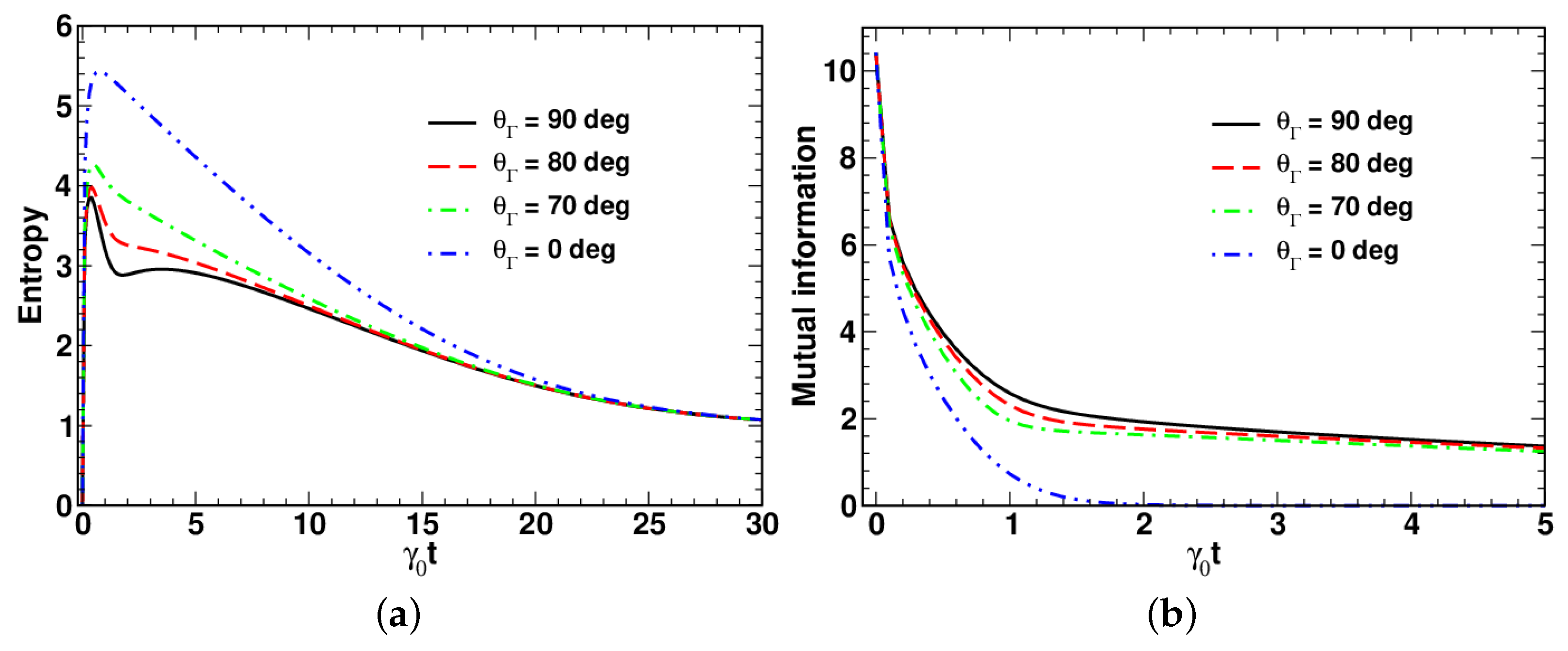
We have also computed time dependencies of the entropy and the mutual information for differently oriented vectors and . The list of parameters used in these calculations is as follows: , , and . At these parameters, we have the initial values of the symplectic eigenvalues , and giving the corresponding values for the entropy, , and the mutual information, .
The results for the entropy and the mutual information are depicted in
Figure 9a,b, respectively. As is shown in
Figure 9b, the mutual information monotonically decays, whereas the time dependence of the entropy (see
Figure 9a) is non-monotonic. It starts from zero and reaches its maximum value, which is well above its equilibrium value
.
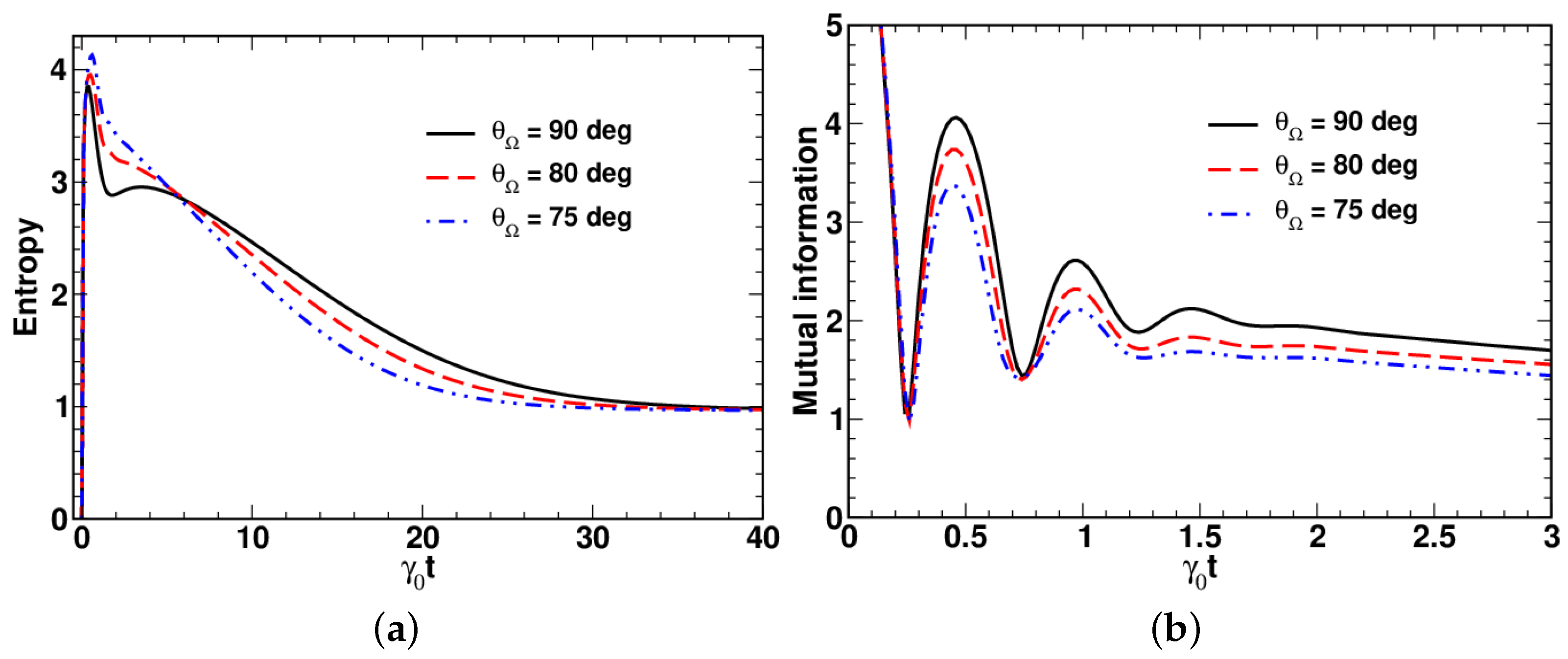
Referring to
Figure 10, by contrast to the entropy curves presented in
Figure 10a, the time dependence of the mutual information shown in
Figure 10b exhibits pronounced oscillations induced by the intermode coupling.
5. Conclusions
In this paper, we have adopted a QSL-based approach to dynamics of a multi-mode bosonic system governed by the thermal bath Lindblad master equation. Within this approach, we have focused our attention on the speed of evolution and related time-dependent QSL times. It is found that the evolution speed gives the upper bound for the rate of change of both the fidelity and the Hilbert–Schmidt distance (see Equations (
6) and (
8)). So, the HS distance and the fidelity-based QSL times,
and
, (see Equations (
9) and (
10)) are both inversely proportional to the time average of the evolution speed.
By using exact solution for the characteristic function obtained in [
43] (see Equations (
28)–(
31)), we have derived general formulas for the evolution speed (see Equations (
45), (
47) and (
50)) and the QSL times of evolving Gaussian states. Note that the latter also involves explicit expressions for the purity (
43) and the fidelity (
44) giving the HS distance:
.
General analytical results are applied to the special case of the two-mode bosonic system. In this case, the dynamics is determined by the intermode couplings that enter the dynamical and relaxation parts of the Lindblad superoperator
(see Equation (
13)) and can be conveniently described in terms of the frequency and the relaxation rate vectors (see Equation (
51)),
and
, that might be referred to as the intermode coupling vectors.
For the system initially prepared in the two-mode squeezed state, we have analyzed dynamical regimes assuming that the intermode coupling vectors are parallel, . In general, these regimes depend on a number of factors such as the squeezing parameter, the intermode interactions and temperature.
It turned out that different regimes can be related to the disentanglement time,
, (see Equations (
69) and (
76)) which is found to either increase or decrease with the relaxation rate,
, equal to the magnitude of the relaxation vector depending on the value of the squeezing parameter (see
Figure 1). The critical value of the squeezing parameter,
, separating the low-squeezing region, where
grows with
, from the high-squeezing one is found to be an increasing function of temperature (see
Figure 2). (In this paper, we use the temperature-dependent mean value of thermal photons
instead of temperature.)
Figure 3 shows that in the region above the threshold
, the time dependence of the purity and the fidelity becomes non-monotonic, whereas this is not the case for the HS distance.
The starting point of our study of the regimes associated with the QSL times was the long-time asymptotic behavior of the time-dependent QSL times characterized by the proportionality coefficients,
and
, that enter the linear relations linking the QSL times,
and
, and the actual time
t (see Equation (
81)). These coefficients called the large-time asymptotic ratios are plotted against the squeezing parameter at varying temperature and the relaxation rate
in
Figure 4,
Figure 5 and
Figure 6. Interestingly, the curves for
with
close to the overall relaxation rate
reveal a well-pronounced local maximum in the vicinity of the above squeezing threshold
. Note also that at high temperature, the curves for
and
are similar in shape (see
Figure 6). Referring to
Figure 4, this is clearly no longer the case when the temperature is low.
For mutually orthogonal intermode coupling vectors, according to Equations (
84)–(
86), the dynamical regimes are dictated by the sign of the difference between the vector magnitudes:
. In a more general case, where the vectors are arbitrarily oriented in the
–
plane, we have evaluated the maximum speed of evolution in relation to the polar angles
and
(angular parametrization of the vectors is given by Equation (
52)). The surfaces representing angular distributions of this speed are plotted in
Figure 7Figure 8. These distributions demonstrate that the orientation of the intermode coupling vectors has a profound effect on the evolution speed.
Similar to the evolution speed, from
Figure 9 and
Figure 10, it can be inferred that the temporal evolution of the entropy and the mutual information is sensitive to variations in the polar angles. Note that the dynamics of the mutual information,
, qualitatively resembles the dynamical behavior of the logarithmic negativity,
, previously reported in [
43].
The difference is that the decay rate of is typically noticeably slower as compared to the decay rate of . In addition, vanishes at , whereas the mutual information falls off approaching zero in the long-time limit, . These differences can be attributed to both the classical part of intermode correlations quantified by and the nonclassical correlations that differ from entanglement (such correlations can be characterized using the quantum discord that describes the nonlocal fraction of ).
We conclude with the remark that our analytical approach provides tools for a more comprehensive analysis of the evolution speed and QSL-related problems for continuous variable systems in a realistic setup involving open environments and interacting modes. We hope that our work will stimulate further progress in the field.