


Abstract
The point and interval estimations for the unknown parameters of an exponentiated half-logistic distribution based on adaptive type II progressive censoring are obtained in this article. At the beginning, the maximum likelihood estimators are derived. Afterward, the observed and expected Fisher’s information matrix are obtained to construct the asymptotic confidence intervals. Meanwhile, the percentile bootstrap method and the bootstrap-t method are put forward for the establishment of confidence intervals. With respect to Bayesian estimation, the Lindley method is used under three different loss functions. The importance sampling method is also applied to calculate Bayesian estimates and construct corresponding highest posterior density (HPD) credible intervals. Finally, numerous simulation studies are conducted on the basis of Markov Chain Monte Carlo (MCMC) samples to contrast the performance of the estimations, and an authentic data set is analyzed for exemplifying intention.
1. Introduction
1.1. Adaptive Type II Progressive Censoring Scheme
In this day and age, owing to the development of science and technology, industrial products have become greatly reliable and as a result, getting sufficient failure time during a life testing experiment for any statistical analysis purposes results in a sharp increase in cost and time. Hence, the aim of reducing test time and saving the cost leads us into the realm of censoring. With units removed before their failure time purposefully, the duration and cost can be greatly reduced. Many statisticians have investigated various censoring schemes. The two most commonly used censoring schemes are type I and type II censoring schemes. In type I censoring, the life-testing experiment terminates at a predetermined time while, under type II censoring, the life-testing test stops once the observed failure units reach the predetermined number. For the sake of further reducing the experimental cost and time, a concoction of these two schemes called hybrid censoring was put forward. However, none of these schemes permits the survival units to be removed during the experiment, which lacks flexibility. Accordingly, the concept of progressive censoring was brought forward by [1] to increase the flexibility of removing units other than the terminal experimental time. A concise presentation of the progressive type II censoring is as follows. Assume that there are totally n identical units in the test. In addition, the failure time of the units is defined as , and the censoring scheme denotes as , where . When the first unit fails at , we remove units from units remained randomly. Then, we remove units from the remaining units on the occurrence of the j-th failure in the same way. In addition, you can refer to [1,2] for further information in progressive censoring.
However, one of the drawbacks of the scheme is that researchers can not control the experiment time in practical terms. Recently, Ref. [3] proposed a new censoring called adaptive type II progressive censoring scheme in the interest of saving the aggregate time and improving the analysis efficiency. Based on progressive type II censoring, the expected total experimental time T is also pre-fixed before the test. If , the experiment is implemented according to the progressive type II censoring scheme with and terminates at time . However, once the actual time runs over T, namely , we do not stop the test at T but no longer remove survival units after the prefixed time T. Suppose that the time runs over T right after the occurrence of the J-th failure, namely . Therefore, once the concrete test time runs over T, the censoring scheme after time T becomes . In particular, there are two special situations with the change of T. If , the scheme eventually turns into progressive type II censoring. In addition, if the expected time T equals to 0, the scheme changes into the common type II censoring scheme. Figure 1 presents adaptive type II progressive censoring.
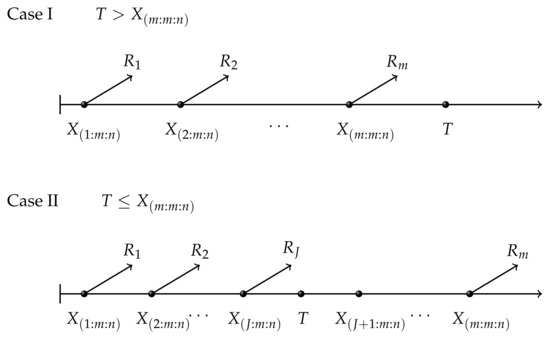
Figure 1.
Adaptive type II progressive censoring.
Since the adaptive type II progressive censoring scheme was proposed, its good property has attracted a great number of researchers to study this field. The adaptive progressive type II censoring model was further studied in Ref. [4]. Under this censoring model, Ref. [5] also studied the estimator of unknown parameters of Weibull distribution. The classical estimations and the Bayesian estimations were both derived from the scheme. The adaptive type II progressive censoring was collaborated with the exponential step-stress accelerated life-testing model to derive confidence intervals in Ref. [6]. Furthermore, this censoring scheme was also extended by taking account of competing risks under two-Parameter Rayleigh Distribution and making classical and Bayesian inference by Ref. [7].
1.2. The Exponentiated Half-Logistic Distribution
The exponentiated half-logistic distribution (EHL) is extremely famous in numerous applications particularly in parameter estimates. It has been applied in many areas, including insurance, engineering, medicine, education, etc. This distribution is suitable for modeling lifetime data and is extremely parallel to the two-parameter family of distributions, which is noted in Ref. [8]. For example, the Gamma distribution is an important distribution in the two-parameter family of distributions. However, compared to the Gamma distribution, exponentiated half-logistic distribution has a whip hand due to the closed form of its cumulative distribution.
In this article, we focus on the exponentiated half-logistic distribution. The probability density function (PDF) is written as:
and the cumulative distribution function (CDF) is described as
where is the shape parameter and is the scale parameter. We denote this distribution as EHI(,).
The corresponding reliability function is written as:
while the hazard rate function is:
From Figure 2, when , the PDF of the exponentiated half-logistic distribution is unimodal. In addition, while , it becomes monotonically decreasing. When is fixed, the smaller is, the more sharply the PDF decreases. As for the CDF of the distribution, the growth of CDF becomes slow with increasing. Furthermore, smaller results in a higher rising rate.
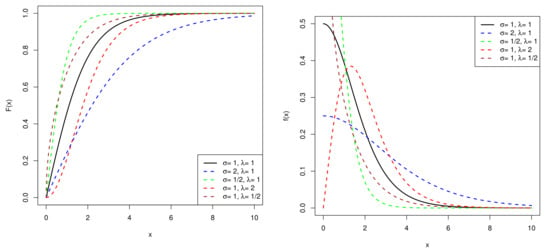
Figure 2.
CDF (left) and PDF (right) of exponentiated half-logistic distribution.
When , the exponentiated half-logistic distribution degrades into the renowned half logistic distribution. The half logistic distribution has extensive use particularly employed in censored data in the area of survival analysis. This distribution has been studied by some researchers. The order statistics of the half logistic distribution was studied in Ref. [9]. On the basis of progressively type II censored data, Ref. [10] derived the classical and Bayes estimators of the scale parameter of this distribution. In accordance with the study results of [10], analytic expressions were studied further for the biases of the maximum likelihood estimators of the distribution in [11]. The generalized ranked-set sampling technique was employed for obtaining parameters estimation of the half-logistic distribution in [12].
The exponentiated half-logistic distribution has recently attracted a lot of researchers. On the basis of progressive Type-II censored data, Ref. [13] derived the maximum likelihood estimator of the scale parameter in an exponentiated half logistic distribution and proposed some approximate maximum likelihood estimators as well. In addition to the MLE, Ref. [14] focused on the moment estimators and entropy estimator in this distribution. For the purpose of promoting practicability of the distribution, Ref. [15] extended the exponentiated half-logistic distribution by putting forward the concept of the exponentiated half-logistic family, which is a fresh generator of continuous distributions of two excess parameters. Considering that the life test sometimes stops at a pre-determined time, Ref. [16] developed acceptance sampling for the percentiles of this distribution. Meanwhile, not only the operating characteristic values of the sampling plans but also the producer’s risk were shown. Based on the distribution, Ref. [17] proposed an attribute control chart for time truncated life tests with different shape parameters. Thus far, research associated with this distribution has a great deal of space to explore.
In this article, the problem of the point and interval estimation of the parameters for exponentiated half logistic distribution under adaptive type II progressive censored data are considered. We organize the remainder paper as follows. In Section 2, the maximum likelihood estimates are derived and computed. Meanwhile, the observed and expected Fisher information matrix is acquired and then the asymptotic confidence intervals are established. We employ the bootstrap resampling method to build two bootstrap confidence intervals in Section 3. As for Section 4, Bayesian estimations under several loss functions are carried out by utilizing the Lindley method. The importance sampling method is also used to calculate the Bayesian estimates and construct the highest posterior density (HPD) credible intervals. Simulations are conducted and the behaviors of estimators obtained with the diverse methods are evaluated and compared in Section 5. An authentic data set is studied to illustrate the effectiveness of estimation means in the above sections in Section 6. In the end, the conclusions of point and interval estimations are drawn in Section 7.
2. Maximum Likelihood Estimation
2.1. Point Estimation
In this section, maximum likelihood estimation is used to estimate the unknown parameters on the basis of the adaptive type II progressive censored data. Assume that the adaptive type II progressive censored data come from an exponentiated half-logistic distribution. Let denote the i-th observation, thus we know . In addition, T represents the expected experimental time and J denotes the index of the last failure before time T.
For the sake of simplicity, let denote . The likelihood function turns to be
where
The corresponding likelihood function is derived as
Therefore, the log-likelihood function can be obtained by
where D is a constant.
Finding the partial derivatives involving and separately and letting them equal zero, the equations correspond to
where , , .
The roots of the equations correspond to the MLEs. However, owing to the nonlinearity of the equations, obviously we can not obtain the explicit expressions. Thus, the Newton–Raphson method is employed to solve this problem. The Newton–Raphson method is an important method to find the roots of equations by employing the Taylor series method. Thus, the Newton–Raphson method is employed to acquire the MLEs, written as and .
2.2. Asymptotic Confidence Interval
In this subsection, the asymptotic confidence intervals for and are established by employing and . We acquire the asymptotic confidence intervals for and from the variance–covariance matrix, which is also known as the inverse Fisher information matrix. The Fisher information matrix is a generalization of the Fisher information amount. The Fisher information amount represents the average amount of information about the state parameters in a certain sense that a sample of random variables can provide. The Fisher information matrix (FIM) is
Here,
where .
The FIM is called the expected Fisher matrix. It is determined by the distribution of the order statistics . The PDF of based on the progressive type II censored sample generally can be derived from [1].
where
The adaptive progressive type II censoring is considered as an improvement of the progressive type II censoring. Actually, the PDF of of EHL(,) under adaptive progressive type II censoring turns out to be
where
After sorting out, the formula (15) can be written as
Afterwards, we can calculate Fisher information matrix FIM directly based on (16). In order to simplify complex calculation, the observed Fisher Information matrix is employed skillfully to approximate the expected Fisher information matrix, and then the variance–covariance matrix can be obtained. Then, the turns out to be
Here, and are the MLEs of and separately.
Then, the asymptotic variance–covariance matrix is the inverse of the observed Fisher Information matrix , denoted as .
Thus, the % asymptotic confidence intervals for and can be constructed as
and
where denotes the upper -th quantile of the standard normal distribution.
3. Bootstrap Confidence Intervals
It is noticed that the classical theory works well with a large sample size while it makes little sense on the condition that the sample size is small. Thus, the bootstrap methods are applied to provide more precise confidence intervals.
The two most commonly used bootstrap methods are proposed, see [18]. One is the percentile bootstrap method (boot-p). It replaces the distribution of original sample statistics with the distribution of Bootstrap sample statistics to establish confidence intervals. The other is the bootstrap-t method (boot-t). In addition, the core idea of this method is to convert the Bootstrap sample statistic into the corresponding t statistic. The detailed procedure for simulation of the two bootstrap methods is listed, see Algorithms 1 and 2.
| Algorithm 1: Constructing percentile bootstrap confidence intervals |
|
3.1. Percentile Bootstrap Confidence Intervals
Then, the Boot-p confidence intervals are given by and , where and are the integer parts of and , respectively.
3.2. Bootstrap-t Confidence Intervals
Then, the Boot-t confidence intervals are given by
and
where and are the integer parts of and , respectively.
| Algorithm 2: Constructing bootstrap-t confidence intervals |
|
4. Bayesian Estimation
In this section, we compute the Bayesian estimates of the quantities by using the Lindley method and the importance sampling procedure. Unlike classical statistics, Bayesian statistics treat quantities as random variables, which combines the prior information with observed information.
The option of prior distribution is a pivotal problem. Generally speaking, the conjugate prior distribution is the first choice due to its algebraic simplicity. However, it is very difficult to find such prior when both quantities and are unknown. The prior distribution is reasonable to keep the same form as (6). Suppose that and and that these two priors are independent. The PDFs of their prior distributions correspond to
The corresponding joint distribution is
Given the sample , the posterior distribution can be written as
4.1. Symmetric and Asymmetric Loss Functions
The loss function is employed to appraise the intensity of inconsistency between the estimation of the parameter and the true value. The squared error loss function is a symmetric loss function, which is applied in many areas. However, on the condition that overestimation causes greater loss compared with underestimation or vice versa, using a symmetric loss function is not suitable. Instead, the asymmetric loss function is employed to fix the problem. Therefore, we consider the Bayesian estimations under one symmetric loss function, namely the squared error loss function (SELF) as well as two asymmetric loss functions, namely the Linex Loss Function (LLF) and the General Entropy Loss Function (GELF) in this subsection.
4.1.1. Squared Error Loss Function (SELF)
The squared error loss function is a symmetric loss function, which puts the overestimate and underestimate on the same level. It is the sum of squared distances between the target variable and the predicted value. The function corresponds to
where is the estimation of .
The Bayesian estimation of under SELF is given by
Then, for the unknown parameters and , the Bayesian estimates under SELF can be given directly as
4.1.2. Linex Loss Function (LLF)
The Linex function is a well-known asymmetric loss function. It is defined as
The size of p denotes the level of asymmetry and its sign represents the direction of asymmetry. For , LLF alters exponentially in the negative direction and linearly in the positive direction, thus a negative bias has a more serious impact—while, for , the positive error will be punished heavily. The larger the dimension of p is, the larger the punishment intensity is. When approaches 0, LLF is almost symmetric.
The Bayesian estimation of under LLF is written as
Then, for unknown parameters and , the Bayesian estimates under LLF are
4.1.3. General Entropy Loss Function (GELF)
The General Entropy loss function (GELF) is another noted asymmetric loss function, which is
For , the overestimation has a more serious impact compared with the underestimation, and vice versa. The Bayesian estimation of under GELF is derived:
Notably, when , the Bayesian estimation under GELF has the same value as that under SELF. The Bayesian estimates of and under GELF correspond to
We can know that the Bayesian estimates of and are in the modality of a ratio of two complicated integrals and the specific and explicit forms cannot be represented without trouble. Thus, the Lindley method is employed to solve this problem.
4.2. Lindley Approximation Method
In this subsection, in order to compute the Bayesian estimates, we apply the Lindley approximation method. Let denote any function about and , l denote the log-likelihood function and . According to the [19], the Bayesian estimates can be expressed by the posterior expectation of
where
Here, and denotes the -th component of the covariance matrix. Then, the Bayesian estimates under three loss functions SELF, LLF, and GELF are derived.
4.2.1. Squared Error Loss Function (SELF)
For , let ; therefore,
Then, the Bayesian estimate of under SELF is
Similarly, for parameter , it is clear that , hence
Then, the Bayesian estimate of under SELF can be written as
4.2.2. Linex Loss Function (LLF)
For , we take , hence
The Bayesian estimate of under LLF is derived as
Similarly, for the parameter , let , hence
The Bayesian estimate of under LLF can be written as
4.2.3. General Entropy Loss Function (GELF)
For parameter , let , hence
The Bayesian estimate of under GELF can be written as
Similarly, for parameter , , it is clear that , hence
The Bayesian estimate of under GELF can be written as
Though the Lindley approximation is effective to obtain point estimations by estimating the ratio of integrals, it can not provide credible intervals of the unknown parameters. Therefore, the importance sampling method is adopted to gain not only point estimation but also credible intervals.
4.3. Importance Sampling Procedure
The importance sampling procedure is an extension to the Monte Carlo method, which can greatly reduce the number of sample points drawn in the simulation, and is widely used in the reliability analysis of various models. From (6) and (21), the joint posterior distribution is derived by
where
It is clear that is the PDF of an inverse Gamma distribution while is the PDF of a Gamma distribution.
Therefore, the Bayesian estimation of is acquired by the following steps:
- Generate from .
- On the basis of step 1, generate from .
- Repeat step 1 and step 2 M times and produce a series of samples.
- The Bayesian estimate of is calculated by
Therefore, the Bayesian estimate of the unknown parameter and is derived by
Let
For the sake of simplicity, is denoted as . Then, we sort in ascending order as . In addition, we combine and together as . The HPD credible interval is established based on the estimate , where is an integer that satisfies
Hence, the credible interval can be represented as , . Therefore, the HPD credible for is obtained by . Note that for all .
5. Simulation
Plenty of simulation experiments are carried out to appraise the performance of our estimations by Monte Carlo simulations. Here, the R software is employed for all the simulations. The point estimation is evaluated by the mean square error (MSE) and estimation value (VALUE), while the interval estimation is assessed based on the coverage rate (CR) and interval mean length (ML). For point estimation, smaller mean square error and closer estimation value suggest better performance of estimation. In addition, for interval estimation, the higher the coverage rate is and the narrower the interval mean length is, the better the estimation is.
First of all, adaptive type II progressive censored data from an exponentiated half-logistic distribution should be generated. The algorithm for generating adaptive Type II progressive censored data from a general distribution can be obtained in [3]. The algorithm to generate the censored data is listed in Algorithm 3.
| Algorithm 3: Generating adaptive type II progressive censored data from EHL(). |
|
In order to carry out simulations, we set and . For comparison purposes, we consider and . For all the combinations of sample size and time T, two different censoring schemes (CS) are chosen:
- Scheme I (Sch I): .
- Scheme II (Sch II): .
In addition, the specific diverse censoring schemes conceived for the simulation are listed in Table 1.

Table 1.
Different censoring schemes.
For simplicity, we abbreviate the censoring schemes. For example, (1, 1, 1, 0, 0, 0, 0) is represented as (1*3, 0*4). In each case, the simulation is repeated 3000 times. Then, the associated MSEs and VALUEs with the point estimation and the related coverage rates and mean lengths with the interval estimation can be acquired through Monte Carlo simulations using R software.
For maximum likelihood estimation, the L-BFGS-B method is used and the simulation results are put into Table A1. In Bayesian estimation, we employ not only non-informative priors (non-infor) but also informative priors (infor). For the non-informative priors, we set . Then, for the informative priors, we should first determine the hyper-parameters for Bayesian estimation. Generally speaking, the actual value of the parameter is usually considered as the expectation of the prior distribution. However, due to the complexity and interactive influence of the two prior distributions, the optimal value can not be found directly. Thus, we adopt a genetic algorithm and simulated annealing algorithm to determine the optimal hyper-parameters and the results are: . To get Bayesian point estimation, the Lindley method and the importance sampling method are employed. Three loss functions are adopted separately for comparison purposes. The parameter p of LLF is set to 0.5 and 1 and the parameter q of GELF is set to and 0.5.
The informative Bayes method uses minimization of loss functions, and such minimizations can only be performed if the true parameter values are known. Hence, informative Bayes can only be seen as a reference, or an oracle method.
The results are presented in Table A2, Table A3, Table A4, Table A5, Table A6, Table A7, Table A8 and Table A9. In addition, the mean length and coverage rate of asymptotic confidence intervals, boot-t intervals, boot-p intervals, and HPD intervals at 95% confidence/credible level are also shown in Table A10 and Table A11.
Due to the excessive amount of tables, it is not easy for readers to find rules of the estimation. Therefore, some figures which present the most representative simulation results are made to show the rules more intuitively. Figure 3 and Figure 4 present the MSEs of the maximum likelihood estimates of the two parameters under censoring scheme I and censoring scheme II when . Figure 5 and Figure 6 compare the MSEs of maximum likelihood estimates with the Bayesian estimates with non-informative and informative priors obtained by importance sampling under censoring scheme I and .
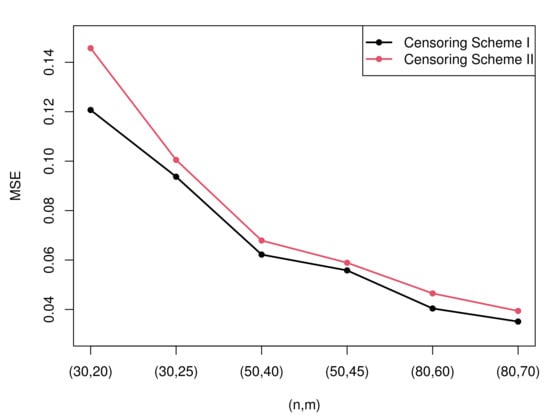
Figure 3.
The MSEs of the MLEs of parameter under two censoring schemes.
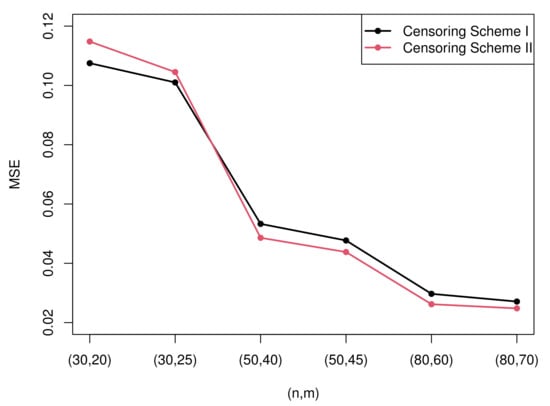
Figure 4.
The MSEs of the MLEs of parameter under two censoring schemes.
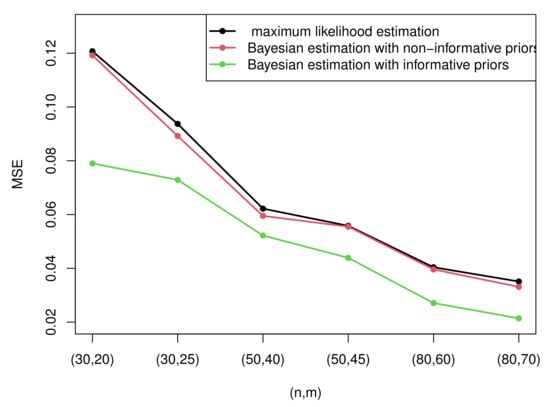
Figure 5.
The MSEs of MLEs and Bayesian estimates with non-informative and informative priors of parameter .
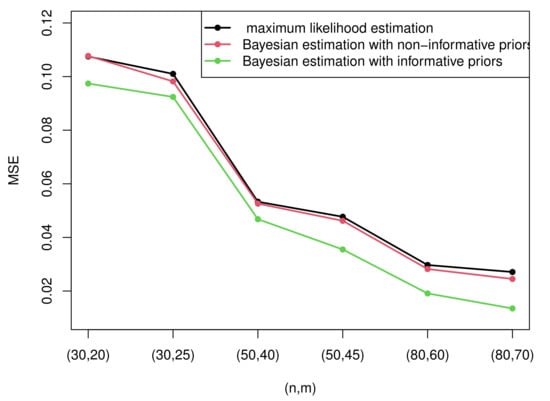
Figure 6.
The MSEs of MLEs and Bayesian estimates with non-informative and informative priors of parameter .
From Table A1, we can draw that
- (1)
- (2)
- The MLEs of perform better than the MLEs of according to the MSE. However, the estimation values of are closer to the true value compared with those of .
- (3)
- (4)
- There is no observed specific pattern with the change of T. It is apprehensible because the observed data may remain unaltered when T changes.
From Table A2, Table A3, Table A4, Table A5, Table A6, Table A7, Table A8 and Table A9, we can find that
- (1)
- Generally, the Bayesian estimates under three loss functions with informative priors are more accurate contrasted with MLEs in terms of MSE in all cases. This rule can be intuitively summarized from Figure 5 and Figure 6. This is because the Bayesian method not only considers the data but also takes the prior information of unknown parameters into account. In addition, the importance sampling procedure outperforms the Lindley method.
- (2)
- From Figure 5 and Figure 6, it is clear that the performance of the Bayesian estimates with non-informative priors is almost similar to MLEs under all circumstances. This is because we have no information with respect to the unknown parameters. In other words, it only takes the data into account. Thus, it is reasonable that the results are analogous to MLEs.
- (3)
- The Bayesian estimates under GELF are superior compared with those under SELF and LLF. For LLF, Bayesian estimates under are better than those under for the parameter , while choosing is better than for the estimate of . For GELF, take the fact that both and are satisfactory and perform well. On the whole, the Bayesian estimates under GELF using the importance sampling procedure are the most effective as they possess the minimal MSEs and the closest estimation values.
- (4)
- When is considered, Sch I performs better than Sch II except when , yet when is taken into account, Sch II is superior compared with Sch I in most cases.
- (1)
- The mean lengths of all the intervals become narrower as n and m increase, and this pattern holds for both and . In addition, the coverage rate of intervals of is higher while the coverage rate of intervals of is stable with the increase of m and n.
- (2)
- The HPD credible intervals and boot-t intervals perform better contrasted by asymptotic confidence intervals due to narrower mean length and higher coverage rate. In addition, the HPD credible intervals possess the narrowest mean length while the boot-t intervals have the highest coverage rate.
- (3)
- The results of the two parameters’ intervals have no obvious connection with different censoring schemes.
6. Real Data Analysis
An authentic dataset is analyzed for expository intention by employing the methods mentioned above in this section. The dataset was initially from [20] and further employed by [21,22]. The complete data set describes log times to the breakdown of an insulating fluid testing experiment and is presented in Table 2.
Table 2.
Real data set.
At the beginning, we should consider the problem whether the distribution EHL fits the data set well. The fitting effect of exponentiated half-logistic distribution and Half Logistic distribution with the CDF is compared. The criteria employed for examining the goodness of fit include the negative log-likelihood function (), Kolmogorov–Smirnov (K-S) statistics with its p-value, Bayesian Information Criterion (BIC), and Akaike Information Criterion (AIC). The definitions are:
where d is the number of parameters, L is the maximized value of the likelihood function, and n denotes the total number of observed values.
The results of the K-S, p-value, AIC, BIC, and of the two distributions are listed in Table 3. Obviously, exponentiated half-logistic distribution fits the model better since it has lower K-S, AIC, BIC, statistics, and higher p-value. Then, we can analyze this data on the basis of our model.
Table 3.
The fitting results of the two distributions.
We set and 2. The two different censoring schemes are and . Table 4 presents the specific adaptive type II censoring data under different schemes based on the data set.
Table 4.
Adaptive progressive type II censoring data under different schemes.
The point estimations for and are presented in Table 5 and Table 6. For Bayesian estimation, since we have no informative prior, a non-informative prior is applied, namely . Three loss functions are considered, and we still use the parameters in the previous simulation. At the same time, 95% ACIs, boot-p, boot-t, and HPD intervals are established, while Table 7 and Table 8 display the corresponding results. Let Lower denote the lower bound and Upper denote the upper bound.
Table 5.
The MLEs and Bayesian estimates of under SELF, LLF, and GELF by the Lindley approximation and the importance sampling.
Table 6.
The MLEs and Bayesian estimates of under SELF, LLF, and GELF by the Lindley approximation and the importance sampling.
Table 7.
The four intervals for at the 95% confidence/credible level.
Table 8.
The four intervals for at the 95% confidence/credible level.
- (1)
- The estimates of parameter using the Lindley method generally tend to be larger than those gained by the importance sampling procedure.
- (2)
- The estimates under the first censoring scheme are closer to the MLEs under the full sample, and the estimations using the Lindley method are more effective than those obtained by the importance sampling.
- (3)
- The results are relatively close between and when using the first censoring scheme because the observed data remain unaltered when the T is increasing.
- (4)
- The HPD credible intervals have the narrowest mean length among all the intervals while the ACIs possess the longest mean length.
- (5)
- The results of the two parameters’ intervals have no obvious connection with different censoring schemes.
7. Conclusions
In this manuscript, classical and Bayesian inference for exponentiated half-logistic distribution under adaptive Type II progressive censoring is considered. The maximum likelihood estimates are derived through the Newton–Raphson algorithm. Bayesian estimation under three loss functions is also considered and the estimates are derived through importance sampling and the Lindley method. Meanwhile, we establish the confidence and credible intervals of and and contrast them with each other. Asymptotic confidence intervals are constructed based on observed and expected Fisher information matrices. In order to tackle the problem of small sample size, boot-p and boot-t intervals are computed.
In the simulation section, estimation values and mean squared values are calculated to test the performance of the point estimation while mean lengths and coverage rates are considered for the interval estimation. According to the simulation results, it is clear that the Bayesian estimation which possesses suitable informative priors performs better than MLEs under all circumstances. In more detail, the Bayesian estimations under GELF perform best among all the estimations and the importance sampling procedure makes more sense than Lindley approximation. In addition, when it comes to interval estimation, boot-t and boot-p intervals perform better in the case of a small sample size than asymptotic confidence intervals. In addition, HPD credible intervals generally possess the shortest mean length while boot-t intervals have the highest coverage rate compared with other intervals.
Exponentiated half-logistic distribution under adaptive Type II progressive censoring is significant and practical due to the flexibility of the censoring scheme and the superior features of distribution. Furthermore, the competing risks and accelerated life test can be explored in the research field. In brief, carrying out further research on this model has great potential for survival and reliability analysis.
Author Contributions
Investigation, Z.X.; Supervision, W.G. All authors have read and agreed to the published version of the manuscript.
Funding
This research was supported by Project 202210004001 which was supported by NationalTraining Program of Innovation and Entrepreneurship for Undergraduates.
Institutional Review Board Statement
Not applicable.
Informed Consent Statement
Not applicable.
Data Availability Statement
The data presented in this study are openly available in [20].
Conflicts of Interest
The authors declare no conflict of interest.
Appendix A. The Simulation Results of MLEs
Table A1.
The simulation results of MLEs for and .
Table A1.
The simulation results of MLEs for and .
| T | n | m | Sch | ||||
|---|---|---|---|---|---|---|---|
| VALUE | MSE | VALUE | MSE | ||||
| 2 | 30 | 20 | I | 1.4694 | 0.1207 | 1.1028 | 0.1075 |
| II | 1.4661 | 0.1457 | 1.1075 | 0.1138 | |||
| 25 | I | 1.4667 | 0.0937 | 1.1024 | 0.1010 | ||
| II | 1.4754 | 0.1005 | 1.1006 | 0.1025 | |||
| 50 | 40 | I | 1.4787 | 0.0622 | 1.0607 | 0.0533 | |
| II | 1.4792 | 0.0649 | 1.0565 | 0.0496 | |||
| 45 | I | 1.4832 | 0.0558 | 1.0580 | 0.0477 | ||
| II | 1.4816 | 0.0559 | 1.0553 | 0.0458 | |||
| 80 | 60 | I | 1.4898 | 0.0404 | 1.0403 | 0.0297 | |
| II | 1.4858 | 0.0425 | 1.0341 | 0.0272 | |||
| 70 | I | 1.4858 | 0.0351 | 1.0348 | 0.0271 | ||
| II | 1.4892 | 0.0364 | 1.0337 | 0.0258 | |||
| 4 | 30 | 20 | I | 1.4651 | 0.1260 | 1.1133 | 0.1140 |
| II | 1.4573 | 0.1316 | 1.1152 | 0.1170 | |||
| 25 | I | 1.4655 | 0.0990 | 1.1063 | 0.1039 | ||
| II | 1.4661 | 0.1025 | 1.1049 | 0.1057 | |||
| 50 | 40 | I | 1.4772 | 0.0583 | 1.0569 | 0.0503 | |
| II | 1.4857 | 0.0655 | 1.0500 | 0.0454 | |||
| 45 | I | 1.4823 | 0.0572 | 1.0518 | 0.0474 | ||
| II | 1.4805 | 0.0580 | 1.0542 | 0.0456 | |||
| 80 | 60 | I | 1.4904 | 0.0419 | 1.0342 | 0.0305 | |
| II | 1.4912 | 0.0445 | 1.0303 | 0.0288 | |||
| 70 | I | 1.4843 | 0.0352 | 1.0342 | 0.0266 | ||
| II | 1.4884 | 0.0369 | 1.0336 | 0.0264 | |||
Appendix B. The Simulation Results of Bayesian Estimates with Non-Informative Priors
Table A2.
The results of Bayesian estimates with non-informative priors for using the Lindley method.
Table A2.
The results of Bayesian estimates with non-informative priors for using the Lindley method.
| T | n | m | ||||||||||
|---|---|---|---|---|---|---|---|---|---|---|---|---|
| VALUE | MSE | VALUE | MSE | VALUE | MSE | VALUE | MSE | VALUE | MSE | |||
| 2 | 30 | 20 | 1.5300 | 0.1187 | 1.5303 | 0.1183 | 1.5301 | 0.1201 | 1.5309 | 0.1156 | 1.5296 | 0.1117 |
| 1.5328 | 0.1415 | 1.5347 | 0.1376 | 1.5335 | 0.1397 | 1.5333 | 0.1386 | 1.5329 | 0.1397 | |||
| 25 | 1.5289 | 0.0926 | 1.5336 | 0.0891 | 1.5323 | 0.0916 | 1.5327 | 0.0917 | 1.5330 | 0.0864 | ||
| 1.5346 | 0.1003 | 1.5247 | 0.1010 | 1.5244 | 0.9938 | 1.5242 | 0.0971 | 1.5242 | 0.0965 | |||
| 50 | 40 | 1.5209 | 0.0596 | 1.5221 | 0.0612 | 1.5209 | 0.0603 | 1.5210 | 0.0622 | 1.5201 | 0.0572 | |
| 1.5206 | 0.0636 | 1.5210 | 0.0659 | 1.5200 | 0.0632 | 1.5199 | 0.0657 | 1.5198 | 0.0603 | |||
| 45 | 1.5202 | 0.0541 | 1.5175 | 0.0546 | 1.5167 | 0.0559 | 1.5164 | 0.0504 | 1.5162 | 0.0525 | ||
| 1.5195 | 0.0563 | 1.5194 | 0.0548 | 1.5181 | 0.0560 | 1.5174 | 0.0535 | 1.5183 | 0.0504 | |||
| 80 | 60 | 1.5092 | 0.0402 | 1.5105 | 0.0401 | 1.5098 | 0.0397 | 1.5101 | 0.0353 | 1.5092 | 0.0285 | |
| 1.5136 | 0.0438 | 1.5143 | 0.0431 | 1.5138 | 0.0419 | 1.5137 | 0.0415 | 1.5131 | 0.0404 | |||
| 70 | 1.5126 | 0.0341 | 1.5148 | 0.0339 | 1.5141 | 0.0348 | 1.5134 | 0.0312 | 1.5132 | 0.0329 | ||
| 1.5104 | 0.0358 | 1.5116 | 0.0371 | 1.5106 | 0.0360 | 1.5105 | 0.0336 | 1.5104 | 0.0375 | |||
| 4 | 30 | 20 | 1.5324 | 0.1200 | 1.5359 | 0.1270 | 1.5339 | 0.1237 | 1.5341 | 0.1173 | 1.5343 | 0.1214 |
| 1.5367 | 0.1297 | 1.5433 | 0.1281 | 1.5427 | 0.1268 | 1.5421 | 0.1296 | 1.5415 | 0.1246 | |||
| 25 | 1.5327 | 0.0970 | 1.5354 | 0.0980 | 1.5340 | 0.0960 | 1.5338 | 1.0002 | 1.5343 | 0.0964 | ||
| 1.5292 | 0.0983 | 1.5347 | 0.1031 | 1.5339 | 0.1059 | 1.5331 | 0.1020 | 1.5331 | 0.1025 | |||
| 50 | 40 | 1.5196 | 0.0579 | 1.5235 | 0.0579 | 1.5218 | 0.0521 | 1.5221 | 0.0561 | 1.5220 | 0.0524 | |
| 1.5183 | 0.0633 | 1.5149 | 0.0652 | 1.5136 | 0.0565 | 1.5133 | 0.0628 | 1.5136 | 0.0586 | |||
| 45 | 1.5168 | 0.0580 | 1.5182 | 0.0552 | 1.5168 | 0.0532 | 1.5170 | 0.0521 | 1.5174 | 0.0542 | ||
| 1.5195 | 0.0584 | 1.5197 | 0.0598 | 1.5188 | 0.0570 | 1.5192 | 0.0579 | 1.5186 | 0.0559 | |||
| 80 | 60 | 1.5109 | 0.0403 | 1.5097 | 0.0402 | 1.5091 | 0.0405 | 1.5086 | 0.0407 | 1.5085 | 0.0358 | |
| 1.5088 | 0.0414 | 1.5098 | 0.0430 | 1.5088 | 0.0435 | 1.5083 | 0.0412 | 1.5080 | 0.0582 | |||
| 70 | 1.5121 | 0.0326 | 1.5160 | 0.0372 | 1.5150 | 0.0331 | 1.5151 | 0.0299 | 1.5156 | 0.0331 | ||
| 1.5105 | 0.0334 | 1.5124 | 0.0353 | 1.5108 | 0.0362 | 1.5113 | 0.0361 | 1.5105 | 0.0371 | |||
Table A3.
The results of Bayesian estimates with non-informative priors for using the Lindley method.
Table A3.
The results of Bayesian estimates with non-informative priors for using the Lindley method.
| T | n | m | ||||||||||
|---|---|---|---|---|---|---|---|---|---|---|---|---|
| VALUE | MSE | VALUE | MSE | VALUE | MSE | VALUE | MSE | VALUE | MSE | |||
| 2 | 30 | 20 | 1.1021 | 0.1065 | 1.1024 | 0.1075 | 1.1019 | 0.1062 | 1.1017 | 0.1059 | 1.1018 | 0.1062 |
| 1.1064 | 0.1129 | 1.1071 | 0.1147 | 1.1063 | 0.1127 | 1.1071 | 0.1134 | 1.1055 | 0.1125 | |||
| 25 | 1.1024 | 0.1012 | 1.1021 | 0.1003 | 1.1019 | 0.1003 | 1.1006 | 0.1000 | 1.1019 | 0.0991 | ||
| 1.0999 | 0.1014 | 1.0996 | 0.1022 | 1.0990 | 0.1022 | 1.1005 | 0.1016 | 1.0995 | 0.1016 | |||
| 50 | 40 | 1.0594 | 0.0524 | 1.0604 | 0.0539 | 1.0600 | 0.0523 | 1.0604 | 0.0514 | 1.0590 | 0.0524 | |
| 1.0563 | 0.0491 | 1.0561 | 0.0489 | 1.0558 | 0.0481 | 1.0547 | 0.0487 | 1.0561 | 0.0487 | |||
| 45 | 1.0578 | 0.0474 | 1.0570 | 0.0461 | 1.0567 | 0.0463 | 1.0572 | 0.0479 | 1.0565 | 0.0462 | ||
| 1.0543 | 0.0454 | 1.0552 | 0.0439 | 1.0551 | 0.0449 | 1.0534 | 0.0454 | 1.0551 | 0.0444 | |||
| 80 | 60 | 1.0393 | 0.0282 | 1.0393 | 0.0285 | 1.0392 | 0.0313 | 1.0387 | 0.0282 | 1.0400 | 0.0290 | |
| 1.0328 | 0.0267 | 1.0325 | 0.0260 | 1.0330 | 0.0275 | 1.0325 | 0.0255 | 1.0339 | 0.0256 | |||
| 70 | 1.0342 | 0.0266 | 1.0338 | 0.0264 | 1.0347 | 0.0261 | 1.0330 | 0.0259 | 1.0341 | 0.0269 | ||
| 1.0327 | 0.0250 | 1.0324 | 0.0250 | 1.0335 | 0.0268 | 1.0336 | 0.0256 | 1.0317 | 0.0257 | |||
| 4 | 30 | 20 | 1.1121 | 0.1138 | 1.1123 | 0.1120 | 1.1127 | 0.1122 | 1.1124 | 0.1135 | 1.1119 | 0.1128 |
| 1.1145 | 0.1176 | 1.1140 | 0.1158 | 1.1148 | 0.1164 | 1.1144 | 0.1157 | 1.1140 | 0.1155 | |||
| 25 | 1.1053 | 0.1032 | 1.1057 | 0.1028 | 1.1060 | 0.1024 | 1.1055 | 0.1031 | 1.1054 | 0.1023 | ||
| 1.1034 | 0.1059 | 1.1048 | 0.1038 | 1.1034 | 0.1054 | 1.1047 | 0.1042 | 1.1040 | 0.1049 | |||
| 50 | 40 | 1.0566 | 0.0501 | 1.0560 | 0.0490 | 1.0558 | 0.0493 | 1.0568 | 0.0493 | 1.0560 | 0.0490 | |
| 1.0493 | 0.0450 | 1.0491 | 0.0448 | 1.0487 | 0.0446 | 1.0491 | 0.0460 | 1.0492 | 0.0449 | |||
| 45 | 1.0509 | 0.0462 | 1.0517 | 0.0470 | 1.0517 | 0.0473 | 1.0501 | 0.0459 | 1.0507 | 0.0459 | ||
| 1.0527 | 0.0448 | 1.0530 | 0.0449 | 1.0525 | 0.0450 | 1.0527 | 0.0457 | 1.0527 | 0.0436 | |||
| 80 | 60 | 1.0338 | 0.0297 | 1.0337 | 0.0297 | 1.0340 | 0.0293 | 1.0330 | 0.0297 | 1.0340 | 0.0292 | |
| 1.0297 | 0.0290 | 1.0290 | 0.0272 | 1.0300 | 0.0278 | 1.0288 | 0.0287 | 1.0287 | 0.0285 | |||
| 70 | 1.0326 | 0.0260 | 1.0331 | 0.0268 | 1.0334 | 0.0264 | 1.0336 | 0.0252 | 1.0340 | 0.0263 | ||
| 1.0328 | 0.0263 | 1.0324 | 0.0253 | 1.0324 | 0.0258 | 1.0332 | 0.0262 | 1.0316 | 0.0247 | |||
Table A4.
The results of Bayesian estimates with non-informative priors for using importance sampling.
Table A4.
The results of Bayesian estimates with non-informative priors for using importance sampling.
| T | n | m | ||||||||||
|---|---|---|---|---|---|---|---|---|---|---|---|---|
| VALUE | MSE | VALUE | MSE | VALUE | MSE | VALUE | MSE | VALUE | MSE | |||
| 2 | 30 | 20 | 1.5302 | 0.1207 | 1.4709 | 0.1089 | 1.4641 | 0.1172 | 1.5326 | 0.1205 | 1.5251 | 0.1298 |
| 1.5382 | 0.1419 | 1.5321 | 0.1323 | 1.5292 | 0.1391 | 1.5328 | 0.1356 | 1.5307 | 0.1438 | |||
| 25 | 1.5305 | 0.0892 | 1.5301 | 0.0882 | 1.5246 | 0.0815 | 1.5327 | 0.0822 | 1.5299 | 0.0844 | ||
| 1.5393 | 0.0997 | 1.5327 | 0.0989 | 1.5257 | 0.0907 | 1.5311 | 0.0925 | 1.5279 | 0.0942 | |||
| 50 | 40 | 1.5293 | 0.0595 | 1.5275 | 0.0616 | 1.5244 | 0.0589 | 1.5203 | 0.0585 | 1.5242 | 0.0558 | |
| 1.5253 | 0.0631 | 1.5220 | 0.0602 | 1.5291 | 0.0675 | 1.5253 | 0.0593 | 1.5281 | 0.0653 | |||
| 45 | 1.5269 | 0.0568 | 1.5296 | 0.0567 | 1.5266 | 0.0541 | 1.5290 | 0.0557 | 1.5237 | 0.0536 | ||
| 1.5253 | 0.0562 | 1.5270 | 0.0527 | 1.5248 | 0.0548 | 1.5277 | 0.0571 | 1.5226 | 0.0550 | |||
| 80 | 60 | 1.5126 | 0.0403 | 1.5125 | 0.0357 | 1.5109 | 0.0396 | 1.5179 | 0.0389 | 1.5147 | 0.0376 | |
| 1.5098 | 0.0428 | 1.5151 | 0.0404 | 1.5135 | 0.0422 | 1.5140 | 0.0444 | 1.5103 | 0.0431 | |||
| 70 | 1.5117 | 0.0350 | 1.5091 | 0.0340 | 1.5078 | 0.0331 | 1.5130 | 0.0340 | 1.5104 | 0.0360 | ||
| 1.5148 | 0.0371 | 1.5078 | 0.0310 | 1.5064 | 0.0331 | 1.5108 | 0.0348 | 1.5082 | 0.0328 | |||
| 4 | 30 | 20 | 1.5288 | 0.1211 | 1.5313 | 0.1121 | 1.5323 | 0.1185 | 1.5330 | 0.1145 | 1.5321 | 0.1225 |
| 1.5378 | 0.1372 | 1.5324 | 0.1366 | 1.5302 | 0.1309 | 1.5363 | 0.1335 | 1.5356 | 0.1371 | |||
| 25 | 1.5298 | 0.0943 | 1.5352 | 0.0906 | 1.5285 | 0.0924 | 1.5227 | 0.0973 | 1.5202 | 0.0990 | ||
| 1.5311 | 0.1021 | 1.5241 | 0.1081 | 1.5370 | 0.0991 | 1.5333 | 0.1054 | 1.5206 | 0.1078 | |||
| 50 | 40 | 1.5265 | 0.0515 | 1.5250 | 0.0556 | 1.5222 | 0.0553 | 1.5274 | 0.0590 | 1.5212 | 0.0562 | |
| 1.5250 | 0.0633 | 1.5241 | 0.0665 | 1.5221 | 0.0634 | 1.5253 | 0.0609 | 1.5290 | 0.0683 | |||
| 45 | 1.5266 | 0.0579 | 1.5241 | 0.0507 | 1.5214 | 0.0584 | 1.5290 | 0.0558 | 1.5239 | 0.0537 | ||
| 1.5240 | 0.0596 | 1.5262 | 0.0556 | 1.5239 | 0.0537 | 1.5263 | 0.0575 | 1.5212 | 0.0553 | |||
| 80 | 60 | 1.5167 | 0.0444 | 1.5101 | 0.0480 | 1.5184 | 0.0468 | 1.5117 | 0.0430 | 1.5183 | 0.0416 | |
| 1.51198 | 0.0479 | 1.5145 | 0.0499 | 1.5130 | 0.0389 | 1.5162 | 0.0465 | 1.5148 | 0.0451 | |||
| 70 | 1.5083 | 0.0337 | 1.5108 | 0.0355 | 1.5095 | 0.0346 | 1.5144 | 0.0327 | 1.5118 | 0.0318 | ||
| 1.5082 | 0.0353 | 1.5069 | 0.0334 | 1.5157 | 0.0356 | 1.5146 | 0.0342 | 1.5121 | 0.0332 | |||
Table A5.
The results of Bayesian estimates with non-informative priors for using importance sampling.
Table A5.
The results of Bayesian estimates with non-informative priors for using importance sampling.
| T | n | m | ||||||||||
|---|---|---|---|---|---|---|---|---|---|---|---|---|
| VALUE | MSE | VALUE | MSE | VALUE | MSE | VALUE | MSE | VALUE | MSE | |||
| 2 | 30 | 20 | 1.1076 | 0.1033 | 1.1079 | 0.1053 | 1.1042 | 0.1003 | 1.1002 | 0.1083 | 1.1004 | 0.1028 |
| 1.1061 | 0.1110 | 1.1086 | 0.1157 | 1.1006 | 0.1173 | 1.1004 | 0.1183 | 1.1078 | 0.1193 | |||
| 25 | 1.1063 | 0.0962 | 1.1023 | 0.0927 | 1.1013 | 0.0914 | 1.1031 | 0.0941 | 0.9085 | 0.0932 | ||
| 1.1089 | 0.0966 | 1.1040 | 0.0918 | 1.1026 | 0.0934 | 1.1051 | 0.0939 | 1.1006 | 0.0948 | |||
| 50 | 40 | 1.0589 | 0.0526 | 1.0513 | 0.0498 | 0.9547 | 0.0501 | 1.0514 | 0.0503 | 0.9470 | 0.0508 | |
| 1.0532 | 0.0468 | 1.0561 | 0.0459 | 0.9493 | 0.0478 | 1.0561 | 0.0463 | 0.9517 | 0.0484 | |||
| 45 | 0.9475 | 0.0432 | 0.9508 | 0.0429 | 0.9531 | 0.0424 | 0.9507 | 0.0432 | 0.9561 | 0.0433 | ||
| 1.0507 | 0.0459 | 1.0518 | 0.0453 | 0.9554 | 0.0457 | 1.0519 | 0.0456 | 0.9585 | 0.0463 | |||
| 80 | 60 | 0.9648 | 0.0282 | 0.9702 | 0.0279 | 0.9723 | 0.0271 | 0.9702 | 0.0281 | 0.9774 | 0.0276 | |
| 0.9694 | 0.0265 | 0.9755 | 0.0264 | 0.9793 | 0.0253 | 0.9754 | 0.0265 | 0.9749 | 0.0257 | |||
| 70 | 0.9773 | 0.0245 | 0.9737 | 0.0245 | 0.9774 | 0.0257 | 0.9735 | 0.0246 | 0.9731 | 0.0262 | ||
| 0.9731 | 0.0261 | 0.9797 | 0.0261 | 0.9705 | 0.0261 | 0.9796 | 0.0262 | 0.9764 | 0.0265 | |||
| 4 | 30 | 20 | 1.1117 | 0.1115 | 1.1143 | 0.1158 | 1.1164 | 0.1108 | 1.1157 | 0.1182 | 1.1126 | 0.1130 |
| 1.1187 | 0.1111 | 1.1155 | 0.1153 | 1.1134 | 0.1155 | 1.1168 | 0.1175 | 1.1112 | 0.1172 | |||
| 25 | 1.1080 | 0.1096 | 1.1032 | 0.1047 | 1.1046 | 0.1084 | 1.1045 | 0.1066 | 1.1021 | 0.1099 | ||
| 1.1042 | 0.1003 | 1.1078 | 0.1096 | 1.1024 | 0.1081 | 1.1087 | 0.1013 | 0.9001 | 0.1097 | |||
| 50 | 40 | 1.0540 | 0.0498 | 0.9489 | 0.0491 | 1.0527 | 0.0522 | 0.9489 | 0.0495 | 0.9450 | 0.0533 | |
| 1.0576 | 0.0488 | 1.0502 | 0.0479 | 1.0552 | 0.0396 | 1.0504 | 0.0384 | 0.9479 | 0.0430 | |||
| 45 | 1.0537 | 0.0482 | 0.9468 | 0.0475 | 0.9548 | 0.0449 | 0.9468 | 0.0479 | 0.9577 | 0.0456 | ||
| 1.0544 | 0.0454 | 0.9477 | 0.0449 | 0.9587 | 0.0447 | 0.9477 | 0.0452 | 0.9518 | 0.0452 | |||
| 80 | 60 | 0.9650 | 0.0307 | 0.9607 | 0.0306 | 0.9682 | 0.0292 | 0.9706 | 0.0307 | 0.9734 | 0.0366 | |
| 0.9675 | 0.0268 | 0.9636 | 0.0267 | 0.9647 | 0.0259 | 0.9635 | 0.0268 | 0.9703 | 0.0363 | |||
| 70 | 0.9630 | 0.0245 | 0.9693 | 0.0245 | 0.9684 | 0.0232 | 0.9692 | 0.0246 | 0.9642 | 0.0337 | ||
| 0.9639 | 0.0261 | 0.9603 | 0.0261 | 0.9622 | 0.0234 | 0.9702 | 0.0262 | 0.9683 | 0.0338 | |||
Appendix C. The Simulation Results of Bayesian Estimates with Informative Priors
Table A6.
The results of Bayesian estimates with informative priors for using the Lindley method.
Table A6.
The results of Bayesian estimates with informative priors for using the Lindley method.
| T | n | m | ||||||||||
|---|---|---|---|---|---|---|---|---|---|---|---|---|
| VALUE | MSE | VALUE | MSE | VALUE | MSE | VALUE | MSE | VALUE | MSE | |||
| 2 | 30 | 20 | 1.5319 | 0.1153 | 1.5307 | 0.1125 | 1.5315 | 0.1259 | 1.4699 | 0.1010 | 1.5329 | 0.1187 |
| 1.5352 | 0.1254 | 1.5338 | 0.1176 | 1.5310 | 0.1301 | 1.4637 | 0.1042 | 1.5305 | 0.1271 | |||
| 25 | 1.5235 | 0.0895 | 1.5298 | 0.0890 | 1.5212 | 0.1117 | 1.4737 | 0.0750 | 1.5295 | 0.0937 | ||
| 1.5295 | 0.1102 | 1.5257 | 0.0984 | 1.5205 | 0.1218 | 1.4741 | 0.0821 | 1.5377 | 0.1018 | |||
| 50 | 40 | 1.5203 | 0.0542 | 1.5217 | 0.0499 | 1.5245 | 0.0516 | 1.4785 | 0.0531 | 1.5235 | 0.0567 | |
| 1.5281 | 0.0566 | 1.5265 | 0.0519 | 1.5248 | 0.0593 | 1.4780 | 0.0545 | 1.5230 | 0.0632 | |||
| 45 | 1.5156 | 0.0417 | 1.5166 | 0.0485 | 1.5105 | 0.0439 | 1.4841 | 0.0440 | 1.5106 | 0.0498 | ||
| 1.5250 | 0.0473 | 1.5256 | 0.0535 | 1.5234 | 0.0448 | 1.4834 | 0.0476 | 1.5236 | 0.0509 | |||
| 80 | 60 | 1.5059 | 0.0357 | 1.5114 | 0.0339 | 1.5133 | 0.0346 | 1.4961 | 0.0315 | 1.5165 | 0.0325 | |
| 1.5154 | 0.0399 | 1.5151 | 0.0436 | 1.5149 | 0.0409 | 1.4992 | 0.0316 | 1.5176 | 0.0462 | |||
| 70 | 1.5033 | 0.0289 | 1.5010 | 0.0276 | 1.5052 | 0.0297 | 1.4993 | 0.0255 | 1.5095 | 0.0283 | ||
| 1.5059 | 0.0294 | 1.5034 | 0.0280 | 1.5023 | 0.0307 | 1.4934 | 0.0257 | 1.5164 | 0.0291 | |||
| 4 | 30 | 20 | 1.5324 | 0.1234 | 1.5312 | 0.1144 | 1.5381 | 0.1292 | 1.4606 | 0.1025 | 1.5305 | 0.1202 |
| 1.5371 | 0.1235 | 1.5356 | 0.1154 | 1.5306 | 0.1364 | 1.4654 | 0.1026 | 1.5391 | 0.1250 | |||
| 25 | 1.5265 | 0.1056 | 1.5227 | 0.0945 | 1.5261 | 0.1094 | 1.4779 | 0.0775 | 1.5244 | 0.0920 | ||
| 1.5242 | 0.1064 | 1.5305 | 0.0951 | 1.5227 | 0.1115 | 1.4753 | 0.0789 | 1.5311 | 0.1141 | |||
| 50 | 40 | 1.5173 | 0.0624 | 1.5258 | 0.0579 | 1.5239 | 0.0630 | 1.4772 | 0.0511 | 1.5227 | 0.0577 | |
| 1.5198 | 0.0640 | 1.5284 | 0.0594 | 1.5290 | 0.0679 | 1.4750 | 0.0519 | 1.5275 | 0.0622 | |||
| 45 | 1.5091 | 0.0551 | 1.5199 | 0.0417 | 1.5129 | 0.0544 | 1.4853 | 0.0467 | 1.5132 | 0.0505 | ||
| 1.5121 | 0.0530 | 1.5130 | 0.0495 | 1.5146 | 0.0507 | 1.4899 | 0.0439 | 1.5253 | 0.0473 | |||
| 80 | 60 | 1.5107 | 0.0380 | 1.5162 | 0.0360 | 1.5133 | 0.0346 | 1.4911 | 0.0320 | 1.5125 | 0.0325 | |
| 1.5148 | 0.0471 | 1.5140 | 0.0404 | 1.5108 | 0.0406 | 1.4907 | 0.0329 | 1.5134 | 0.0457 | |||
| 70 | 1.5061 | 0.0284 | 1.5037 | 0.0270 | 1.5059 | 0.0278 | 1.4954 | 0.0260 | 1.5101 | 0.0264 | ||
| 1.5078 | 0.0300 | 1.5054 | 0.0285 | 1.5059 | 0.0318 | 1.4925 | 0.0248 | 1.5100 | 0.0302 | |||
Table A7.
The results of Bayesian estimates with informative priors for using the Lindley method.
Table A7.
The results of Bayesian estimates with informative priors for using the Lindley method.
| T | n | m | ||||||||||
|---|---|---|---|---|---|---|---|---|---|---|---|---|
| VALUE | MSE | VALUE | MSE | VALUE | MSE | VALUE | MSE | VALUE | MSE | |||
| 2 | 30 | 20 | 1.0909 | 0.1012 | 1.0895 | 0.0995 | 1.0908 | 0.0923 | 1.0887 | 0.0983 | 1.0915 | 0.0934 |
| 1.0961 | 0.0975 | 1.0883 | 0.0976 | 1.0856 | 0.0922 | 1.0873 | 0.0962 | 1.0795 | 0.0920 | |||
| 25 | 1.0878 | 0.0969 | 1.0772 | 0.0957 | 0.9273 | 0.0932 | 1.0766 | 0.0949 | 1.0773 | 0.0924 | ||
| 1.0765 | 0.0908 | 1.0697 | 0.0929 | 0.9278 | 0.0919 | 1.0689 | 0.0932 | 1.6983 | 0.0910 | |||
| 50 | 40 | 1.0664 | 0.0498 | 1.0496 | 0.0491 | 0.9424 | 0.0437 | 1.0594 | 0.0487 | 0.9490 | 0.0433 | |
| 1.0579 | 0.0435 | 1.0411 | 0.0431 | 0.9548 | 0.0402 | 1.0510 | 0.0428 | 0.9518 | 0.0397 | |||
| 45 | 0.9952 | 0.0385 | 0.9691 | 0.0385 | 0.9548 | 0.0337 | 0.9511 | 0.0383 | 0.9533 | 0.0333 | ||
| 1.0547 | 0.0373 | 1.0362 | 0.0368 | 0.9679 | 0.0313 | 1.0480 | 0.0366 | 0.9545 | 0.0310 | |||
| 80 | 60 | 1.0476 | 0.0191 | 1.0328 | 0.0190 | 0.9737 | 0.0134 | 1.0328 | 0.0188 | 0.9684 | 0.0132 | |
| 1.0302 | 0.0141 | 0.9763 | 0.0143 | 1.0312 | 0.0135 | 0.9765 | 0.0142 | 1.0254 | 0.0144 | |||
| 70 | 0.9775 | 0.0135 | 0.9737 | 0.0134 | 0.9809 | 0.0137 | 0.9738 | 0.0133 | 0.9849 | 0.0133 | ||
| 0.9752 | 0.0119 | 0.9763 | 0.0119 | 0.9852 | 0.0139 | 0.9814 | 0.0119 | 0.9790 | 0.0115 | |||
| 4 | 30 | 20 | 1.0927 | 0.1037 | 1.0892 | 0.1017 | 0.9186 | 0.0996 | 1.0882 | 0.1006 | 1.0897 | 0.0967 |
| 1.0899 | 0.0965 | 1.0882 | 0.0957 | 1.0833 | 0.0977 | 1.0873 | 0.0937 | 1.0835 | 0.0967 | |||
| 25 | 0.9271 | 0.0930 | 0.9265 | 0.0925 | 0.9202 | 0.0861 | 0.9262 | 0.0918 | 1.0708 | 0.0955 | ||
| 1.0835 | 0.0858 | 1.0629 | 0.0850 | 1.0760 | 0.0838 | 1.0726 | 0.0844 | 1.0653 | 0.0826 | |||
| 50 | 40 | 1.0565 | 0.0408 | 1.0683 | 0.0401 | 1.0591 | 0.0317 | 1.0520 | 0.0397 | 1.0559 | 0.0317 | |
| 1.0506 | 0.0302 | 0.9340 | 0.0300 | 0.9599 | 0.0291 | 0.9539 | 0.0298 | 1.0465 | 0.0289 | |||
| 45 | 1.0546 | 0.0323 | 1.0482 | 0.0320 | 0.9576 | 0.0314 | 1.0481 | 0.0317 | 0.9542 | 0.0310 | ||
| 1.0495 | 0.0286 | 1.0433 | 0.0283 | 1.0449 | 0.0254 | 1.0432 | 0.0280 | 1.0412 | 0.0253 | |||
| 80 | 60 | 0.9729 | 0.0152 | 0.9685 | 0.0152 | 0.9652 | 0.0135 | 0.9786 | 0.0151 | 0.9797 | 0.0142 | |
| 1.0327 | 0.0151 | 0.9688 | 0.0150 | 0.9670 | 0.0184 | 0.9787 | 0.0149 | 1.0210 | 0.0132 | |||
| 70 | 0.9765 | 0.0120 | 0.9725 | 0.0129 | 0.9708 | 0.0125 | 0.9825 | 0.0129 | 0.9847 | 0.0120 | ||
| 1.0225 | 0.0120 | 0.9789 | 0.0125 | 0.9740 | 0.0120 | 0.9889 | 0.0128 | 0.9780 | 0.0119 | |||
Table A8.
The results of Bayesian estimates with informative priors for using importance sampling.
Table A8.
The results of Bayesian estimates with informative priors for using importance sampling.
| T | n | m | ||||||||||
|---|---|---|---|---|---|---|---|---|---|---|---|---|
| VALUE | MSE | VALUE | MSE | VALUE | MSE | VALUE | MSE | VALUE | MSE | |||
| 2 | 30 | 20 | 1.5380 | 0.0790 | 1.5336 | 0.0678 | 1.5337 | 0.0745 | 1.5379 | 0.0694 | 1.5336 | 0.0632 |
| 1.5347 | 0.0985 | 1.5394 | 0.0848 | 1.5353 | 0.0918 | 1.5320 | 0.0845 | 1.5342 | 0.0778 | |||
| 25 | 1.5352 | 0.0729 | 1.5304 | 0.0675 | 1.5313 | 0.0691 | 1.5282 | 0.0652 | 1.5269 | 0.0561 | ||
| 1.5303 | 0.0796 | 1.5362 | 0.0635 | 1.5361 | 0.0757 | 1.5368 | 0.0715 | 1.5330 | 0.0598 | |||
| 50 | 40 | 1.5296 | 0.0522 | 1.5210 | 0.0471 | 1.5222 | 0.0505 | 1.5274 | 0.0487 | 1.5295 | 0.0457 | |
| 1.5332 | 0.0476 | 1.5289 | 0.0439 | 1.5260 | 0.0461 | 1.5215 | 0.0445 | 1.5271 | 0.0424 | |||
| 45 | 1.5207 | 0.0439 | 1.5276 | 0.0377 | 1.5216 | 0.0427 | 1.5177 | 0.0413 | 1.5158 | 0.0362 | ||
| 1.5270 | 0.0463 | 1.5201 | 0.0437 | 1.5279 | 0.0443 | 1.5221 | 0.0425 | 1.5286 | 0.0421 | |||
| 80 | 60 | 1.5188 | 0.0271 | 1.5151 | 0.0261 | 1.5139 | 0.0261 | 1.5109 | 0.0252 | 1.5108 | 0.0253 | |
| 1.5201 | 0.0314 | 1.5114 | 0.0264 | 1.5142 | 0.0301 | 1.5044 | 0.0290 | 1.5113 | 0.0255 | |||
| 70 | 1.5075 | 0.0214 | 1.5038 | 0.0187 | 1.5037 | 0.0205 | 1.5022 | 0.0198 | 1.5088 | 0.0181 | ||
| 1.5117 | 0.0217 | 1.5071 | 0.0196 | 1.5068 | 0.0210 | 1.5044 | 0.0204 | 1.5110 | 0.0190 | |||
| 4 | 30 | 20 | 1.5322 | 0.0527 | 1.5371 | 0.0737 | 1.5351 | 0.0494 | 1.5345 | 0.0461 | 1.5333 | 0.0685 |
| 1.5331 | 0.0828 | 1.5309 | 0.0931 | 1.5346 | 0.0777 | 1.5325 | 0.0718 | 1.5344 | 0.0853 | |||
| 25 | 1.5277 | 0.0763 | 1.5292 | 0.0849 | 1.5234 | 0.0732 | 1.5243 | 0.0665 | 1.5249 | 0.0596 | ||
| 1.5261 | 0.0771 | 1.5321 | 0.0639 | 1.5334 | 0.0817 | 1.5344 | 0.0684 | 1.5358 | 0.0698 | |||
| 50 | 40 | 1.5254 | 0.0453 | 1.5203 | 0.0392 | 1.5263 | 0.0434 | 1.5206 | 0.0416 | 1.5191 | 0.0378 | |
| 1.5249 | 0.0453 | 1.5207 | 0.0465 | 1.5268 | 0.0440 | 1.5219 | 0.0424 | 1.5195 | 0.0451 | |||
| 45 | 1.5233 | 0.0352 | 1.5204 | 0.0346 | 1.5261 | 0.0345 | 1.5219 | 0.0336 | 1.5228 | 0.0394 | ||
| 1.5157 | 0.0405 | 1.5133 | 0.0354 | 1.5183 | 0.0391 | 1.5136 | 0.0377 | 1.5156 | 0.0342 | |||
| 80 | 60 | 1.5168 | 0.0270 | 1.5126 | 0.0217 | 1.5116 | 0.0258 | 1.5093 | 0.0247 | 1.5114 | 0.0210 | |
| 1.5127 | 0.0278 | 1.5161 | 0.0229 | 1.5130 | 0.0268 | 1.5105 | 0.0248 | 1.5148 | 0.0221 | |||
| 70 | 1.5072 | 0.0227 | 1.5108 | 0.0220 | 1.5132 | 0.0220 | 1.5108 | 0.0214 | 1.5097 | 0.0214 | ||
| 1.5024 | 0.0254 | 1.5088 | 0.0261 | 1.5082 | 0.0244 | 1.5055 | 0.0236 | 1.5078 | 0.0235 | |||
Table A9.
The results of Bayesian estimates with informative priors for using importance sampling.
Table A9.
The results of Bayesian estimates with informative priors for using importance sampling.
| T | n | m | ||||||||||
|---|---|---|---|---|---|---|---|---|---|---|---|---|
| VALUE | MSE | VALUE | MSE | VALUE | MSE | VALUE | MSE | VALUE | MSE | |||
| 2 | 30 | 20 | 1.0909 | 0.1012 | 1.0895 | 0.0995 | 1.0908 | 0.0923 | 1.0887 | 0.0983 | 1.0915 | 0.0934 |
| 1.0961 | 0.0975 | 1.0883 | 0.0976 | 1.0856 | 0.0922 | 1.0873 | 0.0962 | 1.0795 | 0.0920 | |||
| 25 | 1.0878 | 0.0969 | 1.0772 | 0.0957 | 0.9273 | 0.0932 | 1.0766 | 0.0949 | 1.0773 | 0.0924 | ||
| 1.0765 | 0.0908 | 1.0697 | 0.0929 | 0.9278 | 0.0919 | 1.0689 | 0.0932 | 1.6983 | 0.0910 | |||
| 50 | 40 | 1.0664 | 0.0498 | 1.0496 | 0.0491 | 0.9424 | 0.0437 | 1.0594 | 0.0487 | 0.9490 | 0.0433 | |
| 1.0579 | 0.0435 | 1.0411 | 0.0431 | 0.9548 | 0.0402 | 1.0510 | 0.0428 | 0.9518 | 0.0397 | |||
| 45 | 0.9952 | 0.0385 | 0.9691 | 0.0385 | 0.9548 | 0.0337 | 0.9511 | 0.0383 | 0.9533 | 0.0333 | ||
| 1.0547 | 0.0373 | 1.0362 | 0.0368 | 0.9679 | 0.0313 | 1.0480 | 0.0366 | 0.9545 | 0.0310 | |||
| 80 | 60 | 1.0476 | 0.0191 | 1.0328 | 0.0190 | 0.9737 | 0.0134 | 1.0328 | 0.0188 | 0.9684 | 0.0132 | |
| 1.0302 | 0.0141 | 0.9763 | 0.0143 | 1.0312 | 0.0135 | 0.9765 | 0.0142 | 1.0254 | 0.0144 | |||
| 70 | 0.9775 | 0.0135 | 0.9737 | 0.0134 | 0.9809 | 0.0137 | 0.9738 | 0.0133 | 0.9849 | 0.0133 | ||
| 0.9752 | 0.0119 | 0.9763 | 0.0119 | 0.9852 | 0.0139 | 0.9814 | 0.0119 | 0.9790 | 0.0115 | |||
| 4 | 30 | 20 | 1.0927 | 0.1037 | 1.0892 | 0.1017 | 0.9186 | 0.0996 | 1.0882 | 0.1006 | 1.0897 | 0.0967 |
| 1.0899 | 0.0965 | 1.0882 | 0.0957 | 1.0833 | 0.0977 | 1.0873 | 0.0937 | 1.0835 | 0.0967 | |||
| 25 | 0.9271 | 0.0930 | 0.9265 | 0.0925 | 0.9202 | 0.0861 | 0.9262 | 0.0918 | 1.0708 | 0.0955 | ||
| 1.0835 | 0.0858 | 1.0629 | 0.0850 | 1.0760 | 0.0838 | 1.0726 | 0.0844 | 1.0653 | 0.0826 | |||
| 50 | 40 | 1.0565 | 0.0408 | 1.0683 | 0.0401 | 1.0591 | 0.0317 | 1.0520 | 0.0397 | 1.0559 | 0.0317 | |
| 1.0506 | 0.0302 | 0.9340 | 0.0300 | 0.9599 | 0.0291 | 0.9539 | 0.0298 | 1.0465 | 0.0289 | |||
| 45 | 1.0546 | 0.0323 | 1.0482 | 0.0320 | 0.9576 | 0.0314 | 1.0481 | 0.0317 | 0.9542 | 0.0310 | ||
| 1.0495 | 0.0286 | 1.0433 | 0.0283 | 1.0449 | 0.0254 | 1.0432 | 0.0280 | 1.0412 | 0.0253 | |||
| 80 | 60 | 0.9729 | 0.0152 | 0.9685 | 0.0152 | 0.9652 | 0.0135 | 0.9786 | 0.0151 | 0.9797 | 0.0142 | |
| 1.0327 | 0.0151 | 0.9688 | 0.0150 | 0.9670 | 0.0184 | 0.9787 | 0.0149 | 1.0210 | 0.0132 | |||
| 70 | 0.9765 | 0.0120 | 0.9725 | 0.0129 | 0.9708 | 0.0125 | 0.9825 | 0.0129 | 0.9847 | 0.0120 | ||
| 1.0225 | 0.0120 | 0.9789 | 0.0125 | 0.9740 | 0.0120 | 0.9889 | 0.0128 | 0.9780 | 0.0119 | |||
Appendix D. The Simulation Results of All Intervals
Table A10.
The simulation results of five intervals for .
Table A10.
The simulation results of five intervals for .
| T | n | m | Sch | ACI | boop-p | boot-t | HPD | ||||||
|---|---|---|---|---|---|---|---|---|---|---|---|---|---|
| non-infor | infor | ||||||||||||
| ML | CR | ML | CR | ML | CR | ML | CR | ML | CR | ||||
| 2 | 30 | 20 | I | 1.3317 | 0.8903 | 1.2490 | 0.8847 | 1.2206 | 0.9163 | 1.3226 | 0.8883 | 1.1232 | 0.8277 |
| II | 1.3911 | 0.8893 | 1.4017 | 0.8917 | 1.3817 | 0.9047 | 1.3757 | 0.8891 | 1.1982 | 0.8383 | |||
| 25 | I | 1.1989 | 0.8923 | 1.2019 | 0.8970 | 1.1141 | 0.9210 | 1.1695 | 0.8887 | 1.0093 | 0.8410 | ||
| II | 1.2153 | 0.9083 | 1.2504 | 0.8970 | 1.1093 | 0.9157 | 1.1835 | 0.9038 | 1.0141 | 0.8477 | |||
| 50 | 40 | I | 0.9626 | 0.9160 | 0.9915 | 0.9056 | 0.8741 | 0.9440 | 0.9483 | 0.9106 | 0.7634 | 0.8580 | |
| II | 0.9712 | 0.9280 | 0.9817 | 0.9193 | 0.9596 | 0.9253 | 0.9382 | 0.9214 | 0.7762 | 0.8767 | |||
| 45 | I | 0.9131 | 0.9260 | 0.9540 | 0.9220 | 0.8097 | 0.9440 | 0.9080 | 0.9219 | 0.7233 | 0.8773 | ||
| II | 0.9126 | 0.9250 | 0.9416 | 0.9147 | 0.8124 | 0.9433 | 0.8982 | 0.9237 | 0.7168 | 0.8753 | |||
| 80 | 60 | I | 0.7919 | 0.9293 | 0.8117 | 0.9180 | 0.6917 | 0.9527 | 0.7732 | 0.9230 | 0.5902 | 0.8700 | |
| II | 0.8053 | 0.9283 | 0.7979 | 0.9293 | 0.7052 | 0.9520 | 0.7863 | 0.9272 | 0.6035 | 0.8800 | |||
| 70 | I | 0.7347 | 0.9317 | 0.7573 | 0.9396 | 0.6328 | 0.9500 | 0.7059 | 0.9252 | 0.5310 | 0.8847 | ||
| II | 0.7313 | 0.9247 | 0.7766 | 0.9380 | 0.6373 | 0.9487 | 0.6982 | 0.9228 | 0.5385 | 0.8773 | |||
| 4 | 30 | 20 | I | 1.3309 | 0.8943 | 1.3719 | 0.8897 | 1.2348 | 0.9007 | 1.3268 | 0.8903 | 1.1348 | 0.8367 |
| II | 1.3853 | 0.8810 | 1.3972 | 0.8967 | 1.3912 | 0.9150 | 1.3740 | 0.8800 | 1.1838 | 0.8273 | |||
| 25 | I | 1.1981 | 0.9020 | 1.2543 | 0.8980 | 1.1131 | 0.9257 | 1.1897 | 0.8983 | 1.0104 | 0.8243 | ||
| II | 1.2229 | 0.9050 | 1.2726 | 0.9113 | 1.1227 | 0.9190 | 1.1945 | 0.9015 | 1.0109 | 0.8387 | |||
| 50 | 40 | I | 0.9621 | 0.9200 | 0.9906 | 0.9115 | 0.8622 | 0.9510 | 0.9562 | 0.9149 | 0.7614 | 0.8453 | |
| II | 0.9795 | 0.9230 | 0.9850 | 0.9160 | 0.8725 | 0.9487 | 0.9656 | 0.9202 | 0.7693 | 0.8513 | |||
| 45 | I | 0.9129 | 0.9223 | 0.9343 | 0.9267 | 0.8169 | 0.9467 | 0.9111 | 0.9183 | 0.7151 | 0.8680 | ||
| II | 0.9114 | 0.9217 | 0.9162 | 0.9273 | 0.8148 | 0.9500 | 0.8882 | 0.9183 | 0.7154 | 0.8760 | |||
| 80 | 60 | I | 0.7892 | 0.9340 | 0.8126 | 0.9438 | 0.6891 | 0.9467 | 0.7601 | 0.9314 | 0.5927 | 0.8673 | |
| II | 0.8000 | 0.9210 | 0.8165 | 0.9247 | 0.7062 | 0.9560 | 0.7723 | 0.9154 | 0.6034 | 0.8647 | |||
| 70 | I | 0.7354 | 0.9300 | 0.7443 | 0.9173 | 0.6323 | 0.9580 | 0.7286 | 0.9281 | 0.5374 | 0.8727 | ||
| II | 0.7336 | 0.9310 | 0.7372 | 0.9333 | 0.6357 | 0.9520 | 0.7175 | 0.9258 | 0.5355 | 0.8713 | |||
Table A11.
The simulation results of five intervals for .
Table A11.
The simulation results of five intervals for .
| T | n | m | Sch | ACI | boop-p | boot-t | HPD | ||||||
|---|---|---|---|---|---|---|---|---|---|---|---|---|---|
| non-infor | infor | ||||||||||||
| ML | CR | ML | CR | ML | CR | ML | CR | ML | CR | ||||
| 2 | 30 | 20 | I | 1.1725 | 0.9757 | 1.2475 | 0.9683 | 1.1384 | 0.9727 | 1.1518 | 0.9740 | 0.9855 | 0.9333 |
| II | 1.1256 | 0.9760 | 1.1127 | 0.9720 | 1.0805 | 0.9767 | 1.1010 | 0.9757 | 0.9149 | 0.9343 | |||
| 25 | I | 1.0975 | 0.9670 | 1.1181 | 0.9683 | 1.0467 | 0.9700 | 1.0800 | 0.9662 | 0.8888 | 0.9310 | ||
| II | 1.0547 | 0.9737 | 1.0705 | 0.9660 | 1.0307 | 0.9737 | 1.0333 | 0.9691 | 0.8649 | 0.9290 | |||
| 50 | 40 | I | 0.8137 | 0.9563 | 0.9125 | 0.9570 | 0.7454 | 0.9665 | 0.8130 | 0.9531 | 0.8149 | 0.9165 | |
| II | 0.7850 | 0.9600 | 0.7832 | 0.9593 | 0.7540 | 0.9697 | 0.7843 | 0.9599 | 0.6828 | 0.9167 | |||
| 45 | I | 0.7861 | 0.9610 | 0.7972 | 0.9620 | 0.7409 | 0.9687 | 0.7572 | 0.9583 | 0.5714 | 0.9127 | ||
| II | 0.7715 | 0.9540 | 0.7716 | 0.9533 | 0.7373 | 0.9597 | 0.7483 | 0.9474 | 0.5620 | 0.9207 | |||
| 80 | 60 | I | 0.6444 | 0.9553 | 0.6664 | 0.9560 | 0.6028 | 0.9680 | 0.6177 | 0.9524 | 0.4456 | 0.9180 | |
| II | 0.6072 | 0.9543 | 0.6552 | 0.9467 | 0.5687 | 0.9510 | 0.5985 | 0.9509 | 0.4104 | 0.9213 | |||
| 70 | I | 0.6071 | 0.9533 | 0.6263 | 0.9593 | 0.5707 | 0.9503 | 0.5891 | 0.9521 | 0.4114 | 0.9193 | ||
| II | 0.6119 | 0.9547 | 0.6244 | 0.9613 | 0.5569 | 0.9507 | 0.5953 | 0.9486 | 0.3963 | 0.9120 | |||
| 4 | 30 | 20 | I | 1.1804 | 0.9730 | 1.2876 | 0.9690 | 1.0701 | 0.9767 | 1.1675 | 0.9673 | 0.9649 | 0.9340 |
| II | 1.1162 | 0.9670 | 1.1590 | 0.9730 | 1.0710 | 0.9773 | 1.1049 | 0.9643 | 0.9150 | 0.9300 | |||
| 25 | I | 1.0862 | 0.9660 | 1.1597 | 0.9707 | 1.0303 | 0.9750 | 1.0706 | 0.9621 | 0.8776 | 0.9260 | ||
| II | 1.0459 | 0.9667 | 1.0828 | 0.9703 | 1.0023 | 0.9793 | 1.0172 | 0.9643 | 0.8611 | 0.9293 | |||
| 50 | 40 | I | 0.8169 | 0.9573 | 0.9245 | 0.9595 | 0.7183 | 0.9745 | 0.7907 | 0.9543 | 0.6126 | 0.9153 | |
| II | 0.7839 | 0.9553 | 0.7913 | 0.9620 | 0.7482 | 0.9727 | 0.7708 | 0.9530 | 0.5899 | 0.9193 | |||
| 45 | I | 0.7806 | 0.9543 | 0.7859 | 0.9627 | 0.7277 | 0.9613 | 0.7739 | 0.9525 | 0.5706 | 0.9113 | ||
| II | 0.7724 | 0.9610 | 0.7674 | 0.9513 | 0.7157 | 0.9760 | 0.7442 | 0.9548 | 0.5634 | 0.9180 | |||
| 80 | 60 | I | 0.6437 | 0.9593 | 0.6638 | 0.9520 | 0.5828 | 0.9647 | 0.6175 | 0.9584 | 0.4463 | 0.9167 | |
| II | 0.6125 | 0.9473 | 0.6484 | 0.9547 | 0.5991 | 0.9600 | 0.5976 | 0.9432 | 0.4108 | 0.9107 | |||
| 70 | I | 0.6094 | 0.9550 | 0.6255 | 0.9587 | 0.5227 | 0.9687 | 0.5813 | 0.9493 | 0.4106 | 0.9067 | ||
| II | 0.6124 | 0.9523 | 0.5959 | 0.9600 | 0.5347 | 0.9667 | 0.6093 | 0.9471 | 0.3967 | 0.9187 | |||
References
- Balakrishnan, N.; Balakrishnan, N.; Aggarwala, R. Progressive Censoring: Theory, Methods, and Applications; Springer Science & Business Media: Berlin, Germany, 2000. [Google Scholar]
- Balakrishnan, N.; Cramer, E. The Art of Progressive Censoring; Birkhäuser: New York, NY, USA, 2014. [Google Scholar]
- Ng, H.K.T.; Kundu, D.; Chan, P.S. Statistical analysis of exponential lifetimes under an adaptive Type-II progressive censoring scheme. Nav. Res. Logist. 2009, 56, 687–698. [Google Scholar] [CrossRef]
- Cramer, E.; Iliopoulos, G. Adaptive progressive Type-II censoring. Test 2010, 19, 342–358. [Google Scholar] [CrossRef]
- Nassar, M.; Abo-Kasem, O.E.; Zhang, C.; Dey, S. Analysis of Weibull Distribution Under Adaptive Type-II Progressive Hybrid Censoring Scheme. J. Indian Soc. Probab. Stat. 2018, 19, 25–65. [Google Scholar] [CrossRef]
- Wang, B.X. Interval estimation for exponential progressive Type-II censored step-stress accelerated life-testing. J. Stat. Plan. Inference 2010, 140, 2706–2718. [Google Scholar] [CrossRef]
- Liu, S.; Gui, W. Estimating the parameters of the two-parameter Rayleigh distribution based on adaptive type II progressive hybrid censored data with competing risks. Mathematics 2020, 8, 1783. [Google Scholar] [CrossRef]
- Seo, J.I.; Kang, S.B. Notes on the exponentiated half logistic distribution. Appl. Math. Model. 2015, 39, 6491–6500. [Google Scholar] [CrossRef]
- Balakrishnan, N. Order statistics from the half logistic distribution. J. Stat. Comput. Simul. 1985, 20, 287–309. [Google Scholar] [CrossRef]
- Kim, C.; Han, K. Estimation of the scale parameter of the half-logistic distribution under progressively type II censored sample. Stat. Pap. 2010, 51, 375–387. [Google Scholar] [CrossRef]
- Giles, D.E. Bias Reduction for the Maximum Likelihood Estimators of the Parameters in the Half-Logistic Distribution. Commun. Stat.-Theory Methods 2012, 41, 212–222. [Google Scholar] [CrossRef]
- Adatia, A. Estimation of parameters of the half-logistic distribution using generalized ranked set sampling. Comput. Stat. Data Anal. 2000, 33, 1–13. [Google Scholar] [CrossRef]
- Kang, S.B.; Seo, J.I. Estimation in an exponentiated half logistic distribution under progressively type-II censoring. Commun. Stat. Appl. Methods 2011, 18, 657–666. [Google Scholar] [CrossRef][Green Version]
- Gui, W. Exponentiated half logistic distribution: Different estimation methods and joint confidence regions. Commun. Stat.-Simul. Comput. 2017, 46, 4600–4617. [Google Scholar] [CrossRef]
- Cordeiro, G.M.; Alizadeh, M.; Ortega, E.M. The exponentiated half-logistic family of distributions: Properties and applications. J. Probab. Stat. 2014, 2014, 864396. [Google Scholar] [CrossRef]
- Rao, G.S.; Naidu, R. Acceptance sampling plans for percentiles based on the exponentiated half logistic distribution. Appl. Appl. Math. Int. J. 2014, 9, 39–53. [Google Scholar]
- Rao, G.S. A control chart for time truncated life tests using exponentiated half logistic distribution. Appl. Math. Inf. Sci. 2018, 12, 125–131. [Google Scholar] [CrossRef]
- Efron, B.; Tibshirani, R.J. An Introduction to the Bootstrap; CRC Press: Boca Raton, FL, USA, 1994. [Google Scholar]
- Lindley, D.V. Approximate bayesian methods. Trab. Estadística Investig. Oper. 1980, 31, 223–245. [Google Scholar] [CrossRef]
- Nelson, W.B. Applied Life Data Analysis; John Wiley & Sons: Hoboken, NJ, USA, 2003; Volume 521. [Google Scholar]
- Rastogi, M.K.; Tripathi, Y.M. Parameter and reliability estimation for an exponentiated half-logistic distribution under progressive type II censoring. J. Stat. Comput. Simul. 2014, 84, 1711–1727. [Google Scholar] [CrossRef]
- Kang, S.B.; Seo, J.I.; Kim, Y. Bayesian analysis of an exponentiated half-logistic distribution under progressively type-II censoring. J. Korean Data Inf. Sci. Soc. 2013, 24, 1455–1464. [Google Scholar] [CrossRef]
Publisher’s Note: MDPI stays neutral with regard to jurisdictional claims in published maps and institutional affiliations. |
© 2021 by the authors. Licensee MDPI, Basel, Switzerland. This article is an open access article distributed under the terms and conditions of the Creative Commons Attribution (CC BY) license (https://creativecommons.org/licenses/by/4.0/).