


Abstract
Einstein-Podolsky-Rosen (EPR) steering is very important quantum correlation of a composite quantum system. It is an intermediate type of nonlocal correlation between entanglement and Bell nonlocality. In this paper, based on introducing definitions and characterizations of EPR steering, some EPR steering inequalities are derived. With these inequalities, the steerability of the maximally entangled state is checked and some conditions for the steerability of the -states are obtained.
1. Introduction
Generally, quantum correlations means the correlations between subsystems of a composite quantum system, including Bell nonlocality, steerability, entanglement and quantum discord.
Einstein-Podolsky-Rosen (EPR) steering was first observed by Schrodinger [1] in the context of famous Einstein-Podolsky-Rosen (EPR) paradox [2,3,4,5]. It was realized that EPR steering, as a form of bipartite quantum correlation, is an intermediate between entanglement and Bell nonlocality. Wiseman et al. [6] shown the inequivalence between entanglement, steering, and nonlocality when considering the projective measurements. Then, Quintino et al. [7] further considered the general measurements and proved that these three quantum relations are inequivalent. Interestingly, steering can be characterized by a simple quantum information processing task, namely, entanglement verification with an untrusted party [6,7,8,9,10]. In addition, steering has been found useful in several applications, such as one-sided device-independent quantum key distribution [11]; subchannel discrimination [12]; temporal steering and security of quantum key distribution with mutually unbiased bases against individual attacks [13]; temporal steering in four dimensions with applications to coupled qubits and magnetoreception [14]; no-cloning of quantum steering [15]; and spatio-temporal steering for testing nonclassical correlations in quantum networks [16]. Recently, detection and characterization of steering have attracted increasing attention [3,6,8,17,18,19,20,21,22,23,24,25,26,27,28,29,30,31,32]. Many of the standard Bell inequalities (e.g., CHSH) are not effective for detection of quantum correlations which allow for steering, because for a wide range of such correlations they are not violated. Various steering inequalities have been derived, such as linear steering inequalities [33,34,35]; inequalities based on multiplicative variances [3,17,33]; entropy uncertainty relations [36,37]; fine-grained uncertainty relations [38], temporal steering inequality [39]. Besides, Zukowski et al. [40] presented some Bell-like inequalities which have lower bounds for non-steering correlations than for local causal models. These inequalities involve all possible measurement settings at each side. Based on the data-processing inequality for an extended Rényi relative entropy, Zhu et al. [41] introduced a family of steering inequalities, which detect steering much more efficiently than those inequalities known before. Chen et al. [42] showed that Bell nonlocal states can be constructed from some steerable states. Furthermore, a nine-setting steering inequality had also been presented for developing more efficient one-way steering and detecting some Bell nonlocal states. Bhattacharya et al. [43] present absolute non-violation of a three-setting steering inequality by two-qubit states. Recently, some characterizations of EPR steering are given in [44] and the generalized steering robustness was introduced and some interesting properties were established in [45], which suggests a way of quantifying quantum steering. Very recently, Bell nonlocality and EPR steering of bipartite states were discussed mathematically in [46], including mathematical definitions and characterizations of these two quantum correlations, the convexity and closedness of the sets of all Bell local states and all EPR unsteerable states, respectively. Lastly, a sufficient condition for a state to be steerable was established, which leads to proofs of the EPR steerability of the maximally entangled states and that of entangled pure states. Tripartite systems have more complex structures than bipartite systems and then have more diversified steering scenarios. In [47], two types of quantum steering scenarios were introduced for a tripartite quantum system, named “one-sided device-independent steering”and “two-sided device-independent steering”. Based on giving the mathematical definitions of these steering scenarios, some necessary and sufficient conditions for a state to be unsteerable were obtained and sufficient conditions for a state to be steerable were established.
In this paper, we will derive some EPR steering inequalities for bipartite states, including a more general steering inequality that extends some known steering inequalities. Furthermore, we derive some EPR steering criteria, with which the EPR steerability of the maximally entangled states and Bell-diagonal states are checked. The other parts of this paper are divided as follows. In Section 2, we will introduce the definitions of EPR unsteerability and EPR steerability of bipartite states, and some equivalent characterizations of EPR unsteerability. In Section 3, we will establish some EPR steering inequalities, prove the steerability of the maximally entangled state and derive some conditions for the steerability of the -states.
2. Steering Inequalities of Bipartite Quantum States
In this section, we will recall mathematical definitions related to steering motivated by the literature (e.g., [29]) and proposed in [46], and list related results proved in [46]. To do this, we use and to denote two finite dimensional complex Hilbert spaces, which describe two quantum systems A and B, respectively. We use to denote the set of all quantum states of the system X described by a Hilbert space and to denote the identity operator on .
In a typical quantum-steering scenario, there are two spatially separated systems A and B, which are measured by one of the two distant observers, Alice and Bob; they share a joint state (Figure 1). Alice may choose one measurement, labeled by x, from her measurement assemblage , and perform it on her system A. Bob performs tomography and reconstructs the set of states
conditioned on Alice’s measurements. The aim of this experiment is to steer Bob’s state using Alice’s measurement on her system.
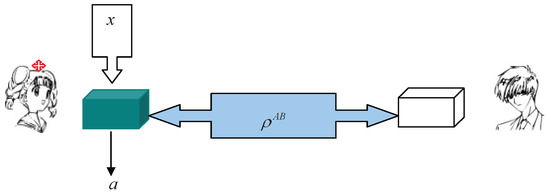
Figure 1.
Sketch of a quantum steering from Alice to Bob, in which denotes the shared state and x and a denote Alice’s measurement choice and corresponding outcome, respectively, when the measurement x is chosen and performed.
Here are the mathematical definitions concerning EPR steering given by [46].
Definition 1.
Let be a set of positive operator value measurements (POVMs) that Alice want to perform, called a measurement assemblage of Alice, where the letters x and a label Alice’s measurement choice and outcome, respectively, each POVM having possible values.
(1) A state of the system is said to be unsteerable from A to B with if there exists a probability distribution (PD) and a set of states such that
where is a PD for each . In this case, we also say that Equation (1) is an LHV-LHS model of with respect to .
(2) A state is said to be steerable from A to B with if it is not unsteerable from A to B with . In this case, we also say that exhibits quantum steering with .
(3) A state is said to be unsteerable from A to B if for any , is unsteerable from A to B with .
(4) A state is said to be steerable from A to B if ∃ an such that it is steerable from A to B with , i.e., it is not unsteerable from A to B with .
Symmetrically, we define unsteerability and steerability of a state from B to A.
(5) A state is said to be steerable if it is steerable from A to B or B to A.
(6) A state is said to be unsteerable if it is not steerable, i.e., it is unsteerable both from A to B, and B to A.
Here are some remarks to the definitions above.
Remark 1.
Denote by the set of all states which are unsteerable from A to B with respect to , by the set of all states which are ussteerable from A to B, and denote by the set of all states which are steerable from A to B with , by the set of all states which are steerable from A to B. From the definition above, we have
Remark 2.
The physical interpretation is as follows. When a state is unsteerable with , Bob can interpret his conditional states by Equation (1) as coming from the pre-existing states and the PD , where only the probabilities are changed due to the knowledge of Alice’s measurement choice x and outcome a.
Example 1.
Let us now assume that Alice’s measurements in are compatible, in the sense of being jointly measurable [29]. This means that there exists a single ‘parent’ POVM such that , there is d PDs , such that
Thus, for any state of the system , we have for each ,
where
This shows that every state is unsteerable from A to B with a compatible measurement assemblage .
The following theorems were proved in [46].
Theorem 1.
([46], Theorem 3.2) A state of the system is unsteerable from A to B with if and only if there exists a PD , a set of states , and PDs such that every local POVM of B, it holds that
Theorem 2.
([46], Theorem 3.3) A state of the system is unsteerable from A to B if and only if for every , there exists a PD , a set of states and PDs such that for every POVM of B, it holds that
3. EPR Steering Inequalities
Let be the set of all hermitian operators of the system .
Theorem 3.
Suppose that and there exists a positive constant M such that
Then for every , it holds that
where , is the spectral radius of .
Proof.
Since , then the following spectrum decompositions are valid:
Consider POVMs and the measurement assemblages . Suppose that , then . Thus, we see from Theorem 2 that there exists a PD , a set of states , and PDs such that
for all and all . Hence, by Equations (7) and (8), we compute that
where
Thus, by Cauchy inequality and Equation (5), we have
□
In Theorem 3, we see that if the inequality (6) is invalid for any observables satisfying the condition there, then the state must be steerable. Thus, the violating of the inequality implies the steerability of the state . Since this, we call the inequality a steering inequality.
In particular, let , and
where are unit vectors in for all and are orthonormal vectors in . Then are all self-adjoint unitary operators of trace 0 for all i, thus the eigenvalues of are all , we get .
Since are orthonormal vectors, we can easily obtain that operators are orthonormal. Thus, the Bessel inequality yields that
and so
Thus, inequality (5) is valid for and then we obtain the following result which was pointed out in [43] without proof.
Corollary 1.
Example 2.
For the maximally entangled 2-qubit state , we have
Generally, for all real unit vectors: and the Pauli operator vector we have
with for all except for the following three cases:
Thus,
In particular, put , and
we obtain
By Corollary 1, we get that is steerable from A to B.
Example 3.
The 2-qubit state is steerable from A to B, where .
By computation, we obtain
Generally, for all real unit vectors: and the Pauli operator vector we obtain
with for all except for the following four cases
Thus,
Particularly, take , and
where , we get
By Corollary 1, we get that is steerable from A to B.
Any two-qubit state can be written in the following form
where are three Pauli matrices, is the vector composed of these Pauli matrices, is the correlation matrix of , with eigenvalues .
As an application of Corollary 1, we have the following result.
Corollary 2.
Let be as in Equation (9) and . If , then it holds that
Proof.
Let . Then, we see from Corollary 1 that
□
It was proved in ([25], Theorem 2) that a Bell diagonal state is steerable with three projective measurements if . We see from Corollary 2 that if the inequality (15) is not valid, then the state must be steerable with n projective measurements . For instance, we have Corollary 3 and Corollary 4 below, which give sufficient conditions for a general two-qubit state to be steerable under two and three projective measurements, respectively. In [26], a strong necessary condition was obtained for the steerability of two-qubit states having maximally mixed reduced states, via the construction of local hidden state models and two provably sufficient conditions were also obtained, via asymmetric EPR steering inequalities.
Corollary 3.
Suppose that with and , then , where
and are the orthonormal eigenvectors corresponding to the first two largest eigenvalues of , respectively.
Proof.
We compute that and so
Thus, Corollary 2 yields that . □
Similarly, we can arrive the following conclusion for the case of .
Corollary 4.
Suppose that with and , then , where
and are the orthonormal eigenvectors corresponding to the eigenvalues of , respectively.
Proof.
We compute that and so
Thus, Corollary 2 yields . □
Example 4.
Consider the state ρ characterized by the correlation matrix
where and We note that and
Hence, we get from Corollary 4 that , where
and . In particular, the Bell state characterized by the correlation matrix
is steerable from A to B with , where , is given in Equation (16).
The following corollary gives a sufficient condition for a general two-qubit state to be steerable in terms of eigenvalues of .
Corollary 5.
Suppose that , and , are the eigenvalues of , are the orthonormal eigenvectors corresponding to the eigenvalues . Then
(a) When , where
(b) When , where
Proof.
(a) Let . Since , and are the orthonormal eigenvectors corresponding to the eigenvalues of , respectively, we have
since . It follows from Corollary 2 that .
(b) Let . Since are the orthonormal eigenvectors corresponding to the eigenvalues of , respectively, and , we compute
since . It follows from Corollary 2 that . □
Example 5.
Consider the steerability of an "X" state given in [48]
where ’s are real parameters satisfying . It is not necessarily a Bell-diagonal state.
By computation, we get that the correlation matrix
We can easily see that the eigenvalues of are with the corresponding eigenstates . Put
then is a POVM for . The steerability of is as follows.
(a) When or or , the condition in Corollary 5 is satisfied and so where .
(b) When , the condition in Corollary 5 is satisfied and so where .
4. Conclusions
In this paper, we have obtained some remarks on EPR steering of bipartite states, including mathematical definitions and characterizations of steerability. Using the characterizations, we have established some necessary conditions for a state to be unsteerable by proving some inequalities. The validity of the derived inequalities are necessary for unsteerability of bipartite states, and then the violation of some of them are sufficient for a state to be steerable. As applications, the EPR steerability of the maximally entangled states is checked and some conditions for the steerability of the -states are obtained.
Author Contributions
The work of this paper was accomplished by H.X.C. and Y.Y. Moreover, all authors have read the paper carefully and approved the research contents that were written in the final manuscript.
Acknowledgments
This work was supported by the National Natural Science Foundation of China (Nos. 11871318, 11371012, 11771009, 11571213, 11601300) and the Fundamental Research Funds for the Central Universities (GK201703093, GK201801011), China Post-doctoral Science Foundation (No. 2018M631726).
Conflicts of Interest
The authors declare no conflict of interest.
References
- Schrodinger, E. Discussion of probability relations between separated systems. Math. Proc. Camb. Philos. Soc. 1935, 31, 555–563. [Google Scholar] [CrossRef]
- Einstein, A.; Podolsky, B.; Rosen, N. Can quantum-mechanical description of physical reality be considered complete? Phys. Rev. 1935, 47, 777. [Google Scholar] [CrossRef]
- Reid, M.D. Demonstration of the Einstein-Podolsky-Rosen paradox using nondegenerate parametric amplification. Phys. Rev. A 1989, 40, 913–923. [Google Scholar] [CrossRef]
- Werner, R.F. Quantum states with Einstein-Podolsky-Rosen correlations admitting a hidden-variable model. Phys. Rev. A 1989, 40, 4277–4281. [Google Scholar] [CrossRef]
- Qu, Z.Y.; Pereira, S.F.; Kimble, H.J.; Peng, K.C. Realization of the Einstein-Podolsky-Rosen paradox for continuous variables. Phys. Rev. Lett. 1992, 68, 3663. [Google Scholar]
- Wiseman, H.M.; Jones, S.J.; Doherty, A.C. Steering, entanglement, nonlocality, and the Einstein-Podolsky-Rosen paradox. Phys. Rev. Lett. 2007, 98, 140402. [Google Scholar] [CrossRef] [PubMed]
- Quintino, M.T.; Vértesi, T.; Cavalcanti, D.; Augusiak, R.; Demianowicz, M.; Acín, A.; Brunner, N. Inequivalence of entanglement, steering, and Bell nonlocality for general measurements. Phys. Rev. A 2015, 92, 032107. [Google Scholar] [CrossRef]
- Jones, S.J.; Wiseman, H.M.; Doherty, A.C. Entanglement, Einstein-Podolsky-Rosen correlations, Bell nonlocality, and steering. Phys. Rev. A 2007, 76, 052116. [Google Scholar] [CrossRef]
- Li, C.M.; Chen, Y.N.; Lambert, N.; Chiu, C.Y.; Nori, F. Certifying single-system steering for quantum-information processing. Phys. Rev. A 2015, 92, 062310. [Google Scholar] [CrossRef]
- Pusey, M.F. Verifying the quantumness of a channel with an untrusted device. JOSA B 2015, 32, A56–A63. [Google Scholar] [CrossRef]
- Branciard, C.; Cavalcanti, E.G.; Walborn, S.P.; Scarani, V.; Wiseman, H.M. One-sided device-independent quantum key distribution: Security, feasibility, and the connection with steering. Phys. Rev. A 2012, 85, 010301. [Google Scholar] [CrossRef]
- Piani, M.; Watrous, J. Necessary and sufficient quantum information characterization of Einstein-Podolsky-Rosen steering. Phys. Rev. Lett. 2015, 114, 060404. [Google Scholar] [CrossRef] [PubMed]
- Bartkiewicz, K.; Černoch, A.; Lemr, K.; Miranowicz, A.; Nori, F. Temporal steering and security of quantum key distribution with mutually unbiased bases against individual attacks. Phys. Rev. A 2016, 93, 062345. [Google Scholar] [CrossRef]
- Ku, H.Y.; Chen, S.L.; Chen, H.B.; Lambert, N.; Chen, Y.N.; Nori, F. Temporal steering in four dimensions with applications to coupled qubits and magnetoreception. Phys. Rev. A 2016, 94, 062126. [Google Scholar] [CrossRef]
- Chiu, C.Y.; Lambert, N.; Liao, T.L.; Nori, F.; Li, C.M. No-cloning of quantum steering. NPJ Quantum Inf. 2016, 2, 16020. [Google Scholar] [CrossRef]
- Chen, S.L.; Lambert, N.; Li, C.M.; Chen, G.Y.; Chen, Y.N.; Miranowicz, A.; Nori, F. Spatio-temporal steering for testing nonclassical correlations in quantum networks. Sci. Rep. 2017, 7, 3728. [Google Scholar] [CrossRef] [PubMed]
- Reid, M.D.; Drummond, P.D.; Bowen, W.P.; Cavalcanti, E.G.; Lam, P.K.; Bachor, H.A.; Andersen, U.L.; Leuchs, G. Colloquium: The Einstein-Podolsky-Rosen paradox: from concepts to applications. Rev. Rev. Mod. Phys. 2009, 81, 1727. [Google Scholar] [CrossRef]
- Saunders, D.J.; Jones, S.J.; Wiseman, H.M.; Pryde, G.J. Experimental EPR-steering using Bell local states. Nat. Phys. 2010, 6, 845–849. [Google Scholar] [CrossRef]
- Bennet, A.J.; Evans, D.A.; Saunders, D.J.; Branciard, C.; Cavalcanti, E.G.; Wiseman, H.M.; Pryde, G.J. Arbitrarily loss-tolerant Einstein-Podolsky-Rosen steering allowing a demonstration over 1 km of optical fiber with no detection loophole. Phys. Rev. X 2012, 2, 031003. [Google Scholar]
- Händchen, V.; Eberle, T.; Steinlechner, S.; Samblowski, A.; Franz, T.; Werner, R.F.; Schnabel, R. Observation of one-way Einstein-Podolsky-Rosen steering. Nat. Photonics 2012, 6, 596–599. [Google Scholar] [CrossRef]
- Wittmann, B.; Ramelow, S.; Steinlechner, F.; Langford, N.K.; Brunner, N.; Wiseman, H.M.; Ursin, R.; Zeilinger, A. Loophole-free Einstein-Podolsky-Rosen experiment via quantum steering. New J. Phys. 2012, 14, 053030. [Google Scholar] [CrossRef]
- Steinlechner, S.; Bauchrowitz, J.; Eberle, T.; Schnabel, R. Strong Einstein-Podolsky-Rosen steering with unconditional entangled states. Phys. Rev. A 2013, 87, 022104. [Google Scholar] [CrossRef]
- Skrzypczyk, P.; Navascues, M.; Cavalcanti, D. Quantifying Einstein-Podolsky-Rosen steering. Phys. Rev. Lett. 2014, 112, 180404. [Google Scholar] [CrossRef] [PubMed]
- Sun, K.; Ye, X.J.; Xu, J.S.; Xu, X.Y.; Tang, J.S.; Wu, Y.C.; Chen, J.L.; Li, C.F.; Guo, G.C. Experimental quantification of asymmetric Einstein-Podolsky-Rosen steering. Phys. Rev. Lett. 2016, 116, 160404. [Google Scholar] [CrossRef] [PubMed]
- Quan, Q.; Zhu, H.J.; Liu, S.Y.; Fei, S.M.; Fan, H.; Yang, W.L. Steering Bell-diagonal states. Sci. Rep. 2016, 6, 22025. [Google Scholar] [CrossRef] [PubMed]
- Jevtic, S.; Hall, M.J.W.; Anderson, M.R.; Zwierz, M.; Wiseman, H.M. Einstein-Podolsky-Rosen steering and the steering ellipsoid. J. Opt. Soc. Am. B 2015, 32, A40–A49. [Google Scholar] [CrossRef]
- Chen, S.L.; Lambert, N.; Li, C.M.; Miranowicz, A.; Chen, Y.N.; Nori, F. Quantifying Non-Markovianity with Temporal Steering. Phys. Rev. Lett. 2016, 116, 020503. [Google Scholar] [CrossRef] [PubMed]
- Bartkiewicz, K.; Černoch, A.; Lemr, K.; Miranowicz, A.; Nori, F. Experimental temporal quantum steering. Sci. Rep. 2016, 6, 38076. [Google Scholar] [CrossRef] [PubMed]
- Cavalcanti, D.; Skrzypczyk, P. Quantum steering: A review with focus on semidefinite programming. Rep. Prog. Phys. 2017, 80, 024001. [Google Scholar] [CrossRef] [PubMed]
- Das, D.; Datta, S.; Jebaratnam, C.; Majumdar, A.S. Einstein-Podolsky-Rosen steering cost in the context of extremal boxes. Phys. Rev. A 2018, 97, 022110. [Google Scholar] [CrossRef]
- Ku, H.Y.; Chen, S.L.; Lambert, N.; Chen, Y.N.; Nori, F. Hierarchy in temporal quantum correlations. Phys. Rev. A 2018, 98, 022104. [Google Scholar] [CrossRef]
- Ku, H.Y.; Chen, S.L.; Chen, H.B.; Nori, F.; Chen, Y.N. Measurement-device-independent measure of steerability and witnesses for all steerable resources. airXiv, 2018; arXiv:1807.08901. [Google Scholar]
- Cavalcanti, E.G.; Jones, S.J.; Wiseman, H.M.; Reid, M.D. Experimental criteria for steering and the Einstein-Podolsky-Rosen paradox. Phys. Rev. A 2009, 80, 032112. [Google Scholar] [CrossRef]
- Pusey, M.F. Negativity and steering: a stronger Peres conjecture. Phys. Rev. A 2013, 88, 032313. [Google Scholar] [CrossRef]
- Ren, C.L.; Su, H.Y.; Shi, H.F.; Chen, J.L. Maximally steerable mixed state based on the linear steering inequality and the Clauser-Horne-Shimony-Holt-like steering inequality. Phys. Rev. A 2018, 97, 032119. [Google Scholar] [CrossRef]
- Walborn, S.P.; Salles, A.; Gomes, R.M.; Toscano, F.; Ribeiro, P.H.S. Revealing hidden Einstein-Podolsky-Rosen nonlocality. Phys. Rev. Lett. 2011, 106, 130402. [Google Scholar] [CrossRef] [PubMed]
- Schneeloch, J.; Broadbent, C.J.; Walborn, S.P.; Cavalcanti, E.G.; Howell, J.C. Einstein-Podolsky-Rosen steering inequalities from entropic uncertainty relations. Phys. Rev. A 2013, 87, 062103. [Google Scholar] [CrossRef]
- Pramanik, T.; Kaplan, M.; Majumdar, A.S. Fine-grained Einstein-Podolsky-Rosen steering inequalities. Phys. Rev. A 2014, 90, 050305. [Google Scholar] [CrossRef]
- Chen, Y.N.; Li, C.M.; Lambert, N.; Chen, S.L.; Ota, Y.; Chen, G.Y.; Nori, F. Temporal steering inequality. Phys. Rev. A 2014, 89, 032112. [Google Scholar] [CrossRef]
- Zukowski, M.; Dutta, A.; Yin, Z. Geometric Bell-like inequalities for steering. Phys. Rev. A 2015, 91, 032107. [Google Scholar] [CrossRef]
- Zhu, H.; Hayashi, M.; Chen, L. Universal steering inequalities. Phys. Rev. Lett. 2016, 116, 070403. [Google Scholar] [CrossRef] [PubMed]
- Chen, J.L.; Ren, C.L.; Chen, C.B.; Ye, X.J.; Pati, A.K. Bell’s nonlocality can be detected by the violation of Einstein-Podolsky-Rosen steering inequality. Sci. Rep. 2016, 6, 39063. [Google Scholar] [CrossRef] [PubMed]
- Bhattacharya, S.S.; Mukherjee, A.; Roy, A.; Paul, B.; Mukherjee, K.; Chakrabarty, I.; Jebaratnam, C.; Ganguly, N. Absolute Non-violation of a three-setting steering inequality by two-qubit states. Quantum Inf. Process. 2018, 17, 3. [Google Scholar] [CrossRef]
- Li, Z.W.; Guo, Z.H.; Cao, H.X. Some characterizations of EPR steering. Int. J. Theor. Phys. 2018. [Google Scholar] [CrossRef]
- Zheng, C.M.; Guo, Z.H.; Cao, H.X. Generalized steering robustness of quantum states. Int. J. Theor. Phys. 2018, 57, 1787–1801. [Google Scholar] [CrossRef]
- Cao, H.X.; Guo, Z.H. Characterzing Bell nonlocality and EPR steering. Sci. China Phys. Mech. Astron. 2018. [Google Scholar] [CrossRef]
- Xiao, S.; Guo, Z.H.; Cao, H.X. Quantum steering in tripartite quantum systems. Sci. Sin. Phys. Mech. Astron. 2018. (In Chinese) [Google Scholar] [CrossRef]
- Yu, T.; Eberly, J.H. Evolution from entanglement to decoherence of bipartite mixed “X” states. Quantum Inf. Comput. 2007, 7, 459. [Google Scholar]
© 2018 by the authors. Licensee MDPI, Basel, Switzerland. This article is an open access article distributed under the terms and conditions of the Creative Commons Attribution (CC BY) license (http://creativecommons.org/licenses/by/4.0/).