


Abstract
In the present paper, we use analytical techniques to solve fractional nonlinear differential equations systems that arise in Bergman’s minimal model, used to describe blood glucose and insulin metabolism, after intravenous tolerance testing. We also discuss the stability and uniqueness of the solution.
1. Introduction
Mathematical modeling is a very important branch of applied mathematics. By using this approach, we can convert a real world problem into a mathematical module and then analyze it in a better manner. In the 1990s when researchers were faced with the blood or blood’s constituent dynamical transport phenomena, they used classical theory to describe these processes [1,2,3]. After that, many researchers conducted research in that direction to remove the complexity of this phenomenon [1,2,3,4,5,6,7].
Regarding research modules , one of the most important modules is Bergman’s minimal model [4,5,6]. In this model, a body is described as a compartment with a basal concentration of glucose and insulin. Bergman’s minimal model has two variations. the first describes glucose kinetics, and the second describes insulin kinetics. The two models have mostly been used to understand the kinetics during IVGTT test (Glucose Tolerance Test) [7,8].
In applied mathematics, one of the most used concepts is the derivative. Derivatives show the rate of change of a function. This is helpful to describe many real phenomena. After this research, mathematicians faced some complex problems of the real world; to solve them, mathematicians introduced the fractional derivative [9,10,11,12,13]. The concept of fractional calculus has great importance in many branches and is also important for modeling real world problems [14,15,16,17].
For this reason, many researchers have engaged in a great amount of research work, conferences, and paper publications. Various definitions of fractional derivatives have been given to date. Recently, researchers have described a new fractional derivative operator named the Caputo–Fabrizio fractional derivative [18,19,20,21]. In this paper, we use this operator to describe the Bergman’s minimal glucose-insulin model and solve it by the iterative technique.
2. The Caputo–Fabrizio Fractional Order Derivative
Singularity at the end point of the interval is the main problem that is faced with the definition of the fractional order derivative. To avoid this problem, Caputo and Fabrizio recently proposed a new fractional order derivative that does not have any singularity. The novel fractional derivative given by Caputo and Fabrizio is more suitable to describe the rate of change in concentration of the model because its kernel is non-local and non-singular. The definition is based on the convolution of a first-order derivative and the exponential function, given in the following definition:
Definition 1.
Let . Then, the new fractional order Caputo derivative is defined as:
Here denotes the normalization function such that for detail, see [18]. If the function does not belong to , then the derivative can be written as
Remark 1.
The authors state that if then Equation (2) reduces to
and
As we have defined a new derivative above, then there should be its anti-derivative; the integral of this new fractional derivative is given by Losada and Nieto [19].
Definition 2.
The fractional integral of order of the function f is defined below:
Remark 2.
It is clear from Equation (5) that the fractional integral of order is an average of function f and its integral of order 1. Hence we get the condition [19]:
the above term yields an explicit formula,
Due to the above relation, Nieto and Losada [19] anticipated that the new Caputo derivative of order could be written as:
Theorem 1.
Here denotes the normalization function such as
then, we have
For more detail see [18,19].
3. Bergman’s Minimal Model Fractional Module
The minimal model of the glucose insulin kinetics has been proposed to describe the time course of these concentrations. We will use the standard formulation of the minimal model represented by the following system of differential equations:
subject to initial conditions,
The parameters for the minimal model (11) are given in Table 1.

Table 1.
Parameter used in minimal model (11).
This model can be used to describe the pancreas as the source of insulin. In a healthy individual, a small amount of insulin is always created and cleared [4]. This helps to keep the basal concentration . The glucose-independent production and clearance of insulin is proportional to the blood insulin concentration. If the insulin level is above basal concentration, clearance increases. On the other hand, if the insulin level is below basal concentration, production increases. When the glucose level gets high, the pancreas reacts by releasing more insulin at a given rate. To explain this mathematically, one has to derive a function describing the reaction of the pancreas. This function was derived by Bergman et al. and adjusted by Gaetano et al. [7,8] to become Pancreas(t) where max (, 0).
4. Existence of the Coupled Solutions
By using the Fixed-Point theorem, we define the existence of the solution. First, transform Equation (11) into an integral equation as follows:
on using the definition defined by Nieto, we get
and
we also have
Let us consider the following kernels:
Theorem 2.
Show that and satisfy Lipschiz condition.
Proof.
First we prove this condition for . Let G and be two functions, then we have
on using the Cauchy’s inequality, we get
or
where
Additionally, for
on using the Cauchy’s inequality, we get
or
where
Similarly, for
by Cauchy’s inequality
or
where
We consider the following recursive formula
and
as well as
Now the difference between the consecutive terms is
and
It is worth noting that
Now take norm on both sides of Equations (37)–(39), respectively
and
as well as
From Equations (40)–(42), by using triangular inequality
and
Since the kernel satisfies the Lipchitz condition, we obtain:
☐
Theorem 3.
Show that the Bergman’s Minimal Model Fractional Module is the minimal model of the glucose insulin kinetics having a solution.
Proof.
As we have seen that the above Equations (43)–(45) are bounded, and we have proven that the kernels satisfy Lipschiz condition, therefore following the results obtained in Equations (43)–(45) using the recursive technique, we get the following relation
and
as well as
Therefore, the above solutions exist and are continuous. Nonetheless, to show that the above is a solution of Equation (11), we get
where , and are remainder terms of series solution. Thus,
and
as well as
It follows from the above that:
Now, applying the norm on both sides and using the Lipchitz condition, we get
similarly, we get
and
On taking the limit of Equations (54)–(56), we get
and
Equations (57)–(59) is the solution of the system (11); therefore, we can say that a solution exists. ☐
Uniqueness of the Solutions
In this part, we want to show that solutions presented in the above section are unique.
To prove this, we can another solutions for system (11), say ; then:
apply the norm both sides of Equation (60),
On using the Lipchitz condition, having the fact in mind that the solution is bounded, we get
this is true for any n; hence,
Similarly, we get
and
Hence, it shows the uniqueness of the solution of system (11).
5. Application of Caputo–Fabrizio Derivative to Bergman’s Minimal Model
Watugala introduced the Sumudu transform in early 1990s [20]. The Sumudu transform is defined over the set of functions:
the Sumudu transform is defined by
for detail, see [15,16,21].
Theorem 4.
Let be a function for which the Caputo–Fabrizio exists; then, the Sumudu transform of the Caputo–Frabrizio fractional derivative of is given as:
Solution of Fractional Module by Sumudu Transform
Since the Bergman’s Minimal Model Fractional Module has three equations, it may be challenging to get the exact solution. To obtain the best solution, we will use an iterative technique with the help of the Sumudu Transform.
Applying the Sumudu transform on both sides of (11), we get
or
Applying the inverse Sumudu transform on both sides of (67), we get
and in the same manner
and
We next obtain the following recursive formula from (68)–(70):
and
The solution is thus provided as:
we get the required solution.
6. Numerical Solution
As a particular instance to be treated, we assume the base level blood glucose concentration to be mg/dL, while the base level blood concentration of insulin to be mU/L. The glucose clearance rate independent of insulin is min−1, the rate of clearance of active insulin (decrease of uptake) is min−1, the increase in uptake ability caused by insulin is L/(min2·mU), the decay rate of blood insulin is min−1, the target glucose level is mg/dL, and the rate of pancreatic release after glucose bolus is mUdL/L·mg·min. Substituting the above values in (74)–(76) with = 287 mg/DL, mg/DL, and mg/DL, the numerical solution is described by Figure 1.
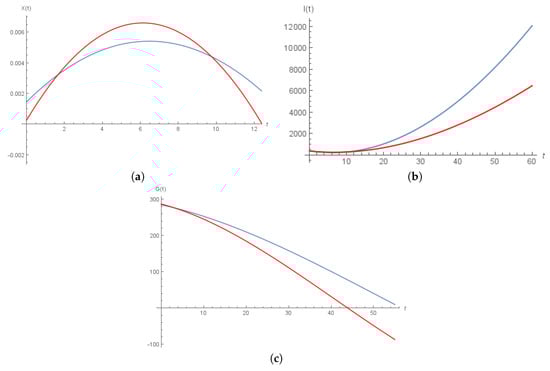
Figure 1.
(a) X(t) vs. t (Red line—; Blue Line—); (b) I(t) vs. t (Red line—; Blue Line—); (c) G(t) vs. t (Red`Line—; Blue Line—).
7. Conclusions
This paper is an attempt to describe the existence and uniqueness of the Bergman Minimal Model which is extended by Caputo–Fabrizio fractional derivative in the context of glucose and insulin levels in blood. We obtain the approximate solution of the Model and a numerical solution of the system which shows that effect of time on the concentrations and .
Acknowledgments
The authors extend their sincere appropriations to the Deanship of Scientific Research at King Saud University for its funding this Profile Research Group (PRG-1437-35). Further authors are thankful to reviewers for giving their fruitful comments to improve this paper.
Author Contributions
All authors contributed equally in the paper. All authors have read and approved the final manuscript.
Conflicts of Interest
The authors declare no conflict of interest.
References
- Eckstein, E.C.; Belgacem, F.B.M. Model of platelet transport in flowing blood with drift and diffusion terms, extended platelet transport equation. Biophys. J. 1991, 60, 53–69. [Google Scholar] [CrossRef]
- Mountrakis, L.; Lorenz, E.; Hoekstra, A.G. Where do the platelets go? A simulation study of fully resolved blood flow through aneurysm vessels. Interface Focus 2013, 3, 1–10. [Google Scholar] [CrossRef] [PubMed]
- Bourouiba, L.; Dehandschoewercker, E.; Bush, J.W.M. Violent expiratory events: On coughing and sneezing. J. Fluid Mech. 2014, 745, 537–563. [Google Scholar] [CrossRef]
- Caumo, A.; Cobelli, C.; Omenetto, M. Overestimation of minimal model glucose effectiveness in presence of insulin response is due to under modeling. Am. J. Physiol. 1999, 278, 481–488. [Google Scholar]
- Bergman, R.N.; Ider, Y.Z.; Bowden, C.R.; Cobelli, C. Quantitative estimation of insulin sensitivity. Am. J. Physiol. 1979, 236, 667–677. [Google Scholar]
- Bowden, C.R.; Bergman, R.N.; Toffolo, G.; Cobelli, C. Minimal modeling, partition analysis, and identification of glucose disposal in animals and man. IEEE Trans. Biomed. Eng. 1980, 18, 129–135. [Google Scholar]
- Gaetano, A.D.; Arino, O. Mathematical modeling of the intravenous glucose tolerance test. J. Math. Biol. 2000, 40, 136–168. [Google Scholar] [CrossRef] [PubMed]
- Gatewood, L.C.; Ackerman, E.; Rosevear, J.W.; Molnar, G.D.; Burns, T.W. Tests of a mathematical model of the blood-glucose regulatory system. Comput. Biomed. Res. 1968, 2, 1–14. [Google Scholar] [CrossRef]
- Caputo, M. Linear models of dissipation whose Q is almost frequency independent, part II. Geophys. J. Int. 1967, 13, 529–539. [Google Scholar] [CrossRef]
- Podlubny, I. Fractional Differential Equations; Academic Press: New York, NY, USA, 1999. [Google Scholar]
- Kilbas, A.A.; Srivastava, H.M.; Trujillo, J.J. Theory and Applications of Fractional Differential Equations; Elsevier: Amsterdam, The Netherlands, 2006. [Google Scholar]
- Chaurasia, V.B.L.; Dubey, R.S. Analytical solution for the differential equation containing generalized fractional derivative operators and Mittag-Leffler-type function. ISRN Appl. Math. 2011, 2011, 682381. [Google Scholar] [CrossRef]
- Chaurasia, V.B.L.; Dubey, R.S. Analytical solution for the generalized time-fractional telegraph equation. Fract. Differ. Calc. 2013, 3, 21–29. [Google Scholar] [CrossRef]
- Atangana, A.; Alabaraoye, E. Solving a system of fractional partial differential equations arising in the model of HIV infection of CD4+ cells and attractor one-dimensional Keller-Segel equations. Adv. Differ. Equ. 2013, 2013, 94. [Google Scholar] [CrossRef]
- Chaurasia, V.B.L.; Dubey, R.S.; Belgacem, F.B.M. Fractional radial diffusion equation analytical solution via hankel and Sumudu transforms. Math. Eng. Sci. Aerosp. 2012, 3, 1–10. [Google Scholar]
- Dubey, R.S.; Goswami, P.; Belgacem, F.B.M. Generalized time-fractional telegraph equation analytical solution by Sumudu and Fourier transforms. J. Fract. Calc. Appl. 2014, 5, 52–58. [Google Scholar]
- Belgacem, F.B.M. Diffusion and drift models for population dispersal from stochastic and continuum views. Int. J. Appl. Math. 2001, 5, 85–106. [Google Scholar]
- Caputo, M.; Fabrizio, M. A new Definition of Fractional Derivative without Singular Kernel. Prog. Fract. Differ. Appl. 2015, 1, 73–85. [Google Scholar]
- Losada, J.; Nieto, J.J. Properties of a New Fractional Derivative without Singular Kernel. Fract. Differ. Appl. 2015, 1, 87–92. [Google Scholar]
- Atangana, A.; Alkahtani, B.S.T. Extension of the RLC electrical circuit to fractional derivative without singular kernel. Adv. Mech. Eng. 2015, 7, 1–6. [Google Scholar]
- Dubey, R.S.; Alkahtani, B.S.T.; Atangana, A. Analytical solution of space-time fractional Fokker–Plank equation by homotopy perturbation Sumudu transform method. Math. Probl. Eng. 2015, 2015, 780929. [Google Scholar] [CrossRef]
© 2017 by the authors. Licensee MDPI, Basel, Switzerland. This article is an open access article distributed under the terms and conditions of the Creative Commons Attribution (CC BY) license ( http://creativecommons.org/licenses/by/4.0/).