


Abstract
In recent years, clear aligners have diversified and evolved in their primary characteristics (material, gingival margin design, attachments, divots, auxiliaries), increasing their indications and efficiency. We overviewed the brands of aligners used in Italy and reviewed the literature on the evolution of clear aligners based on their characteristics mentioned above by consulting the main scientific databases (PubMed, Scopus, Lilacs, Google Scholar, Cochrane Library). Inclusion and exclusion criteria were established. The data were collected on a purpose-made data collection form and analyzed descriptively. From the initial 580 records, 527 were excluded because they were not related to the subject of the review or because they did not meet the eligibility criteria. The remaining 31 studies were deemed comprehensive for the purpose of the review, although the “gingival margin design” feature and “auxiliaries” tool are not well represented in the more recent literature. Current knowledge on invisible aligners allows us to have a much clearer idea of the basic characteristics of aligner systems. There remains a need to deepen the use of systems other than Invisalign™ to give greater evidence to aligners that are very different based on the characteristics analyzed here and that are very widespread on the market.
Keywords:
clear aligners; orthodontics; biomechanics; efficiency; efficacy; attachments; divots; auxiliaries; mini-screws; elastics 1. Introduction
Clear aligners were introduced in the United States, where they were born at the end of the 1990s by the company Align Technology© (Santa Clara, CA, USA), which then gave life to the Invisalign® system, and then they were distributed in Italy and other European countries starting from 2001 [1,2]. Since then, the interest and the diffusion of this therapeutic alternative to the classic multibracket orthodontic therapy have increased exponentially [3,4,5], also considering the needs and aesthetic perception of orthodontic patients [6]. Almost 20 years later, the commercial proposals regarding aligners include many different brands all over the world (almost twenty just in Italy), and their indications, applications and constitutive features have evolved [7,8,9]. The thermoplastic materials used, the gingival margin design, and the different strategies used to guide orthodontic movement such as attachments, divots and auxiliary tools converge in determining the effectiveness of a system of aligners [10]. Clear aligners do not seem to all be the same and consistent differences can be observed between different brands, as if we can no longer speak of a “single system” but of “several different systems” [11,12]. Their indication was initially limited to the leveling and alignment of the arches in the presence of slight crowding or diastemas [13,14]. Today, a large part of cases, even moderately or extremely complex, can be managed with aligners. The entire resolution of a case in which aesthetic needs can also be associated with functional ones can be often successfully treated with the so-called “hybrid” therapies, where clear aligners’ action is joined to auxiliary tools (mini-screws, elastics, sectional wires, rapid palatal expanders, etc.) [15,16,17,18,19]. The quality of the orthodontic digital workflow, also extended to other specialized fields [20,21,22], has made it possible to better evaluate the fit of the aligners and their overall design for better case management [23,24,25]. The purpose of this scoping review is to systematically map the scientific evidence and any gaps in knowledge on the evolution of invisible aligners available in Italy on the basis of their primary characteristics (thermoplastic material, gingival margin design, the presence of attachments with different shapes, the alternative use of divots and auxiliary tools such as elastics and mini-screws, etc.), which are highlighted by the manufacturers as winning points of their clear aligners’ effectiveness compared to competitors.
2. Materials and Methods
Preliminary research on clear aligner systems available in Italy has been performed. Technical information and data were searched on official websites of the manufacturers and in professional magazines. The primary characteristics have been identified: materials used, design of the gingival margin, presence of attachments or other strategies to guide orthodontic dental movement. The research of the articles useful for the scoping review was last conducted on 5 January 2021 to evaluate the evidence in the scientific literature given to the aligner systems available on the Italian market as an alternative to Invisalign. Two independent operators (A.P. and G.G.) consulted the English language literature available for full-text reading on the scientific literature databases: PubMed, Scopus, Lilacs, Cochrane Library, following the framework for scoping reviews of the PRISMA-ScR guidelines [26]. The research questions were: “what is the scientific evidence of the clear aligner systems available in Italy as alternative to Invisalign?” and “are their constitutive characteristics comprehensively described?”. The potentially relevant articles were selected following these eligibility criteria: published in the period of 2015–2021, written in the English language, abstract and full-text available, investigating the primary characteristics of clear aligners. No limit was put on study design. Studies on Invisalign invisible aligners were included only if used in comparative studies with other brands of aligners present in the results of our preliminary market research, or if significantly related to the characteristics that are the subject of this review. Two consecutive searches have been performed using “AND” and “OR” Boolean operators between free text terms or keywords combined as follows:
- Clear aligner appliances
- Orthodontic appliance, removable
- 1 OR 2 OR
- Tooth movement
- Biomechanics
- Attachments
- Divots
- Mini-screws
- Elastics
- Auxiliaries
- OR 4 OR 5 OR 6 OR 7 OR 8 OR 9 OR 10
- 3 AND 11
After comparing and unifying the results found by the two operators, duplicate results of the different databases were deleted and a third reviewer (E.B.) read the abstracts of all the results in order to verify that the articles properly adhered to the objectives of the study. Articles that have not been deemed adequate since this first observation have been discarded. Doubtful articles have been retained to reserve an assessment for a full-text reading. The three reviewers, always independently, extracted data in duplicate and subsequently compared them. The following information was extracted: authors, year, country, study design (reviews were included), sample size and characteristics (subjects, dental models, clear aligners, brands used), main topic of the article, type of primary feature of clear aligner investigated, important conclusions/outcomes. Subsequently, all the authors analyzed these results in agreement in order to be able to discuss them in this article. Additionally, the scoping review search strategy was depicted as a flow diagram using the PRISMA model [27] for systematic reviews.
3. Results
The preliminary research allowed us to know the basic distinctive features of the clear aligners which are used more in Italy (name, manufacturer, material, introduction year, wearing time, indications, contraindications, the presence of attachments and/or divots, auxiliaries, number of studies). Of 19 brands for which it has been possible to describe the constitutive characteristics, only eight, in addition to Invisalign, are mentioned in the official scientific literature since they were used in experimental studies (Table 1). Invisalign has the highest rate of presence in the literature with 110 papers, followed by Clear Aligners with 10 papers, F22 (Sweden & Martina SpA, Due Carrare, Italy) with 9 research articles, Airnivol (AirNivol SpA, Navacchio, Italy) with 3 articles and Nuvola (Nuvola®, Vicenza, Italy) with 2 articles, and ALL IN, Arc Angel, Smiletech and Sorridi with 1 research article only. For the scoping review, instead, we identified 580 studies of potential relevance. After the removal of duplicated results from the different databases (n = 443), 137 articles were screened in detail, and 52 of these were considered eligible for a full-text review. Of these, 31 studies published between 2015 and 2021 were included in the scoping review. The flow diagram (Figure 1) describes the entire search strategy and review process. Fifteen articles are dedicated to the study of materials and their properties, twelve to attachments and other movement strategies, two refer to the design of the gingival margin which, however, is not really the main object of the articles in question (in fact, they deal specifically with the other two already mentioned topics taken into consideration in this study), and five studies help determine the usefulness of auxiliary tools in combination therapies with aligners (Table 2). There are sixteen in vitro comparative studies, while there are two digital models. There are four prospective clinical studies, two retrospective studies, three case reports and one case series. There are three reviews considered useful for the compilation of the scoping review; one of them is a systematic review with meta-analysis, the other two are narrative reviews.

Table 1.
Brands of clear aligners currently used in Italy with the main basic information and number of scientific studies in which they are used.
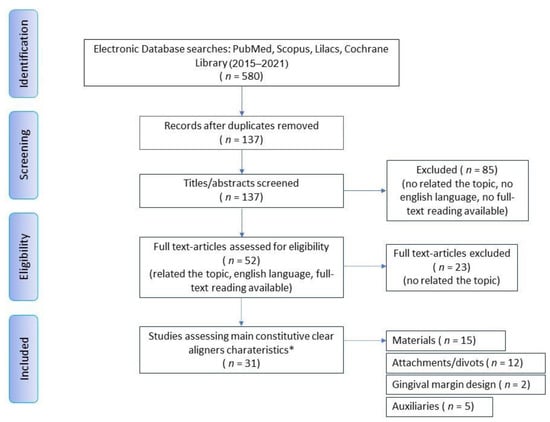
Figure 1.
Review flow diagram. Caption: the PRISMA flow diagram for the systematic review detailing the database searches, the number of abstracts screened and the full texts retrieved. * Some articles analyzed > 1 characteristic.
Table 2.
Articles included in the review.
The most active country in research on the evolution of aligners based on the primary characteristics object of this review of the literature is Italy, which, with twelve studies, is also the one to have carried out most of the clinical research (eight out of ten among prospective works, retrospectives, case reports and case series).
4. Discussion
Since the introduction of the aligners with the Invisalign™ brand distributed by the US company Align Technology© [1,2], the commercial offer of the aligners has been significantly enriched with national, European and international competitor brands. They have also diversified their characteristics over time, defining a current trend that differs from Invisalign™ for the modification of some essential characteristics, ranging from the type of material used to the design of the gingival margin that is increasingly straight and extended beyond the gingival zenith to give greater adherence and reduce the presence of attachments for retentive purposes. The presence of attachments is questioned by some brands of aligners who propose their almost total absence and the introduction of other tools for controlling movements, such as divots, which are currently only actively used by three manufacturers. The use of auxiliaries such as elastics or mini-screws has certainly broadened the indications for the use of aligners for orthodontic therapies, even of a certain complexity that the aligners alone would not be able to manage in a predictable way. Thermoplastic material, of which the aligners are made, their design at the gingival level and the possibility of using attachments or alternative movement strategies such as divots and auxiliaries are precisely the primary characteristics on which the effectiveness and efficiency of the various aligner systems depend. The concepts of “efficacy and efficiency” in clinical orthodontics are used interchangeably to describe “achieving the desired results without wasting time for the orthodontist and the patient” [10]. In the field of invisible aligners, the search for ever better efficacy and efficiency is expressed through the ability of these devices to perform more or less complex dental movements in a predictable way as much as traditional fixed appliances with equally stable results [3]. These elements are linked to the ability to maintain adequate adhesion of the aligner (fitting) on the teeth, but also to guarantee the transmission of the forces necessary to move the teeth in a predictable way without sacrificing the comfort of the patient, which helps with compliance [4,5]. Despite the wide commercial offer, the scientific literature lacks studies that testify to the use of alternative brands with different systematics. There are few comparative studies between systematics, and more than 90% of publications focus on the use of Invisalign™ exclusively. In any case, based on the data observed in this scoping review, it seems that Italy is the country that joins, more than others, the scientific interest in alternative brands to Invisalign with the study of the primary characteristics of each of them. Eight brands are mentioned in the scientific literature. Airnivol (AirNivol S.p.A, Navacchio di Cascina -Pisa, Italy) has been used in three comparative studies between systematics on fitting influenced by the thickness of the aligner, by exposure to the oral environment and in the study of the extrusion movement of the central incisor [29,30,53]. ALL IN (Micerium S.p.A., Avegno- Genova, Italy) and Arc Angel (Gruppo Dextra, Modena, Italy) have only been used in one study about the comparative analysis of the gap and thickness of different brands [27]. The aligner named Clear Aligner (Scheu Dental GmbH, Iserlohn, Germany) has been used in ten studies on the material (PET-G) they are made of and on its mechanical properties after the thermoforming process, exposure to saliva and different beverages, after stress relaxation due to use and cito-toxicity [29,30,31,32,33,34,54,55,56,57]. F22 is a system of clear aligners (Sweden & Martina SpA, Due Carrare—Padova, Italy) used for experimental research in nine studies. Two of them explore the aligner fitting based on the presence of attachments compared with clear aligners produced by different companies [27,55]. One comparative study evaluates the stress relaxation after use [32]. Other studies evaluate the behavior of the clear aligner after oral exposure and with aging [58,59]. A clinical study has been published on the efficiency of the use of this clear aligners’ system with elastics in class II malocclusions [15]. A recent study evaluates the progress of the therapies with this clear aligner and other brands during the last pandemic [35]. Another two studies show how to plan hybrid therapies with clear aligners and fixed appliances to manage class II and III malocclusions [36,37]. Nuvola (G.E.O. S.r.l., Rome, Italy) is present in the scientific literature with two published studies. It has been used in the comparative study by MicroCT X-ray on the aligners’ gap and thicknesses [27], and in another recent study on the predictability of this aligner during the movement of anterior teeth [38]. The use of the clear aligners named Smiletech (Ortodontica Italia s.r.l.) and Sorridi (Tecnologia Dentale, Latina, Italy) is documented in the study describing the advantage of using clear aligners when regular orthodontic checks cannot be performed in person. The Sorridi system includes divots (and no attachments), and this is probably the reason why patients wearing these clear aligners reached better results and had no discomfort during the SARS-Cov2 pandemic [35]. Clear aligners are made of thermoplastic materials. The most commonly used materials are polyurethane, polyester and polyethylene glycol terephthalate (PETG). Many spectrophotometric studies analyze their composition to confirm the chemical structure stated by the manufacturers and eventual differences in different brands using the same material [33,39]. This kind of article compares the clear aligners’ material mechanical properties with experimental studies in vitro, mainly applying the test indentation (with Vickers indenter), the Martens hardness, the indentation modulus, the elastic to total work ratio (elastic index) and the indentation creep [40]. The clear aligners made in polyurethane showed higher hardness and modulus values, a slightly higher brittleness and lesser creep resistance compared with the PETG-based products. The results offered are very important because they anticipate the clinical behavior expected in clear aligners of different brands, motivating qualities and limitations [27,33,39,40]. Many studies evaluate the stability of the materials after their average use of two weeks through the colorimetric alterations of the aligner. Studies of this type simulate the environment of the oral cavity through solutions of artificial saliva and exposure to highly pigmented foods such as wine, coffee, cola, tea and different cleaning methods [41]. The most recent data, in which both PET-G and polyurethane based aligners are used, agree in affirming that there are foods that stain more than others (above all black tea), that polyurethanes are more subject to color alterations, that even the surface analysis with a scanning electron microscope shows a greater alteration of the integrity of the material, and that this becomes all the more significant the longer the aligner is used (the aligners after two weeks show values of surface alteration above the threshold level of 0.20 μm) [30,42]. Other authors [31,32,43] found that material properties change during the wear-time, and this may affect treatment outcomes since the intraoral aging of clear aligners (regardless of the type of material they are made of) through biofilm modifications and oral environmental conditions might have an adverse effect on material properties and stability over the treatment time, compromising the force delivery capacity and treatment efficacy. A final aspect to analyze concerning the materials and their properties is the thickness of the thermoplastic material with which the invisible aligners are manufactured. The thickness of the aligners is predetermined by some manufacturers or is variable according to others, and in some system it is established based on the type of treatment or used alternately to apply forces of variable intensity that simulate fixed orthodontics [28,29,34,44,45]. The production process seems to affect the final thickness of the aligners with effects that can be negative if the creation takes place through 3D printing [44], even if the process of production is time-saving and ensures an aligner which is mechanically stronger and more elastic than the conventionally produced thermoplastic-based thermoformed clear dental aligners [29]. The intraoral use may change the thickness but not in a clinically relevant manner, and the thermoforming process does not induce an alteration of the active or passive aligner configurations [45]. Furthermore, the thickness (commonly used 0.5, 0.625, 075 mm) does not affect forces and moments generated under the most commonly examined tooth movements (rotation and tipping) [28], while labial or palatal movements are negatively affected by the incremented thickness of the clear aligners (recommended by some manufacturers during the setup) [34]. The ability of an invisible aligner to move teeth is given by the pressure exerted by the material on the tooth. Traditionally, the displacement is guided by the presence of composite resin buttons which are applied to the buccal and/or oral-palatal surface of one or more teeth, and whose shape and position depend on the function they must perform [14,46]. Attachments have also undergone some sort of evolution over the years. Initially, they were only ellipsoidal in shape: horizontal for active intrusion movements and vertical for retentive purposes. We then moved on to rectangular ones distinguished by horizontal, vertical and beveled shapes [47]. The horizontal ones are for intrusions and extrusions on premolars and incisors, on premolars to increase aligner stability when using class II or III elastics, for retention in subjects with short dental crowns or hypodivergent patterns (to control the Spee curve and deep bite), and on restored teeth because the attachment’s bonding area is smaller. The vertical rectangular attachments are used to derotate the canines and premolars (in particular, on the mandibular ones to close the extraction spaces), for the axial control of the anterior teeth and for the uprighting of the posterior teeth (for example, after extractions, in pre-prosthetic orthodontics or in the preparation of implant sites). The beveled rectangular attachments are used in cases of deep bite; in particular, they are indicated in the second classes second divisions and to extrude canines and incisors [12,16]. The beveled attachments have then evolved in turn into customized and smaller beveled attachments that have the same function as conventional ones but are applied along the vertical axis of the tooth in the so-called “active surface area” to avoid the sliding soap effect during placement. Always customized according to the shape, length and width of the teeth are the teardrop attachments that are used in cases of multiple rotations (greater than five elements), to guide the derotation of the canines and when, in general, the correction exceeds 2 degrees [48]. More recently introduced are “power ridges”, initially introduced only for the “teen” treatments of Invisalign™ and now extended to all treatments in which it is necessary to improve the correction of the torque (>3°) and the vertical control of the axis of the incisors, but also in multiple movements, for example, in a second class second division before extruding [17,38]. Finally, the “bite ramps” are horizontal attachments that are applied to the lingual surface of the upper teeth to correct deep bites and are applied buccally only in cases of cross bite [16,49]. In all cases, the effectiveness of the aligner–attachment–tooth interaction depends a lot on the precision with which the operative protocol used for bonding the attachment itself is performed and on the composite material used [46,50]. The divots are small depressions programmed and pre-inserted on the invisible aligners that are able to replace the attachments to guide many movements (rotations, minor tipping movements, buccal-oral movements) and/or guarantee the retention of the aligner. In the literature, their action is still poorly documented [12,27], despite their very promising efficacy even in cases whose management can be very complex, such as the recovery of a compromised element due to excessive torque with bone defect [51]. Although the design of the gingival margin of the aligner is important in defining the characteristics of one aligner rather than another, this aspect in the literature has so far been treated only marginally [12,27]. The studies that mention this element refer to a single study that has actually developed research on this topic and which is present in the literature, but dates back to 2012 [60]. Based on it, the aligners can also be classified according to the design of the gingival margin, which can be scalloped by reproducing the patient’s normal gingival scallop, straight at the gingival zenith level, or straight but extended 2 mm beyond the gingival zenith. These three types of margin would affect the retention of the aligner (the most retentive aligner margin design is the straight-line margin cut 2 mm above the gingival zenith), but also the fitting of the aligner on the tooth and, because of that, the predictability of the clear aligner therapies [27]. The versatility of an aligner is also given by the possibility of extending its indications by inserting auxiliary elements in the system, such as mainly elastic and mini-screws [12]. Not all systems on the market include the use of these integrated devices. Intermaxillary elastics are used, with good movement control and allowing the maintenance of adequate oral hygiene, mainly for class II corrections and dental cross bites by making cuts on the aligners that allow the bonding of orthodontic buttons or by making changes on the aligner itself, which can act as a direct anchor for the elastic bands [15]. A recent study states “no significant Class II correction or overjet reduction was observed with elastics” and “additional refinements may be necessary to address problems created during treatment, as evidenced by a posterior open bite incidence” [52]. Orthodontic mini-screws can be used in hybrid therapies to aid both skeletal maxillary expansion in class III malocclusions [36] and the treatment of class II malocclusions to achieve unilateral distalization by means of a single bone-borne appliance followed by the treatment with invisible aligners [37].
5. Conclusions
The most recent contributions to the scientific literature on the basic constitutive characteristics of invisible aligners show that the knowledge of experts converges in classifying the behavior of materials and their mechanical properties, allowing the establishment of advantages and disadvantages of the different brands of aligners. Even on movement strategies, the variety of attachment types allows us to build an increasingly precise clinical setup. The possibility of using divots to support attachments or in the total replacement of them is still poorly documented. Even the design of the gingival margin is not an element whose influence on the effectiveness of the aligners is now well documented and clarified. The use of auxiliary tools is documented in studies with few observations. These results and the few comparative studies between systems of invisible aligners place the attention on the need to deepen through experimental studies those systems which, although very popular and widespread in clinical practice, are not supported by scientific data. The need for this is also given by the fact that many of them in their basic constitutive characteristics are not superimposable to the systems on which most of the scientific experimentation documented by the literature is concentrated, and this leads to an important gap between knowledge and clinical practice.
Author Contributions
A.P. designed the study, performed the initial phase of sources research, wrote the article. G.G. performed the initial phase of sources research and revised the article. E.B. supervised the review process and revised the final version of the article. All authors have read and agreed to the published version of the manuscript.
Funding
This research received no external funding.
Institutional Review Board Statement
Not applicable.
Informed Consent Statement
Not applicable.
Conflicts of Interest
The authors declare no conflict of interest.
References
- Kuo, E.; Miller, R.J. Automated custom-manufacturing technology in orthodontics. Am. J. Orthod. Dentofac. Orthop. 2003, 123, 578–581. [Google Scholar] [CrossRef]
- Meier, B.; Wiemer, K.B.; Miethke, R.R. Invisalign®-patient profiling. Analysis of aprospective survey. J. Orofac. Orthop. 2003, 64, 352–358. [Google Scholar] [CrossRef] [PubMed]
- Cardoso, P.C.; Espinosa, D.G.; Mecenas, P.; Flores-Mir, C.; Normando, D. Pain level between clear aligners and fixed appliances: A systematic review. Prog. Orthod. 2020, 21, 3. [Google Scholar] [CrossRef]
- Jiang, Q.; Li, J.; Mei, L.; Du, J.; Levrini, L.; Abbate, G.M.; Li, H. Periodontal health during orthodontic treatment with clear aligners and fixed appliances: A meta-analysis. J. Am. Dent. Assoc. 2018, 149, 712–720.e12. [Google Scholar] [CrossRef] [PubMed]
- Zhang, B.; Huang, X.; Huo, S.; Zhang, C.; Zhao, S.; Cen, X.; Zhao, Z. Effect of clear aligners on oral health-related quality of life: A systematic review. Orthod. Craniofac. Res. 2020, 23, 363–370. [Google Scholar] [CrossRef] [PubMed]
- Putrino, A.; Abed, M.R.; Barbato, E.; Galluccio, G. A current tool in facial aesthetics perception of orthodontic patient: The digital warping. Dental. Cadmos. 2021, 89, 46–52. [Google Scholar] [CrossRef]
- Tamer, İ.; Öztaş, E.; Marşan, G. Orthodontic Treatment with Clear Aligners and The Scientific Reality Behind Their Marketing: A Literature Review. Turk. J. Orthod. 2019, 32, 241–246. [Google Scholar] [CrossRef]
- Zheng, M.; Liu, R.; Ni, Z.; Yu, Z. Efficiency, effectiveness and treatment stability of clear aligners: A systematic review and meta-analysis. Orthod. Craniofac. Res. 2017, 20, 127–133. [Google Scholar] [CrossRef]
- Rossini, G.; Parrini, S.; Castroflorio, T.; Deregibus, A.; Debernardi, C.L. Efficacy of clear aligners in controlling orthodontic tooth movement: A systematic review. Angle Orthod. 2015, 85, 881–889. [Google Scholar] [CrossRef]
- Rinchuse, D.J.; Cozzani, M. Effectiveness and efficiency in clinical orthodontic practice. Int. Orthod. 2015, 13, 507–524. [Google Scholar] [CrossRef]
- Jindal, P.; Juneja, M.; Siena, F.L.; Bajaj, D.; Breedon, P. Mechanical and geometric properties of thermoformed and 3D printed clear dental aligners. Am. J. Orthod. Dentofac. Orthop. 2019, 156, 694–701. [Google Scholar] [CrossRef]
- Weir, T. Clear aligners in orthodontic treatment. Aust. Dent. J. 2017, 62, 58–62. [Google Scholar] [CrossRef]
- Doomen, R.A.; Aydin, B.; Kuitert, R. Mogelijkheden en beperkingen van orthodontische behandeling met clear aligners. Een verkenning [Possibilities and limitations of treatment with clear aligners. An orientation]. Ned Tijdschr Tandheelkd. 2018, 125, 533–540. [Google Scholar] [CrossRef] [PubMed]
- Hennessy, J.; Al-Awadhi, E.A. Clear aligners generations and orthodontic tooth movement. J. Orthod. 2016, 43, 68–76. [Google Scholar] [CrossRef] [PubMed]
- Lombardo, L.; Colonna, A.; Carlucci, A.; Oliverio, T.; Siciliani, G. Class II subdivision correction with clear aligners using intermaxilary elastics. Prog. Orthod. 2018, 19, 32. [Google Scholar] [CrossRef]
- Liu, Y.; Hu, W. Force changes associated with different intrusion strategies for deep-bite correction by clear aligners. Angle Orthod. 2018, 88, 771–778. [Google Scholar] [CrossRef]
- Caruso, S.; Nota, A.; Ehsani, S.; Maddalone, E.; Ojima, K.; Tecco, S. Impact of molar teeth distalization with clear aligners on occlusal vertical dimension: A retrospective study. BMC Oral Health 2019, 19, 182. [Google Scholar] [CrossRef] [PubMed]
- Kankam, H.; Madari, S.; Sawh-Martinez, R.; Bruckman, K.C.; Steinbacher, D.M. Comparing Outcomes in Orthognathic Surgery Using Clear Aligners Versus Conventional Fixed Appliances. J. Craniofac. Surg. 2019, 30, 1488–1491. [Google Scholar] [CrossRef] [PubMed]
- Kook, M.S.; Kim, H.M.; Oh, H.K.; Lee, K.M. Clear Aligner Use Following Surgery-First Mandibular Prognathism Correction. J. Craniofac. Surg. 2019, 30, e544–e547. [Google Scholar] [CrossRef]
- Putrino, A.; Bruti, V.; Marinelli, E.; Ciallella, C.; Barbato, E.; Galluccio, G. Intraoral scanners in personal identification of corpses: Usefulness and reliability of 3D technologies in modern forensic dentistry. Open Dent. J. 2020, 14, 255–266. [Google Scholar] [CrossRef]
- Cattoni, F.; Teté, G.; Calloni, A.M.; Manazza, F.; Gastaldi, G.; Capparè, P. Milled versus moulded mock-ups based on the superimposition of 3D meshes from digital oral impressions: A comparative in vitro study in the aesthetic area. BMC Oral Health 2019, 19, 230. [Google Scholar] [CrossRef] [PubMed]
- Lucchese, A.; Manuelli, M.; Bassani, L.; Albertini, P.; Matarese, G.; Perillo, L.; Gastaldi, G.; Gherlone, E.F. Fiber reinforced composites orthodontic retainers. Minerva Stomatol. 2015, 64, 323–333. [Google Scholar] [PubMed]
- Martorelli, M.; Gerbino, S.; Giudice, M.; Ausiello, P. A comparison between customized clear and removable orthodontic appliances manufactured using RP and CNC techniques. Dent. Mater. 2013, 29, e1–e10. [Google Scholar] [CrossRef]
- McCarty, M.C.; Chen, S.J.; English, J.D.; Kasper, F. Effect of print orientation and duration of ultraviolet curing on the dimensional accuracy of a 3-dimensionally printed orthodontic clear aligner design. Am. J. Orthod. Dentofacial Orthop. 2020, 158, 889–897. [Google Scholar] [CrossRef]
- Tricco, A.C.; Lillie, E.; Zarin, W.; O’Brien, K.K.; Colquhoun, H.; Levac, D.; Moher, D.; Peters, M.D.J.; Horsley, T.; Weeks, L.; et al. PRISMA Extension for Scoping Reviews (PRISMA-ScR): Checklist and Explanation. Ann. Intern. Med. 2018, 169, 467–473. [Google Scholar] [CrossRef]
- Liberati, A.; Altman, D.G.; Tetzlaff, J.; Mulrow, C.; Gøtzsche, P.C.; Ioannidis, J.P.; Clarke, M.; Devereaux, P.J.; Kleijnen, J.; Moher, D. The PRISMA Statement for Reporting Systematic Reviews and Meta-Analyses of Studies That Evaluate Health Care Interventions: Explanation and Elaboration. BMJ 2009, 62, e1–e34. [Google Scholar]
- Lombardo, L.; Palone, M.; Longo, M.; Arveda, N.; Nacucchi, M.; De Pascalis, F.; Spedicato, G.A.; Siciliani, G. MicroCT X-ray comparison of aligner gap and thickness of six brands of aligners: An in-vitro study. Prog. Orthod. 2020, 21, 12. [Google Scholar] [CrossRef]
- Bucci, R.; Rongo, R.; Levatè, C.; Michelotti, A.; Barone, S.; Razionale, A.V.; D’Antò, V. Thickness of orthodontic clear aligners after thermoforming and after 10 days of intraoral exposure: A prospective clinical study. Prog. Orthod. 2019, 20, 36. [Google Scholar] [CrossRef]
- Jindal, P.; Worcester, F.; Siena, F.L.; Forbes, C.; Juneja, M.; Breedon, P. Mechanical behaviour of 3D printed vs thermoformed clear dental aligner materials under non-linear compressive loading using FEM. J. Mech. Behav. Biomed. Mater. 2020, 112, 104045. [Google Scholar] [CrossRef]
- Porojan, L.; Vasiliu, R.D.; Porojan, S.D.; Bîrdeanu, M.I. Surface Quality Evaluation of Removable Thermoplastic Dental Appliances Related to Staining Beverages and Cleaning Agents. Polymers 2020, 12, 1736. [Google Scholar] [CrossRef]
- Ihssen, B.A.; Willmann, J.H.; Nimer, A.; Drescher, D. Effect of in vitro aging by water immersion and thermocycling on the mechanical properties of PETG aligner material. J. Orofac. Orthop. 2019, 80, 292–303. [Google Scholar] [CrossRef] [PubMed]
- Lombardo, L.; Martines, E.; Mazzanti, V.; Arreghini, A.; Mollica, F.; Siciliani, G. Stress relaxation properties of four orthodontic aligner materials: A 24-hour in vitro study. Angle Orthod. 2017, 87, 11–18. [Google Scholar] [CrossRef] [PubMed]
- Alexandropoulos, A.; Al Jabbari, Y.S.; Zinelis, S.; Eliades, T. Chemical and mechanical characteristics of contemporary thermoplastic orthodontic materials. Aust. Orthod. J. 2015, 31, 165–170. [Google Scholar] [PubMed]
- Elkholy, F.; Mikhaiel, B.; Schmidt, F.; Lapatki, B.G. Mechanical load exerted by PET-G aligners during mesial and distal derotation of a mandibular canine: An in vitro study. J. Orofac. Orthop. 2017, 78, 361–370. [Google Scholar] [CrossRef]
- Putrino, A.; Caputo, M.; Giovannoni, D.; Barbato, E.; Galluccio, G. Impact of the SARS-Cov2 Pandemic on Orthodontic Therapies: An Italian Experience of Teleorthodontics. Pesqui. Bras. Odontopediatria Clín. Integr. 2020, 20. [Google Scholar] [CrossRef]
- Lombardo, L.; Carlucci, A.; Maino, B.G.; Colonna, A.; Paoletto, E.; Siciliani, G. Class III malocclusion and bilateral cross-bite in an adult patient treated with miniscrew-assisted rapid palatal expander and aligners. Angle Orthod. 2018, 88, 649–664. [Google Scholar] [CrossRef]
- Lombardo, L.; Palone, M.; Maino, G.; Paoletto, E.; Carlucci, A.; Siciliani, G. Class II subdivision with skeletal transverse maxillary deficit treated by single-sitting bone-borne appliance. Angle Orthod. 2020. [Google Scholar] [CrossRef]
- Tepedino, M.; Paoloni, V.; Cozza, P.; Chimenti, C. Movement of anterior teeth using clear aligners: A three-dimensional, retrospective evaluation. Prog. Orthod. 2018, 19, 9. [Google Scholar] [CrossRef]
- Gerard Bradley, T.; Teske, L.; Eliades, G.; Zinelis, S.; Eliades, T. Do the mechanical and chemical properties of InvisalignTM appliances change after use? A retrieval analysis. Eur. J. Orthod. 2016, 38, 27–31. [Google Scholar] [CrossRef]
- Tamburrino, F.; D’Antò, V.; Bucci, R.; Alessandri-Bonetti, G.; Barone, S.; Razionale, A.V. Mechanical Properties of Thermoplastic Polymers for Aligner Manufacturing: In Vitro Study. Dent. J. 2020, 8, 47. [Google Scholar] [CrossRef]
- Liu, C.L.; Sun, W.T.; Liao, W.; Lu, W.X.; Li, Q.W.; Jeong, Y.; Liu, J.; Zhao, Z.H. Colour stabilities of three types of orthodontic clear aligners exposed to staining agents. Int. J. Oral. Sci. 2016, 8, 246–253. [Google Scholar] [CrossRef]
- Bernard, G.; Rompré, P.; Tavares, J.R.; Montpetit, A. Colorimetric and spectrophotometric measurements of orthodontic thermoplastic aligners exposed to various staining sources and cleaning methods. Head Face Med. 2020, 16, 1–11. [Google Scholar] [CrossRef]
- Papadopoulou, A.K.; Cantele, A.; Polychronis, G.; Zinelis, S.; Eliades, T. Changes in Roughness and Mechanical Properties of Invisalign® Appliances after One- and Two-Weeks Use. Materials 2019, 12, 2406. [Google Scholar] [CrossRef] [PubMed]
- Edelmann, A.; English, J.D.; Chen, S.J.; Kasper, F.K. Analysis of the thickness of 3-dimensional-printed orthodontic aligners. Am. J. Orthod. Dentofacial Orthop. 2020, 158, e91–e98. [Google Scholar] [CrossRef] [PubMed]
- Iliadi, A.; Koletsi, D.; Eliades, T. Forces and moments generated by aligner-type appliances for orthodontic tooth movement: A systematic review and meta-analysis. Orthod. Craniofac. Res. 2019, 22, 248–258. [Google Scholar] [CrossRef] [PubMed]
- Barreda, G.J.; Dzierewianko, E.A.; Muñoz, K.A.; Piccoli, G.I. Surface wear of resin composites used for Invisalign® attachments. Acta. Odontol. Latinoam. 2017, 30, 90–95. [Google Scholar] [PubMed]
- Costa, R.; Calheiros, F.C.; Ballester, R.Y.; Gonçalves, F. Effect of three different attachment designs in the extrusive forces generated by thermoplastic aligners in the maxillary central incisor. Dental Press J. Orthod. 2020, 25, 46–53. [Google Scholar] [CrossRef]
- Dasy, H.; Dasy, A.; Asatrian, G.; Rózsa, N.; Lee, H.F.; Kwak, J.H. Effects of variable attachment shapes and aligner material on aligner retention. Angle Orthod. 2015, 85, 934–940. [Google Scholar] [CrossRef] [PubMed]
- Staderini, E.; Patini, R.; Meuli, S.; Camodeca, A.; Guglielmi, F.; Gallenzi, P. Indication of clear aligners in the early treatment of anterior crossbite: A case series. Dental Press J. Orthod. 2020, 25, 33–43. [Google Scholar] [CrossRef]
- Weckmann, J.; Scharf, S.; Graf, I.; Schwarze, J.; Keilig, L.; Bourauel, C.; Braumann, B. Influence of attachment bonding protocol on precision of the attachment in aligner treatments. J. Orofac. Orthop. 2020, 81, 30–40. [Google Scholar] [CrossRef] [PubMed]
- Mencattelli, M.; Donati, E.; Cultrone, M.; Stefanini, C. Novel universal system for 3-dimensional orthodontic force-moment measurements and its clinical use. Am. J. Orthod Dentofacial Orthop. 2015, 148, 174–183. [Google Scholar] [CrossRef]
- Patterson, B.D.; Foley, P.F.; Ueno, H.; Mason, S.A.; Schneider, P.P.; Kim, K.B. Class II malocclusion correction with Invisalign: Is it possible? Am. J. Orthod. Dentofacial Orthop. 2021, 159, e41–e48. [Google Scholar] [CrossRef] [PubMed]
- Savignano, R.; Valentino, R.; Razionale, A.V.; Michelotti, A.; Barone, S.; D’Antò, V. Biomechanical Effects of Different Auxiliary-Aligner Designs for the Extrusion of an Upper Central Incisor: A Finite Element Analysis. J. Healthc. Eng. 2019, 2019. [Google Scholar] [CrossRef] [PubMed]
- Martina, S.; Rongo, R.; Bucci, R.; Razionale, A.V.; Valletta, R.; D’Antò, V. In vitro cytotoxicity of different thermoplastic materials for clear aligners. Angle Orthod. 2019, 89, 942–945. [Google Scholar] [CrossRef]
- Mantovani, E.; Castroflorio, E.; Rossini, G.; Garino, F.; Cugliari, G.; Deregibus, A.; Castroflorio, T. Scanning electron microscopy analysis of aligner fitting on anchorage attachments. J. Orofac. Orthop. 2019, 80, 79–87. [Google Scholar] [CrossRef] [PubMed]
- Jaggy, F.; Zinelis, S.; Polychronis, G.; Patcas, R.; Schätzle, M.; Eliades, G.; Eliades, T. ATR-FTIR Analysis and One-Week Stress Relaxation of Four Orthodontic Aligner Materials. Materials 2020, 13, 1868. [Google Scholar] [CrossRef]
- Iijima, M.; Kohda, N.; Kawaguchi, K.; Muguruma, T.; Ohta, M.; Naganishi, A.; Murakami, T.; Mizoguchi, I. Effects of temperature changes and stress loading on the mechanical and shape memory properties of thermoplastic materials with different glass transition behaviours and crystal structures. Eur. J. Orthod. 2015, 37, 665–670. [Google Scholar] [CrossRef]
- Lombardo, L.; Martini, M.; Cervinara, F.; Spedicato, G.A.; Oliverio, T.; Siciliani, G. Comparative SEM analysis of nine F22 aligner cleaning strategies. Prog. Orthod. 2017, 18, 26. [Google Scholar] [CrossRef]
- Lombardo, L.; Arreghini, A.; Maccarrone, R.; Bianchi, A.; Scalia, S.; Siciliani, G. Optical properties of orthodontic aligners--spectrophotometry analysis of three types before and after aging. Prog. Orthod. 2015, 16, 1–8. [Google Scholar] [CrossRef]
- Cowley, D.P.; Mah, J.; O’Toole, B. The effect of gingival-margin design on the retention of thermoformed aligners. J. Clin. Orthod. 2012, 46, 697–702. [Google Scholar] [PubMed]
Publisher’s Note: MDPI stays neutral with regard to jurisdictional claims in published maps and institutional affiliations. |
© 2021 by the authors. Licensee MDPI, Basel, Switzerland. This article is an open access article distributed under the terms and conditions of the Creative Commons Attribution (CC BY) license (http://creativecommons.org/licenses/by/4.0/).