

Dating Apps and Their Sociodemographic and Psychosocial Correlates: A Systematic Review



Abstract
1. Introduction
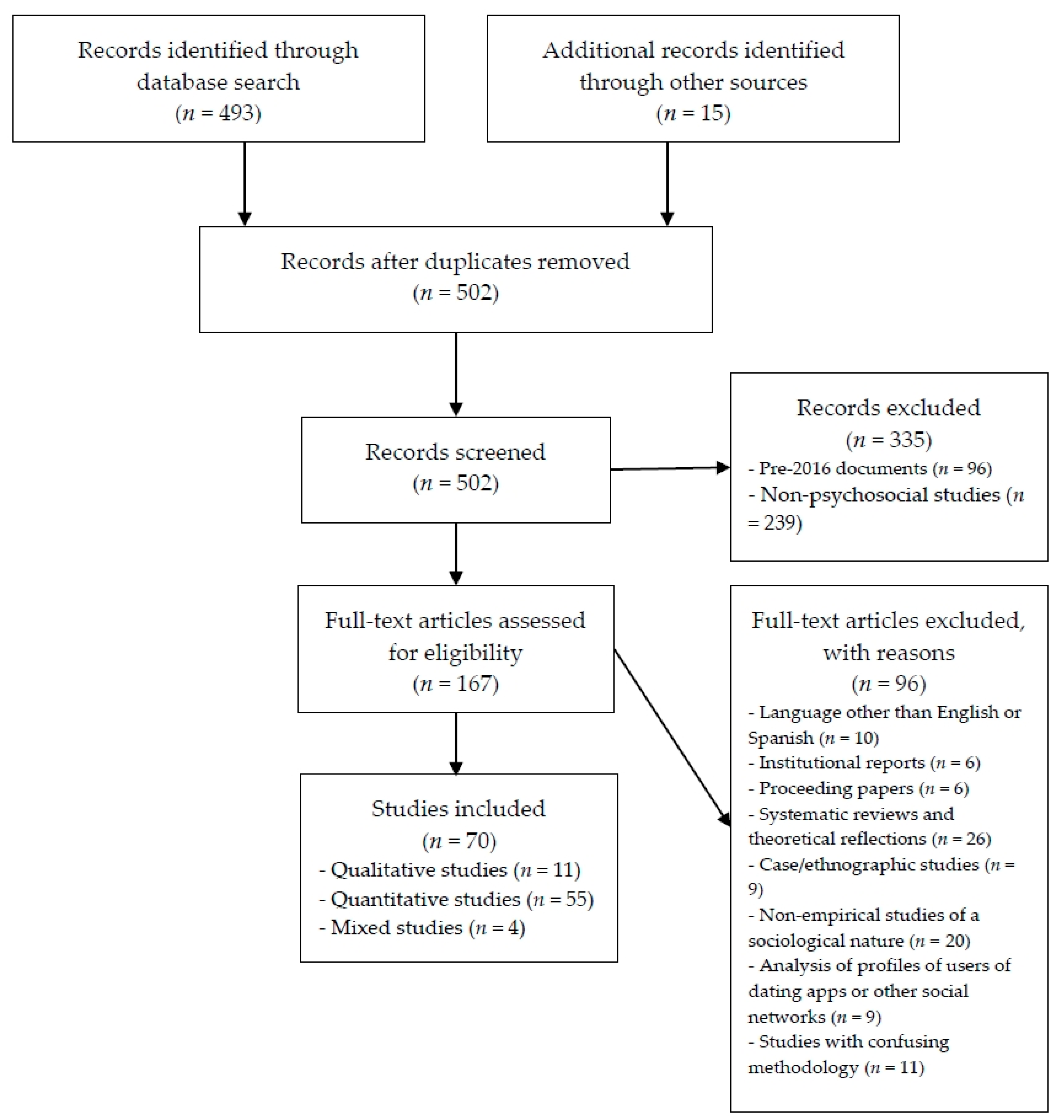
2. Materials and Methods
2.1. Literature Search and Inclusion/Exclusion Criteria
2.2. Data Collection Process and Data Items
3. Results
3.1. Characteristics of Reviewed Studies
3.2. Characteristics of Dating App Users
3.3. Characteristics of Dating App Use
3.4. Motives for Dating App Use
3.5. Benefits and Risks of Using Dating Apps
4. Discussion
Limitations and Future Directions
5. Conclusions
Author Contributions
Funding
Conflicts of Interest
References
- Anzani, A.; Di Sarno, M.; Prunas, A. Using smartphone apps to find sexual partners: A review of the literature. Sexologies 2018, 27, e61–e65. [Google Scholar] [CrossRef]
- Strugo, J.; Muise, A. Swiping for the right reasons: Approach and avoidance goals are associated with actual and perceived dating success on Tinder. Can. J. Hum. Sex. 2019, 28, 93–104. [Google Scholar] [CrossRef]
- Sumter, S.R.; Vandenbosch, L. Dating gone mobile: Demographic and personality-based correlates of using smartphone-based dating applications among emerging adults. New Media Soc. 2019, 21, 655–673. [Google Scholar] [CrossRef]
- Timmermans, E.; Courtois, C. From swiping to casual sex and/or committed relationships: Exploring the experiences of Tinder users. Inf. Soc. 2018, 34, 59–70. [Google Scholar] [CrossRef]
- Statista Market Forecast. eServices Report 2019—Dating Services. Available online: https://www.statista.com/study/40456/dating-services-report/ (accessed on 15 April 2020).
- Duncan, Z.; March, E. Using Tinder® to start a fire: Predicting antisocial use of Tinder® with gender and the Dark Tetrad. Personal. Individ. Differ. 2019, 145, 9–14. [Google Scholar] [CrossRef]
- Sevi, B.; Aral, T.; Eskenazi, T. Exploring the hook-up app: Low sexual disgust and high sociosexuality predict motivation to use Tinder for casual sex. Personal. Individ. Differ. 2018, 133, 17–20. [Google Scholar] [CrossRef]
- Gatter, K.; Hodkinson, K. On the differences between Tinder versus online dating agencies: Questioning a myth. An exploratory study. Cogent Psychol. 2016, 3. [Google Scholar] [CrossRef]
- Neyt, B.; Vandenbulcke, S.; Baert, S. Are men intimidated by highly educated women? Undercover on Tinder. Econ. Educ. Rev. 2019, 73, 101914. [Google Scholar] [CrossRef]
- Wang, H.; Zhang, L.; Zhou, Y.; Wang, K.; Zhang, X.; Wu, J.; Wang, G. The use of geosocial networking smartphone applications and the risk of sexually transmitted infections among men who have sex with men: A systematic review and meta-analysis. BMC Public Health 2018, 18, 1178. [Google Scholar] [CrossRef]
- Wu, S.; Ward, J. The mediation of gay men’s lives: A review on gay dating app studies. Sociol. Compass 2018, 12, e12560. [Google Scholar] [CrossRef]
- Gillett, R. Intimate intrusions online: Studying the normalisation of abuse in dating apps. Womens Stud. Int. Forum 2018, 69, 212–219. [Google Scholar] [CrossRef]
- Liberati, A.; Altman, D.G.; Tetzlaff, J.; Mulrow, C.; Gøtzsche, P.C.; Ioannidis, J.P.A.; Clarke, M.; Devereaux, P.J.; Kleijnen, J.; Moher, D. The PRISMA statement for reporting systematic reviews and meta-analyses of studies that evaluate health care interventions: Explanation and elaboration. PLoS Med. 2009, 6, e1000100. [Google Scholar] [CrossRef] [PubMed]
- Moher, D.; Liberati, A.; Tetzlaff, J.; Altman, D.G. The PRISMA Group Preferred reporting items for systematic reviews and meta-analyses: The PRISMA statement. PLoS Med. 2009, 6, e1000097. [Google Scholar] [CrossRef] [PubMed]
- Gough, D.; Oliver, S.; Thomas, J. An Introduction to Systematic Reviews; SAGE: New Park, CA, USA, 2012. [Google Scholar]
- Albury, K.; Byron, P. Safe on my phone? Same-sex attracted young people’s negotiations of intimacy, visibility, and risk on digital hook-up apps. Soc. Media Soc. 2016, 2, 205630511667288. [Google Scholar] [CrossRef]
- Alexopoulos, C.; Timmermans, E.; McNallie, J. Swiping more, committing less: Unraveling the links among dating app use, dating app success, and intention to commit infidelity. Comput. Hum. Behav. 2020, 102, 172–180. [Google Scholar] [CrossRef]
- Badal, H.J.; Stryker, J.E.; DeLuca, N.; Purcell, D.W. Swipe Right: Dating Website and App Use Among Men Who Have Sex with Men. AIDS Behav. 2018, 22, 1265–1272. [Google Scholar] [CrossRef]
- Boonchutima, S.; Kongchan, W. Utilization of dating apps by men who have sex with men for persuading other men toward substance use. Psychol. Res. Behav. Manag. 2017, 10, 31–38. [Google Scholar] [CrossRef]
- Smith Boonchutima; Sopon Sriwattana; Rungroj Rungvimolsin; Nattanop Palahan Gays dating applications: Information disclosure and sexual behavior. J. Health Res. 2016, 30, 231–239. [CrossRef]
- Botnen, E.O.; Bendixen, M.; Grøntvedt, T.V.; Kennair, L.E.O. Individual differences in sociosexuality predict picture-based mobile dating app use. Personal. Individ. Differ. 2018, 131, 67–73. [Google Scholar] [CrossRef]
- Breslow, A.S.; Sandil, R.; Brewster, M.E.; Parent, M.C.; Chan, A.; Yucel, A.; Bensmiller, N.; Glaeser, E. Adonis on the apps: Online objectification, self-esteem, and sexual minority men. Psychol. Men Masc. 2020, 21, 25–35. [Google Scholar] [CrossRef]
- Castro, Á.; Barrada, J.R.; Ramos-Villagrasa, P.J.; Fernández-del-Río, E. Profiling Dating Apps Users: Sociodemographic and Personality Characteristics. Int. J. Environ. Res. Public. Health 2020, 17, 3653. [Google Scholar] [CrossRef] [PubMed]
- Chan, L.S. The role of gay identity confusion and outness in sex-seeking on mobile dating apps among men who have sex with men: A conditional process analysis. J. Homosex. 2017, 64, 622–637. [Google Scholar] [CrossRef] [PubMed]
- Chan, L.S. Who uses dating apps? Exploring the relationships among trust, sensation-seeking, smartphone use, and the intent to use dating apps based on the Integrative Model. Comput. Hum. Behav. 2017, 72, 246–258. [Google Scholar] [CrossRef]
- Chan, L.S. Ambivalence in networked intimacy: Observations from gay men using mobile dating apps. New Media Soc. 2018, 20, 2566–2581. [Google Scholar] [CrossRef]
- Chan, L.S. Liberating or disciplining? A technofeminist analysis of the use of dating apps among women in urban China. Commun. Cult. Crit. 2018, 11, 298–314. [Google Scholar] [CrossRef]
- Chan, L.S. Paradoxical associations of masculine ideology and casual sex among heterosexual male geosocial networking app users in China. Sex Roles 2019, 81, 456–466. [Google Scholar] [CrossRef]
- Chin, K.; Edelstein, R.S.; Vernon, P.A. Attached to dating apps: Attachment orientations and preferences for dating apps. Mob. Media Commun. 2019, 7, 41–59. [Google Scholar] [CrossRef]
- Choi, E.P.H.; Wong, J.Y.H.; Fong, D.Y.T. An emerging risk factor of sexual abuse: The use of smartphone dating applications. Sex. Abuse J. Res. Treat. 2016, 107906321667216. [Google Scholar] [CrossRef]
- Choi, E.P.H.; Wong, J.Y.H.; Lo, H.H.M.; Wong, W.; Chio, J.H.M.; Fong, D.Y.T. The association between smartphone dating applications and college students’ casual sex encounters and condom use. Sex. Reprod. Healthc. 2016, 9, 38–41. [Google Scholar] [CrossRef]
- Choi, E.P.H.; Wong, J.Y.H.; Lo, H.H.M.; Wong, W.; Chio, J.H.M.; Fong, D.Y.T. Association between using smartphone dating applications and alcohol and recreational drug use in conjunction with sexual activities in college students. Subst. Use Misuse 2017, 52, 422–428. [Google Scholar] [CrossRef]
- Choi, E.P.-H.; Wong, J.Y.-H.; Lo, H.H.-M.; Wong, W.; Chio, J.H.-M.; Fong, D.Y.-T. The impacts of using smartphone dating applications on sexual risk behaviours in college students in Hong Kong. PLoS ONE 2016, 11, e0165394. [Google Scholar] [CrossRef] [PubMed]
- Coduto, K.D.; Lee-Won, R.J.; Baek, Y.M. Swiping for trouble: Problematic dating application use among psychosocially distraught individuals and the paths to negative outcomes. J. Soc. Pers. Relatsh. 2020, 37, 212–232. [Google Scholar] [CrossRef]
- Ferris, L.; Duguay, S. Tinder’s lesbian digital imaginary: Investigating (im)permeable boundaries of sexual identity on a popular dating app. New Media Soc. 2020, 22, 489–506. [Google Scholar] [CrossRef]
- Filice, E.; Raffoul, A.; Meyer, S.B.; Neiterman, E. The influence of Grindr, a geosocial networking application, on body image in gay, bisexual and other men who have sex with men: An exploratory study. Body Image 2019, 31, 59–70. [Google Scholar] [CrossRef]
- Goedel, W.C.; Krebs, P.; Greene, R.E.; Duncan, D.T. Associations between perceived weight status, body dissatisfaction, and self-objectification on sexual sensation seeking and sexual risk behaviors among men who have sex with men using Grindr. Behav. Med. 2017, 43, 142–150. [Google Scholar] [CrossRef]
- Green, S.M.; Turner, D.; Logan, R.G. Exploring the effect of sharing common Facebook friends on the sexual risk behaviors of Tinder users. Cyberpsychol. Behav. Soc. Netw. 2018, 21, 457–462. [Google Scholar] [CrossRef]
- Griffin, M.; Canevello, A.; McAnulty, R.D. Motives and concerns associated with geosocial networking app usage: An exploratory study among heterosexual college students in the United States. Cyberpsychol. Behav. Soc. Netw. 2018, 21, 268–275. [Google Scholar] [CrossRef]
- Hahn, H.A.; You, D.S.; Sferra, M.; Hubbard, M.; Thamotharan, S.; Fields, S.A. Is it too soon to meet? Examining differences in geosocial networking app use and sexual risk behavior of emerging adults. Sex. Cult. 2018, 22, 1–21. [Google Scholar] [CrossRef]
- Hart, M.M.; Zdravkov, J.; Plaha, K.; Cooper, F.; Allen, K.; Fuller, L.; Jones, R.; Day, S. Digital sex and the city: Prevalent use of dating apps amongst heterosexual attendees of genito-urinary medicine (GUM) clinics. Sex. Transm. Infect. 2016, 92, A1. [Google Scholar] [CrossRef][Green Version]
- Kesten, J.M.; Dias, K.; Burns, F.; Crook, P.; Howarth, A.; Mercer, C.H.; Rodger, A.; Simms, I.; Oliver, I.; Hickman, M.; et al. Acceptability and potential impact of delivering sexual health promotion information through social media and dating apps to MSM in England: A qualitative study. BMC Public Health 2019, 19, 1236. [Google Scholar] [CrossRef]
- Lauckner, C.; Truszczynski, N.; Lambert, D.; Kottamasu, V.; Meherally, S.; Schipani-McLaughlin, A.M.; Taylor, E.; Hansen, N. “Catfishing,” cyberbullying, and coercion: An exploration of the risks associated with dating app use among rural sexual minority males. J. Gay Lesbian Ment. Health 2019, 23, 289–306. [Google Scholar] [CrossRef]
- LeFebvre, L.E. Swiping me off my feet: Explicating relationship initiation on Tinder. J. Soc. Pers. Relatsh. 2018, 35, 1205–1229. [Google Scholar] [CrossRef]
- Licoppe, C. Liquidity and attachment in the mobile hookup culture. A comparative study of contrasted interactional patterns in the main uses of Grindr and Tinder. J. Cult. Econ. 2020, 13, 73–90. [Google Scholar] [CrossRef]
- Luo, Q.; Wu, Z.; Chen, Z.; Ma, Y.; Mi, G.; Liu, X.; Xu, J.; Rou, K.; Zhao, Y.; Scott, S.R. App use frequency and condomless anal intercourse among men who have sex with men in Beijing, China: A cross-sectional study. Int. J. STD AIDS 2019, 30, 1146–1155. [Google Scholar] [CrossRef]
- Lutz, C.; Ranzini, G. Where dating meets data: Investigating social and institutional privacy concerns on Tinder. Soc. Media Soc. 2017, 3, 205630511769773. [Google Scholar] [CrossRef]
- Lyons, M.; Messenger, A.; Perry, R.; Brewer, G. The Dark Tetrad in Tinder: Hook-up app for high psychopathy individuals, and a diverse utilitarian tool for Machiavellians? Curr. Psychol. 2020. [Google Scholar] [CrossRef]
- Macapagal, K.; Kraus, A.; Moskowitz, D.A.; Birnholtz, J. Geosocial networking application use, characteristics of app-met sexual partners, and sexual behavior among sexual and gender minority adolescents assigned male at birth. J. Sex. Res. 2019, 1–10. [Google Scholar] [CrossRef]
- Macapagal, K.; Moskowitz, D.A.; Li, D.H.; Carrión, A.; Bettin, E.; Fisher, C.B.; Mustanski, B. Hookup app use, sexual behavior, and sexual health among adolescent men who have sex with men in the United States. J. Adolesc. Health 2018, 62, 708–715. [Google Scholar] [CrossRef]
- March, E.; Grieve, R.; Marrington, J.; Jonason, P.K. Trolling on Tinder® (and other dating apps): Examining the role of the Dark Tetrad and impulsivity. Personal. Individ. Differ. 2017, 110, 139–143. [Google Scholar] [CrossRef]
- Miller, B. A picture is worth 1000 messages: Investigating face and body photos on mobile dating apps for men who have sex with men. J. Homosex. 2019, 1–25. [Google Scholar] [CrossRef]
- Miller, B.; Behm-Morawitz, E. “Masculine Guys Only”: The effects of femmephobic mobile dating application profiles on partner selection for men who have sex with men. Comput. Hum. Behav. 2016, 62, 176–185. [Google Scholar] [CrossRef]
- Numer, M.; Holmes, D.; Joy, P.; Thompson, R.; Doria, N. Grinding against HIV discourse: A critical exploration of social sexual practices in gay cruising apps. Gend. Technol. Dev. 2019, 23, 257–276. [Google Scholar] [CrossRef]
- Orosz, G.; Benyó, M.; Berkes, B.; Nikoletti, E.; Gál, É.; Tóth-Király, I.; Bőthe, B. The personality, motivational, and need-based background of problematic Tinder use. J. Behav. Addict. 2018, 7, 301–316. [Google Scholar] [CrossRef] [PubMed]
- Orosz, G.; Tóth-Király, I.; Bőthe, B.; Melher, D. Too many swipes for today: The development of the Problematic Tinder Use Scale (PTUS). J. Behav. Addict. 2016, 5, 518–523. [Google Scholar] [CrossRef] [PubMed]
- Parisi, L.; Comunello, F. Dating in the time of “relational filter bubbles”: Exploring imaginaries, perceptions and tactics of Italian dating app users. Commun. Rev. 2020, 23, 66–89. [Google Scholar] [CrossRef]
- Queiroz, A.A.F.L.N.; de Sousa, A.F.L.; Brignol, S.; Araújo, T.M.E.; Reis, R.K. Vulnerability to HIV among older men who have sex with men users of dating apps in Brazil. Braz. J. Infect. Dis. 2019, 23, 298–306. [Google Scholar] [CrossRef] [PubMed]
- Ranzini, G.; Lutz, C. Love at first swipe? Explaining Tinder self-presentation and motives. Mob. Media Commun. 2017, 5, 80–101. [Google Scholar] [CrossRef]
- Rochat, L.; Bianchi-Demicheli, F.; Aboujaoude, E.; Khazaal, Y. The psychology of “swiping”: A cluster analysis of the mobile dating app Tinder. J. Behav. Addict. 2019, 8, 804–813. [Google Scholar] [CrossRef]
- Rodgers, R.F.; Campagna, J.; Attawala, R.; Richard, C.; Kakfa, C.; Rizzo, C. In the eye of the swiper: A preliminary analysis of the relationship between dating app use and dimensions of body image. Eat. Weight Disord. Stud. Anorex. Bulim. Obes. 2019. [Google Scholar] [CrossRef]
- Sawyer, A.N.; Smith, E.R.; Benotsch, E.G. Dating Application Use and Sexual Risk Behavior Among Young Adults. Sex. Res. Soc. Policy 2018, 15, 183–191. [Google Scholar] [CrossRef]
- Schreurs, L.; Sumter, S.R.; Vandenbosch, L. A prototype willingness approach to the relation between geo-social dating apps and willingness to sext with dating app matches. Arch. Sex. Behav. 2020, 49, 1133–1145. [Google Scholar] [CrossRef] [PubMed]
- Shapiro, G.K.; Tatar, O.; Sutton, A.; Fisher, W.; Naz, A.; Perez, S.; Rosberger, Z. Correlates of Tinder use and risky sexual behaviors in young adults. Cyberpsychol. Behav. Soc. Netw. 2017, 20, 727–734. [Google Scholar] [CrossRef] [PubMed]
- Solis, R.J.C.; Wong, K.Y.J. To meet or not to meet? Measuring motivations and risks as predictors of outcomes in the use of mobile dating applications in China. Chin. J. Commun. 2019, 12, 204–223. [Google Scholar] [CrossRef]
- Srivastava, A.; Rusow, J.A.; Holguin, M.; Semborski, S.; Onasch-Vera, L.; Wilson, N.; Rice, E. Exchange and survival sex, dating apps, gender identity, and sexual orientation among homeless youth in Los Angeles. J. Prim. Prev. 2019, 40, 561–568. [Google Scholar] [CrossRef]
- Strubel, J.; Petrie, T.A. Love me Tinder: Body image and psychosocial functioning among men and women. Body Image 2017, 21, 34–38. [Google Scholar] [CrossRef]
- Sumter, S.R.; Vandenbosch, L.; Ligtenberg, L. Love me Tinder: Untangling emerging adults’ motivations for using the dating application Tinder. Telemat. Inform. 2017, 34, 67–78. [Google Scholar] [CrossRef]
- Tang, D.T.-S. All I get is an emoji: Dating on lesbian mobile phone app Butterfly. Media Cult. Soc. 2017, 39, 816–832. [Google Scholar] [CrossRef]
- Timmermans, E.; De Caluwé, E. Development and validation of the Tinder Motives Scale (TMS). Comput. Hum. Behav. 2017, 70, 341–350. [Google Scholar] [CrossRef]
- Timmermans, E.; De Caluwé, E. To Tinder or not to Tinder, that’s the question: An individual differences perspective to Tinder use and motives. Personal. Individ. Differ. 2017, 110, 74–79. [Google Scholar] [CrossRef]
- Timmermans, E.; De Caluwé, E.; Alexopoulos, C. Why are you cheating on tinder? Exploring users’ motives and (dark) personality traits. Comput. Hum. Behav. 2018, 89, 129–139. [Google Scholar] [CrossRef]
- Tran, A.; Suharlim, C.; Mattie, H.; Davison, K.; Agénor, M.; Austin, S.B. Dating app use and unhealthy weight control behaviors among a sample of U.S. adults: A cross-sectional study. J. Eat. Disord. 2019, 7, 16. [Google Scholar] [CrossRef] [PubMed]
- Ward, J. What are you doing on Tinder? Impression management on a matchmaking mobile app. Inf. Commun. Soc. 2017, 20, 1644–1659. [Google Scholar] [CrossRef]
- Weiser, D.A.; Niehuis, S.; Flora, J.; Punyanunt-Carter, N.M.; Arias, V.S.; Hannah Baird, R. Swiping right: Sociosexuality, intentions to engage in infidelity, and infidelity experiences on Tinder. Personal. Individ. Differ. 2018, 133, 29–33. [Google Scholar] [CrossRef]
- Wu, O. Tinder y conductas sexuales de riesgo en jóvenes españoles [Tinder and sexual risk behaviors in Spanish youth]. Aloma 2019, 37, 35–42. [Google Scholar]
- Yeo, T.E.D.; Fung, T.H. “Mr Right Now”: Temporality of relationship formation on gay mobile dating apps. Mob. Media Commun. 2018, 6, 3–18. [Google Scholar] [CrossRef]
- Zervoulis, K.; Smith, D.S.; Reed, R.; Dinos, S. Use of ‘gay dating apps’ and its relationship with individual well-being and sense of community in men who have sex with men. Psychol. Sex. 2020, 11, 88–102. [Google Scholar] [CrossRef]
- Kachur, R.; Copen, C.; Strona, F.; Furness, B.; Bernstein, K.; Hogben, M. P509 Use of internet/mobile dating apps to find sex partners among a nationally representative sample of men who have sex with men. In Poster Presentations; BMJ Publishing Group Ltd.: London, UK, 2019; p. A234. [Google Scholar]
- Goldenberg, D. Disconnected connectedness: The paradox of digital dating for gay and bisexual men. J. Gay Lesbian Ment. Health 2019, 23, 360–366. [Google Scholar] [CrossRef]
- Conner, C.T. The Gay Gayze: Expressions of inequality on Grindr. Sociol. Q. 2019, 60, 397–419. [Google Scholar] [CrossRef]
- Rowse, J.; Bolt, C.; Gaya, S. Swipe right: The emergence of dating-app facilitated sexual assault. A descriptive retrospective audit of forensic examination caseload in an Australian metropolitan service. Forensic Sci. Med. Pathol. 2020, 16, 71–77. [Google Scholar] [CrossRef]
- Wu, S.; Ward, J. Looking for “interesting people”: Chinese gay men’s exploration of relationship development on dating apps. Mob. Media Commun. 2019, 205015791988855. [Google Scholar] [CrossRef]
- Eleuteri, S.; Rossi, R.; Tripodi, F.; Fabrizi, A.; Simonelli, C. How the smartphone apps can improve your sexual wellbeing? Sexologies 2018, 27, 139–143. [Google Scholar] [CrossRef]

| Author/s (Year) | Sample (N, Characteristics) | Methodology | Findings |
|---|---|---|---|
| Albury & Byron (2016) [16] | Same-sex attracted Australian men and women, aged between 18 and 29 | Focus groups interviews | Mobile and apps contributed to participants’ perceptions of safety and risk when flirting or meeting with new sexual partners. Users strategically engaged with the security features of apps to block unwanted approaches and to manage privacy concerns when interacting with others. |
| Alexopoulos et al. (2020) [17] | 395 participants, recruited through a U.S.-based university and Amazon Mechanical Turk, both sexes (M = 26.7, SD = 8.32) | Online survey | People´s perceived success on a dating app was positively associated with their intention to commit infidelity through perceived amount of available partners. |
| Badal et al. (2018) [18] | 3105 males identified as gay or bisexual, aged 18–64 (M = 32.35, SD = 9.58), residents in the United States or Puerto Rico | Web-based survey | More than half (55.7%) of participants were frequent users of dating websites and apps. Two third (66.7%) of users had casual partner only in the prior 12 months and reported a high average number of casual sex partners in the previous 12 months compared to never users. The most frequently used dating apps was Grindr (60.2%). |
| Boonchutima & Kongchan (2017) [19] | 350 Thai men who have sex with men | Online survey | 73% of participants were dating app users, to find potential partners as well as for inviting others into illicit drug practice. Persuasion through dating apps influenced people toward accepting the substance use invitation, with a 77% invitation success rate. Substance use was linked with unprotected sex. |
| Boonchutima et al. (2016) [20] | 286 gay dating app users in Thailand | Online survey | There are positive associations between the degree of app usage and the amount of information being disclosed. Moreover, the frequency of usage and the disclosure of personal information were associated with a higher rate of unprotected sex. |
| Botnen et al. (2018) [21] | 641 Norwegian university students, both sexes, aged between 19 and 29 (M = 21.4, SD = 1.6) | Offline questionnaire | Nearly half of the participants reported former or current dating app use. 20% was current users. Dating app users tend to report being less restricted in their sociosexuality than participants who have never used apps. This effect was equally strong for men and women. |
| Breslow et al. (2020) [22] | 230 sexual minority men, U.S.-located | Online survey | The number of apps used was positively related with objectification, internalization, and body surveillance, and negatively related with body satisfaction and self-esteem. |
| Castro et al. (2020) [23] | 1705 students from a Spanish university, both sexes, aged between 18 and 26 (M = 20.60, SD = 2.09) | Online survey | Men, older youths, members of sexual minorities, and people without partner were more likely to be dating app users. In addition, some traits of the Big Five (openness to experience) allowed prediction of the current use of dating apps. The dark personality showed no predictive ability. |
| Chan (2017) [24] | 401 men who have sex with men, U.S.-located, ages ranged from 18 to 44 years (M = 23.45, SD = 4.09) | Online survey | There was a significant relationship between sex-seeking and the number of casual sex partners, mediated by the intensity of apps use. Furthermore, gay identity confusion and outness to the world moderated these indirect effects. |
| Chan (2017) [25] | 257 U.S. citizens, both sexes, aged between 18 and 34 (M = 27.1, SD = 4.35), heterosexuals. | Online survey (via Qualtrics) | Regarding using dating apps to seek romance, people´s attitude and perceived norms were predictive of such intent. Sensation-seeking and smartphone use had a direct relationship with intent. Regarding using dating apps for seeking sex, people´s attitude and self-efficacy were predictive of such intent. |
| Chan (2018) [26] | (1) 7 Asian-American users of gay male dating apps, aged between 26 and 30; (2) 245 U.S. male dating app users, aged between 19 and 68. | (1) semi-structured interviews; (2) online survey | Users reported ambivalence in establishing relationships, which brought forth the ambiguity of relationships, dominance of profiles, and over-abundance of connections on these apps. |
| Chan (2018) [27] | 19 female dating app users in China, aged between 21 and 38 | Semi-structured interviews | Female dating app users offered multiple interpretations of why they use dating apps (e.g., sexual experience, looking for a relationship, entertainment). They also face several challenges in using dating apps (e.g., resisting social stigma, assessing men´s purposes, undesirable sexual solicitations). |
| Chan (2019) [28] | 125 male heterosexual active users of dating apps (Momo) in urban cities in China, aged between 18 and 47 (M = 28.94, SD = 5.96) | Online survey (via Qualtrics) | The endorsement of masculinity had an indirect positive relationship with the number of sex partners mediated by the sex motive. At the same time, this had a direct but negative association with the number of sex partners. These paradoxical associations were explained by different patterns across the individual dimension of masculinity ideology (e.g., importance of sex, avoidance of femininity). |
| Chin et al. (2019) [29] | 183 North-American adults, both sexes, aged between 18 and 65 (M = 29.97, SD = 8,50). Recruited via Amazon´s Mechanical Turk. | Online survey | People with a more anxious attachment orientation were more likely to report using dating apps than people lower in anxiety attachment. People with a more avoidance attachment orientation were less like to report using dating apps than people lower in avoidant attachment. The most common reason people reported for using apps was to meet others, and the most common reason people reported for not using apps was difficulty trusting people online. |
| Choi et al. (2016) [30] | 666 university students from Hong Kong, both sexes (M = 20.03, SD = 1.52) | Self-administered survey (not online) | Users of dating apps were more likely to have unprotected sex with a casual sex partner the last time they engaged in sexual intercourse. Using dating apps for more than 12 months was associated with having a casual sex partner in the last episode of sexual intercourse, as well as having unprotected sex with that casual partner. |
| Choi et al. (2016) [31] | 666 university students from Hong Kong, both sexes (M = 20.03, SD = 1.52) | Self-administered survey (not online) | Users of dating apps and current drinkers were less likely to have consistent condom use. Users of dating apps, bisexual/homosexual subjects, and female subjects were more likely not to have used condoms the last time they had sexual intercourse. |
| Choi et al. (2017) [32] | 666 university students from Hong Kong, both sexes (M = 20.03, SD = 1.52) | Self-administered survey (not online) | The use of dating apps for more than one year was found to be associated with recreational drug use in conjunction with sexual activities. Other risk factors of recreational drug use in conjunction with sexual activities included being bisexual/homosexual, male, a smoker, and having one´s first sexual intercourse before 16 years. The use of dating apps was not a risk factor for alcohol consumption in conjunction with social activities. |
| Choi et al. (2017) [33] | 666 university students from Hong Kong, both sexes (M = 20.03, SD = 1.52) | Self-administered survey (not online) | Users of dating apps were more likely to have been sexually abused in the previous year than non-users. Using dating apps was also a risk factor for lifetime sexual abuse. |
| Coduto et al. (2020) [34] | 269 undergraduate students, both sexes, aged between 18 and 24 (M = 20.85, SD = 2.45) | Online survey | The data provided support for moderated serial mediation. This type of mediation predicted by the social skills model was significant only among those high in loneliness, with positive association between preference for online social interaction and compulsive use being significant among those with high in loneliness. |
| Duncan & March (2019) [6] | 587 Tinder users, both sexes (M = 23.75, SD = 6.05) | Online survey | They created and validated the Antisocial Uses of Tinder Scale. Exploratory and confirmatory factor analyses revealed three forms of antisocial behavior (general, esteem, and sexual). Regression analyses showed the predictive utility of gender and the dark traits across antisocial behaviors. |
| Ferris & Duguay (2020) [35] | 27 women seeking women (WSW) from Australia, Canada, and the UK, aged between 19 and 35. | Semi-structured interviews | Participants perceived that they were entering a space conducive to finding women seeking women. However, men, couples, and heterosexual women permeated this space, heightening the need for participants to signal non-heterosexual identity. |
| Filice et al. (2019) [36] | 13 men who have sex with men, aged between 18 and 65 (M = 29). | Semi-structured interviews | Grindr affects user body image through three primary mechanisms: weight stigma, sexual objectification and social comparison. Moreover, participants identified several protective factors and coping strategies. |
| Gatter & Hodkinson (2016) [8] | 75 participants, both sexes, aged between 20 and 69, divided in three groups (Tinder users, online dating agency users, and non-users). | Online survey | No differences were found in motivations, suggesting that people may use both online dating agencies and Tinder for similar reasons. Tinder users were younger than online dating agency users, which accounted for observed group differences in sexual permissiveness. There were no differences in self-esteem or sociability between the groups. Men were more likely than women to use both types of dating and scored higher in sexual permissiveness. |
| Goedel et al. (2017) [37] | 92 men who have sex with men, Grindr users, aged between 18 and 70. | Online survey | Obese participants scored significantly higher on measures of body dissatisfaction and lower on measures of sexual sensation seeking. Decreased propensities to seek sexual-sensation were associated with fewer sexual partners. |
| Green et al. (2018) [38] | 953 university students, both sexes, aged between 18 and 24 (M = 20.76, SD = 1.81) | Online survey | Tinder users may: (1) perceive partners with whom they share “common connections” as familiar or “safe”, which may give users a false sense of security about the sexual health risks; or (2) be hesitant to discuss sexual health matters with partners who are within their sexual network due to fear of potential gossip. Both lines of thought may reduce safer sex behaviors. |
| Griffin et al. (2018) [39] | 409 U.S. university students, heterosexuals, both sexes (M = 19.7, SD = 7.2) | Online survey | 39% of participants had used a dating app, and 60% of them were regular users. Tinder was the most popular dating app. Top reasons for app use were fun and to meet people. Very few users (4%) reported using apps for casual sex encounters, although many users (72% of men and 22% of women) were open to meeting a sexual partner with a dating app. Top concerns included safety and privacy. |
| Hahn et al. (2018) [40] | Study 1: 64 men who have sex with men dating app users, aged between 18 and 24 (M = 22.66, SD = 1.38). Study 2: 217 participants, both sexes, aged between 18 and 21 (M = 20.23, SD = 0.85). Recruited by Amazon Mechanical Turk (both studies). | Online survey (both studies) | Study 1: those who talked less before meeting in person engaged in more sexual risk behaviors than those who spent more time talking before meeting in person. Study 2: there were no differences in sexual risk behaviors between dating app users and non-users. However, when examining app users by time before meeting, those with a shorter time before meeting were more impulsive and more likely to report sexual risk behaviors. |
| Hart et al. (2016) [41] | 539 heterosexual attenders of two genito-urinary medicine clinics, both sexes (Mdn = 21–30 years). | Self-administered survey | A quarter of participants use apps to find partners online. This study identified high rates of sexually transmitted infections, condomless use and recreational drug use among app users. |
| Kesten et al. (2019) [42] | 25 men who have sex with men residents in England aged between 26 and 57 years (Mdn = 30–39). | Semi-structured interviews | Sexual health information delivery through social media and dating apps was considered acceptable. Concerns were expressed that sharing or commenting on social media sexual health information may lead to judgments and discrimination. Dating apps can easily target men who have sex with men. |
| Lauckner et al. (2019) [43] | 20 sexual minority males living in U.S. non-metropolitan areas, aged between 18 and 60. | Survey and semi-structured interviews | Many participants reported negative experiences while using dating apps. Specifically, they discussed instances of deception or “catfishing”, discrimination, racism, harassment, and sexual coercion. |
| LeFebvre (2018) [44] | 395 participants recruited from Amazon Mechanical Turk, both sexes, aged between 18 and 34 (M = 26.41, SD = 4.17) | Online survey | The prevalent view that Tinder is a sex or hookup app remains salient among users; although, many users utilize Tinder for creating other interpersonal communication connections and relationships, both romantic and platonic. Initially, Tinder users gather information to identify their preferences. |
| Licoppe (2020) [45] | Grindr study: 23 male users of Grindr in Paris. Tinder study: 40 male and female users of Tinder in France. | In-depth interviews | Grindr and Tinder users take almost opposite conversational stances regarding the organization of casual hookups as sexual, one-off encounters with strangers. While many gay Grindr users have to chat to organize quick sexual connections, many heterosexual Tinder users are looking to achieve topically-rich chat conversations. |
| Luo et al. (2019) [46] | 9280 men who have sex with men dating app users in China (Mdn = 31–40 years). | Online survey | Results indicated that frequent app use was associated with lower odds of condomless anal intercourse among men who have sex with men in China. |
| Lutz & Ranzini (2017) [47] | 497 U.S.-based participants, both sexes (M = 30.9, SD = 8.2), recruited through Amazon Mechanical Turk. | Online survey | Tinder users were more concerned about institutional privacy than social privacy. Moreover, different motivations for using Tinder (hooking up, relationship, friendship, travel, self-validation, entertainment) affect social privacy concerns more strongly than institutional concerns. Finally, loneliness significantly increases users´ social and institutional privacy concerns. |
| Lyons et al. (2020) [48] | 216 current or former Tinder users, from UK, USA and Canada, both sexes, aged between 18 and 56 (M = 22.87, SD = 7.09). | Online survey | Using Tinder for acquiring sexual experience was related to being male and being high in psychopathy. Psychopathy was positively correlated with using Tinder to distract oneself from other tasks. Higher Machiavellianism and being female were related to peer pressure as a Tinder use motivation. Using Tinder for acquiring social or flirting skills had a negative relationship with narcissism, and a positive relationship with Machiavellianism. Finally, Machiavellianism was also a significant, positive predictor of Tinder use for social approval and to pass the time. |
| Macapagal et al. (2019) [49] | 219 adolescent members of sexual and gender minorities assigned male at birth, U.S.-located, aged between 15 and 17 (M = 16.30, SD = 0.74). | Online survey | Most participants (70.3%) used apps for sexual minority men, 14.6% used social media/other apps to meet partners, and 15.1% used neither. Nearly 60% of adolescents who used any type of app reported having met people from the apps in person. Dating apps and social media users were more like to report condomless receptive anal sex. |
| Macapagal et al. (2018) [50] | 200 adolescent men who have sex with men, aged between 14 and 17 (M = 16.64, SD = 0.86). | Online survey | 52.5% of participants reported using gay-specific apps to meet partner for sex. Of these, most participants reported having oral (75.7%) and anal sex (62.1%) with those partners. Of those who reported having anal sex, only 25% always used condoms. |
| March et al. (2017) [51] | 357 Australian adults, both sexes, aged between 18 and 60 (M = 22.50, SD = 6.55). | Online survey | Traits of psychopathy, sadism, and dysfunctional impulsivity were significantly associated with trolling behaviors. Subsequent moderation analyses revealed that dysfunctional impulsivity predicts perpetration of trolling, but only if the individual has medium or high levels of psychopathy. |
| Miller (2019) [52] | 322 North-American men who have sex with men apps users, aged between 18 and 71 (M = 30.6). | Online survey | Results indicated that the majority of men presented their face in their profile photo and that nearly one in five presented their unclothed torso. Face-disclosure was connected to higher levels of app usage, longer-term app usage, and levels of outness. The use of shirtless photos was related to age, a higher drive for muscularity, and more self-perceived masculinity. |
| Miller & Behm-Morawitz (2016) [53] | 143 men who have sex with men app users, aged between 18 and 50 (M = 27.41, SD = 7.60). | Online experiment | Results indicated that the use of femmephobic language in dating profiles affects a potential partner´s perceived intelligence, sexual confidence, and dateability, as well as one´s desire to meet potential partners offline for friendship or romantic purposes. |
| Numer et al. (2019) [54] | 16 gay/bisexual Canada-located males, Grindr users, aged between 20 and 50. | Semi-structured interviews | Three threads of disclosure emerged: language and images, filtering, and trust. These threads of disclosure provide insights into how the sexual beliefs, values, and practices of gay and bisexual men who have sex with men are shaped on dating apps. |
| Orosz et al. (2018) [55] | Study 1: 414 participants, both sexes, aged between 18 and 43 (M = 22.71, SD = 3.56). Study 2: 346 participants, both sexes, aged between 18 and 51 (M = 22.02, SD = 3.41). Study 3: 298 participants, both sexes, aged between 19 and 65 (M = 25.09, SD = 5.82) | Online survey (via Qualtrics) | Study 1: a 16-item first-order factor structure was identified with four motivational factors (sex, love, self-esteem enhancement, boredom). Study 2: problematic Tinder use was mainly related to using Tinder for self-esteem enhancement. The Big Five personality factors were only weakly related to the four motivations and to problematic Tinder use. Study 3: showed that instead of global self-esteem, relatedness-need frustration was the strongest predictor of self-esteem enhancement Tinder use motivation that, in turn, was the strongest predictor of problematic Tinder use. |
| Orosz et al. (2016) [56] | 430 Hungarian participants, both sexes, aged between 18 and 51 (M = 22.53, SD = 3.74). | Online survey | They created and validated the Problematic Tinder Use Scale (PTUS). Both the 12- and the 6-item versions were tested. The 6-item unidimensional structure has appropriate reliability and factor structure. No salient demographic-related differences were found. |
| Parisi & Comunello (2020) [57] | 20 Italian dating app users, both sexes, aged between 22 and 65 (M = 38). | Focus groups | Participants appreciated the role of mobile dating apps in reinforcing their relational homophile (their tendency to like people that are “similar” to them) whilst, at the same time, mainly using these apps for increasing the diversity of their intimate interactions in terms of extending their networks. |
| Queiroz et al. (2019) [58] | 412 men who have sex with men dating app users, located in Brazil, with ages over 50 years. | Online survey | Factors associated with a higher chance of having HIV were: sexual relations with an HIV-infected partner, chemsex and, above all, having an HIV-infected partner. The belief that apps increase protection against STI, and not being familiar with post-exposure prophylaxis, were associated with decreased chances of having HIV. |
| Ranzini & Lutz (2017) [59] | 497 U.S.-based participants, both sexes (M = 30.9, SD = 8.2), recruited through Amazon Mechanical Turk | Online survey (via Qualtrics) | Self-esteem was the most important psychological predictor, fostering real self-presentation but decreasing deceptive self-presentation. The motives of use (hooking up/sex, friendship, relationship, traveling, self-validation, entertainment) also affect self-presentation, and were related to demographic characteristics and psychological antecedents. |
| Rochat et al. (2019) [60] | 1159 heterosexual Tinder users, both sexes, aged between 18 and 74 (M = 30.02, SD = 9.19). | Online survey | Four reliable clusters were identified: two with low levels of problematic use (“regulated” and “regulated with low sexual desire”), one with and intermediate level of problematic use (“unregulated-avoidant”), and one with a high-level of problematic use (“unregulated-avoidant”). The clusters differed on gender, marital status, depressive mood, and use patterns. |
| Rodgers et al. (2019) [61] | 170 college students, both sexes, aged between 18 and 32 (M = 22.2) | Online survey | Among males, frequent checking of dating apps was positively correlated with body shame and negatively with beliefs regarding weight/shape controllability. Media internalization was negatively correlated with experiencing negative feelings when using dating apps, and positively with positive feelings. Few associations emerged among females. |
| Sawyer et al. (2018) [62] | 509 students from an U.S. university, both sexes, aged between 18 and 25 (M = 20.07, SD = 1.37). | Online survey | 39.5% of the participants reported using dating apps. Individuals who used dating apps had higher rates of sexual risk behavior in the last three months, including sex after using drugs or alcohol, unprotected sex (anal or vaginal), and more lifetime sexual partners. |
| Schreus et al. (2020) [63] | 286 participants, both sexes, aged between 18 and 30 (M = 24.60, SD = 3.41). | Online survey (via Qualtrics) | More frequent dating app use was positively related to norms and beliefs about peers´ sexting behaviors with unknown dating app matches (descriptive norms), norms beliefs about peers´ approval of sexting with matches (subjective norms), and negatively related to perceptions of danger sexting with matches (risk attitudes). |
| Sevi et al. (2018) [7] | 163 U.S.-located Tinder users, both sexes, aged between 18 and 53 (M = 27.9, SD = 6.5), recruited through Amazon Mechanical Turk. | Online survey | Sexual disgust sensitivity and sociosexuality were predictors of motivation to use Tinder for casual sex. The participants with higher sexual disgust sensitivity reported a lower motivation while the participants with higher sociosexuality reported a higher motivation for casual sex in their Tinder usage. While this model explained the motivation for men, a different model explained women´s motivation. Sociosexuality mediated the relationship between sexual disgust sensitivity and the motivation to use Tinder for casual sex for women Tinder users. |
| Shapiro et al. (2017) [64] | 415 students from a Canadian university, both sexes, aged between 18 and 26 (M = 20.73, SD = 1.73). | Online survey (via Qualtrics) | Greater likelihood of using Tinder was associated with a higher level of education and greater reported need for sex, while decreased likelihood of using Tinder was associated with a higher level of academic achievement, lower sexual permissiveness, living with parents or relatives, and being in a serious relationship. Higher odds of reporting nonconsexual sex and having five or more previous sexual partners users were found in Tinder users. Tinder use was not associated with condom use. |
| Solis & Wong (2019) [65] | 433 Chinese dating app users, both sexes, aged between 11 and 50 (M = 30). | Online survey | Sexuality was the only predictor of the reasons that people use dating apps to meet people offline for dates and casual sex. Among the perceived risks of mobile dating, only the fear of self-exposure to friends, professional networks, and the community significantly explained why users would not meet people offline for casual sex. |
| Srivastava et al. (2019) [66] | 253 homeless youth located in Los Angeles, both sexes, aged between 14 and 24 (M = 21.9, SD = 2.16). | Computer-administered survey | Sexual minority (43.6%) and gender minority (12.1%) youth reported elevated rates of exchange sex compared to cisgender heterosexual youth. 23% of youth who engaged in survival or exchange sex used dating apps or websites to find partners. Exchange sex and survival sex were associated with having recent HIV-positive sex partners. |
| Strubel & Petrie (2017) [67] | 1,147 U.S.-located single participants, both sexes, aged between 18 and 34. | Online survey | Tinder users, regardless of gender, reported significantly lower levels of satisfaction with face and body and higher levels of internalization, appearance comparisons, and body shame and surveillance than non-users. For self-esteem, male Tinder users scored significantly lower than the other groups. |
| Strugo & Muise (2019) [2] | Study 1: 334 Tinder users, both sexes. Study 2: 441 single Tinder users, both sexes, aged between 18 and 59 (M = 27.7, SD = 6.6), recruited via Amazon Mechanical Turk. | Online survey | Study 1: higher approach goals for using Tinder, such as to develop intimate relationships, were associated with more positive beliefs about people on Tinder, and, in turn, associated with reporting greater perceived dating success. In contrast, people with higher avoidance goals, reported feeling more anxious when using Tinder. Study 2: previous results were not accounted for by attractiveness of the user and were consistent between men and women, but differed based on the age of user. |
| Sumter & Vandenbosch (2019) [3] | 541 participants, both sexes, aged between 18 and 30 (M = 23.71, SD = 3.29). | Online survey (via Qualtrics) | Nearly half of the sample used dating apps regularly, with Tinder being the most popular. Non-users were more likely to be heterosexual, high in dating anxiety, and low in sexual permissiveness than dating app users. Among app users, dating app motivations (relational, interpersonal, entertainment), were meaningfully related to identity features. |
| Sumter et al. (2017) [68] | 266 Dutch young, both sexes, aged between 18 and 30 (M = 23.74, SD = 2.56). | Online survey (via Qualtrics) | They found six motivations to use Tinder (love, casual sex, ease of communication, self-worth validation, thrill of excitement, trendiness). The Love motivation appeared to be a stronger motivation to use Tinder than the Casual sex motivation. Men were more likely to report a Casual sex motivation for using Tinder than women. With regard to age, the motivations Love, Casual Sex, and Ease of communication were positively related to age. |
| Tang (2017) [69] | 12 Chinese lesbian and bisexual women, aged 35 and above. | In-depth interviews | Although social media presents ample opportunities for love and intimacy, the prevailing conservative values and cultural norms surrounding dating and relationships in Hong Kong are often reinforced and played out in their choice of romantic engagement. |
| Timmermans & Courtois (2018) [4] | 1038 Belgian Tinder users, both sexes, aged between 18 and 29 (M = 21.80, SD = 2.35). | Online survey | User´s swiping quantity does not guarantee a higher number of Tinder matches. Women have generally more matches than men and men usually have to start a conversation on Tinder. Less than half of the participants reported having had an offline meeting with another Tinder user. More than one third of these offline encounters led to casual sex, and more than a quarter resulted in a committed relationship. |
| Timmermans & De Caluwé (2017) [70] | Study 1: 18 students from an U.S. university, between 18 and 24 years. Study 2: 1728 Belgian Tinder users, both sexes, aged between 18 and 67 (M = 22.66, SD = 4.28). Study 3: 485 Belgian Tinder users, both sexes, aged between 19 and 49 (M = 26.71, SD = 5.32). Study 4: 1031 Belgian Tinder users, both sexes, aged between 18 and 69 (M = 26.93, SD = 7.93). | Study 1: semi-structured interviews. Studies 2–4: online survey | The Tinder Motives Scale (TMS) consists of 58 items and showed a replicable factor structure with 13 reliable motives (social approval, relationship seeking, sexual experience, flirting/social skills, travelling, ex, belongingness, peer pressure, socializing, sexual orientation, pass time/entertainment, distraction, curiosity). The TMS is a valid and reliable scale to assess Tinder use motivations. |
| Timmermans & De Caluwé (2017) [71] | 502 single Belgian participants, both sexes, aged between 18 and 29 (M = 23.11, SD = 2.83). | Online survey | Single Tinder users were more extraverted and open to new experiences than single non-users, whereas single non-users tended to be more conscientious than single users. Additionally, the findings provide insights into how individual differences (sociodemographic and personality variables) in singles can account for Tinder motives. |
| Timmermans et al. (2018) [72] | Sample 1: 1616 participants, both sexes, aged between 18 and 74 (M = 28.90, SD = 10.32). Sample 2: 1795 participants, both sexes, aged between 18 and 58 (M = 22.89, SD = 4.57). | Online survey | Non-single Tinder users differed significantly on nine Tinder motives from single Tinder users. Non-single users generally reported a higher number of romantic relationships and casual sex relationships with other Tinder users compared to single Tinder users. Non-single Tinder users scored significantly lower on agreeableness and conscientiousness, and significantly higher on neuroticism and psychopathy compared to non-users in a committed relationship. |
| Tran et al. (2019) [73] | 1726 U.S.-located participants, both sexes, aged between 18 and 65, recruited through Amazon Mechanical Turk | Online survey | Dating app users had substantially elevated odds of unhealthy weight control behaviors compared with non-users. These findings were supported by results of additional gender-stratified multivariate logistic regression analyses among women and men. |
| Ward (2017) [74] | 21 Dutch participants, recruited in Tinder, both sexes, aged between 19 and 52 years. | Semi-structured interviews | Users´ motivations for using Tinder ranged from entertainment to ego-boost to relationship seeking, and these motivations sometimes change over time. Profile photos are selected in an attempt to present an ideal yet authentic self. Tinder users “swipe” not only in search of people they like, but also for clues as to how to present themselves in order to attract others like them. |
| Weiser et al. (2018) [75] | 550 students from an U.S.- university, both sexes, aged between 18 and 33 (M = 20.86, SD = 1.82). | Online survey | Participants indicated that most knew somebody who had used Tinder to meet extradyadic partners, and several participants reported that their own infidelity had been facilitated by Tinder. Sociosexuality and intentions to engage in infidelity were associated with having used Tinder to engage in infidelity. |
| Wu (2019) [76] | 262 participants, both sexes, aged between 18 and 30 (M = 23.14, SD = 2.11). | Online survey | Tinder users reported higher scores for sexual sensation seeking and sexual compulsivity than non-users. No differences were found regarding risky sexual behavior, except that Tinder users use condoms more frequently than non-users. |
| Wu & Ward (2019) [11] | 21 Chinese urban dating app users, aged between 20 and 31 (M = 25.3). | Semi-structured interviews | Casual sex is perceived as a form of social connection with the potential to foster a relationship. |
| Yeo & Fung (2018) [77] | 74 gay mobile dating app users, aged between 18 and 26 years | Semi-structured interviews and focus groups | The accelerated tempo of interactions facilitated by perpetual connectivity, mutual proximity awareness, and instant messaging was seen to entail instantaneous and ephemeral relationships. The interface design, which foregrounds profile photos and backgrounds textual self-descriptions, was perceived to structure the sequence of browsing and screening in favor of physical appearance and users seeking casual hook-ups. |
| Zervoulis et al. (2019) [78] | 191 men who have sex with men living in the United Kingdom aged between 18 and 72 (M = 36.51, SD = 10.17). | Online survey | High users of dating apps reported a lower sense of community, higher levels of loneliness, and lower levels of satisfaction with life. There was some evidence that those men who have sex with men who use dating apps mainly for sexual encounters reported higher levels of self-esteem and of satisfaction with life compared to those who used dating apps mainly for other reasons. |
© 2020 by the authors. Licensee MDPI, Basel, Switzerland. This article is an open access article distributed under the terms and conditions of the Creative Commons Attribution (CC BY) license (http://creativecommons.org/licenses/by/4.0/).
Share and Cite
Castro, Á.; Barrada, J.R. Dating Apps and Their Sociodemographic and Psychosocial Correlates: A Systematic Review. Int. J. Environ. Res. Public Health 2020, 17, 6500. https://doi.org/10.3390/ijerph17186500
Castro Á, Barrada JR. Dating Apps and Their Sociodemographic and Psychosocial Correlates: A Systematic Review. International Journal of Environmental Research and Public Health. 2020; 17(18):6500. https://doi.org/10.3390/ijerph17186500
Chicago/Turabian StyleCastro, Ángel, and Juan Ramón Barrada. 2020. "Dating Apps and Their Sociodemographic and Psychosocial Correlates: A Systematic Review" International Journal of Environmental Research and Public Health 17, no. 18: 6500. https://doi.org/10.3390/ijerph17186500
APA StyleCastro, Á., & Barrada, J. R. (2020). Dating Apps and Their Sociodemographic and Psychosocial Correlates: A Systematic Review. International Journal of Environmental Research and Public Health, 17(18), 6500. https://doi.org/10.3390/ijerph17186500

