Role of TORS as De-Escalation Strategy in HPV-Related Oropharyngeal Cancer, What We Need to Know

 , , , , and
Abstract
1. Introduction

- Modification of chemoradiation (CRT) protocols: this approach involves either reducing the dosage or replacing cisplatin with targeted drugs like cetuximab, used alongside RT.
- Sequential therapy with induction CT: patients first receive induction CT. If they show a favorable response to CT, they might then undergo a lower total dose of RT or less extensive target volume compared to the standard RT approach, or they might receive conservative surgery alone.
- RT as an exclusive approach: some studies are investigating the effectiveness of using only RT, with either a standard or reduced dose, in place of the more conventional CRT treatment.
- Minimally invasive transoral surgery, such as transoral robotic surgery (TORS) or transoral laser microsurgery (TLM): these surgical approaches are gaining prominence, particularly for early-stage HPV-related OPSCC (T1-T2). They offer improved visualization and precise control, facilitating thorough pathological staging through resection with clear margins. The detailed insights obtained from surgical staging may enable more personalized postoperative treatments, particularly in HPV-positive patients, potentially minimizing the need for intensive follow-up therapies and associated complications. Furthermore, in cases where HPV-positive lymph node cervical metastases are present without a detectable primary tumor (CUP), TORS plays a crucial role in identifying the primary tumor site, allowing for a reduction in RT field or dosage to the oropharyngeal mucosa. The advent of de-escalation strategies represents a significant evolution in the management of OPSCC. With its ability to provide precise surgical staging and facilitate targeted therapy, TORS aligns with the goals of de-escalation strategies by enabling tailored treatment plans that optimize outcomes while minimizing treatment-related toxicities [5].
2. Materials and Methods
Search Strategy
3. Results
4. Discussion
4.1. HPV Status Determination
4.2. Risk Determination
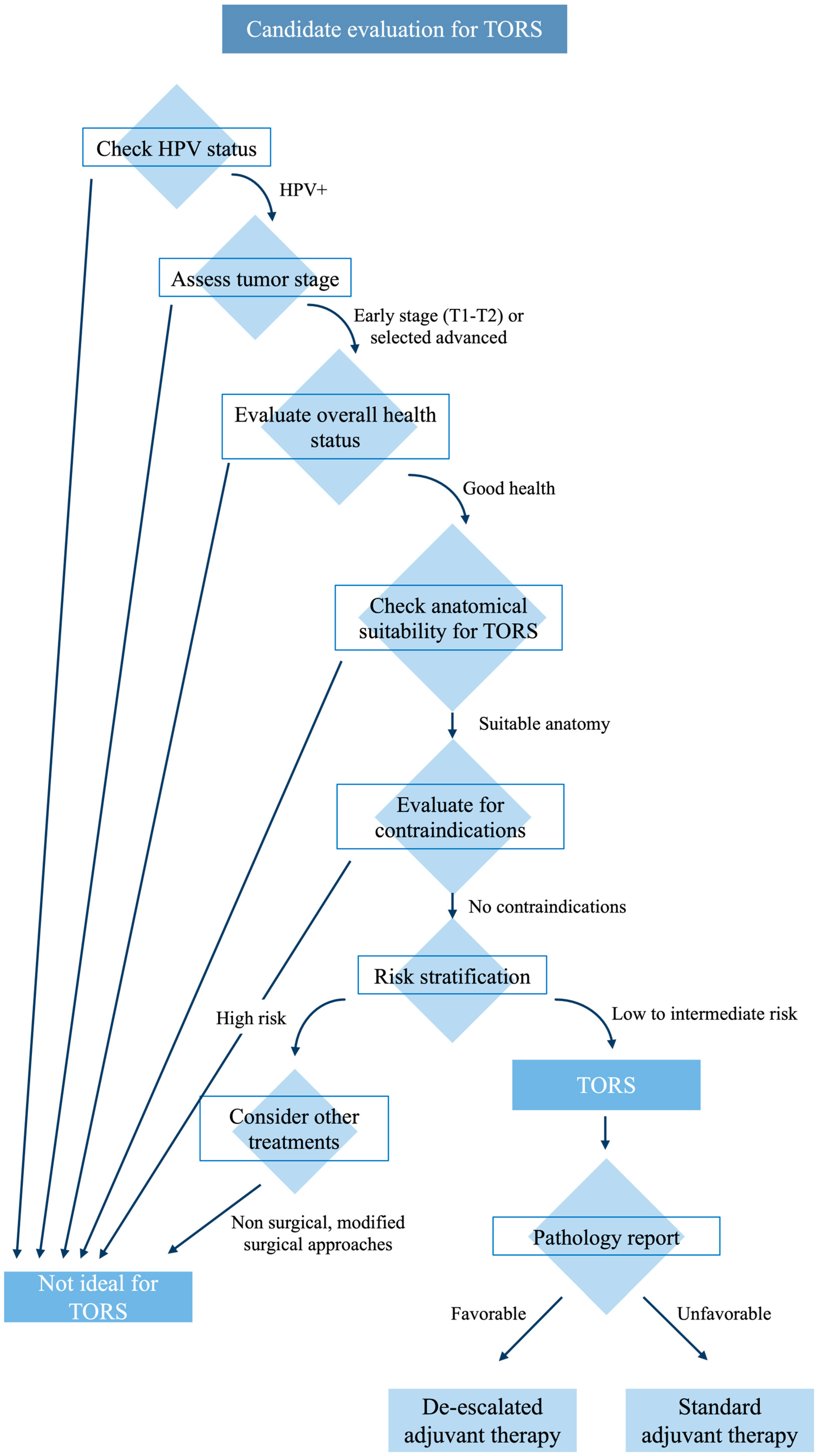
4.3. TORS Indication
4.4. Role of TORS as a De-Escalation Strategy
4.5. TORS as a De-Escalation Strategy for cT1-cT2
- Reducing the RT total dose;
- Reducing the extension of RT target volumes. One noteworthy strategy being investigated involves omitting adjuvant RT to the primary tumor site in cases of early T stages [89].
4.6. TORS as a De-Escalation Strategy for cT3–cT4
4.7. Functional Results and Quality of Life
4.8. Further Considerations
5. Conclusions
Author Contributions
Funding
Institutional Review Board Statement
Informed Consent Statement
Conflicts of Interest
References
- Lechner, M.; Liu, J.; Masterson, L.; Fenton, T.R. HPV-Associated Oropharyngeal Cancer: Epidemiology, Molecular Biology and Clinical Management. Nat. Rev. Clin. Oncol. 2022, 19, 306–327. [Google Scholar] [CrossRef]
- Pan, C.; Issaeva, N.; Yarbrough, W.G. HPV-driven oropharyngeal cancer: Current knowledge of molecular biology and mechanisms of carcinogenesis. Cancers Head Neck 2018, 3, 12. [Google Scholar] [CrossRef] [PubMed]
- Chen, A.M. De-Escalation Treatment for Human Papillomavirus–Related Oropharyngeal Cancer: Questions for Practical Consideration. Oncology 2023, 37, 281–287. [Google Scholar] [CrossRef] [PubMed]
- Orlandi, E.; Licitra, L. The day after De-ESCALaTE and RTOG 1016 trials results. Future Oncol. 2019, 15, 2069–2072. [Google Scholar] [CrossRef] [PubMed]
- Kim, C.; Martinez, E.; Kulich, M.; Swanson, M.S. Surgeon practice patterns in transoral robotic surgery for HPV-related oropharyngeal cancer. Oral Oncol. 2021, 121, 105460. [Google Scholar] [CrossRef] [PubMed]
- Page, M.J.; McKenzie, J.E.; Bossuyt, P.M.; Boutron, I.; Hoffmann, T.C.; Mulrow, C.D.; Shamseer, L.; Tetzlaff, J.M.; Akl, E.A.; Brennan, S.E.; et al. The PRISMA 2020 statement: An updated guideline for reporting systematic reviews Systematic reviews and Meta-Analyses. BMJ 2021, 372, 71. [Google Scholar] [CrossRef] [PubMed]
- Ang, K.K.; Harris, J.; Wheeler, R.; Weber, R.; Rosenthal, D.I.; Nguyen-Tân, P.F.; Westra, W.H.; Chung, C.H.; Jordan, R.C.; Lu, C.; et al. Human Papillomavirus and Survival of Patients with Oropharyngeal Cancer. N. Engl. J. Med. 2010, 363, 24–35. [Google Scholar] [CrossRef] [PubMed]
- Achim, V.; Bolognone, R.K.; Palmer, A.D.; Graville, D.J.; Light, T.J.; Li, R.; Gross, N.; Andersen, P.E.; Clayburgh, D. Long-term Functional and Quality-of-Life Outcomes After Transoral Robotic Surgery in Patients With Oropharyngeal Cancer. JAMA Otolaryngol. Head Neck Surg. 2018, 144, 18–27. [Google Scholar] [CrossRef]
- Albergotti, W.G.; Jordan, J.; Anthony, K.; Abberbock, S.; Wasserman-Wincko, T.; Kim, S.; Ferris, R.L.; Duvvuri, U. A Prospective Evaluation of Short-Term Dysphagia after Transoral Robotic Surgery for Squamous Cell Carcinoma of the Oropharynx. Cancer 2017, 123, 3132–3140. [Google Scholar] [CrossRef] [PubMed]
- Amit, M.; Hutcheson, K.; Zaveri, J.; Lewin, J.; E Kupferman, M.; Hessel, A.C.; Goepfert, R.P.; Gunn, G.B.; Garden, A.S.; Ferraratto, R.; et al. Patient-Reported Outcomes of Symptom Burden in Patients Receiving Surgical or Nonsurgical Treatment for Low-Intermediate Risk Oropharyngeal Squamous Cell Carcinoma: A Comparative Analysis of a Prospective Registry. Oral Oncol. 2019, 91, 13–20. [Google Scholar] [CrossRef]
- Baliga, S.; Kabarriti, R.; Jiang, J.; Mehta, V.; Guha, C.; Kalnicki, S.; Smith, R.V.; Garg, M.K. Utilization of Transoral Robotic Surgery (TORS) in patients with Oropharyngeal Squamous Cell Carcinoma and its impact on survival and use of chemotherapy. Oral Oncol. 2018, 86, 75–80. [Google Scholar] [CrossRef] [PubMed]
- Biron, V.L.; O’connell, D.A.; Barber, B.; Clark, J.M.; Andrews, C.; Jeffery, C.C.; Côté, D.W.J.; Harris, J.; Seikaly, H. Transoral Robotic Surgery with Radial Forearm Free Flap Reconstruction: Case Control Analysis. J. Otolaryngol. Head Neck Surg. 2017, 46, 20. [Google Scholar] [CrossRef] [PubMed]
- Brody, R.M.; Shimunov, D.; Cohen, R.B.; Lin, A.; Lukens, J.N.; Hartner, L.; Aggarwal, C.; Duvvuri, U.; Montone, K.T.; Jalaly, J.B.; et al. A Benchmark for Oncologic Outcomes and Model for Lethal Recurrence Risk after Transoral Robotic Resection of HPV-Related Oropharyngeal Cancers. Oral Oncol. 2022, 127, 105798. [Google Scholar] [CrossRef] [PubMed]
- Cannavicci, A.; Cioccoloni, E.; Moretti, F.; Cammaroto, G.; Iannella, G.; De Vito, A.; Sgarzani, R.; Gessaroli, M.; Ciorba, A.; Bianchini, C.; et al. Single Centre Analysis of Perioperative Complications In Trans-Oral Robotic Surgery for Oropharyngeal Carcinomas. Indian J. Otolaryngol. Head Neck Surg. 2023, 75, 842–847. [Google Scholar] [CrossRef] [PubMed]
- Cannon, R.B.; Houlton, J.J.; Patel, S.; Raju, S.; Noble, A.; Futran, N.D.; Parvathaneni, U.; Méndez, E. Patterns of Cervical Node Positivity, Regional Failure Rates, and Fistula Rates for HPV+ Oropharyngeal Squamous Cell Carcinoma Treated with Transoral Robotic Surgery (TORS). Oral Oncol. 2018, 86, 296–300. [Google Scholar] [CrossRef]
- Carey, R.M.; Brody, R.M.; Shimunov, D.; Shinn, J.R.; Mady, L.J.; Rajasekaran, K.; Cannady, S.B.; Lin, A.; Lukens, J.N.; Bauml, J.M.; et al. Locoregional Recurrence in p16-Positive Oropharyngeal Squamous Cell Carcinoma After TORS. Laryngoscope 2021, 131, E2865–E2873. [Google Scholar] [CrossRef]
- Chao, H.; Schonewolf, C.A.; Tan, E.X.; Swisher-McClure, S.; Ghiam, A.F.; Weinstein, G.S.; O’Malley, B.W.; Chalian, A.A.; Rassekh, C.H.; Newman, J.G.; et al. The Impact of Treatment Package Time on Locoregional Control for HPV+ Oropharyngeal Squamous Cell Carcinoma Treated with Surgery and Postoperative (Chemo)Radiation. Head Neck 2019, 41, 3858–3868. [Google Scholar] [CrossRef]
- Chen, S.Y.; Sinha, P.; Last, A.; Ettyreddy, A.; Kallogjeri, D.; Pipkorn, P.; Rich, J.T.; Zevallos, J.P.; Paniello, R.; Puram, S.V.; et al. Outcomes of Patients With Single-Node Metastasis of Human Papillomavirus–Related Oropharyngeal Cancer Treated With Transoral Surgery. JAMA Otolaryngol. Head Neck Surg. 2021, 147, 16–22. [Google Scholar] [CrossRef]
- Chen, S.Y.; Last, A.; Ettyreddy, A.; Kallogjeri, D.; Wahle, B.; Chidambaram, S.; Mazul, A.; Thorstad, W.; Jackson, R.S.; Zevallos, J.P.; et al. 20 Pack-Year Smoking History as Strongest Smoking Metric Predictive of HPV-Positive Oropharyngeal Cancer Outcomes. Am. J. Otolaryngol. 2021, 42, 102915. [Google Scholar] [CrossRef]
- Costantino, A.; Sampieri, C.; De Virgilio, A.; Kim, S.-H. Neo-Adjuvant Chemotherapy And Transoral Robotic Surgery in Locoregionally Advanced Oropharyngeal Cancer. Eur. J. Surg. Oncol. 2023, 49, 107121. [Google Scholar] [CrossRef]
- Cramer, J.D.; Ferris, R.L.; Kim, S.; Duvvuri, U. Primary Surgery for Human Papillomavirus-Associated Oropharyngeal Cancer: Survival Outcomes with or without Adjuvant Treatment. Oral Oncol. 2018, 87, 170–176. [Google Scholar] [CrossRef] [PubMed]
- Dhanireddy, B.; Burnett, N.P.; Sanampudi, S.; Wooten, C.E.; Slezak, J.; Shelton, B.; Shelton, L.; Shearer, A.; Arnold, S.; Kudrimoti, M.; et al. Outcomes in Surgically Resectable Oropharynx Cancer Treated with Transoral Robotic Surgery Versus Definitive Chemoradiation. Am. J. Otolaryngol. 2019, 40, 673–677. [Google Scholar] [CrossRef] [PubMed]
- De Virgilio, A.; Pellini, R.; Cammaroto, G.; Sgarzani, R.; De Vito, A.; Gessaroli, M.; Costantino, A.; Petruzzi, G.; Festa, B.M.; Campo, F.; et al. Trans Oral Robotic Surgery for Oropharyngeal Cancer: A Multi Institutional Experience. Eur. J. Surg. Oncol. (EJSO) 2023, 49, 106945. [Google Scholar] [CrossRef] [PubMed]
- Feng, A.L.; Holcomb, A.J.; Abt, N.B.; Mokhtari, T.E.; Suresh, K.; McHugh, C.I.; Parikh, A.S.; Holman, A.; Kammer, R.E.; Goldsmith, T.A.; et al. Feeding Tube Placement Following Transoral Robotic Surgery for Oropharyngeal Squamous Cell Carcinoma. Otolaryngol. Neck Surg. 2022, 166, 696–703. [Google Scholar] [CrossRef] [PubMed]
- Ford, S.E.; Brandwein-Gensler, M.; Carroll, W.R.; Rosenthal, E.L.; Magnuson, J.S. Transoral Robotic versus Open Surgical Approaches to Oropharyngeal Squamous Cell Carcinoma by Human Papillomavirus Status. Otolaryngol. Neck Surg. 2014, 151, 606–611. [Google Scholar] [CrossRef] [PubMed]
- Frederiksen, J.G.; Channir, H.I.; Larsen, M.H.H.; Christensen, A.; Friborg, J.; Charabi, B.W.; Rubek, N.; von Buchwald, C. Long-term Survival Outcomes after Primary Transoral Robotic Surgery (TORS) with Concurrent Neck Dissection for Early-Stage Oropharyngeal Squamous Cell Carcinoma. Acta Oto-Laryngol. 2021, 141, 714–718. [Google Scholar] [CrossRef] [PubMed]
- Groysman, M.; Yi, S.K.; Robbins, J.R.; Hsu, C.C.; Julian, R.; Bauman, J.E.; Baker, A.; Wang, S.J.; Bearelly, S. The Impact Of Socioeconomic and Geographic Factors on Access to Transoral Robotic/Endoscopic Surgery for Early Stage Oropharyngeal Malignancy. Am. J. Otolaryngol. 2022, 43, 103243. [Google Scholar] [CrossRef] [PubMed]
- Haller, T.; Yin, X.; O’Byrne, T.; Moore, E.; Ma, D.; Price, K.; Patel, S.; Hinni, M.; Neben-Wittich, M.; McGee, L.; et al. 30-Day Morbidity and Mortality after Transoral Robotic Surgery for Human Papillomavirus (HPV) associated Oropharyngeal Squamous Cell Carcinoma: A Retrospective Analysis of Two Prospective Adjuvant De-Escalation Trials (MC1273 & MC1675). Oral Oncol. 2023, 137, 106248. [Google Scholar] [CrossRef]
- Hughes, R.T.; Levine, B.J.; May, N.; Shenker, R.F.; Yang, J.H.; Lanier, C.M.; Frizzell, B.A.; Greven, K.M.; Waltonen, J.D. Survival and Swallowing Function after Primary Radiotherapy versus Transoral Robotic Surgery for Human Papillomavirus-Associated Oropharyngeal Squamous Cell Carcinoma. ORL J. Oto-Rhino-Laryngol. Its Relat. Spec. 2023, 85, 284–293. [Google Scholar] [CrossRef]
- Isenberg, A.L.; Channir, H.I.; von Buchwald, C.; Rubek, N.; Friborg, J.; Kiss, K.; Charabi, B.W. Transoral Robotic Surgery: A 4-Year Learning Experience in a Single Danish Cancer Centre. Acta Oto-Laryngol. 2019, 140, 157–162. [Google Scholar] [CrossRef]
- Jackson, R.S.; Sinha, P.; Zenga, J.; Kallogjeri, D.; Suko, J.; Martin, E.; Moore, E.J.; Haughey, B.H. Transoral Resection of Human Papillomavirus (HPV)-Positive Squamous Cell Carcinoma of the Oropharynx: Outcomes with and Without Adjuvant Therapy. Ann. Surg. Oncol. 2017, 24, 3494–3501. [Google Scholar] [CrossRef] [PubMed]
- Kaffenberger, T.M.; Patel, A.K.; Lyu, L.; Li, J.; Wasserman-Wincko, T.; Zandberg, D.P.; Clump, D.A.; Johnson, J.T.; Nilsen, M.L. Quality of Life after radIation and Transoral Robotic Surgery in Advanced Oropharyngeal Cancer. Laryngoscope Investig. Otolaryngol. 2021, 6, 983–990. [Google Scholar] [CrossRef]
- Kucur, C.; Durmus, K.; Teknos, T.N.; Ozer, E. How Often Parapharyngeal Space is Encountered in TORS Oropharynx Cancer Resection. Eur. Arch. Oto-Rhino-Laryngol. 2015, 272, 2521–2526. [Google Scholar] [CrossRef] [PubMed]
- Li, H.; Torabi, S.J.; Park, H.S.; Yarbrough, W.G.; Mehra, S.; Choi, R.; Judson, B.L. Clinical Value Of Transoral Robotic Surgery: Nationwide Results from the First 5 Years of Adoption. Laryngoscope 2019, 129, 1844–1855. [Google Scholar] [CrossRef] [PubMed]
- Ling, D.C.; Chapman, B.V.; Kim, J.; Choby, G.W.; Kabolizadeh, P.; Clump, D.A.; Ferris, R.L.; Kim, S.; Beriwal, S.; Heron, D.E.; et al. Oncologic Outcomes and Patient-Reported Quality of Life in Patients with Oropharyngeal Squamous Cell Carcinoma Treated with Definitive Transoral Robotic Surgery Versus Definitive Chemoradiation. Oral Oncol. 2016, 61, 41–46. [Google Scholar] [CrossRef]
- Lu, J.S.; Cao, A.C.; Shimunov, D.; Sun, L.; Lukens, J.N.; Lin, A.; Cohen, R.B.; Basu, D.; Cannady, S.B.; Rajasekaran, K.; et al. Functional Outcomes in Patients with Human Papillomavirus-Associated Oropharyngeal Squamous Cell Cancer Treated with Trimodality Therapy. Laryngoscope 2023, 133, 3013–3020. [Google Scholar] [CrossRef] [PubMed]
- Lybak, S.; Ljøkjel, B.; Haave, H.; Karlsdottir, À.; Vintermyr, O.K.; Aarstad, H.J. Primary Surgery Results in No Survival Benefit Compared to Primary Radiation for Oropharyngeal Cancer Patients Stratified by High-Risk Human Papilloma Virus Status. Eur. Arch. Oto-Rhino-Laryngol. 2016, 274, 477–487. [Google Scholar] [CrossRef]
- McMullen, C.P.; Garneau, J.; Weimar, E.; Ali, S.; Farinhas, J.M.; Yu, E.; Som, P.M.; Sarta, C.; Goldstein, D.P.; Su, S.; et al. Occult Nodal Disease and Occult Extranodal Extension in Patients With Oropharyngeal Squamous Cell Carcinoma Undergoing Primary Transoral Robotic Surgery With Neck Dissection. JAMA Otolaryngol. Head Neck Surg. 2019, 145, 701–707. [Google Scholar] [CrossRef]
- Meccariello, G.; Bianchi, G.; Calpona, S.; Parisi, E.; Cammaroto, G.; Iannella, G.; Sgarzani, R.; Montevecchi, F.; De Vito, A.; Capaccio, P.; et al. Trans Oral Robotic Surgery Versus Definitive Chemoradiotherapy for Oropharyngeal Cancer: 10-Year Institutional Experience. Oral Oncol. 2020, 110, 104889. [Google Scholar] [CrossRef]
- Mehanna, H.; Rapozo, D.; von Zeidler, S.V.; Harrington, K.J.; Winter, S.C.; Hartley, A.; Nankivell, P.; Schache, A.G.; Sloan, P.; Odell, E.W.; et al. Developing and Validating a Multivariable Prognostic-Predictive Classifier for Treatment Escalation of Oropharyngeal Squamous Cell Carcinoma: The PREDICTR-OPC Study. Clin. Cancer Res. 2023, 30, 356–367. [Google Scholar] [CrossRef]
- Nichols, D.S.; Zhao, J.; Boyce, B.J.; Amdur, R.; Mendenhall, W.M.; Danan, D.; Hitchcock, K.; Ning, K.; Keyes, K.; Lee, J.-H.; et al. HPV/p16-Positive Oropharyngeal Cancer Treated with Transoral Robotic Surgery: The Roles of Margins, Extra-Nodal Extension and Adjuvant Treatment. Am. J. Otolaryngol. 2021, 42, 102793. [Google Scholar] [CrossRef] [PubMed]
- O’hara, J.; Warner, L.; Fox, H.; Hamilton, D.; Meikle, D.; Counter, P.; Robson, A.; Goranova, R.; Iqbal, S.; Kelly, C.; et al. Primary Transoral Robotic Surgery +/− Adjuvant Therapy for Oropharyngeal Squamous Cell Carcinoma—A Large Observational Single-Centre Series from the United Kingdom. Clin. Otolaryngol. 2021, 46, 1005–1012. [Google Scholar] [CrossRef]
- Olaleye, O.; Krishnan, G.; Beck, J.; Noor, A.; Bulsara, V.; Boase, S.; Solomon, P.; Krishnan, S.; Hodge, J.C.; Foreman, A. Validation of the TNM-8 AJCC Classification for HPV-Positive Oropharyngeal Cancers in Patients Undergoing Trans-Oral Robotic Surgery. J. Robot. Surg. 2023, 17, 1463–1469. [Google Scholar] [CrossRef] [PubMed]
- Olson, B.; Edwards, J.; Stone, L.; Jiang, A.; Zhu, X.; Holland, J.; Li, R.; Andersen, P.; Krasnow, S.; Marks, D.L.; et al. Association of Sarcopenia With Oncologic Outcomes of Primary Surgery or Definitive Radiotherapy Among Patients With Localized Oropharyngeal Squamous Cell Carcinoma. JAMA Otolaryngol. Head Neck Surg. 2020, 146, 714–722. [Google Scholar] [CrossRef]
- Oliver, J.R.; Persky, M.J.; Wang, B.; Duvvuri, U.; Gross, N.D.; Vaezi, A.E.; Morris, L.G.T.; Givi, B. Transoral Robotic Surgery Adoption and Safety in Treatment of Oropharyngeal Cancers. Cancer 2022, 128, 685–696. [Google Scholar] [CrossRef] [PubMed]
- Park, Y.M.; Kim, H.R.; Cho, B.C.; Keum, K.C.; Cho, N.H.; Kim, S.-H. Transoral Robotic Surgery-Based Therapy in Patients with Stage III-IV Oropharyngeal Squamous Cell Carcinoma. Oral Oncol. 2017, 75, 16–21. [Google Scholar] [CrossRef]
- Park, Y.M.; Jung, C.M.; Cha, D.; Kim, D.H.; Kim, H.R.; Keum, K.C.; Cho, N.H.; Kim, S.-H. A New Clinical Trial of Neoadjuvant Chemotherapy Combined With Transoral Robotic Surgery and Customized Adjuvant Therapy for Patients With T3 or T4 Oropharyngeal Cancer. Ann. Surg. Oncol. 2017, 24, 3424–3429. [Google Scholar] [CrossRef] [PubMed]
- Park, Y.M.; Kim, D.H.; Kang, M.S.; Lim, J.Y.; Choi, E.C.; Koh, Y.W.; Kim, S.-H. The First Human Trial of Transoral Robotic Surgery Using a Single-Port Robotic System in the Treatment of Laryngo-Pharyngeal Cancer. Ann. Surg. Oncol. 2019, 26, 4472–4480. [Google Scholar] [CrossRef]
- Plonowska, K.A.; Ochoa, E.; Zebolsky, A.L.; Patel, N.; Hoppe, K.R.; Ha, P.K.; Heaton, C.M.; Ryan, W.R. Nasogastric Tube Feeding after Transoral Robotic Surgery for Oropharynx Carcinoma. Am. J. Otolaryngol. 2021, 42, 102857. [Google Scholar] [CrossRef]
- Ranta, P.; Kinnunen, I.; Jouhi, L.; Vahlberg, T.; Back, L.J.J.; Halme, E.; Koivunen, P.; Autio, T.; Pukkila, M.; Irjala, H. Long-term Quality of Life After Treatment of Oropharyngeal Squamous Cell Carcinoma. Laryngoscope 2021, 131, E1172–E1178. [Google Scholar] [CrossRef]
- Rubek, N.; Channir, H.I.; Charabi, B.W.; Lajer, C.B.; Kiss, K.; Nielsen, H.U.; Bentzen, J.; Friborg, J.; von Buchwald, C. Primary Transoral Robotic Surgery with Concurrent Neck Dissection for Early Stage Oropharyngeal Squamous Cell Carcinoma Implemented at a Danish Head And Neck Cancer Center: A Phase II Trial on Feasibility and tumour Margin Status. Eur. Arch. Oto-Rhino-Laryngol. 2017, 274, 2229–2237. [Google Scholar] [CrossRef] [PubMed]
- Scott, S.I.; Madsen, A.K.; Rubek, N.; Kehlet, H.; von Buchwald, C. Days Alive and out of Hospital after Treatment for Oropharyngeal Squamous Cell Carcinoma with Primary Transoral Robotic Surgery or Radiotherapy—A Prospective Cohort Study. Acta Oto-Laryngol. 2020, 141, 193–196. [Google Scholar] [CrossRef] [PubMed]
- Scott, S.I.; Madsen, A.K.O.; Rubek, N.; Charabi, B.W.; Wessel, I.; Hadju, S.F.; Jensen, C.V.; Stephen, S.; Patterson, J.M.; Friborg, J.; et al. Long-Term Quality of Life & Functional Outcomes after Treatment of Oropharyngeal Cancer. Cancer Med. 2021, 10, 483–495. [Google Scholar] [CrossRef] [PubMed]
- Sethia, R.; Yumusakhuylu, A.C.; Ozbay, I.; Diavolitsis, V.; Brown, N.V.; Zhao, S.; Wei, L.; Old, M.; Agrawal, A.; Teknos, T.N.; et al. Quality of Life Outcomes of Transoral Robotic Surgery with or without Adjuvant Therapy for Oropharyngeal Cancer. Laryngoscope 2018, 128, 403–411. [Google Scholar] [CrossRef]
- Sharma, A.; Patel, S.; Baik, F.M.; Mathison, G.; Pierce, B.H.G.; Khariwala, S.S.; Yueh, B.; Schwartz, S.M.; Méndez, E. Survival and Gastrostomy Prevalence in Patients With Oropharyngeal Cancer Treated With Transoral Robotic Surgery vs Chemoradiotherapy. JAMA Otolaryngol. Head Neck Surg. 2016, 142, 691–697. [Google Scholar] [CrossRef]
- Sims, J.R.; Van Abel, K.; Martin, E.J.; Lohse, C.M.; Price, D.L.; Olsen, K.D.; Moore, E.J. Management of Recurrent and Metastatic HPV-Positive Oropharyngeal Squamous Cell Carcinoma after Transoral Robotic Surgery. Otolaryngol. Neck Surg. 2017, 157, 69–76. [Google Scholar] [CrossRef]
- Singh, R.; Song, S. Clinical Outcomes Following Observation, Post-Operative Radiation Therapy, or Post-Operative Chemoradiation for HPV-Associated Oropharyngeal Squamous Cell Carcinomas. Oral Oncol. 2023, 146, 106493. [Google Scholar] [CrossRef] [PubMed]
- Sinha, P.; Kallogjeri, D.; Gay, H.; Thorstad, W.L.; Lewis, J.S.; Chernock, R.; Nussenbaum, B.; Haughey, B.H. High Metastatic Node Number, Not Extracapsular Spread or N-Classification is a Node-Related Prognosticator in transorally-Resected, Neck-Dissected p16-Positive Oropharynx Cancer. Oral Oncol. 2015, 51, 514–520. [Google Scholar] [CrossRef]
- Stephens, E.M.; Plonowska-Hirschfeld, K.; Gulati, A.; Kansara, S.; Qualliotine, J.; Zelbolsky, A.L.; van Zante, A.; Ha, P.K.; Heaton, C.M.; Ryan, W.R. Prospective Quality of Life Outcomes For Human Papillomavirus Associated Oropharynx Cancer Patients after Surgery Alone. Am. J. Otolaryngol. 2023, 44, 103915. [Google Scholar] [CrossRef]
- Sun, L.; Shimunov, D.; Tan, E.X.; Swisher-Mcclure, S.; Lin, A.; Lukens, J.N.; Basu, D.; Chalian, A.A.; Cannady, S.B.; Newman, J.G.; et al. Survival and Toxicity in Patients with Human Papilloma Virus-Associated Oropharyngeal Squamous Cell Cancer Receiving Trimodality Therapy Including Transoral Robotic Surgery. Head Neck 2021, 43, 3053–3061. [Google Scholar] [CrossRef]
- Swisher-McClure, S.; Lukens, J.N.; Aggarwal, C.; Ahn, P.; Basu, D.; Bauml, J.M.; Brody, R.; Chalian, A.; Cohen, R.B.; Fotouhi-Ghiam, A.; et al. A Phase 2 Trial of Alternative Volumes of Oropharyngeal Irradiation for De-intensification (AVOID): Omission of the Resected Primary Tumor Bed After Transoral Robotic Surgery for Human Papilloma Virus-Related Squamous Cell Carcinoma of the Oropharynx. Int. J. Radiat. Oncol. 2020, 106, 725–732. [Google Scholar] [CrossRef] [PubMed]
- Van Abel, K.M.; Quick, M.H.; Graner, D.E.; Lohse, C.M.; Price, D.L.; Price, K.A.; Ma, D.J.; Moore, E.J. Outcomes Following TORS for HPV-Positive Oropharyngeal Carcinoma: PEGs, Tracheostomies, and Beyond. Am. J. Otolaryngol. 2019, 40, 729–734. [Google Scholar] [CrossRef] [PubMed]
- Van Abel, K.M.; Yin, L.X.; Price, D.L.; Janus, J.R.; Kasperbauer, J.L.; Moore, E.J. One-Year Outcomes For Da Vinci Single Port Robot for Transoral Robotic Surgery. Head Neck 2020, 42, 2077–2087. [Google Scholar] [CrossRef] [PubMed]
- van Loon, J.W.L.; Smeele, L.E.; Hilgers, F.J.M.; Brekel, M.W.M.v.D. Outcome of Transoral Robotic Surgery for Stage I–II Oropharyngeal Cancer. Eur. Arch. Oto-Rhino-Laryngol. 2015, 272, 175–183. [Google Scholar] [CrossRef] [PubMed]
- Waltonen, J.D.; Thomas, S.G.; Russell, G.B.; Sullivan, C.A. Oropharyngeal Carcinoma Treated with Surgery Alone: Outcomes and Predictors of Failure. Ann. Otol. Rhinol. Laryngol. 2022, 131, 281–288. [Google Scholar] [CrossRef] [PubMed]
- Wright, C.M.; Lee, D.Y.; Shimunov, D.; Carmona, R.; Barsky, A.R.; Sun, L.; Cohen, R.B.; Bauml, J.M.; Brody, R.M.; Basu, D.; et al. Definitive Tumor Directed Therapy Confers a Survival Advantage for Metachronous Oligometastatic HPV-Associated Oropharyngeal Cancer Following Trans-Oral Robotic Surgery. Oral Oncol. 2021, 121, 105509. [Google Scholar] [CrossRef] [PubMed]
- Xu, M.J.; Plonowska, K.A.; Gurman, Z.R.; Humphrey, A.K.; Ha, P.K.; Wang, S.J.; El-Sayed, I.H.; Heaton, C.M.; George, J.R.; Yom, S.S.; et al. Treatment Modality Impact on Quality of Life for Human Papillomavirus–Associated Oropharynx Cancer. Laryngoscope 2020, 130, E48–E56. [Google Scholar] [CrossRef]
- Yin, X.; Shan, C.; Wang, J.; Zhang, H. Factors Associated with the Quality of Life for Hospitalized Patients with HPV-Associated Oropharyngeal Squamous Cell Carcinoma. Oral Oncol. 2020, 103, 104590. [Google Scholar] [CrossRef]
- Zebolsky, A.L.; George, E.; Gulati, A.; Wai, K.C.; Carpenter, P.; Van Zante, A.; Ha, P.K.; Heaton, C.M.; Ryan, W.R. Risk of Pathologic Extranodal Extension and Other Adverse Features After Transoral Robotic Surgery in Patients With HPV-Positive Oropharynx Cancer. JAMA Otolaryngol. Head Neck Surg. 2021, 147, 1080–1088. [Google Scholar] [CrossRef]
- Zubair, F.; McMahon, J.; Afzali, P.; Cuschieri, K.; Yan, Y.S.; Schipani, S.; Brands, M.; Ansell, M. Staging and Treatment Outcomes in Oropharyngeal Squamous Cell Carcinoma: A Single-Centre UK Cohort. Br. J. Oral Maxillofac. Surg. 2021, 59, 28–34. [Google Scholar] [CrossRef]
- Fakhry, C.; Lacchetti, C.; Rooper, L.M.; Jordan, R.C.; Rischin, D.; Sturgis, E.M.; Bell, D.; Lingen, M.W.; Harichand-Herdt, S.; Thibo, J.; et al. Human Papillomavirus Testing in Head and Neck Carcinomas: ASCO Clinical Practice Guideline Endorsement of the College of American Pathologists Guideline. J. Clin. Oncol. 2018, 36, 3152–3161. [Google Scholar] [CrossRef]
- O’Sullivan, B.; Huang, S.H.; Su, J.; Garden, A.S.; Sturgis, E.M.; Dahlstrom, K.; Lee, N.; Riaz, N.; Pei, X.; A Koyfman, S.; et al. Development and validation of a staging system for HPV-related oropharyngeal cancer by the International Collaboration on Oropharyngeal cancer Network for Staging (ICON-S): A multicentre cohort study. Lancet Oncol. 2016, 17, 440–451. [Google Scholar] [CrossRef]
- Mehanna, H.; Taberna, M.; von Buchwald, C.; Tous, S.; Brooks, J.; Mena, M.; Morey, F.; Grønhøj, C.; Rasmussen, J.H.; Garset-Zamani, M.; et al. Prognostic implications of p16 and HPV discordance in oropharyngeal cancer (HNCIG-EPIC-OPC): A multicentre, multinational, individual patient data analysis. Lancet Oncol. 2023, 24, 239–251. [Google Scholar] [CrossRef] [PubMed]
- Deschuymer, S.; Dok, R.; Laenen, A.; Hauben, E.; Nuyts, S. Patient Selection in Human Papillomavirus Related Oropharyngeal Cancer: The Added Value of Prognostic Models in the New TNM 8th Edition Era. Front. Oncol. 2018, 8, 273. [Google Scholar] [CrossRef] [PubMed]
- Rietbergen, M.M.; Witte, B.I.; Velazquez, E.R.; Snijders, P.J.F.; Bloemena, E.; Speel, E.J.; Brakenhoff, R.H.; Kremer, B.; Lambin, P.; Leemans, C.R. Different prognostic models for different patient populations: Validation of a new prognostic model for patients with oropharyngeal cancer in Western Europe. Br. J. Cancer 2015, 112, 1733–1736. [Google Scholar] [CrossRef] [PubMed]
- Lassen, P.; Huang, S.H.; Su, J.; O’Sullivan, B.; Waldron, J.; Andersen, M.; Primdahl, H.; Johansen, J.; Kristensen, C.; Andersen, E.; et al. Impact of tobacco smoking on radiotherapy outcomes in 1875 HPV-positive oropharynx cancer patients. J. Clin. Oncol. 2019, 37, 6047. [Google Scholar] [CrossRef]
- Hoff, C.M.; Grau, C.; Overgaard, J. Effect of smoking on oxygen delivery and outcome in patients treated with radiotherapy for head and neck squamous cell carcinoma—A prospective study. Radiother. Oncol. 2012, 103, 38–44. [Google Scholar] [CrossRef]
- Roden, D.F.; Hobelmann, K.; Vimawala, S.; Richa, T.; Fundakowski, C.E.; Goldman, R.; Luginbuhl, A.; Curry, J.M.; Cognetti, D.M. Evaluating the impact of smoking on disease-specific survival outcomes in patients with human papillomavirus–associated oropharyngeal cancer treated with transoral robotic surgery. Cancer 2020, 126, 1873–1887. [Google Scholar] [CrossRef]
- Lee, N.Y.; Sherman, E.J.; Schöder, H.; Wray, R.; Boyle, J.O.; Singh, B.; Grkovski, M.; Paudyal, R.; Cunningham, L.; Zhang, Z.; et al. Hypoxia-Directed Treatment of Human Papillomavirus–Related Oropharyngeal Carcinoma. J. Clin. Oncol. 2024, 42, 940–950. [Google Scholar] [CrossRef]
- Arora, A.; Kotecha, J.; Acharya, A.; Garas, G.; Darzi, A.; Davies, D.C.; Tolley, N. Determination of biometric measures to evaluate patient suitability for transoral robotic surgery. Head Neck 2015, 37, 1254–1260. [Google Scholar] [CrossRef]
- Luginbuhl, A.; Baker, A.; Curry, J.; Drejet, S.; Miller, M.; Cognetti, D. Preoperative cephalometric analysis to predict transoral robotic surgery exposure. J. Robot. Surg. 2014, 8, 313–317. [Google Scholar] [CrossRef][Green Version]
- Weinstein, G.S.; O’malley, B.W.; Rinaldo, A.; Silver, C.E.; Werner, J.A.; Ferlito, A. Understanding contraindications for transoral robotic surgery (TORS) for oropharyngeal cancer. Eur. Arch. Oto-Rhino-Laryngol. 2014, 272, 1551–1552. [Google Scholar] [CrossRef] [PubMed]
- Rich, J.T.; Milov, S.; Lewis, J.S., Jr.; Thorstad, W.L.; Adkins, D.R.; Haughey, B.H. Transoral laser microsurgery (TLM)±adjuvant therapy for advanced stage oropharyngeal cancer: Outcomes and prognostic factors. Laryngoscope 2009, 119, 1709–1719. [Google Scholar] [CrossRef] [PubMed]
- White, H.; Ford, S.; Bush, B.; Holsinger, F.C.; Moore, E.; Ghanem, T.; Carroll, W.; Rosenthal, E.; Sweeny, L.; Magnuson, J.S. Salvage Surgery for Recurrent Cancers of the Oropharynx: Comparing TORS with Standard Open Surgical Approaches. JAMA Otolaryngol. Head Neck Surg. 2013, 139, 773–777. [Google Scholar] [CrossRef] [PubMed]
- Ma, D.J.; Price, K.A.; Moore, E.J.; Patel, S.H.; Hinni, M.L.; Garcia, J.J.; Graner, D.E.; Foster, N.R.; Ginos, B.; Neben-Wittich, M.; et al. Phase II Evaluation of Aggressive Dose De-Escalation for Adjuvant Chemoradiotherapy in Human Papillomavirus–Associated Oropharynx Squamous Cell Carcinoma. J. Clin. Oncol. 2019, 37, 1909–1918. [Google Scholar] [CrossRef] [PubMed]
- Ferris, R.L.; Flamand, Y.; Weinstein, G.S.; Li, S.; Quon, H.; Mehra, R.; Garcia, J.J.; Chung, C.H.; Gillison, M.L.; Duvvuri, U.; et al. Phase II Randomized Trial of Transoral Surgery and Low-Dose Intensity Modulated Radiation Therapy in Resectable p16+ Locally Advanced Oropharynx Cancer: An ECOG-ACRIN Cancer Research Group Trial (E3311). J. Clin. Oncol. 2022, 40, 138–149. [Google Scholar] [CrossRef] [PubMed]
- Miles, B.A.; Posner, M.R.; Gupta, V.; Teng, M.S.; Bakst, R.L.; Yao, M.; Misiukiewicz, K.J.; Chai, R.L.; Sharma, S.; Westra, W.H.; et al. De-Escalated Adjuvant Therapy After Transoral Robotic Surgery for Human Papillomavirus-Related Oropharyngeal Carcinoma: The Sinai Robotic Surgery (SIRS) Trial. Oncologist 2021, 26, 504–513. [Google Scholar] [CrossRef] [PubMed]
- Owadally, W.; Hurt, C.; Timmins, H.; Parsons, E.; Townsend, S.; Patterson, J.; Hutcheson, K.; Powell, N.; Beasley, M.; Palaniappan, N.; et al. PATHOS: A Phase II/III Trial of Risk-Stratified, Reduced Intensity Adjuvant Treatment in Patients Undergoing Transoral Surgery for Human Papillomavirus (HPV) Positive Oropharyngeal Cancer. BMC Cancer 2015, 15, 602. [Google Scholar] [CrossRef] [PubMed]
- Strohl, M.P.; Wai, K.C.; Ha, P.K. De-Intensification Strategies in HPV-Related Oropharyngeal Squamous Cell Carcinoma–A Narrative Review. Ann. Transl. Med. 2020, 8, 1601. [Google Scholar] [CrossRef]
- Yom, S.S.; Clair, J.M.-S.; Ha, P.K. Controversies in Postoperative Irradiation of Oropharyngeal Cancer After Transoral Surgery. Surg. Oncol. Clin. N. Am. 2017, 26, 357–370. [Google Scholar] [CrossRef]
- NCCN Guidelines for Head and Neck Cancers V.1.2023. Available online: https://www.nccn.org/professionals/physician_gls/pdf/head-and-neck.pdf (accessed on 1 March 2024).
- Machiels, J.-P.; Leemans, C.R.; Golusinski, W.; Grau, C.; Licitra, L.; Gregoire, V. Reprint of “Squamous cell carcinoma of the oral cavity, larynx, oropharynx and hypopharynx: EHNS-ESMO-ESTRO Clinical Practice Guidelines for diagnosis, treatment and follow-up”. Oral Oncol. 2021, 113, 105042. [Google Scholar] [CrossRef] [PubMed]
- Molony, P.; Kharytaniuk, N.; Boyle, S.; Woods, R.S.R.; O’Leary, G.; Werner, R.; Heffron, C.; Feeley, L.; Sheahan, P. Impact of positive margins on outcomes of oropharyngeal squamous cell carcinoma according to p16 status. Head Neck 2017, 39, 1680–1688. [Google Scholar] [CrossRef] [PubMed]
- Sinha, P.; Patrik, P.; Thorstad, W.L.; Gay, H.A.; Haughey, B.H. Does elimination of planned postoperative radiation to the primary bed in p16-positive, transorally-resected oropharyngeal carcinoma associate with poorer outcomes? Oral Oncol. 2016, 61, 127–134. [Google Scholar] [CrossRef] [PubMed]
- Geiger, J.L.; Ku, J.A. Postoperative Treatment of Oropharyngeal Cancer in the Era of Human Papillomavirus. Curr. Treat. Options Oncol. 2019, 20, 20. [Google Scholar] [CrossRef] [PubMed]
- Orlandi, E.; Iacovelli, N.A.; Cavallo, A.; Resteghini, C.; Gandola, L.; Licitra, L.; Bossi, P. Could the extreme conformality achieved with proton therapy in paranasal sinuses cancers accidentally results in a high rate of leptomeningeal progression? Head Neck 2019, 41, 3733–3735. [Google Scholar] [CrossRef] [PubMed]
- White, H.N.; Moore, E.J.; Rosenthal, E.L.; Carroll, W.R.; Olsen, K.D.; Desmond, R.A.; Magnuson, J.S. Transoral Robotic-Assisted Surgery for Head and Neck Squamous Cell Carcinoma: One-and 2-Year Survival Analysis. Arch. Otolaryngol.-Head Neck Surg. 2010, 136, 1248–1252. [Google Scholar] [CrossRef] [PubMed][Green Version]
- Zenga, J.; Wilson, M.; Adkins, D.R.; Gay, H.A.; Haughey, B.H.; Kallogjeri, D.; Michel, L.S.; Paniello, R.C.; Rich, J.T.; Thorstad, W.L.; et al. Treatment Outcomes for T4 Oropharyngeal Squamous Cell Carcinoma. JAMA Otolaryngol. Neck Surg. 2015, 141, 1118–1127. [Google Scholar] [CrossRef]
- Cohen, M.A.; Weinstein, G.S.; O’Malley, B.W.; Feldman, M.; Quon, H. Transoral robotic surgery and human papillomavirus status: Oncologic results. Head Neck 2010, 33, 573–580. [Google Scholar] [CrossRef]
- Kejner, A.; Gentile, C.; Porterfield, Z.; Carroll, W.R.; Buczek, E.P. Positive Deep Initial Incision Margin Affects Outcomes in TORS for HPV plus Oropharynx Cancer. Laryngoscope 2023, 133, 1132–1137. [Google Scholar] [CrossRef]
- Hurtuk, A.; Agrawal, A.; Old, M.; Teknos, T.N.; Ozer, E. Outcomes of Transoral Robotic Surgery: A Preliminary Clinical Experience. Otolaryngol. Head Neck Surg. 2011, 145, 248–253. [Google Scholar] [CrossRef]
- Lukens, J.N.; Lin, A.; Gamerman, V.; Mitra, N.; Grover, S.; McMenamin, E.M.; Weinstein, G.S.; O’Malley, B.W.; Cohen, R.B.; Orisamolu, A.; et al. Late consequential surgical bed soft tissue necrosis in advanced oropharyngeal squamous cell carcinomas treated with transoral robotic surgery and postoperative radiation therapy. Int. J. Radiat. Oncol. Biol. Phys. 2014, 89, 981–988. [Google Scholar] [CrossRef] [PubMed]
- Sadeghi, N.; Mascarella, M.A.; Khalife, S.; Ramanakumar, A.V.; Richardson, K.; Joshi, A.S.; Taheri, R.; Fuson, A.; Bouganim, N.; Siegel, R. Neoadjuvant chemotherapy followed by surgery for HPV-associated locoregionally advanced oropharynx cancer. Head Neck 2020, 42, 2145–2154. [Google Scholar] [CrossRef] [PubMed]
- Sadeghi, N.; Khalife, S.; Mascarella, M.A.; Ramanakumar, A.V.; Richardson, K.; Joshi, A.S.; Bouganim, N.; Taheri, R.; Fuson, A.; Siegel, R. Pathologic response to neoadjuvant chemotherapy in HPV-associated oropharynx cancer. Head Neck 2019, 42, 417–425. [Google Scholar] [CrossRef]
- De Virgilio, A.; Costantino, A.; Festa, B.M.; Sampieri, C.; Spriano, G.; Kim, S.-H. Compartmental Transoral Robotic Lateral Oropharyngectomy with the da Vinci Single-Port System: Surgical Technique. Ann. Surg. Oncol. 2023, 30, 5728–5732. [Google Scholar] [CrossRef]

| Author and Year | Country | Type of Study | Sample Size | Robotic System Used | Stages Included | Main Findings | Main Limitations |
|---|---|---|---|---|---|---|---|
| Achim [8], 2018 | USA | Prospective | 74 | Da Vinci SI | pT1, T2 (7th) | In patients with OPSCC, treatment with TORS alone was associated with improved long-term functional outcomes in swallowing and speech, with QOL metrics returning to near baseline. Patients who received adjuvant treatment did not recover as quickly, and those who underwent CRT in addition to TORS had the greatest risk for poor long-term outcomes. |
|
| Albergotti [9], 2017 | USA | Prospective | 51 | NS | pT1, T2, T3, TX (7th) | Patients undergoing TORS for OPSCC were prospectively enrolled and their short-term swallowing outcomes were evaluated. Despite elevated EAT-10 scores up to a month post-operatively, adverse dysphagia-related outcomes are rare. |
|
| Amit [10], 2019 | USA | Prospective | 86 | NS | cT1, T2, T3 (7th) | Symptom burden and QOL improved over time after treatment in low–intermediate-risk OPSCC survivors, regardless of whether primary surgical or nonsurgical treatment was used. |
|
| Baliga [11], 2018 | USA | Retrospective | 17150 | NS | T1, T2 (7th) | Patients with OPSCC treated with TORS had similar survival outcomes to definitive RT, with a lower likelihood of receiving CT. |
|
| Biron [12], 2017 | Canada | Prospective | 47 (18 TORS, 29 mandibulotomies) | Da Vinci S | pT1, T2, T3 (7th) | TORS with radial forearm free flap reconstruction is a safe, effective, and cost-saving alternative to the lip-splitting mandibulotomy approach for the treatment of advanced stage OPSCC. |
|
| Brody [13], 2022 | USA | Retrospective | 634 | NS | pT0, T1, T2, T3, T4 (8th) | Oncologic outcomes of a large HPV+ OPSCC cohort treated with TORS were evaluated to develop a risk prediction model for recurrence. Positive surgical margins were associated with risk for distant metastatic recurrence but not isolated locoregional recurrence. | |
| Cannavicci [14], 2023 | Italy | Retrospective | 87 | NS | pT0, T1, T2, T3 (8th) | Rates of perioperative complications after TORS were evaluated in a retrospective analysis of 87 consecutive OPSCC patients. No major intraoperative complications and no total local or free flap failure were registered. | |
| Cannon [15], 2018 | USA | Retrospective | 88 | NS | T1, T2, T3 (7th) | A retrospective case series of 88 patients with OPSCC treated with TORS and simultaneous neck dissection showed excellent survival outcomes with no regional recurrences, suggesting level Ib dissection could be avoided to limit morbidity. |
|
| Carey [16], 2021 | USA | Retrospective | 541 | NS | pT0, T1, T2, T3, T4 (8th) | LRR rates are low for HPV+ OPSCCs completing TORS and guideline-compliant adjuvant therapy. Patients without indication for adjuvant therapy more often suffer LRR, but these recurrences are generally controllable by salvage therapy. | |
| Chao [17], 2019 | USA | Retrospective | 267 | NS | pT1, T2, T3, T4a, T4b (8th) | The impact of “package time” from surgery to completion of adjuvant therapy on oncological outcomes in HPV+ OPSCC patients was analyzed. Prolongation of package time appears to compromise locoregional control, but not survival. |
|
| Chen [18], 2021 (1) | USA | Retrospective | 207 | NS | pT0, T1, T2, T3, T4 (8th) | Recurrence and survival in HPV-related OPSCC with single-lymph node metastasis treated with transoral surgery with or without adjuvant therapy were evaluated. Excellent survival with a high rate of successful salvage treatment among patients with regional recurrence was observed. |
|
| Chen [19], 2021 (2) | USA | Retrospective | 375 | NS | pT0, T1, T2, T3, T4 (8th) | The association between smoking, survival, and recurrence in HPV-related OPSCC was retrospectively assessed, showing heavier smoking >20 pack years was strongly associated with worse outcomes. |
|
| Costantino [20], 2023 | Korea | Retrospective | 198 | Da Vinci Si/Xi | cT1, T2, T3, T4a (8th) | In locoregionally advanced OPSCC, neoadjuvant chemotherapy followed by TORS provided excellent tumor control and survival, potentially reducing the need of adjuvant treatment |
|
| Cramer [21], 2018 | USA | Retrospective | 1677 | NS | pT1, T2 (8th) | Deintensification to surgery alone in patients with low- or intermediate-risk features was not associated with a decrease in OS for stage I HPV+ OPSCC. Classic intermediate-risk pathologic features offer diminished prognostic value in HPV+ OPSCC. |
|
| Dhanireddy [22], 2019 | USA | Retrospective | 219 | NS | pT1, T2 (7th) | TORS with directed adjuvant therapy appears to have comparable outcomes to primary CRT in terms of survival and PEG dependence, with no significant differences beyond 12 months. | |
| De Virgilio [23], 2023 | Italy | Retrospective | 139 | NS | pT0, T1, T2, T3, T4 (8th) | TORS is useful in the management of selected cases of OPSCC to limit the treatment to the surgical approach or to de-intensify adjuvant treatments. The choice of the therapeutic strategy for OPSCC requires evaluation by a multidisciplinary team. |
|
| Feng [24], 2022 | USA | Retrospective | 138 | NS | pT0, T1, T2, T3 (8th) | Factors associated with feeding tube placement following TORS for OPSCC were identified in a retrospective series, with a low rate of long-term feeding tube dependence and favorable outcomes. |
|
| Ford [25], 2014 | USA | Retrospective | 130 | NS | pT1, T2, T3, T4 (7th) | Patients treated for OPSCC with TORS appeared to survive more frequently than those treated with open surgery, suggesting that oncologic outcomes are not sacrificed when using TORS. |
|
| Frederiksen [26], 2021 | Denmark | Prospective | 30 | Da Vinci SI HD | pT1, T2 (7th) | A prospective cohort of thirty patients who underwent TORS and neck dissection for early-stage OPSCC showed good long-term oncological outcomes in terms of five-year OS, DSS and RFS. | |
| Groysman [27], 2022 | USA | Retrospective | 9267 | NS | cT1, T2 (7th) | Socioeconomic and geographic factors are associated with a lower likelihood of patients being treated with TORS or transoral endoscopic surgery. |
|
| Haller [28], 2023 | USA | Retrospective | 2019 | NS | pT1, T2, T3, T4 (8th) | The study reports low morbidity and mortality after TORS in clinical trials, examining the safety of de-escalated adjuvant chemoradiotherapy for HPV+ OPSCC. |
|
| Hughes [29], 2023 | USA | Retrospective | 167 | NS | pT1, T2, T3 (8th) | Treatment outcomes for patients with early-stage HPV-associated OPSCC appeared comparable between primary TORS or RT, with swallowing dysfunction more frequent in patients requiring more aggressive treatment to the neck. |
|
| Isenberg [30], 2020 | Denmark | Retrospective | 205 | Da Vinci | NS | A year-by-year comparative analysis of indications for TORS, hospitalization, and complication rates showed a shift in indications and a reduction in complication rates over time. | |
| Jackson [31], 2017 | USA | Retrospective | 105 | NS | cT0, T1, T2, T3, T4 (8th) | Matched analysis of patients treated for OPSCC with either TORS or open surgery plus standard-of-care adjuvant therapy showed no difference in disease-specific survival or overall survival with the addition of adjuvant therapy. The risk of gastrostomy tube was higher in those receiving adjuvant therapy. |
|
| Kaffenberger [32], 2021 | USA | Retrospective | 73 | NS | T1, T2, T3, T4 (7th) | QOL outcomes in advanced-stage, mostly HPV+, OPSCC were assessed through patient-reported outcomes after primary treatment, highlighting the need for continued therapy de-escalation. |
|
| Kucur [33], 2015 | USA | Retrospective | 73 | Da Vinci | cT1, T2, selected T3 (7th) | The utility of TORS in the resection of oropharyngeal cancers extending to PPS was evaluated, showing it to be a safe and feasible technique with minimal complications compared to traditional transcervical techniques. |
|
| Li [34], 2019 | USA | Retrospective | 2224 | NS | cT1, T2 (7th) | Long-term oncologic outcomes and subsequent adjuvant therapy use for patients treated with TORS compared to those treated with TLM and non-robotic surgery were analyzed, showing that TORS patients had equivalent overall survival. |
|
| Ling [35], 2016 | USA | Retrospective | 92 | NS | cT0, T1, T2 (7th) | Oncologic outcomes and QOL scores between early-stage OPSCC patients treated with definitive CRT and those treated with TORS ± adjuvant therapy were compared, showing similar rates of control and improved long-term saliva-related QOL for definitive TORS. |
|
| Lu [36], 2023 | USA | Retrospective | 255 | NS | Swallowing and feeding-tube outcomes in patients with high-risk oropharyngeal cancer treated with trimodality therapy, including TORS and adjuvant chemoradiotherapy, were evaluated, showing low rates of long-term feeding tube dependence and favorable swallowing outcomes. | ||
| Lybak [37], 2017 | Norway | Retrospective | 232 | NS | cT1, Y2, T3, T4 (8th) | OPSCC treatment recommendations and outcomes were compared across two time periods, with a shift from primary RT to surgery and neck dissection, followed by RT. The health-related quality of life scores among successfully treated patients were worse following surgery plus RT than RT only. |
|
| McMullen [38], 2019 | USA–Canada | Retrospective | 92 | NS | pT0, T1, T2 (8th) | Challenges in estimating pathologic nodal metastases and ENE, as well as the need for adjuvant therapy, were analyzed in a multicenter study, indicating that a portion of patients had unanticipated ENE, potentially indicating a need for adjuvant chemotherapy. |
|
| Meccariello [39], 2020 | Italy | Retrospective | 129 | NS | cT0, T1, T2, T3 (surgery group, 8th), cT0, T1, T2, T3, T4, T4a, T4b (definitive CRT group, 8th) | No statistical difference in 5-year survival rate and disease-free interval between TORS and CRT groups in OPSCC patients, with HPV status not affecting the rate of local and regional recurrence. | |
| Mehanna [40], 2023 | UK–Poland | Retrospective | 985 | NS | cT1, T2, T3, T4 (7th) | Clinical data and samples from a consecutive cohort of 985 OPSCC cases treated with curative intent were collected to develop clinical and/or biomarker predictive models for patient outcome and treatment escalation. |
|
| Nichols [41], 2021 | USA | Retrospective | 48 | NS | pT0, T1, T2 (8th) | The impact of margins, ENE, and adjuvant therapy on survival in 48 patients treated with TORS was assessed, showing high survival rates. |
|
| O’Hara [42], 2021 | UK | Retrospective | 120 | Da Vinci | pT0, T1, T2, T3 (8th) | The largest single-centre analysis in the UK reporting oncological outcomes following primary TORS for OPSCC, showing that survival and locoregional control outcomes compare well with other large published series. |
|
| Olaleye [43], 2023 | Australia | 102 | The TNM-8 AJCC classification was validated in a cohort treated predominantly with primary surgery and adjuvant therapy for HPV-OPSCC, showing comparable survival outcomes. | ||||
| Olson [44], 2020 | USA | Retrospective | 245 | NS | pT1, T2 (8th) | The association between sarcopenia and OPSCC survival for patients treated by either primary surgery or definitive RT was characterized, showing improved survival for sarcopenic patients with primary surgical resection. |
|
| Oliver [45], 2022 | USA | Retrospective | 73661 | NS | pT1, T2, T3 (8th) | Data from 73,661 patients with OPSCC treated from 2010 to 2016 were reviewed to investigate the adoption and safety of TORS, demonstrating an increase in TORS utilization and very low risk of severe complications. |
|
| Park [46], 2017 (1) | Korea | Retrospective | 80 | NS | pT3, T4 (7th) | TORS-based therapy for stage III–IV OPSCC showed excellent oncological and functional outcomes, with clear margins in the majority of patients and a significant relationship between ENE and recurrence-free survival. |
|
| Park [47], 2017 (2) | Korea | Clinical trial | 31 | NS | pT3, T4 (8th) | Neoadjuvant chemotherapy combined with TORS was useful for treating advanced oropharyngeal cancer, showing promising oncologic and functional outcomes. | |
| Park [48], 2019 (3) | Korea | Retrospective | 188 | DaVinci | pT1,T2 (8th) | Surgical treatment for p16+ OPSCC patients showed excellent oncologic results, with the AJCC 8th-edition staging system showing a significant relationship with patient survival. |
|
| Plonowska [49], 2021 | USA | Retrospective | 95 | NS | pTis, T0,T1,T2,T3(8th) | The need for and predictors of nasogastric tube feeding in a cohort of OPSCC patients undergoing TORS were determined, identifying larger tumor size and concurrent bilateral ND as risk factors for NGTF. |
|
| Ranta [50], 2021 | Finland | Retrospective | 263 | NS | pT1,T2,T3,T4 (7th) | Long-term QOL was assessed in survivors of OPSCC diagnosed and treated between 2000 and 2009, showing that most survivors reported a good QOL. Single modality treatment group had significantly better QOL outcomes than the combined treatment group. |
|
| Rubek [51], 2017 | Denmark | Prospective | 30 | Da Vinci | cT1,T2 (7th) | TORS and concurrent neck dissection were shown to be a safe and feasible procedure for patients with early-stage OPSCC, with a microscopic radical T-site achieved in 97% of patients. However, due to N-site stage migration and ENE, 43% of the patients were eligible for adjuvant therapy. |
|
| Scott [52], 2021 (1) | Denmark | Prospective | 44 | NS | pT1,T2 (8th) | Patients treated with TORS had high “days alive and out of hospital” (DAOH) in the first 30 and 180 days after treatment, while patients treated with RT had reduced DAOH30 and DAOH180, calling for further large-scale studies. |
|
| Scott [53], 2021 (2) | Denmark | Prospective | 44 | NS | cT1,T2 (7th) | Functional and QOL outcomes in the first 12 months after treatment with either primary TORS or primary RT were reviewed, showing overall good functional and QOL outcomes 1 year after treatment for OPSCC regardless of modality. |
|
| Sethia [54], 2018 | USA–Turkey | Prospective | 111 | Da Vinci | pT1,T2,T3,T4 (7th) | Quality of life of OPSCC patients who underwent TORS alone, with adjuvant RT, or adjuvant CRT was prospectively evaluated, showing that TORS alone maintained higher QOL than adjuvant RT or CRT in eating, social function, speech, and overall QOL post-surgery for 6 months. | |
| Sharma [55], 2016 | USA | Retrospective | 127 | NS | pT1,T2,T3 (7th) | Patients undergoing TORS for OPSCC had statistically indistinguishable survival but lower gastrostomy prevalence compared with patients undergoing nonsurgical therapy for stage-matched OPSCC. |
|
| Sims [56], 2017 | USA | Retrospective | 286 total | Da Vinci | pT1,T2,T3,T4 (7th) | Management and oncologic outcomes for patients who developed LRR and distant metastasis DM following TORS for HPV-positive OPSCC were described, showing favorable cancer-specific survival rates and recommending aggressive salvage treatment for appropriate candidates. |
|
| Singh [57], 2023 | USA | Retrospective | 6301 | NS | cT1,T2,T3,T4a (8th) | The National Cancer Database was queried for patients with HPV-associated OPSCCs initially managed with surgery with intermediate risk factors (IRFs) or high-risk factors (HRFs), showing that IRFs should continue to be utilized to guide decisions on receipt of adjuvant therapy and suggesting potential opportunities for the de-escalation of therapy among patients with HRFs. |
|
| Sinha [58], 2015 | USA | Prospective | 220 | pT1,T2,T3,T4 (7th) | A prospectively assembled cohort of transoral surgery + neck dissection ± adjuvant therapy-treated p16+ OPSCC patients was analyzed, identifying ≥5 nodes and T3-T4 classification as predictors for recurrence and prognostic for DSS. |
| |
| Stephens [59], 2023 | USA | Prospective | 48 | NS | pT1,T2,T3 (8th) | Changes in patient-reported outcomes measures on QOL in relation to pre-surgery QOL in patients who underwent surgery alone for early-stage HPV+ OPSCC were evaluated, showing favorable QOL outcomes. |
|
| Sun [60], 2021 | USA | Retrospective | 178 | NS | cT1,T2,T3,T4 (7th) | A cohort of 178 consecutive patients with HPV+ OPSCC receiving TORS + trimodality therapy (TMT) was analyzed, showing a 5-year survival of 93.6% and low rates of long-term feeding tube dependence. |
|
| Swisher-McClure [61], 2020 | USA | Prospective | 60 | NS | pT1,T2 (7th) | Sixty patients underwent de-intensified RT approach after initial surgical resection for HPV-associated OPSCC, with a 2-year local control of 98.3% and OS of 100% at the time of analysis. |
|
| Van Abel [62], 2019 (1) | USA | Retrospective | 267 | NS | pT1,T2,T3,T4 (7th) and pT1,T2,T3,T4a (8th) | Clinical data of 267 patients who underwent TORS ± standard adjuvant therapy were recorded, reviewing swallowing, airway, and speech outcomes, with a small percentage of patients remaining PEG-dependent at last follow-up. |
|
| Van Abel [63], 2020 (2) | USA | Retrospective | 78 | Da Vinci | pT1,T2,T3,T4 (8th) | A retrospective cohort study included 78 consecutive patients undergoing TORS procedures with da Vinci single-port robot, comparing outcomes to a historical cohort of OPSCC patients, showing no significant differences in operative time or post-TORS bleeds. |
|
| Van Loon [64], 2015 | The Netherlands | Retrospective | 18 | NS | pT1,T2 (7th) | TORS appears to be a safe treatment for early-stage T1-2 N0 OPSCC, with successful tumor removal with clear margins in most patients. However, careful patient selection is crucial to avoid the need for adjuvant radiotherapy. |
|
| Waltonen [65], 2022 | USA | Retrospective | 74 | NS | pT1,T2,T3 (8th) | Seventy-four patients who underwent surgery for OPSCC and were not recommended to adjuvant therapy or declined it had a low risk of recurrence, with lymphovascular invasion and lymph node features such as N-stage and presence of ENE having a statistically significant impact on relapse. |
|
| Wright [66], 2021 | USA | Retrospective | 676 | NS | pT1,T2,T3 (8th) | The prognostic significance of oligometastatic versus polymetastatic disease in HPV-associated OPSCC and the impact of definitive tumor-directed therapy on survival outcomes were assessed, showing improved median OS) for oligometastatic patients. |
|
| Xu [67], 2020 | USA | Retrospective | 76 | NS | pT1,T2 (8th) | Long-term post-treatment overall QOL was comparably high for most AJCC eighth edition early-stage HPV+ OPSCC patients, with nuances specific to treatment modality. |
|
| Yin [68], 2020 | China | Retrospective | 294 | NS | cT1,T2,T3 (8th) | The QOL of HPV-related OPSCC patients was measured before and 3–6 months after definitive treatment, demonstrating that the treatment decreased the QOL of these patients. |
|
| Zebolsky [69], 2021 | USA | Retrospective | 136 | NS | cT1,T2 (7th) | This study evaluated the risk of adverse histopathologic features in patients with HPV-positive OPSCC selected for primary surgery, showing about one-quarter will have pathologic ENE and/or PSM, indications for adjuvant CRT. |
|
| Zubair [70], 2021 | UK | Retrospective | 272 | NS | cT1,T2,T3,T4 (8th) | The 8th edition of the UICC TNM staging rules for OPSCC based on HPV tumor status was validated in 272 patients, with a dichotomous disease biology confirmed. Patients with HPV-positive T1 and T2 primary tumors have an excellent prognosis when treated with non-surgical treatment regimens. |
Disclaimer/Publisher’s Note: The statements, opinions and data contained in all publications are solely those of the individual author(s) and contributor(s) and not of MDPI and/or the editor(s). MDPI and/or the editor(s) disclaim responsibility for any injury to people or property resulting from any ideas, methods, instructions or products referred to in the content. |
© 2024 by the authors. Licensee MDPI, Basel, Switzerland. This article is an open access article distributed under the terms and conditions of the Creative Commons Attribution (CC BY) license (https://creativecommons.org/licenses/by/4.0/).
Share and Cite
Molteni, G.; Bassani, S.; Arsie, A.E.; Zampieri, E.; Mannelli, G.; Orlandi, E.; Bossi, P.; De Virgilio, A. Role of TORS as De-Escalation Strategy in HPV-Related Oropharyngeal Cancer, What We Need to Know. Healthcare 2024, 12, 1014. https://doi.org/10.3390/healthcare12101014
Molteni G, Bassani S, Arsie AE, Zampieri E, Mannelli G, Orlandi E, Bossi P, De Virgilio A. Role of TORS as De-Escalation Strategy in HPV-Related Oropharyngeal Cancer, What We Need to Know. Healthcare. 2024; 12(10):1014. https://doi.org/10.3390/healthcare12101014
Chicago/Turabian StyleMolteni, Gabriele, Sara Bassani, Athena Eliana Arsie, Erica Zampieri, Giuditta Mannelli, Ester Orlandi, Paolo Bossi, and Armando De Virgilio. 2024. "Role of TORS as De-Escalation Strategy in HPV-Related Oropharyngeal Cancer, What We Need to Know" Healthcare 12, no. 10: 1014. https://doi.org/10.3390/healthcare12101014
APA StyleMolteni, G., Bassani, S., Arsie, A. E., Zampieri, E., Mannelli, G., Orlandi, E., Bossi, P., & De Virgilio, A. (2024). Role of TORS as De-Escalation Strategy in HPV-Related Oropharyngeal Cancer, What We Need to Know. Healthcare, 12(10), 1014. https://doi.org/10.3390/healthcare12101014