


Leveraging mHealth and Virtual Reality to Improve Cognition for Alzheimer’s Patients: A Systematic Review



Abstract
1. Introduction
1.1. Rationale
1.2. Objectives
2. Methods
2.1. Eligibility Criteria
2.2. Information Sources
2.3. Search Strategy
2.4. Selection Process
2.5. Data Collection Process
2.6. Data Items
2.7. Study Risk of Bias Assessment and Reporting Bias Assessment
2.8. Effect Measures
2.9. Synthesis Methods
2.10. Additional Analyses and Certainty Assessment
3. Results
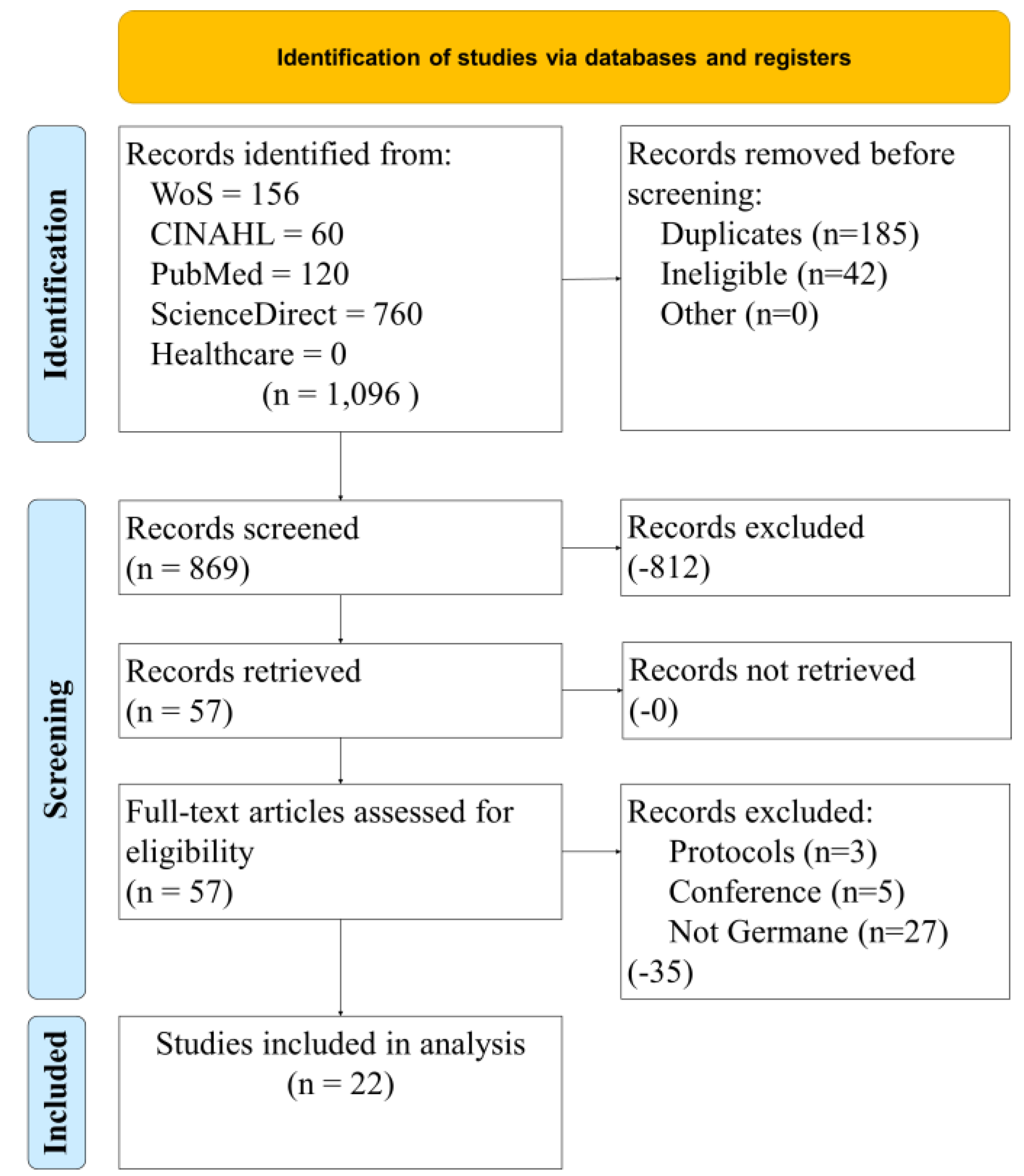
3.1. Study Selection
3.2. Study Characteristics
3.3. Risk of Bias in and across Studies
3.4. Results of Individual Studies
3.5. Results of Syntheses, Additional Analysis, and Certainty of Evidence
3.5.1. Patient Satisfaction
3.5.2. Results to the Adoption of mHealth and VR for Memory Care for AD Patients
3.5.3. Medical Outcome Commensurate with the Adoption of mHealth and VR for Memory Care
3.5.4. Effectiveness Themes and Observations
3.5.5. Barriers to the Adoption of mHealth and VR for Memory Care for Patients with AD
3.5.6. Interactions between Observations
4. Discussion
4.1. Summary of Evidence
4.2. Limitations
4.3. Conclusions
Author Contributions
Funding
Protocol and Registration
Institutional Review Board Statement
Informed Consent Statement
Data Availability Statement
Conflicts of Interest
Appendix A

| Authors | Experimental Intervention | Intervention Themes | Results (Compared to Control Group) | Results Themes | Medical Outcomes Reported | Outcome Themes |
|---|---|---|---|---|---|---|
| Zhuang et al. | mHealth, eHealth cognitive training program | mHealth, eHealth | Intervention group with global cortical atrophy (GCA) showed improvement (p < 0.05). No change with baseline cognitive exam. | Improvement in cortical atrophy | Improvement in memory, language, and visuospatial abilities | Improvement in cortical atrophy |
| Improved memory | Improved memory | |||||
| Improved language | Improved language | |||||
| Jelcic et al. | Telephone-based | Telephone | The mean Mini Mental State Examination (MMSE) score improved significantly in Telecommunication technology (LSS-tele) and LSS-direct treatments | Improved MMSE scores (cognition) | Improvement in working memory and semantic fluency | Improved MMSE scores (cognition) |
| Improved language | Improved language | |||||
| Singh et al. | mHealth, eHealth multidomain cognitive training | mHealth, eHealth | Resistance training was 74% higher for Executive Domain compared with combined training, cognition, and verbal memory | Improved resistance training | Improvement in global cognition, executive function and verbal/constructional memory | Improved resistance training |
| Improved MMSE scores (cognition) | Improved MMSE scores (cognition) | |||||
| Improved language | Improved language | |||||
| Tarnanas et al. | Virtual Reality (VR), and Augmented Reality (AR) | Virtual Reality (VR) | improvements of specific cognitive functions and working memory | Improved MMSE scores (cognition) | improves untrained cognitive functions in MCI | Improved MMSE scores (cognition) |
| Burdea et al. | mHealth (BrightBrainer) app | mHealth, eHealth | statistically significant improvement in decision making, with trend improvements in depression. Non-statistically significant results found in processing speed and auditory attention. | Improved depression | Improvements in decision making and depression | Improved depression |
| Finn et al. | mHealth, VR, Telemedicine | mHealth + VR | (p < 0.05). Improved on the task itself over the course of training. | Improved memory | repetition-lag training (RLT), a form of recognition memory training reported | Improved memory |
| Callan et al. | mHealth cognitive training task (APVSAT) | mHealth, eHealth | Improved task performance, in terms of speed, by nearly 50% | Improved MMSE scores (cognition) | Reported as useful approach for incorporating device usage into daily routines. | Improved MMSE scores (cognition) |
| Cavallo et al. | structured rehabilitative software | mHealth, eHealth | (p < 0.05). Improvement in the intervention group greater than the control. | Improved memory | Improvement in memory | Improved memory |
| Hagovska et al. | Training battery prog- Cogni-Plus, SCHUHFRIED GmbH Austria, Dynamic balance training | mHealth, eHealth | (p < 0.05). improvement in postural reactions, attention, memory and language ability in the intervention group | Improved attention | improvement in postural reactions, attention, memory and language | Improved attention |
| Improved memory | Improved memory | |||||
| Improved language | Improved language | |||||
| Improved vitality | Improved vitality | |||||
| Hyer et al. | Cogmed or a Sham computer program. For Repeatable Battery for Neuropsychological Status and the Clinical Dementia Rating | mHealth, eHealth | The Cogmed group demonstrated better performance on the Functional Activities Questionnaire (FAQ), a measure of adjustment and far transfer, at follow-up. | Improved MMSE scores (cognition) | Both groups, especially Cogmed, enjoyed the intervention. Cognitive stimulation activities improved mental skills | Improved MMSE scores (cognition) |
| Boyd et al. | Trials to use Apps-evaluation of EnCare diagnostics (ECD) and the brain fit plan (BFP) in healthy older adults | mHealth, eHealth | No control group. Improved brain waves | Improved EEG scores (brain waves) | ECD is highly acceptable in both healthy older adults and those with early stage dementia when given the shorter versions to accommodate their diagnosis. | Improved EEG scores (brain waves) |
| Yang et al. | 24 sessions of computer-based cognitive training, over a 12 week period. | mHealth, eHealth | Computer-based cognitive treatment resulting in self-training and self-learning of a patient | Improved MMSE scores (cognition) | Improvement in language, attention, calculation, verbal memory, and frontal function for the experimental group | Improved MMSE scores (cognition) |
| Improved memory | Improved memory | |||||
| Improved language | Improved language | |||||
| Lee et al. | 12 sessions of a computerized cognitive rehabilitation program for three weeks | mHealth, eHealth | “No control group”. Two treatment groups only | Improved MMSE scores (cognition) | Improvement in subjects who underwent computerized cognitive rehabilitation using Bettercog. | Improved MMSE scores (cognition) |
| Park et al. | NCT group showed improvement in vitality, role-emotional, and mental health compared with the CCT group | mHealth, eHealth | Cognitive function (attention, memory, and visual spatial ability) showed a significant increase in both groups (p < 0.05), as did the mental components of health-related quality of life (p < 0.05) | Improved attention | Regarding health-related quality of life, the NCT group showed more improvement in vitality, role-emotional, and mental health compared with the CCT group | Improved attention |
| Improved memory | Improved memory | |||||
| Improved vitality | Improved vitality | |||||
| Improved mental health | Improved mental health | |||||
| Improved quality of life | Improved quality of life | |||||
| Flak et al. | mHealth memory training app | mHealth, eHealth | Adaptive training group did not show significantly greater improvement on the main outcome of working memory performance at 1 and 4 months after training | No improvement | no improvement | None reported |
| Kahn | Game console with cognitive games | Game console | Theta, delta waves and complexity of EEG significantly improved | Improved EEG scores (brain waves) | Xbox 360 Kinect cognitive games improved EEG indicators and cognitive functions probably through multiple mechanisms, such as, cognition improvement, 15–17 increasing cerebral blood flow, 59 neural plasticity, 60 activation of arousal system, 61 neurotransmitters modulation | Improved EEG scores (brain waves) |
| Improved MMSE scores (cognition) | Improved MMSE scores (cognition) | |||||
| Improved cerebral blood flow | Improved cerebral blood flow | |||||
| Improved neuro plasticity | Improved neuro plasticity | |||||
| Park | culture based virtual reality | Virtual Reality (VR) | VR-based training group exhibited no significant differences following the three-month VR program | No significant differences | no significant improvements noted | None reported |
| Park et al. | VR | Virtual Reality (VR) | No control group. improvement in physical, memory and brain stimulation, but the participants have a low focus on decision making | Improved vitality | Improvement in physical outcomes, memory and brain stimulation | Improved vitality |
| Improved memory | Improved memory | |||||
| Improved EEG scores (brain waves) | Improved EEG scores (brain waves) | |||||
| Robert et al. | mHealth app (MeMo) | mHealth, eHealth | Significant differences in two attention tests | Improved attention | Improvement in attention tests | Improved attention |
| Thapa et al. | VR | Virtual Reality (VR) | Intervention group exhibited a significantly improved executive function and brain function at the resting state | Improved EEG scores (brain waves) | Intervention group exhibited a significantly improved executive function and brain function at the resting state | Improved EEG scores (brain waves) |
| Oliveria et al. | VR | Virtual Reality (VR) | an improvement in overall cognitive function in the experimental group | Improved MMSE scores (cognition) | an improvement in overall cognitive function in the experimental group | Improved MMSE scores (cognition) |
| Seredakis et al. | VR | Virtual Reality (VR) | No group interaction | No improvement | No group interaction | None reported |
Appendix B
| Authors | Effectiveness | Effectiveness Themes | Barriers to Adoption | Barrier Themes |
|---|---|---|---|---|
| Zhuang et al. | pts value technology, improvement in memory, language, and visuospatial abilities | Improvement in cortical atrophy | Cost to acquire equipment, staff training, low reimbursement, time to administer tests | Cost |
| Improved memory | Training | |||
| Improved language | Low reimbursement | |||
| Time of providers | ||||
| Jelcic et al. | Improvement in memory, phonemic fluency, semantic fluency, stabilizing delayed/working memory | Improved MMSE scores (cognition) | Time of providers/staff on phone, training of staff, time to administer tests | Time of providers |
| Improved language | Training | |||
| Time of providers | ||||
| Singh et al. | trials of isolated moderate-high intensity resistance training had significant effects on memory, cognition, and language | Improved resistance training | Cost to acquire equipment, staff training, low reimbursement, time to administer tests | Cost |
| Improved MMSE scores (cognition) | Training | |||
| Improved language | Low reimbursement | |||
| Time of providers | ||||
| Tarnanas et al. | improves untrained cognitive functions in MCI | Improved MMSE scores (cognition) | Cost to acquire equipment, staff training, low reimbursement, time to administer tests | Cost |
| Training | ||||
| Low reimbursement | ||||
| Time of providers | ||||
| Burdea et al. | Improvements in decision making and depression | Improved depression | Cost to acquire equipment, staff training, low reimbursement | Cost |
| Training | ||||
| Low reimbursement | ||||
| Time of providers | ||||
| Finn et al. | repetition-lag training (RLT), a form of recognition memory training reported | Improved memory | Cost to acquire equipment, staff training, low reimbursement, time to administer tests | Cost |
| Training | ||||
| Low reimbursement | ||||
| Time of providers | ||||
| Callan et al. | Improved task performance, in terms of speed, by nearly 50% | Improved MMSE scores (cognition) | Cost to acquire equipment, staff training, low reimbursement, time to administer tests | Cost |
| Training | ||||
| Low reimbursement | ||||
| Time of providers | ||||
| Cavallo et al. | Improvement in memory | Improved memory | Cost to acquire equipment, staff training, low reimbursement, time to administer tests | Cost |
| Training | ||||
| Low reimbursement | ||||
| Time of providers | ||||
| Hagovska et al. | improvement in postural reactions, attention, memory and language | Improved attention | Cost to acquire equipment, staff training, low reimbursement, time to administer tests | Cost |
| Improved memory | Training | |||
| Improved attention | Low reimbursement | |||
| Improved language | Time of providers | |||
| Hyer et al. | improvement in mental sharpness | Improved MMSE scores (cognition) | Cost to acquire equipment, staff training, low reimbursement, time to administer tests | Cost |
| Training | ||||
| Low reimbursement | ||||
| Time of providers | ||||
| Boyd et al. | Improved brain waves | Improved EEG scores (brain waves) | dexterity limitations, use of touch screen and accidental screen presses, cost to acquire equipment, staff training, low reimbursement, time to administer benchmark tests | Dexterity limitations of older adults |
| Cost | ||||
| Training | ||||
| Low reimbursement | ||||
| Time of providers | ||||
| Yang et al. | Improvement in language, attention, calculation, verbal memory, and frontal function for the experimental group, convenience, savings in time | Improved MMSE scores (cognition) | Cost to acquire equipment, staff training, low reimbursement, time to administer tests | Cost |
| Improved memory | Training | |||
| Improved language | Low reimbursement | |||
| Savings in time | Time of providers | |||
| Lee et al. | convenience, savings in time, improved cognition | Savings in time | Cost to acquire equipment, staff training, low reimbursement, time to administer tests | Cost |
| Improved MMSE scores (cognition) | Training | |||
| Low reimbursement | ||||
| Time of providers | ||||
| Park et al. | Regarding health-related quality of life, the NCT group showed more improvement in vitality, role-emotional, and mental health compared with the CCT group | Improved attention | Cost to acquire equipment, staff training, low reimbursement, time to administer tests | Cost |
| Improved memory | Training | |||
| Improved vitality | Low reimbursement | |||
| Improved mental health | Time of providers | |||
| Improved quality of life | ||||
| Flak et al. | none | None reported | Cost to acquire equipment, staff training, low reimbursement, time to administer tests | Cost |
| Training | ||||
| Low reimbursement | ||||
| Time of providers | ||||
| Kahn | Increase in brain waves, increase in cognition, incresae in cerebral blood flow, improved neuro plasticity | Improved EEG scores (brain waves) | Cost to acquire equipment, staff training, low reimbursement, time to administer tests | Cost |
| Improved MMSE scores (cognition) | Training | |||
| Improved cerebral blood flow | Low reimbursement | |||
| Improved neuro plasticity | Time of providers | |||
| Park | none | None reported | Cost to acquire equipment, staff training, low reimbursement | Cost |
| Training | ||||
| Low reimbursement | ||||
| Time of providers | ||||
| Park et al. | Improvement in physical outcomes, memory and brain stimulation | Improved vitality | Cost to acquire equipment, staff training, low reimbursement | Cost |
| Improved memory | Training | |||
| Improved EEG scores (brain waves) | Low reimbursement | |||
| Time of providers | ||||
| Robert et al. | significant differences in two attention tests | Improved attention | Cost to acquire equipment, staff training, low reimbursement | Cost |
| Training | ||||
| Low reimbursement | ||||
| Time of providers | ||||
| Thapa et al. | Intervention group exhibited a significantly improved executive function and brain function at the resting state | Improved EEG scores (brain waves) | Cost to acquire equipment, staff training, low reimbursement | Cost |
| Training | ||||
| Low reimbursement | ||||
| Time of providers | ||||
| Oliveria et al. | an improvement in overall cognitive function in the experimental group | Improved MMSE scores (cognition) | Cost to acquire equipment, staff training, low reimbursement | Cost |
| Training | ||||
| Low reimbursement | ||||
| Time of providers | ||||
| Seredakis et al. | No group interaction | None reported | Cost to acquire equipment, staff training, low reimbursement | Cost |
| Training | ||||
| Low reimbursement | ||||
| Time of providers |
Appendix C
| Authors | Sample Size (#s only) | Bias within Study Selection Bias, Sample Bias, etc. | Effect Size | Country of Origin (Where the Study Was Conducted) | Statistics Used | Patient Satisfaction | Strength of Evidence | Quality of Evidence |
|---|---|---|---|---|---|---|---|---|
| Zhuang et al. | 33 | China only (selection bias), Mostly female (sample bias) | Not reported | China | Measures of central tendency, MANOVA, ANOVA, Wilk’s lambda | Positive effect on patient experience | I | A |
| Short intervention period (design bias) | Pts value technology | |||||||
| Jelcic et al. | 27 | Venice only (selection bias), Mostly female and Caucasian (sample bias) | not reported | Venice | Measures of central tendency, Kruskal–Wallis ANOVA, Mann–Whitney U-test | Positive effect on patient experience | II | B |
| Singh et al. | 100 | Australia and New Zealand only (selection bias) | small (0.2) | Australia and New Zealand | Measures of central tendency, Odds ratio | improved global cognitive function | I | A |
| Tarnanas et al. | 114 | Greece only (selection bias) | sensitivity 80.4%, specificity 94.3%Large effect (3.91) | Greece | Measures of central tendency, ANOVA | Positive effect on patient experience, | I | A |
| pts value technology | ||||||||
| Burdea et al. | 10 | one country (selection bias), majority male (sample bias) | not reported | USA | paired t-test | high rates of satisfaction | II | B |
| Finn et al. | 31 | Sydney, Australia only (selection bias) | small (0.17) | Australia | Measures of central tendency, ANOVA, t-test | Positive effect on patient experience, | I | A |
| pts value technology | ||||||||
| Callan et al. | 27 | Pittsburg, USA only (selection bias) | not reported | USA | Measures of central tendency, paired t-test, Fisher’s exact test | Positive effect on patient experience, | I | B |
| pts value technology | ||||||||
| Cavallo et al. | 80 | Moncalieri, Italy (selection bias) | not reported | Italy | Measures of central tendency, repeated measures GLM, t-tests | Positive effect on patient experience, | I | A |
| pts value technology | ||||||||
| Hagovska et al. | 80 | Kosice, Slovak Republic only (selection bias) | medium (0.64) | Slovakia | Measures of central tendency, ANOVA, t-tests, Shapiro–Wilk test, D’Agostino-Pearson test | Positive effect on patient experience, | I | A |
| pts value technology | ||||||||
| Hyer et al. | 68 | US only (selection bias) | medium | USA | Measures of central tendency, ANOVA | pts value technology | II | A |
| Boyd et al. | 19 | Northern Ireland only (selection bias) | not reported | Ireland | Measures of central tendency, t-tests | Positive effect on patient experience, | III | B |
| pts value technology | ||||||||
| Yang et al. | 20 | Namyangju, south Korea only (selection bias) | not reported | Korea | Measures of central tendency, Mann–Whitney U-test, t-tests | Positive effect on motivation and mood | I | B |
| pts value technology | ||||||||
| Lee et al. | 20 | Chungbuk National University Hospital, Korea only (selection bias) | not reported | Korea | Measures of central tendency, independent t-test, Mann–Whitney U-test | not reported | I | B |
| limited number of treatment sessions (design bias) | pts value technology | |||||||
| Park et al. | 78 | one country (selection bias) | not reported | Korea | Measures of central tendency | not reported | I | A |
| pts value technology | ||||||||
| Flak et al. | 68 | Norway only (selection bias), majority male (sample bias) | Not reported | Norway | Linear mixed models | patients experienced frustration | I | A |
| Kahn | 38 | Pakistan only (selection bias) | not reported | Pakistan | ANOVA with Scheffe post hoc analysis, paired t-test | not reported | I | A |
| Park | 21 | Korea only (selection bias) | not reported | Korea | ANOVA with Shapiro–Wilks test, student’s t-test | not reported | I | A |
| Park et al. | 45 | One country (selection bias) | not reported | Korea | GLM | not reported | III | A |
| Robert et al. | 46 | One country (selection bias) | not reported | France | Student t-test, Wilcoxon-Mann–Whitney, Chi-square, Fisher’s exact, and Wilcoxon | not reported | I | A |
| Thapa et al. | 66 | One country (selection bias) | not reported | Korea | ANOVA, Shapiro–Wilk | not reported | I | A |
| Oliveria et al. | 34 | One country (selection bias) | large | Portugal | ANOVA with Bonferroni correction | not reported | I | A |
| Seredakis et al. | 43 | One country (selection bias) | medium | Australia | Chi-square, Shapiro–Wilk, Wilcoxon signed rank test, Mann–Whitney U test | not reported | II | A |
References
- Alzheimer’s Association. 2022 Alzheimer’s Disease Facts and Figures; Alzheimer’s Association: Chicago, IL, USA, 2022; pp. 131–168. [Google Scholar]
- Patterson, C. World Alzheimer Report 2018; Alzheimer’s Disease International: London, UK, 2018. [Google Scholar]
- Marcello, E.; Gardoni, F.; Di Luca, M. Alzheimer’s disease and modern lifestyle: What is the role of stress? J. Neurochem. 2015, 134, 795–798. [Google Scholar] [CrossRef] [PubMed]
- Meng, L.; He, M.; Xiong, M.; Zhang, X.; Nie, S.; Xiong, J.; Hu, D.; Zhang, Z.; Mao, L.; Zhang, Z. 2′,3′-Dideoxycytidine, a DNA polymerase-β inhibitor, reverses memory deficits in a mouse model of Alzheimer’s disease. J. Alzheimer’s Dis. 2019, 67, 515–525. [Google Scholar] [CrossRef] [PubMed]
- Wright, J.W.; Harding, J.W. The brain renin–angiotensin system: A diversity of functions and implications for CNS diseases. Pflüg. Arch.-Eur. J. Physiol. 2013, 465, 133–151. [Google Scholar] [CrossRef] [PubMed]
- Posner, M.I. Cognition: An Introduction; Scott, Foresman & Co.: Dallas, TX, USA, 1973. [Google Scholar]
- Tombaugh, T.N.; McIntyre, N.J. The mini-mental state examination: A comprehensive review. J. Am. Geriatr. Soc. 1992, 40, 922–935. [Google Scholar] [CrossRef]
- World Health Organization. Telemedicine: Opportunities and Developments in Member States. Report on the Second Global Survey on eHealth; World Health Organization: Geneva, Switzerland, 2010. [Google Scholar]
- Garnett, A.; Northwood, M.; Ting, J.; Sangrar, R. mHealth Interventions to Support Caregivers of Older Adults: Equity-Focused Systematic Review. JMIR Aging 2022, 5, e33085. [Google Scholar] [CrossRef] [PubMed]
- Fox, S.; Brown, L.J.; Antrobus, S.; Brough, D.; Drake, R.J.; Jury, F.; Leroi, I.; Parry-Jones, A.R.; Machin, M. Co-design of a Smartphone App for People Living with Dementia by Applying Agile, Iterative Co-design Principles: Development and Usability Study. JMIR Mhealth Uhealth 2022, 10, e24483. [Google Scholar] [CrossRef] [PubMed]
- Jacobson, N.; Lithgow, B.; Jafari Jozani, M.; Moussavi, Z. The Effect of Transcranial Alternating Current Stimulation with Cognitive Training on Executive Brain Function in Individuals with Dementia: Protocol for a Crossover Randomized Controlled Trial. JMIR Res. Protoc. 2022, 11, e37282. [Google Scholar] [CrossRef] [PubMed]
- Garcia-Betances, R.I.; Jiménez-Mixco, V.; Arredondo, M.T.; Cabrera-Umpiérrez, M.F. Using virtual reality for cognitive training of the elderly. Am. J. Alzheimer’s Dis. Other Dement. 2015, 30, 49–54. [Google Scholar] [CrossRef]
- Bateman, D.R.; Srinivas, B.; Emmett, T.W.; Schleyer, T.K.; Holden, R.J.; Hendrie, H.C.; Callahan, C.M. Categorizing health outcomes and efficacy of mHealth apps for persons with cognitive impairment: A systematic review. J. Med. Internet Res. 2017, 19, e7814. [Google Scholar] [CrossRef] [PubMed]
- Hill, N.T.; Mowszowski, L.; Naismith, S.L.; Chadwick, V.L.; Valenzuela, M.; Lampit, A. Computerized cognitive training in older adults with mild cognitive impairment or dementia: A systematic review and meta-analysis. Am. J. Psychiatry 2017, 174, 329–340. [Google Scholar] [CrossRef]
- Abd-alrazaq, A.; Alhuwail, D.; Ahmed, A.; Househ, M. Effectiveness of Serious Games for Improving Executive Functions Among Older Adults with Cognitive Impairment: Systematic Review and Meta-analysis. JMIR Serious Games 2022, 10, e36123. [Google Scholar] [CrossRef]
- Kruse, C.S. Writing a Systematic Review for Publication in a Health-Related Degree Program. JMIR Res. Protoc. 2019, 8, e15490. [Google Scholar] [CrossRef] [PubMed]
- Newhouse, R.; Dearholt, S.; Poe, S.; Pugh, L.; White, K. The Johns Hopkins Nursing Evidence-Based Practice Rating Scale; The Johns Hopkins Hospital: Baltimore, MD, USA, 2005. [Google Scholar]
- Pannucci, C.J.; Wilkins, E.G. Identifying and avoiding bias in research. Plast. Reconstr. Surg. 2010, 126, 619. [Google Scholar] [CrossRef] [PubMed]
- Braun, V.; Clarke, V. Using thematic analysis in psychology. Qual. Res. Psychol. 2006, 3, 77–101. [Google Scholar] [CrossRef]
- Kruse, C.; Betancourt, J.; Ortiz, S.; Luna, S.M.V.; Bamrah, I.K.; Segovia, N. Barriers to the use of mobile health in improving health outcomes in developing countries: Systematic review. J. Med. Internet Res. 2019, 21, e13263. [Google Scholar] [CrossRef] [PubMed]
- Kruse, C.; Heinemann, K. Facilitators and Barriers to the Adoption of Telemedicine during the First Year of COVID-19: Systematic Review. J. Med. Internet Res. 2022, 24, e31752. [Google Scholar] [CrossRef] [PubMed]
- Kruse, C.S.; Lee, K.; Watson, J.B.; Lobo, L.G.; Stoppelmoor, A.G.; Oyibo, S.E. Measures of effectiveness, efficiency, and quality of telemedicine in the management of alcohol abuse, addiction, and rehabilitation: Systematic review. J. Med. Internet Res. 2020, 22, e13252. [Google Scholar] [CrossRef] [PubMed]
- Zhuang, J.-P.; Fang, R.; Feng, X.; Xu, X.-H.; Liu, L.-H.; Bai, Q.-K.; Tang, H.-D.; Zhao, Z.-G.; Chen, S.-D. The impact of human-computer interaction-based comprehensive training on the cognitive functions of cognitive impairment elderly individuals in a nursing home. J. Alzheimer’s Dis. 2013, 36, 245–251. [Google Scholar] [CrossRef] [PubMed]
- Jelcic, N.; Agostini, M.; Meneghello, F.; Bussè, C.; Parise, S.; Galano, A.; Tonin, P.; Dam, M.; Cagnin, A. Feasibility and efficacy of cognitive telerehabilitation in early Alzheimer’s disease: A pilot study. Clin. Interv. Aging 2014, 9, 1605. [Google Scholar]
- Singh, M.A.F.; Gates, N.; Saigal, N.; Wilson, G.C.; Meiklejohn, J.; Brodaty, H.; Wen, W.; Singh, N.; Baune, B.T.; Suo, C. The Study of Mental and Resistance Training (SMART) study—resistance training and/or cognitive training in mild cognitive impairment: A randomized, double-blind, double-sham controlled trial. J. Am. Med. Dir. Assoc. 2014, 15, 873–880. [Google Scholar] [CrossRef]
- Tarnanas, I.; Tsolakis, A.; Tsolaki, M. Assessing virtual reality environments as cognitive stimulation method for patients with MCI. In Technologies of Inclusive Well-Bein; Springer: New York, NY, USA, 2014; pp. 39–74. [Google Scholar]
- Burdea, G.; Polistico, K.; Krishnamoorthy, A.; House, G.; Rethage, D.; Hundal, J.; Damiani, F.; Pollack, S. Feasibility study of the BrightBrainer™ integrative cognitive rehabilitation system for elderly with dementia. Disabil. Rehabil. Assist. Technol. 2015, 10, 421–432. [Google Scholar] [CrossRef] [PubMed]
- Finn, M.; McDonald, S. Repetition-lag training to improve recollection memory in older people with amnestic mild cognitive impairment. A randomized controlled trial. Aging Neuropsychol. Cogn. 2015, 22, 244–258. [Google Scholar] [CrossRef] [PubMed]
- Callan, J.A.; Siegle, G.J.; Abebe, K.; Black, B.; Martire, L.; Schulz, R.; Reynolds, C., III; Hall, M.H. Feasibility of a pocket-PC based cognitive control intervention in dementia spousal caregivers. Aging Ment. Health 2016, 20, 575–582. [Google Scholar] [CrossRef]
- Cavallo, M.; Hunter, E.M.; van der Hiele, K.; Angilletta, C. Computerized structured cognitive training in patients affected by early-stage Alzheimer’s disease is feasible and effective: A randomized controlled study. Arch. Clin. Neuropsychol. 2016, 31, 868–876. [Google Scholar] [CrossRef] [PubMed]
- Hagovska, M.; Takáč, P.; Dzvonik, O. Effect of a combining cognitive and balanced training on the cognitive, postural and functional status of seniors with a mild cognitive deficit in a randomized, controlled trial. Eur. J. Phys. Rehabil. Med. 2016, 52, 101–109. [Google Scholar]
- Hyer, L.; Scott, C.; Atkinson, M.M.; Mullen, C.M.; Lee, A.; Johnson, A.; Mckenzie, L.C. Cognitive training program to improve working memory in older adults with MCI. Clin. Gerontol. 2016, 39, 410–427. [Google Scholar] [CrossRef] [PubMed]
- Boyd, A.; Synnott, J.; Nugent, C.; Elliott, D.; Kelly, J. Community-based trials of mobile solutions for the detection and management of cognitive decline. Healthc. Technol. Lett. 2017, 4, 93–96. [Google Scholar] [CrossRef]
- Yang, Y.; Kwak, Y.T. Improvement of cognitive function after computer-based cognitive training in early stage of Alzheimer’s dementia. Dement. Neurocogn. Disord. 2017, 16, 7–11. [Google Scholar] [CrossRef] [PubMed]
- Lee, G.J.; Bang, H.J.; Lee, K.M.; Kong, H.H.; Seo, H.S.; Oh, M.; Bang, M. A comparison of the effects between 2 computerized cognitive training programs, Bettercog and COMCOG, on elderly patients with MCI and mild dementia: A single-blind randomized controlled study. Medicine 2018, 97, e13007. [Google Scholar] [CrossRef]
- Park, J.-H.; Park, J.-H. Does cognition-specific computer training have better clinical outcomes than non-specific computer training? A single-blind, randomized controlled trial. Clin. Rehabil. 2018, 32, 213–222. [Google Scholar] [CrossRef]
- Flak, M.M.; Hol, H.R.; Hernes, S.S.; Chang, L.; Engvig, A.; Bjuland, K.J.; Pripp, A.; Madsen, B.-O.; Knapskog, A.-B.; Ulstein, I. Adaptive computerized working memory training in patients with mild cognitive impairment. A randomized double-blind active controlled trial. Front. Psychol. 2019, 10, 807. [Google Scholar] [CrossRef] [PubMed]
- Khan, N. Xbox 360 Kinect cognitive games improve slowness, complexity of EEG, and cognitive functions in subjects with mild cognitive impairment: A randomized control trial. Games Health J. 2019, 8, 144–152. [Google Scholar]
- Park, S.-J. Brain Stimulation of Elderly with Dementia Using Virtual Reality Home. J. Inf. Technol. Appl. Manag. 2019, 26, 1–18. [Google Scholar]
- Park, J.-H.; Liao, Y.; Kim, D.-R.; Song, S.; Lim, J.H.; Park, H.; Lee, Y.; Park, K.W. Feasibility and tolerability of a culture-based virtual reality (VR) training program in patients with mild cognitive impairment: A randomized controlled pilot study. Int. J. Environ. Res. Public Health 2020, 17, 3030. [Google Scholar] [CrossRef] [PubMed]
- Robert, P.; Manera, V.; Derreumaux, A.; Montesino, M.F.Y.; Leone, E.; Fabre, R.; Bourgeois, J. Efficacy of a web app for cognitive training (MeMo) regarding cognitive and behavioral performance in people with neurocognitive disorders: Randomized controlled trial. J. Med. Internet Res. 2020, 22, e17167. [Google Scholar] [CrossRef] [PubMed]
- Thapa, N.; Park, H.J.; Yang, J.-G.; Son, H.; Jang, M.; Lee, J.; Kang, S.W.; Park, K.W.; Park, H. The effect of a virtual reality-based intervention program on cognition in older adults with mild cognitive impairment: A randomized control trial. J. Clin. Med. 2020, 9, 1283. [Google Scholar] [CrossRef] [PubMed]
- Oliveira, J.; Gamito, P.; Souto, T.; Conde, R.; Ferreira, M.; Corotnean, T.; Fernandes, A.; Silva, H.; Neto, T. Virtual Reality-Based Cognitive Stimulation on People with Mild to Moderate Dementia due to Alzheimer’s Disease: A Pilot Randomized Controlled Trial. Int. J. Environ. Res. Public Health 2021, 18, 5290. [Google Scholar] [CrossRef] [PubMed]
- Saredakis, D.; Keage, H.A.; Corlis, M.; Ghezzi, E.S.; Loffler, H.; Loetscher, T. The effect of reminiscence therapy using virtual reality on apathy in residential aged care: Multisite nonrandomized controlled trial. J. Med. Internet Res. 2021, 23, e29210. [Google Scholar] [CrossRef] [PubMed]
| Authors | Participants | Experimental Intervention | Results (Compared to Control Group) | Medical Outcomes Reported | Study Design |
|---|---|---|---|---|---|
| Zhuang et al. [23] | Older Adult (≥70), average age 83, 24% male, 76% female, all Asian (Chinese) | mHealth, eHealth cognitive training program | Intervention group with global cortical atrophy (GCA) showed improvement (p < 0.05). No change with baseline cognitive exam. | Improvement in memory, language, and visuospatial abilities | RCT |
| Jelcic et al. [24] | Older Adult (≥80), average age 83, 22% male, 77% female, 100% Caucasian | Telephone-based | The mean Mini Mental State Examination (MMSE) scores improved significantly in telecommunication technology (LSS-tele) and LSS-direct treatments | Improvement in working memory and semantic fluency | Quasi-experimental |
| Singh et al. [25] | Older Adult (>55), average age 68.5, 68% female | mHealth, eHealth multidomain cognitive training | Resistance training was 74% higher for executive domain compared with combined training, cognition, and verbal memory | improvement in global cognition, executive function and verbal/constructional memory | RCT |
| Tarnanas et al. [26] | Older Adult (>65), average age 70.5, 73% male,77% Caucasian | Virtual Reality (VR), and Augmented Reality (AR) | improvements of specific cognitive functions and working memory | improves untrained cognitive functions in MCI | RCT |
| Burdea et al. [27] | Adults (>50 years) with MCI, 70% male | mHealth (BrightBrainer) app | (p < 0.05)Improvement in decision making, with trend improvements in depression. Non-statistically significant results found in processing speed and auditory attention. | Improvements in decision making and depression | Pre-post |
| Finn et al. [28] | Older Adult (>65), average age 75, 71% male, 29% female, 100% Caucasian | mHealth, VR, Telemedicine | (p < 0.05)- Improved task performance over the course of training. | Repetition-lag training (RLT), a form of recognition memory training reported | RCT |
| Callan et al. [29] | Older Adult (>64), average age 75, 100% Caucasian, non Latino | mHealth cognitive training task (APVSAT) | Improved task performance, in terms of speed, by nearly 50% | Reported as useful approach for incorporating device usage into daily routines. | RCT |
| Cavallo et al. [30] | Older Adult (>75), average age 76, 100% Caucasian | Structured rehabilitative software | (p < 0.05)-improvement in the intervention group greater than the control. | Improvement in memory | RCT |
| Hagovska et al. [31] | Older Adult(≥65 years of age), average age 67.07, female 51.02% male 49% male, 100% Caucasian | Training battery prog- Cogni-Plus, SCHUHFRIED GmbH Austria, Dynamic balance training | (p < 0.05) improvement in postural reactions, attention, memory and language ability in the intervention group | Improvement in postural reactions, attention, memory and language | RCT |
| Hyer et al. [32]. | Older Adult (≥65 years) average age 75, female 53% male 47%, 89% white, 11% black | Cogmed or a Sham computer program. For Repeatable Battery for Neuropsychological Status and the Clinical Dementia Rating | Cogmed group demonstrated better performance on the Functional Activities Questionnaire (FAQ), a measure of adjustment and far transfer, at follow-up. | Both groups, especially Cogmed, enjoyed the intervention. Cognitive stimulation activities improved mental skills | Pre-post |
| Boyd et al. [33] | Older Adult (≥74 years) average age 78, female 68% male 31%, Caucasian | Trials to use Apps-evaluation of EnCare diagnostics (ECD) and the brain fit plan (BFP) in healthy older adults | No control group. Improved brain waves | ECD is highly acceptable in both healthy older adults and those with early-stage dementia when given the shorter versions to accommodate their diagnosis. | Observational |
| Yang et al. [34] | Older Adult (≥68 years) average age 70, female 68% male 31%, Caucasian | 24 sessions of computer-based cognitive training, over a 12 week period. | Computer-based cognitive treatment resulting in self-training and self-learning of a patient | Improvement in language, attention, calculation, verbal memory, and frontal function for the experimental group | RCT |
| Lee et al. [35] | Older Adult (≥70 years) average age 74.3, female 60% male 40% | 12 sessions of a computerized cognitive rehabilitation program for three weeks | “No control group”. Two treatment groups only | Improved attention in subjects who underwent computerized cognitive rehabilitation using Bettercog. | RCT |
| Park et al. [36] | Older Adult (≥60 years) average age 66.5, female 47% male 53% | NCT group showed improvement in vitality, role-emotional, and mental health compared with the CCT group | Cognitive function (attention, memory, and visual spatial ability) showed a significant increase in both groups p < 0.05), as did the mental components of health-related quality of life (p < 0.05) | Regarding health-related quality of life, the NCT group showed more improvement in vitality, role-emotional, and mental health compared with the CCT group | RCT |
| Flak et al. [37] | Adults (>42 years) with MCI, 66% male | mHealth memory training app | Adaptive training group did not show significantly greater improvement on the main outcome of working memory performance at 1 and 4 months after training | no improvement | RCT |
| Kahn [38] | Adults (>50 years) with MCI | game console with cognitive games | Theta, delta waves and complexity of EEG significantly improved | Xbox 360 Kinect cognitive games improved EEG indicators and cognitive functions, and, 15–17 increasing cerebral blood flow,59 neural plasticity,60 activation of arousal system,61 neurotransmitters modulation | RCT |
| Park [39] | Adults (>50 years) with MCI | culture based virtual reality | VR-based training group exhibited no significant differences following the three-month VR program | no improvement | RCT |
| Park et al. [40] | Adults (>59 years, avg age 70.4), with MCI | VR | No control group. improvement in physical, memory and brain stimulation, but the participants have a low focus on decision making | Improvement in physical outcomes, memory and brain stimulation | Mixed Methods |
| Robert et al. [41] | Adults (>50 years, avg age 79.4), with MCI | mHealth app (MeMo) | Significant differences in two attention tests | significant differences in two attention tests | RCT |
| Thapa et al. [42] | Adults (>50 years) with MCI | VR | Intervention group exhibited a significantly improved executive function and brain function at the resting state | Intervention group exhibited a significantly improved executive function and brain function at the resting state | RCT |
| Oliveria et al. [43] | Adults (>50 years) with MCI | VR | Improvement in overall cognitive function in the experimental group | Improvement in overall cognitive function in the experimental group | RCT |
| Seredakis et al. [44] | Adults (>50 years) with MCI | VR | No group interaction | No group interaction | Quasi-experimental |
| Authors | Intervention Themes | Results Themes | Outcome Themes | Effectiveness Themes | Barrier Themes |
|---|---|---|---|---|---|
| Zhuang et al. [23] | mHealth, eHealth | Improvement in cortical atrophy | Improvement in cortical atrophy | Improvement in cortical atrophy | Cost |
| Improved memory | Improvedmemory | Improved memory | Training | ||
| Improved language | Improved language | Improved language | Low reimbursement | ||
| Time of providers | |||||
| Jelcic et al. [24] | Telephone | Improved MMSE scores (cognition) | Improved MMSE scores (cognition) | Improved MMSE scores (cognition) | Time of providers |
| Improved language | Improved language | Improved language | Training | ||
| Time of providers | |||||
| Singh et al. [25] | mHealth, eHealth | Improved resistance training | Improved resistance training | Improved resistance training | Cost |
| Improved ADAS-Cog scores (cognition) | Improved ADAS-Cog scores (cognition) | Improved ADAS-Cog scores (cognition) | Training | ||
| Improved language | Improved language | Improved language | Low reimbursement | ||
| Time of providers | |||||
| Tarnanas et al. [26] | Virtual Reality (VR) | Improved MMSE scores (cognition) | Improved MMSE scores (cognition) | Improved MMSE scores (cognition) | Cost |
| Training | |||||
| Low reimbursement | |||||
| Time of providers | |||||
| Burdea et al. [27] | mHealth, eHealth | Improved depression | Improved depression | Improved depression | Cost |
| Training | |||||
| Low reimbursement | |||||
| Time of providers | |||||
| Finn et al. [28] | mHealth + VR | Improved memory | Improved memory | Improved memory | Cost |
| Training | |||||
| Low reimbursement | |||||
| Time of providers | |||||
| Callan et al. [29] | mHealth, eHealth | Improved MMSE scores (cognition) | Improved MMSE scores (cognition) | Improved MMSE scores (cognition) | Cost |
| Training | |||||
| Low reimbursement | |||||
| Time of providers | |||||
| Cavallo et al. [30] | mHealth, eHealth | Improved memory | Improved memory | Improved memory | Cost |
| Training | |||||
| Low reimbursement | |||||
| Time of providers | |||||
| Hagovska et al. [31] | mHealth, eHealth | Improved attention | Improved attention | Improved attention | Cost |
| Improved memory | Improved memory | Improved memory | Training | ||
| Improved language | Improved language | Improved attention | Low reimbursement | ||
| Improved vitality | Improved vitality | Improved language | Time of providers | ||
| Hyer et al. [32] | mHealth, eHealth | Improved CFQ scores (cognition) | Improved CFQ scores (cognition) | Improved CFQ scores (cognition) | Cost |
| Training | |||||
| Low reimbursement | |||||
| Time of providers | |||||
| Boyd et al. [33] | mHealth, eHealth | Improved EEG scores (brain waves) | Improved EEG scores (brain waves) | Improved EEG scores (brain waves) | Dexterity limitations of older adults |
| Cost | |||||
| Training | |||||
| Low reimbursement | |||||
| Time of providers | |||||
| Yang et al. [34] | mHealth, eHealth | Improved K-MMSE scores (cognition) | Improved K-MMSE scores (cognition) | Improved K-MMSE scores (cognition) | Cost |
| Improved memory | Improved memory | Improved memory | Training | ||
| Improved language | Improved language | Improved language | Low reimbursement | ||
| Improved attention | Improved attention | Savings in time | Time of providers | ||
| Improved attention | |||||
| Lee et al. [35] | mHealth, eHealth | Improved MMSE scores (cognition) | Improved MMSE scores (cognition) | Savings in time | Cost |
| Improved MMSE scores (cognition) | Training | ||||
| Low reimbursement | |||||
| Time of providers | |||||
| Park et al. [36] | mHealth, eHealth | Improved attention | Improved attention | Improved attention | Cost |
| Improved memory | Improved memory | Improved MMSE scores (memory) | Training | ||
| Improved vitality | Improved vitality | Improved vitality | Low reimbursement | ||
| Improved mental health | Improved mental health | Improved mental health | Time of providers | ||
| Improved quality of life | Improved quality of life | Improved quality of life | |||
| Flak et al. [37] | mHealth, eHealth | No improvement | None reported | None reported | Cost |
| Training | |||||
| Low reimbursement | |||||
| Time of providers | |||||
| Kahn [38] | Game console | Improved EEG scores (brain waves) | Improved EEG scores (brain waves) | Improved EEG scores (brain waves) | Cost |
| Improved MMSE scores (cognition) | Improved MMSE scores (cognition) | Improved MMSE scores (cognition) | Training | ||
| Improved cerebral blood flow | Improved cerebral blood flow | Improved cerebral blood flow | Low reimbursement | ||
| Improved neuro plasticity | Improved neuro plasticity | Improved neuro plasticity | Time of providers | ||
| Park [39] | Virtual Reality (VR) | No significant differences | None reported | None reported | Cost |
| Training | |||||
| Low reimbursement | |||||
| Time of providers | |||||
| Park et al. [40] | Virtual Reality (VR) | Improved vitality | Improved vitality | Improved vitality | Cost |
| Improved memory | Improved memory | Improved memory | Training | ||
| Improved EEG scores (brain waves) | Improved EEG scores (brain waves) | Improved EEG scores (brain waves) | Low reimbursement | ||
| Time of providers | |||||
| Robert et al. [41] | mHealth, eHealth | Improved attention | Improved attention | Improved attention | Cost |
| Training | |||||
| Low reimbursement | |||||
| Time of providers | |||||
| Thapa et al. [42] | Virtual Reality (VR) | Improved EEG scores (brain waves) | Improved EEG scores (brain waves) | Improved EEG scores (brain waves) | Cost |
| Training | |||||
| Low reimbursement | |||||
| Time of providers | |||||
| Oliveria et al. [43] | Virtual Reality (VR) | Improved MMSE scores (cognition) | Improved MMSE scores (cognition) | Improved MMSE scores (cognition) | Cost |
| Training | |||||
| Low reimbursement | |||||
| Time of providers | |||||
| Seredakis et al. [44] | Virtual Reality (VR) | No improvement | None reported | None reported | Cost |
| Training | |||||
| Low reimbursement | |||||
| Time of providers |
| Results Themes and Observations | Frequency |
|---|---|
| Improved cognition (MMSE, ADAS-Cog, WAIS) [24,25,26,29,32,34,35,38,43] | 9 |
| Improved memory [23,28,30,31,34,36,40] | 7 |
| Improved language [23,24,25,31,34] | 5 |
| Improved EEG scores (brain waves) [33,38,40,42] | 4 |
| Improved attention [31,34,36,41] | 4 |
| Improved vitality [31,36,40] | 3 |
| No improvement [37,44] | 2 |
| Improvement in cortical atrophy [23] | 1 |
| Improved resistance training [25] | 1 |
| Improved quality of life [36] | 1 |
| Improved mental health [36] | 1 |
| Improved cerebral blood flow [38] | 1 |
| Improved depression [27] | 1 |
| No significant differences [39] | 1 |
| Improved neuro plasticity [38] | 1 |
| 41 |
| Outcomes Themes and Observations | Frequency |
|---|---|
| Improved cognition (MMSE, ADAS-Cog, WAIS) [24,25,26,29,32,34,35,38,43] | 9 |
| Improved memory [23,28,30,31,34,36,40] | 7 |
| Improved language [23,24,25,31,34] | 5 |
| Improved EEG scores (brain waves) [33,38,40,42] | 4 |
| Improved attention [31,34,36,41] | 4 |
| Improved vitality [31,36,40] | 3 |
| None reported [37,39,44] | 3 |
| Improvement in cortical atrophy [23] | 1 |
| Improved resistance training [25] | 1 |
| Improved quality of life [36] | 1 |
| Improved mental health [36] | 1 |
| Improved cerebral blood flow [38] | 1 |
| Improved neuro plasticity [38] | 1 |
| Improved depression [27] | 1 |
| 41 |
| Effectiveness Themes and Observations | Frequency |
|---|---|
| Improved MMSE scores (cognition) [24,25,26,29,32,34,35,38,43] | 9 |
| Improved MMSE scores (memory) [23,28,30,31,34,36,40] | 7 |
| Improved language [23,24,25,31,34] | 5 |
| Improved attention [31,34,36,41] | 4 |
| Improved EEG scores (brain waves) [33,38,40,42] | 4 |
| Improved vitality [31,36,40] | 3 |
| None reported [37,39,44] | 3 |
| Savings in time [34,35] | 2 |
| Improvement in cortical atrophy [23] | 1 |
| Improved resistance training [25] | 1 |
| Improved quality of life [36] | 1 |
| Improved mental health [36] | 1 |
| Improved cerebral blood flow [38] | 1 |
| Improved neuro plasticity [38] | 1 |
| Improved depression [27] | 1 |
| 43 |
| Barrier Themes and Observation | Frequency |
|---|---|
| Time of providers [23,24,25,26,27,28,29,30,31,32,33,34,35,36,37,38,39,40,41,42,43,44] * | 23 |
| Training [23,24,25,26,27,28,29,30,31,32,33,34,35,36,37,38,39,40,41,42,43,44] | 22 |
| Cost [23,25,26,27,28,29,30,31,32,33,34,35,36,37,38,39,40,41,42,43,44] | 21 |
| Low reimbursement [23,25,26,27,28,29,30,31,32,33,34,35,36,37,38,39,40,41,42,43,44] | 21 |
| Dexterity limitations of older adults [33] | 1 |
| 88 |
Publisher’s Note: MDPI stays neutral with regard to jurisdictional claims in published maps and institutional affiliations. |
© 2022 by the authors. Licensee MDPI, Basel, Switzerland. This article is an open access article distributed under the terms and conditions of the Creative Commons Attribution (CC BY) license (https://creativecommons.org/licenses/by/4.0/).
Share and Cite
Kruse, C.S.; Sen, K.; Armenta, V.; Hubbard, N.; Brooks, R. Leveraging mHealth and Virtual Reality to Improve Cognition for Alzheimer’s Patients: A Systematic Review. Healthcare 2022, 10, 1845. https://doi.org/10.3390/healthcare10101845
Kruse CS, Sen K, Armenta V, Hubbard N, Brooks R. Leveraging mHealth and Virtual Reality to Improve Cognition for Alzheimer’s Patients: A Systematic Review. Healthcare. 2022; 10(10):1845. https://doi.org/10.3390/healthcare10101845
Chicago/Turabian StyleKruse, Clemens Scott, Keya Sen, Valery Armenta, Nicole Hubbard, and Rebekah Brooks. 2022. "Leveraging mHealth and Virtual Reality to Improve Cognition for Alzheimer’s Patients: A Systematic Review" Healthcare 10, no. 10: 1845. https://doi.org/10.3390/healthcare10101845
APA StyleKruse, C. S., Sen, K., Armenta, V., Hubbard, N., & Brooks, R. (2022). Leveraging mHealth and Virtual Reality to Improve Cognition for Alzheimer’s Patients: A Systematic Review. Healthcare, 10(10), 1845. https://doi.org/10.3390/healthcare10101845

