

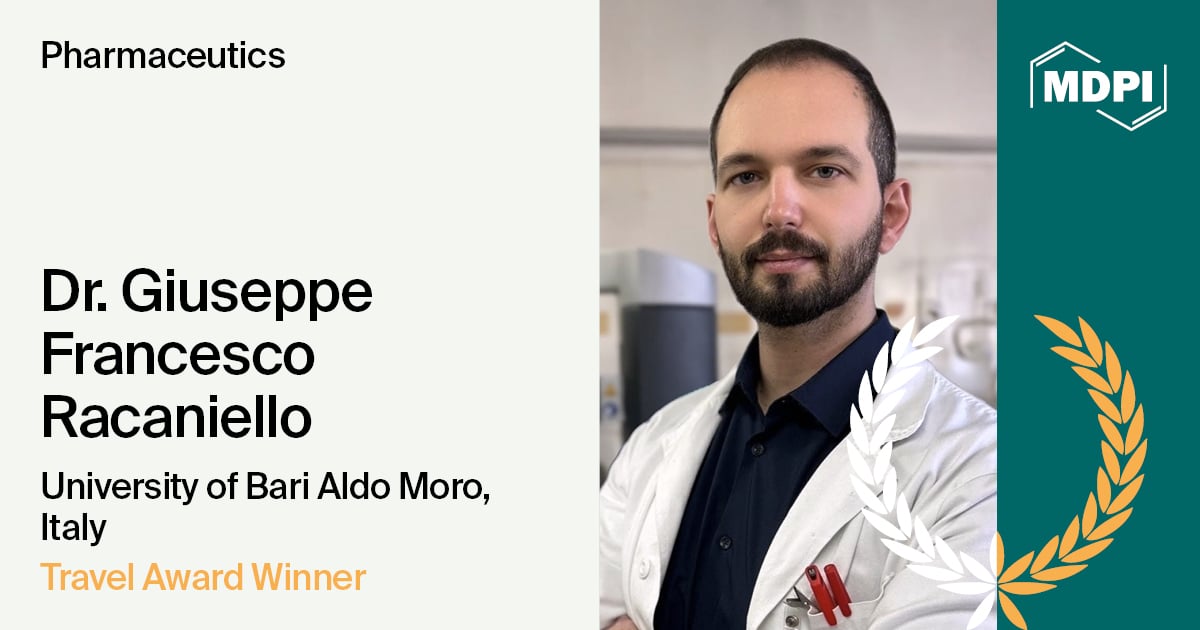
Interview with Dr. Giuseppe Francesco Racaniello—Winner of the Pharmaceutics Travel Award
Dr. Giuseppe Francesco Racaniello is currently a post-doctoral researcher at the University of Bari Aldo Moro, Italy, where his research focuses on advanced drug delivery systems, with particular emphasis on 3D printing technologies for personalized medicines. We would like to congratulate Dr. Giuseppe Francesco Racaniello on winning the Pharmaceutics 2026 Travel Award.
The following is an interview with Dr. Racaniello:
1. As the winner of this award, what would you most like to express?
First of all, I would like to express my sincere gratitude to the Pharmaceutics Editorial Board and the Award Committee for this recognition. Receiving this award is both an honor and a strong motivation to continue pursuing high-quality research in pharmaceutical technology. I see it as a recognition not only of my individual work but also of the collaborative efforts of my research group, PhartecoLab, whose support has been fundamental to my scientific development.
2. How did you first become aware of this award, and what inspired you to submit your application?
I became aware of the Pharmaceutics Travel Award through the email communications sent by the journal. What inspired me to apply was the opportunity to showcase my research in the field of pharmaceutical 3D printing and advanced manufacturing technologies. In particular, the fact that this award is specifically designed to support early-career researchers who wish to present and disseminate their work was a strong motivation. I considered it a valuable opportunity to increase the visibility of my research within a highly relevant scientific community.
3. Could you briefly introduce your primary research focus and share an update on your current progress? Looking ahead, what do you anticipate will be the key emerging topics in your field over the next few years?
My primary research focus is on advanced drug delivery systems, with particular emphasis on 3D printing technologies for personalized medicines, including direct powder extrusion and pressure-assisted manufacturing. I work on the development of patient-tailored dosage forms such as orodispersible films, solid oral dosage forms, and wound-healing platforms, often integrating polymer science, solid-state characterization, and biopharmaceutical evaluation.
Currently, my work is centered on optimizing formulation design and manufacturing parameters to improve drug release, stability, and patient compliance, especially for thermolabile or poorly soluble compounds. In parallel, I am increasingly focused on the development of personalized pharmaceutical dosage forms that are functionally engineered to be mucoadhesive or site-specific. A significant part of my research also addresses the production of dosage forms for orphan drugs, medicines with limited availability, and pediatric formulations that are currently not available on the pharmaceutical market, with the aim of filling unmet clinical needs through advanced manufacturing technologies.
Looking ahead, I believe that key emerging topics will include personalized and decentralized pharmaceutical manufacturing, the integration of digital health and 3D printing, the use of sustainable and bio-based excipients, and the translation of additive manufacturing technologies into regulated clinical and hospital settings.
4. What significance does this award hold for your research career and your participation in this conference?
This award represents an important milestone in my early research career. It provides tangible support for my participation in the next PBP 2026 conference, facilitating scientific exchange, networking, and discussion with leading experts in the field. Beyond the financial aspect, the award enhances the visibility of my work and reinforces my commitment to pursuing innovative research directions within pharmaceutical sciences.
5. In your view, how can academic journals and publishers further support early career researchers and the broader academic community?
Academic journals and publishers play a crucial role in supporting early career researchers by promoting transparent peer review, offering mentorship-oriented feedback, and providing opportunities for visibility, such as awards, Special Issues, and invited contributions. Initiatives that reduce publication barriers, encourage interdisciplinary research, and support open science practices are also essential to foster innovation and inclusivity within the academic community.
6. Based on your experience, do you have any specific suggestions for the continued development of Pharmaceutics?
Based on my experience, Pharmaceutics could further strengthen its impact by continuing to support cutting-edge topics such as personalized medicine, additive manufacturing, and sustainable pharmaceutical technologies. Expanding thematic Special Issues, enhancing engagement with early career researchers, and promoting high-quality methodological and translational studies would further consolidate the journal’s position as a leading platform in pharmaceutical sciences.