

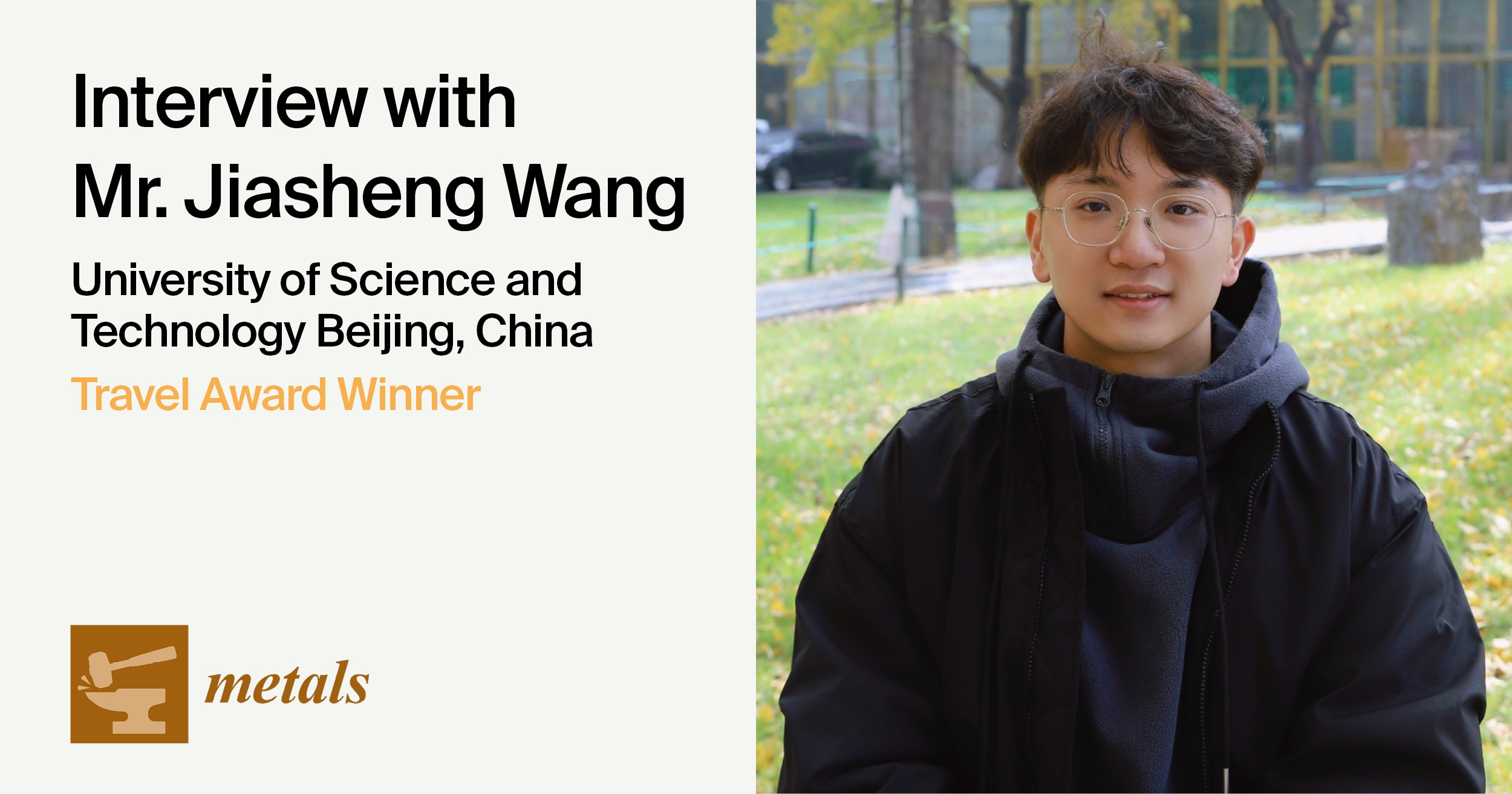
Interview with Mr. Jiasheng Wang—Winner of the Metals Travel Award
The journal Metals (ISSN: 2075-4701) is proud to present the winner of the 2025 Metals Travel Award—Mr. Jiasheng Wang!
Mr. Jiasheng Wang is a PhD researcher studying metallic material science and technology at the University of Science and Technology Beijing. China. He has been committed to research related to the microstructure and mechanical properties of high-entropy alloys for more than 4 years.
The following is a short interview with Mr. Jiasheng Wang:
1. Congratulations on winning the Metals Travel Award! What does this recognition mean to you, and how has it impacted your research and professional development? Can you share with us your feelings after winning the award?
Winning the Metals Travel Award is an immense honor and provides profound encouragement for my early-career research journey. To me, this recognition represents far more than financial or logistical support—it provides validation of the potential and value of my work in the field of advanced metallic materials. It also reinforces my confidence in pursuing challenging research directions, such as optimizing coating deposition processes via magnetron sputtering or exploring the structure–property relationships of alloys under extreme service conditions.
On a professional level, this award has already opened new doors: it has provided me with the opportunity to present my findings at high-impact international conferences, connect with leading scholars in the field, and potentially establish collaborative research partnerships. In terms of emotions, when I first received the notification, I felt a surge of excitement mixed with gratitude—gratitude to my supervisor for their mentorship, to my lab colleagues for their support, and to the Metals editorial team for recognizing young researchers. This award has not only motivated me to strive for higher standards in my research but also inspired me to contribute more actively to the academic community in the future.
2. Can you tell us about your current research interests? What motivated you to pursue this area of study?
My current research interests primarily focus on two interconnected directions: the design and fabrication of high-performance metallic coatings for extreme environments and the development of low-activation, high-strength alloys for nuclear energy applications.
My motivation to pursue this area stems from two core factors. Firstly, the growing demand for advanced materials that can withstand harsh service conditions—such as high temperature, high pressure, and intense radiation—has created urgent technological gaps. I am passionate about developing materials solutions that address real-world engineering challenges and support the sustainable development of high-tech industries. Secondly, my undergraduate and graduate research experiences ignited my fascination with the structure–property relationships of metals.
3. Where did you learn about how to apply for this journal award? Can you briefly introduce which conference or conferences you plan to attend with this award?
I first learned about the Metals Travel Award through the journal’s official website and its regular email newsletters, which I subscribed to due to my frequent references to Metals papers in my research. Additionally, my supervisor, who has published several high-quality articles in Metals and follows the journal’s initiatives closely, also recommended the award to me, highlighting its reputation for supporting young researchers’ conference participation.
With this generous support, I plan to attend the 11th International Conference on Technological Advances of Thin Films and Surface Coatings (THINFILMS2026), scheduled for July 13-17, 2026, at the Holiday Inn Atrium in Singapore. This biennial conference is the premier global platform for thin film technology, bringing together academia, industry experts, and innovators to share breakthroughs in areas ranging from nanostructures and functional coatings to industrial applications of thin film technologies. Notably, it features dedicated symposia on “High Entropy & Amorphous Coatings”—topics directly aligned with my research focus. At THINFILMS2026, I will deliver an oral presentation on my latest work. This conference not only offers the chance to showcase my research to a targeted, global audience through a formal oral presentation but also to engage with leading scholars (such as plenary speakers specializing in thin film deposition and functional materials) and explore potential collaborations.
4. Attending international conferences is an essential part of scientific collaboration and growth. How did the Metals Travel Award support your participation, and how do you plan to promote the journal at the conference? Do you have any thoughts on how the promotion of the journal at conferences could be more effective?
The Metals Travel Award has been instrumental in facilitating my conference participation, primarily by covering critical expenses such as registration fees, travel costs, and accommodation expenses. For early-career researchers like me, these costs often pose a significant barrier to attending international conferences, which are vital for academic growth. Without this support, I would not have been able to present my work to a global audience or engage with leading experts in my field.
To promote Metals at the conferences, I have planned several concrete actions:
- Highlight the journal in my presentation: I will explicitly mention that my research is supported by the Metals Travel Award in the acknowledgments section of my poster and oral presentation (if selected), and reference key papers published in Metals that have informed my work;
- Share journal resources with peers: I will bring printed materials about Metals and distribute them to fellow researchers during networking sessions. I will also recommend Metals as a high-quality publication venue for their work, especially emphasizing its rigorous peer review process and broad readership in the metallurgy community;
- Engage in journal-related discussions: I will participate in any Metals-sponsored events or booths at the conferences (if available) and share my positive experience with the journal, encouraging other young researchers to submit their work and apply for future awards.
Regarding more effective conference promotion, I have two suggestions:
- First, organize small-scale thematic workshops or roundtables at conferences. These events can focus on emerging topics in metallurgy and invite journal editors and leading authors to participate. This would not only enhance the journal’s visibility but also foster targeted academic discussions.
- Second, create a “Metals Young Researchers Network” at conferences, where awardees and young authors can connect, share research experiences, and discuss publication strategies. This network can serve as a platform for long-term engagement, encouraging more young researchers to contribute to and support the journal.
5. Do you have any other suggestions on how our journal could further support young researchers and the academic community?
I believe Metals can enhance its support for young researchers and the broader academic community through several initiatives:
- Publish more educational content: Create a “Young Researcher Corner” section in the journal, featuring tutorial articles, case studies on successful research projects, and insights from early-career scientists about their research journeys. This content would be invaluable for students and new researchers entering the field.
- Offer reduced publication fees for young researchers from low- and middle-income countries: Open access has democratized academic publishing, but publication fees can still be a burden for researchers in resource-limited regions. Waiving or reducing these fees for eligible young authors would increase the journal’s global inclusivity and diversify its authorship.
- Host annual “Metals Research Awards” beyond travel grants: Recognize outstanding research papers by young authors published in Metals, with prizes including cash rewards, invitations to keynote at a conference, or editorial board membership opportunities. This would incentivize high-quality submissions from young researchers and highlight their contributions to the field.
6. As a winner, how do you view the role of open access journals (such as Metals) in academic communication? Will you consider reviewing or contributing to them in the future?
I firmly believe that open access (OA) journals like Metals play a transformative role in modern academic communication. Unlike traditional subscription-based journals, OA journals eliminate barriers to knowledge access, allowing researchers, engineers, and students worldwide—regardless of their institutional affiliation or financial resources—to read, cite, and build upon the latest research findings. This is particularly critical for interdisciplinary fields like metallurgy, where collaboration across academia, industry, and government is essential for innovation.
Moreover, OA journals often adopt efficient peer review processes and flexible publication formats (e.g., rapid communications, data papers), which accelerate the dissemination of research results and promote the sharing of research data—a key driver of reproducible science. Metals, in particular, has distinguished itself by maintaining high editorial standards while embracing open access, making it a trusted venue for both fundamental and applied metallurgy research.
Looking to the future, I am eager to both contribute to and review for Metals.
7. How would you describe your experience with our services and the journal so far?
My experience with Metals has been overwhelmingly positive, characterized by professionalism, efficiency, and a strong commitment to supporting researchers. From the moment I first interacted with the journal—through reading its open access articles for my research—to applying for the Travel Award, every step has been seamless and user-friendly.
The journal’s website is well organized, making it easy to search for relevant papers, navigate submission guidelines, and find information about awards and special issues. The application process for the Travel Award was straightforward, with clear instructions and prompt communication from the editorial team.
Furthermore, the quality of research published in Metals is consistently high. The journal covers a broad range of topics in metallurgy and materials science, and its papers are well cited and widely recognized in the community. As a regular reader, I have found many Metals articles to be essential references for my own research, providing valuable insights and methodologies.
Overall, my experience has reinforced my admiration for Metals as a leading open access journal in the field. I am grateful for the support the journal has provided to me as a young researcher and look forward to continuing my engagement with Metals in the years to come.