

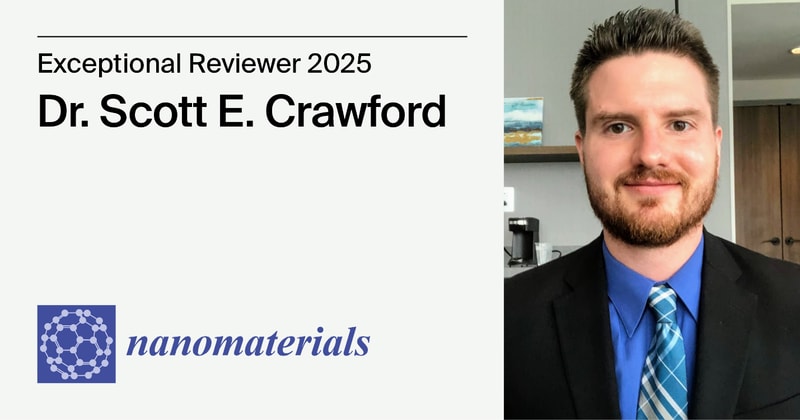
Interview with Dr. Scott E. Crawford—Nanomaterials Exceptional Reviewer 2025
- Could you briefly introduce yourself to the readers? What are you currently researching, and why did you choose this research field?
I am a research physical scientist at the National Energy Technology Laboratory in Pittsburgh, PA, USA. My background is primarily in materials science and analytical chemistry, and I leverage this background to contribute to multiple research projects of relevance to the energy sector. For instance, a major thrust of my research has focused on developing low-cost optical sensors for economically critical metals such as rare earth elements and battery materials, which can significantly reduce the financial and time costs associated with metal prospecting and process monitoring. This has been a wonderful learning experience as the project involves both the development and discovery of new sensing materials as well as the design of compact instrumentation to analyze the optical readout from these materials. In addition, I am currently researching novel extraction materials for critical minerals that are informed by computational modelling, with the ultimate goal of using computational methods to screen, and even discover, chelators targeting specific metals in a given feedstock. I also broadly investigate application areas for quantum information science, a rapidly maturing field, within the energy sector, and also contribute to the development of optical sensors for hydrogen gas.
Interestingly, if you would have asked me 15 years ago, I would not have anticipated being a researcher in the chemical sciences. I was a double major in chemistry and economics, with a strong interest in working in international affairs. It wasn’t until I got my first hands-on experience working in a research lab that I began to seriously consider a career in chemistry.
- Can you please share with us your sentiments about being recognized as Nanomaterials Exceptional Reviewer?
I am very appreciative of the recognition. Peer review is a crucial professional service that helps maintain the integrity and quality of published research. Nonetheless, it can be a thankless task at times. Recognitions such as the Nanomaterials Exceptional Reviewer provide a nice incentive to continue serving as a peer reviewer and are also helpful for building the CV of younger researchers in particular.
- Could you share some insights into your approach to reviewing manuscripts? How do you balance thoroughness with efficiency?
Generally after reading through the abstract I try to do a quick skim of the paper and supporting information to identify any major or obvious flaws; for example, is all of the required characterization data shown? Have all appropriate experiments and controls been conducted? Are there any obvious errors in any of the figures? I then typically will do a brief literature search to help assess the novelty of the manuscript, provide context on what other similar works have been reported, and whether these works have been appropriately cited. I then do a detailed readthrough of the main text and supporting information, writing down any concerns or comments as I go and supplementing the comments as needed through literature searches. Finally, I will put together a summary of the article and provide a detailed list of any concerns for the authors to address. I have found this to be an effective approach for providing helpful feedback to the author and editor efficiently.
- What are the key factors and aspects that you consider most when reviewing a manuscript?
The most important factor for me when reviewing a manuscript is whether or not the authors have provided sufficient evidence to support the claims made within the manuscript. For example, in a materials science-focused journal such as Nanomaterials, it is critical that the authors have conducted thorough and appropriate characterization of their material. If the authors report a novel sensor, it is important that they report figures of merit such as selectivity and sensitivity in relevant environments to confirm that the sensor works as advertised. In addition, novelty and impact in the context of previously published literature is also a key consideration, and I will often ask the authors to explicitly differentiate the novelty of their work relative to previous reports if it isn’t clear in the initial submission. Of course, other factors such as alignment with the journal scope, quality of presentation, and appropriate use of citations must also be carefully evaluated.