

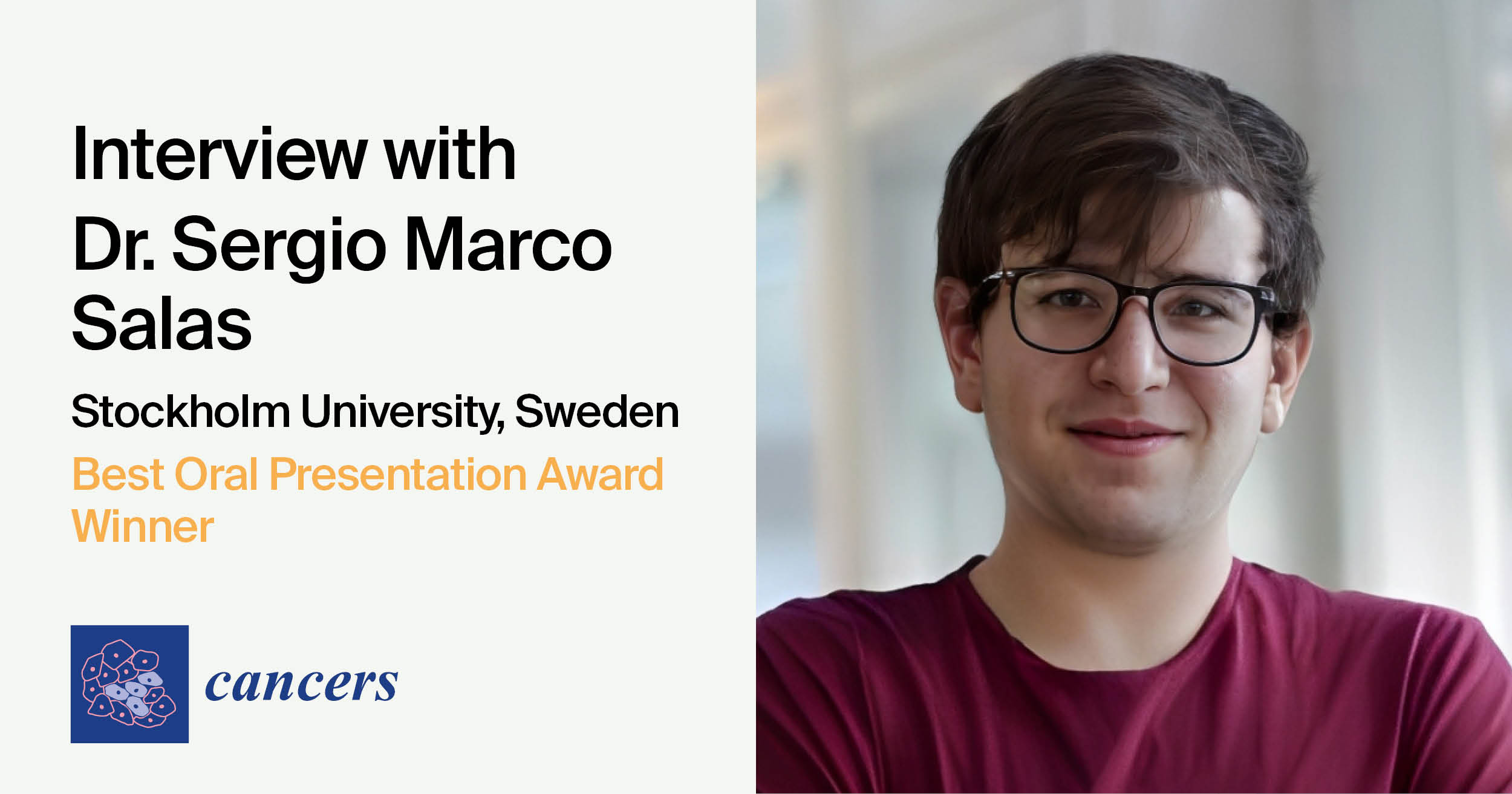
Interview with Dr. Sergio Marco Salas—Winner of the Best Oral Presentation Award
In November 2025, the journal Cancers (ISSN: 2072-6694) successfully hosted its first in-person conference, “CancersScape: Spatial Biology of the Tumor Ecosystem”, in Barcelona, Spain (5–7 November 2025). The event brought together leading global experts to discuss cutting-edge advances in multi-omics and spatial biology aimed at decoding the tumor microenvironment.
We are honored to congratulate Dr. Sergio Marco Salas on receiving one of the conference’s Best Oral Presentation Awards, in recognition of his outstanding contribution.
Brief introduction:
Dr. Sergio Marco Salas is a postdoctoral researcher at Helmholtz Munich, where he conducts his work under the supervision of Prof. Fabian Theis. He holds a multidisciplinary background spanning computational biology, spatial transcriptomics, and image-based omics technologies. His current research is dedicated to advancing the analytical framework of spatial omics by developing novel computational tools and methodologies for the scientific community. Through this work, he aims to improve the interpretation of complex spatially resolved molecular data and to uncover previously inaccessible layers of biological organization.
In the following interview, Dr. Salas shares the story behind his award-winning research—from its initial inspiration and key findings to his vision for the future of spatial biology—and offers valuable advice for the next generation of oncology scientists.
1. Could you please briefly introduce the main content of the award-winning paper?
In our recent study, we investigated a largely overlooked component of spatial transcriptomics data: RNA signals that cannot be assigned to segmented cells, which we refer to as unassigned RNA (uRNA). We systematically characterize the nature of these signals and quantify the contribution of technical factors, such as segmentation inaccuracies and molecular diffusion. Importantly, we demonstrate that not all unassigned RNA has a purely technical origin. By comparing multiple spatial transcriptomics technologies applied to the same tissue types, we observe a high degree of consistency in uRNA profiles. Our results suggest that biological phenomena, including intracellular RNA organization and cellular protrusions, play a significant role in shaping these signals. In addition, we have developed an analytical package, called troutpy, to enable the community to systematically explore these signals.
2. What initially inspired your research interest in this field?
Spatial omics technologies, and spatial transcriptomics in particular, generate exceptionally complex datasets. While the field has expanded rapidly in recent years, with hundreds of studies now published annually, our understanding of the full analytical and biological potential of measuring individual molecules at subcellular resolution remains incomplete. This gap between technological capability and biological interpretation has been a strong motivating factor for me. I am driven by the challenge of helping to decipher the underlying principles of spatial biology and to translate these measurements into meaningful biological insight.
3. What are the future research frontiers in this field?
Despite the remarkable progress achieved so far, spatial transcriptomics remains a rapidly evolving field with substantial room for development. Beyond its growing diagnostic and prognostic impact in oncology, analytical limitations still constrain the scope of biological questions that can be addressed. Future directions include the integration of true multimodal spatial assays, ideally extending into three dimensions and incorporating temporal information. In parallel, there is a clear need to address the high cost of current technologies. Developing more accessible and cost-effective platforms will be essential for the widespread adoption of spatial omics in both research and clinical settings.
4. What advice would you give to early-career researchers aiming to make an impact in oncology?
My advice to early-career researchers is to remain attentive to emerging technologies and methodological innovations. While the repertoire of established experimental and analytical approaches is extensive, many critical questions in oncology remain difficult to answer due to technical limitations. The development and thoughtful application of new technologies, combined with rigorous experimental design, will be key to overcoming these barriers. Such an approach will not only accelerate discovery but also create meaningful opportunities for impactful contributions to the field.