

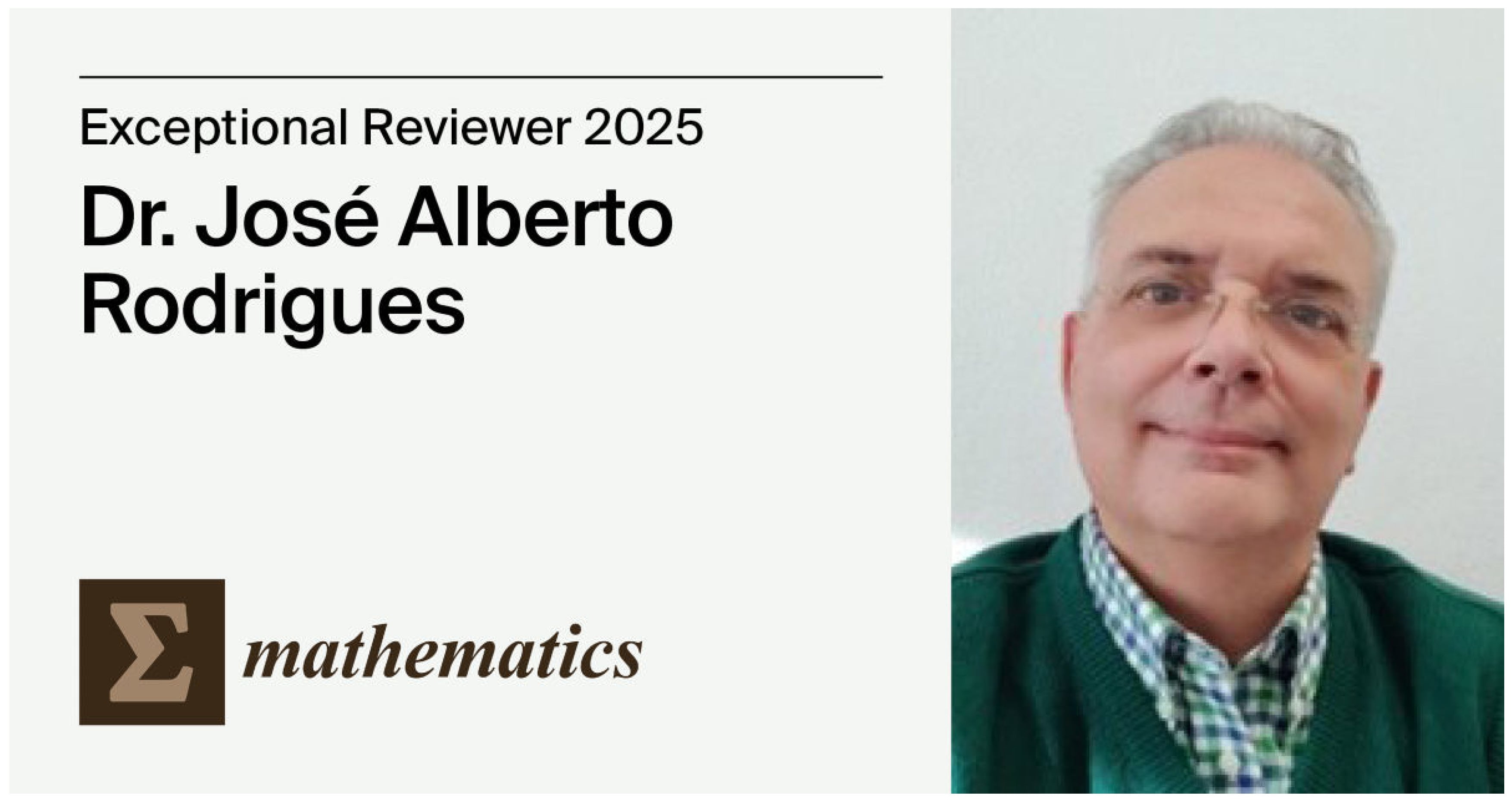
Interview with Dr. José Alberto Rodrigues—Mathematics Exceptional Reviewer 2025
Name: Dr. José Alberto Rodrigues
Affiliation: Polytechnic Institute of Lisbon, Portugal
Research interests: Finite element methods, isogeometric analysis, numerical analysis, numerical methods, topological data analysis, graph theory, network dynamics, machine learning, mathematical biology
The following is an interview with Dr. José Alberto Rodrigues:
1. Could you give a brief introduction of yourself to the readers? Could you introduce your current research direction and provide an update on your progress?
I am currently affiliated with the Department of Mathematics at the Instituto Superior de Engenharia de Lisboa, part of the Polytechnic Institute of Lisbon. My work lies at the intersection of mathematical analysis, applied mathematics, scientific computing, and data-driven modeling. Throughout my academic career, I have been motivated by a desire to understand complex systems through rigorous mathematical frameworks, while at the same time developing computational tools that can be used to address real scientific and engineering challenges. This dual focus has allowed me to work across both theoretical and applied domains, contributing to mathematical foundations as well as interdisciplinary collaborations.
My research spans a broad range of topics, including finite element methods, isogeometric analysis, numerical analysis, numerical methods, topological data analysis, graph theory, network dynamics, machine learning, and mathematical biology. These areas provide complementary perspectives on how to model, approximate, and analyze complex phenomena. For example, finite element and isogeometric methods offer powerful tools for solving partial differential equations arising in engineering and physics, while numerical analysis ensures the reliability and stability of these computations. At the same time, topological data analysis, graph theory, and network dynamics allow me to study the structure of high-dimensional data and interconnected systems, and machine learning provides modern techniques for extracting patterns and building predictive models. Mathematical biology further enriches this work by grounding these methods in real-world biological processes.
In my recent research, I have been working on integrating these mathematical and computational approaches to create more robust and versatile analytical frameworks. My current efforts include developing improved numerical schemes, exploring the use of topological and graph-based methods for understanding complex data, and studying dynamical behaviors in networked systems. I am also interested in how machine learning can be combined with classical numerical techniques to enhance accuracy and efficiency. These ongoing projects reflect my broader aim: to contribute to the advancement of mathematical tools that not only deepen theoretical understanding but also support practical applications in science, engineering, and biology.
2. Can you please share with us your sentiments about winning the award?
This recognition is not just a personal milestone, but also a reflection of my commitment to advancing the field through careful, constructive, and rigorous peer review. Reviewing allows me to engage deeply with the latest research, support authors in refining their work, and contribute to maintaining the high standards of our community. Winning this award inspires me to continue dedicating myself to this important aspect of scholarly collaboration, and I hope it encourages others to recognize the value of thoughtful, thorough peer review.
3. Could you share some insights into your approach to reviewing manuscripts? How do you balance thoroughness with efficiency?
My approach to reviewing manuscripts is grounded in a balance of rigor, fairness, and clarity. I start by carefully reading the paper to understand its core contributions, methodology, and context within the field. I aim to identify both the strengths and areas that need improvement, providing constructive feedback that can genuinely help the authors enhance their work.
To balance thoroughness with efficiency, I focus on prioritizing the most critical aspects first: the validity of the results, the clarity of the arguments, and the originality of the contribution. I also use a structured approach, breaking the review into sections such as novelty, methodology, presentation, and references, so I can systematically cover all important points without getting lost in minor details. My goal is to provide detailed, actionable feedback in a timely manner, ensuring that the review is both valuable and respectful of everyone’s time.
4. What are the key factors and aspects that you consider most when reviewing a manuscript?
When reviewing a manuscript, I focus on several key factors to ensure a thorough and fair evaluation. First, originality and significance: I assess whether the work makes a meaningful contribution to the field. Second, rigor and validity: I examine the soundness of the methodology, the accuracy of the results, and the logic of the conclusions. Third, clarity and presentation: I consider whether the ideas are communicated clearly, the structure is coherent, and the figures and tables effectively support the content. Fourth, relevance and context: I check if the work properly situates itself within existing literature and acknowledges prior research. Finally, I pay attention to ethical and reproducibility standards, ensuring that the research meets professional and scholarly expectations.
By keeping these aspects in mind, I strive to provide constructive, fair, and actionable feedback that helps both the authors and the broader research community.
5. Based on your experience, which research topics do you think are of particular interest to the research community in the coming years?
Based on my experience, several research areas are likely to attract significant attention in the coming years. In mathematics, data-driven and computational approaches, including machine learning, numerical analysis, and optimization, are rapidly evolving and increasingly intersecting with other fields. Applied mathematics in modeling complex systems, such as climate dynamics, epidemiology, medical imaging, and personalized medicine, is gaining prominence due to its real-world impact. Pure mathematical research in areas like algebra, number theory, topology, and combinatorics continues to inspire breakthroughs that underpin other disciplines.
I also see growing interest in interdisciplinary work, where mathematics collaborates with artificial intelligence, quantum computing, biomedical research, and engineering, creating new challenges and opportunities. Overall, the community is keen on research that combines rigor with practical relevance, particularly in applications that improve human health and advance medical science.