

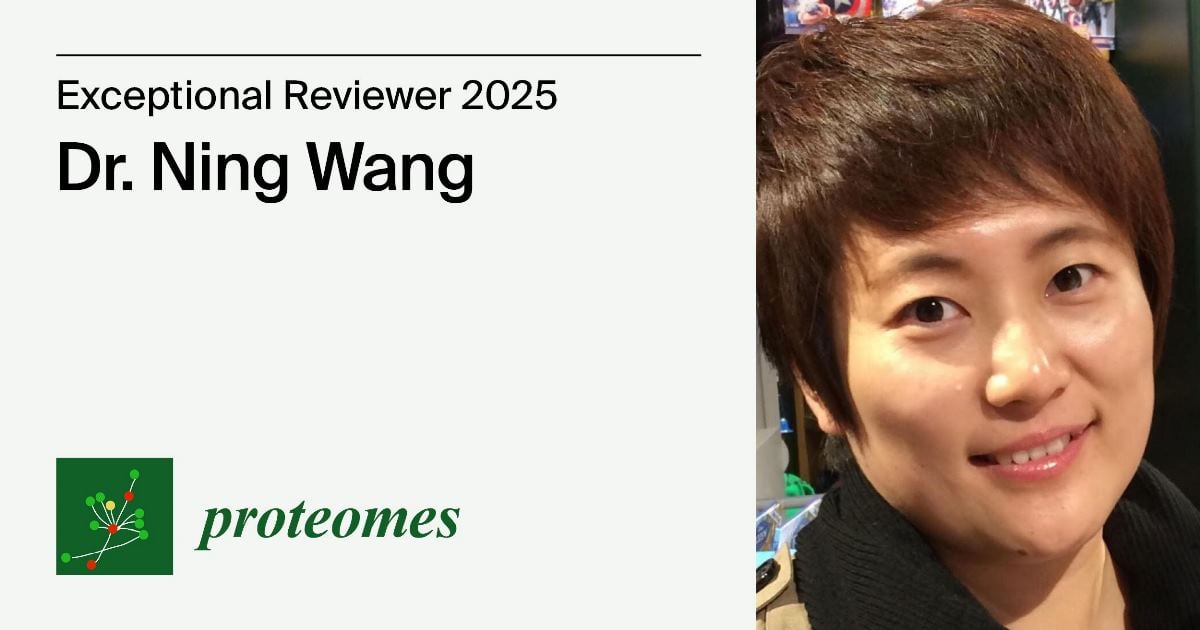
Proteomes | Interview with One of Reviewers—Dr. Ning Wang
Name: Dr. Ning Wang
Affiliation: Memorial Sloan Kettering Cancer Center. 417 E 68th St, 10065, New York, NY, USA
Interests: protein engineering; drug delivery; cancer biology; microbiology; mass spectrometry; proteomics
We recently had the opportunity to interview Dr. Ning Wang, who reviewed manuscripts for Proteomes (ISSN: 2227-7382). Through the interview, she generously provided the following insights into her research, challenges, and personal journey.
The following is a short interview with Dr. Wang:
1. Could you tell us a little bit about yourself to our readers?
Sure. My name is Ning Wang, a current senior research scientist at Memorial Sloan Kettering Cancer Center. I graduated with a PhD degree in chemistry and chemical biology from Rutgers, the State University of New Jersey. Over the years, I have served as a frequent reviewer for MDPI journals, including Proteomes, which has been a valuable experience for me as a scientist.
2. Could you introduce your current research direction and provide an update on your progress?
My current research focuses on the intersection of proteomics, protein/peptide engineering, and therapeutic development. At Memorial Sloan Kettering Cancer Center, I apply quantitative proteomics, phosphoproteomics, and immunoassays to investigate signaling mechanisms and therapeutic responses in hematopoietic malignancies. In parallel, I am developing bio-orthogonal protein and peptide conjugates (BMCs) to achieve tissue-specific delivery of macromolecular therapeutics, including peptidomimetic inhibitors and gene-editing tools. This work recently advanced to the final round of MSK Entrepreneurship Initiative program due to its translational potential. Together, these efforts aim to bridge molecular design with functional proteomic readouts, accelerating the translation of novel macromolecular modalities into oncology.
3. What do you think is the biggest challenge currently and the future directions in your area of research?
As a team, we’re studying the in vivo PK/PD profiles of bio-orthogonal macromolecular conjugates (BMCs) and expanding the platform to include new classes of macromolecular therapeutics. I see both challenges and opportunities ahead. One is integrating multi-omics (proteomics, transcriptomics, metabolomics, and genomics) to build patient-specific profiles that truly guide therapy. Another is advancing chemical and biochemical strategies for site-specific, non-invasive, and efficient macromolecular engineering. Together, these directions could really shape the future of precision therapeutics.
4. What tools or software were especially helpful during the research and writing stages?
General open-access literature resources such as PubMed and MDPI have been essential for me to stay up-to-date with scientific advances in my field.
5. What advice would you give to young scholars seeking to get into academia or publish their work?
I think getting into academia and publishing are closely related. Let your genuine interests and enthusiasm guide you, and devote yourself to some structured thinking: what scientific question you want to answer, where the field currently stands, what the logical approach is, and is there any Plan B? How you frame these questions will naturally shape your publication. Take advantage of the peer review process, as every round of revision improves your work.
6. What is your impression of the reviewing experience with the Proteomes journal?
I’ve had very good experiences reviewing for Proteomes. The editorial team of Proteomes does a good job in matching reviewers with relevant manuscripts, and the online reviewing platform makes the process efficient.
7. How do you manage your time between research and daily life? Do you have any tips to share?
Balancing research and daily life can be challenging, but I am lucky to have strong support from my husband in my personal life and career.
As a chemical biologist, I believe we should not only study nature but also draw inspiration from it. I have many hobbies that keep me energetic and maintain my love for nature: cooking, hiking, mineral collecting.
My tip is to treat rest as part of productivity: stepping away often brings inspiration and better focus when you return to work.