

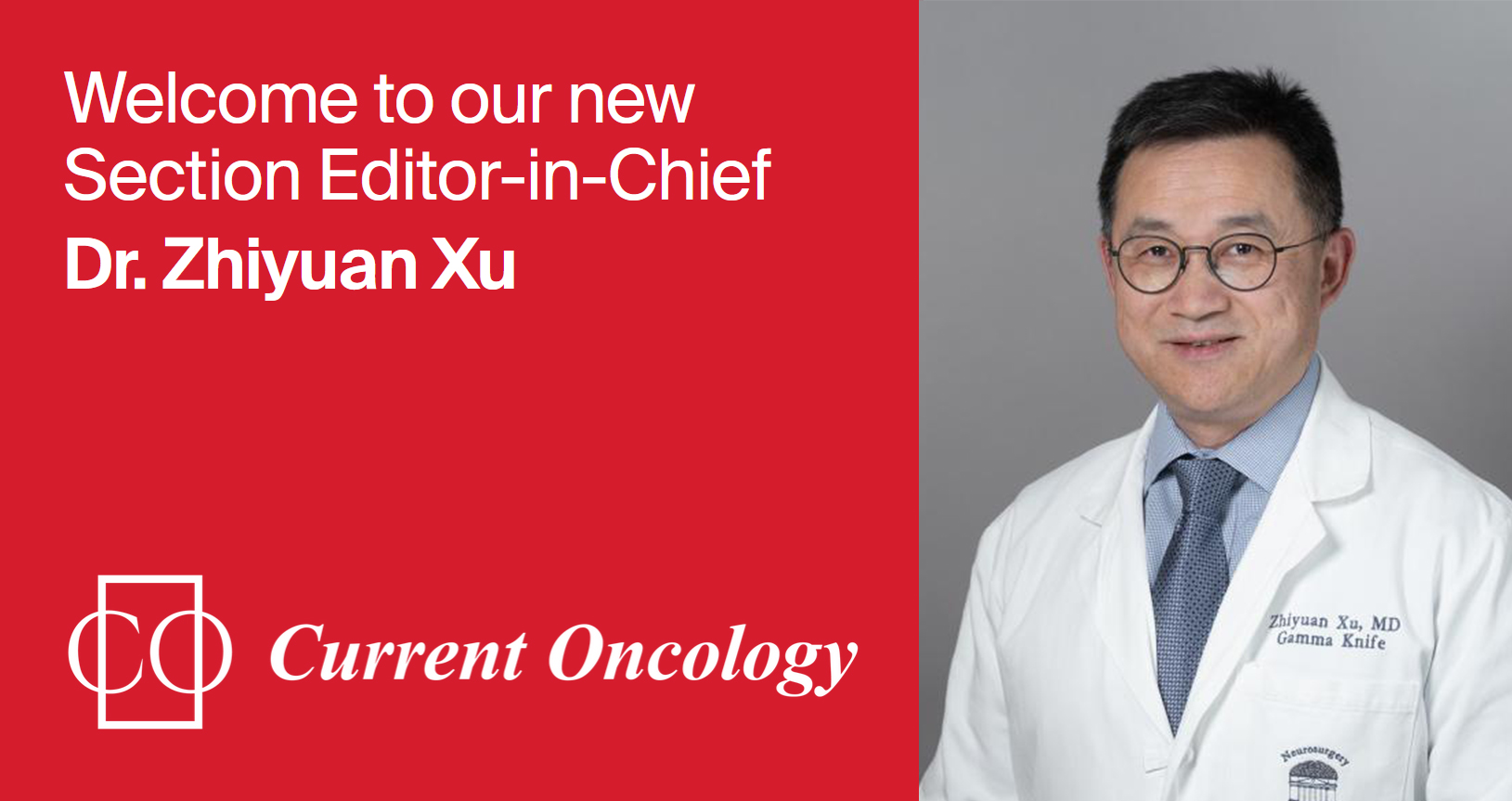
Dr. Zhiyuan Xu Appointed Section Editor-in-Chief of Section “Neuro-Oncology” in Current Oncology
We are pleased to announce that Dr. Zhiyuan Xu has been appointed Section Editor-in-Chief of the Section “Neuro-Oncology” in Current Oncology (ISSN: 1718-7729).
Dr. Zhiyuan Xu, MD, was born in China and completed his residency training in neurosurgery there before pursuing research at the Lady Davis Institute at McGill University in Montreal, Canada, where he focused on DNA repair mechanisms and anticancer drug resistance in glioblastoma. He subsequently completed a neurosurgical oncology fellowship at the Cleveland Clinic’s Neurological Institute from 2007 to 2010. In 2010, he joined the Department of Neurosurgery at the University of Virginia Health System. His clinical subspecialty is stereotactic radiosurgery, and he completed dedicated fellowship training in this area under Jason Sheehan, MD, PhD.
Dr. Xu is a principal investigator and collaborator on multiple research projects involving focused ultrasound. He has authored more than 140 peer-reviewed publications in stereotactic radiosurgery and 26 papers in basic science disciplines, including DNA repair and focused ultrasound–related research. He has also contributed numerous book chapters on DNA repair and stereotactic radiosurgery. In addition, he serves as an ad hoc reviewer for several leading journals, including Lancet Oncology, the International Journal of Radiation Oncology, Biology, and Physics, Neurosurgical Focus, Neurosurgical Review, the Journal of Neurosurgery, Cancers, Current Oncology, the Journal of Neurorestoratology, and World Neurosurgery, among others. He has also served as an abstract reviewer for the Society for Neuro-Oncology (SNO) annual conference since 2019.
The following is a short Q&A with Dr. Zhiyuan Xu, who shared his vision for the journal with us, as well as his views of the research area and open access publishing:
1. What appealed to you about the journal that made you want to take the role of Section Editor-in-Chief?
What initially attracted me to Current Oncology was the journal’s focus on clinically meaningful, evidence-based research that directly impacts patient care. When I began as an ad hoc reviewer in 2022, I appreciated the journal’s commitment to rigor, transparency, and constructive peer review. That experience made it clear that Current Oncology valued both scientific depth and practical relevance—something that resonates strongly with my own work as a physician–scientist in neurosurgery.
As my role grew into Academic Editor, I became even more engaged with the journal’s mission. I particularly valued the opportunity to help authors strengthen manuscripts spanning clinical practice, radiosurgical innovation, and translational neuro-oncology research. Given my background in Gamma Knife radiosurgery, focused ultrasound, and DNA damage and repair, I was excited by how the journal bridges fundamental mechanisms with real-world therapeutic applications.
Stepping into the role of Section Editor-in-Chief appealed to me because it offers the chance to shape the scientific direction of a field undergoing rapid evolution. I hope to continue fostering a Section that highlights rigorous methodology, emerging therapeutic technologies, and high-impact translational advances. It is a privilege to help guide work that aligns with my clinical and research passions and contributes meaningfully to the neuro-oncology community.
2. What is your vision for the journal and Section?
My vision for the Section is to establish it as a trusted, forward-looking platform where clinically meaningful research and emerging technological advancements converge. Current Oncology is uniquely positioned to bridge rigorous scientific discovery with real-world patient care, and I hope for our Section to help lead that integration.
By promoting robust methodology, clear reporting, and thoughtful peer review, we can ensure that the work we publish not only advances science but also informs clinical decision-making. This includes encouraging studies that integrate molecular profiling, radiogenomics, and advanced imaging.
With rapid developments in liquid biopsy, stereotactic radiosurgery, focused ultrasound, and DNA damage and repair, our Section should highlight research that pushes boundaries—whether through precision therapies, novel delivery systems, or translational insights that connect bench to bedside.
Open access allows us to reach clinicians, scientists, and trainees worldwide. I aim to cultivate submissions that reflect diverse perspectives, multidisciplinary approaches, and even statistically nonsignificant but clinically meaningful findings—ensuring that all insights that matter to patient care have a place in the literature.
The 2025 WFNOS/SNO Annual Meeting—celebrating SNO’s 30th anniversary and drawing participants from more than 40 countries—underscores the strength of our international neuro-oncology community. Collaboration among global societies such as WFNOS, EANO, and ASNO exemplifies the cross-disciplinary exchange that drives innovation in areas including AI-enabled research, liquid biopsy, and clinical trials.
Ultimately, my goal is to build a Section that is authoritative, innovative, and inclusive—one that elevates impactful science and advances the field while remaining firmly grounded in clinical relevance.
3. What does the future of this field of research look like?
The future of neuro-oncology is defined by increasing precision—biologically, radiographically, and therapeutically. We are moving away from broad treatment paradigms toward approaches that integrate molecular signatures, radiogenomics, and real-time image guidance to personalize therapy at an unprecedented level.
In neurosurgical oncology, the next decade will bring major advances in minimally invasive and noninvasive technologies. Focused ultrasound and stereotactic radiosurgery will expand beyond local tumor control into applications such as blood–brain barrier opening, targeted drug delivery, and immunomodulation. These technologies will increasingly converge with our growing understanding of DNA damage and repair pathways, enabling us to exploit tumor-specific vulnerabilities with exceptional precision.
We will also see a shift toward multimodal treatment strategies—integrating radiation, systemic agents, immunotherapies, and device-based technologies into unified, biologically informed care plans. Artificial intelligence will further accelerate this evolution through enhanced imaging interpretation, prediction of treatment response, and optimization of radiosurgical planning.
Overall, the field is moving toward therapies that are more targeted, less invasive, and deeply informed by molecular biology. This convergence of technology and biological insight will redefine how we manage complex tumors and improve both survival and quality of life for patients.
4. What do you think of the development of open access in the publishing field?
The growth of open access has been one of the most transformative developments in scientific publishing. At its core, open access democratizes knowledge—making high-quality research available to clinicians, scientists, and patients regardless of institutional or geographic barriers. In neuro-oncology, where timely access to emerging findings can influence patient care, this accessibility has real impact.
Open access also promotes transparency and accelerates scientific progress. When data and methods are freely available, findings can be validated, improved upon, and translated more rapidly. This is particularly important in fast-moving areas such as stereotactic radiosurgery, focused ultrasound, liquid biopsy, and molecular oncology, where cross-disciplinary collaboration drives innovation.
At the same time, the field is still evolving. Sustainable publication models and consistent editorial standards remain important to ensure that open access maintains both rigor and integrity. Journals that combine accessibility with strong peer review—such as Current Oncology—are helping set that standard.
Overall, open access strengthens the global research community. It broadens participation, increases visibility for authors, and ensures that new discoveries reach those who can apply them to advance science and improve patient outcomes.
We wish Dr. Zhiyuan Xu every success in his new position, and we look forward to his contributions to the journal.