

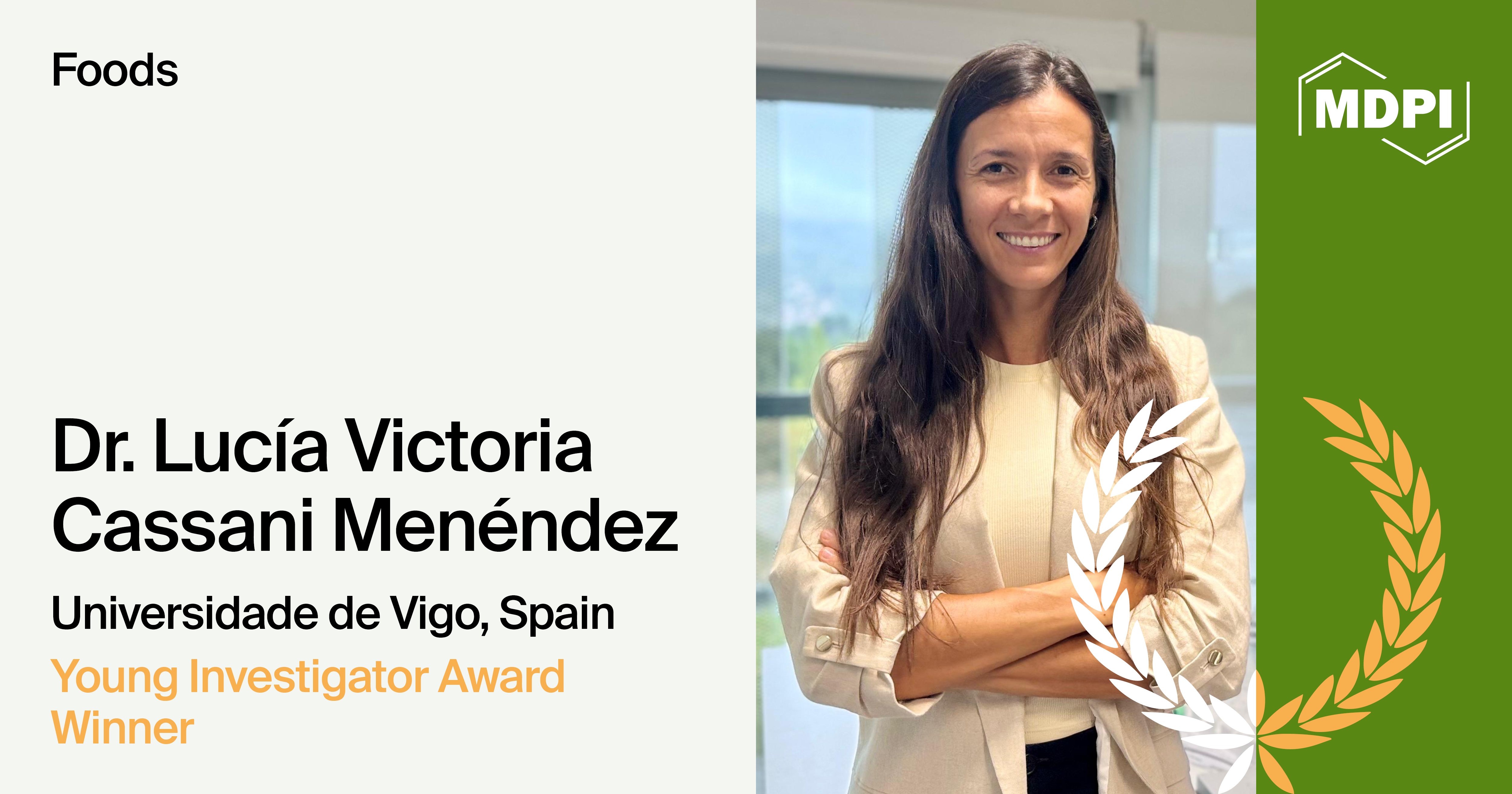
Interview with Dr. Lucía Victoria Cassani Menéndez—Winner of the Foods Young Investigator Award
The journal Foods (ISSN: 2304-8158) is delighted to present the winner of the 2025 Young Investigator Award—Dr. Lucía Victoria Cassani Menéndez.
Dr. Lucía Victoria Cassani Menéndez is a postdoctoral researcher in the Department of Analytical and Food Chemistry at Universidade de Vigo, working within the Agricultural and Food Research Group (AA1). She specializes in the “green extraction” of bioactive compounds from agro-food byproducts, aiming to revalorize waste streams and develop functional foods with improved nutritional and health properties. In 2025, she received the Young Investigator Award from the journal Foods in recognition of her innovative contributions to food science. She holds a PhD in engineering from the Universidad de Buenos Aires and combines research with teaching and scientific dissemination.
The following is an interview with Dr. Lucía Victoria Cassani Menéndez:
1. Could you briefly introduce yourself and share your current research focus?
My name is Lucia Cassani, and I am a postdoctoral researcher at the University of Vigo. I work in the Agricultural and Food Research group (AA1), where my research focuses on the valorization of food by-products and plant materials. I aim to recover bioactive compounds with strong potential to be reintroduced into functional foods or other applications. I am particularly interested in exploring how these bioactive compounds can modulate gut microbiota, in order to gain deeper insight into their real impact on human health.
2. What inspired you to pursue research in the field of food science?
I have always been fascinated by the connection between food, health, and sustainability. During my BSc in food engineering, about 15 years ago, I became intrigued by how science can transform natural ingredients into functional foods. This curiosity naturally led me toward research. Today, I remain passionate about food sustainability and food innovation, which continue to inspire my work.
3. How does it feel to be recognized with the Foods Young Investigator Award?
It is truly an honor. This recognition from Foods means a great deal to me because it reflects not only my scientific achievements but also my commitment to advancing sustainable food research. It motivates me to continue contributing to the field and to collaborate with other researchers in the Foods community. For me, it is a validation that I am on the right path, especially considering that the selection committee was composed of diverse international experts. I feel very grateful for this acknowledgment.
4. Can you tell us about the research that led to this recognition and its potential impact?
Over the last years, I have built a strong foundation in the sustainable valorization of food by-products and plants to recover high-value bioactive compounds. I have characterized these compounds and studied their biological properties. This work has led to the development of functional ingredients with antioxidants, anti-inflammatory, and antitumoral activities against different cancer cell lines.
In addition, my career has been shaped by strong international collaborations across Latin America and Europe. These collaborations have exposed me to diverse research environments and enriched my experience. I believe this international profile and my focus on circularity, sustainability, and innovation played an important role in this recognition.
5. What challenges have you encountered in your work, and how did you overcome them?
One major challenge was adapting to different research environments. I began my research career in Argentina and later moved to Spain, which required flexibility while remaining focused on my scientific goals. Through this experience, I learned to be adaptable, to collaborate effectively, and to strengthen my problem-solving skills.
Another challenge has been managing multiple responsibilities—research, teaching, and mentoring. Although it can be demanding, I find it very rewarding, as it has helped me develop leadership skills that are essential at this stage of my career.
6. What trends or developments in food science do you find most exciting right now?
I am particularly excited about research exploring how natural ingredients and bioactive compounds can shape the gut microbiota. Identifying biomarkers and understanding their associations with health is crucial for revealing the real effects of the compounds I have been studying, and for developing personalized nutritional strategies.
I also see great potential in sustainable food systems, food singularity, and the integration of machine learning and artificial intelligence into food research. These topics are very relevant, and I aim to stay up to date with them.
7. What advice would you give to young researchers starting their careers in this field?
Be curious, persistent, and patient, patience is truly essential. Be open to collaboration, as you can learn a great deal from researchers around the world and from different working environments. Do not be afraid of failure or unexpected results; they can be valuable learning opportunities throughout your career. Above all, staying creative, our field needs creativity to keep advancing.
8. Looking ahead, what are your main goals or projects for the coming years?
Scientifically, I aim to deepen my research on the interaction between the bioactive compounds I have been studying and the gut microbiota, using integrative tools such as metabolomics and metagenomics. My goal is to identify candidate compounds responsible for specific biological activities and to better understand their mechanisms of action.
I would also like to continue developing collaborative projects in sustainable food innovation. Additionally, I am committed to supporting young scientists through teaching and mentoring.