

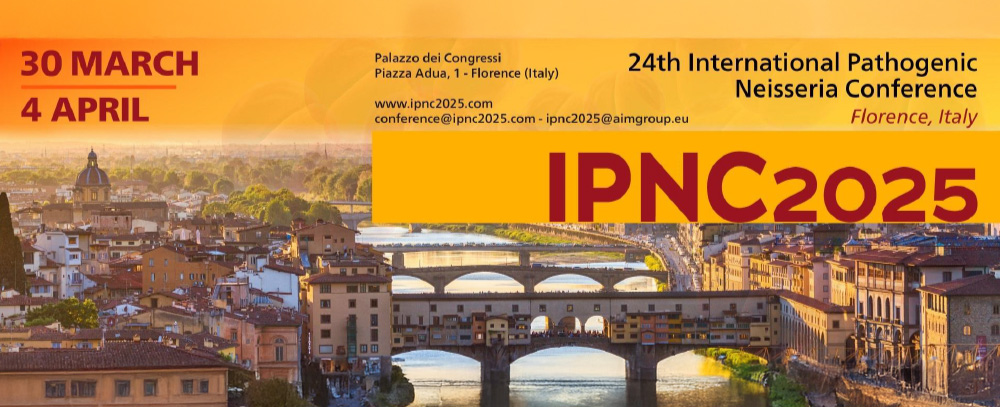
Free Media Partnership Between Pathogens and the 24th International Pathogenic Neisseria Conference, 30 March–4 April 2025, Florence, Italy
Conference: The 24th International Pathogenic Neisseria Conference
Date: 30 March–4 April 2025
Place: Florence, Italy
We are organizing the 24th International Pathogenic Neisseria Conference, which will be held in Florence, Italy, from 30 March to 4 April 2025.
The IPNC is a biannual scientific meeting that engages basic and translational scientists with interest in two genetically related bacterial pathogens, Neisseria meningitidis, which induces devasting diseases such as meningitis and sepsis, and Neisseria gonorrhoeae, a WHO priority pathogen resistant to most antibiotics, causing more than 80 million of sexually transmitted diseases.
Both diseases are of great public health importance in all continents and in most countries, and their prevalence has reached a critical point, thus necessitating a change in science, policy, investment and focus in high-, medium- and low-income countries.
In the case of meningococcus, for the first time in history, we have vaccines covering all pathogenic serotypes, available for infant and for adult populations as single vaccines and in combinations. During the conference, discussions will be held on epidemiology, vaccine coverage to estimate country needs, health economic evaluations, recommendations and post-licensure safety and efficacy monitoring. In addition, we will organize a round table on the WHO agenda on defeating meningitis by 2030 and the opportunity provided by the recent licensure of the ACYWX conjugate for low-income countries to eliminate such a devasting disease, especially in the Sub-Saharan African meningitis belt.
In the case of gonococcus, for the first time since the failures of the 1970s, we have proof of principle that an efficacious vaccine for gonococcus is possible. Moreover, a vaccine against meningococcus B has been shown to provide partial protection from gonococcal infection, and this observation is encouraging new investments to bring novel vaccines against a bacterium resistant to most antibiotics to clinical trials as it may become untreatable and can lead to more than 700,000 cases of the disease in the USA and more than 80 million cases globally. Infection can cause pelvic inflammatory disease, infertility, and ectopic pregnancies and increases the transmission of and susceptibility to the human immunodeficiency virus 1 (HIV-1), thus being designated a high-priority pathogen by the WHO.
The IPNC2025 represents a great opportunity to share ideas and data on recent advances in basic, clinical and translational research as well as promote exchanges between academia and industry to stimulate new and relevant areas of research. This conference aims to gather scientists and clinicians from all over the world to connect in person and brainstorm solutions and ideas related to understanding, managing and reducing the burden of disease caused by Neisseria meningitidis and Neisseria gonorrhoeae.
The IPNC covers a wide range of topics including host responses to infection, bacterial responses and adaptation, clinical disease presentation and evaluation, diagnostics, therapy and prevention through new vaccine development, evaluation and implementation, antimicrobial resistance, epidemiology, population genomics, host–pathogen interactions, molecular physiology, gene regulation and modeling.