
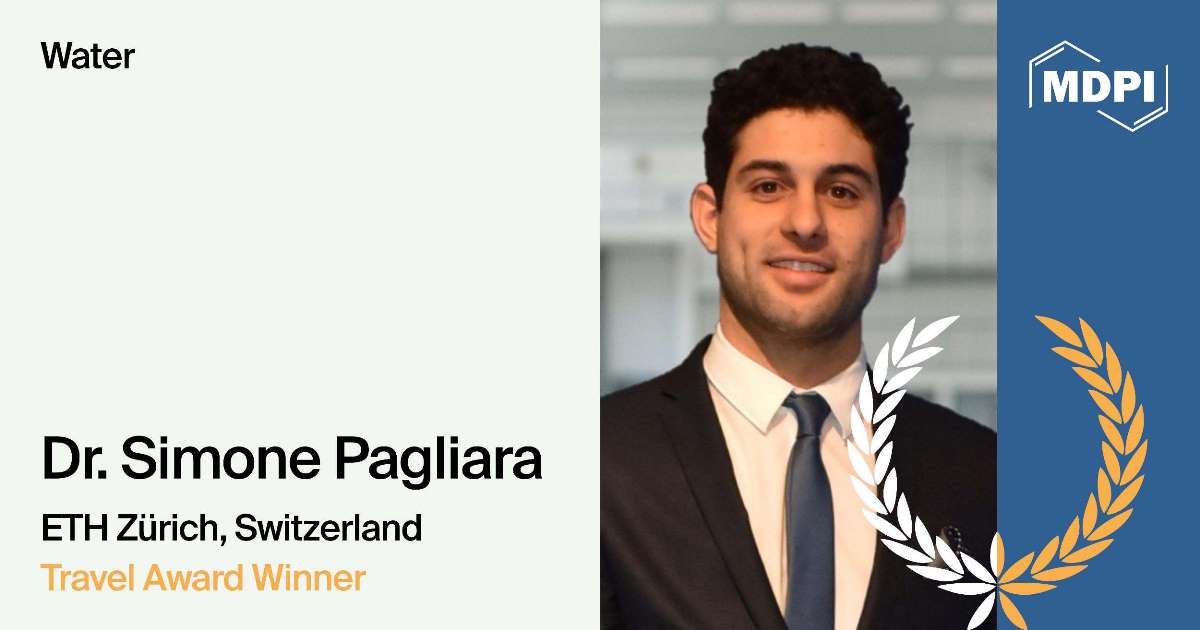
Interview with Dr. Simone Pagliara—Winner of the Water Travel Award
Dr. Simone Pagliara is currently a post-doctoral researcher at VAW, ETH Zürich, Switzerland, where his research focuses on the safe design of low-level outlets of large dams. We would like to congratulate Dr. Simone Pagliara on winning the Water 2026 Travel Award.
The following is an interview with Dr. Pagliara:
1. Could you briefly introduce yourself and tell us about your area of research?
My name is Simone Pagliara, and I am a Civil Engineer specialized in hydraulic engineering and hydrology. I obtained a BSc in civil engineering from the University of Pisa (Italy) in 2018. Through a double degree program, I subsequently earned an MSc in hydraulic engineering from the University of Bologna (Italy) and an MSc in hydrology and water resources management from Imperial College London (UK) in 2020. I completed my PhD at ETH Zurich (Switzerland) in 2025, where my research focused on the experimental investigation of high-velocity air–water flows in low-level outlets. I am currently a postdoctoral researcher at the Laboratory of Hydraulics, Hydrology and Glaciology (VAW), ETH Zürich, investigating high-energy air–water flows in hydraulic structures. In parallel, I work as a project engineer at Lombardi Engineering (Switzerland), with a focus on hydraulic and hydroelectric projects. My research interests include hydraulic structures, fluid mechanics, and river engineering.
2. Where did you obtain information about the journal award? In your previous collaborations with MDPI, what impressed you the most?
I got the information about the journal award from an email newsletter I received. In my previous collaborations with MDPI as a co-author of several journal papers (https://doi.org/10.3390/w13060771, https://doi.org/10.3390/w12030718, https://doi.org/10.3390/w13070971, https://doi.org/10.3390/w13152118), I was impressed by the speed and efficiency of the peer review process, as well as the responsiveness of the Editorial Office.
3. As the winner of this award, is there anything you would like to share or express?
I would like to express my sincere gratitude to the MDPI Water Editorial Office for this award, which will significantly support my participation in the International Symposium on Hydraulic Structures 2026 in Chengdu, China. This opportunity will enable me to present the latest findings of my research on prototype-scale high-velocity air–water flows to leading researchers and practitioners engaged in the field of hydraulic structures worldwide.
4. As you are aware, Water is an open access journal. What is your opinion on the open access model of publication?
Overall, I view the open access publication model positively, as it promotes the broad dissemination of scientific knowledge and facilitates access for researchers, practitioners, and institutions with limited subscription resources. This is particularly valuable in applied fields such as hydraulic engineering, where research outcomes can directly inform professional practice and decision-making. Nevertheless, it is essential to maintain rigorous peer review standards and high editorial quality to ensure scientific integrity, regardless of the publication model.
5. What advice do you have for researchers who are pursuing this path?
My suggestion to young researchers is to remain curious and actively engage with established researchers. The hydraulic structures community is composed of very talented people who, based on my experience, are always willing to support early-career researchers in developing their ideas and advancing their work. A valuable starting point is the IAHR Committee on Hydraulic Structures (https://www.iahr.org/index/committe/5), of which I am a member, and where I have consistently found the exchanges to be constructive, supportive, and intellectually stimulating.
6. Can you briefly introduce which conference you plan to attend with this award? What is the significance of attending such conferences in expanding your international cooperation or enhancing your academic influence?
This award will support my participation in the 11th International Symposium on Hydraulic Structures, to be held in June 2026 in Chengdu, China. At this conference, I will present the first results from a pioneering experimental campaign conducted at the low-level outlet of the recently constructed Spitallamm Dam in Switzerland. During the reservoir impounding phase in summer 2025, I carried out systematic measurements of air demand and air–water flow properties using state-of-the-art instrumentation and advanced measurement techniques. Given the scarcity of prototype-scale data on high-velocity air–water flows, these results will contribute to the quantification of scale effects and the validation of laboratory-based predictive equations, ultimately supporting the safe design of low-level outlets of large dams. The symposium brings together leading researchers and practitioners worldwide in the field of hydraulic structures, providing a unique platform for scientific exchange, critical discussion, and strengthening existing collaborations, as well as the establishment of new international research partnerships.