Feature Papers in Thalassemia Reports

Editors


E-Mail Website
Collection Editor
Foundation Franco and Piera Cutino, Villa Sofia-Cervello Hospital, Palermo, Italy
Interests: ematologia; thalassemia; malattie rare
Special Issues, Collections and Topics in MDPI journals

E-Mail Website
Collection Editor
International Network of Hematology, London, UK
Interests: anemia; iron; thalassemia; sickle cell; thrombosis; hemostasis

Topical Collection Information

Dear Colleagues,

This is a collection of top-quality papers on the study, diagnosis and treatment of thalassemia by the Editorial Board members, or those invited by the Editors-in-Chief (Prof. Dr. Aurelio Maggio and Dr. Khaled Musallam) and the Editorial Office. All papers submitted to this Special Issue would be published free of charge in open access form.

Researchers are also welcome to send short proposals for submissions of feature papers to our Editorial Office for evaluation.

Prof. Dr. Aurelio Maggio
Dr. Khaled Musallam
Collection Editors

Manuscript Submission Information

Manuscripts should be submitted online at www.mdpi.com by registering and logging in to this website. Once you are registered, click here to go to the submission form. All submissions that pass pre-check are peer-reviewed. Accepted papers will be published continuously in the journal (as soon as accepted) and will be listed together on the collection website. Research articles, review articles as well as short communications are invited. For planned papers, a title and short abstract (about 250 words) can be sent to the Editorial Office for assessment.

Submitted manuscripts should not have been published previously, nor be under consideration for publication elsewhere (except conference proceedings papers). All manuscripts are thoroughly refereed through a single-blind peer-review process. A guide for authors and other relevant information for submission of manuscripts is available on the Instructions for Authors page. Thalassemia Reports is an international peer-reviewed open access quarterly journal published by MDPI.

Please visit the Instructions for Authors page before submitting a manuscript. The Article Processing Charge (APC) for publication in this open access journal is 1000 CHF (Swiss Francs). Submitted papers should be well formatted and use good English. Authors may use MDPI's English editing service prior to publication or during author revisions.


Published Papers (1 paper)

2026

28 pages, 1280 KB  
Review
Recent Advances in Thalassemia Management: From Curative Therapies to Artificial Intelligence
by Mohamed Medhat Abdelwahab Gamaleldin, Shaimaa Mahmoud Nashat Sayed Abdelhalim and Ivo Abraham
Thalass. Rep. 2026, 16(2), 7; https://doi.org/10.3390/thalassrep16020007 - 22 Apr 2026
Viewed by 707
Abstract
Thalassemia is an inherited hemoglobin disorder characterized by chronic hemolytic anemia and substantial long-term healthcare needs. In β-thalassemia major, patients typically require regular red blood cell transfusions with iron chelation to prevent transfusional iron overload. Although supportive care has markedly improved survival, it [...] Read more.
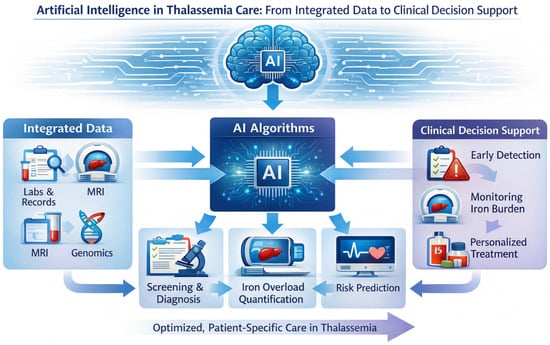
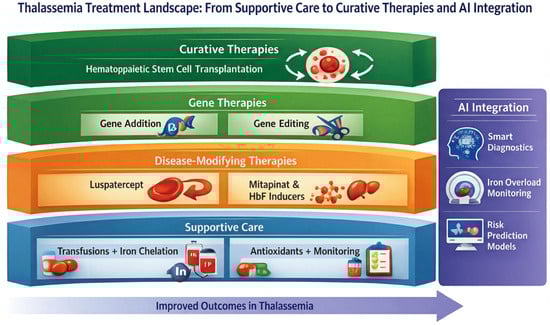
Thalassemia is an inherited hemoglobin disorder characterized by chronic hemolytic anemia and substantial long-term healthcare needs. In β-thalassemia major, patients typically require regular red blood cell transfusions with iron chelation to prevent transfusional iron overload. Although supportive care has markedly improved survival, it is associated with a high treatment burden and does not provide a cure. In recent years, curative and disease-modifying therapies have expanded the treatment landscape. Allogeneic hematopoietic stem cell transplantation (HSCT) offers a potentially curative option for selected patients, while autologous gene therapy and gene-editing approaches have shown the capacity to achieve transfusion independence in clinical studies. In parallel, pharmacologic advances—including luspatercept, a transforming growth factor-beta (TGF-β) ligand trap—have been shown to enhance erythropoiesis and reduce transfusion requirements, and emerging agents such as fetal hemoglobin inducers (e.g., thalidomide) and the oral pyruvate kinase activator mitapivat have demonstrated clinically meaningful hemoglobin improvements in selected populations. Adjunctive strategies, including antioxidants, are under investigation to mitigate oxidative stress, and applications of artificial intelligence are increasingly used to support screening, diagnosis, and longitudinal monitoring of iron overload. This review synthesizes recent advances in curative therapies, novel pharmacologic agents, supportive strategies, and AI-enabled tools and highlights priorities for future clinical development and implementation. Full article
Show Figures

Figure 1

Back to TopTop