



Mapping the Reality and Developing the Strategy of Water Resource in Arid/Semi-Arid Regions
A special issue of Sustainability (ISSN 2071-1050). This special issue belongs to the section "Resources and Sustainable Utilization".
Deadline for manuscript submissions: closed (31 January 2022) | Viewed by 10245
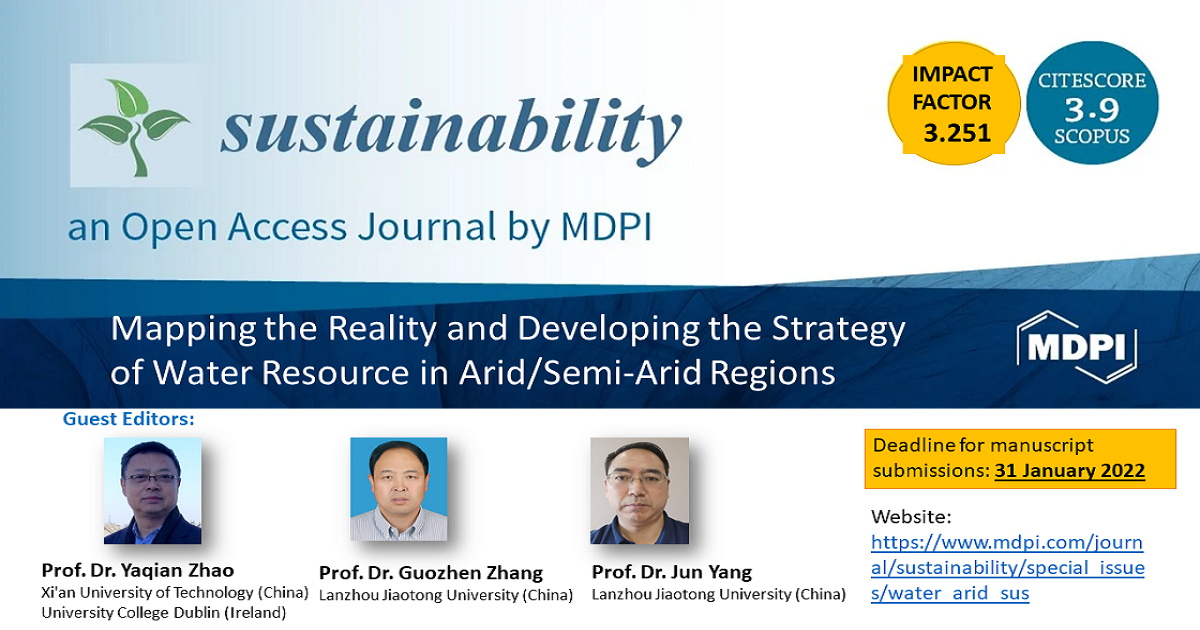
Special Issue Editors

2. Institute of Water Resources & Hydro-electric Engineering, Xi'an University of Technology, Xi’an 710048, China
Interests: unconventional water and wastewater treatment technology; new constructed wetland technology; microbial fuel cell; ecological engineering; ecological restoration of surface water (rivers, lakes, bays, etc.); waterworks sludge regulation; dehydration and beneficial reuse
Special Issues, Collections and Topics in MDPI journals

Interests: Arid/semi-arid water resources; Theory and technology of water pollution control; Regional and watershed water environmental pollution control and resource recovery.

Interests: Solid waste treatment and recycling; Aird/semiarid environmental control.
Special Issue Information
Dear Colleagues,
Due to the global geodistribution, water-resource-related problems in arid and semi-arid regions are aggravating at present. In general, these problems are complex not only due to technical and economic parameters, but also due to the policy and institutional framework, human resource development, and sociocultural reasons. There is no doubt that we have some excellent showcases and good experience to manage water resources in these regions at the world level, but these problems have still not been solved in most arid and semi-arid regions, and more attention should be paid to facing and solving them.
The aim of this proposed special issue is to reflect the wide variety of water-resource-related topics with their inherent complexity and to highlight the successful showcases and experience to share with global academic peers, industrial partners, and policy makers. The issue will review the nature of the problems that are emerging in water resource management, and policy and institutional challenges of concern. It will also focus on the water resources strategies and options whichare important in research, policy, and human resources in order to successfully respond to these challenges. The issue will finally identify future water resource research areas. It is expected that this Special Issue will make a different contribution in water resource practice for various communities and countries around the globe, but with special focus on China.
Potential topics to cover:
1) Profile of water resources in arid and semi-arid regions
2) Various approaches for mapping the water resource profile
3) Wiser application of remote sensors in mapping water resources
4) Lessons learned from the past for water resource management in arid/semi-arid regions
5) Potential and perspectives of water resource management in arid regions
6) Insight into water resources in arid and semi-arid regions
7) Developing new strategies for managing water resources in arid and semi-arid regions
8) Updating various technical solutions for water resource management in arid regions
9) Water problems and solutions of agricultural use in arid regions
10) “Smart city” solutions in arid and semi-arid regions
11) “Sponge city” construction in arid and semi-arid regions
12) “Proof of concept” of eco-solutions for water resource protection in arid and semi-arid regions
13) Challenges and strategies of water resource management under Chinese fast economical development
14) Integrated consideration of solid waste management in arid and semi-arid regions
Prof. Dr. Yaqian Zhao
Prof. Guozhen Zhang
Prof. Jun Yang
Guest Editors
Manuscript Submission Information
Manuscripts should be submitted online at www.mdpi.com by registering and logging in to this website. Once you are registered, click here to go to the submission form. Manuscripts can be submitted until the deadline. All submissions that pass pre-check are peer-reviewed. Accepted papers will be published continuously in the journal (as soon as accepted) and will be listed together on the special issue website. Research articles, review articles as well as short communications are invited. For planned papers, a title and short abstract (about 250 words) can be sent to the Editorial Office for assessment.
Submitted manuscripts should not have been published previously, nor be under consideration for publication elsewhere (except conference proceedings papers). All manuscripts are thoroughly refereed through a single-blind peer-review process. A guide for authors and other relevant information for submission of manuscripts is available on the Instructions for Authors page. Sustainability is an international peer-reviewed open access semimonthly journal published by MDPI.
Please visit the Instructions for Authors page before submitting a manuscript. The Article Processing Charge (APC) for publication in this open access journal is 2400 CHF (Swiss Francs). Submitted papers should be well formatted and use good English. Authors may use MDPI's English editing service prior to publication or during author revisions.
Keywords
- arid/semi-arid water resource
- wastewater treatment
- solid waste management
- strategy
- sustainability
Benefits of Publishing in a Special Issue
- Ease of navigation: Grouping papers by topic helps scholars navigate broad scope journals more efficiently.
- Greater discoverability: Special Issues support the reach and impact of scientific research. Articles in Special Issues are more discoverable and cited more frequently.
- Expansion of research network: Special Issues facilitate connections among authors, fostering scientific collaborations.
- External promotion: Articles in Special Issues are often promoted through the journal's social media, increasing their visibility.
- Reprint: MDPI Books provides the opportunity to republish successful Special Issues in book format, both online and in print.
Further information on MDPI's Special Issue policies can be found here.
