



Journal Menu
► ▼ Journal Menu-
- Sustainability Home
- Aims & Scope
- Editorial Board
- Reviewer Board
- Topical Advisory Panel
- Instructions for Authors
- Special Issues
- Topics
- Sections & Collections
- Article Processing Charge
- Indexing & Archiving
- Editor’s Choice Articles
- Most Cited & Viewed
- Journal Statistics
- Journal History
- Journal Awards
- Society Collaborations
- Conferences
- Editorial Office
Journal Browser
► ▼ Journal BrowserNeed Help?
Announcements
25 May 2026
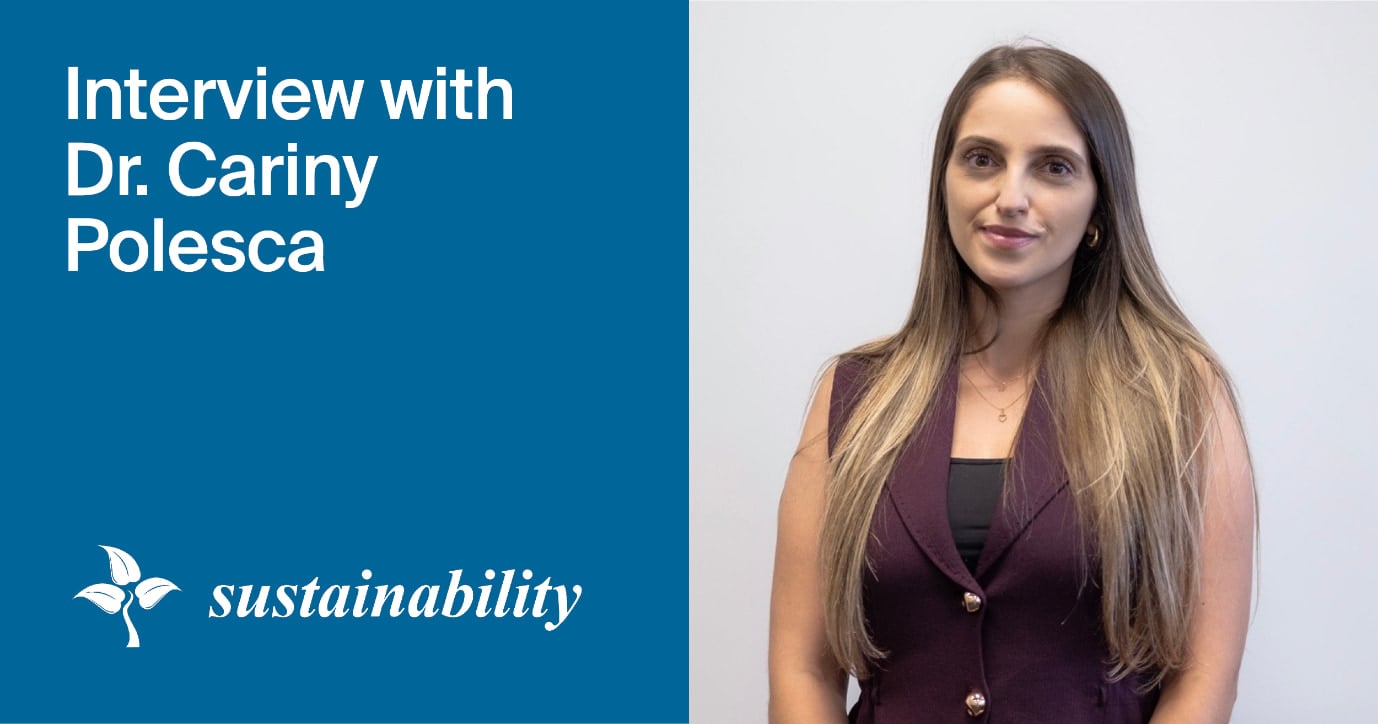
Interview with Dr. Cariny Polesca—Winner of the Sustainability Travel Award
1. Congratulations on winning the Sustainability 2026 Travel Award! Could you briefly introduce yourself and explain your research to someone with a limited scientific background?
Thank you very much! I am truly honoured and happy to receive this award.
My name is Cariny, I am from Brazil, and I have a background in chemical engineering. I am a Research Associate at the Department of Chemical Engineering at Imperial College London under the supervision of Prof. Jason Hallett. My research focuses on recovering high-value compounds from different types of biomass and industrial waste and using these compounds to develop biomaterials for different types of applications, including biomedical applications, wastewater treatment and food packaging. To make these processes more sustainable, I work with ionic liquids, which are alternative and greener solvents that can be designed for specific applications by selecting different cations and anions, resulting in different properties and costs. These solvents have low volatility and, at the end of the process, can be recovered and reused, making the overall process more cost-effective and sustainable.
2. When and how did you first learn about the journal Sustainability? What was your motivation to apply for our 2026 Travel Award?
I have read some papers related to my research area published in the journal, and while exploring the journal’s website, I found out about the Travel Award. I became interested because this award is a good opportunity to support young researchers in attending international conferences. And to be honest, I had applied previously, so this year I decided to apply again. My main motivation was the opportunity to share my research with the scientific community, establish new collaborations, and keep learning.
3. What was the biggest challenge you encountered during your research? How did you overcome it?
I believe the biggest challenge during my research was developing a multidisciplinary PhD thesis. During my PhD, I was introduced to ionic liquids and their use for protein recovery, which was initially very connected to chemical engineering and separation processes. Then, after optimising the process and characterising the recovered protein, I started developing different biomaterials for several applications, with a special focus on biomedical applications. At that point, my research expanded far beyond my original background and moved more into materials science and biotechnology. I needed to learn new concepts and processes, and started collaborating with different research groups, especially to perform biological tests on the biomaterials. In the beginning, this made me quite anxious because there was so much to learn. However, looking back now, I can say it was one of the best things that happened to me in my academic journey. I accepted the challenge, trusted the process, and developed an interest in each area I worked in. More importantly, I learned how valuable collaboration is and how to work with people from different backgrounds and countries.
4. Which conference do you plan to attend with this funding, and what aspect of your research are you most looking forward to sharing at the conference?
With this funding, I will attend the RRB 2026 in Belgium next month, where I will present two research projects that are very important to my academic journey. The first project is related to my current work at Imperial College. In this work, I have used ionic liquids to valorise lignocellulosic biomass, obtaining high-purity cellulose pulp and lignin without volatile organic solvents, thereby contributing to the development of a simpler and more sustainable process for scale-up and subsequent processing. The second project is related to my PhD and focuses on the use of ionic liquids for dissolving chicken feathers and developing 3D-printed keratin-based scaffolds for tissue engineering applications.
5. Which emerging trends or key research topics in your field do you believe will be of most interest to your research community in the coming years?
I believe that one of the most important research topics in my field will be the development and scale-up of sustainable and circular biorefinery processes for biomass and waste valorisation. This is becoming increasingly important due to the environmental challenges associated with fossil resources and the global need to reduce dependence on petroleum-based processes, chemicals and materials.
6. Do you have any advice for aspiring young researchers looking to make a meaningful impact in their respective fields?
My main advice would be to stay curious and to not be afraid of stepping outside your comfort zone. During my academic journey, I moved from Brazil to Portugal, worked as a Visiting PhD student in Italy and the UK, and now I have been working in the UK since February 2025. These experiences helped me grow both personally and professionally, teaching me how to adapt, collaborate with different people from different cultures, communicate in different languages, and see research from new perspectives. I also moved into multidisciplinary research areas that were completely new to me, and those challenges became some of the most important experiences in my development as a researcher. So, I believe young researchers should be brave, persistent, and enjoy the journey!
I think the journal already provides important support to the academic community and young researchers, for example, through the Travel Award and the webinars. I believe the journal could further promote these opportunities to ensure more young researchers have access to these opportunities and are encouraged to take part in them.
