





Impact of Fecal Microbiota Transplantation on Human Health

A topical collection in Microorganisms (ISSN 2076-2607). This collection belongs to the section "Gut Microbiota".

Viewed by 2194

Editors


E-Mail Website
Collection Editor
“Agostino Gemelli” Teaching Hospital, Catholic University of Sacred Heart, 00168 Rome, Italy
Interests: fecal microbiota transplantation; Clostridium infections; microbiota; parasitology
Special Issues, Collections and Topics in MDPI journals

E-Mail Website
Collection Editor
Dipartimento di Scienze di Laboratorio e Infettivologiche, Fondazione Policlinico Universitario A. Gemelli IRCCS, 00168 Rome, Italy
Interests: clinical microbiology; gastro-intestinal infections; FMT; parasitology
Special Issues, Collections and Topics in MDPI journals

Topical Collection Information

Dear Colleagues,

Fecal microbiota transplantation (FMT) consists in the infusion of a feces suspension obtained from a healthy donor into the intestinal tract of a recipient patient. The principle of FMT is the reconstitution of a eubiotic state in an altered intestinal bacterial community or providing potentially protective bacteria against local and systemic pathologies.

Therefore, the restoration of a eubiotic state is not only indicated in intestinal infectious diseases but also in noninfectious diseases. In fact, a normal bacterial community provides protection against an inflammatory status that may have potential systemic effects. Conversely, overexpressed bacterial communities can stimulate inflammatory processes, triggering neurodegenerative disorders such as Parkinson’s disease, amyolateral sclerosis, multiple sclerosis, and autism.

As is evident in the literature, the potential therapeutic options are numerous when considering the capability of FMT to modulate an eventual dysbiotic status, as described in intestinal bowel diseases, cardiovascular diseases, immunity disorders, hepatic encephalopathy, psychiatric conditions, and others.

The aim of this Topic Collection is to provide current and thoughtful scientific evidence of the clinical impact of FMT on human health.

Thus, we especially welcome interventional and observational studies aiming to improve the knowledge of FMT’s effects on systemic health and of its use for the treatment of local and systemic diseases. Review studies, including those that use conceptual frameworks for any of the aforementioned topics, will also be welcomed.

Dr. Luca Masucci
Dr. Gianluca Quaranta
Collection Editors

Manuscript Submission Information

Manuscripts should be submitted online at www.mdpi.com by registering and logging in to this website. Once you are registered, click here to go to the submission form. All submissions that pass pre-check are peer-reviewed. Accepted papers will be published continuously in the journal (as soon as accepted) and will be listed together on the collection website. Research articles, review articles as well as short communications are invited. For planned papers, a title and short abstract (about 250 words) can be sent to the Editorial Office for assessment.

Submitted manuscripts should not have been published previously, nor be under consideration for publication elsewhere (except conference proceedings papers). All manuscripts are thoroughly refereed through a single-blind peer-review process. A guide for authors and other relevant information for submission of manuscripts is available on the Instructions for Authors page. Microorganisms is an international peer-reviewed open access monthly journal published by MDPI.

Please visit the Instructions for Authors page before submitting a manuscript. The Article Processing Charge (APC) for publication in this open access journal is 2700 CHF (Swiss Francs). Submitted papers should be well formatted and use good English. Authors may use MDPI's English editing service prior to publication or during author revisions.

Keywords

  • fecal microbiota transplantation
  • laboratory activity and innovation
  • gut microbiota manipulation
  • immunity
  • basic research
  • translational research
  • systematic review

Published Papers (1 paper)

2026

13 pages, 567 KB  
Article
Fecal Microbiota Transplantation Donor Screening: Is Dientamoeba fragilis a Valid Criterion for Donor Exclusion? A Longitudinal Study of a Swiss Cohort
by Keyvan Moser, Aurélie Ballif, Trestan Pillonel, Maura Concu, Elena Montenegro-Borbolla, Beatrice Nickel, Camille Stampfli, Marie-Therese Ruf, Maxime Audry, Nathalie Kapel, Susanna Gerber, Damien Jacot, Claire Bertelli and Tatiana Galpérine
Microorganisms 2026, 14(1), 217; https://doi.org/10.3390/microorganisms14010217 - 17 Jan 2026
Viewed by 858
Abstract
Dientamoeba fragilis is a protozoan of the human digestive tract, yet its transmission and pathogenic role remain poorly understood. This study aimed to evaluate its impact on the efficacy and safety of fecal microbiota transplantation (FMT) in treating recurrent Clostridioides difficile infection (rCDI). [...] Read more.
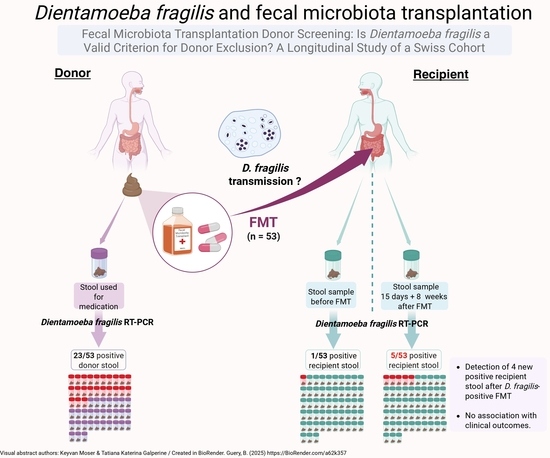
Dientamoeba fragilis is a protozoan of the human digestive tract, yet its transmission and pathogenic role remain poorly understood. This study aimed to evaluate its impact on the efficacy and safety of fecal microbiota transplantation (FMT) in treating recurrent Clostridioides difficile infection (rCDI). This longitudinal cohort study analyzed stool samples from FMT donors and recipients pre-treatment and at 2 and 8 weeks post-FMT. All samples were retrospectively tested using real-time PCR. Shotgun metagenomics was also performed on selected donor–recipient pairs to explore transmission. CDI cure rates, gastrointestinal adverse events (AEs), and serious adverse events (SAEs) were assessed prospectively. A total of 53 FMT were analyzed (179 samples), with 23 (43%) derived from D. fragilis-positive donor stool (4 of 10 donors, 40%). Four of 52 recipients (18.2%), initially negative and who received treatment from positive donors, tested positive post-FMT. Shotgun metagenomics could not definitely confirm transmission due to the lack of a good reference genome. No significant differences in efficacy, AE, or SAE were observed between FMT from D. fragilis-positive versus -negative donors, even in immunocompromised patients. No SAEs were attributed to FMT. D. fragilis may be transmitted via FMT without evidence of short-term clinical impact. Consequently, RT-PCR detection should be interpreted cautiously in the context of donor exclusion decisions. Full article
Show Figures

Graphical abstract

Back to TopTop
