

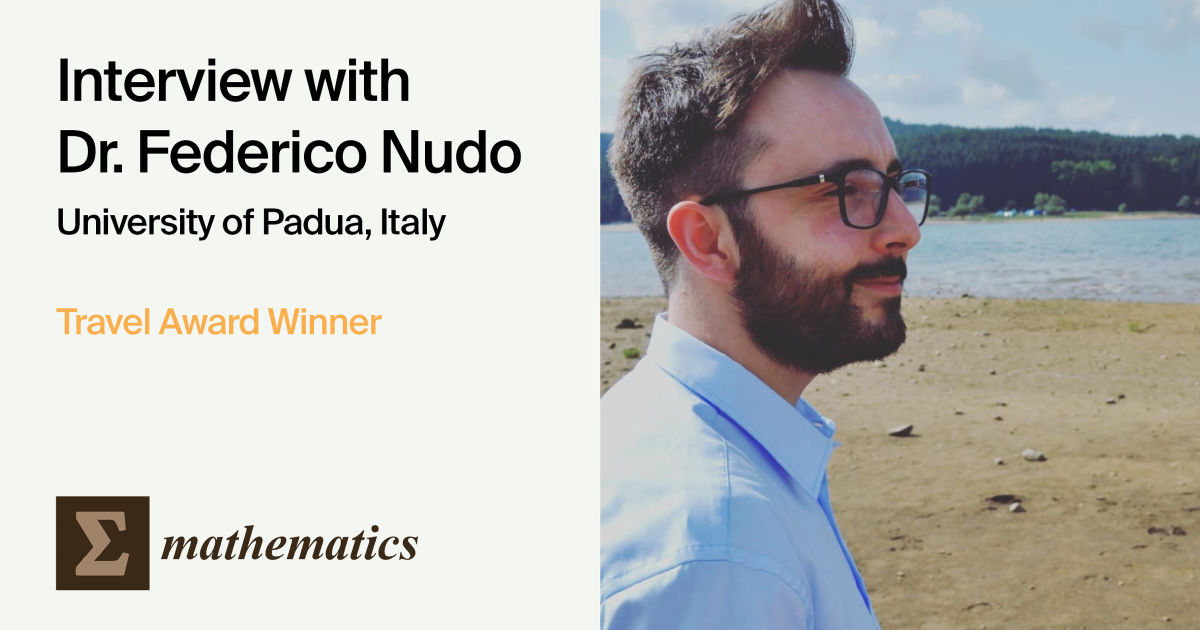
Interview with Dr. Federico Nudo—Winner of the Mathematics Travel Award
The journal Mathematics (ISSN: 2227-7390) is proud to present the winner of the Mathematics 2026 Travel Award—Dr. Federico Nudo!
Dr. Federico Nudo is a postdoctoral researcher specializing in the intersection of approximation theory, numerical analysis, and finite element methods. He earned his PhD through a joint program between the University of Calabria and Université de Pau et des Pays de l’Adour. Following his doctorate, he conducted postdoctoral research at the University of Padova and currently holds a prestigious European Union-funded research contract. His research focuses on developing novel numerical schemes to handle challenging problems involving singularities or oscillatory structures.
The following is a short interview with Dr. Federico Nudo:
1. Could you give a brief introduction of yourself to the readers? Could you introduce your current research direction and provide an update on your progress?
My name is Federico Nudo. I completed my PhD in a cotutelle program between the University of Calabria in Italy and the University de Pau et des Pays de L'adour in France, under the supervision of Professor Francesco Dell'Accio and Professor Allal Guessab. During my PhD, my research focused on polynomial approximation theory, with particular attention to interpolation problems in several dimensions, orthogonal polynomials, and finite element methods.
Before starting my PhD, I was awarded a three-month research grant in Lugano, Switzerland, where I worked on the development of my master’s thesis. After completing my PhD, I held postdoctoral positions in Padova and at the Institute of High Mathematics in Italy. In Padova, my research activities were mainly devoted to interpolation and related approximation techniques.
I am currently a postdoctoral researcher in Calabria, where I continue working on polynomial approximation, orthogonal polynomials, local and global approximation problems, and finite element and least-squares-type methods.
2. Based on your experience, which research topics do you think are of particular interest to the research community in the coming years?
Rather than singling out one specific topic as more important than others, I believe that a particularly promising direction for the research community in the coming years lies in the interaction between well-established mathematical theories and emerging problems arising from modern applications. In particular, the development of numerical and approximation methods that are both theoretically sound and computationally efficient will continue to be of great interest, especially in high-dimensional and locally adaptive settings.
3. Could you introduce the core content of your conference presentation at NUMTA 2026 conference and what you hope to contribute or gain from the discussion?
The work I intend to present at the NUMTA 2026 conference, titled “Truncated Gegenbauer–Hermite Weighted Approach for the Enrichment of the Crouzeix–Raviart Finite Element”, recently published in BIT Numerical Mathematics in collaboration with F. Dell’Accio, A. Guessab and G. V. Milovanović, is a clear example of this approach. In this paper, we propose two families of weighted polynomial enrichments for the classical Crouzeix–Raviart finite element, designed to enhance its approximation power when reconstructing bivariate functions from integral data. The enrichment functions are built using exponential Gegenbauer–Hermite weighted polynomials, depending on two real parameters, σ > 0 and λ > −1/2, which allow the basis to adapt to specific features of the function being approximated. Numerical experiments demonstrate a significant gain in accuracy compared to standard finite element methods, particularly in handling functions with rapid variation or low smoothness.
This work is also deeply connected to the theory of orthogonal polynomials—a subject in which Prof. Gradimir V. Milovanović, one of the co-authors, is a world-renowned expert. His guidance and insights have been fundamental in the development of the weighted framework that underpins this contribution. The fusion of classical polynomial theory with modern numerical techniques is at the heart of this research and reflects the kind of interdisciplinary dialogue.
NUMTA 2026 provides an ideal platform for presenting this work, as its themes encompass not only advanced numerical methods but also their philosophical and theoretical foundations. The conference’s openness to a broad range of computational paradigms and its emphasis on modeling in nature make it particularly relevant to the mathematical framework developed in our paper. Participating in NUMTA would allow me to exchange ideas with a wide community of researchers, gain valuable feedback, and initiate new collaborations that build upon the synergy between approximation theory and numerical computation.
4. Can you please share with us your sentiments about winning the award? Where do you obtain information about participation in journal awards?
Winning the award is extremely important to me, both professionally and personally. It is an international prize evaluated by a strong and independent committee, which makes it particularly meaningful for my CV. The Mathematics Travel Award is especially valuable because it enables me to attend conferences that I could not otherwise afford due to limited financial support.
I learned about the awards directly through the journal’s website and communication. The application process was very intuitive and accessible, which I truly appreciated. I also value that the committee evaluates the applications seriously and fairly, independent of whether candidates have published them in the journal before.
5. What is your opinion on the open access model of publishing?
I strongly support the open access publishing model. In today’s world, science should be accessible to everyone. Keeping research behind paywalls no longer makes sense, especially when information can often be found through unofficial channels. Open access ensures equal opportunities for researchers and readers worldwide and reflects the idea that science belongs to the entire community.
6. What inspired you to pursue mathematics, and were there pivotal moments or mentors who guided your path? As the winner of this award, is there something you want to express or someone you wish to thank most?
I was inspired to pursue mathematics during high school, mainly thanks to an excellent and passionate teacher in my final years who motivated me deeply. Another pivotal experience was participating in university-level mathematics courses for high school students organized by the University of Calabria, where I encountered inspiring lectures on probability and complex analysis.
As the winner of this award, I would like to sincerely thank the entire committee, the Editorial Board and everyone involved in organizing and promoting the award. I am also grateful for the clear communication and email notifications, which make these opportunities accessible to young researchers like myself.