
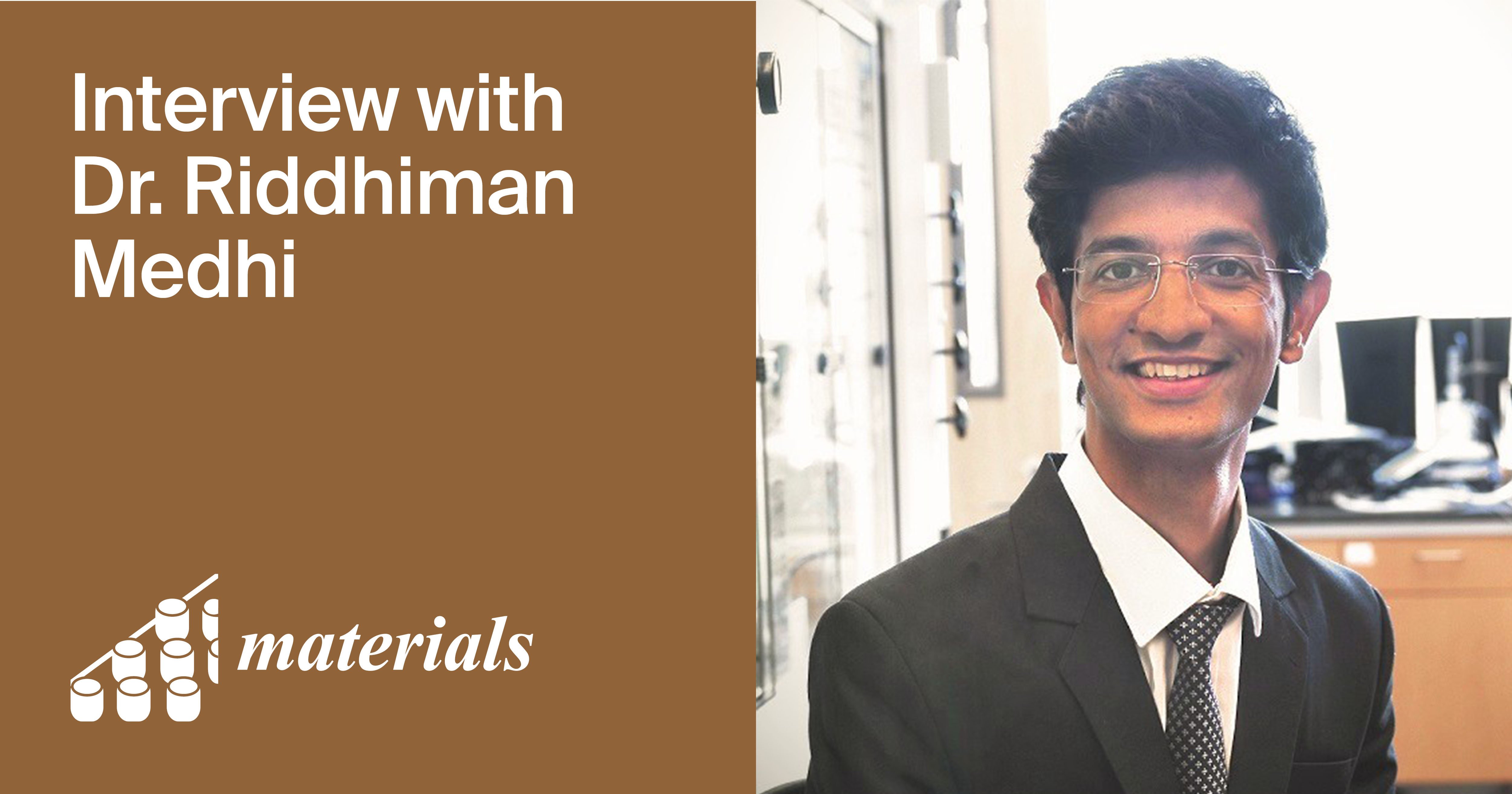
Materials | Interview with the Issue Cover Author Dr. Riddhiman Medhi
Dr. Riddhiman Medhi is one of the authors of the Issue Cover paper entitled “Stabilizing the Localized Surface Plasmon Resonance (LSPR) of Citrate-Synthesized Metal Nanoparticles in Organic Solvents”, published in Materials (ISSN: 1996-1944).
Author’s introduction:
Dr. Medhi obtained his PhD in chemistry from the University of Houston, where he was a recipient of the Dan E. Wells Outstanding Dissertation Award (Summer 2020) and the Jay K. Kochi fellowship-funded Graduate Student Research Award (2020) for excellence in research. Dr. Medhi’s research focused on novel optoelectronic nanoparticles with composite architectures for applications in renewable energy, biomedical therapy, and environmental remediation. Following his postdoctoral work at Cornell University on bioinspired polymer coatings, Dr. Medhi established an independent research laboratory as an Assistant Professor at the University of Scranton. Currently, Dr. Medhi’s work focuses on the synthesis and application of novel nanomaterials for a sustainable future, spanning inorganic chemistry, polymer chemistry, surface science, and fabrication, with an application focus on optical sensing and photocatalysis.
Based on the positive evaluations by the reviewers and academic editors for Dr. Riddhiman Medhi’s group article, we have selected their article as the Issue Cover for display on the Materials’ website.

“Stabilizing the Localized Surface Plasmon Resonance (LSPR) of Citrate-Synthesized Metal Nanoparticles in Organic Solvents”
by Jacob P. Magdon, Matthew J. Jasienski, Madison R. Waltz, Gabrielle A. Grzymski, Calvin Chen, Arion M. Solomon, Minh Dang Nguyen, Jong Moon Lee, John C. Deàk, T. Randall Lee and Riddhiman Medhi
Materials 2025, 18(22), 5246; https://doi.org/10.3390/ma18225246
The following is an interview with Dr. Riddhiman Medhi:
1. Congratulations on your published paper. Could you please briefly introduce the main research content of the published paper?
Thank you! In this published work, our research group has unveiled a deep-dive analysis that could significantly expand the applications of metal nanoparticles beyond water-based systems. It is well known that these metal nanoparticles exhibit a phenomenon known as localized surface plasmon resonance (LSPR), where their electron clouds oscillate in resonance with visible to near-infrared light frequencies. This unique property has already revolutionized fields such as medical diagnostics, sensing, photothermal therapy, drug delivery, energy harvesting, and photocatalysis.
Until now, most fabrication methods have relied on aqueous environments, with the citrate method being the method of choice for the majority of researchers and industry. Here, the particles are stabilized in the form of nanosized colloids using electrostatic forces coming from the citrate ions on the surface. However, when transferred to organic solvents, the particles quickly clump together, losing their LSPR capabilities—a major barrier for broader use.
This new study demonstrates innovative techniques for functionalizing and transferring these nanoparticles into organic solvents without compromising their optical properties. By testing a range of nanoparticles, ligands, and solvents, our team identified polymer-based systems that can encapsulate the particles and provide alternative stabilization through dipole–dipole and hydrogen-bonding interactions. Unlike electrostatic interactions, these dipole–dipole and hydrogen-bonding interactions are transferable to other solvents, thereby sustaining their role in colloidal stability.
This advancement opens the door to new possibilities for nanoparticle modification and utilization in organic media, paving the way for next-generation applications in energy, medicine, and advanced materials.
2. What are the key takeaways you hope readers will gain from your paper?
The readers of this article will gather two main insights: Firstly, the readers will be able to quickly identify that hydroxypropyl cellulose, a cellulose derivative, is a great ligand for citrate substitution and phase transfer of pretty much all kinds of citrate-stabilized metal nanoparticles. With this key phase transfer step already figured out, researchers will now be able to focus on using these plasmonic nanoparticles in non-aqueous chemistry and applications of interest to them.
Secondly, readers will see that solvent–solvent interactions and solvent viscosity also play a key role in nanoparticle stability and may therefore consider their solvent choices more carefully, as well as possibly investigate these interactions further. Overall, this work will be of great benefit to synthetic, applied, and physical chemists alike.
3. Was there a specific experience or event in your research career that led you to focus on your current field of research?
When I was attempting to synthesize core–shell and core–dual-shell nanoparticles featuring TiO2 as the shell, I wanted to use a titanium butoxide precursor to generate my TiO2, as it is the most standard and established method. However, we faced a major roadblock with this approach, since the TBOT transformation to TiO2 happens via hydrolysis with water, and if we are running the reaction in an aqueous medium, it leads to uncontrolled TiO2 growth. This is a problem if we are trying to grow a uniform and well-defined shell around a nanoparticle. However, at that time, there were no straightforward methods for phase transfer and stabilization of standard citrate-stabilized nanoparticles in nonaqueous systems. I realized this must be a significant problem for other synthetic chemists like myself as well, and that a well-defined investigation into this question was warranted.
4. What appealed to you about the Materials journal that made you want to submit your paper? In your opinion, what can authors expect when they submit to Materials?
Materials was my choice for publication because of multiple factors. Firstly, they are a well-established, peer-reviewed topical journal in materials science that precisely matches the scope of our work and has a broad reach. Secondly, they have a rapid turnaround on their decisions, which means I don’t have to be in limbo for months; instead, we can get the research out quickly for others to read and apply. Thirdly, I have previously published in Materials, and the authoring experience has always been smooth, while also providing ease of access and quality for readers.
5. How do you think open access way of publishing impacts authors?
Open access is a great way to share your research with the broader research community. Especially if you believe your research addresses an important, widely applicable question, open access is the most appropriate approach. This way, we can ensure that the solutions we provide are immediately available to all researchers in the field, thereby maximizing their impact.