
Skip Content
You are currently on the new version of our website. Access the old version .
  • 33 days
    Time to First Decision

Literature

Literature is an international, peer-reviewed, open access journal on literature and cultural studies published quarterly online by MDPI.

All Articles (124)

We present a psycholinguistic test battery designed to examine the cognitive and affective processes involved in reading Polish poetry. This toolkit combines reader profiling (vocabulary, memory and reading proficiency) with tasks that assess the influence of lexical, textual, affective and poetic features on recognition, context restoration and association generation. Pilot data confirmed the reliability of the measures and their sensitivity to recognised psycholinguistic effects. Vocabulary size and delayed memory rehearsal strongly predicted performance in content restoration, while recognition and association latencies were closely related, indicating shared retrieval mechanisms. Structural and affective properties also influenced responses: line-final words improved recognition but impeded association, with these effects being moderated by word length and frequency. Words that were negatively valenced, abstract and hardly imaginable were restored more accurately than positive or concrete ones. These findings demonstrate the potential of the battery for profiling readers and provide new insights into how Polish poetic language engages memory and associative processes.

4 December 2025
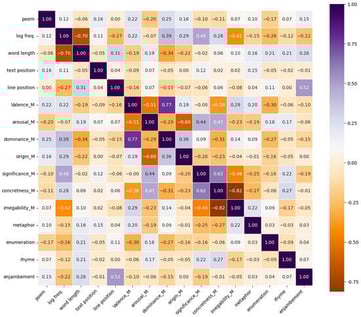
The correlation matrix of all variables included in the study.

Over the past century, literary theory has branched out in several directions. Diverse schools of literary thought, such as Semiotics, New Criticism, Intentionalism, Structuralism, and Deconstruction, have passionately plowed new ground within the academy and just as passionately defended that territory against their neighbor’s incursions. At times, authors and their intentions have been central to literary criticism, while at others, they are intellectually discarded or severely reduced in importance. Much of the friction caused by the shifting focus of literary criticism is driven by impassioned rhetoric and convictions that leave little room for compromise. The emergence of artificial intelligence (AI) has opened the possibility of a dispassionate arbiter, one that, should the literary community have the courage and conviction to embrace and exploit, could offer a new level of harmony between divergent literary theories.

10 February 2026

Peter S. Beagle’s decision to feminize the formerly masculine figure of the unicorn in his influential 1968 fantasy novel The Last Unicorn represents a key moment in the evolution of this now ubiquitous image, one embraced today as a symbol of pride by LGBTQ+ communities. The novel and its 1982 animated film adaptation have themselves remained popular among queer and especially trans audiences, who have often found the narrative resonant with their own experiences. This essay provides a preliminary overview of the queer history of the unicorn symbol and continues into a trans reading of the novel, arguing that these responses to Beagle’s work by contemporary readers reflect dimensions of the narrative congruent with concerns about gender performance and misrecognition; gender dysphoria; and queer temporalities. The nature of the fantasy form itself, we maintain throughout, can also particularly enable reparative readings by queer and trans audiences.

13 January 2026

This essay examines how contemporary Anglophone Chinese women writers rewrite the imagery of Chinese snake women through speculative retellings that foreground sisterhood, queer desire, and diasporic identity. Drawing on queer diaspora studies and feminist criticism, I argue that Larissa Lai’s Salt Fish Girl (2002) and Amanda Lee Koe’s Sister Snake (2024) revise the figure of the Chinese snake woman to imagine forms of female intimacy and kinship that transcend heteronormative and patriarchal frameworks. In these works, sisterhood operates both as a familial bond and as an intimate, queer relation charged with affective, physical, and occasionally erotic intensity. The original White Snake legend—one of China’s Four Great Folktales—has long invited queer readings, especially through the complex relationship between White Snake and her companion Green Snake. In dialogue with the Chinese snake myth, Lai and Koe relocate the snake woman into speculative worlds shaped by queer desire, racial marginalization, and transnational migration. In Salt Fish Girl, Lai reimagines the reincarnations of the half-snake Chinese mother goddess Nu Wa across colonial South China and near-future bio-capitalist Canada, portraying a cross-temporal lesbian love between the protagonist and the titular Salt Fish Girl. In Sister Snake, Koe’s protagonists—serpent sisters Su and Emerald, separated between Singapore and New York—disrupt normative family scripts while forging a fragmented but enduring affective bond. Through the motif of the Chinese snake woman, these works construct imaginative spaces in which intimate sisterhood subverts patriarchal and national containment, advancing a queer vision of female togetherness.

22 December 2025

News & Conferences

Issues

Open for Submission

Editor's Choice

Get Alerted

Add your email address to receive forthcoming issues of this journal.

XFacebookLinkedIn
Literature - ISSN 2410-9789