


Abstract
My sinuous life as a humanist traversing disciplinary, periodic, geographical, and national borders has yielded palpable wonders, the most wonderful being the opportunity to live and connect many lives. I was made bilingual, bicultural, and cosmopolitan in colonial Hong Kong, a classicist at Pepperdine University, a Renaissance scholar at Berkeley, an intersectional Americanist at UCLA, and a polyglot comparatist by UCEAP. The many splendors of literary America unraveled by Bruins of disparate stripes have driven me to herald the variegated beauty of Chinese American heritage. I have gone from being an outsider, a suspect even, in both English and Asian American studies to being a humanist resource. It behooves me to usher in, among the Bruins, my mother tongue—the language of the Tang poets, gold miners, and the Transpacific railroad workers, and to stage Cantonese opera. “In my end is my beginning.”
1. Prologue
“Poetry communicates best through its humanity. [It] must resist all forms of coercion.”(Arthur Sze)
“Won’t you memorize a bit of poetry to halt the slaughter?”(Mahmoud Darwish)
I was conceived during a typhoon in colonial Hong Kong. Ever since Fae Myenne Ng had found out through my review essay on Orphan Bachelors (Ng 2023) that I was created in a vortex of wind and dust, she has demanded “A Memoir of the Typhoon Baby.” I am obliging her halfway with this sprawling portrait of a migrant academic—a humanist traversing from East to West—and back and forth. Yet this retrospection does pulsate to our kindred heartbeat as zhiyin, literally, “know thy tune.” As a literary scholar, music lover, teacher, and martial artist (admittedly a shameless lie), I am keenly attuned to the distinctive styles of writers, composers, divas, students, and sifus, and glean my rewards from any reciprocation in kind.
Lessons I have learned from my zigzag career include: (1) race still matters in (mis)shaping our perceptions; (2) dominant standards may induce subconscious self-contempt; (3) super powers tend to disavow plural cultures; (4) trespassing borders—be they disciplinary, generic, national, geographical, ethnic, periodic, or linguistic—is conducive to tolerance and diversity, but so is preserving, reclaiming, and grafting one’s roots elsewhere; (5) the humanities and attendant zhiyin cultivation can galvanize interdependent communities without borders. The term zhiyin derives from the shortest short (one page) on Boya 伯牙, an accomplished guqin (seven-string zither) player and Zhong Ziqi 鍾子期, a woodcutter who visualizes images that answer to Boya’s melodies. Exhilarated upon meeting someone who can tune in to his music consummately, Boya returns to the same locale to rendezvous with Ziqi annually. When Ziqi fails to appear one year and Boya learns that his musical soulmate—zhiyin—has died, he breaks the strings of his instrument and plays no more thereafter (Boya n.d.). I shared this story during a 2016 interview when Neil Thompsett asked me about my favorite story (Thompsett 2016), and again at my commencement address for the UCLA English Department in 2023. This tale, in which the zither strings and the player’s heartstrings are interwoven, speaks feelingly to the ecstasy of lighting upon a zhiyin, and the nadir of despair wrought by the loss of the consummate cognoscenti. Sealed by the arts, zhiyin fellowship can range across the humanities.
The humanities do not belong to any one culture, discipline, or generation; like the 2022 sci-fi drama, it can be “everything everywhere all at once.” “Poetry communicates best through its humanity,” remarked Arthur Sze. “If you make the reader experience what’s going on, they can decide for themselves…. [P]oetry must resist all forms of coercion” (Harris 2025). I myself have no partisan allegiance except to the Bears (Berkeley), Bruins (UCLA), and Bards (from Homer to Tong Dik Sang). Most humanists never stop cultivating ourselves through some form of artistic or linguistic pursuit. I have been more diligent in expanding my fields of interest to Hungarian, Korean, Spanish, digital media, martial arts, and Cantonese opera upon becoming a research professor. This essay is not just a paean to my métier, however, but also a confession. Just as I thought I had discharged myself decently as a Professor Emeritus of English and Asian American Studies, reading Fae Myenne Ng’s Orphan Bachelors catapulted me into recognizing a glaring oversight and into making amends. Through tracing my sinuous academic journey this essay addresses the pernicious effects of racialization and colonization of the mind—how one’s face (Asian, White, Black, Brown, Mixed) could “psyche” others and oneself, and the empowering impact of zhiyin and transnational network. Though my academic trajectory is anything but smooth, I now appreciate all the twists, torques, and turns. Otherwise, I never would have seen so much through a nomadic lens; nor would I be savoring my second career of teaching Cantonese opera and team-teaching martial arts.
2. Faustian Ambition Roused by Graduate Mentors
When Chinese friends ask why I was brazen enough to pursue a stateside career in Anglophone literature, my quick response is both facetious and partially true. I wrote my MA thesis on Homer, and Greek was Greek to everyone else at the Pepperdine English department, including Professor James Atteberry (1923–2018) who directed my thesis and recommended me to pursue a PhD in English at Berkeley, where I focused on Paradise Lost, which is equally challenging to native speakers. But the real answer lies in the professors who spurred my literary ambition notwithstanding my race and alien status. To grasp these mentors’ exceptionality, a couple examples to the contrary are in order. At Pepperdine two students in Professor H. Wilson’s class forgot to put down their names in their in-class midterms. Dr. Wilson read the A+ paper aloud and then handed it to a white student; it was mine. The day I walked into the Cal English Department in Wheeler Hall, the graduate advisor greeted me with “I hope you are not planning to look for a job in this country.” As the only nonwhite foreign student in 1976, I was indeed a misfit among my brilliant cohort, and I remember the discomfiture of sitting between two classmates before a lecture when they talked shop to each other nonstop but did not once glance my way. Hence, I remember to this day the one classmate who befriended me—Liz Muther, now Professor of English at Bowdoin College. My sense of isolation was further mitigated after being recruited to teach English Composition and Cantonese by Cal’s nascent Ethnic Studies department, where I met Fae, long before Bone (Ng 1993), her first novel, was published.
The singularly encouraging professors of English who did not see my ESL background as a hindrance were the ones who transformed my Berkeley years from being the most mortifying into the most affirming. To them I remain grateful to this day: Professors John Anson (diss. director), Stephen Booth (oral exam Chair, 1933–2020), Frederick Crews (1933–2024), Stephen Greenblatt, Norman Rabkin (1930–2012); also Marvin Rosenberg (1912–2003), Professor of Dramatic Art. I name them all to show what a lasting impact supportive mentors could make on an outlier, not only in boosting my confidence but in teaching me how to be a teacher. With Rabkin there was an initial rub not unlike Wilson’s. I had already completed my course work when I asked to audit his Renaissance Drama seminar, but he urged me to enroll instead. Toward the end of the quarter I proposed to write a term paper on Milton’s Samson Agonistes, and got a stern reply. Rabkin forgot he was the one who made me take his course for credit and assumed, because I never spoke up in class, that I did not read any assignments. I ended up submitting a paper on Dr. Faustus, Macbeth, and Paradise Lost, and expanding my dissertation at Rabkin’s behest to cover the two other Renaissance pillars. The misunderstanding occasioned “Drawing Out the Silent Minority,” a paper for Crews’s TA workshop (Cheung 1984a). Rosenberg was working on The Masks of Hamlet then and I helped him with the Cantonese production in Hong Kong (Rosenberg 1992). These professors each wrote a reference for me that landed me two Regents fellowships.
Stephen Booth and Stephen Greenblatt, two professors who have had the strongest impact on my literary approaches, aroused my Faustian ambition (though I didn’t ask either luminary to serve on my doctoral committee due to my foreign-student complex). Greenblatt gave me an A for my paper on Sidney’s “Astrophel and Stella,” but asked me to watch out for my “Latinate” style, adding, “I said that only because you are already a stylist of some distinction.” As Chair of English the year I filed my dissertation, he summoned me to his office, which I entered with trepidation, but exited merrily: he liked my chapter on Doctor Faustus (Cheung 1988b). In Booth’s Shakespeare seminar, we had to take a pop quiz after reading a play a day for two weeks; he told the class I was the only student who ever got a perfect score (probably because I had to read all the annotations to understand Shakespeare). He chaired my dreaded oral qualifying exam and wrote a one-sentence assessment that Dean Bill Schaffer at UCLA told me was sufficient to have me recruited as a “Target of Opportunity”: “In her PhD oral last spring, Ms. Cheung was the most lucid, best prepared, and most imaginatively independent candidate I have ever examined or heard examined, period (I have been in this department for a long time).”
3. Double Marginalization at UCLA
My joint appointment at UCLA in 1984 as Professor of English with an affiliation with the Asian American Studies Center (AASC) is, in retrospect, the luckiest break of my life, but the beginning was unusually fraught. I was interviewed with considerable hostility by the AASC student rep, and only found out why months later: AASC had wanted English to hire an Asian American, but my department kept rejecting their highly qualified inside candidate, even after AASC told the Search Committee that they could not expect to hire an Asian American specializing in the English canon. Then I came along as someone who could teach the three English requirements, on Shakespeare and Milton. When I branched out to Asian American Literature, several English colleagues pulled me aside to warn me that I would never get tenure unless I adhered to Renaissance scholarship. One said that there’s no such thing as Asian American literature; another urged me to seek a job elsewhere should I dally with the emerging field “if The Woman Warrior is the best [this field] has to offer.” (She was wrong: the Cornell English Department voted to offer me a tenured appointment after the publication of my article on The Color Purple and The Woman Warrior (Cheung 1988a).
Knowing that I had been foisted onto AASC, I studied American history and explored Asian American literary studies from scratch by compiling a bibliography with two dedicated students—Brian Niiya and Stan Yogi (Cheung and Yogi 1988). Ploughing a new field was strenuous but ultimately rewarding beyond measure. Leaving behind beloved soil and letting down Booth was painful. I had thought I could straddle two fields, for each chapter of my dissertation was published in some form by my 4th Year review: on Macbeth (Cheung 1984b), Paradise Lost (Cheung 1987), and Doctor Faustus (Cheung 1988b). But several events in succession deterred me from straddling. The Center for Medieval and Renaissance Studies hosted a Macbeth conference in 1985; faculty members, lecturers, and graduate students were asked to present papers, while I wasn’t even invited to attend. When a Miltonist retired, shortly after my article on Eve and the Serpent was published in Milton Studies, a colleague stressed the urgent need for a replacement: “this department now has no Miltonist.” I presented a paper on the film adaptations of King Lear by Kozintzev and Kurosawa at the Shakespeare Association of America in 1987; the matron who introduced me associated my scholarship with Chinese embroidery. (That paper was modified and published over three decades later in Shakespeare and Asia (Cheung 2019a). During my fourth-year review the ad hoc committee lauded the PMLA article on Walker and Kingston, the MLA bibliography on Asian American Literature, and my book chapter about gender trouble in Conflicts in Feminism (Cheung 1990). But it merely said, condescendingly, that my publications on the three canonical giants indicated my capability to engage in conversation with the Renaissance circle. A Medievalist colleague did like my article on Milton’s Eve so much that he introduced me to a seminal Shakespearean, an Existentialist and a Getty Fellow a few decades my senior. The scholar took to me instantly (I foolishly thought solely on account of my scholarship) and invited me to look at a painting of Eve and the Serpent in his Getty’s private room, where he removed his pants. I did not kiss him, but Milton, goodbye.
I revisit those years of infamy as a Renaissance renegade to trace dubious racialization. I still feel the pangs of letting down Stephen Booth, who kept in touch with me after I’d left Cal. He told me that Maxine Hong Kingston (new faculty) was wonderful and fumed about Berkeley trying to limit the admission of Asians “for studying too hard.” When he was diagnosed with terminal illness and his former student asked me to contribute to a book in his honor, I chokingly declined, for I had not touched Shakespeare for decades. But I should have said yes, for my Americanist trajectory has been deeply informed by what I’d learned from the two Stephens, resulting in a hybrid methodology of new historicist close reading. Asian American texts used to be analyzed primarily as social history. Reved up by Milton’s revolutionary ethos and Greenblatt’s New Historicism, I had no difficulty placing texts by ethnic writers in their socio-historical context. Unlike early Asian Americanists, I approached the texts word by word the way Booth analyzes Shakespeare, and ferreted out indefinite interpretations after his King Lear, Macbeth, Indefinition, and Tragedy (Booth 1983). Greenblatt’s concept of “self-fashioning” was especially applicable to early memoirists of color, most of whom constructed identity according to “a set of socially acceptable standards,” consciously imitating a “praised model in society.” In American literature before (and even after) the civil rights movement, the acceptable standards were invariably European American, and the praised model, Anglo-Saxon. In British Renaissance and contemporary America, “fashioning oneself and being fashioned by cultural institutions–family, religion, state–were inseparably intertwined” (Greenblatt 1980). I now realize that I, too, was imitating, albeit unconsciously, the acceptable standards of English and Asian American Studies.
4. Self-Made (Asian) Americanist and Attendant Communities
The joint impact of Booth and Greenblatt on someone vaulting over another field attests to the productive crossing of literary borders, whether geographic, ethnic, or periodic. Yet borders, especially racial borders, have been constantly erected by all, to which many of us wittingly or unwittingly subscribe. The publishing industry often assigns ethnographic rather than artistic value to writing by authors of color, and marginalized groups may in turn impose a burden of representation on fellow ethnics. Just as Alice Walker was criticized by Ishmael Reed for allegedly misrepresenting black men, Maxine Hong Kingston was blasted by Frank Chin for “distorting” Chinese culture and for “maligning” Chinese men. Both hegemonic and marginalized groups look for a one-to-one mapping of authorial ancestry onto fictional (and scholarly) content and frown on what Stephen Hong Sohn calls “racial asymmetries” (Sohn 2014). If European American academics doubt whether darker colleagues can tackle European American writers, critics of color disfavor writers or scholars who do not champion their own groups.
The expectation for ethnic scholars to dovetail research with their race was rather confounding in my case because so many groups fall under the Asian American rubric. Furthermore, being Han Chinese, I must not focus on Chinese American literature alone since Chinese and Japanese Americans were already perceived as the dominant groups within the field. Our 1988 MLA bibliography contains primary and secondary sources on writers of Chinese, Japanese, Filipino, Korean, South Asian (Indian and Pakistani), and Southeast Asian (Vietnamese, Thai, Indonesian, Cambodian) descent, as well as on European American writers who write about Asians. I also edited Words Matter, a collection of interviews in which graduate students from AASC and English were asked to dialogue with a writer of their choice. Most Bruins picked an author from their ethnic group; I interviewed Filipino American playwright Paul Stephen Lim, as well as Hisaye Yamamoto and Wakako Yamauchi (Cheung 2000). That work evinces both “racial symmetry” and “ethnic asymmetry” in the sense of allyship. Nevertheless, in an effort to be inclusive, Asian Americanists, myself included, brushed aside the diversity within each nationality.
Fast forward to 2023, when I received the Lifetime Career Achievement Award from the Association of Asian American Studies, which made possible the joyous reunion at the award banquet with a dozen former MA and PhD students of whom I am inordinately fond and proud, for I went from being an interloper to an award recipient largely on their coattails (Figure 1). I have learned far more from them than they from me, though I could claim credit for abetting Bruins diffident about their topics (See Cruz 2012; Ho 2015; Eng and Hom 1998; Kwon 1999) to take a deep dive into unexplored archives, as I myself have been doing. This point is worth stressing, for many doctoral students abroad are required to work on famous theorists and award-winning writers exclusively.
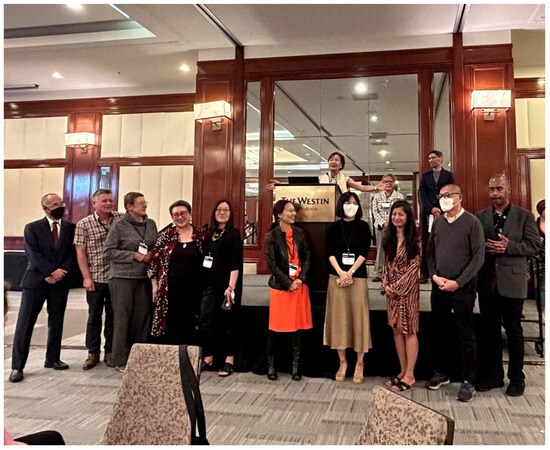
Figure 1.
From Left: Brian Niiya, Sean Metzger, Dominika Ferens, Tamara Ho, Lynn Itagaki, Erin Suzuki, Julia Lee, Denise Cruz, James Kyung-Jin Lee, Robert Kyriakos Smith.
The MA and Honor theses and dissertations I directed also reveal a telling tale, for out of the forty-plus students who asked me to be their supervisor, over thirty are of Asian descent, albeit of different nationalities. This phenomenon attests to the impact of ethnic studies programs and of the print media in engendering a pan-ethnic Asian American community. Yet it is disconcerting that so few non-Asians gravitated to Asian American literary studies. Two major exceptions prove the rule. Dominika Ferens, author of Edith and Winnifred Eaton: Chinatown Missions and Japanese Romances (Ferens 2002; diss. 1998) was a Fulbright scholar from the University of Wroclaw, Poland, where she is currently Professor. Yasser Fouad Selim, whose dissertation is entitled “East–West Collision in the Major Plays of David Henry Hwang” (2008), was from Sohag University, Egypt, and is currently Dean of Buraimi University College. Both Dominika and Yasser, like myself, were foreign students. No less puzzling, given my multiethnic orientation, was the scarcity of European Americans and non-Asians of color who knocked at my door. Acutely aware that ethnic studies programs owe their emergence to the civil rights movement in the late 1960s and early 1970s, fought and won through a multiethnic coalition spearheaded by African Americans, from the outset I taught Asian American literature alongside texts by writers of other races. My article on Walker and Kingston reflects this direction, and is also an indication that Chinese American literature was to me no less challenging than African American literature at the time.
5. Culture Wars, Curricular Transformation, and Interracial Alliances
Since I have pushed toward a multiracial, interethnic, and gender-sensitive goal throughout my teaching career, the near absence of non-Asians who sought me out as a resource could only be attributed to what Stephen Hong Sohn calls “racial asymmetries” (Sohn 2014). What rights did I have to teach works by writers who do not have a drop of Mongolian blood? Several former students are pioneers in interracial and interethnic cultural studies (see Itagaki 2016; J. H. Lee 2011; K.-J. J. Lee 2004; R. C. Lee 1999). Furthermore, the courses co-designed or designed by me that reflect UCLA diversity have been my strongest curricular contributions on account of the concerted effort of colleagues of all genders and colors. I would like to acknowledge them here while simultaneously addressing the counterproductive effects of racialization and “genderization” in fostering an intersectional humanist community.
The two senior colleagues who have consistently supported multiracial and feminist endeavors are Karen Rowe, former director of Women’s Studies, and Richard Yarborough, who held a joint appointment in African American Studies. Karen received a 1989 Ford grant to integrate works by women of color into the curriculum and invited me—the lone female of color in the Humanities Division—to facilitate a workshop that introduced writers of African, Native American, Chican@, and Asian descent. Both Karen and Richard felt uncomfortable as co-facilitators, however, because women of color at the time took exception to white feminists for speaking as universal women and to racialized men for being no less sexist than white men. A black poet from afar was invited to be my co-facilitator. Had Karen or Richard (both recipients of campus-wide distinguished teaching awards) been my co-facilitator, the workshop and its ensuing impact would have been redoubtable. Racialized and gendered accusations that homogenize people deterred eminently qualified colleagues from assuming leadership roles that would have diversified UCLA sooner rather than later. During that volatile time of the “culture wars” (Jay 1997), I too did not get away unscathed; my piece in Conflicts in Feminism (Cheung 1990), which seeks to reconcile women and men of color by underlining their parallel subjugation and anticipates Kimberlé Crenshaw’s concept of intersectionality, was accused of catering to white feminism by airing dirty Chinese laundry.
Under the charged climate, Karen and Richard understandably felt self-conscious even though I was far less qualified than either in leading the 1989 Ford workshop. My seeming edge over them–an amber face–was spurious, for many Asians outside UC do not consider themselves—nor were perceived by others—as “colored.” Two experiences drove that point home. My Women of Color course (WS130) was attended by opalescent Bruins. Hence, I was taken aback when I taught two courses at Harvard in Fall 1991, on Asian Americans and on women of color, respectively. Both courses, capped at 30, were full, but 30 Asian faces greeted me in one and zero in the other. The reason, according to the Asian students, was that they didn’t identify with racialized minorities. The myth of the “model minority,” which might have elevated Asians as “honorary whites,” has created a cleavage between Asians and the disfranchised. The 2023 lawsuit by Asian Americans against Harvard for admitting people of color at their expense suggests that this division still persists. Yet my course on Asian American authors might have jolted some Vardians. I was jubilant to hear, decades later, from Roger Kuo (B.A. Harvard 1993): “Your course inspired me in a foundational way. Last year, my wife and I funded a professorship in Asian American Studies at Harvard, so that future generations of Asian Americans can be similarly inspired” (email dated 19 April 2024). Richard and Karen are special for promoting diversity at UCLA long before it was sanctioned by the administration. They strive for racial and gender justice not because it was “politically correct” but because they live their cause; they teach not so much for “livelihood” as to change lives.
What I learned from the students then was no less phenomenal. After studying works by writers of color in the Ford workshop, the same colleague who disparaged The Woman Warrior said she would set aside a week for people of color in her women writers course, whereupon a nonbinary black student snapped that the workshop is not about tokenization but transformation, and would the professor please overhaul her syllabus. The pungent point made by the doctoral student and her temerity in dissing a professor stunned me. That heated exchange taught me not to ever demarcate a color line when teaching authors of different origins and to stress interracial dynamics instead, also to encourage disagreement from students so that we can learn from one another.
The Ford workshop and the ensuing courses emboldened me to develop with Richard an interdisciplinary General Education Cluster in the wake of the 1992 LA riots. Our three-quarter pilot, entitled “Interracial Dynamics in American Culture, Law, and Society,” was team-taught by Kimberlé Crenshaw (Law), Henry Yu (History), Richard and me in 1998–1999 (Figure 2) and by Cheryl Harris (Law), Brenda Stevenson (History), Henry and me in 1999–2000. The invigorating experience ejected me from my literary cocoon. As in the Ford seminar, the jarring viewpoints generated were staggering but eye-opening. When we played the video of Korean grocer Soon Ja Du shooting black teenager Latasha Harlins, the empathy expressed by Korean American students toward Soon and the outrage of African American students against her floored me. Their reactions replicated those of the black and Korean federal mediators. “I watched the video and saw a frightened Korean American woman whose gun went off accidentally,” Jan Jung-Min Sunoo said. “My black colleague watched and said, ‘That settles that. She shot the girl in cold blood’” (Zia 2000, p. 176). These antithetical responses throw into question whether judgment can be independent of racial allegiances. Korean American writer Ty Pak’s fictionalization of this killing in “The Court Interpreter” (assigned reading) reveals how the identity politics that mobilized ethnic groups during the civil rights movements can skew perceptions. I taught a related course subsequently on Literature and Society, with Reading Rodney King/Reading Urban Uprising as the required text (Gooding-Williams 1993). The essays therein, along with the class discussions, inform my article on “The Court Interpreter” (Cheung 2005).
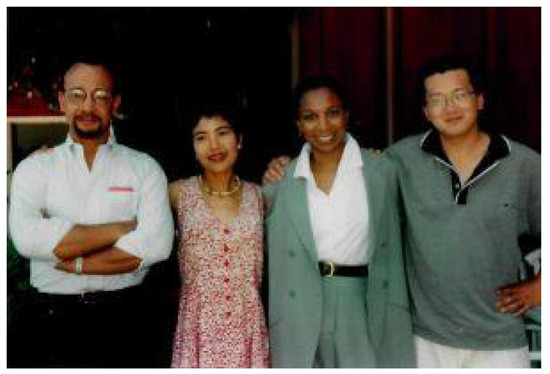
Figure 2.
Original GE Cluster team, 1998–1999. From the left: Richard Yarborough (English), King-Kok Cheung (coordinator, English), Kimberlé Crenshaw (Law), and Henry Yu (History).
The faculty members of this GE Cluster consider the experience to be a milestone; we have learned so much from one another and from the Bruins. Two teaching assistants—James Kyung-Jin Lee and Lynn Mie Itagaki—went on to complete dissertations focusing on interracial dynamics. Fifteen years later, in 2014, I joined Marissa Lopez (Principal PI), Rafael Perez-Torres, Uri McMillan and four doctoral candidates in developing an Upper Division Ethnic Literature course funded by a Mellon grant; our efforts resulted in English 100: Ways of Reading Race.
The GE Cluster and English 100 might have buttressed “racial asymmetries,” exemplified by Hannah Nahm and Robert Kyriakos Smith, co-editors of this special issue. Hannah took my seminar that was part of the 1999–2000 GE Cluster, and returned to UCLA to pursue her doctorate. Her dissertation, “Alien Love: Passing, Race, and the Ethics of the Neighbor in Postwar African American Novels 1945–1956” (2021), codirected by Richard and me, examines African American fiction without any ostensible black characters. Robert Kyriakos Smith, co-designer of English 100, completed “Representing Radical Politics in Anglophone Caribbean Literature After Independence” (diss. 2020), but neither Bobby nor Jenny Sharpe, his director, is from the Caribbean. Bobby, Hannah, and I formed a racially asymmetrical trio when the two responded to my articles on Yamamoto’s “A Fire in Fontana” and Ty Pak’s “The Court Interpreter” for a special issue of Philosophia commemorating the tenth-year anniversary of Sai-I-Gu (Nahm 2021; Smith and Cheung 2021) (Figure 3).
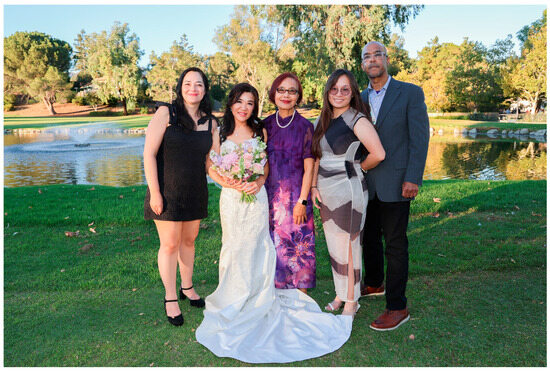
Figure 3.
Hannah Nahm’s wedding (7 September 2025). From the left: Lupe Escobar, Hannah Nahm, King-Kok Cheung, Qinglan Li, Robert Kyriakos Smith (all Bruins).
I invoke my humanist formation by the Ford workshop, the GE Cluster, and English 100 to acknowledge the Bruins who have made me grow and ripen, and to justify my multiethnic credentials, which have nothing to do with my race. Similarly, while Richard Yarborough has been exalted, deservedly, as an African Americanist legend and Karen Rowe as the dynamo pathbreaker of women’s studies, their contributions to a multicultural and intersectional curriculum and to the diversification of the faculty and student population have been elided. Another farsighted game changer is Ishmael Reed, founder of the Before Columbus Foundation (BCF) in 1976, a nonprofit organization that has mounted a literary rainbow. Shawn Wong, one of Reed’s partners, recalls: “I first met Ishmael in 1969 when I was twenty and have been included in all of his endeavors since then—there’s even a picture of me in his novel Mumbo Jumbo” (email dated 11 September 2024). In 1980, Reed proposed an American Book Award to challenge the lack of diversity in the Pulitzer Prizes and the National Book Awards; since then over three dozen Asian American writers, including Peter Bacho, Thi Bui, Frank Chin, Jessica Hagedorn, Joy Kogawa, Chang-rae Lee, David Wong Louie, Ruthanne Lum McCunn, Hualing Nieh, Ruth Ozeki, Bienvenido Santos, Ocean Vuong, and Karen Tei Yamashita, have won the BCF award. Yet few people today know that this award was established by Reed, known primarily as a vociferous black writer. Reed, Rowe, Yarborough and I all practice what we preach: we don’t just advocate for diversity but staunchly support each other and each other’s students. Just as Ishmael has included Shawn in all his endeavors for decades, Karen took me to a conference on women of color in Buffalo; Richard nominated me as a coeditor of The Heath Anthology of American Literature; I nominated Richard for the campus-wide diversity award. Our friendship has lasted four decades, since 1984. In comparison with these colleagues who have worked tirelessly toward gender and racial equality, my pedagogical aims are constantly in flux, shifting and stretching according to student composition. James Kyung-Jin Lee and Julia Lee (former PhD mentees) put it best when they nominated me for the 2023 AAAS Lifetime Career Award: “Professor Cheung continues to wonder and ask of herself and of us: who is next yet in the room?” (Lee and Lee 2023).
6. Racial Asymmetries
What accounted for the racial disproportion among students who have called on my expertise? Perhaps Asian students find it easier to develop a good rapport with me; non-Asians of color are likewise drawn to mentors of like hues; Caucasians hesitate to focus on ethnic literature for fear of “reverse discrimination.” But why had not a single student called upon my Renaissance expertise before I shifted my research to the New World, given that I was the workhorse who taught the Shakespeare and Milton requirements, and was thanked for “justifying Milton to the Bruins”? The Bruins, too, seem wary of racial asymmetries. I was touted as an Asian Americanist authority almost overnight, but I was (and still am) far more at home with Shakespeare and Milton, Toni Morrison and Langston Hughes, Louise Erdrich and Leslie Silko, Sandra Cisneros and Helena Maria Viramontes than with Pacific Islanders, or writers of Hmong, Cambodian, Thai, Indonesian, Pakistani, and Palestinian descent.
Furthermore, a double standard prevails with respect to racial asymmetries, for Caucasian sinologists are rightly venerated in the Asian Languages and Cultures Departments, while mastery of Anglophone literature by Asians, especially those with foreign accents, is often regarded with a grain of salt. In China, Euro-American sinologists deliver their papers or lectures in English, while I have been asked, repeatedly, to present mine on American writers in Putonghua, my third language. How refreshing, therefore, when Saree Makdisi, Chair of English, invited me to be the 2023 commencement faculty speaker. In his introduction Saree did not commend my mastery of English, but recounted my Homer-Renaissance-Americanist trajectory as a hallmark of UC’s “extraordinary global conjunctures that could bring someone from Hong Kong to study Shakespeare and Milton at Berkeley and then for her to teach other great writers to students whose first language, like hers, is not English.” Let me echo his plaudits for UC’s “global conjunctures” by returning the compliment: our Chair not only possesses “the supreme gift of great teaching” but also writes beautifully; he is, above all, a public intellectual like the late Edward Said, his uncle, whose Orientalism has changed the world (Said 1979). After Said and Saree, who can look askance at Asian American professors of English? (See also Nguyen 2024).
The Renmin University of China (RUC)-UCLA Conference on American Literature and the Changing World (30 June–1 July 2012, Beijing), co-organized by Keli Diao (RUC Chair of Foreign Languages) and myself, unfurled a colorful tapestry (Figure 4). Flouting the tacit “white” preference, I submitted as keynote speakers Ali Behdad, Paul Lauter, Valerie Smith, and Richard Yarborough without disclosing their ethnicities. The joint conference was a huge success, but there was a glaring blunder during the opening ceremony when all the keynoters were spotlighted on stage: RUC neglected to reserve a VIP seat for Richard, the sole African American in the huge auditorium. Richard took the oversight in stride, but it stung me, though I too have been frequently effaced as a Chinese female. During the photo session of the 2016 international Shakespeare conference at Peking University, for example, two seats with my name and that of a female keynoter were reserved in the front row, but the photographer curtly asked all the seated ladies to stand behind (Figure 5). Bemused, Jonathan Hart asked me afterwards, “What was that about?”
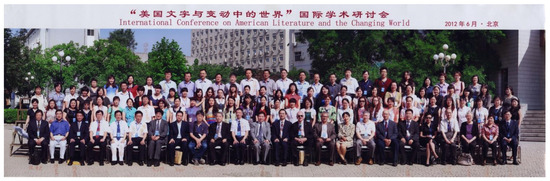
Figure 4.
Front Row from Right: Keli Diao, Wei Lu, Lili Wang, Ning Wang, Cindy Fan, Jianping Wang, Richard Yarborough, Guiyou Huang, King-Kok Cheung, Ali Behdad, Paul Lauter, Qixin He, Huilin Yang, Shouren Wang, Te-hsing Shan, Kun Jong Lee, Selim Yassar, Guodong Jia, Qiqing Guo, Yingjian Guo, Guoqiang Ren, Xiaoming Yang, Shidan Chen, Yongxian Zhang.
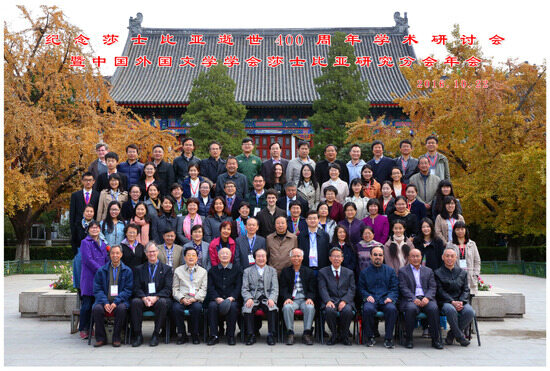
Figure 5.
Shakespeare Symposium at Peking University, 22 October 2016. Back Row R1 Cun Xie, R10 David Li; 5th Row R1 Cong Zhang, R2 Ivy Liu; 2nd Row: L1 Jiangnan Xie, L2 Yan Zhang, L4 Ping Ning, L5 King-Kok Cheung, R3 Shuang Wu; 1st row: L2 Jonathan Hart, L4 An Tu, L5 Zhengkun Gu.
7. Comparatist Turn and Transpacific Communities
Retooling myself as an Americanist connects me with prismatic communities at UCLA and all over Asia. Since 1993 the Institute of European and American Studies of Academia Sinica, led by indefatigable Americanists Te-hsing Shan 單德興 and Wen-ching Ho 何文敬, has sponsored over six symposiums on Chinese/Asian American literature. No less pivotal to the development of this field is the Chinese American Literature Center inaugurated by the late Bing Wu 吴冰 et al. of Beijing Foreign Studies University (BFSU). Wu stated that “Chinese American literature can deepen our knowledge of America, Chinese America as well as China” (2008, 105). With a holding of some 300 books and a website, this center has been the hub of Chinese American literary research in mainland China. Transnational Asian American literary studies flourish on account of the persistent engagement of Chinese scholars.
Asian American literary studies itself has taken a transpacific turn, from stressing the distinction between “Orientals” and Americans to convoking Asians from distant shores and heeding the heterogeneity within each nationality. The editors of the groundbreaking Aiiieeeee! An Anthology of Asian American Writers (Chin et al. [1974] 2019) depart from their 1974 definition of “Asian American sensibility” as neither Asian nor white and from their “English only” criteria (Chin et al. [1974] 2019). Frank Chin in The Big Aiiieeeee! (1990) goes so far as to affiliate Chinese and Japanese epics (Chushingua, Water Margin, Romance of the Three Kingdoms, Monkey, etc.) with an Asian American heroic tradition (Chin 1991). Because these works are unfamiliar to most Americans, however, his ardent pronouncements fell mostly on deaf ears. But not on mine. Familiar with these works since school days, I welcome the opportunity to connect them with American, Greek, and English studies, though I balk at the association of masculinity with “heroic” violence. Chin’s attempt at “re-masculation” recalls Greenblatt’s observation that any “self-fashioning” is inextricable from existing mores, including in this instance East-West gender hierarchy. Hence the subtitle of “The Woman Warrior versus The Chinaman Pacific: Must a Chinese American Critic Choose between Feminism and Heroism?” (Cheung 1990). I designed two honors collegium courses entitled “Comparative Heroic Traditions” and “Comparative Odysseys” successively, assigning the “Ballad of Mulan,” the Iliad/Odyssey, Water Margins/Monkey, Samson Agonistes/Antony and Cleopatra, and Derek Walcott’s Omeros in both, but ending “Heroic Traditions” with two feminist re-visions—Christa Wolf’s Cassandra and Hong Kingston’s Tripmaster Monkey; and ending “Comparative Odysseys” with Edward Said’s Out of Place and Barack Obama’s Dreams from My Father.
These two courses paved the way for a global research spin during my two terms as UCEAP director in Beijing and Shanghai, propelling me further from the familiar turfs of British and American literature. The ensuing publications include “Chinese and Chinese American life writing,” inspired in part by the joint UCEAP-PKU seminar co-taught with Baisheng Zhao 赵白生, on the negotiation of independence and interdependence between Chinese luminaries (Kang Youwei 康有為, Liang Qichao 梁啟超, Hu Shi 胡適) and American writers (Maxine Hong Kingston, Ruthanne Lum McCunn, William Poy Lee) (Cheung 2015); “Theorizing in Narrative Form” on Bing Xin 冰心’s anticipation through narrative of Said’s Orientalism (also Jeffery Paul Chan and Frank Chin’s “racist love”) (Cheung 2012); “Postcolonial Forerunners: Pearl Buck and Bing Xin,” on the two writers’ critique of American missionary condescension toward heathens (Cheung 2018); “Two Forms of Solitude,” on Tao Yuanming 陶淵明’s pastoral ideal and Emerson’s transcendentalism (Cheung 2016b); “Self-Critique Prompted by Immersion in (An)Other Culture,” on Xu Zhimo, Pearl Buck, and Goldsworthy Lowes Dickinson. This article argues that immersion in a foreign culture can spark astute censure of one’s homeland (Cheung 2017b). Along this line, I play the devil’s advocate against Chinese Ethical Literary Criticism developed by Zhenzhao Nie 聶珍釗 by asking, “whose ethics?” (Cheung 2017a). Several of these articles are revised and expanded as book chapters in Chinese American Literature without Borders (Cheung 2016a). The sojourn abroad even prompted me to connect life writing with Obama’s presidential election; I presented “Dreams from My Father(s): The Making of a Transnational President” at a 2009 conference co-sponsored by US-China Education Trust and Beijing Foreign Studies University, which evolves into a co-authored book chapter (Smith and Cheung 2017), and gave a public lecture at PKU in 2010 entitled “Hamlet in Obama: Triple Legacies and Soul-Searching (In)Decisions.” I might have lobbied indirectly for President Obama (Figure 6).
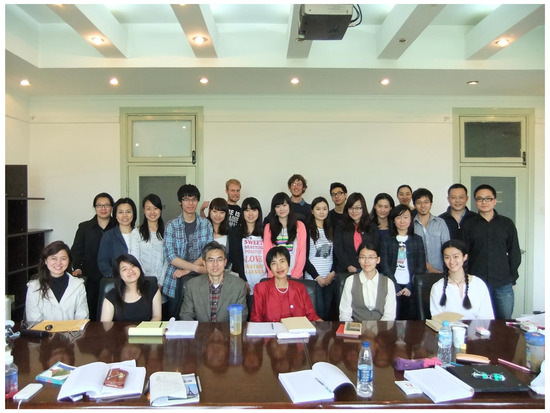
Figure 6.
Joint UCEAP-PKU seminar on World Autobiography taught by Baisheng Zhao and King-Kok Cheung (Peking University, 10 May 2010) Front Row: L1 Zhong Yan, L3 Baisheng Zhao, L4 King-Kok Cheung, L5 Xiaomu Cheng, L6 Shuang Wu; 2nd Row: R2 Yiping Zhao, R3 Guangchen Chen, R4 Lu Gao, R6 Xiaoxue Sun, R8 Di Liu, R9 Ying Cheng, R11 Yizhi Xiao, back row; R1 Ryan (UCB), Kong Ming (UCB).
The Cathay years also enabled me to dip into taichi and traditional Chinese medicine (TCM), and to resume my affair with Shakespeare and start another one with Jin Yong. These hobbyhorses end up cohabiting, for every taichi guru I have befriended—Renan Lu 陆仁安, Jun Wang 王軍, Ivy Liu 刘昊, Tianjin Lin 林添進, Yun Zhao 趙雲, and Zifang Su 蘇自芳—is a humanist. Lu, now 98, used to lead taichi practice at RUC every day; he dedicates himself to its dissemination because it has saved his life. Jun is a PKU professor of Information Science who spearheaded “Digital China”; Ivy is a Shakespearian at Tsinghua University (our encounter later ballooned into a mini “Globe”). These fetching mentors notwithstanding, I was a poor learner, having to supervise 120 UCEAP students and to take care of my 10-year-old son’s transition from UCLA Elementary School to a local one; I “returned” every routine I learned from this trio once back in the US. Luckily, a second chance presented itself in Shanghai when I met Master Lin, founder of College Taichi. I relayed its flexibility exercises to the Bruins till COVID-19 descended upon the world, whereupon I was introduced, via Zoom, to Yun Zhao 趙雲 and his mother Zifang Su 蘇自芳, the 1990 ASIAD (亞運) gold medalist. I have been team teaching with Master Yun Zhao at UCLA ever since (Figure 7).
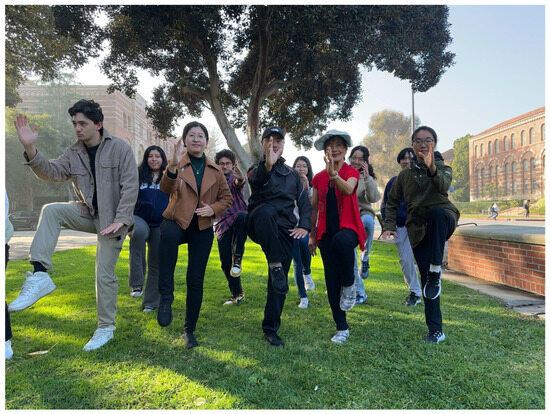
Figure 7.
Fiat Qi Seminar Team-Taught by Master Yun Zhao and King-Kok Cheung (Fall, 2024). R1 Wenwen Jia (TA), R2 King-Kok Cheung, R3 Yun Zhao, R4 Chunduan Xiao (Visiting Scholar).
A pause here to explain why someone dubbed a “sports inactivist” by schoolmates can be induced to learn taichi. The answer: it is not a sport, but a form of martial arts and liberal arts that requires the synergistic coordination of mind and body, words and motion, self and the environment. “Taichi is for [cultivating] smart people” is Grandmaster Su’s refrain; it is conducive to “xiushen yangxing 修身養性,” i.e., self-cultivation of disposition and moral character (see also Zhang 2023). The six aforementioned instructors, all caring teachers, are versed in TCM, its attendant physiological structure and worldview: the connection of every joint, ligament, bone, muscle, and crevice of the human body, and of the microcosm and macrocosm analogous to the “Elizabethan world picture” (Tillyard [1942] 1959). The most unexpected affinities of martial arts and liberal arts are the importance of mnemonic chants and poetic formulations, the “mobilization” (pun intended) of the five senses, and the connection of every verbal, vocal, or physical component to attain an organic whole. Both Confucius and Socrates submit that humans advance intellectually, morally, and spiritually through acquisition of the arts; the Sages who have thus cultivated themselves would naturally want to share their holistic knowledge. My gut feeling that “the human is the humanist” stems from the exemplary teachers in my life, including the taichi sifus dedicated to propagating this flowing art. Transcultural and multi-disciplinary knowledge brings it to another level. Master Yun Zhao, a martial artist who is thoroughly bilingual and bicultural, conversant in Western and Chinese medicine, is a perfect role model for the Bruins to emulate—in intellect, creativity, physical agility, mental acuity, tolerance, kindness and empathy.
Literature and martial arts also converge in my fling with Jin Yong/Louis Cha (JY), acclaimed wuxia novelist. As a busy mother, I fed my son on wuxia TV series adapted from JY fiction since he was a toddler and facilitated his transition to a Beijing local school in 2008 by getting him the complete JY set of 36 volumes, which he soaked up surreptitiously during bedtime within a year. Even I got acclimated to the JY universe sufficiently to offer a JY Fiat Lux seminar in 2018, and published an article that traces the humanist genesis of his fiction (Cheung 2019b). The Chinese counterpart of Shakespeare—who appeals to folks from all walks of life—is for me not erudite Tang Xianzu 湯顯祖 but JY, also Tong Dik Sang (more on TDS anon). Who did JY profess as his greatest influence? The Bard. This amazing genealogy could have reconciled the opposing camps of my department during a major curricular reform when heated dissension raged over the replacement of earlier requirements, Milton included, with gender inclusive courses and world literature. UCEAP kept me in Shanghai (2015–2017), or I could have proposed an alternative requirement along the lines of “comparative odysseys,” whereby Shakespeare and Milton are taught alongside Homer, Three Kingdoms, Journey to the West, Cassandra, Tripmaster Monkey, Omeros, Dreams from My Father, and Out of Place, so as to catch up with the new without jettisoning the old, and reticulate the humanities.
Not surprisingly, the bardolaters I met in Beijing all happened to be JY fans. Ivy Liu 刘昊, Professor at Tsinghua University, met RUC Shakespearian Jiangnan Xie 謝江南, and Ivy introduced me to her PKU Bardmate Cun Xie 解村, and Cun and I have since coauthored an article entitled “Shakesphere” to encapsulate Booth’s “Indefinition” and Rabkin’s “complementarity” (Xie and Cheung 2024). I also got reacquainted in Shanghai with Jonathan Locke Hart, whom I met in 1988 at the School of Criticism and Theory at Dartmouth College. Jonathan “reminded” me that Edward Said had admonished me at SCT not to forsake Shakespeare, and I almost fell for his hoax. The 2016 Shakespeare symposium Hart organized in Shanghai was attended by Francis K.H. So 蘇其康, an old friend who translated Le Morte D’Arthur and Canterbury Tales, and Walter Lim, a fellow Renaissance Asian Americanist. My second life as a Shakespearian culminated in a panel entitled “‘More things in heaven and earth’: Shakespeare through Other Cultural Prisms,” co-organized by Ivy and me for the World Shakespeare Congress (WSC), Stratford-upon-Avon and London (31 July–6 August 2016); among the panel participants were Jonathan (London and Alberta, Canada), Francis (Kao Hsiung, Taiwan), Jane Wong (Singapore), Jiangnan (Beijing), and me (Shanghai, Hong Kong, France, and LA). A little globe. The most pleasant surprise was a brief reunion with Stephen Greenblatt, whose voice has hardly changed in thirty-five years (Figure 8).
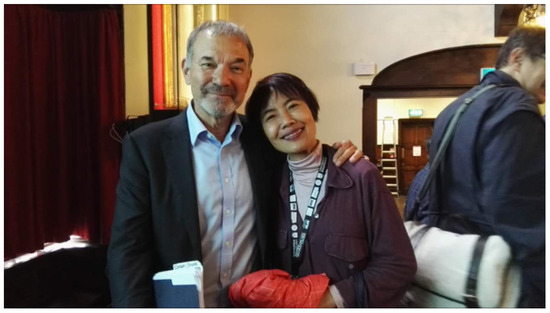
Figure 8.
Stephen Greenblatt and King-Kok Cheung (World Shakespeare Congress, Stratford-upon-Avon and London (31 July–6 August 2016); photo by Ivy Liu.
This reunion conjures up the line of my dear tertiary mentors, though my humanist formation began long before I set foot in the New World. In Hong Kong my peers and I had received an enviable bicultural primary and secondary education. Owing to colonization and Orientalism, however, we did not treasure our Cantonese heritage. The flipside of this indigenous obfuscation is the consecration of Western civilization, so much so that Asians may look askance at fellow ethnics specializing in English literature as “not quite” because “not white” (to borrow Homi Bhabha’s evocative expression). When I was UCEAP Director, Chinese colleagues who asked me to recommend UC students to teach English at their institutions imposed a “whites only” criterion; informing them that most UC students are native English speakers did not change their mind. What to call such discrimination against heritage students (also an affront to me, a yellow Professor of English)? “Self-contempt”?
8. “Self-Contempt”: Disavowal of Ancestral Culture
Ng’s Orphan Bachelors is for me “the most potent literary tonic since The Woman Warrior” (Cheung 2024). (The original subtitle of “The Human Is the Humanist” is “A Renaissance Renegade Reads Fae Myenne Ng’s Orphan Bachelors.”) In addition to transmuting personal and communal history into literature, these two memoirs resonate with the brass and gongs of Cantonese opera. Professor Fae takes a “linguistic inventory” at the start of each semester at Cal: “What’s your first language? In which are you the most honest, the most playful?”
Many raised by grandparents speak … Cantonese, Hmong, Hokkien…. More have parents who refuse to speak anything but English. Sometimes, when my students open their mouths, I cringe.“…everybody sounds white. Why the AP speak? Why don’t I hear your ancestral language in your English?”(Ng 2023, p. 73)
I can answer: international academic institutions, whether in the U.S., U.K., Canada, or China, give imprimatur to AP speak, “Standard English,” or “Queen’s English.” Fae is the first Professor of English I know who refuses to be the standard bearer. While she could use the “master’s tools” to “dismantle the master’s house” (Lorde 1984), she does so with impudent variation. Her visceral knowledge of Taishanese allows her to grasp the dialect of Mrs. Lily Chin (mother of Vincent Chin) as the “language for lament,” and to describe her wailing as “a shovel pitched into the earth, a rake in my four chambers.” “When she sighs, her neck sinks into her spine, her back bends as she wraps her arms over her own chest” (Ng 2023, p. 76). Mrs. Chin and Fae’s parents are subalterns who belt Toishanese but are not heard. Ng pushes her students to consider ancestral languages as “an unadulterated power of voice” (Ng 2023, p. 76). Like Fae, I cherish my first language to the extent of uprooting my son from his beloved UCLA pre-school to sojourn in Hong Kong for two years, where he attended a local kindergarten, my alma mater. But I have never infiltrated English with Cantonese, let alone urged Bruins to “adulterate” English with their mother tongues. Why? The term “self-contempt” is coined by the Aiiieeeee! editors to refer to minority members’ blind acceptance of the dominant standards of beauty and excellence. This self-denigration is painfully fleshed out in Toni Morrison’s The Bluest Eye, John Okada’s No-No Boy and Nina Revoyr’s Southland.
The very editors who coined this term back in 1974 too turned their backs on their Asian roots initially and regarded American nativity as integral to “Asian American sensibility,” held to be “so delicate at this point that the fact of Chinese and Japanese birth is enough to distinguish you from being American-born, in spite of the fact that you may have no actual memories of life in Asia” (Chin et al. [1974] 2019, p. xxvii). They adopted this litmus test because American culture still portrays American-born Asians “as foreigners and refuses to recognize Asian American literature as ‘American’ literature” (Ibid, p. xxvii). They deprecated popular writers such as Lin Yutang 林语堂 (1895–1976) and C.Y. Lee 黎锦扬 (1915–2018) as “Americanized Chinese” who succeeded in being “Chinese American” only in the “stereotypical sense of the good, loyal, obedient, passive, law-abiding, cultured sense of the word”; “their writing is from whiteness, not from Chinese America” (Ibid, pp. xxviii–xxix). They even denounced Lin and Lee for “becoming white supremacist” in “consciously and voluntarily becoming ‘American’” (Ibid, p. xxix). The editors’ attempt to “claim America” for American-born Asians by repudiating anything that smacks of Orientalism might have been the reason why Arthur Sze, the first American of Chinese descent named 25th poet laureate of the United States, is not mentioned, let alone included, in Aiiieeeee! (1976) and The Big Aiiieeeee! (1991), when Sze had already published The Willow Wind back in 1972 (Sze 1972), and four books of poetry by 1991. Though Sze was born in New York City, he “learned his craft by translating ancient Chinese poems” (Harris 2025). The editors might have taken exception to Sze’s attachment to the glory of Cathay.
Sze is included in Breaking Silence: An Anthology of Contemporary Asian American Poets (Bruchac 1983) and Asian American Literature: An Annotated Bibliography (Cheung and Yogi 1988). Back in the late 1980s (and even now), my sensibility as a Hong Kong native who holds ancient Chinese poetry dear was closer to Sze’s than to the “Asian American sensibility” propounded in Aiiieeeee! One might say an ancestral “symmetry” connects the prospective poet laureate and the Asian Americanist novice despite our birthplaces apart. Lest I be condemned as “Americanized Chinese” and “white supremacist” by the cocksure Asian Americanist spokesmen, however, I learned my Americanist craft by studying works by writers of color—the opposite direction of Sze’s apprenticeship as poet—instead of capitalizing on any indigenous sensibility. In a sense Chin’s clarion call to reclaim an Asian heroic tradition gave me the green light to mine the Asian ore, though I remain far more attached to Chinese poetry than to Asian epics.
I agree with Sze that poetry, and arts in general, must resist “all forms of coercion.” Even resistant identity politics and “spokesmanship” can coerce; the subtitle of one of the earliest articles on Sze hails him as “A New Mexican Poet Who Refuses to be Categorized” (Lim 1986). Take the editors’ denouncement of Lin Yutang for trying to become American by creating stereotypical Chinese and model Asian Americans. Ha Jin echoes the editors with regard to Lin’s pollyannish portrayal of the Chinese: “Throughout Moment in Peking (Lin [1939] 1942) the narrative reveals that the book was written only for a Western audience…. Among the oversized cast of eighty-odd characters, there is not a single evil person, which cannot be true to life” (Jin 2008, p. 17). Unlike the editors, however, Jin offers a sympathetic and far more plausible reason for Lin’s choice of audience and one-dimensional portrayal: after the outbreak of the Sino-Japanese War, Lin took on the role of cultural ambassador so as to help China gain U.S. public support. Consequently, Lin painted a benign picture of his compatriots at the expense of their complexity. Cognizant that spokesmanship hampers artistic expression, Jin consciously negates the role of being a cultural spokesman (Jin 2008, p. 28).
Jin’s caveats about the contingencies of spokesmanship (the sexist word kept intentionally) are worth heeding, especially since what is espoused in one country or at one time can be pilloried in another. Any one-sided story can come across only as propaganda, not as literature. Resonant arts and culture have always defied constraints, regardless of the artist’s ethnic or national origins. Though Lin falls short of the Aiiieeeee! editors’ post-civil rights oppositional politics, he should not be relegated to the “white supremacist” party. In light of the historical context, Lin should be lauded rather than roasted for being a cultural spokesman of war-torn China, just as the Aiiieeeee! editors should be credited for being booming mouthpieces of repressed Asian America. Nevertheless, Lin’s attempt to represent the Chinese favorably to a Western audience does occasion homogenization of the tribe. The impulse to represent “Asian America” to Americans of many stripes also trips the Aiiieeeee! editors. Any categorization and categorical injunction positing acceptable and unacceptable ways of being or telling is a form of coercion. The Aiiieeeee! editors accuse Lin of pandering to white America, but their criteria of American nativity and Anglophone focus in Aiiieeeee! also marginalize foreign-born and naturalized Asians. They have made considerable amends in The Big Aiiieeeee! by including “The Ballad of Mulan” and other works in Chinese. Frank Chin, as I noted earlier, even takes pains to expatiate on Asian epics.
Yet Chin’s about-face—from giving short shrift to Asian lore to appointing himself as the arbiter of the “Real and the Fake” Asian American writing—is done with excessive vengeance. He reprimands Hong Kingston for distorting Chinese myths by putting a tattoo on her Mulan figure in The Woman Warrior. I consider this transfiguration of a legendary swordswoman into a wordswoman and Hong Kingston’s redefinition of baochou 报仇 (the Chinese idiom for revenge) as “report a crime” to be an ingenious stroke of invention that has heralded an Asian American heroic tradition of avenging injustice: “The reporting is the vengeance—not the beheading, not the gutting, but the words” (Kingston 1976, p. 53). The expanded Chinese edition of Chinese American Literature without Borders contains a brand-new chapter on Ng’s Orphan Bachelors (2024) and Ha Jin’s The Woman Back from Moscow (Jin 2023), two works of creative life-writing that epitomize this tradition (Cheung 2025). In our warmongering age, avenging heinous crimes through poetry, songs, operas, journalism, and scholarship may be the only heroism worthy of exaltation.
As a former member of the Hong Kong Chinese majority, I glibly thought I was immune to any cultural inferiority complex. Orphan Bachelors makes me think again, for I have never “tampered” with my writing in English and Chinese with Cantonese—the lingua franca of 99 percent of Transcontinental Railroad builders from Guangzhou and of Titanic’s Chinese survivors. This vernacular, “spoken by 80 million people globally” (Under Threat 2025), also animates the works of Ava Chin, Frank Chin, Louis Chu, Hong Kingston as well as the movies of Jackie Chan, Leslie Cheung, Maggie Cheung, Chow Yuen Fat, Bruce Lee, Anita Mui and Michelle Yeoh. Upon reading Ng’s memoir I have been, to borrow Stanley Fish’s title, “surprised by sin”—the sin of occluding an ethnic culture I should have proudly reclaimed and proclaimed. I never put on my CV the experience of teaching Cantonese at Cal, lest the eyebrows of English dons be raised. My misgiving was not peculiar to my status as the solitary foreign student in the department, however, for the lack of pride in our Cantonese bequest was no less prevalent among my HK contemporaries, though the unconscious disavowal of an indigenous culture is the more reprehensible in a professed advocate of ethnic diversity. My mother, disparaged by Father and some of my siblings for not being a dexterous housewife, was an avid fan of Cantonese Opera (CO) diva Yam Kim-fai 任劍輝 (YKF), the lead male impersonator, with Pak Suet-sin 白雪仙 (PSS) as the female lead. Mom’s accidental lastborn became an yueju 粵劇 aficionado by eavesdropping. Imagine my thrill at running into the name of PSS in Fae’s memoir.
The fabled duo’s repertoire was scripted and composed by Tong Dik Sang/Tang Ti-sheng 唐滌生 (TDS) who, like Shakespeare, composed each play with the actors in mind. BSS was most likely TDS’s Muse, for her persona executed by his strokes exudes artistry and confidence, even a kind of noblesse oblige bordering on hauteur. This prima donna is invariably drawn to a suitor of like accomplishment, played by YGF; once their zhiyin bond is sealed, love lasts unto death, even beyond. YGF-PSS could play these roles with nonpareil verisimilitude out of reciprocal admiration of each other’s caihua 才華—artistic talents, scholarly breadth and depth, and the personality forged thereby. The term, which defies a succinct English translation, means accomplishment in wen 文 liberal arts, especially in renwen 人文—the humanities—which in ancient China encompassed all knowledge. The YGF-PSS-TDS collaboration evinces a kind of zhiyin bond deeper than eros and philia, and more insistent than hetero or homoerotic sex. The caihua of the two divas, straight onstage and nonbinary offstage, comes through in each play, thanks to the exquisite lyrics by TDS, whose aforementioned talent is comparable to the Bard’s. Yet hardly anyone knew his name outside Hong Kong. He will likely be better known in the future, for yueju (CO) was declared an “Intangible Cultural Heritage of Humanity” by the United Nations in 2009 (UNESCO n.d.).
If I kept my Cantonese bloodstream from seeping into English departments, my CO penchant was buried nine feet deep, unbeknownst to Mom, my siblings, HK peers, and the Bruins. My high schoolmates were already captivated by the Beatles; I wasn’t about to tell them I could sing CO arias by heart. Nor had I met any colleague who likes this antiquated art till 2014, when I sat next to Weng Kee Wong (Biostatistics) at a dinner hosted by Chancellor Gene Block in honor of Richard Yarborough, recipient of the Diversity, Equity and Inclusion Award. Weng Kee and I “came out” as CO lovers in late 2023 by singing, acapella, “Purple Hairpin Pickup” composed by TDS at the UCLA celebration honoring Min Zhou. In this lyric, Tang poet Li Yi 李益 (impersonated by Yam) stalks Huo Xiaoyu 霍小玉 (played by PSS), whose caihua is known all over town. In honor of Min, I changed the line sung by YGF—“[I] admire your [i.e., Xiaoyu’s] nonpareil caihua in Luoyang” to “we admire Zhou Min’s nonpareil caihua in Luocheng 洛城 (i.e., LA).” Li Yi has heard through the grapevine that the virtuoso maiden is also his zhiyin. This caihua-zhiyin touchstone pervades the YGF-PSS-TDS repertoire.
In hindsight Cantonese Opera has fostered my love of poetry, vocal and instrumental music, and theater, my grasp of gender as performance, my deference to nonbinary orientation, and my zhiyin predilection; it has contoured my self-fashioning sub rosa. In Legend of the Purple Hairpin Li Yi 李益 pursues Huo Xiaoyu 霍小玉 not only because she excels in the arts but also because she admires his poetry. This magnetic attraction is so strong that they mated (with her mother’s approval) the very evening they met. Later, when Li Yi is coerced by a mean magistrate to marry his daughter, the poet threatens suicide. Zhiyin intimacy also informs the unromantic plot within the plot: Li Yi’s dear friend Cui Yunming 崔允明 falls into hard times during the poet’s absence, whereupon Xiaoyu sells her purple hairpin to succor Cui, who subsequently is tortured to death by the magistrate for refusing to persuade the affianced Li Yi to remarry.
“Self-contempt” aside, I hesitated to flaunt my Cantonese birthright lest I be snubbed by Asian American spokesmen as FOB. I also bucked against the ethnographic assumption that a racialized person should tout her own culture. I am atoning for my “sin of omission” by sharing my inheritance belatedly with the Bruins and getting them transported by yueju. However, teaching the Chinese heroic classics in the West is one thing, but teaching Cantonese—sidelined by three superpowers (UK, US, and China) and on the fringes of the five continents—is quite another. In the Chinese, British, and American academies, there is only one Chinese language, just as there was only Standard English in the past. Of course, Chaucer, Shakespeare, Faulkner, and Flannery O’Connor all deploy vernaculars and regional intonation masterfully, and whatever diction these canonical writers favor is sanctified. Shirley Fisher Fishkin might have been the first to ascribe Mark Twain’s genius to scintillating (and not substandard) African American voices (Fishkin 1994). Thanks to ethnic studies, we can now tune in readily to the melodious modulation that accompanies the works of Gwendolyn Brooks, Louise Erdrich, Sandra Cisneros, and Helena Maria Viramontes, all of whom have enriched English with their mother tongues. So have Hong Kingston and Fae Myenne Ng. Yet no literary scholar (mea culpa) has ever bruited their distinctive inflection because Cantonese—unlike official Chinese—is hardly taught anywhere. We must recognize multicultural China and the diversity of Chinese American languages and cultures, varied like those of the Americas. Chinese, though seemingly monochrome, has a trove of languages. Cantonese was the common parlance of Li Bai and Tu Fu, and of the anonymous author of “The Ballad of Mulan.” It preserves many aspects of Middle Chinese, in which Tang poetry can rhyme perfectly. Therefore, not offering Cantonese in Chinese departments is tantamount to not teaching Chaucer and Shakespeare in the English Department. (Cantonese was listed in the 1980 UCLA catalogue under the Oriental Languages Department; may that course be reinstated.)
American-born Hong Kingston and Ng could hardly understand yueju, but they convey its irresistible pull. The coda of The Woman Warrior begins with the narrator’s grandmother ordering the entire clan in her village to attend CO performances. This colorful episode has never been analyzed, perhaps because few could identify with the grandma who so loved the theater that she “bought a large section up front for the entire family and a bed” so as to stay there around the clock, at the risk of bandits raiding their emptied house (Kingston 1976, p. 206). “So let them,” the matriarch ordered. “We are going to the theater without worries” (Kingston 1976, p. 207). Sure enough, the bandits struck, not their house but the theater. But the fact that the entire family was home safe despite scary scuffles on their way back was “proof” to Grandma that their family was “immune to harm as long as they went to plays” (Kingston 1976, p. 207). Not even Bizet’s Carmen or Mozart’s Magic Flute could attract an audience for days on end. Surely the decline of the humanities can be reversed by rekindling the intense passion for lyrics, music, and theatrical arts, matching the CO fervor.
Immigrants, coolies, and refugees have carried this yueju enthrallment to the New World. When Fae was growing up in San Francisco, her family attended yueju “every night for weeks” during the summer (Ng 2023, p. 18). Ng recounts how the sweatshop seamstresses listen to CO in the factory, turning up the volume to drown out the noises of the sewing machines (Ng 2023, p. 18). This theatrical passion is still aflame in Chinatowns, as I discovered in 2024 when I met four octogenarian divas at the Chinese Consolidated Benevolent Association of Los Angeles (中華會館), and later befriended two mayors (Anthony Wong, the former mayor of Monterey Park and Polly Low, the current mayor of Rosemead) who are Cantonese opera performers. The discovery fortifies my resolve to bring about a Cantonese American Renaissance at UCLA. That idea was just a pipe dream in late 2023, planted by Bell Yung 容鴻曾, author of Cantonese Opera: Performance as Creative Process (Yung 1989). Yet the ball has kept rolling and gathering speed since, thanks to the support of generous donors, mayors, divas, writers, the Bears and Bruins. How I wish Mom were alive to witness my CO legacy.
9. “Only Connect”: Linking Academies and Communities
The unexpected gains of crossing borders punctuate this self-portrait: Renaissance training allows me to speak in a different Americanist voice; investigation of the many nationalities under the “Asian American” umbrella unburies overlooked terrains, including my Cantonese provenance; transpacific exchange opens up a new horizon in American Studies; team teaching with colleagues from other disciplines broadens our intellectual scope and diversifies the campus; dabbling into taichi, qigong, and martial arts sheds a yellow light on Hippocrates’ four humors and E. M. W. Tillyard’s Elizabethan world picture. Furthermore, my Anglophone career pricks up my ears for TDS’s exquisite librettos and spurs me to bring about a Canto-American Renaissance. This belated reclamation is not prompted by my peers in Hong Kong, where Cantonese has taken a backseat to English and Putonghua, but by Maxine and Fae, the Aiiieeee! editors and Shelley Fisher Fishkin, former President of the American Studies Association.
Tracking a Canto-American lineage links my maternal legacy with that of Maxine and Fae, reconnects American studies with my Hong Kong education, and bridges academia and the Chinatown communities throughout the Americas, not to mention global Cantonese enclaves. Mother’s engrossment with YGF was an object of derision; had I disclosed my like susceptibility (especially when I ought to be studying), it would have been put down as her bad influence. Sadly, therefore, we missed the chance to form a filial cabal and to be each other’s zhiyin the way Grandmaster Su and Master Yun are for each other. Still, I owe Mom my maternal wiles: while I was brought up fortuitously on yueju, I served my son a sumptuous JY fare knowingly, though unbeknownst to him. Fifteen-year-old Shenandoah Márkos, whose Cantonese and vocal impersonation are perfect, was my trophy singing partner in LA Chinatown (Figure 9). Ever since watching our performance of a YGF-PSS lyric at the 2024 CNY celebration, Mayor Anthony Wong has invited her family and me to every single CO performance in Los Angeles; I too wowed Shenandoah’s caihua and the attendant humanist aura. Good fortune descended on me again when I met five ABC juvenile performers trained at the Perfect Harmony Cultural Center in Southern California: Chloe Bi, Emily La, Anthony Lam, Melany Mar, and Carissa Yu. Both Shenandoah and Carissa were guest speakers in my “Learn [Cantonese] through Play [Cantonese Opera]” seminar during the 2024–2025 academic year (Figure 10); Emily La, Anthony Lam, and Shenandoah are team teaching the seminar with me in the 2025–2026 academic year.
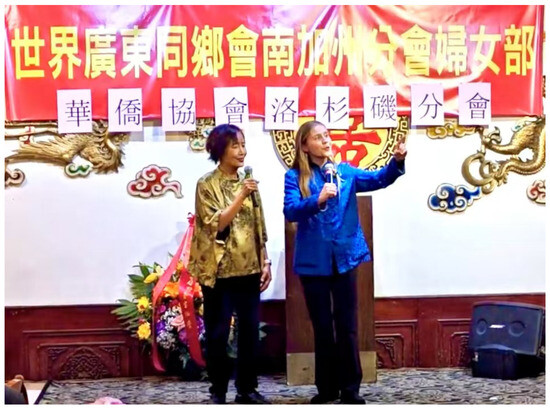
Figure 9.
15-year-old Katherine Shenandoah Donaldson Márkos (馬晶晶) and King-Kok Cheung doing a Cantonese Opera duet for the Lunar New Year celebration at Golden Dragon Restaurant, LA, 15 March 2024.
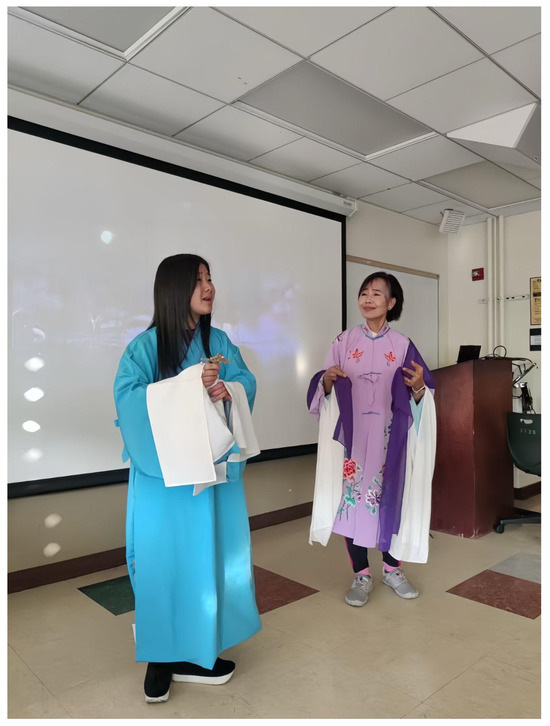
Figure 10.
17-year-old Carissa Yu (余采嵐) and King-Kok Cheung doing a Cantonese Opera duet in a Fiat Lux seminar entitled “Learn [Cantonese] through Play” at UCLA to celebrate the Year of the Snake, 30 January 2025.
Cantonese alliance with American Studies was further sealed when Shelley Fisher Fishkin and I were invited to speak at the Transnational American Studies Symposium at Texas Technological University, commemorating her 2004 ASA address advocating transnational American Studies (Fishkin 2005; Figure 11). After my talk on Orphan Bachelors, Shelley asked: “Would you consider doing a book about the Cantonese impact on American literature?” It took six hours for me to change my instant “no” to a provisional “yes.” We are currently coediting, with Belinda Kong, Selina Lai-Henderson, Bo Wah Leung and Sean Metzger a volume entitled “Canto Aiiieeeee! Cantonese American Reverberations in Literature, History, Drama, Martial Arts, and Popular Culture.” As coeditor of The Chinese and the Iron Road (Chang and Fishkin 2019) Shelley, my latest zhiyin catch, could sound the depth of this linguistic legacy. Accentuating Chinese polyphony is also in sync with my academic mission of tapping into the rich veins of the American ore.
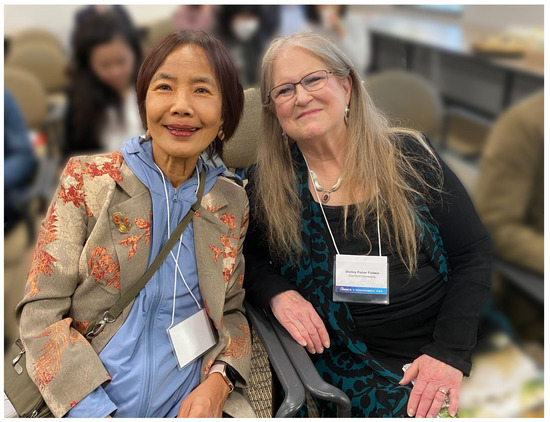
Figure 11.
King-Kok Cheung and Shelley Fisher Fishkin at the “Transnational American Studies Revisited” symposium at Texas Technological University in Lubbock, Texas, 13 April 2024.
The most astounding connections are happening in my “Learn [Cantonese] through Play [Cantonese Opera]” Fiat Lux seminars. My Canto call, initially a lone cry in the tertiary educational wilderness, ends up reverberating with the intercollegiate “Save Cantonese” movement triggered by the firing of a Cantonese lecturer at Stanford during the pandemic, but which has since spread to Yale and Berkeley, so that Cantonese instruction—including Medical Cantonese—is being offered at Cal, synchronically with my seminars at UCLA. The Daily Cal chronicles how this initiative comes to pass: “In May 2021, 84-year-old Jean Chang Kan Fung passed away after California Highway Patrol officers dropped her off at the wrong location… due to their not speaking Cantonese” (Cheng and Talvola 2023; see also “Save Cantonese 守護粵語 n.d.” https://www.savecantonese.org, accessed on 28 October 2025). My dream to bring Cantonese lingo and yueju to UCLA complements this grassroots advocacy, couples the English Department’s humanist orientation with AASC’s community outreach mission and intersects the Humanist North Campus and the STEM South Campus.
10. Conclusions: Humanist Communities Through Time and Space
Chinese TimeOh, but Poet crosses eternaldistances. Perfect reader, come though 1000years from now. Poem can also reachreader born 1000 years beforethe poem, wished into being. Li Baiand Du Fu, lucky sea turtles,found each other within their lifetimes.Oh, the hopes of Chinese timeand Chinese poets. You don’t haveto be a poet; you live in the turningand returning cosmos this way: An actof love I do this morning saves a lifeon a far future battlefield. And the surprisingjoy I feel that saves my life comes froma person whose soul somehow correspondingwith my soul doing me a good deed 1000years ago.(Maxine Hong Kingston 2025)
My sinuous life as an omnivorous humanist traversing disciplinary, periodic, geographical, and national borders has yielded palpable wonders, the most wonderful being the opportunity to live and range across many lives, and to connect arts and people from the whole wide world. Though I was born accidentally as a left-handed black sheep, I was made bilingual, bicultural, and cosmopolitan at SSGC in colonial Hong Kong, a classicist at Pepperdine University, a Renaissance scholar at Berkeley, an intersectional Americanist at UCLA, and a polyglot comparatist by UCEAP. The many splendors of literary America unraveled by Bruins of disparate stripes have driven me to herald the variegated beauty of Chinese American heritage at UCLA. I have gone from being an outsider, a suspect even, in both English and Asian American studies to being a bilateral resource. It behooves me to usher in, among the Bruins, my mother tongue—the language of the Tang poets, gold miners, transpacific railroad workers, and to stage Cantonese opera. “In my end is my beginning.”
Bristles and brambles brought on by putative symmetries and asymmetries deck my odyssey. An older and wiser humanist discerns a reason, nay continuity, in the seemingly mad misalignment of race, gender, class, and culture. Take my revelry in epics. The Homeric pantheon recalls the throng of Chinese divinities; the rivalries of the Asian and Greek gods result in cosmic discord. Milton’s Satan recalls the Chinese Monkey King; the pandemonium in Paradise Lost has a counterpart in the cosmic war in Wu Cheng’en’s Journey to the West. In both epics deities can be banished as devils and sinners; Satan’s followers are Homeric gods and Monkey’s motley crew of pilgrims are former divinities. To my renegade mind both Milton’s paradise and the Chinese heaven seem lackluster. William Blake touts Milton for being of the Devil’s party; the author of The Journey to the West undoubtedly belongs to the recalcitrant Monkey’s party. My familiarity with the Asian folktale allows me to spot this archetype in the Odyssey, Metamorphosis, Aeneid, the Divine Comedy, Paradise Lost, and Mahabharata. I also fit snugly in my shoes as ESL instructor of Shakespeare and Milton, thanks to the multifocal vision that allows me to ferret out “slanted allusions.” Privy to the Cantonese Opera version of the Legend of the White Snake 《白蛇傳》 (based on a tale by Feng Meng Long 馮夢龍) and to Marlowe’s Dr. Faustus, I salute Eve alongside her pact with the Serpent.
Plunging into unexplored Americanist waters with cold feet was a fortunate fall that has allowed me to discover fables instilled in my childhood about the serpentine woman, Monkey, and Mulan as mother lodes of world arts and culture. Monkey King alone has begotten a slew of Anglophone opuses: Patricia Chao’s Monkey King (1997), Christina Garcia’s Monkey Hunting (2003), David Henry Hwang’s The Lost Empire (2001), Maxine Hong Kingston’s Tripmaster Monkey, Russell C. Leong’s “Azure in Angel City” (2021), Timothy Mo’s The Monkey King (2000), Gerald Vizenor’s Griever (1986), and Gene Luen Yang’s American Born Chinese (2006). The Simian hero is also the protagonist of the eponymous Black Myth: Wukong, an action RPG (2024); he even appears for a fleeting minute in Sinners (2025), Ryan Coogler’s southern gothic horror-musical. The Simic avatars in world arts and culture are not necessarily the scions of the “Chinese” Sun Wukong, however. I found out from teaching John Keats’s “Lamia” and Barack Obama’s Dreams from My Fathers that the mythological roots of Monkey and the White Snake trace back to South Asia. The fact that the primate chieftain and the serpentine maiden hail from Indian lore does not detract from the artistry of Keats, Feng Meng Long, or Wu Cheng’en. These cultural asymmetries have given rise to wonderous world literature without borders.
Being “out of place” in the womb and in every nation has gifted me with the ability of conjuring everyone everywhere all at once with the help of two magic spells. The first, “only connect” (E.M. Forster’s epigraph in Howards End, a required text for my HK matriculation), facilitates the formation of lasting communities among colleagues, staff, students, even Uber drivers who love the humanities, regardless of disciplines and métiers. The second, “zhiyin”, a spell I shared with the 2023 graduating English seniors, calls forth the most intimate liaisons. Any lover of literary, musical, martial, visual and performance arts is already a zhiyin of some poet, lyricist, composer, painter, auteur, sifu, or performer. We can go from appreciating an artist on the page, in the air, or on stage to stepping to the music or comingling the qi of the person next to us. Master Yun is a zhiyin in martial arts. Unlike practitioners who simply ask students to follow their moves, the Bruins are told not to “just follow” but to “feel” him. The more advanced students are asked to “listen and feel your body,” to go from being his zhiyin to being our own. He deems taichi to be an art whose highest stage cannot be verbalized; it must be “embodied,” intuited, and expressed through articulate silences.
For the two spells to work, a certain pas de deux is vital. As a connoisseur of writers, I want readers to feel their unique artistry, and to assimilate its sense and sensibility. I wish to go on record saying that AI can never replace zhiyin. My literary analyses are generated from the creative works themselves rather than using texts to illustrate a theory. Readers who relish a writer from reading my work are both the writer’s zhiyin and mine, and writers who second my ruminations are my vaunted zhiyin. When I asked Maxine for permission to quote “Chinese Time” and showed her an early draft of this essay, she replied: “I feel so in synch with you…. I felt vindication coming back to Cal as a professor, and all those people who gave me a Chinese ‘C’ became my colleagues, whom I could call by their first names” (Email 19 November 2024). Professor Fae, giving me an “A+” for this self-portrait and calling me “an old sea turtle who can learn new tricks,” lifts me up from the ocean to Cloud 9. (Turtles and tortoises are deep symbols in both “Chinese Time” and Orphan Bachelors.) Russ Leong sees through this meandering piece as “a long and tenuous return to original identity, albeit through many decades of research, teaching, and living a literary life without borders.” Upon being asked by a student why I have so many zhiyin I answered, “through being one of whoever is in our room.” These two spells can call forth the most lasting, bracing and expansive communities. Mine are made up of writers, colleagues, the Bruins, and students from the four seas. The Bruins venturing into uncharted territories offer one another and me intellectual, emotional and moral support. My bond with students in Asia has another nuance; because I took the liberty to teach texts considered problematic by the authorities, students pursuing heterodox projects need extra succor. My life has been an ironic perplex: my steadfast effort to install Cantonese culture and opera at UCLA and throughout the Americas is prompted not by my colonial homeland but by Maxine and Fae, Toishanese American descendants who could hardly comprehend the language and performance art of the ancestors immortalized in their memoirs. Yet they beckon me to excavate the Cantonese inheritance I had bracketed hitherto as an Asian Americanist, thereby connecting my natal and adopted homes.
The Bruins I have kept in touch with have one thing in common: they are shining examples of “The Human is the Humanist.” It cannot be sheer luck that every single one of my master’s and doctoral students can stand on the human(ist) pedestal. The world would be a better place if more politicians were humanists, zhiyin of Dostoyevsky’s The Brothers Karamazov, Viet Thanh Nguyen’s The Sympathizer (Nguyen 2016) or Han Kang’s Human Acts (Kang 2017). When asked by David Frost how he’d like to be remembered, Robert F. Kennedy (1925–1968) quoted Camus: “Perhaps we cannot prevent this world from being a world in which children are tortured. But we can reduce the number of tortured children” (Robert F. Kennedy Human Rights 2024). Asked by another reporter why he went from pro to against capital punishment, he answered: “That was before I read Camus” (Boublil and Khadavi 2023). If more heads of state were humanists capable of exposing themselves to “feel what wretched feel” (King Lear 3.4.35), would there still be wars and genocides today? “Won’t you memorize a bit of poetry to halt the slaughter?” enjoined Mamoud Darwish in “The Penultimate Speech of the Red Indian.” David Brooks suggests that we need to “rediscover the humanist code” (Brooks 2024), but we must also be adept at “code-switching” instead of being stuck with the code of one nation, one superpower or one time. Have faith in the woman warrior that “you live in the turning and returning cosmos,” that an act of love you do “saves a life on a far future battlefield” and that the surprising joy you feel that saves your life “comes from/a person … doing [you] a good deed 1000/years ago.”
The Humanities may bestow the most fertile ground to raise the young and sprout empathetic and self-sustaining interdependent communities—collegiate, intercollegiate, interdisciplinary, national, international, interracial, and intergenerational. First, it blurs the boundaries between the sciences and the humanities; many scientists, mathematicians, businessmen and politicians are top-notch writers or musicians (Borgman 2009). Second, it encourages nonbinary ways of seeing because there is no absolute right or wrong in the interpretation of literature and the fine arts, and the multiple points of view redound to plenitude and the tolerance of difference. Third, it bridges people across generations. Because humanistic knowledge is cumulative, we seniors may revel in our vintage to keep dotage at bay; we could also reach out to callow youth by learning their proclivities, and encourage them to return the favor. (I now have four Cantonese Opera singing partners under twenty, and a young kinsman humored me recently by producing a bilingual rap of the “Ballad of Mulan.”) Fourth, because literature and the fine arts emanate from lived experiences, art and life perpetually animate each other to illuminate our way. If “all the world’s a stage,” humanists may be more proficient at directing their lives and even others’. Finally, our knack for zhiyin is peculiar to the artistic tribe. If a person can pulsate to the contrapuntal music of Su Shi and Shakespeare, Milton and Kingston, Beethoven and Tong Dik Sang, she can also harken to the incipient bards within sight and earshot, who would not blush unseen or sing unheard. Little wonder that so many faculty members and TAs in my department have won campus-wide distinguished teaching awards.
The Humanities has raised me to be a zhiyin across languages, space and “Chinese time.” I need not envy Li Bai and Du Fu, “lucky sea turtles” who “found each other within their lifetimes.” Though not a poet, I have found, within our lifetimes and “facetime,” James Atteberry and Stephen Booth, Maxine Hong Kingston and Fae Myenne Ng, Paul Lauter and Shelley Fisher Fishkin, Viet Thanh Nguyen and David Wong Louie, Joy Kogawa and Hisaye Yamamoto, Marilyn Chin and Russell Leong, Ha Jin and Yiyun Li, Kennith Pai and Bell Yung, Richard Yarborough and Valerie Smith, Zifang Su and Yun Zhao, Edward Said and Saree Makdisi, the YGF-PSS-TDS trio, Shenandoah Márcos and Carissa Yu, and beloved Bears and Bruins. I have also crossed “eternal distances” to commune with Homer and Virgil, Boya and Zhong Ziqi, Shakespeare and Milton, Li Qingzhao and Su Shi. Am I not the luckiest sea turtle?
Funding
This research received no external funding.
Institutional Review Board Statement
Not applicable.
Informed Consent Statement
Not applicable.
Data Availability Statement
No new data were created or analyzed in this study. Data sharing is not applicable to this article.
Conflicts of Interest
The author declares no conflicts of interest.
References
- Booth, Stephen. 1983. King Lear, Macbeth, Indefinition, and Tragedy. New Haven: Yale University Press. [Google Scholar]
- Borgman, Christine L. 2009. Scholarship in the Digital Age: Blurring the Boundaries Between the Sciences and the Humanities. Digital Humanities ’09. August 12. Available online: https://escholarship.org/uc/item/3sj3w1jh (accessed on 28 October 2025).
- Boublil, Zoel, and Kevin Khadavi. 2023. RFK: Personal Anecdotes 55 Years on. RFK Human Rights. May 1. Available online: https://rfkhumanrights.org/our-voices/rfk-personal-anecdotes-55-years-on/ (accessed on 15 November 2024).
- Boya. n.d. Qin Shi 琴史 38. Available online: https://silkqin.com/09hist/qinshi/boya.htm (accessed on 28 October 2025).
- Brooks, David. 2024. How to Save a Sad, Lonely, Angry and Mean Society. NYT. March 11. Available online: https://www.nytimes.com/2024/01/25/opinion/art-culture-politics.html (accessed on 28 October 2025).
- Bruchac, Joseph, ed. 1983. Breaking Silence: An Anthology of Contemporary Asian American Poets. New York: Greenfield Center Press. [Google Scholar]
- Chang, Gordon H., and Shelley Fisher Fishkin, eds. 2019. The Chinese and the Iron Road: Building the Transcontinental Railroad. Stanford: Stanford UP. [Google Scholar]
- Cheng, Samuel, and Ryan Talvola. 2023. Why Advanced Cantonese Education Matters? The Daily Californian, July 21. [Google Scholar]
- Cheung, King-Kok. 1984a. Drawing Out the Silent Minority. College Composition and Communication 35: 452–54. [Google Scholar] [CrossRef][Green Version]
- Cheung, King-Kok. 1984b. Shakespeare and Kierkegaard: “Dread” in Macbeth. Shakespeare Quarterly 35: 430–39. [Google Scholar] [CrossRef][Green Version]
- Cheung, King-Kok. 1987. Beauty and the Beast: A Sinuous Reflection of Milton’s Eve. Milton Studies 23: 197–214. [Google Scholar] [CrossRef]
- Cheung, King-Kok. 1988a. “Don’t Tell”: Imposed Silences in The Color Purple and The Woman Warrior. Publications of the Modern Language Association of America 103: 162–74. [Google Scholar] [CrossRef]
- Cheung, King-Kok. 1988b. The Dialectic of Despair in Doctor Faustus. In “A Poet & a Filthy Play-Maker”: New Essays on Christopher Marlowe. Edited by Kenneth Friedenreich, Roma Gill and Constance B. Kuriyama. New York: AMS Press, pp. 193–201. [Google Scholar]
- Cheung, King-Kok. 1990. The Woman Warrior versus The Chinaman Pacific: Must a Chinese American Critic Choose between Feminism and Heroism? In Conflicts in Feminism. Edited by Marianne Hirsch and Evelyn Fox Keller. New York: Routledge, pp. 234–51. [Google Scholar]
- Cheung, King-Kok. 2000. Words Matter: Conversations with Asian American Writers. Honolulu: University of Hawai’i Press. [Google Scholar]
- Cheung, King-Kok. 2005. (Mis)interpretation and (In)justice: The 1992 Los Angeles “Riots” and “Black-Korean Conflict”. MELUS 30: 3–40. [Google Scholar] [CrossRef]
- Cheung, King-Kok. 2012. “Theorizing in Narrative Form”: Premonitions of Orientalism and “Racist Love” in Bing Xin’s “The Photograph”. Transnational Literature 5: 1–17. [Google Scholar]
- Cheung, King-Kok. 2015. Chinese and Chinese American Life-Writing. Cambridge Journal of China Studies 10: 1–20. [Google Scholar]
- Cheung, King-Kok. 2016a. Chinese American Literature Without Borders: Gender, Genre, Form. New York: Palgrave. [Google Scholar]
- Cheung, King-Kok. 2016b. Tao Qian and Emerson: Alignment of Mindscape and Landscape. In Chinese and American Cultural Studies in the Global Context. Edited by Cheng Aimin and Pan Wang. Nanjing: Nanjing University Press, pp. 1–38. [Google Scholar]
- Cheung, King-Kok. 2017a. Ethnic Ethic and Aesthetic: Russell C. Leong and Marilyn Chin [族裔伦理与审美互彰]. Foreign Literature Studie [外国文学研究] 39: 9–25. [Google Scholar]
- Cheung, King-Kok. 2017b. Self-Critique Prompted by Immersion in (An) Other Culture: Goldsworthy Lowes Dickinson, Xu Zhimo, and Pearl Buck. Canadian Review of Comparative Literature 44: 607–19. [Google Scholar] [CrossRef]
- Cheung, King-Kok. 2018. Pearl Buck and Bing Xin: Transpacific Postcolonial and Asian American Legacies. Amerasia Journal 44: 52–60. [Google Scholar]
- Cheung, King-Kok. 2019a. Is Shakespeare “Translatable”? Cinematic Adaptations by Kozintsev, Kurosawa, and Feng Xiaogang. In Shakespeare and Asia. Edited by Jonathan Locke Hart. New York: Routledge, pp. 177–89. [Google Scholar]
- Cheung, King-Kok. 2019b. The Dyadic Wenwu Ideal via Qinqishuhua 琴棋书画 in Jin Yong’s Fiction. Asia-Pacific Translation & Intercultural Studies 8: 36–55. [Google Scholar]
- Cheung, King-Kok. 2024. “Report a Crime”: Fae Myenne Ng’s Orphan Bachelors. Amerasia Journal 49: 221–30. [Google Scholar] [CrossRef]
- Cheung, King-Kok 张敬珏. 2025. “心心相報:伍慧明的《孤兒散仔》與哈金的《莫斯科回來的女人》” Trans. Susan Chan Egan. In 《文心无界——不拘性别文类与形式的华美文学》. 增訂版. [“The Reverberation of Art and Heart.” Chinese American Literature without Borders: Gender, Genre, Form], Expanded ed. Translated by Susan Chan Egan, and King-Kok Cheung. Taipei: Bookman Press, pp. 393–469. [Google Scholar]
- Cheung, King-Kok, and Stan Yogi. 1988. Asian American Literature: An Annotated Bibliography. New York: Modern Language Association. [Google Scholar]
- Chin, Frank. 1991. Come All Ye Asian American Writers of the Real and the Fake. In The Big Aiiieeeee! An Anthology of Asian American Writers. Edited by Jeffery Paul Chan, Frank Chin, Lawson Fusao Inada and Shawn Wong. New York: New American Library-Meridian, pp. 1–92. [Google Scholar]
- Chin, Frank, Jeffery Paul Chan, Lawson Fusao Inada, and Shawn Wong, eds. 2019. Aiiieeeee! An Anthology of Asian American Writers. Seattle: University of Washington Press. First published 1974. [Google Scholar]
- Cruz, Denise. 2012. Transpacific Femininities: The Making of the Modern Filipina. Durham: Duke University Press. [Google Scholar]
- Eng, David L., and Alice Y. Hom. 1998. Q&A: Queer in Asian America. Philadelphia: Temple University Press. [Google Scholar]
- Ferens, Dominika. 2002. Edith and Winnifred Eaton: Chinatown Missions and Japanese Romances. Urbana: University of Illinois Press. [Google Scholar]
- Fishkin, Shelley Fisher. 1994. Was Huck Black? Mark Twain and African American Voices. London: Oxford University Press. [Google Scholar]
- Fishkin, Shelley Fisher. 2005. Crossroads of Cultures: The Transnational Turn in American Studies—Presidential Address to the American Studies Association, November 12, 2004. American Quarterly 57: 17–57. Available online: https://muse.jhu.edu/article/180093 (accessed on 28 October 2025). Reprinted in Junling Cai 蔡昀伶 trans.,《中外文学》 (Chung Wai Literary Monthly), 35.6 (2006): 87–119; and in Xiaohuang Yin ed.《跨国美国研究与亚洲的交会》[An Anthology of Global and Transnational Studies]. Nanjing: Nanjing University Press, 2014). [CrossRef]
- Gooding-Williams, Robert. 1993. Reading Rodney King/Reading Urban Uprising. New York: Routledge. [Google Scholar]
- Greenblatt, Stephen. 1980. Renaissance Self-Fashioning: From More to Shakespeare. Chicago: University of Chicago Press. [Google Scholar]
- Harris, Elizabeth A. 2025. Arthur Sze Will Be the Next U.S. Poet Laureate. New York Times, September 15. [Google Scholar]
- Ho, Tamara C. 2015. Romancing Human Rights: Gender, Intimacy, and Power Between Burma and the West. Honolulu: University of Hawai’i Press. [Google Scholar]
- Itagaki, Lynn Mie. 2016. Civil Racism: The 1992 Los Angeles Rebellion and the Crisis of Racial Burnout. Minneapolis: University of Minnesota Press. [Google Scholar]
- Jay, Gregory S. 1997. American Literature and the Culture Wars. Ithaca: Cornell University Press. [Google Scholar]
- Jin, Ha. 2008. The Writer as Migrant. Chicago: University of Chicago Press. [Google Scholar]
- Jin, Ha. 2023. The Woman Back From Moscow: In Pursuit of Beauty. New York: Other Press. [Google Scholar]
- Kang, Han. 2017. Human Acts. New York: Random House. [Google Scholar]
- Kingston, Maxine Hong. 1976. The Woman Warrior: Memoirs of a Girlhood Among Ghosts. New York: Vintage International. [Google Scholar]
- Kingston, Maxine Hong. 2025. Chinese Time. Poetry Foundation 25 April. [This poem is part of the portfolio “Maxine Hong Kingston: Water to the Brim.” You can read the rest of the portfolio in the April 2025 issue]. Available online: https://www.poetryfoundation.org/poetrymagazine/poems/1661176/chinese-time (accessed on 28 October 2025).
- Kwon, Brenda Lee. 1999. Beyond Ke’eaumoku: Koreans, Nationalism, and Local Culture in Hawai’i. New York: Routledge. [Google Scholar]
- Lee, Julia H. 2011. Interracial Encounters: Reciprocal Representations in African and Asian American Literatures, 1896–1937. New York: New York University Press. [Google Scholar]
- Lee, Kyun-Jin James. 2004. Urban Triage: Race and the Fictions of Multiculturalism. Minneapolis: University of Minnesota Press. [Google Scholar]
- Lee, Kyun-Jin James, and Julia H. Lee. 2023. AAAS Lifetime Achievement Award Nomination: King-Kok Cheung.
- Lee, Rachel C. 1999. The Americas of Asian American Literature: Gendered Fictions of Nation and Transnation. Princeton: Princeton University Press. [Google Scholar]
- Lim, Edilberto G. 1986. Arthur Sze: A New Mexican Poet Who Refuses to be Categorized. East/West 13: 6–7. [Google Scholar]
- Lin, Yutang. 1942. Moment in Peking. New York: John Day. First published 1939. [Google Scholar]
- Lorde, Audre. 1984. The Master’s Tools Will Never Dismantle the Master’s House. In Sister Outsider: Essays and Speeches. Berkeley: Crossing Press, pp. 110–14, Printed 2007. [Google Scholar]
- Nahm, Hannah. 2021. Minority (Tres)Passing in the BLM Age: Asian Stereotypes as Subversive Strategy for Combating Anti-Blackness in Yamamoto’s “A Fire in Fontana” and Ty Pak’s “The Court Interpreter”. philoSOPHIA 10: 254–68. [Google Scholar] [CrossRef]
- Ng, Fae Myenne. 1993. Bone. New York: Hyperion. [Google Scholar]
- Ng, Fae Myenne. 2023. Orphan Bachelors: A Memoir. New York: Grove Press. [Google Scholar]
- Nguyen, Viet Thanh. 2016. The Sympathizer. New York: Grove. [Google Scholar]
- Nguyen, Viet Thanh. 2024. Palestine Is in Asia: An Asian American Argument for Solidarity. Nation, January 29. [Google Scholar]
- Robert F. Kennedy Human Rights. 2024. @RFKHumanRights. Available online: https://x.com/RFKHumanRights/status/1798701402698776576 (accessed on 1 October 2024).
- Rosenberg, Marvin. 1992. The Masks of Hamlet. Newark: University of Delaware Press. [Google Scholar]
- Said, Edward. 1979. Orientalism. New York: Vintage. [Google Scholar]
- Save Cantonese 守護粵語. n.d. Available online: https://www.savecantonese.org (accessed on 28 October 2025).
- Smith, Robert Kyriakos, and King-Kok Cheung. 2017. The Other Father in Barack Obama’s Dreams from My Father. In Critical Approaches to Multicultural Criticism. Edited by Robert C. Evans. Salem: Salem Press/Grey House Publishing, pp. 203–16. [Google Scholar]
- Smith, Robert Kyriakos, and King-Kok Cheung. 2021. Rereading Hisaye Yamamoto and Ty Pak after Black Lives Matter. philoSOPHIA 10: 247–53. [Google Scholar] [CrossRef]
- Sohn, Stephen Hong. 2014. Racial Asymmetries: Asian American Fictional Works. New York: NYU Press. [Google Scholar]
- Sze, Arthur. 1972. The Willow Wind. Berkeley: Rainbow Zenith Press. Guadalupita: Tooth of Time Books. [Google Scholar]
- Thompsett, Neil. 2016. Four Questions from the Humanity Department: King-Kok Cheung. Available online: https://vimeo.com/157640409 (accessed on 28 October 2025).
- Tillyard, Eustace Mandeville Wetenhall. 1959. The Elizabethan World Picture. New York: Vintage. First published 1942. [Google Scholar]
- Under Threat: Cantonese Speakers Worry About Their Language’s Future. 2025. DW News. Available online: https://www.youtube.com/watch?v=QUELieQeUKM (accessed on 28 October 2025).
- UNESCO: Yueju Opera. n.d. Available online: https://ich.unesco.org/en/RL/yueju-opera-00203 (accessed on 28 October 2025).
- Xie, Cun 解村, and King-Kok Cheung 張敬珏. 2024. “Shakesphere” or Polyphonic Indefinition: King Lear Cinematic Adaptation’s Expressive Deficiency and Cross-Media Compensation. Journal of Literature in English 11: 16–28. [Google Scholar]
- Yung, Bell 容鴻曾. 1989. Cantonese Opera: Performance as Creative Process (Yung 1989). Cambridge: Cambridge UP. [Google Scholar]
- Zhang, Qifeng 張其鳳. 2023. Appeal of Taichi and Poetic and Painting Implications: My Opinion on the Calligraphy Art of Lin Sanzhi in His Later Years [太极韵味与诗境画魂——林散之晚年书艺妙谛之我见]. Journal of Aesthetics [美学研究] 4: 122–31. [Google Scholar]
- Zia, Helen. 2000. Asian American Dreams: The Emergence of an American People. New York: Farrar. [Google Scholar]
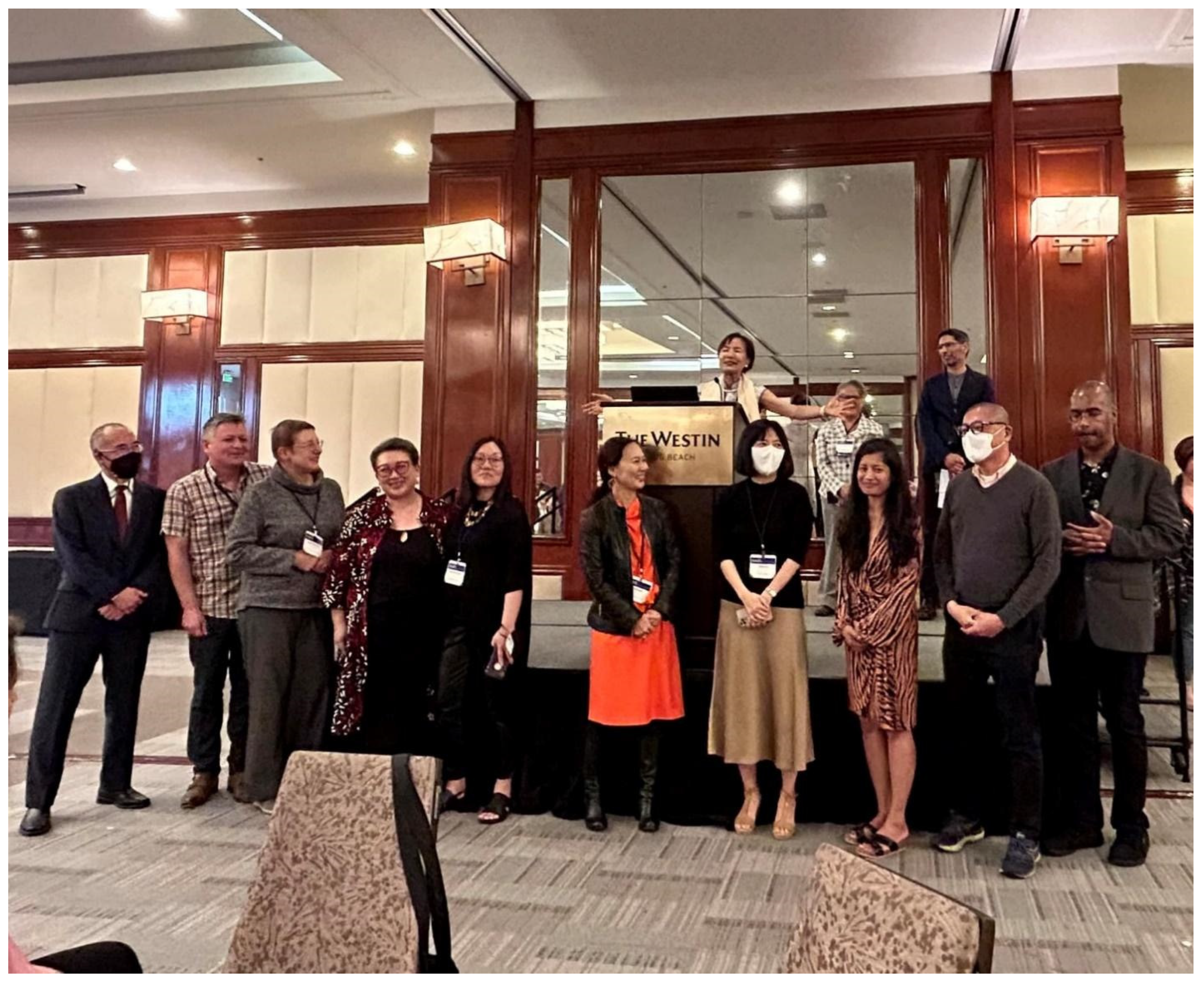
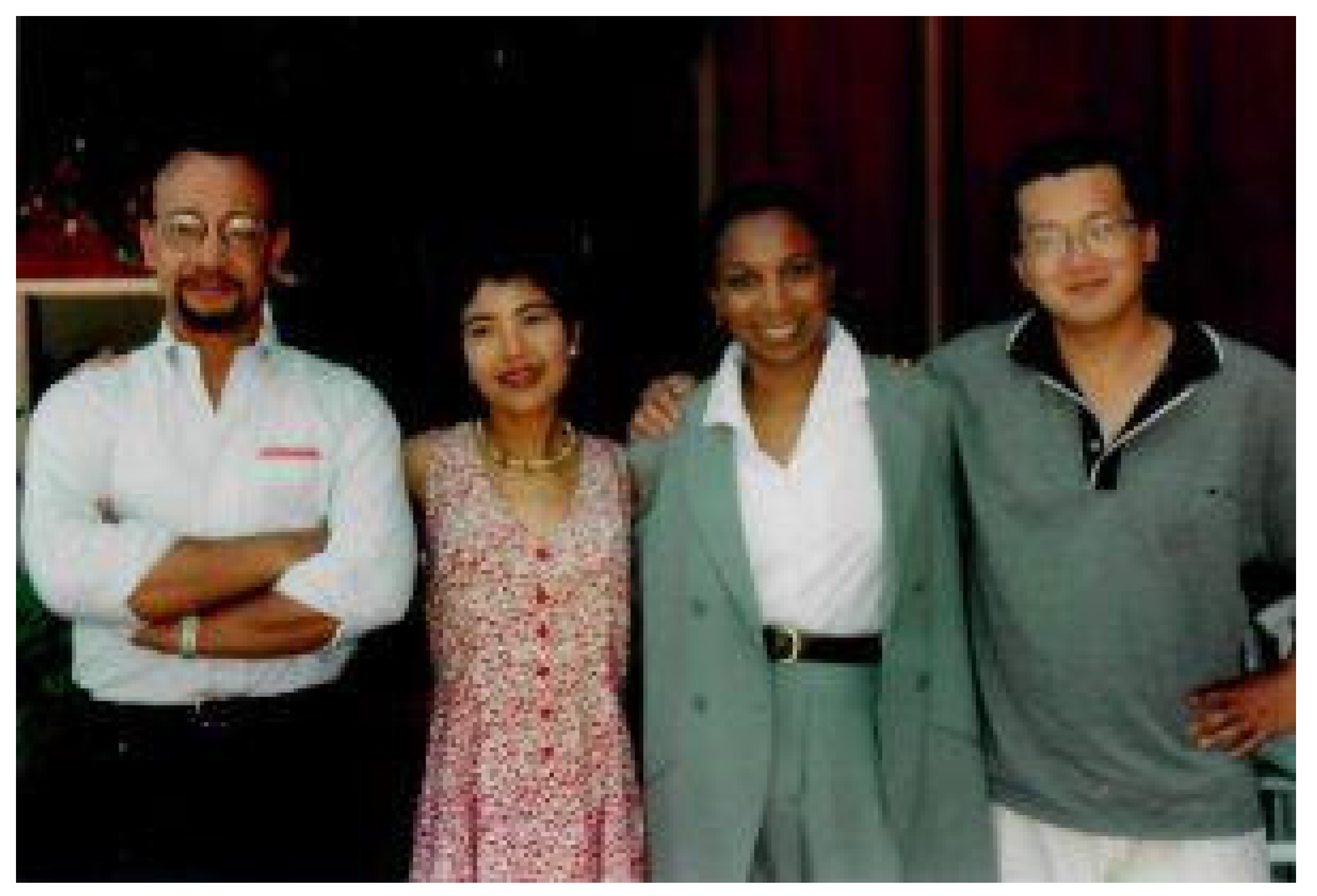
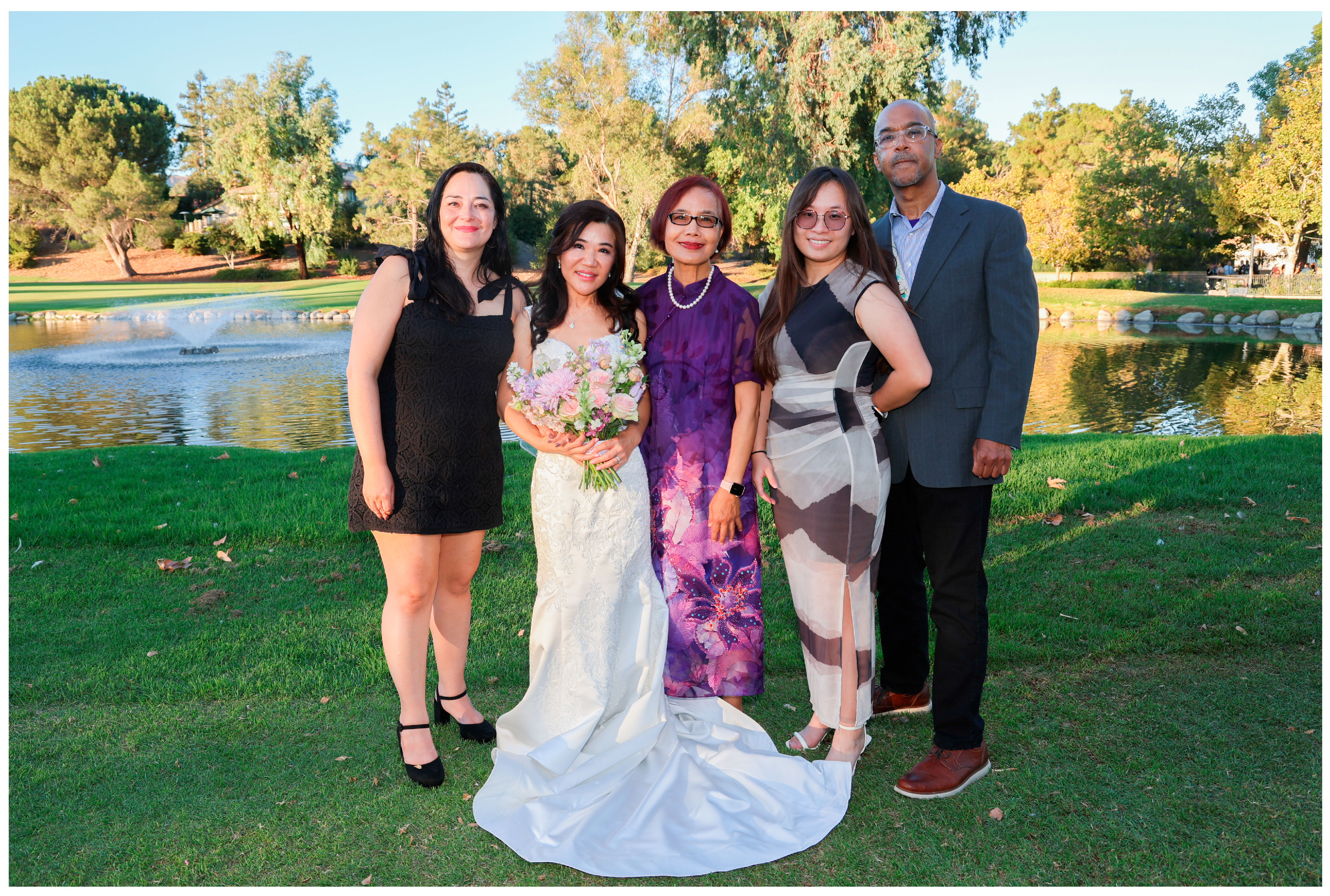
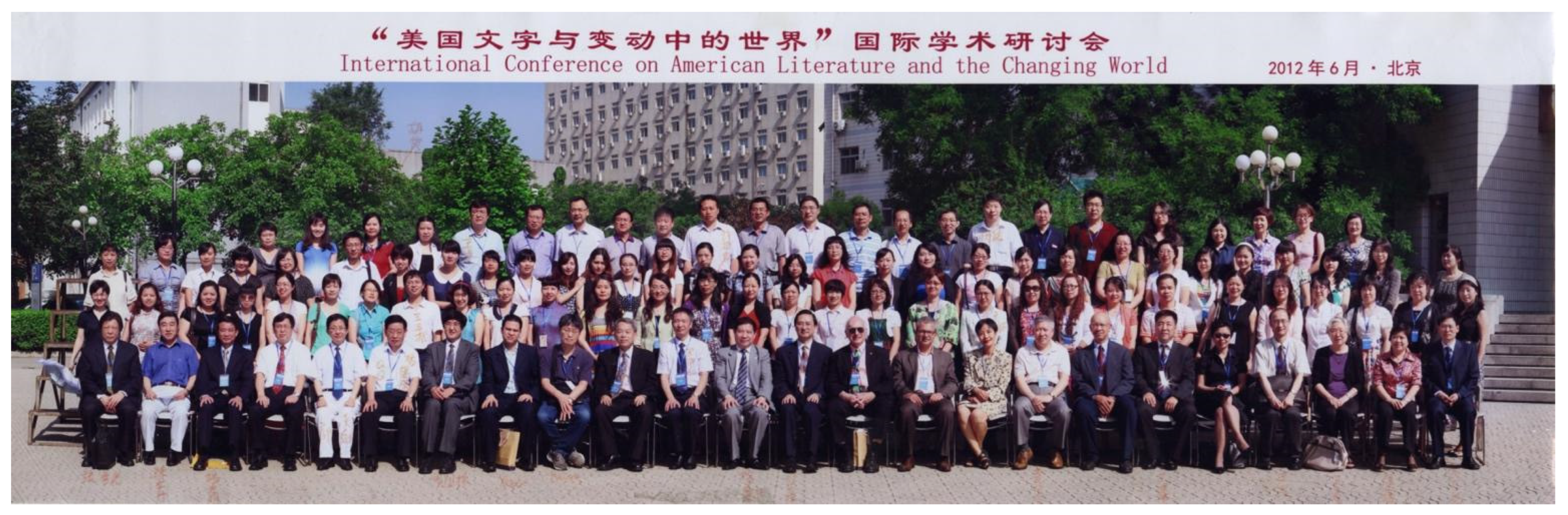
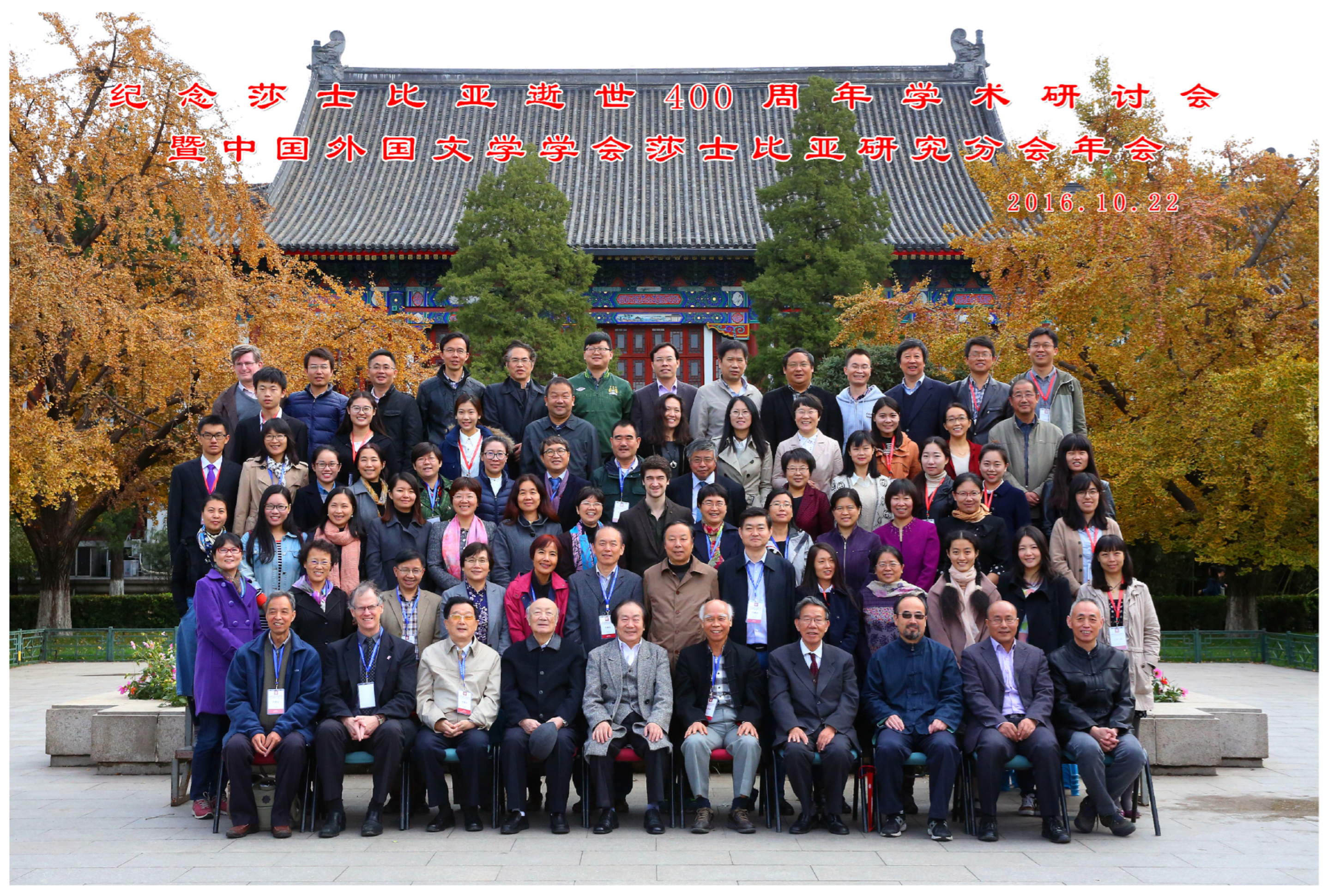
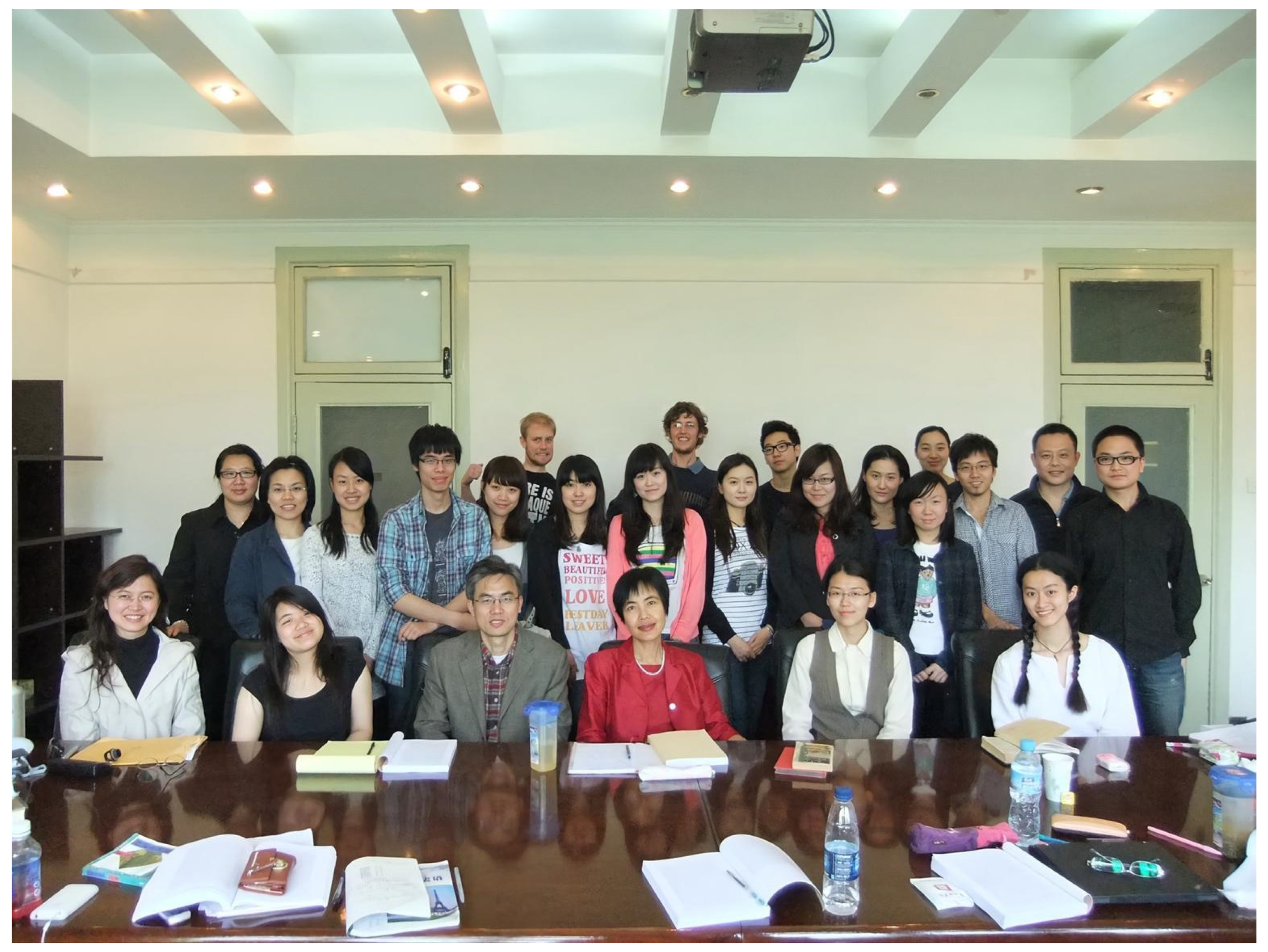
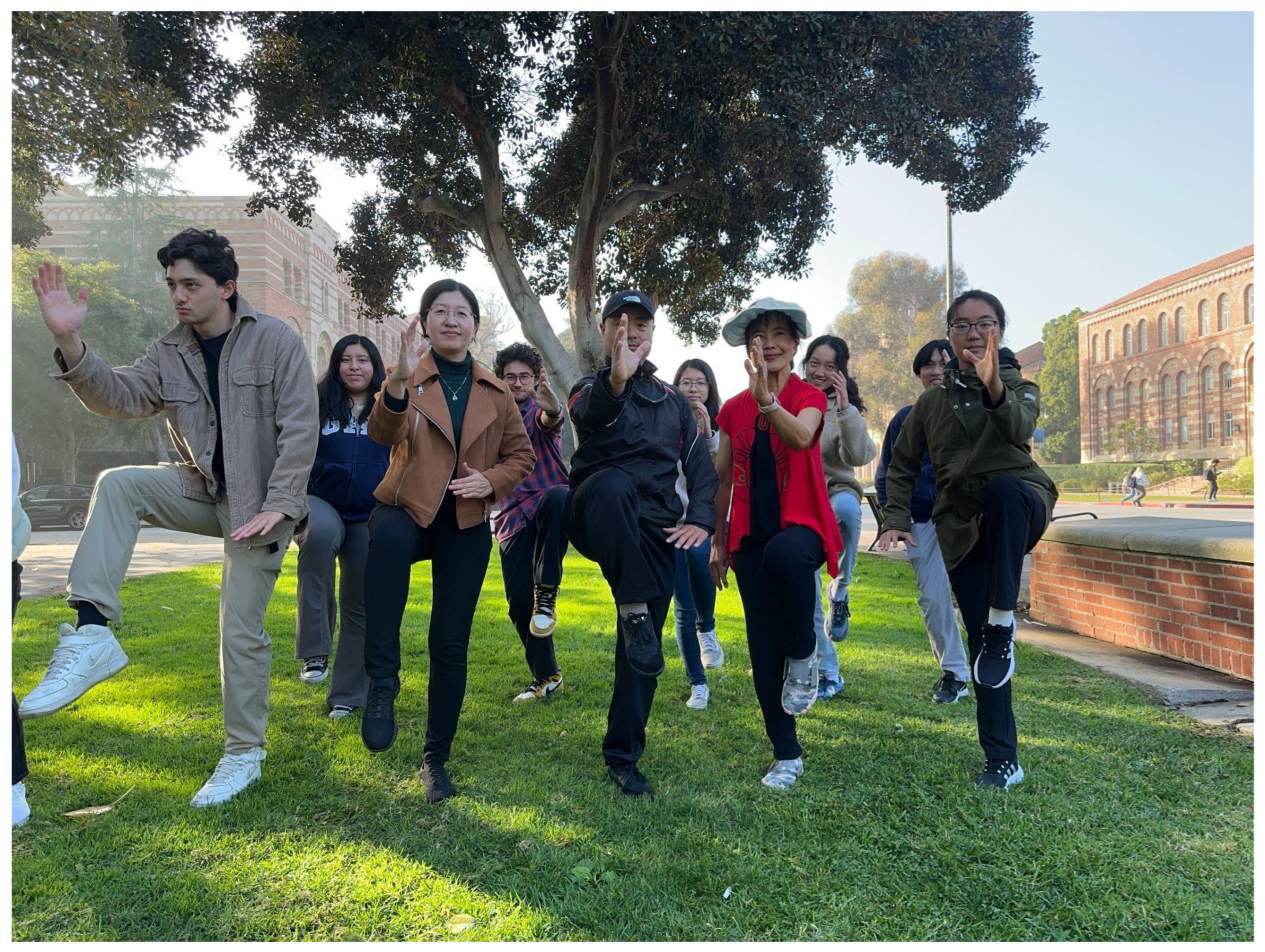
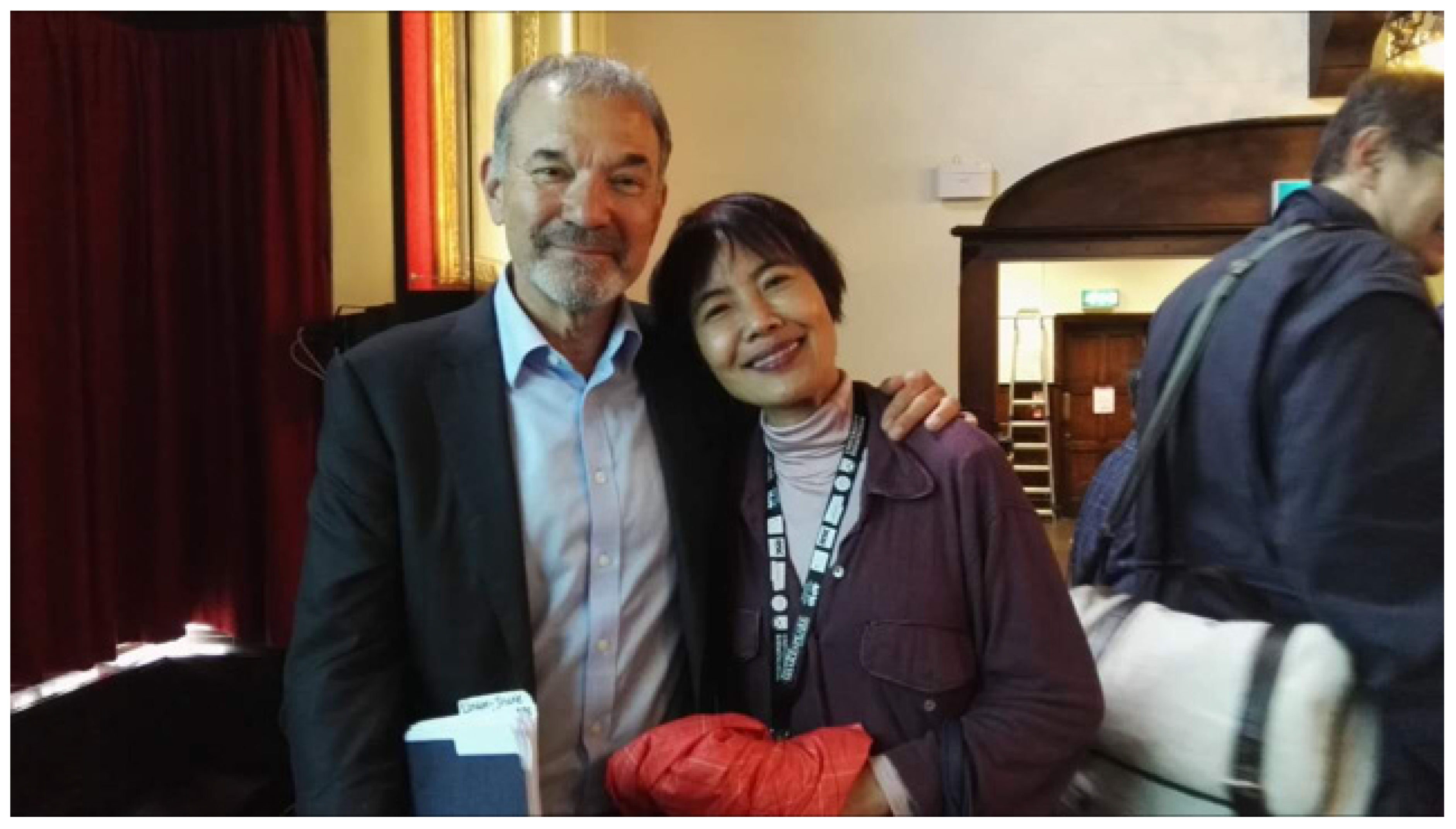
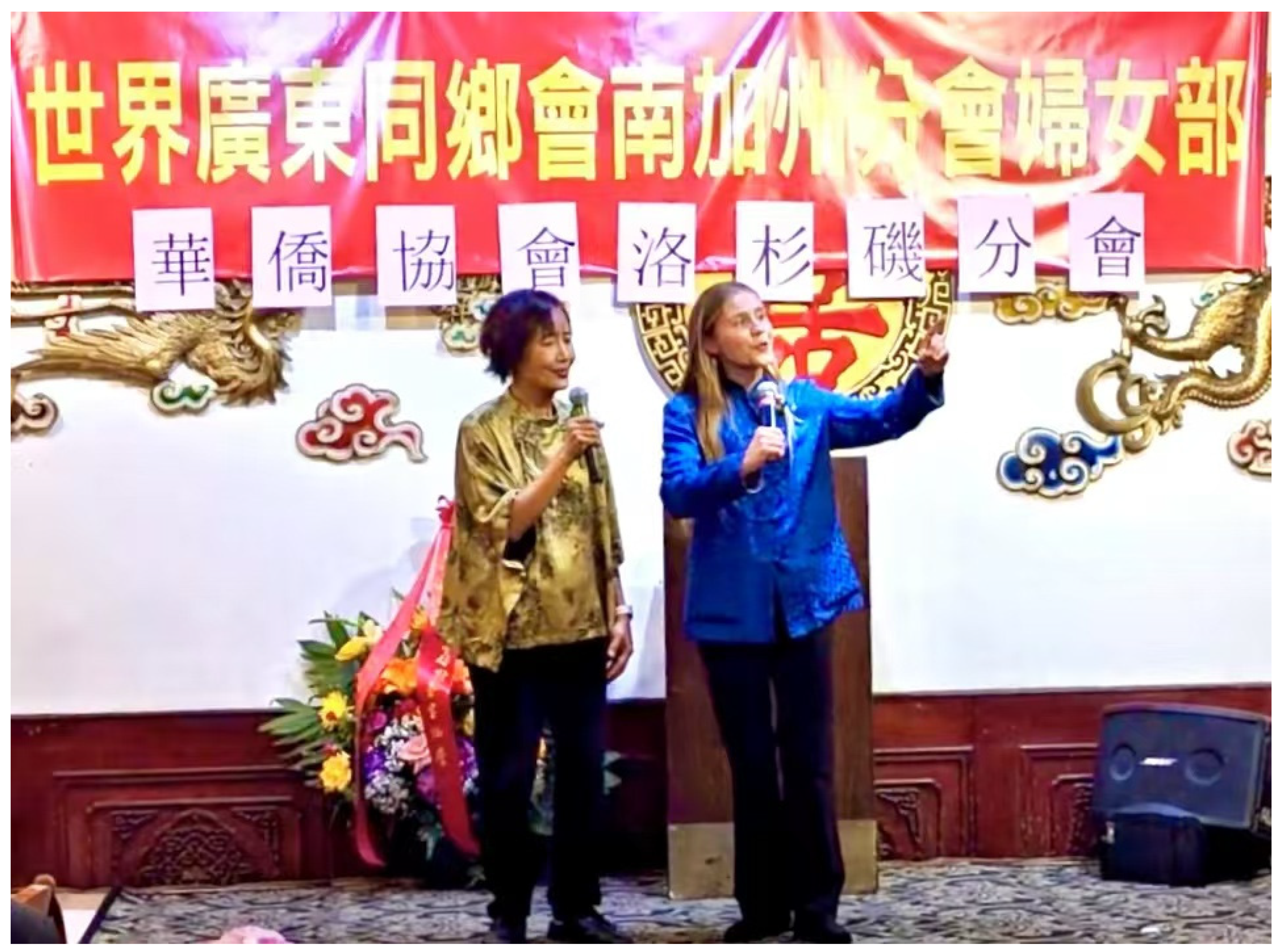
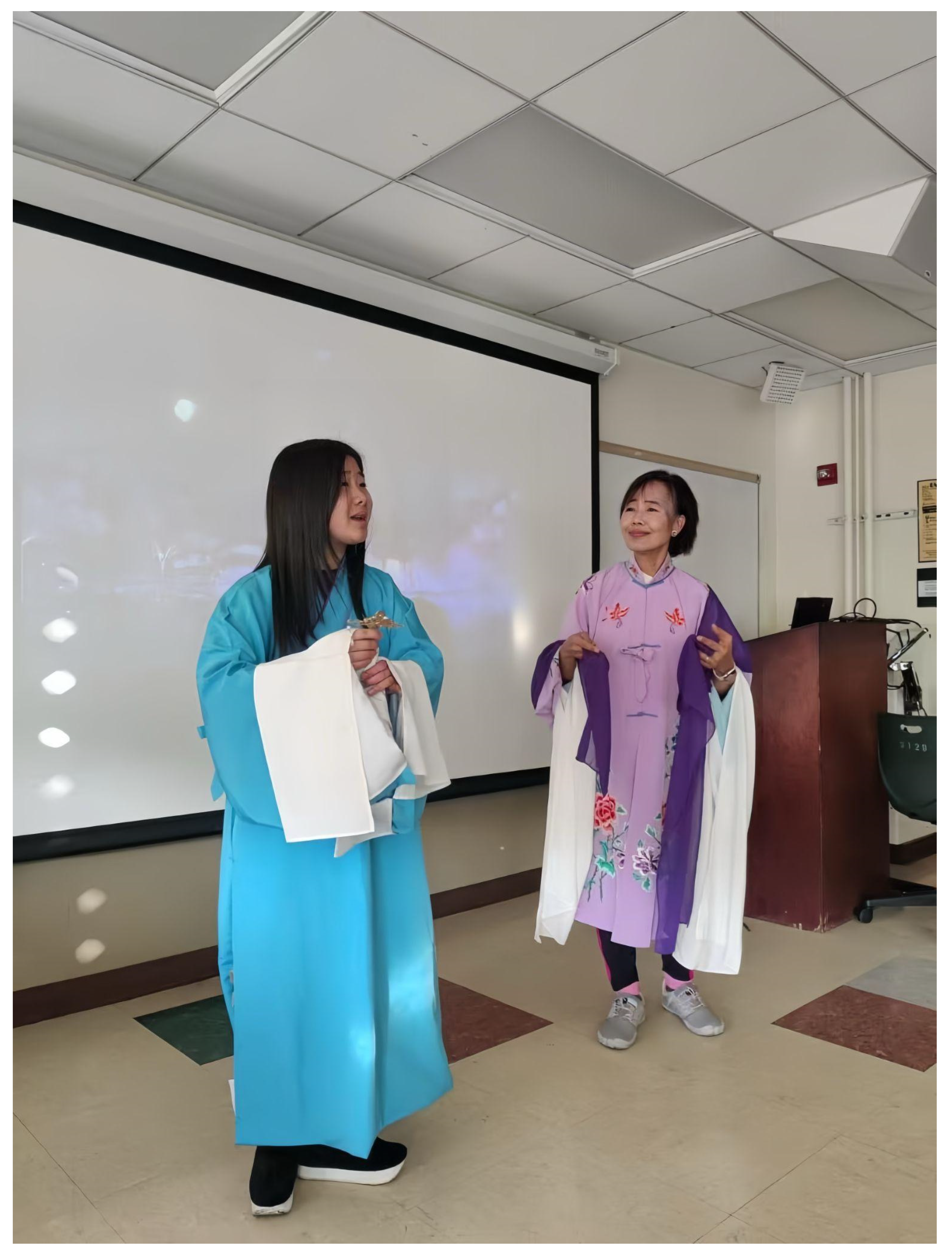
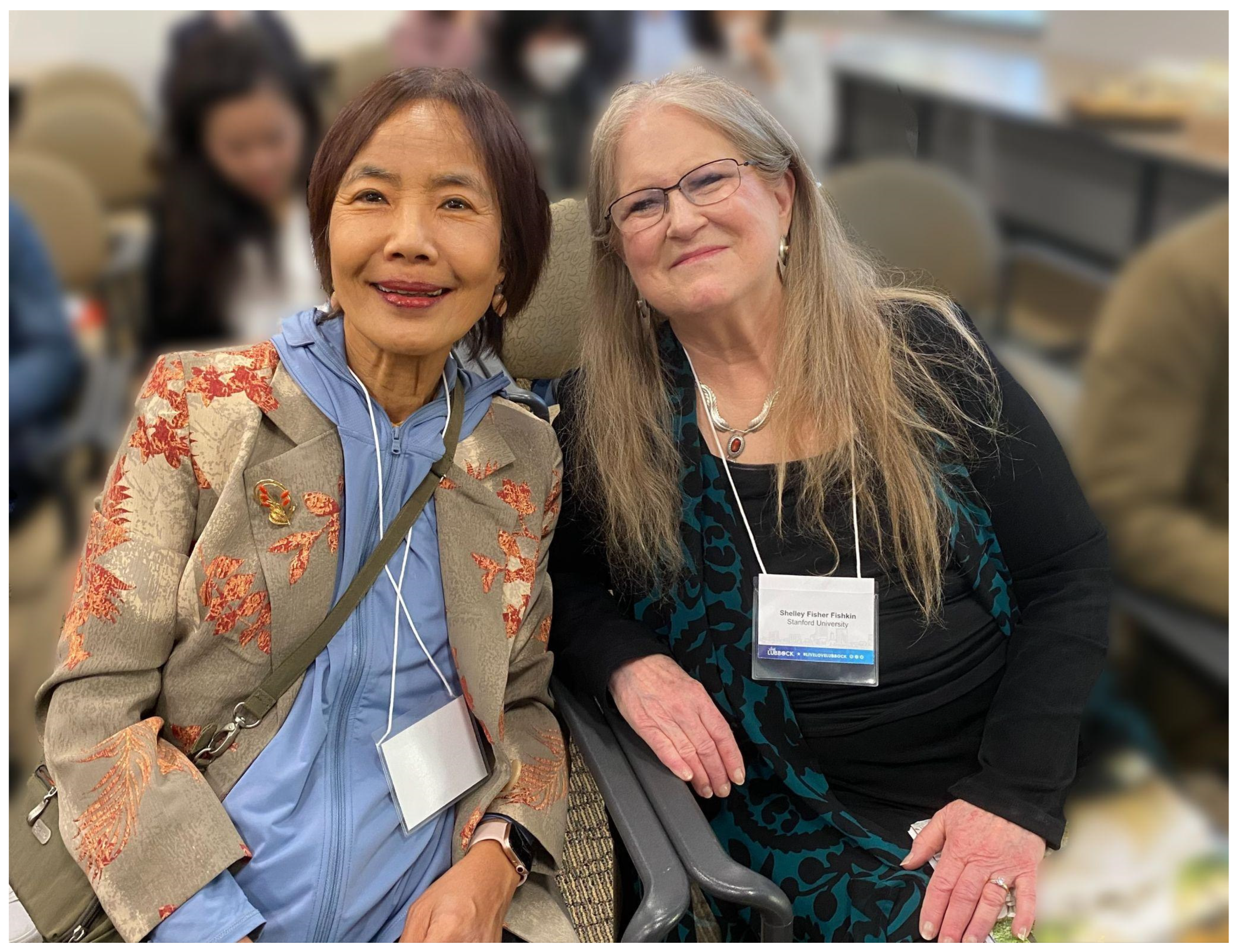
Disclaimer/Publisher’s Note: The statements, opinions and data contained in all publications are solely those of the individual author(s) and contributor(s) and not of MDPI and/or the editor(s). MDPI and/or the editor(s) disclaim responsibility for any injury to people or property resulting from any ideas, methods, instructions or products referred to in the content. |
© 2025 by the author. Licensee MDPI, Basel, Switzerland. This article is an open access article distributed under the terms and conditions of the Creative Commons Attribution (CC BY) license (https://creativecommons.org/licenses/by/4.0/).