



Journal Menu
► ▼ Journal Menu-
- Insects Home
- Aims & Scope
- Editorial Board
- Reviewer Board
- Topical Advisory Panel
- Instructions for Authors
- Special Issues
- Topics
- Sections & Collections
- Article Processing Charge
- Indexing & Archiving
- Editor’s Choice Articles
- Most Cited & Viewed
- Journal Statistics
- Journal History
- Journal Awards
- Conferences
- Editorial Office
Journal Browser
► ▼ Journal BrowserNeed Help?
Announcements
30 June 2026
Insights from Dr. Adriana E. Flores—Winner of the Insects Best Paper Award
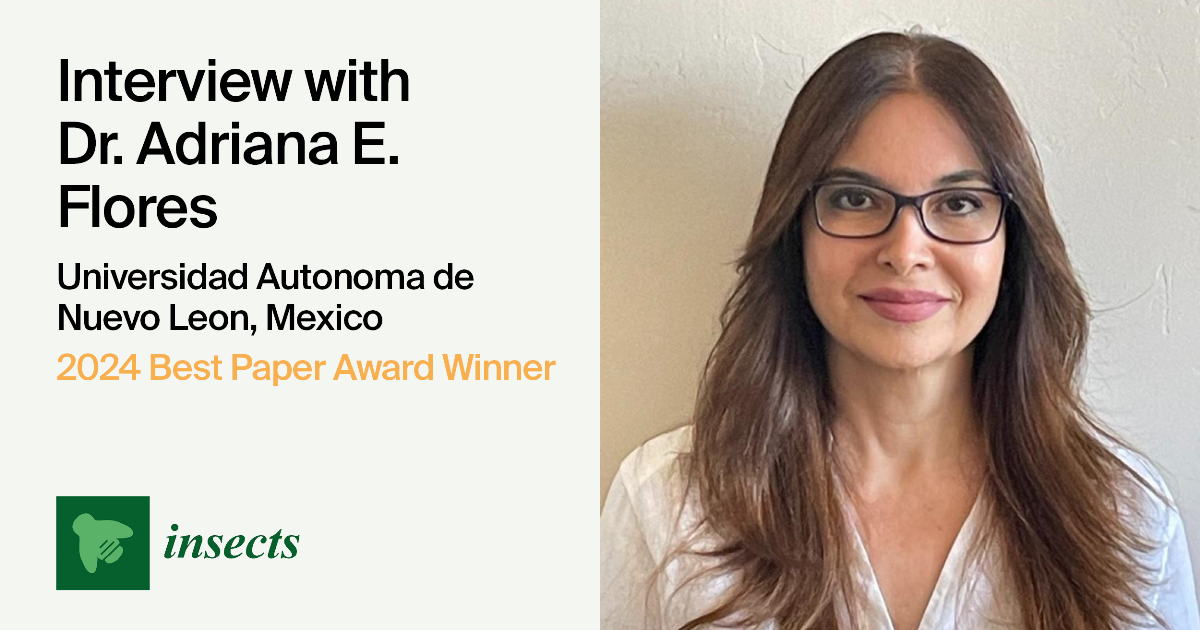
We recently invited Dr. Adriana E. Flores to share her reflections on her paper, “Widespread Resistance to Temephos in Aedes aegypti (Diptera: Culicidae) from Mexico”, one of the papers that won the Insects 2024 Best Paper Award.
Reflections from Dr. Adriana E. Flores:
“I would like to express my sincere gratitude to the Editorial Board of Insects for selecting our article, “Widespread resistance to temephos in Aedes aegypti (Diptera: Culicidae) from Mexico”, for the Best Paper Award. It is a tremendous honor, not only for me, but also for all the students, technicians, collaborators, and colleagues who have contributed to this research over many years. Receiving this award has given me the opportunity to look back and realize that this publication represents much more than a single study; it reflects the evolution of a research line built over more than three decades.
My interest in insecticide resistance began during my PhD, when I worked on resistance in agricultural mites. That experience introduced me to the fascinating evolutionary processes that enable arthropods to adapt to chemical control. It also taught me that resistance is not simply the failure of an insecticide but rather the inevitable consequence of continuous selection pressure. Soon afterward, I had the opportunity to apply that knowledge to medically important insects, and that transition completely changed the direction of my scientific career.
A defining moment came with the project “Assessing the Significance of Insecticide Resistance in Aedes aegypti in Mexico”. This was the first research project in Mexico specifically devoted to insecticide resistance in Aedes aegypti. At that time, there was no organized national research program addressing this issue, despite the increasing importance of dengue in the country. That project laid the foundation for insecticide resistance surveillance in Mexico and marked the beginning of a research line that my laboratory has continued to develop for more than twenty years. Looking back, I feel privileged to have witnessed and contributed to the growth of this field from its very beginning in Mexico.
Although insecticide resistance has remained the central theme of my research, the questions we ask have evolved over time. Initially, our efforts focused on documenting resistance in field populations and understanding the biochemical and molecular mechanisms responsible for reduced susceptibility. As our knowledge expanded, so did our research. We began investigating the evolution of kdr mutations, metabolic resistance mechanisms, nationwide resistance surveillance, and strategies for insecticide resistance management.
Today, our laboratory addresses insecticide resistance from a much broader perspective. In addition to surveillance and investigating the biochemical and molecular mechanisms underlying resistance, we focus on the development and evaluation of innovative strategies for vector control. Our research includes botanical products, nanoformulations, compounds with novel modes of action, the repurposing of existing chemistries, and the study of sublethal effects that may contribute to more sustainable mosquito control. Rather than simply documenting resistance, our goal is to anticipate it by identifying complementary tools that can preserve the effectiveness of vector control interventions. These efforts reflect our belief that the future of mosquito control will depend not only on developing new products but also on implementing integrated, evidence-based strategies that remain effective over the long term.
Throughout my career, I have believed that research should not end with publication. Scientific knowledge should ultimately provide practical solutions for public health. One of the most rewarding aspects of my work has been seeing how research findings can contribute to resistance surveillance, support evidence-based decision-making, and improve vector control strategies.
The award-winning paper represents an important milestone within this long-term research program. For decades, temephos has been one of the most widely used larvicides for controlling Aedes aegypti in Mexico. Although resistance had been reported in individual locations, there was no comprehensive understanding of its distribution throughout the country. We wanted to answer a fundamental question: had resistance remained localized, or had it become a nationwide problem?
To address this question, we conducted a nationwide assessment of Aedes aegypti populations using standardized WHO bioassays and spatial analyses to characterize resistance patterns across Mexico. Our findings demonstrated that resistance to temephos is widespread and highlighted important geographical differences in resistance intensity. These results emphasize the need to incorporate resistance management into vector control programs rather than relying on a single larvicide.
One aspect that makes this paper particularly meaningful to me is that it represents the culmination of many years of continuous work. Large-scale studies such as this require much more than laboratory experiments. They involve coordinating mosquito collections across an entire country, maintaining colonies under standardized conditions, conducting thousands of bioassays, analyzing enormous amounts of data, and working closely with collaborators from many different institutions. Behind every figure, every table, and every map presented in the article are years of dedication, persistence, and teamwork.
Like many long-term projects, this study also presented numerous challenges. Coordinating field collections from geographically distant regions, ensuring the quality and reproducibility of bioassays, and integrating data generated over several years required patience and close collaboration. However, these challenges also made the study especially rewarding because they allowed us to generate one of the most comprehensive assessments of temephos resistance conducted in Mexico.
Looking ahead, I believe that one of the greatest challenges facing vector control will be the sustainable management of insecticide resistance. Mosquito populations continue to evolve, while the number of new insecticides developed specifically for public health remains limited. For that reason, future research should combine continuous resistance surveillance with insecticide rotation based on different modes of action, molecular monitoring, botanical products, biological control, repurposed compounds from agriculture, and other environmentally friendly alternatives. Integrated vector management is no longer simply an option; it is becoming a necessity.
If I could offer one piece of advice to young researchers, it would be to choose questions that truly matter and to be patient enough to pursue them over many years. Scientific careers are not built through a single publication but through perseverance, curiosity, collaboration, and consistency. There will always be failed experiments, rejected manuscripts, and unexpected results, but these experiences often become the most valuable lessons in science.
Finally, I would like to express my deepest gratitude to the many students, technicians, collaborators, and colleagues who have shared this scientific journey with me. Research is never an individual effort, and I have been fortunate to work alongside talented and dedicated people who have enriched both our laboratory and this field of research. I would also like to dedicate this recognition to the memory of our dear colleague and friend, Dr. Gustavo Ponce-García, whose enthusiasm for mosquito surveillance and whose scientific contributions continue to inspire our work.
Receiving this award is deeply meaningful because, to me, it recognizes not only a publication but also the continuity of a research line that has grown over many years. It reminds me that good science is built with patience, collaboration, and persistence. More importantly, it encourages us to continue searching for innovative and sustainable solutions that help protect the effectiveness of vector control tools and ultimately contribute to improving public health.”
