
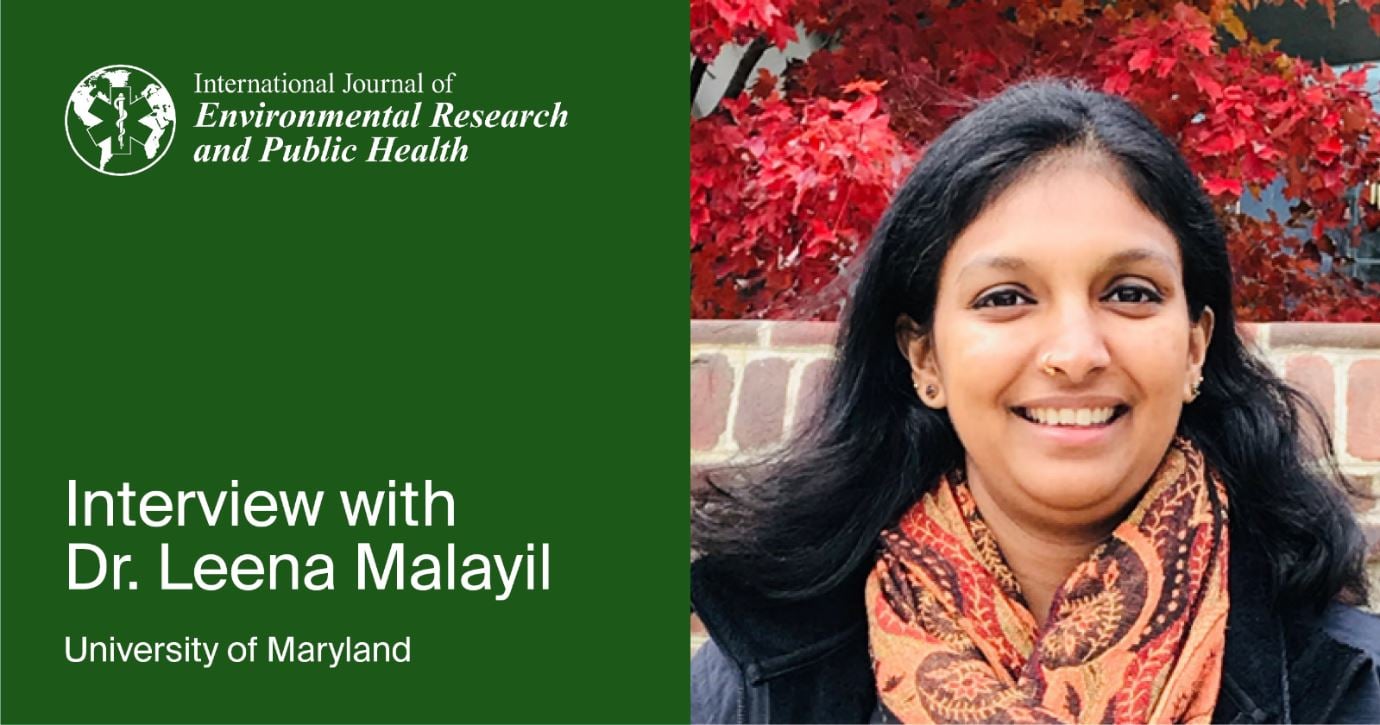
International Journal of Environmental Research and Public Health | An Interview with One of the Authors—Dr. Leena Malayil
Name: Dr. Leena Malayil
Affiliations: Department of Global, Environmental, and Occupational Health, School of Public Health, University of Maryland, College Park, MD 20742, USA
Interests: environmental health; food safety and water quality; human infectious diseases; global health
“Microbial and Chemical Water Quality Assessments Across the Rural and Urban Areas of Nepal: A Scoping Review”
by Suhana Chattopadhyay, Alex Choiniere, Nedelina Tchangalova, Yunika Acharya, Amy R. Sapkota and Leena Malayil
Int. J. Environ. Res. Public Health 2025, 22(10), 1526; https://doi.org/10.3390/ijerph22101526
Available online: https://www.mdpi.com/1660-4601/22/10/1526
The following is a interview with Dr. Leena Malayil:
1. Congratulations on your recent publication! Could you briefly introduce yourself and your current research focus?
Firstly, thank you so much for this great opportunity to talk to your reacders about my research. I am Dr. Leena Malayil, an Associate Research Professor in the Department of Global, Environmental and Occupational Health at the University of Maryland's (UMD) School of Public Health. I am also a Co-Principal Investigator and the Nepal team lead for the Global FEWture Alliance (GFA), a UMD-based international alliance led by Dr. Amy R. Sapkota. The goal of this alliance is to develop a holistic solution that focuses mostly on the areas of food, energy and water (FEW), enhancing climate resilience and protecting global public health. I also co-direct the Maryland Safe Drinking WATER Study, an initiative aimed to protect drinking water, especially in underserved communities within Maryland. Both projects that I've described were funded through the University of Maryland’s Grand Challenges Grant initiative.
My overall research focus lies in the realm of environmental health, food safety and water quality that impacts public health. Currently, I am focusing on microbial water quality data analysis within the Global FEWture Alliance and the Maryland Safe Drinking WATER Study.
2. What initially drew you to this particular research focus?
My interest in this research focus evolved naturally from my work as the Nepal team lead for GFA, where I oversee several related projects in the country. Even prior to this role, during my post-doctoral training (2021), I had received funding through the Conservation, Food and Health Foundation to study the microbial quality of harvested rainwater in Nepal. With the support of my mentor, Dr. Amy R. Sapkota, we built strong partnerships within Nepal to conduct field studies and engage in capacity building efforts with multiple stakeholders- including farming communities that rely on harvested rainwater for irrigation purposes. We also made sure that we involved students who are our future FEW leaders through a global classroom, which I teach every fall, and which emphasizes water quality and scarcity, especially in a global perspective. Through all of these experiences, it became clear that we needed to better understand existing knowledge on both the drinking and the irrigation water quality within Nepal. This realization motivated me to look into what is being published in the literature. So a scoping review is what we envisioned to identify the gaps and provide a comprehensive overview of what's in the current literature. Through that I feel we can build up on it and understands what needs to be done in the future.
3. In your view, what is the most significant theoretical or practical implication of this research? How might it impact our daily lives?
So, through our scoping review, we highlighted some of the critical gaps and inconsistencies that we came across when we looked at the water quality monitoring within Nepal, especially when you look in terms of the rural and urban areas. By bringing together evidence on both chemical and the microbial contaminants, I feel the study underscores that there's an urgent need for more systematic region-specific surveillance and better infrastructure to ensure safe drinking and irrigation water.
From a theoretical perspective, the research strengthens the understanding that water quality cannot be separated from broader environmental and public health systems. It reinforces the idea that addressing water safety requires an integrated approach, one that considers agricultural practices, sanitation, land use, and also policy frameworks.
In terms of day-to-day life, I feel the implications are profound. Water is essential as you know, for drinking, for cooking, hygiene and farming, from morning to night. It's the most important thing. Poor water quality affects the health, it contributes to infectious diseases, and it also impacts the food safety and crop productivity. So, by identifying the major risks lie and where the data gaps exist, we can work and guide future interventions and policies that can improve the water quality on which people rely on a day-to-day basis, which ultimately supports a healthier community, safer food systems, and greater climate resilience.
4. What was the most significant challenge you encountered during this research, and how did you overcome it?
I would say the most significant challenge that we encountered was the lack of consistent, regular monitored water quality data across Nepal, especially in rural areas. Yes, we could get a lot of data within the urban area, but rural areas were neglected. I feel this resulted in a notable gap and made it difficult to even compare the findings between a rural area and an urban city.
Additionally, the studies that we reviewed varied in data quality and methodological approaches, which complicated cross-paper comparisons.
Another limitation that I could think of was the uneven geographic distribution of the available data. For instance, we mentioned this in our paper as one of the limitations too; the Bagmati province within Nepal had substantially more published studies than other regions.
Another interesting limitation was based on different terminologies used for the word water itself and publications that were non-English. This made it difficult for us when we were trying to group certain words, for example we had dug-well water, ground-well water. We were thinking they might be all different but then found out that they're just different terms used by different people who are publishing based on their native local languages or dialects. We tried our best to overcome this challenge with help of our Nepali collaborators.
5. If you could offer one piece of advice to a young scholar just entering this field, what would it be?
Looking at my trajectory of work from my undergraduate until my journey over here, I feel an interdisciplinary approach is something that everyone has to start embracing and also actively building global connections, especially within the FEW nexus. Food, energy, and water for a complex nexus, and to create meaningful solutions, there's a necessity to integrate insights from environmental health, engineering, agriculture sector, social sciences, and policy.
Additionally, I also feel it is not just one country's issue. It's a global issue when we talk about the food, energy, water nexus. Water scarcity, food insecurity, and energy pressures—they're all global issues that transcend borders. And I feel collaborating with your international partners will deepen your understanding of diverse contexts and strengthen the relevance and impact of your work. Having a lot of international collaborators and being interdisciplinary has its own challenges, but I believe one will be better equipped to contribute to holistic, sustainable solutions that benefit communities around the world—exactly the mission our alliance strives sto advance.
6. What are your next steps in terms of research plans? Are you exploring any new directions currently?
There are several ongoing projects within the Global FEWture Alliance. In Nepal specifically, a major initiative is our partnership with colleagues in Israel is to design and implement an off-grid wastewater treatment system. The system will treat wastewater generated in a model school in Nepal and make it suitable for agriculture irrigation, helping to ease the region’s growing water shortages by using treated water rather than further depleting ground or surface water sources. We are also exploring the use of biochar as a soil amendment to support higher crop yields through a sustainable, climate-friendly fertilizer alternative. In parallel, we are continuing the Namobuddha Drinking and Irrigation Water Quality Study to better understand contamination patterns and guide safer water management strategies.
Together, these efforts reflect our commitment to advancing innovative, integrated FEW solutions that are practical, sustainable, and responsive to community needs.
7. Could you share your experience of publishing in IJERPH? In addition, do you think that IJERPH, as a platform, plays a unique role in promoting interdisciplinary integration and knowledge dissemination?
Publishing in IJERPH was a very smooth and positive experience for me, especially as it was my first time submitting a manuscript to this journal. The submission and the review process was very straightforward. The excellent editorial team were very supportive throughout. They were very helpful.
I believe that IJERPH could be more active in promoting global and interdisciplinary research submissions by being more accessible and inclusive to low- and middle-income countries. Overall, I see IJERPH as a valuable platform for promoting interdisciplinary integration and knowledge dissemination, bridging diverse fields in environmental and public health research.
Quotes from the other authors of this notable paper:
“Contributing comprehensive literature searching and reference management for this review was a rewarding part of our collaborative work as a team. The journal’s clear guidance and prompt communication further strengthened the overall experience.”—Nedelina Tchangalova, UMD Public Health Librarian.
“Working on this scoping review underscored how complex and uneven water-quality challenges are across Nepal. The experience of compiling and analyzing the scattered evidence strengthened our commitment to supporting evidence-based interventions for safer water in both rural and urban settings. Importantly, this effort aligns directly with the Global FEWture Alliance’s mission — advancing systems-based, interdisciplinary research-to-action, community-driven capacity building and experiential education to effect positive change at the nexus of food, energy, water, climate, and health. By mapping water-quality risks in Nepal, we contribute to GFA’s goal of protecting global public health and bolstering resilience in underserved communities.”—Suhana Chattopadhyay, UMD GEOH Assistant Research Professor