
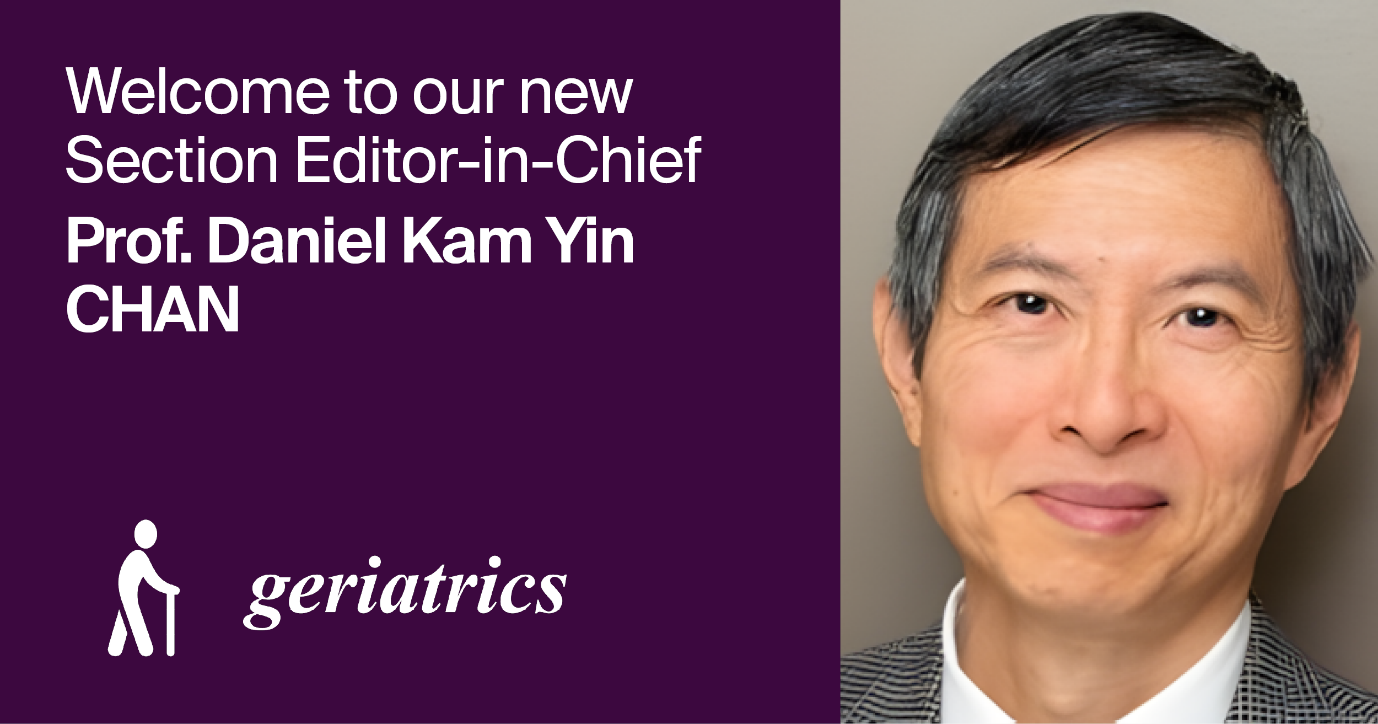
Prof. Daniel Kam Yin Chan Appointed Section Editor-in-Chief of Section “Geriatric Rehabilitation” in Geriatrics
We are pleased to announce the appointment of Prof. Daniel Kam Yin Chan as the new Section Editor-in-Chief of Section “Geriatric Rehabilitation” in Geriatrics (ISSN: 2308-3417).
Name: Prof. Daniel Kam Yin Chan
Affiliation: Faculty of Medicine and Health, University of New South Wales, Kensington, NSW 2033, Australia
Interests: genetics; aging
The following is a short Q&A with Prof. Daniel Kam Yin Chan, who shared his vision for the journal with us, as well as his views on the research area and open access publishing.
1. What appealed to you about the journal that made you want to take the role of Section Editor-in-Chief?
Our global population is ageing rapidly and the need of rehabilitation for our older population is increasing. However, rehabilitation of older people (geriatric rehabilitation) poses challenges as older patients often have multiple comorbidities, cognitive impairments and frailty, coexisting with complex psychosocial background. Acute problems such as shortness of breath, delirium and falls can happen during geriatric rehabilitation and can be difficult to assess or to treat. Geriatricians are at the forefront of these challenges and how to tackle the challenges better and improve the quality and efficacy of geriatric rehabilitation is of paramount importance in patient care. I sincerely hope that as the Section-Editor-in-Chief, I will be able to contribute to this important field.
2. What is your vision for the journal?
As a clinician interested in research, I know how important it is to advance a scientific field through collaboration in research and sharing of knowledge via publications. My vision would be to assist and encourage collaboration via sharing of opinions, ideas or big data, via online seminars or online conferences as well as publications of results in our section so that the field of geriatric rehabilitation can be enhanced and enriched. Advanced technology such as digital technology and AI is greatly welcomed as no doubt the correct use of them will benefit humans and geriatric rehabilitation.
3. What does the future of this field of research look like?
The new challenges in geriatric rehabilitation are how to use latest knowledge and innovations in helping older patients who have lost their function or who are deconditioned to regain independence and continue to enjoy good quality of life. In achieving this, we shall need a skilled multidisciplinary team who can provide comprehensive geriatric assessment and execute a comprehensive plan that harness the new knowledge and innovations to maximize the chance of a patient achieving the best possible outcome in the realistic goals set. In saying so, some big questions remain. For instance, the challenge of geriatric rehabilitation in frailty, the appropriate use of AI and digital technology in aiding older people to undergo rehabilitation or to live independently. Therefore, the field will require collaboration of our healthcare workers with technology and industry sectors. The more we talk and share knowledge, the better will be the chance of furthering the field.
4. Do you have any suggestions for young researchers in this field?
I would recommend young researchers to find senior colleagues who could mentor and nurture them. Furthermore, do not be afraid to ask big questions, to take risk and to be bold. Geriatric rehabilitation is not a new terminology but many challenges in the field remain unresolved. We look forward to young researchers joining the field and contributing to tackling big questions for the good of patient care. I hope I can play a role in this interesting journey with the company of lots of younger colleagues.
We welcome Prof. Daniel Kam Yin Chan as our Section Editor-in-Chief and look forward to receiving his contributions, facilitating the continued success of Geriatrics.