Vitreous and Glass-Based Materials for the Circular Economy

A topical collection in Encyclopedia (ISSN 2673-8392). This collection belongs to the section "Material Sciences".

Viewed by 793

Editors


E-Mail Website
Collection Editor

E-Mail Website
Collection Editor
State Key Laboratory of Silicate Materials for Architectures, Wuhan University of Technology, Wuhan, China
Interests: glasses; glass–ceramics; hazardous and nuclear waste vitrification; numerical simulation of melter
Special Issues, Collections and Topics in MDPI journals

Topical Collection Information

Dear Colleagues,

Searching for routes of optimal waste management with or without their further reuse is an important aspect of the current stage of civilisation development and progress. Non-radioactive waste streams can be transformed into an inert form via contaminants binding or encapsulation. Such stabilisation reduces the potential hazard of toxic waste components by converting contaminants into insoluble forms. This can be done using durable solids of high structural integrity. Waste processing technologies which produce durable materials with a minimal ecological impact are preferred among affordable options. Inertisation provides minimal environmental impact of materials and therefore is a key technological component both for any reusage and/or disposal of waste materials. In contrast to non-radioactive waste the nuclear waste is associated with intrinsic harmful radiations and if not cleared from regulatory control for its negligible hazard is always intended to disposal which is considered as the end point of nuclear waste management. Technologies which effectively immobilise toxic waste components and radionuclides are hence most appreciated. With many research programmes under way this Topical Collection invites contributing articles and Encyclopedia entries reporting on current advances and perspectives in utilisation of vitreous and glass-based materials, especially accounting for their applications in circular economy including hazardous waste processing as well as nuclear waste immobilisation. All aspects of materials synthesis and structural and property investigation are welcome with focus on utilisation of materials in practical applications.

Prof. Dr. Michael Ojovan
Prof. Dr. Kai Xu
Collection Editors

Manuscript Submission Information

Manuscripts should be submitted online at www.mdpi.com by registering and logging in to this website. Once you are registered, click here to go to the submission form. All submissions that pass pre-check are peer-reviewed. Accepted papers will be published continuously in the journal (as soon as accepted) and will be listed together on the Topical Collection website. Review articles and Entry papers are invited. For planned papers, a title and short abstract (about 250 words) can be sent to the Editorial Office for assessment.

Submitted manuscripts should not have been published previously, nor be under consideration for publication elsewhere (except conference proceedings papers). All manuscripts are thoroughly refereed through a single-anonymized peer-review process. A guide for authors and other relevant information for submission of manuscripts is available on the Instructions for Authors page. Encyclopedia is an international peer-reviewed open access monthly journal published by MDPI.

Please visit the Instructions for Authors page before submitting a manuscript. The Article Processing Charge (APC) for publication in this open access journal is 1200 CHF (Swiss Francs). Submitted papers should be well formatted and use good English. Authors may use MDPI's English editing service prior to publication or during author revisions.

Keywords

  • vitreous materials
  • glasses
  • glass-ceramics
  • glass-crystalline composites
  • vitrification
  • nuclear waste
  • hazardous waste
  • immobilisation
  • inert forms

Published Papers (1 paper)

2026

28 pages, 4235 KB  
Review
Towards High-Strength Transparent Glass-Ceramics: Processing, Microstructure, and Applications
by Ivan Veselov, Georgiy Shakhgildyan, Kirill Tregubov, Daniil Vinogradov and Vladimir Sigaev
Encyclopedia 2026, 6(8), 176; https://doi.org/10.3390/encyclopedia6080176 - 19 Aug 2026
Viewed by 128
Abstract
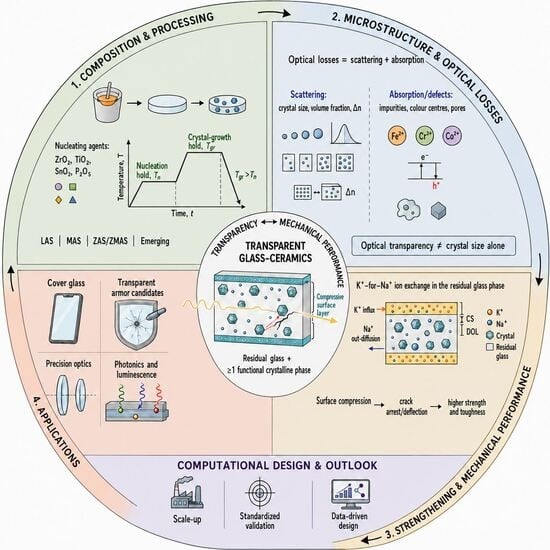
Glass-ceramics are inorganic, non-metallic materials obtained by controlled crystallization of glasses through different processing routes; they contain at least one functional crystalline phase together with a residual glass, and the crystallized fraction may range from trace levels to nearly complete crystallization. Transparent glass-ceramics [...] Read more.
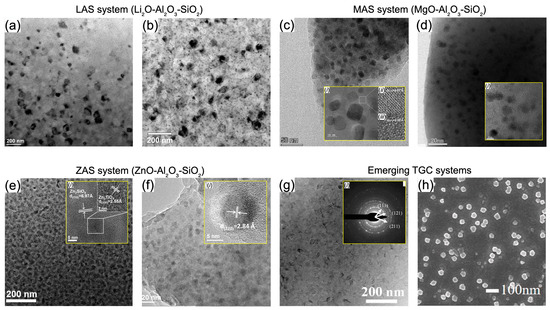
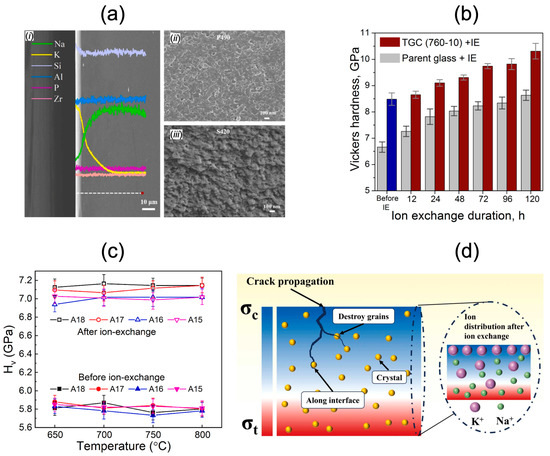
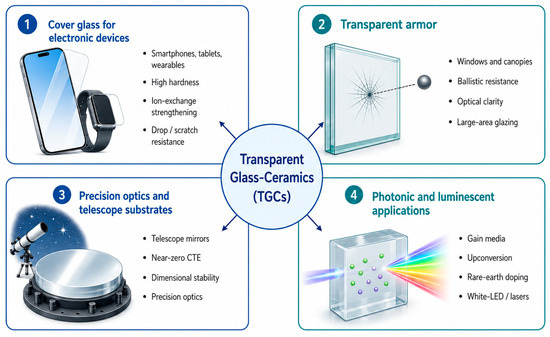
Glass-ceramics are inorganic, non-metallic materials obtained by controlled crystallization of glasses through different processing routes; they contain at least one functional crystalline phase together with a residual glass, and the crystallized fraction may range from trace levels to nearly complete crystallization. Transparent glass-ceramics (TGCs) constitute the optically transparent subset of this class and combine a controlled crystalline microstructure with a residual amorphous matrix. Their transparency distinguishes them from conventional opaque glass-ceramics and is achieved by minimizing light scattering through careful control of crystallite size, volume fraction, spatial distribution, and refractive-index mismatch between the crystalline and glassy phases. Unlike conventional sintered ceramics, TGCs retain many of the processing advantages of glass while incorporating crystalline phases that can enhance mechanical, thermal, optical, or functional properties. Depending on their composition and microstructure, TGCs may exhibit improved hardness, fracture toughness, thermal stability, chemical durability, luminescence, nonlinear optical response, or ion-exchange strengthening capability. These features make TGCs attractive for applications requiring both optical clarity and advanced performance, including protective cover glass, transparent armour, precision optical substrates, laser and photonic components, optical sensors, and multifunctional host materials for rare-earth ions and nanoparticles. Full article
Show Figures

Graphical abstract

Back to TopTop