

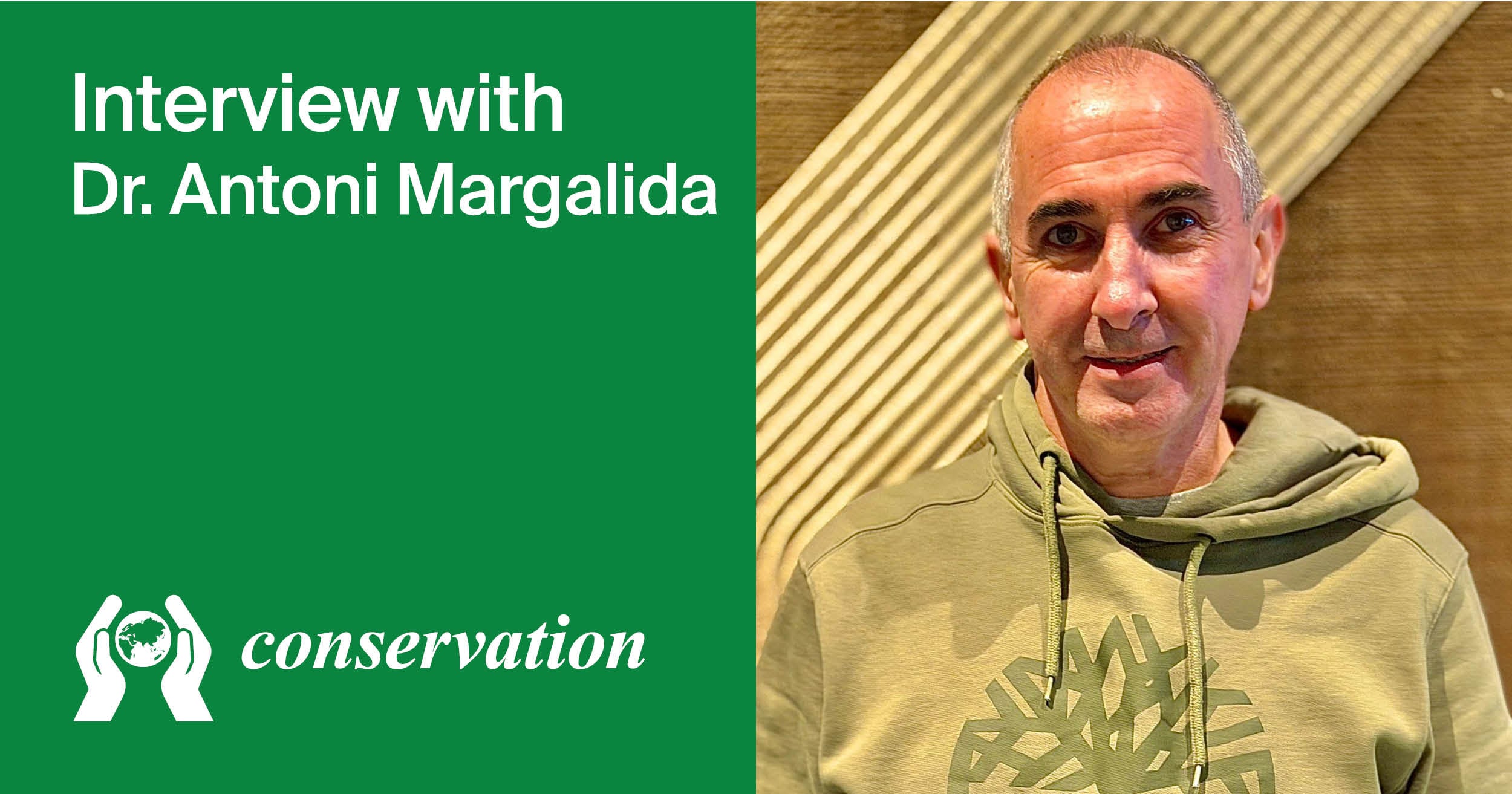
Interview with Dr. Antoni Margalida—Editor-in-Chief of Conservation
Conservation provides a platform for sharing and exchanging research findings on biological, environmental, sociological, ethical, and economic, and other transdisciplinary dimensions of conservation.
Here, we interview the Editor-in-Chief of Conservation (ISSN: 2673-7159), Dr. Antoni Margalida of the Pyrenean Institute of Ecology (CSIC).
Dr. Antoni Margalida (El Pont de Suert, 1969) earned his PhD in ecology and evolution from the University of Bern (Switzerland) and is currently a Senior Scientist of the CSIC (Spanish National Research Council) at the Pyrenean Institute of Ecology (CSIC).
Dr. Antoni Margalida is interested in finding ways to balance human development and wildlife conservation goals, studying the dynamic of scavenger guilds in the Pyrenees (focusing primarily on vultures) and factors that can regulate populations, analysing the contradictions between environmental and health policies to demonstrate that scientific arguments can trigger positive political action and help reconcile the conservation of biodiversity and human activities, and developing another avenue related to conservation biology and behavioural ecology of threatened species to find ways to balance human development and wildlife conservation objectives.
Dr. Antoni Margalida has participated in 40 research projects and published a total of 270 scientific papers (231 SCI papers), 8 books, and 68 book chapters, with an h-index of 61 (Google Scholar), an i10-index of 191, and more than 11000 citations. He has participated in many scientific communications, corresponding to 92 congresses, symposia, and scientific meetings (60 national and 32 international).
The following is an interview with Dr. Antoni Margalida:
1. What attracted you to the role of Editor-in-Chief of Conservation?
When they offered me the responsibility to be Editor-in-Chief of Conservation, I saw it as a very important challenge. I believe that the Conservation journals play a fundamental role in improving biodiversity, and my experience with other conservation journals gave me the confidence to collaborate and meet the challenge of making Conservation a benchmark in this field.
2. What would you say are Conservation’s biggest achievements over the past year?
The increase in the number of articles received and their quality are the best indicators that the journal is on the right track.
3. What is your vision for the journal’s future?
That it becomes a leading journal in the field of conservation and competes with prestigious traditional journals that play a fundamental role in the decision making of conservationists and policymakers. Attracting more authors from other countries and encouraging publication by young scientists who are starting their research careers would be immediate objectives in order to continue the positive trajectory that the journal has had since its inception.
4. How do you envision the field evolving in the future?
I believe it will become increasingly important for improving the management and conservation of species and ecosystems, and that many management decisions are being made based on scientific evidence. Therefore, decision making based on the results published in scientific journals will become increasingly relevant.
5. What advice would you give to someone looking to publish an article in Conservation?
That it is a journal with a fast, but at the same time rigorous, review process. Although the journal's impact is an important attraction, its purpose is to give a voice to all topics related to conservation, regardless of the impact the article may have in terms of citations.
6. What are the current trending topics in ecology and biodiversity conservation research?
Currently, the overall loss of biodiversity due to the increase and impact of human activity, climate change, emerging diseases, and habitat pollution are very pressing issues that affect the entire planet.
7. At a personal level, what do you find most exciting and rewarding about your role as Editor-in-Chief?
Seeing new proposals with fresh approaches, learning every day by reading new research, and seeing how the editorial process improves until the final result is published are very rewarding experiences as an Editor.
8. How do you see open access publishing evolving in the field?
I think it will continue to grow at the same rate. It has been proven that open-access articles receive more downloads and more citations than paywalled articles. Removing barriers to access to publications allows for greater advancement in scientific knowledge, and the need to cover OA publication costs is becoming increasingly evident, but at a price that is affordable for everyone, because the cost of open access publishing should not be a limitation for researchers.