
Recent Advances in Thermochemical Conversion of Biomass and Waste to Fuels, Chemicals and Materials

A special issue of Biomass (ISSN 2673-8783).

Deadline for manuscript submissions: 20 September 2026 | Viewed by 10755

Special Issue Editors


E-Mail Website
Guest Editor
Dipartimento di Ingegneria Chimica, dei Materiali e della Produzione Industriale, Università degli Studi di Napoli Federico II, Naples, Italy
Interests: combustion; gasification; pyrolysis; pollutants control; CO2 capture and utilization; fluidized beds
Special Issues, Collections and Topics in MDPI journals
Istituto di Scienze e Tecnologie per l’Energia e la Mobilità Sostenibili, Consiglio Nazionale delle Ricerche, P. le V. Tecchio, 80, 80125 Napoli, Italy
Interests: torrefaction; pyrolysis; gasification; biomass-based CQDs; fluidized bed reactor; isoconversional kinetic methods

E-Mail Website
Guest Editor
Institute of Sciences and Technologies for Sustainable Energy and Mobility (STEMS), National Research Council (CNR), Naples, Italy
Interests: fluidized beds; CCS&U; biomass thermal conversion; machine learning; TEA; LCA
Special Issues, Collections and Topics in MDPI journals

E-Mail Website
Guest Editor
Institute of Sciences and Technologies for Sustainable Energy and Mobility (STEMS), National Research Council (CNR), Naples, Italy
Interests: combustion; gasification; pyrolysis; energy and material production in a fluidized bed reactors; fate of solid particulates generated in a fluidized bed reactors; thermal treatments of waste and civil and industrial sludges

Special Issue Information

Dear Colleagues,

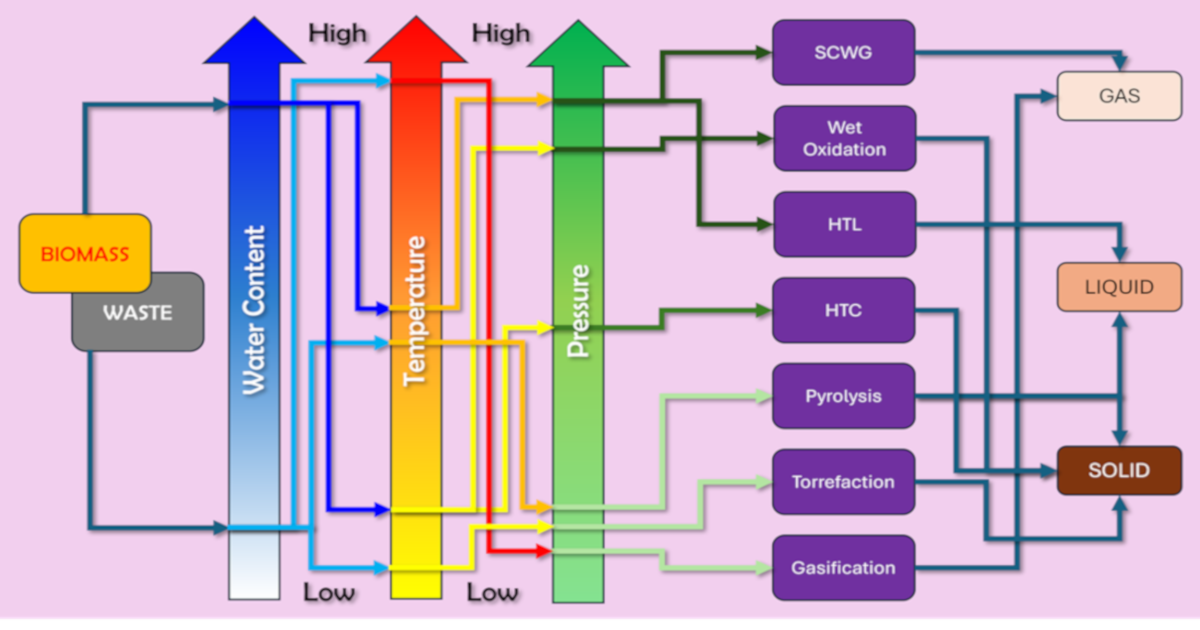
Thermochemical conversion processes, carried out at medium to high temperatures, remain among the most promising methods for converting biomass and waste (including plastics) into fuels, chemicals, and materials. These processes help in addressing the need for greener energy sources and commodities and contribute to the sustainable use of waste materials. Feedstocks with low moisture content are typically processed using dry thermochemical methods, such as torrefaction, pyrolysis, or gasification. Feedstocks with higher moisture content are more appropriately processed using wet thermochemical methods, such as hydrothermal liquefaction (HTL) or carbonization (HTC), supercritical water gasification, or wet oxidation. Each of these technologies produces complex solid, liquid, and gaseous intermediates that require further refining or upgrading to produce marketable fuels, chemicals, and value-added materials. Therefore, the progress and innovation of such conversion technologies plays a crucial role in the development of renewable energy and the replacement of fossil fuels and chemicals in achieving environmental sustainability.

This Special Issue focuses on the recent advances in thermochemical conversion of biomass and waste into fuels, chemicals, and materials. It provides a unique opportunity for researchers and experts to contribute their insights to address the challenges of improving current biomass conversion pathways. We kindly invite authors to submit high-quality original communications, full-length articles on experimental and numerical studies, and state-of-the-art reviews addressing their research on the use of thermochemical processes and emerging strategies for biomass and waste valorization. We invite contributions that delve into process optimization, technological advances, and challenges encountered in the exploitation of biomass and waste for their efficient and sustainable thermochemical conversion.

Key Topics:

  • Novel advances in biomass and waste thermochemical conversion processes;
  • Process optimization strategies for enhancing fuel, chemical, and material yields;
  • Reactor and catalyst development for improved thermochemical conversion;
  • Techno-economic and environmental assessments of thermochemical conversion processes;
  • Integration of thermochemical conversion into existing energy systems.

Prof. Dr. Fabrizio Scala
Dr. Paola Brachi
Dr. Antonio Coppola
Dr. Massimo Urciuolo
Guest Editors

Manuscript Submission Information

Manuscripts should be submitted online at www.mdpi.com by registering and logging in to this website. Once you are registered, click here to go to the submission form. Manuscripts can be submitted until the deadline. All submissions that pass pre-check are peer-reviewed. Accepted papers will be published continuously in the journal (as soon as accepted) and will be listed together on the special issue website. Research articles, review articles as well as short communications are invited. For planned papers, a title and short abstract (about 250 words) can be sent to the Editorial Office for assessment.

Submitted manuscripts should not have been published previously, nor be under consideration for publication elsewhere (except conference proceedings papers). All manuscripts are thoroughly refereed through a single-blind peer-review process. A guide for authors and other relevant information for submission of manuscripts is available on the Instructions for Authors page. Biomass is an international peer-reviewed open access semimonthly journal published by MDPI.

Please visit the Instructions for Authors page before submitting a manuscript. The Article Processing Charge (APC) for publication in this open access journal is 1200 CHF (Swiss Francs). Submitted papers should be well formatted and use good English. Authors may use MDPI's English editing service prior to publication or during author revisions.

Keywords

  • biomass
  • waste
  • thermochemical conversion
  • biofuel
  • bioenergy
  • chemicals
  • materials
  • process optimization
  • reactor design
  • techno-economic and environmental assessments

Benefits of Publishing in a Special Issue

  • Ease of navigation: Grouping papers by topic helps scholars navigate broad scope journals more efficiently.
  • Greater discoverability: Special Issues support the reach and impact of scientific research. Articles in Special Issues are more discoverable and cited more frequently.
  • Expansion of research network: Special Issues facilitate connections among authors, fostering scientific collaborations.
  • External promotion: Articles in Special Issues are often promoted through the journal's social media, increasing their visibility.
  • Reprint: MDPI Books provides the opportunity to republish successful Special Issues in book format, both online and in print.

Further information on MDPI's Special Issue policies can be found here.

Published Papers (6 papers)

Order results
Result details
Select all
Export citation of selected articles as:

Research

Jump to: Review

24 pages, 3713 KB  
Article
Incorporation of Lignin Binder from Agricultural Waste to Enhance Sustainability and Performance of Asphalt Pavements
by Joan G. Lynam, Nazimuddin Wasiuddin, Mostafa A. Elseifi, Syed Ashik Ali, Musharraf Zaman, Md Reazul Islam, Nafisa Tarannum and Kenneth Hobson
Biomass 2026, 6(2), 28; https://doi.org/10.3390/biomass6020028 - 8 Apr 2026
Viewed by 437
Abstract
Utilizing lignin from agricultural wastes as a partial replacement for asphalt binder used in pavement presents a sustainable option, as it is abundant in nature. The effects of the addition of lignin on the properties and performance of asphalt binder and asphalt mixes [...] Read more.
Utilizing lignin from agricultural wastes as a partial replacement for asphalt binder used in pavement presents a sustainable option, as it is abundant in nature. The effects of the addition of lignin on the properties and performance of asphalt binder and asphalt mixes were studied. Lignin was produced from rice husks, using a hydrothermal carbonization (HTC) treatment process. The rice husk-derived lignin was then mixed with a PG 67-22 binder at 0%, 5% and 10% of the mass of the total binder. The HTC treatment of rice husks at 250 °C created a powdery substance with an increased acid-insoluble lignin content and a reduced cellulose and hemicellulose content. The addition of 10% lignin was found to produce an unstable modified binder due to phase separation between the lignin and binder, thus requiring continuous stirring before use. Asphalt mixes prepared with 5% lignin exhibited better moisture-induced damage resistance compared to the control mix. Also, an improved rutting resistance of asphalt mixes was observed with the use of a lignin-modified binder. Lignin from rice husks may constitute a sustainable partial substitute for a crude-oil-based binder. Full article
Show Figures

Graphical abstract

13 pages, 748 KB  
Article
Valorization of Algerian Tomato and Hot Pepper Wastes Through Gasification in a Bubbling Fluidized Bed Reactor and Energy Production
by Nazim M. Bellal, Ouacil Saouli, Massimo Urciuolo, Giovanna Ruoppolo, Anna Basco, Renata Migliaccio, Biagio Ciccone and Fabrizio Scala
Biomass 2026, 6(1), 16; https://doi.org/10.3390/biomass6010016 - 6 Feb 2026
Viewed by 669
Abstract
This study investigates the potential of tomato waste (TW) and hot pepper waste (HPW) biomass from local food industries in Algeria as sustainable feedstocks for fluidized-bed air gasification. Conversion efficiency, syngas composition and energy content were evaluated under different operating conditions, including gasification [...] Read more.
This study investigates the potential of tomato waste (TW) and hot pepper waste (HPW) biomass from local food industries in Algeria as sustainable feedstocks for fluidized-bed air gasification. Conversion efficiency, syngas composition and energy content were evaluated under different operating conditions, including gasification temperature (750 and 850 °C) and bed material (silica sand, olivine, and a ZSM-5 zeolite catalyst/silica sand mixture). The results demonstrate that gasification of these biomasses in a bubbling fluidized-bed reactor is an effective waste-valorization route, producing a syngas rich in hydrogen and methane, suitable for power generation and biofuel applications. Under all operating conditions, hot pepper waste generated a syngas with higher energy content than tomato pomace. Full article
Show Figures

Figure 1

20 pages, 6164 KB  
Article
Methane-Rich Syngas from Pyrolysis of Sewage Sludge with Sorbent/Catalyst
by Cesare Freda, Emanuele Fanelli, Assunta Romanelli, Vito Valerio, Adolfo Le Pera, Miriam Sellaro, Giacinto Cornacchia and Giacobbe Braccio
Biomass 2026, 6(1), 7; https://doi.org/10.3390/biomass6010007 - 8 Jan 2026
Viewed by 1155
Abstract
Sewage sludge was pyrolyzed at mass rate of 500 g/h in a bench-scale rotary kiln for methane-rich syngas production. The tested process variables were the pyrolysis temperature (600, 700 and 800 °C) and the CaO addition to the process (0 and 0.2 CaO/dried [...] Read more.
Sewage sludge was pyrolyzed at mass rate of 500 g/h in a bench-scale rotary kiln for methane-rich syngas production. The tested process variables were the pyrolysis temperature (600, 700 and 800 °C) and the CaO addition to the process (0 and 0.2 CaO/dried sewage sludge). Product distribution (char, condensable product, and gas) as well as their chemical composition were determined. At CaO/dried sewage sludge mass ratio equal to 0, with the increasing pyrolysis temperature from 600 to 800 °C, the gas yield increased from 31.4% to 45.6 wt.%, while the char yield decreased from 41.3 to 37.5 wt.%. At CaO/dried sewage sludge mass ratio equal to 0.2, significantly different product distribution and chemical composition were detected. In fact, syngas showed a net CO2 concentration reduction (under 10 mol %), while methane concentration increased at 600 and 700 °C up to 54 and 42 mol %, respectively. The total gas yield increased, probably because of the CaO behavior as catalyst of volatiles conversion reactions (cracking and reforming). In fact, the condensable product yield decreased up to 7 wt.% at 800 °C. At CaO/dried sewage sludge equal to 0.2 and pyrolysis temperature of 700 °C, the maximum methane yield of 150 g/kg SS was detected. Full article
Show Figures

Figure 1

20 pages, 2540 KB  
Article
Hydrochar from Spent Coffee Ground as a Sustainable Adsorbent for Dye Removal from Water: Adsorption Characterization and Improvement via Soft Alkaline Activation
by Gennaro Pace, Gianluigi Farru, Fabiano Asunis, Giovanna Cappai, Angela De Bonis, Maria Cristina Mascolo, Donatella Caniani, Ignazio Marcello Mancini, Salvatore Masi and Francesco Di Capua
Biomass 2026, 6(1), 6; https://doi.org/10.3390/biomass6010006 - 7 Jan 2026
Viewed by 1117
Abstract
Spent coffee grounds (SCGs) are abundantly produced worldwide as a by-product of coffee brewing, and production is surging following the rise in global coffee consumption. Although the adsorption properties of raw SCGs have been investigated in previous studies, limited attention has been paid [...] Read more.
Spent coffee grounds (SCGs) are abundantly produced worldwide as a by-product of coffee brewing, and production is surging following the rise in global coffee consumption. Although the adsorption properties of raw SCGs have been investigated in previous studies, limited attention has been paid to the use of SCG-derived hydrochars as engineered adsorbents. In this work, hydrochars produced via hydrothermal carbonization (HTC) of SCGs at different temperatures were systematically assessed for their capacity to remove methylene blue (MB) dye from aqueous solution. The effect of HTC temperature and soft alkaline activation on MB adsorption were evaluated through adsorption batch tests. The soft alkaline activation increased the experimental adsorption capacity from <20 mg g−1 for untreated hydrochars to approximately 100 mg g−1 at 20 °C, while Langmuir isotherm analysis yielded a monolayer capacity of 147.1 mg g−1 at the same temperature; experimental uptake further increased to 215.6 mg g−1 at 40 °C and high dye concentrations. Kinetic, isotherm, and thermodynamic tests were performed on selected materials to describe their adsorption behavior and potential mechanisms. Microscopic, diffraction, spectroscopic, and porosimetric analyses were performed to investigate the structural differences among the tested materials. This study shows that temperature regulation and soft alkaline activation can strongly improve the adsorption capacity of the hydrochars, producing competitive low-cost adsorbents from a waste material in compliance with the principles of the circular economy. Full article
Show Figures

Graphical abstract

13 pages, 1841 KB  
Article
Valorizing Biomass Waste: Hydrothermal Carbonization and Chemical Activation for Activated Carbon Production
by Fidel Vallejo, Diana Yánez, Luis Díaz-Robles, Marcelo Oyaneder, Serguei Alejandro-Martín, Rasa Zalakeviciute and Tamara Romero
Biomass 2025, 5(3), 45; https://doi.org/10.3390/biomass5030045 - 5 Aug 2025
Cited by 10 | Viewed by 3044
Abstract
This study optimizes the production of activated carbons from hydrothermally carbonized (HTC) biomass using potassium hydroxide (KOH) and phosphoric acid (H3PO4) as activating agents. A 23 factorial experimental design evaluated the effects of agent-to-precursor ratio, dry impregnation time, [...] Read more.
This study optimizes the production of activated carbons from hydrothermally carbonized (HTC) biomass using potassium hydroxide (KOH) and phosphoric acid (H3PO4) as activating agents. A 23 factorial experimental design evaluated the effects of agent-to-precursor ratio, dry impregnation time, and activation duration on mass yield and iodine adsorption capacity. KOH-activated carbons achieved superior iodine numbers (up to 1289 mg/g) but lower mass yields (18–35%), reflecting enhanced porosity at the cost of material loss. Conversely, H3PO4 activation yielded higher mass retention (up to 54.86%) with moderate iodine numbers (up to 1117.3 mg/g), balancing porosity and yield. HTC pretreatment at 190 °C reduced the ash content, thereby enhancing the stability of hydrochar. These findings highlight the trade-offs between adsorption performance and process efficiency, with KOH suited for high-porosity applications (e.g., water purification) and H3PO4 for industrial scalability. The study advances biomass waste valorization, aligning with circular economy principles and offering sustainable solutions for environmental and industrial applications, such as water purification and energy storage. Full article
Show Figures

Figure 1

Review

Jump to: Research

29 pages, 988 KB  
Review
Bio-Circular Economy and Digitalization: Pathways for Biomass Valorization and Sustainable Biorefineries
by Sergio A. Coronado-Contreras, Zaira G. Ibarra-Manzanares, Alma D. Casas-Rodríguez, Álvaro Javier Pastrana-Pastrana, Leonardo Sepúlveda and Raúl Rodríguez-Herrera
Biomass 2026, 6(1), 1; https://doi.org/10.3390/biomass6010001 - 22 Dec 2025
Cited by 4 | Viewed by 3173
Abstract
This review examines how the integration of circular bioeconomy principles with digital technologies can drive climate change mitigation, improve resource efficiency, and facilitate sustainable biorefinery development. This highlights the urgent need to transition away from fossil fuels and introduces the bio-circular economy as [...] Read more.
This review examines how the integration of circular bioeconomy principles with digital technologies can drive climate change mitigation, improve resource efficiency, and facilitate sustainable biorefinery development. This highlights the urgent need to transition away from fossil fuels and introduces the bio-circular economy as a regenerative model focused on biomass valorization, reuse, recycling, and biodegradability. This study compares linear, circular, and bio-circular approaches and analyzes key policy frameworks in Europe, Latin America, and Asia linked to several UN Sustainable Development Goals. A central focus is the role of digitalization, particularly artificial intelligence (AI), the Internet of Things (IoT), and blockchain. Examples include AI-based biomass yield prediction and biorefinery optimization, IoT-enabled real-time monitoring of material and energy flows, and blockchain technology for supply chain traceability and transparency. Applications in agricultural waste valorization, bioplastics, bioenergy, and nutraceutical extraction are also discussed in this review. Sustainability tools, such as automated life-cycle assessment (LCA) and Industry 4.0 integration, are outlined. Finally, future perspectives emphasize autonomous smart biorefineries, biotechnology–nanotechnology convergence, and international collaboration supported by open data platforms. Full article
Show Figures

Figure 1

Back to TopTop