

applsci-logo

Journal Browser

Journal Browser

Food Quality and Characterization of Animal-Based, Plant-Based and Hybrid Products

A special issue of Applied Sciences (ISSN 2076-3417). This special issue belongs to the section "Food Science and Technology".

Deadline for manuscript submissions: 10 July 2026 | Viewed by 2668

Special Issue Editors


E-Mail Website
Guest Editor
Department of Agriculture, University of Western Macedonia, Terma Kontopoulou, 53100 Florina, Greece
Interests: animal product quality characteristics; valorization of food industry byproducts; research and development of food products; effect of animal diet on product quality

E-Mail Website
Guest Editor Assistant
Department of Agriculture, University of Western Macedonia, Terma Kontopoulou, 53100 Florina, Greece
Interests: animal product quality characteristics; valorization of food industry byproducts; research and development of food products; effect of animal diet on product quality; food microbiology

Special Issue Information

Dear Colleagues,

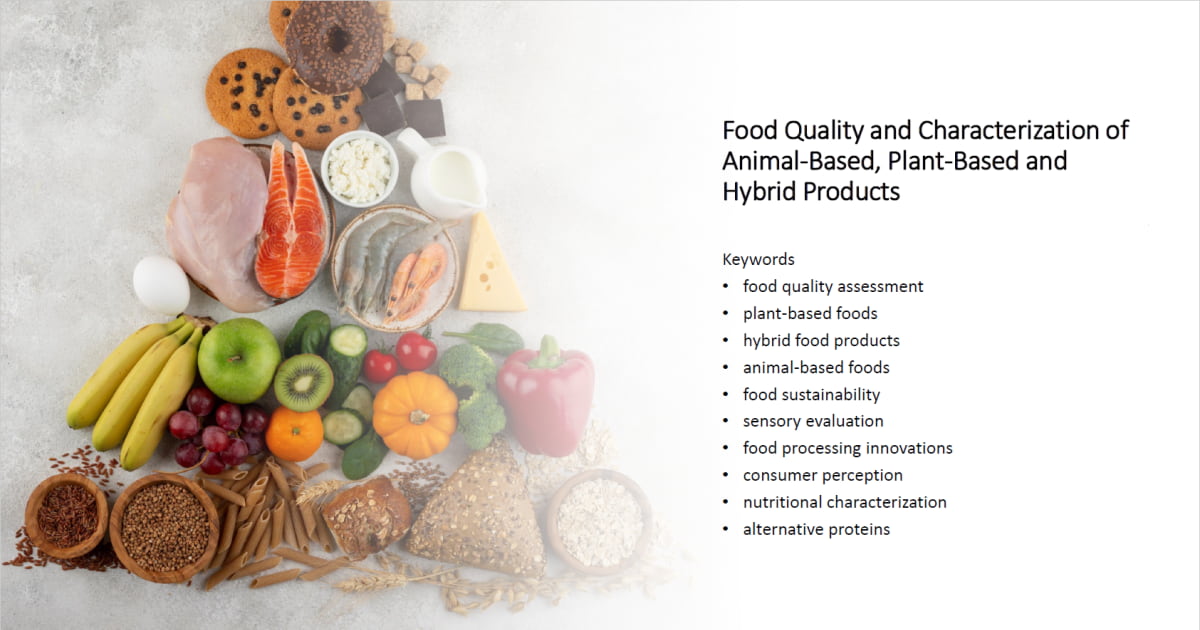
The global food industry is experiencing significant changes, fueled by the increasing popularity of plant-based and hybrid products alongside traditional animal-based foods. It is essential to ensure food quality, safety, sensory appeal, and sustainability to meet the evolving expectations of consumers. This Special Issue highlights recent advancements in the assessment and characterization of animal-based, plant-based, and hybrid food products.

Animal-based foods, such as meat, dairy, and seafood, are essential sources of nutrition. However, the food landscape is changing, with plant-based and hybrid products becoming more popular as healthier and more sustainable alternatives. This shift is primarily driven by increasing consumer demand. Consequently, the food industry is concentrating on improving the safety, quality, and sustainability of all these food types through innovative processing, preservation, and nutritional methods.

We seek contributions that examine the nutritional, physicochemical, and sensory qualities of these food types. Research is encouraged relating to how ingredient selection and processing affect product quality, safety, and consumer acceptance, particularly in response to sustainability concerns.

Topics include, but are not limited to, the following:

  • Nutritional, sensory, and functional traits;
  • Advanced quality assessment methods;
  • Microbial safety of alternative proteins;
  • Texture and flavor enhancement;
  • Consumer trends and perception;
  • Innovations in processing and preservation;
  • Sustainability impacts and labeling challenges.

We invite original research, reviews, and case studies addressing these themes.

Dr. Eleni Kasapidou
Guest Editor

Dr. Georgios Papatzimos
Guest Editor Assistant

Manuscript Submission Information

Manuscripts should be submitted online at www.mdpi.com by registering and logging in to this website. Once you are registered, click here to go to the submission form. Manuscripts can be submitted until the deadline. All submissions that pass pre-check are peer-reviewed. Accepted papers will be published continuously in the journal (as soon as accepted) and will be listed together on the special issue website. Research articles, review articles as well as short communications are invited. For planned papers, a title and short abstract (about 250 words) can be sent to the Editorial Office for assessment.

Submitted manuscripts should not have been published previously, nor be under consideration for publication elsewhere (except conference proceedings papers). All manuscripts are thoroughly refereed through a single-blind peer-review process. A guide for authors and other relevant information for submission of manuscripts is available on the Instructions for Authors page. Applied Sciences is an international peer-reviewed open access semimonthly journal published by MDPI.

Please visit the Instructions for Authors page before submitting a manuscript. The Article Processing Charge (APC) for publication in this open access journal is 2400 CHF (Swiss Francs). Submitted papers should be well formatted and use good English. Authors may use MDPI's English editing service prior to publication or during author revisions.

Keywords

  • food quality assessment
  • plant-based foods
  • hybrid food products
  • animal-based foods
  • food sustainability
  • sensory evaluation
  • food processing innovations
  • consumer perception
  • nutritional characterization
  • alternative proteins

Benefits of Publishing in a Special Issue

  • Ease of navigation: Grouping papers by topic helps scholars navigate broad scope journals more efficiently.
  • Greater discoverability: Special Issues support the reach and impact of scientific research. Articles in Special Issues are more discoverable and cited more frequently.
  • Expansion of research network: Special Issues facilitate connections among authors, fostering scientific collaborations.
  • External promotion: Articles in Special Issues are often promoted through the journal's social media, increasing their visibility.
  • Reprint: MDPI Books provides the opportunity to republish successful Special Issues in book format, both online and in print.

Further information on MDPI's Special Issue policies can be found here.

Published Papers (3 papers)

Order results
Result details
Select all
Export citation of selected articles as:

Research

21 pages, 1057 KB  
Article
Enhancing Pork Patties with Cricket (Acheta domesticus) Powder: A Feasibility Study on Quality Attributes
by Judith Rodríguez-Párraga, Carmen María Botella-Martínez, Manuel Viuda-Martos, Eva María Santos, José Ángel Pérez-Álvarez, Raquel Lucas-González and Juana Fernández-López
Appl. Sci. 2025, 15(20), 11260; https://doi.org/10.3390/app152011260 - 21 Oct 2025
Cited by 1 | Viewed by 473
Abstract
Edible insects represent an emerging and sustainable alternative in human nutrition, characterized by their high protein and fiber content, along with a lipid profile rich in unsaturated fatty acids. This study evaluated the technological feasibility and impact of incorporating Acheta domesticus powder (10% [...] Read more.
Edible insects represent an emerging and sustainable alternative in human nutrition, characterized by their high protein and fiber content, along with a lipid profile rich in unsaturated fatty acids. This study evaluated the technological feasibility and impact of incorporating Acheta domesticus powder (10% and 20% as a substitution of pork meat) into patties, assessing their proximate composition, physicochemical properties, texture profile (TPA), cooking characteristics, and sensory acceptance. Cricket powder (ADP) increased protein and fiber in the meat product, improved texture and reduced cooking losses. Reformulation with 20% substitution led to significant changes in composition, physicochemical properties, and texture and decreased sensory acceptance, while 10% substitution achieved higher sensory ratings with improved nutritional benefits. In conclusion, optimizing the color of these products is essential to enhance consumer acceptance and promote the development of novel formulations based on insect-derived alternative proteins. Full article
Show Figures

Figure 1

14 pages, 283 KB  
Article
Comparative Assessment of Egg Quality Across Farming Systems and Stages of Laying Cycle
by Ioannis-Emmanouil Stavropoulos, Zoitsa Basdagianni, Georgios Manessis, Aikaterini Tsiftsi, Anne-Jo Smits, Peter van de Beek, Vasilios Tsiouris, Georgios Menexes, Georgios Arsenos and Ioannis Bossis
Appl. Sci. 2025, 15(19), 10693; https://doi.org/10.3390/app151910693 - 3 Oct 2025
Viewed by 884
Abstract
The aim of this study was the evaluation of egg quality between three different farming systems. Eggs collected from intensive (IS), extensive (ES), and dual-purpose systems (DPSs) at three stages of the production cycle (age) were analyzed for both external and internal traits. [...] Read more.
The aim of this study was the evaluation of egg quality between three different farming systems. Eggs collected from intensive (IS), extensive (ES), and dual-purpose systems (DPSs) at three stages of the production cycle (age) were analyzed for both external and internal traits. ISs represent high-input systems while ESs and DPSs represent low-input systems. Both the farming system and age had significant effects on quality characteristics. Eggs from the ES displayed a greater egg weight (64.3 ± 0.20 g) and shell weight (6.6 ± 0.03 g). Eggs from the IS farms displayed a higher Haugh unit score (83.2 ± 0.50), darker colored yolks (12.0 ± 0.06), and a lower incidence of blood spots (0.2 ± 0.05). The age and farming system influenced the fatty acid profile of eggs across farming systems. In particular, DPS eggs showed higher levels of unsaturated (62.2 ± 0.20%) and lower levels of saturated (37.8 ± 0.10%) fatty acids. The effect of age was also significant on the oxidation stability of yolks. The interaction effect (farming system × age) had significant effects on most traits. However, the farming system alone accounted for a greater portion of the variation in most egg quality parameters. Full article
17 pages, 2482 KB  
Article
Assessment of Milk Quality in Skopelos Goats Under Low- and High-Input Farming Systems
by Zoitsa Basdagianni, Ioannis-Emmanouil Stavropoulos, Georgios Manessis, Georgios Arsenos and Ioannis Bossis
Appl. Sci. 2025, 15(14), 7906; https://doi.org/10.3390/app15147906 - 15 Jul 2025
Viewed by 1000
Abstract
This study investigated the effect of different farming systems and lactation stages on the physicochemical characteristics, somatic cell count (SCC), and total bacterial count (TBC) of milk from Skopelos goats. This study was conducted over two consecutive lactation periods on two commercial farms [...] Read more.
This study investigated the effect of different farming systems and lactation stages on the physicochemical characteristics, somatic cell count (SCC), and total bacterial count (TBC) of milk from Skopelos goats. This study was conducted over two consecutive lactation periods on two commercial farms in Greece, an extensive system on Skopelos Island and an intensive system in the Attica region, involving 237 goats of shared genetic background, thereby minimizing genetic variability and strengthening the validity of the comparisons between the production systems. Higher milk yields were observed in the extensive system (0.98 vs. 0.85 kg/day), while milk from this system also had a higher protein (3.57% vs. 3.47%; p < 0.001) and casein content (2.72% vs. 2.57%; p < 0.001), which are traits favorable for cheese production. Fat content peaked during mid-lactation (4.83%; p < 0.05) and remained unaffected by the farming system. Lactose declined from early (4.74%) to late lactation (4.42%; p < 0.001). Both SCC and TBC were significantly elevated in the extensive system (p < 0.001), possibly due to hand milking, environmental exposure, and less-controlled hygiene conditions. These findings highlight a trade-off between the nutritional advantages of extensive systems and challenges related to milk hygiene. A balanced approach, optimizing both quality and sustainability, is recommended. Full article
Show Figures

Figure 1

Back to TopTop