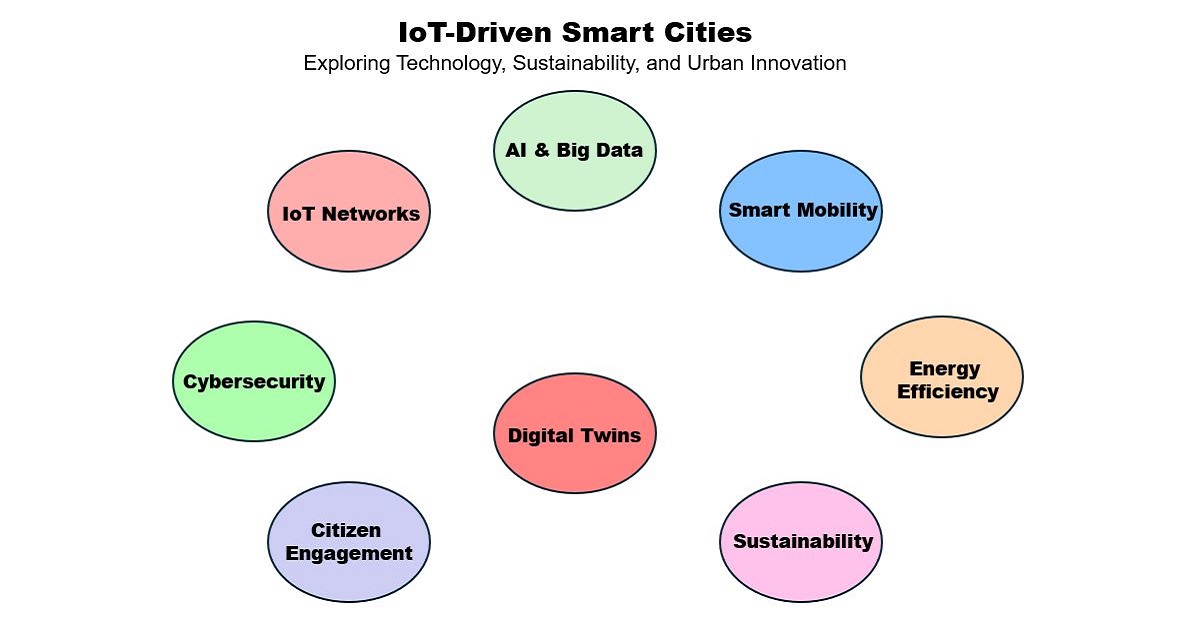


IoT-Driven Smart Cities

A special issue of IoT (ISSN 2624-831X).

Deadline for manuscript submissions: 31 August 2026 | Viewed by 12167

Special Issue Editors


E-Mail Website
Guest Editor
Department of Electrical and Electronic Engineering, Auckland University of Technology, Auckland 1010, New Zealand
Interests: mobile and vehicular networks; wireless sensor networks; Internet of Things (IoT); cognitive radio and spectrum sharing; wireless multi-hop network communications; communication system/circuit design; 5G and beyond; artificial intelligence; embedded systems

E-Mail Website
Guest Editor
Department of Electrical and Electronic Engineering, School of Engineering, Computer and Mathematical Sciences, Auckland University of Technology, Auckland 1010, New Zealand
Interests: mobile computing; wireless communication systems and technologies; networking and communications; communications engineering; cyber–physical systems and the Internet of Things; 4/5/6G; vehicular networks; Internet of Things
Special Issues, Collections and Topics in MDPI journals

Special Issue Information

Dear Colleagues,

The rapid growth of Internet of Things (IoT) technology is transforming urban environments, driving the evolution of smart cities worldwide. By interconnecting sensors, devices, and infrastructure, IoT systems enable real-time data collection and analysis, leading to improved efficiency, sustainability, and quality of life for citizens. Recent research in this domain has focused on diverse applications, including smart traffic management, energy-efficient buildings, enhanced public safety, and waste management systems. This Special Issue brings together recent studies that explore both the theoretical frameworks and practical implementations of IoT-driven smart cities. Emerging trends highlight the integration of AI for advanced decision making, the rise of 5G networks to support massive data transfer, and the increasing focus on data security and privacy. As cities continue to expand and face complex challenges, the future of smart city development will depend on scalable, resilient IoT solutions that can address issues such as climate change, resource management, and urban mobility. This collection of research offers insights into the ongoing advancements in smart city technologies and presents new directions for future innovations, shaping the cities of tomorrow.

This Special Issue welcomes original research articles, short communications, and reviews from the following research areas, among others:

  1. IoT architectures for smart cities;
  2. Data-driven urban planning;
  3. Advanced traffic management and intelligent transportation systems;
  4. Cybersecurity and privacy in smart cities;
  5. Energy-efficient building management systems;
  6. IoT-based environmental monitoring and sustainability;
  7. Digital twin technologies for urban simulation and optimization;
  8. Citizen-centric IoT applications;
  9. Health and safety in smart cities;
  10. IoT for climate resilience and disaster management.

Dr. Hakilo Sabit
Prof. Dr. Peter Han Joo Chong
Guest Editors

Manuscript Submission Information

Manuscripts should be submitted online at www.mdpi.com by registering and logging in to this website. Once you are registered, click here to go to the submission form. Manuscripts can be submitted until the deadline. All submissions that pass pre-check are peer-reviewed. Accepted papers will be published continuously in the journal (as soon as accepted) and will be listed together on the special issue website. Research articles, review articles as well as short communications are invited. For planned papers, a title and short abstract (about 250 words) can be sent to the Editorial Office for assessment.

Submitted manuscripts should not have been published previously, nor be under consideration for publication elsewhere (except conference proceedings papers). All manuscripts are thoroughly refereed through a single-blind peer-review process. A guide for authors and other relevant information for submission of manuscripts is available on the Instructions for Authors page. IoT is an international peer-reviewed open access quarterly journal published by MDPI.

Please visit the Instructions for Authors page before submitting a manuscript. The Article Processing Charge (APC) for publication in this open access journal is 1400 CHF (Swiss Francs). Submitted papers should be well formatted and use good English. Authors may use MDPI's English editing service prior to publication or during author revisions.

Keywords

  • smart cities
  • Internet of Things (IoT)
  • smart urban planning
  • intelligent transportation systems
  • cybersecurity and privacy
  • blockchain in smart cities
  • 5G and beyond
  • artificial intelligence (AI) and big data
  • digital twins
  • energy efficiency
  • sustainability
  • citizen engagement

Benefits of Publishing in a Special Issue

  • Ease of navigation: Grouping papers by topic helps scholars navigate broad scope journals more efficiently.
  • Greater discoverability: Special Issues support the reach and impact of scientific research. Articles in Special Issues are more discoverable and cited more frequently.
  • Expansion of research network: Special Issues facilitate connections among authors, fostering scientific collaborations.
  • External promotion: Articles in Special Issues are often promoted through the journal's social media, increasing their visibility.
  • Reprint: MDPI Books provides the opportunity to republish successful Special Issues in book format, both online and in print.

Further information on MDPI's Special Issue policies can be found here.

Published Papers (5 papers)

Order results
Result details
Select all
Export citation of selected articles as:

Research

21 pages, 457 KB  
Article
Understanding Energy Efficiency of AI Deployments in IoT-Driven Smart Cities
by Salvatore Bramante, Filippo Ferrandino and Alessandro Cilardo
IoT 2026, 7(1), 27; https://doi.org/10.3390/iot7010027 - 8 Mar 2026
Viewed by 870
Abstract
The pervasive adoption of AI and AIoT applications at the network edge presents both opportunities and challenges for smart cities. With a focus on the energy efficiency of AI in urban environments, this paper provides a systematic comparative analysis of representative edge hardware [...] Read more.
The pervasive adoption of AI and AIoT applications at the network edge presents both opportunities and challenges for smart cities. With a focus on the energy efficiency of AI in urban environments, this paper provides a systematic comparative analysis of representative edge hardware platforms, i.e., embedded GPUs, FPGAs, and ultra-low-power microcontroller-/sensor-class devices, assessing their suitability for AI workloads in IoT-driven smart city infrastructures. The evaluation, based on direct characterization of diverse neural networks and relevant datasets, quantifies computational performance and energy behavior through inference latency, throughput, and energy/per inference measurements. Across the evaluated network–board pairs, the measured inference power spans several orders of magnitude, ranging from 0.1–10 mW for ultra-low-power Intelligent Sensor Processing Units (ISPUs) up to 1–10 W for embedded GPUs, highlighting the wide design space between the least and most power-demanding configurations. Results indicate that embedded GPUs provide a favorable performance-to-power ratio for computationally intensive workloads, while MCU/ISPU-class solutions, despite throughput limitations, offer compelling advantages in ultra-low-power scenarios when combined with quantization and pruning, making them well-suited for distributed sensing and actuation typical of smart city deployments. Overall, this comparative analysis guides hardware selection for heterogeneous, sustainable AI-enabled urban services. Full article
(This article belongs to the Special Issue IoT-Driven Smart Cities)
Show Figures

Figure 1

19 pages, 3628 KB  
Article
Ensemble Machine Learning Approach for Traffic Congestion and Travel Time Prediction in Urban Bus Rapid Transit Systems: A Case Study of Trans Metro Bandung
by Rendy Munadi, Dadan Nur Ramadan, Sussi, Nurwulan Fitriyanti and Hilal H. Nuha
IoT 2026, 7(1), 22; https://doi.org/10.3390/iot7010022 - 27 Feb 2026
Viewed by 889
Abstract
Traffic congestion and travel time uncertainty remain major challenges to the operational efficiency of Bus Rapid Transit (BRT) systems in urban areas of developing countries. This study proposes an integrated solution for the Trans Metro Bandung (TMB) system by leveraging Internet of Things [...] Read more.
Traffic congestion and travel time uncertainty remain major challenges to the operational efficiency of Bus Rapid Transit (BRT) systems in urban areas of developing countries. This study proposes an integrated solution for the Trans Metro Bandung (TMB) system by leveraging Internet of Things (IoT)–based GPS data and tree-based ensemble machine learning algorithms. Spatio-temporal data collected from on-board GPS modules are processed to predict traffic congestion levels and estimate travel time across route segments. The performance of Decision Tree, Random Forest, and XGBoost models is evaluated in terms of prediction accuracy, interpretability, and computational efficiency, with particular consideration for deployment on resource-constrained hardware. Experiments conducted on 20,156 data samples show that the Decision Tree model achieves the highest congestion classification accuracy of 96.8%, while Random Forest outperforms other models in travel time regression, achieving an R2 value of 0.95 and a root mean square error (RMSE) of 5.80 min. The trained models are successfully deployed on a Raspberry Pi 3B microcontroller for real-time inference, enabling fleet management and travel planning without reliance on cloud connectivity. The results demonstrate that cost-effective and interpretable machine learning solutions can deliver reliable performance in heterogeneous urban infrastructures while providing a replicable framework for medium-sized cities seeking to implement affordable smart transportation systems. Full article
(This article belongs to the Special Issue IoT-Driven Smart Cities)
Show Figures

Figure 1

49 pages, 6479 KB  
Article
IoT-Driven Destination Prediction in Smart Urban Mobility: A Comparative Study of Markov Chains and Hidden Markov Models
by João Batista Firmino Junior, Francisco Dantas Nobre Neto, Bruno Neiva Moreno and Tiago Brasileiro Araújo
IoT 2025, 6(4), 75; https://doi.org/10.3390/iot6040075 - 3 Dec 2025
Viewed by 1239
Abstract
The increasing availability of IoT-enabled mobility data and intelligent transportation systems in Smart Cities demands efficient and interpretable models for destination prediction. This study presents a comparative analysis between Markov Chains and Hidden Markov Models applied to urban mobility trajectories, evaluated through mean [...] Read more.
The increasing availability of IoT-enabled mobility data and intelligent transportation systems in Smart Cities demands efficient and interpretable models for destination prediction. This study presents a comparative analysis between Markov Chains and Hidden Markov Models applied to urban mobility trajectories, evaluated through mean precision values. To ensure methodological rigor, the Smart Sampling with Data Filtering (SSDF) method was developed, integrating trajectory segmentation, spatial tessellation, frequency aggregation, and 10-fold cross-validation. Using data from 23 vehicles in the Vehicle Energy Dataset (VED) and a filtering threshold based on trajectory recurrence, the results show that the HMM achieved 61% precision versus 59% for Markov Chains (p = 0.0248). Incorporating day-of-week contextual information led to statistically significant precision improvements in 78.3% of cases for precision (95.7% for recall, 87.0% for F1-score). The remaining 21.7% indicate that model selection should balance model complexity and precision-efficiency trade-off. The proposed SSDF method establishes a replicable foundation for evaluating probabilistic models in IoT-based mobility systems, contributing to scalable, explainable, and sustainable Smart City transportation analytics. Full article
(This article belongs to the Special Issue IoT-Driven Smart Cities)
Show Figures

Figure 1

40 pages, 87432 KB  
Article
Optimizing Urban Mobility Through Complex Network Analysis and Big Data from Smart Cards
by Li Sun, Negin Ashrafi and Maryam Pishgar
IoT 2025, 6(3), 44; https://doi.org/10.3390/iot6030044 - 6 Aug 2025
Cited by 4 | Viewed by 2850
Abstract
Urban public transportation systems face increasing pressure from shifting travel patterns, rising peak-hour demand, and the need for equitable and resilient service delivery. While complex network theory has been widely applied to analyze transit systems, limited attention has been paid to behavioral segmentation [...] Read more.
Urban public transportation systems face increasing pressure from shifting travel patterns, rising peak-hour demand, and the need for equitable and resilient service delivery. While complex network theory has been widely applied to analyze transit systems, limited attention has been paid to behavioral segmentation within such networks. This study introduces a frequency-based framework that differentiates high-frequency (HF) and low-frequency (LF) passengers to examine how distinct user groups shape network structure, congestion vulnerability, and robustness. Using over 20 million smart-card records from Beijing’s multimodal transit system, we construct and analyze directed weighted networks for HF and LF users, integrating topological metrics, temporal comparisons, and community detection. Results reveal that HF networks are densely connected but structurally fragile, exhibiting lower modularity and significantly greater efficiency loss during peak periods. In contrast, LF networks are more spatially dispersed yet resilient, maintaining stronger intracommunity stability. Peak-hour simulation shows a 70% drop in efficiency and a 99% decrease in clustering, with HF networks experiencing higher vulnerability. Based on these findings, we propose differentiated policy strategies for each user group and outline a future optimization framework constrained by budget and equity considerations. This study contributes a scalable, data-driven approach to integrating passenger behavior with network science, offering actionable insights for resilient and inclusive transit planning. Full article
(This article belongs to the Special Issue IoT-Driven Smart Cities)
Show Figures

Figure 1

24 pages, 857 KB  
Article
IoT-Based Framework for Connected Municipal Public Services in a Strategic Digital City Context
by Danieli Aparecida From, Denis Alcides Rezende and Donald Francisco Quintana Sequeira
IoT 2025, 6(2), 20; https://doi.org/10.3390/iot6020020 - 25 Mar 2025
Cited by 5 | Viewed by 4469
Abstract
The use of digital technology resources in public services enhances efficiency, responsiveness, and citizens’ quality of life through improved resource management, real-time monitoring, and service performance. The objective is to create and apply an IoT-based framework for connected municipal public services in a [...] Read more.
The use of digital technology resources in public services enhances efficiency, responsiveness, and citizens’ quality of life through improved resource management, real-time monitoring, and service performance. The objective is to create and apply an IoT-based framework for connected municipal public services in a strategic digital city context. The research employed a modeling process validated in a Brazilian city, identifying seven related frameworks and four themes through a bibliometric review. The original framework comprises three constructs, eight subconstructs, and 12 variables, validated through a case study inquiry. The results revealed that the researched city has yet to enlarge IoT into its municipal public services as part of a digital city project initiative. Key recommendations for IoT implementation include prioritizing the preferences of digital citizens, expanding critical services suited for IoT, and updating municipal strategies to incorporate IT resources to streamline decision-making. The conclusion reiterates that the IoT framework for municipal services is effective when actionable information supports strategic planning and decision-making and highlights the transformative potential of IoT in driving more resilient and sustainable cities aligned with citizens’ needs. This approach allows public managers to enhance citizens’ quality of life while improving the efficiency and responsiveness of urban management processes and services. Full article
(This article belongs to the Special Issue IoT-Driven Smart Cities)
Show Figures

Figure 1

Back to TopTop