

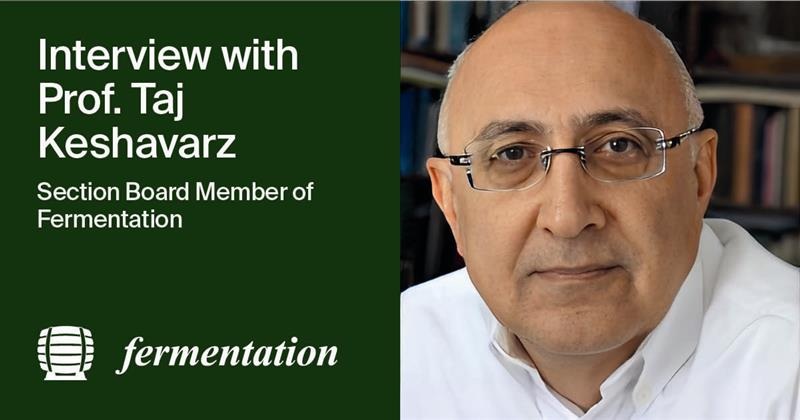
Interview with Prof. Taj Keshavarz—Section Board Member of Fermentation
- What developments in your field of expertise excite you currently?
With a background in biochemical engineering/biotechnology, I witness advances in areas ranging from genetics to industrial bioproduction and biodegradation, leading the research topics to move from being multidisciplinary to interdisciplinary. Specifically, I am interested in the expression of microbes when in communication. This potential can be exploited in diverse areas including biomedicine, agriculture, food, pharmaceuticals, and biodegradation. Of course, machine learning will have a notable impact on all disciplines. An example is in the facilitation of complex and expensive research in small-scale to large-scale processing (scale-down/scale-up).
- What topics in your field of expertise do you believe will gain importance in the future?
Research in the areas of cell factories and biorefineries will continue and gain momentum with the advances in machine learning and AI. Green biotechnology and sustainable processing applied to production (food, agriculture, and industry) as well as biodegradation hold the same degree of significance. For example, the harmful global consequences of microplastic pollution in terrestrial and aquatic environments have come to light and is an established fact. Momentum is building around comprehensive approaches to microplastic mitigation.
- Could you discuss individuals or experiences that have significantly influenced your research career?
My transition into research was shaped by two key decisions made at different points in my career. As a young process engineer working in a petroleum refinery, I had a successful path, but I was fascinated by nature and particularly microbiology. So, I decided to move to academia and continue my interest through research in biochemical engineering. That’s when I started using my engineering background to study how degradative plasmids behave in continuous culture—an inquiry that propelled me into the intersecting domains of genetics, molecular biology, and fermentation technology, expanding both my scientific scope and methodological fluency. The second phase of my research journey, which continues today, was sparked by a personal fascination with philosophy—especially the idea of “communication” as a core principle of life. That perspective led me to establish a research group focused on microbial communication, exploring how microbes interact and how we might harness those interactions for both producing valuable biochemicals and breaking down pollutants.
- The journal Fermentation is celebrating its 10th anniversary in 2025. What is your vision for its development?
To concentrate on the areas that are gaining momentum as mentioned above.
- What do you think about the development of open access in the publishing field?
This is a double-edged sword, which needs to be used wisely to benefit all. In my view, the spread of knowledge and motivating researchers is essential globally. In this context, the role of publishers is of prime importance. Open access publishing facilitates the spread of knowledge. However, this is not of much help for those research and scientific communities that do not have the opportunity to have access due to financial restrictions. MDPI has mechanisms to overcome this limitation, and this is very welcome.
- As an Editorial Board Member, what do you find to be the most important parameter for the success of the journal?
Not one single most important point, but several with the same importance: a) To create a list of good experts (out of the journal’s large available list) who are willing to provide high-quality, timely reviews. b) Reducing the time between receiving a manuscript and having it published. This can be done by eliminating weak manuscripts before arriving at the reviewer stage. c) Creating a group of specific subject experts who have routine online meetings to assess the status of the submitted manuscripts and highlight rate-limiting steps.
- Do you have any advice you would like to share with students and young researchers?
Just as interdisciplinary research thrives by connecting diverse fields, so too does a fulfilling career emerge from aligning heart and mind. When choosing your path, listen to what genuinely excites you—don’t settle for uninspired choices shaped by uncertain advice. Reflect deeply and let your curiosity and intellect guide you forward.