

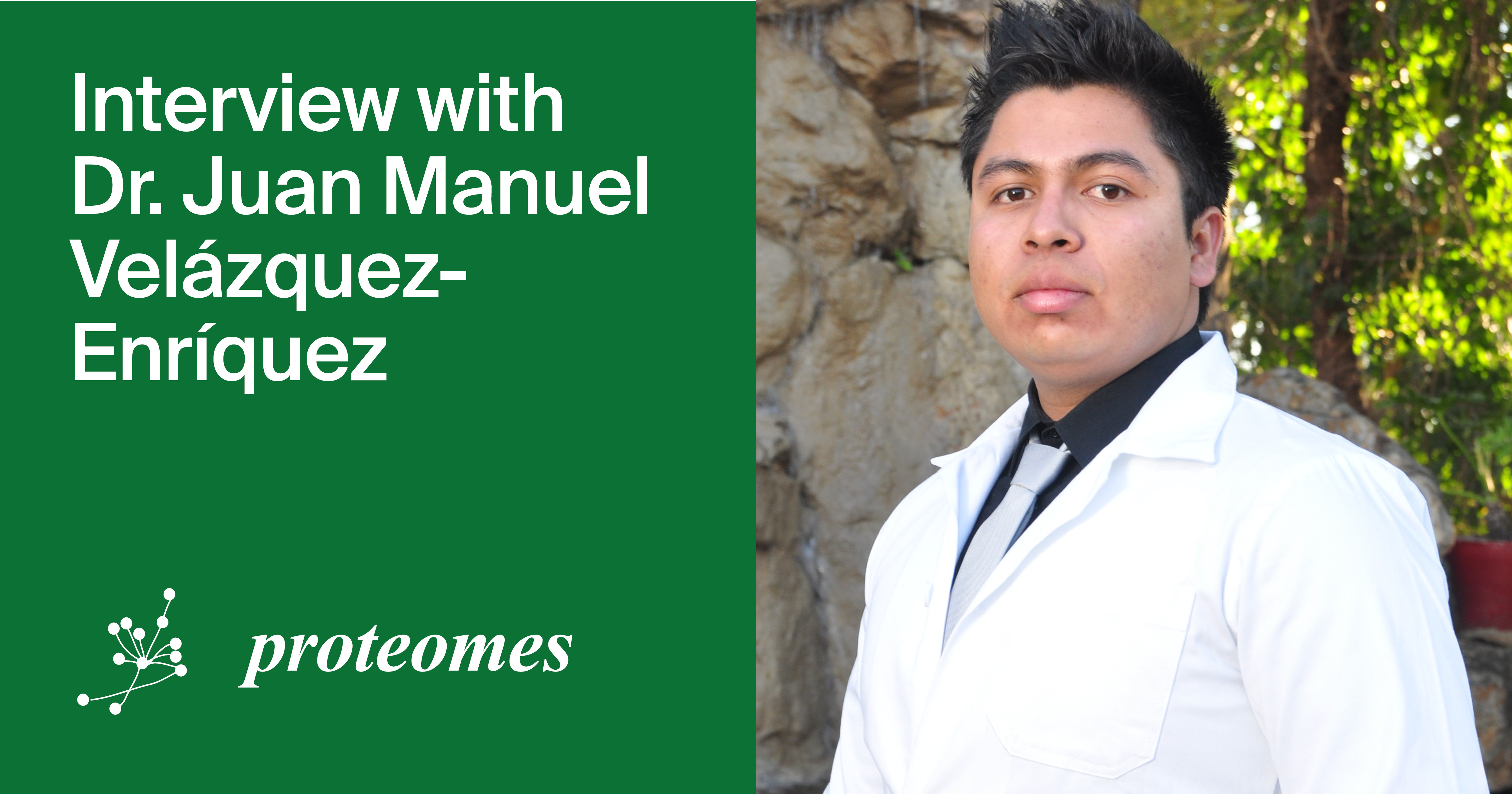
Proteomes | An Interview with One of the Reviewers—Dr. Juan Manuel Velázquez-Enríquez
19 December 2025
Name: Juan Manuel Velázquez-Enríquez
Affiliation: Laboratorio de Fibrosis y Cáncer, Facultad de Medicina y Cirugía, Universidad Autónoma Benito Juárez de Oaxaca, Ex Hacienda de Aguilera S/N, Sur, San Felipe del Agua, Oaxaca C.P. 68020, Mexico
Interests: idiopathic pulmonary fibrosis; fibrosis; extracellular vesicles; proteomics; fibroblasts; bioinformatics; cancer
We recently had the opportunity to interview Dr. Juan Manuel Velázquez-Enríquez, who reviewed manuscripts for Proteomes. Through the interview, he generously provided the following insights into his research, challenges, and personal journey.
The following is an interview with Dr. Velázquez-Enríquez:
- Could you tell us a little bit about yourself?
I am a researcher with a degree in pharmaceutical chemistry and biology from the Faculty of Chemical Sciences at the Benito Juárez Autonomous University of Oaxaca (UABJO). I subsequently obtained my master's and doctorate degrees in experimental biomedicine from the Faculty of Medicine and Surgery at the same university, which has allowed me to consolidate an academic career focused on biomedical research.
My scientific interests center on the study of lung diseases, fibrotic processes, and cancer, where I integrate approaches from cell biology, molecular biology, and bioinformatics to understand the mechanisms underlying the development of these pathologies. Throughout my career, I have had the opportunity to publish my findings in peer-reviewed international journals and collaborate as a scientific reviewer in various specialized journals, which has allowed me to contribute to the advancement and validation of knowledge in my field.
As a young researcher passionate about science, I continually strive to make contributions that combine methodological rigor with innovation, whether through the identification of biomarkers, the evaluation of compounds with therapeutic potential, or the application of tools from omics sciences and bioinformatics.
In addition to research, I am actively involved in training undergraduate students and in scientific outreach activities, convinced that science must transcend the laboratory and reach both the academic community and the general public, thereby strengthening the link between scientific knowledge and society. - Could you introduce your current research direction and provide an update on your progress?
My line of research focuses on the study of lung diseases, fibrosing processes, and cancer, with a particular interest in highly clinically relevant pathologies such as scleroderma, idiopathic pulmonary fibrosis, and lung cancer. To this end, I employ cellular and molecular biology approaches that allow me to unravel the mechanisms underlying the development and progression of these diseases.
A core aspect of my work is the identification of new diagnostic and prognostic biomarkers, as well as the evaluation of compounds with therapeutic potential, using a comprehensive approach that combines in silico, in vitro, and in vivo approaches. These strategies not only facilitate the validation of experimental hypotheses but also enable the more precise exploration of potential clinical interventions.
Complementarily, I integrate bioinformatics and omics science tools, ranging from network pharmacology and molecular docking to label-free proteomics and meta-analysis of transcriptomic data from platforms such as microarrays and RNA-seq. This methodological integration enables me to analyze the complexity of biological systems at multiple levels, generating valuable insights into molecular interactions, signaling pathways, and potential therapeutic targets.
Overall, this combination of experimental and computational methodologies enables me to approach biomedical problems from a multidisciplinary and integrative perspective, to develop more precise diagnostic strategies and innovative therapeutic options that positively impact disease management. - What do you think is the biggest challenge currently and the future directions in your area of research?
The greatest challenge in studying fibrosing diseases and cancer lies in translating laboratory discoveries into tangible clinical applications, resulting in earlier diagnoses and truly effective therapies for patients. Despite notable advances in the understanding of molecular and cellular mechanisms in recent years, these pathologies remain highly complex and heterogeneous, which represents a significant obstacle to the development of universal and effective treatments.
Looking to the future, I believe it will be essential to delve deeper into the field of precision medicine, where the integration of data from the omics sciences with the analytical power of bioinformatics and artificial intelligence will allow us to identify more robust biomarkers, discover new therapeutic targets, and design personalized treatment strategies that respond to the biological variability of each patient.
Likewise, the exploration of new molecules with biological activity, obtained from both natural sources and chemical synthesis, represents an invaluable opportunity. By integrating computational tools, cellular assays, and animal model studies, it is possible to identify more effective therapeutic candidates with better prospects for translational development.
In my opinion, the future of biomedical research in this field will depend on the ability to articulate three key elements: translational research, which brings basic knowledge closer to clinical practice; the incorporation of advanced data analysis technologies; and multidisciplinary collaboration, which allows for the integration of perspectives from biology, medicine, bioinformatics, and chemistry. Only in this way will it be possible to transform scientific advances into tangible benefits for patients facing these high-impact diseases. - What tools or software were especially helpful during the research and writing stages?
For statistical analysis and the graphical representation of experimental data, I use GraphPad Prism and R, tools that I consider complementary, as they enable the application of basic statistical tests and the implementation of highly complex multivariate analyses, ensuring accurate and reproducible results with an appropriate visual presentation.
In the fields of bioinformatics, omics sciences, and proteomics, I extensively utilize R, in conjunction with platforms such as NCBI, GEO, STRING, and DAVID, which are essential for the exploration and meta-analysis of large volumes of transcriptomic and genomic data. I also use Cytoscape for analyzing biological networks and applying systems pharmacology approaches, which enables the integration of information into functional models of molecular interactions.
For the processing and analysis of proteomic data, I use Perseus, a software that facilitates both the cleaning and normalization of data obtained by mass spectrometry, as well as the generation of advanced statistical analyses and high-quality graphical representations. This methodological combination has allowed me to comprehensively address the identification of biomarkers, the study of key molecular interactions, and the proposal of new therapeutic targets.
Finally, regarding scientific writing and bibliographic reference management, I use EndNote, an indispensable tool for maintaining a systematic organization of the literature, ensuring correct citation of sources, and complying with the publication standards required by international journals.
It is worth noting that these are some of the primary tools I utilize in my research work; however, in our laboratory, we continually seek new programs and platforms that enable us to achieve innovative results, optimize analytical processes, and enhance the biomedical research we pursue. - What advice would you give to young scholars seeking to get into academia or publish their work?
For young researchers seeking to make their way in academia, I recommend always keeping their scientific curiosity alive, as it is the driving force behind great discoveries. Research requires patience and perseverance, both in experimental work and in scientific writing, and it is essential to understand that progress is often built on small, cumulative steps.
Another key aspect is not to fear feedback. Every review and every comment, far from being a negative critique, represents an invaluable opportunity to improve and strengthen the work. Science is, by nature, a collective effort, and openness to dialogue enriches the results.
Finally, it is essential to build collaborative networks from an early stage, as exchanges with other researchers not only broaden horizons but also open doors to multidisciplinary projects with greater impact. The best ideas and most significant advances arise precisely from the interaction and cooperation between different areas of knowledge. - What is your impression of the reviewing experience with the Proteomes journal?
My review experience with the journal Proteomes has been highly positive and enriching. The editorial process is distinguished by its clarity, efficiency, and respect for the reviewers' work, which fosters a collaborative environment where one feels truly valued as part of the scientific process. This approach encourages active and committed participation from the academic community while ensuring the quality, transparency, and rigor of its publications.
One aspect I find particularly noteworthy about Proteomes is its commitment to the principles of open science, which ensures that the knowledge generated is freely accessible to researchers worldwide. This philosophy not only democratizes access to information but also boosts the visibility and impact of scientific findings.
Furthermore, Proteomes has established itself as a journal that promotes the integration of disciplines, especially within the fields of omics sciences, molecular biology, and translational biomedicine. This interdisciplinary approach is essential for addressing highly complex biomedical problems, enabling the generation of knowledge that transcends traditional research boundaries and translates into clinical and therapeutic applications.
Participating as a reviewer in Proteomes not only represents an opportunity to contribute to quality assurance in scientific literature but also a way to stay up-to-date on the latest advances and be part of an international community committed to advancing biomedical knowledge. - How do you manage your time between research and daily life? Do you have any tips to share?
Managing time between research and daily life is undoubtedly a constant challenge in a scientific career. In my case, I strive to maintain a dynamic balance by establishing clear schedules for research, teaching, writing, and academic review, while also prioritizing personal activities that I consider essential, such as physical exercise, family time, and adequate rest. This organization enables me not only to fulfill my academic responsibilities but also to maintain my physical and mental well-being.
Personal well-being is the foundation of long-term scientific productivity and creativity. Therefore, my advice is to design realistic and sustainable routines that include time for both concentration and intellectual work, as well as recreation and self-care. Cultivating healthy habits, such as a balanced diet, regular physical activity, and effective stress management, is essential for maintaining motivation and clarity in research.
Furthermore, it is essential to recognize limits and learn to prioritize, understanding that science is an ongoing process that requires perseverance, discipline, resilience, and emotional balance. Ultimately, a fulfilling scientific life is not only built on academic achievements, but also on the ability to harmonize a passion for research with a satisfying personal life.