1. Introduction
Quantum mechanics is built upon the Hilbert space, where two vectors and can be linearly combined into a new state. is generally not the same as . The change in the sign at the amplitude level results in a different interference term, which leads to different physical predictions. Thus, every physicist agrees that the relative phase between the two vectors is important. On the other hand, the overall phase, such as the complex in can be set arbitrarily because it is not physically observable. Despite this degree of freedom in setting the arbitrary overall phases, a unified convention will undoubtedly be helpful, especially when comparing results from various sources.
For simpler groups, such as the
group of the angular momentum, there is a widely accepted phase convention for physicists, the renowned Condon–Shortley phase convention. For larger groups, despite the existing natural extension of the Condon–Shortley phase convention in mathematics [
1,
2,
3,
4], different physicists have started to invent and stick to their own phase conventions.
In principle, it is correct that all phase conventions are physically equivalent as long as each convention is self-consistent, and some peculiar conventions should be suitably explained once used. However, there are inevitably temporary treatments that make the conventions hard to track, e.g., it may happen that not all multiplets are of interest, and only some slices of the full multiplets are calculated for physical convenience. What appears to be the irrelevant overall factors for are in fact deeply connected by ; thus, they are essentially the crucial relative phase.
Differences in conventions and the temporary treatment mentioned above have made it practically challenging to compare and merge coupling constants from different sources. This situation also greatly hinders the communication of physicists. In practice, inconsistencies tend to be introduced to the convention; however, these inconsistencies can sometimes be absorbed by the redefinition of hadronic fields or the coupling constants in the Lagrangian. This brings additional complexity in checking and comparing the results in the literature. This chaotic situation was pointed out in Ref. [
5], and a recommended convention is also offered; however, a detailed analysis and comparison of different sources is still missing. It would be beneficial if the intricate conventions could be classified or compared, and different origins of the conventions could be addressed systematically.
This is the topic that this paper is mainly devoted to. To facilitate the analysis, we used the quark model, which is familiar to physicists as a proxy for group theory. With the quark model, we will address the various conventions that occur at different levels and stages and offer a systematic way to pinpoint and compare the intricate conventions. We will show that a convention is not just from mathematics, as it is a result of interplay between mathematics and physics. In this paper, we mainly focus on the group in the hadron flavor degree of freedom with a slight extension to . We also show an interesting result coming from the constraint of the color degree of freedom.
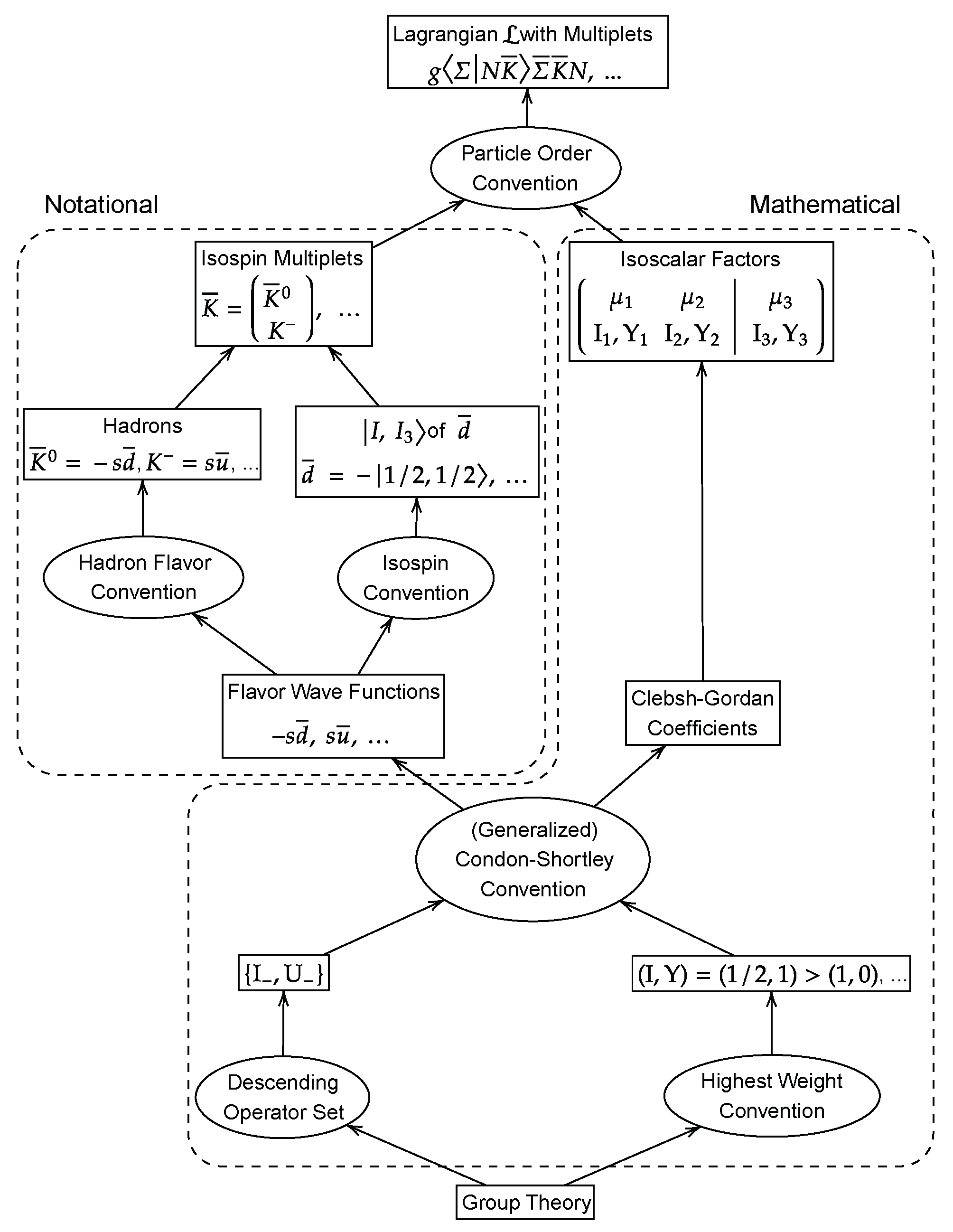
We summarize the whole procedure for writing down a hadronic Lagrangian in
Figure 1. The whole theme starting from the flavor wave function part is the identification of hadrons with derived wave functions. In this part, the differences between different conventions are purely notational. In principle, it is not difficult to translate different conventions using the redefinition of the hadronic field. However, this may lead to various confusions and misinterpretations.
This paper is organized as follows.
Section 2 is devoted to group theory, where different generalizations of the Condon–Shortley phase conventions of the Clebsh–Gordan coefficients are discussed. We also show an interesting result from the interplay of the flavor and color degree of freedom.
Section 3 explains the group theory result with the language of the quark model and different hadron flavor conventions are derived and compared. The isoscalar factor under the convention of Chen et al. [
6] is derived in
Section 4, which is also compared with the conventions used by de Swart [
7,
8] and Rabl et al. [
9,
10]. We provide a short summary of this paper in
Section 5 and some calculation details in
Appendix A and
Appendix B.
2. Clebsh–Gordan Coefficients
2.1. and Condon–Shortley Phase Convention
The traditional way to obtain the
Clebsh–Gordan coefficients (CGCs) is the descending operator method. The main idea is a combination of a descending operator
with orthogonalization. The details can be found in many quantum mechanics textbooks, such as Chapter 3.7 in Ref. [
11]. Since this method will be extended to
, we demonstrate the key steps in the following.
The matrix element of the
operator is derived from the Casimir operator
of
, which has a diagonal matrix form. The
is constructed to be a Hermitian conjugated pair, and by the assumption that both matrix elements should be positive, one can take the square root of the diagonal and obtain the matrix element. Specifically,
In the last two equations, state is treated as a whole no matter whether it is a composite system or not. For the sake of clarity in the following discussion, we introduce the concepts of coupled and uncoupled bases. Consider the case where two angular momenta and couple to form a total angular momentum J; the corresponding Hilbert space can be spanned by two sets of bases: the coupled basis and the uncoupled basis . The coefficient , which relates the coupled/composite basis to the uncoupled basis , is the CGC.
In the coupled basis, the highest weight is
. One recursively applies the
operator, which gradually decreases
by one unit. The matrix element of the
operator is conventionally assumed to be positive. The process naturally terminates when reaching the lowest weights
. All the signs before the family
are fixed to (in fact, the same as) the highest weight
. When this highest weight is expanded in the uncoupled basis, the expanding coefficient (CGC) is assumed to be
, i.e.,
. In this uncoupled basis, the
operator works as
As a result, the CGCs within this
family can be fixed.
To obtain the rest of the CGCs, one has to first make an assumption about the signs of
, which is the highest weight of the
family. Clearly,
should be orthogonal to
, which will fix the CGCs up to an overall sign. This sign can be fixed again by requiring the first non-zero CGC to be positive, i.e.,
. And again, one recursively applies the
operator to
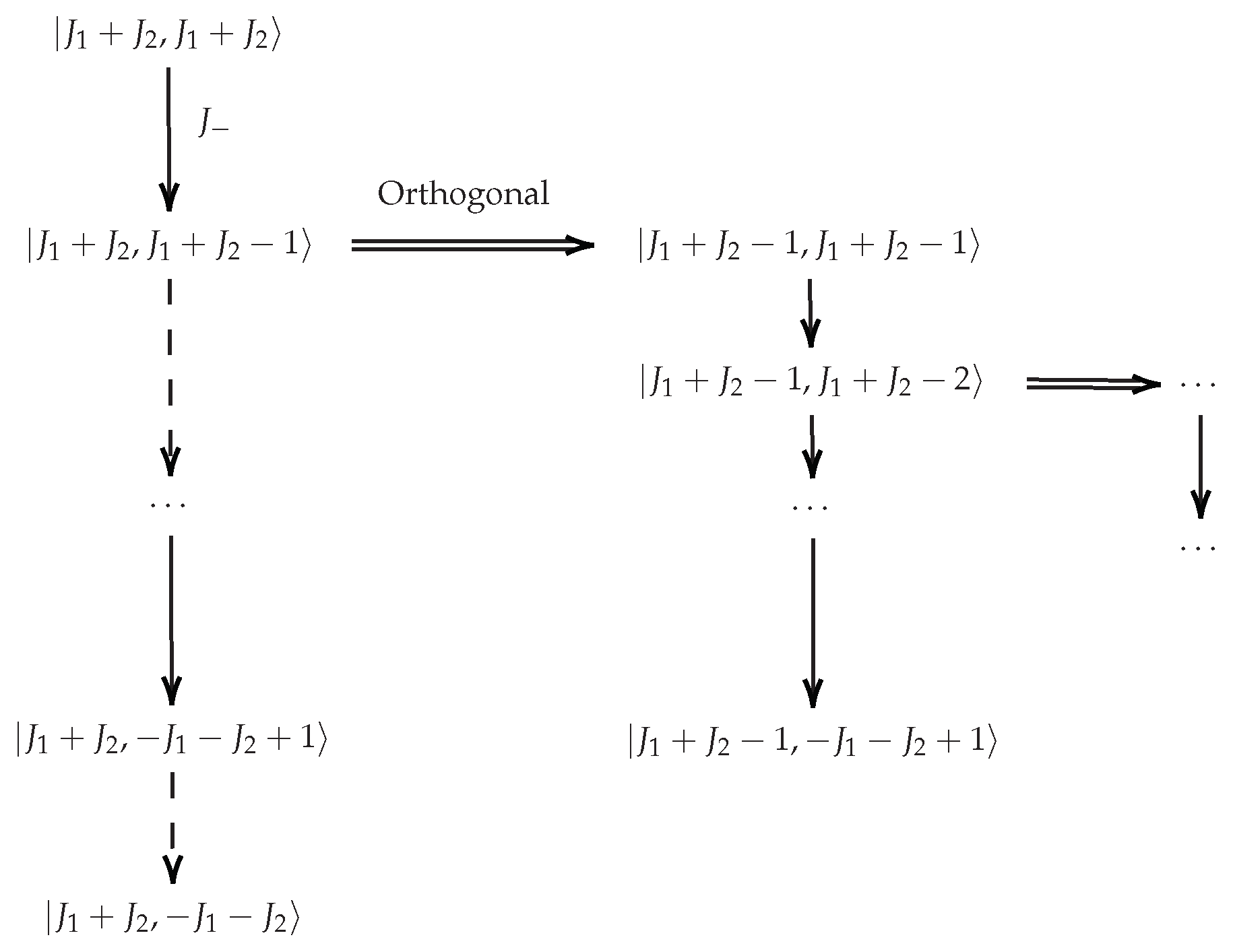
, and the procedure goes on until all the CGCs are worked out. We summarize this descending operator method in
Figure 2.
The convention that is the renowned Condon–Shortley phase convention.
2.2. Generalized Condon–Shortley Phase Convention for
Theoretically, one can apply this descending operator method to obtain the CGCs for , which consists of the following two steps:
Selecting a complete set of descending operators, whose matrix elements are set to be positive.
Extending the Condon–Shortley phase conventions in the orthogonalization process.
There are various ways to achieve this, which leads to different conventions.
Like the gauges in quantum field theory, all conventions are mathematically equivalent, and they should lead to the same prediction for the physical observable. Despite the equivalence of the conventions, it turns out that some choices are mathematically more elegant and more convenient to generalize. In this work, we begin with the analysis of the first prerequisite, namely, the selection of the descending operators.
It is expected that obtaining the CGCs for
is more involved than that for
. The main reason originates from the fact that the rank of
is two, which requires two descending operators (instead of one
in
). In
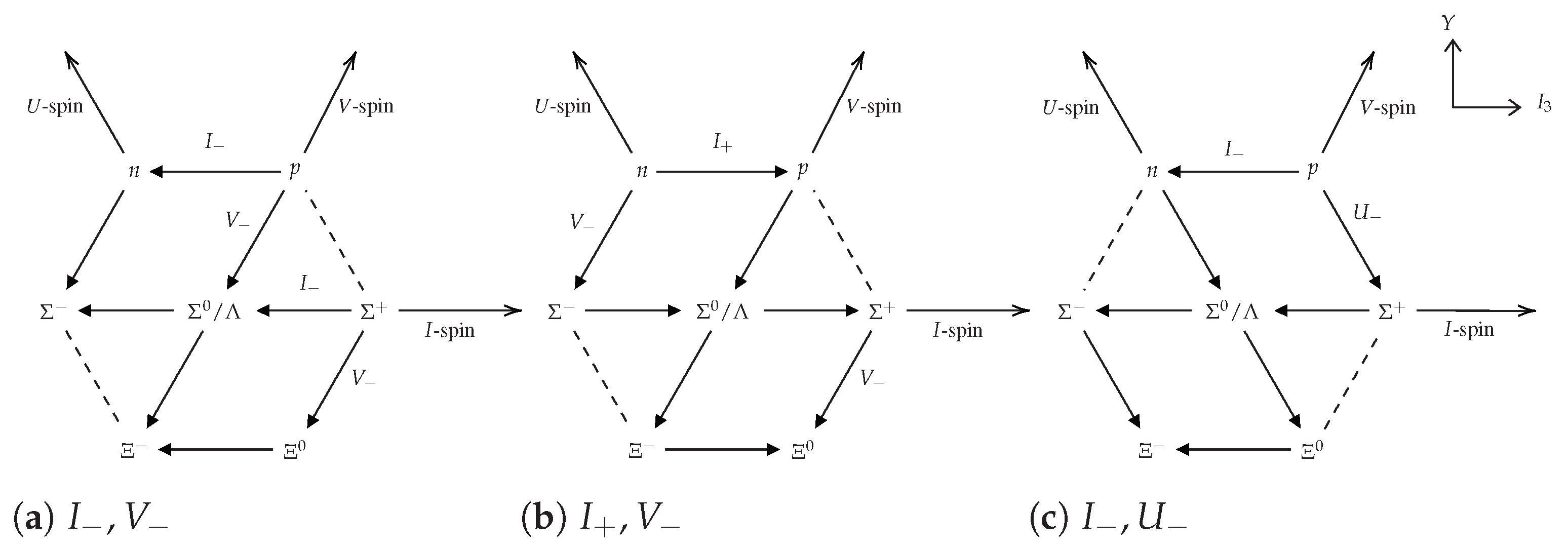
, we have three descending operators to select from,
(see
Figure 3).
Based on experience with
, we intend to keep the operator
as one of two descending operators; otherwise, it would be a restart instead of an extension of
. This choice also has a physical reason in that we can easily track different isospin multiplets. One may want to make an assumption that the matrix elements of
and
can be tuned to be positive; however, the three operators cannot be simultaneously positive due to the structure of the
Lie algebra (see e.g., the
matrix in the
representation in
Appendix A.1).
One may speculate that selecting is the same as ; however, we will show that there is a mathematical reason that the latter selection is superior.
From subplot
Figure 3a, we learn that to enumerate all the states in the root space (or the weight space of the adjoint representation) with only descending operators
and
, one has to start from the two “highest” states
p and
. The consequence is that one cannot naturally define the highest weight. To enumerate all of the octet, we need both the descending operator and the ascending operator, i.e., by
from
n (see
Figure 3b) or
starting from
. However, both the “highest/lowest” starting weights are unconventional and counter-intuitive. Despite that nothing stops one from assigning an additional convention to the order of the octet states, this extra convention is essentially unnecessary.
In contrast, the convention of choosing to be positive is free from this dilemma. All the weights within any representations can be enumerated using pure descending operators . This fact can be easily seen by noting that the angle between and is , and this obtuse angle makes the operator pair capable of enumerating all the weight vectors in any representation, especially in the case like the octet, where the envelope polygon has obtuse angles. This is also the reason why or can also do the job, but, as we have pointed out, if one operator is an ascending operator, it will bring ambiguity to the choice of a highest weight.
To conclude, as long as one keeps the selection of the operator, the positive operator set is the only way to naturally extend the operator in .
The second task is to fix the sign of
in the highest weight. Haacke et al. [
10], de Swart [
7], and Rabl et al. [
9] all take essentially the same convention as
, i.e., in the
CGCs, the largest isospin of the first particle
of the highest weight is assumed to be positive.
However, note that the essence of the second step is to define an order for the uncoupled representation; since already defines a natural order for all the multiplets, the extra assignment of the order is essentially unnecessary. Thus, we extend the Condon–Shortley convention to the requirement that, in the CGCs, the coefficient of the highest weight (instead of the largest isospin I) of the first particle is positive. In , the highest weights happen to be for the largest isospin I (or angular momentum J). We call this convention the generalized Condon–Shortley convention.
It is reasonable to speculate that different conventions will lead to different CGCs and isoscalar factors (ISFs). This turns out to be the case, and we will provide a detailed discussion in
Section 4.
Our definition of the order for the
multiplets will be well defined in the non-degenerate case. However, in some degenerate cases, such as
, where the octet occurs twice, any rotation between the two octets is a valid CGC. This degeneracy can only be broken by additional symmetry, and it is conventional to demand that the CGCs of the
are split into symmetric and anti-symmetric parts. Here, we use the same convention as that of Refs. [
9,
10], namely, the symmetric one is superior to the anti-symmetric one.
At this stage, all the mathematics of the CGC are settled. Once the matrix elements of the operators is given (see, e.g., Equation (48) in Ref. [
2] or Equation (3.3) in Ref. [
10]), we can repeat and extend the process in
, which includes recursively applying the descending operators and performing the orthogonalization with predefined phase conventions.
In principle, it is not difficult to turn these rules into computer programs. However, it is worthy to mention that this method is still cumbersome in practice and not very efficient to generalize to larger groups. The eigen function method (EFM) invented by Jin-Quan Chen et al. [
6,
12] solves this problem once and for all. After a delicate construction of the complete set of commuting operators and and conventions of the eigenvector phases, the EFM can yield the so-called Gel’fand basis, which furnishes the irreducible basis of
. Interested readers are referred to the monograph in [
6].
2.3. Beyond Flavor
Things become more interesting when we push the flavor symmetry to . Although the flavor symmetry is strongly broken by the heavy charm quark, it is worthwhile to study some mathematical properties. Perhaps one unexpected result is that there is no baryon matrix in flavor . This is a direct consequence of interplay between flavor and color symmetry.
In the previous sections, we only focused on the flavor symmetry. It is time to talk about the color symmetry. Unlike the flavor symmetry, which is only approximately fulfilled by the hadrons, the color symmetry is an exact one.
The fundamental theory of the strong interactions is quantum chromodynamics (QCD), which is an gauge theory on the color degree of freedom. So far, all the observed hadrons are color singlets or colorless. Although not theoretically proved, it is widely believed that colors are constrained within hadrons and all hadrons should be colorless. This is an important and stringent constraint.
For baryons, the only way to obtain the color singlet is through quarks with possible quark–antiquark pairs, where n is the baryon number of the system. Formally, we can continue the trick of trading one antiquark with two quarks, so the color-singlet requirement always means quarks.
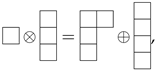
For conventional baryons, with three quarks at our disposal, we have the following tensor decomposition in the flavor degree of freedom:
For flavor
, we have
The adjoint representations of
and
are the irreps of
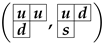
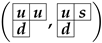
![Symmetry 16 01061 i003]()
and
![Symmetry 16 01061 i004]()
, respectively. The adjoint rep shows up naturally as a result of the tensor product of fundamental and complex conjugate representation. For
, the motivation of constructing the matrix form of the octet baryons and mesons is to explicitly reveal the decomposition process.
Namely, , where U is the transformation matrix in fundamental representation, and M is the octet baryon or meson matrix. For other irreps, such as 10 decuplets in flavor symmetry, one would have to explicitly construct a matrix for each generator. In this case, , and the decuplet baryon is a column vector. They cannot be organized into a matrix form as the adjoint representation. In practice, however, this 10-dimensional vector is rarely used. Instead, people group them into different isospin multiplets and treat them separately. Essentially, the matrix and vector forms of the hadrons are nothing but convenient realizations of the underlying CGCs.
From Equation (7), we can see that adjoint
![Symmetry 16 01061 i004]()
does not show up in the decomposition. There is no such thing like a
baryon matrix, only a meson matrix is possible. It is a lucky coincidence that the flavor
symmetry happens to be the same as color
symmetry.
3. Group Theory from the Quark Model
3.1. Antiquarks and the Complex Conjugation Representation
From the perspective of the quark model, hadrons are made up of quarks and antiquarks. The quark is assumed to furnish the fundamental representation of
(Here, we focus on the quarks with three flavors instead of six. This setting is extensively studied in the literature.) A straightforward definition of an antiquark is that it resides in the complex conjugate representation of the fundamental representation, denoted as
. This definition has the advantage that the singlet
has an easy form:
where
U is the fundamental representation matrix. To further simplify the notation, it is conventional to group the antiquarks into a
row vector, with a transformation property that can be compactly written as
Specifically, for flavor
, we have
Then, the adjoint representation
M has a natural transformation property
. This property is extensively used to simplify the construction process of the Lagrangian in chiral perturbation theory (ChPT).
This Hermitian conjugate also leads to a readily decomposition for
as follows:
Identifying the decomposition on the right-hand side of Equation (
19) with hadrons is equivalent to specifying the hadron flavor wave functions. This is the process of adopting a
hadron flavor convention.
We need to point out that, in principle, one can adopt a different phase convention for the antiquarks, with the consequence that their adjoint representation M would transform differently from the usual . For example, one can define their to be the negative of our ; then, their singlet would be proportional to , which is quite bizarre and counter-intuitive. In practice, it would cause confusions and, in worst cases, misinterpretations of the intermediate steps by another phenomenological model, like ChPT. Since the difference is just trivially notational without any profound reason, we see no need to invent a new convention for the antiquarks.
It is worthy to point out that, in the famous paper [
7] by de Swart (his work shows up just before the dawn of the quark model), the redefinition of possible phases is involved to maintain the positivity of
matrix elements in any representation
. With the language of the modern quark model,
p and
q represent the numbers of quarks and antiquarks, respectively, and de Swart’s requirement can be boiled down to the phase redefinition of the antiquarks.
Equation (8.2) in Ref. [
7] can be extended to manage fractional charged quarks
For
quarks, this would result in
In contrast to the physical particles where
always shows up in any irrep
, one can naturally fix the
by requiring that
(c.f. Equation (8.3) in Ref. [
7]). There is no additional natural phases to pinpoint the phase
in Equation (
20) at the quark level. If, for whatever reason,
, then the singlet would be
where the additional negative sign on the left-hand side is due to the CGCs of
under this convention. We do not adopt this additional redefinition of the antiquarks due to the reason we explained above.
3.2. Antiquarks and the Isospin Convention
There is another way to represent the antiquarks from the anti-symmetrized combination of quarks. This way will also lead to the definition of the isospin convention.
To start, recall that for a system consisting of
m particles, where each particle furnishes a representation of a group, the total wave function is a tensor product of each degree of freedom:
where
is the representation matrix of a group. Note the following mathematical fact:
where
A is an arbitrary square matrix, and
is the Levi-Civita symbol. Replacing
A with unitary matrix
U, we have
From the above equation, we can define a
singlet by
where
is the normalization constant. This statement can be checked by
On the other hand, contracting with
on both sides of Equation (
25), we will arrive at
Inspired by this equation and singlet state, as shown in Equation (
26), we can define a new state
as
i.e., instead of contracting all the indices of the Levi-Civita tensor, we choose to keep the first index
. This new state transforms as follows:
where in the last step,
is used. (The order of the matrix indices represents the row–column relation, and in cases where only quarks are involved, one can safely write only with lower indices.) So,
transforms into the complex conjugate representation, and we call it an antiquark in the context of group theory. The last step also tells us that, in
, the complex conjugate representation is equivalent to applying
from the right side, i.e.,
.
We need to stress that we have kept the
first index free in the definition, Equation (
33), of antiquarks. However, in principle, one can pick any free index in
, and by choosing a specific one, one pick a specific phase convention for antiquarks. Notably, in the special case of the isospin symmetry which belongs to the
group, one can let the first index be free as we do:
or choose to keep the last index be free as some authors do (Ref. [
13]):
The two choices will result in different conventions. This convention is very important in hadron physics, and we call it the isospin convention, because in the strong interaction, the isospin symmetry is decently conserved, and the hadrons are conventionally organized into different isospin multiplets.
As can be seen from Equation (
33), a group representing one antiquark with one quark is a property specific to the
group, i.e., a complex representation of the
group can be achieved through a linear transformation of the fundamental representation
. This tells us that the
group has no complex representation (only a pseudo-real/quaternionic representation).
Exchanging an antiquark with anti-symmetrized
quarks is reminiscent of the Dirac sea. This quark–antiquark duality is proved to be extremely useful in deriving the
CGCs [
6].
3.3. Convention Comparison
We are now ready to study the convention in de Swart’s paper from the perspective of the quark model. As explained before, the states within a multiplet are linked by the descending operators, whose matrix elements are conventionally set to be positive. To start, we should fix the phase of the highest wave function, and from the perspective of the quark model, we set the first state in the octet to be
The second highest state can be obtained using
, i.e.,
where
is used. (This complex conjugate here is what de Swart called the
representation in Ref. [
7].) To obtain the
, we have to use the operator
. Here, we want to emphasize that the appearance of
breaks the “descending” convention, and it also brings ambiguity to the definition of the “highest” weight.
Applying
to
, we obtain
Please note the negative sign before
in the second line. It is due to the non-positiveness of
in this convention. The applications of
and
on the rest states are straightforward, and we present the detailed steps in
Appendix A.1.
For comparison, we also list the octet states with the convention of choosing descending operator set
, which was used by Baird-Biedenharn [
1,
2,
3,
4], Haacke et al. [
10], Rabl et al. [
9], and Chen et al. [
6,
12]. We obtained the octet states with the language of the quark model, as shown in
Table 1.
In
Table 1,
serve as the basis of the octet representation under different conventions. Although octet mesons also serve as the basis of the octet, we can freely pick any phase conventions of their flavor wave functions, which we call the hadron flavor convention. This kind of convention is also purely notational, and thus, it is independent of any mathematical deduction. For instance,
can be set freely to be
whether we choose operator set
or
.
This flavor convention can only be fixed with conventions from physics. One important consideration is the charge conjugation, e.g., if the
flavor wave function is chosen to be
, it is natural to assume that the wave function of its charge conjugate partner
is
. (Here, we shift the notation
into
in order to be consistent with the notation in the modern quark model). Since we conclude that the eighth basis
is
,
, instead of
, should be identified with
. Likewise, there is a relative negative sign between the wave functions of
and
, and one could assign
to eliminate the negative sign in the wave functions. However, de Swart picked a different flavor convention, i.e.,
. We summarize the three hadron flavor conventions in the last three rows of
Table 1 and list the pseudo-scalar octet matrices as the following:
Conventionally, the
octet is organized by its
subgroup, which reflects the isospin. As explained in
Section 3.2, there are two possible conventions for the antiquarks. For the work of de Swart, the isospin doublet convention at the hadronic level is
, and his flavor convention is
. Both of them immediately conclude that the isospin convention at the quark level is
. Thus, we reached a quark model explanation of de Swart’s hadron flavor convention. His isospin multiplets are organized as follows:
where each doublet or triplet are organized by
or
.
For comparison, we also list the isospin conventions
for Chen and Rabl.
Theoretically, one could also adopt the isospin conventions
for Chen and Rabl. For completeness, we list the corresponding isospin multiplets with this convention in
Appendix A.2.
We need to point out that once the meson matrix (which is equivalent to adopting a hadron flavor convention) is fixed, one only needs a meson with quark component or in order to fix the isospin convention. Additional assignments would either be redundant or inconsistent. For example, the meson matrix assignment in Equation (51), which is widely used in ChPT, and the convention will conclude the doublet to be not .
One may argue that, despite the inconsistent assignment , a redefinition of the field is sufficient to cease this inconsistency. This is perhaps the reason why the convention issue does not attract enough attention. However, not all of the parameters in the Lagrangian are free to adjust; in particular, what appears to be the irrelevant overall phase factor in is deeply connected by . This sneaky redefinition can only cause confusion and misunderstanding, and we strongly suggest to do everything mathematically strict and correct.
From
Table 1, one can also read horizontally and directly obtain the isospin multiplets. However, if only the meson matrix is offered, one cannot tell which descending operator convention has been used. In other words, the hadron flavor convention or the meson matrix alone does not lead to the isospin convention, although these two conventions are closely related. One should make a clear distinction between a mathematical basis that directly furnishes the representation and physical particles that one may, in principle, use to arbitrarily invent a convention.
Specifically, from
Table 1, we can see that both operator conventions
and
result in the same wave function for
, i.e.,
. Like the rest of the octet, mathematically,
is treated as
, i.e., all the wave functions are directly identified as the
with no further sign conventions. These states can be marked directly by their quantum numbers in the ISFs table, like Table II in Ref. [
7]. To replace these quantum numbers with physical baryons and mesons, one must refer to their hadron flavor and isospin conventions.
This distinction is often not realized, and mistakes are even present in the paper, which was supposed to offer ISFs. For example, the meson matrix in the paper of Rabl et al. [
9] happens to be the same as that widely used in ChPT. There is a non-trivial phase between
and their
. In their Table VI,
is actually supposed to be the mathematical basis
with quantum number
, rather than physical
under their convention. Then, the sign of the ISF in the channels like
should be changed. In contrast, there is no such problem when quantum numbers are used to represent the mathematical basis, such as in Table II I in Ref. [
10] and the tables in Ref. [
7].
However, to perform the real calculations, one has to obtain the physical basis. Once the meson matrix is fixed to be Equation (51), to use the tables in Rabl et al. [
9], one has to refer to their isospin convention in Equation (57) or Equation (
A25), and keep in mind that their
. We have also carefully checked that the ISF table in Chapter 47 of
Review of Modern Physics by Particle Data Group [
8] is a direct translation of the ISF tables of Ref. [
7], and the mathematical bases are rewritten into physical isospin multiplets. As long as the isospin multiplets are explicitly defined, there would be no ambiguity.
The charge conjugation operator can add the additional constraint on the phases of the particle anti-particle pairs within a multiplet, concluding a meson matrix whose flavor wave function is quite symmetric. For example, in de Swart’s convention,
. And in the convention of Rabl et al. [
9],
. The symmetry of the wave functions will make the construction of the Lagrangian physically straightforward. For instance, to construct the mass term of the mesons, one would expect that it is proportional to
. However, this convenience comes at a price; one has to keep in mind the nontrivial signs in the isospin multiplets.
In contrast, the convention from Chen et al. [
5] has the advantage that the particles are directly the mathematical bases without any phase in Equation (55). However, a non-trivial negative sign shows up when conducting the charge conjugation. For example,
. This explain the following puzzling behavior of the octet mass term:
In short, there is always a trade-off between mathematical and physical simplicity.
3.4. Octet Baryons
The work flow for the octet baryons is quite different from that of mesons. Mathematically, both baryons and anti-baryons fulfill the octet. (We constrained ourselves to the octet, not the decuplet.) From the perspective of the
group theory, baryons and anti-baryons are the same. But physically, we want to classify them into different multiplets because they have different baryon numbers. At the start, one can directly sort the baryons and anti-baryons as in
Table 1, by their quantum numbers
,
After that, the central topic of this paper naturally arises: what would be the consistent phase conventions? Can we freely add signs to each of them?
The charge conjugation
will play an important role here. For the case of mesons,
relates the meson pairs
within the octet, while in the baryon case, it relates the baryon–anti-baryon pairs
between the two octets. Thus, one can freely add signs to one octet. This is the reason why de Swart can assign [
7]
just to keep
simple, and refuse to add the negative sign before
, which will lead to the
(note the relative negative sign) term in the coupling to
.
Recall that the widely used
matrix octet
P is just a compact way to represent the
vector:
where
U and
are the
matrices in the fundamental and adjoint representation, respectively. For the octet, we want
to transform exactly the same as
P. This can be achieved using a Hermitian conjugate, namely, a complex conjugate on each element, and then taking the transpose of the matrix as follows:
The complex conjugate on each elements is just taking the flavor wave function into its complex conjugate. For mesons, this is what we have carried out before, such as . For baryons, we use the physically simplest convention that the wave function of the anti-baryon is the replacement of quarks with antiquarks, such as .
The rest of the process is determining the mathematical basis
under transpose. The transpose operation seems undefined for the quarks, such as
, but this is just a shorthand notation of
In other words, the wave functions at the quark level and the matrices are mathematically equivalent. Then, all of the bases under transformation are properly defined.
For the convention of de Swart [
7], we have
This reproduces what has been claimed in the convention of his anti-baryons (cf. Equation (17.2) in Ref. [
7]). By performing the same calculation and noting the different transpose property of
in
, we can obtain the baryon and anti-baryon matrices for other conventions. Here, we summarize these three cases as follows:
By the construction, all of the three conventions have the property that , which gives the mass term of the octet states. In fact, with the octet baryon and meson matrices under each convention, one can recover some of the ISFs; for example, will obtain the right-hand side of .
Since the decuplets do not show up in the decomposition
, they cannot be organized into a
matrix. Thus, their couplings to the octet baryons and mesons cannot be reproduced by taking traces of the above matrices. However, they do show up in the decomposition:
This ensures that the decuplet (and the octet baryons and mesons) can be packed into an
matrix. This make it possible to write the coupling such as
(decouplet–baryon–meson) using the matrix multiplication method. We present the details of this construction in
Appendix B.
3.5. Mixing Usage of Different Conventions
Despite the extensive usage of the ISFs by de Swart [
7], his meson matrix, shown in Equation (
49), is not widely used at present. However, in ChPT, the meson matrix, shown in Equation (51), is widely used. Thus, if one uses the meson matrix defined in Equation (51) and the ISFs from de Swart [
7,
8], this mixing of the usage of different conventions could result in misleading predictions if the isospin multiplets are not properly defined.
A common misinterpretation comes from the in the meson matrix defined in Equation (71). No matter what isospin convention one uses, or , should always be treated as . In both de Swart’s and Chen’s conventions, , but for the matrix form defined in Equation (51), widely used in ChPT, . Fortunately, is the singlet in the group; thus, such a negative sign will have no physical impact.
By comparing meson Equations (
49) and (51) and baryon matrix Equations (
69) and (71), we arrive at
Table 2.
From
Table 2, we can see that the isospin multiplets have to be defined as in the following:
As we have stated before, the baryon and meson matrices are nothing but convenient ways to organize the octets. In principle, one is not bothered to explicitly write down the meson and baryon matrices if the correct ISFs and isospin multiplets are used, as what was done by de Swart.
4. Isoscalar Factors
Isoscalar factors are the agents between the small group and a larger group . With ISFs and the Clebsch–Gordan coefficients (CGCs) of the smaller group at hand, the CGCs of the bigger group can be constructed. In some sense, ISFs are not as fundamental as CGCs, since the physical processes are directly linked with CGCs, which physicists directly work with. In the case of , the ISFs only appear when one intends to separate the contributions of the isospin group but still wants to find the relations between the couplings of different flavor multiplets, much like how the famous Wigner–Eckart theorem helps us separate the dynamics from the geometry.
Here, we demonstrate the process of obtaining
CGCs from the quark level with the Young–Weyl tableaux method, where the antiquarks are represented by the anti-symmetrized combination of quarks. The phase conventions follow that of Ref. [
6], where the detailed calculation steps can be found.
In
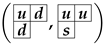
Table 3, we list two possible interpretations of the Weyl tableaux in the decay particles, namely baryon-first or meson-first conventions. The two conventions originate from the fact that both octet baryons and mesons live in the same
representation. For example, the Weyl tableaux
![Symmetry 16 01061 i006]()
, which stands for one state in an octet, can be identified with
or a proton. This two-fold role of the Weyl tableaux turns out to be very useful. In order to obtain the table, we also identify, say, the
![Symmetry 16 01061 i006]()
with
![Symmetry 16 01061 i007]()
, where a
flavor vacuum
![Symmetry 16 01061 i008]()
is prepended to the tableaux. The ISFs in Ref. [
8] adopt the baryon-first convention in the above table, such as,
.
We interpret the term in the Lagrangian like to be directly related to the , whose Hermitian conjugate reflects the “decay” process .
As was explained at the end of
Section 2.2, in order to distinguish the two protons (which are in the last two rows of
Table 3), the two possible couplings
can be further classified into symmetric
and anti-symmetric
parts. The symmetrizer (anti-symmetrizer) can be assigned to
or
because of the following property:
In the language of the Young tableaux, the above is a special case of the following:
Unfortunately, the
CGCs in
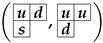
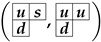
Table 3 do not fulfill this requirement. For example, in the coupled channel of the proton, when exchanging
![Symmetry 16 01061 i010]()
↔
![Symmetry 16 01061 i011]()
or equivalently,
, the CGCs change like
or
, which is neither symmetric nor anti-symmetric. However, additional rotation between the last two row vectors will solve this issue:
where
and
y are constants to be determined later. Note that one cannot fix these constants later, such as
, since
and
are not the only channels that the proton can couple to.
There are two solutions for the equation,
and
, which lead to
Overall, the two solutions of
only differ by a negative sign. Since we use the order convention that the symmetric combination is before the anti-symmetric one, the first non-zero coefficient of the symmetric combination should be positive, which leads to the second rotation angle. Note that this rotation angle is universal for all
couplings.
To obtain the
ISF, we need to divide the
CGCs with the corresponding
isospin CGCs, which results in
Table 4. As shown in
Table 4, we replaced the particles in
Table 3 with their isospin families and dropped the rows of the Weyl tableaux beyond the octet and decuplet baryons, such as
![Symmetry 16 01061 i012]()
. Please note that one isospin channel in
Table 4 corresponds to several charged channels in
Table 3; for example,
and
belong to the family
.
Strictly speaking, the isospin multiplets such as need to be defined. However, in Chen’s convention, the isospin multiplets are directly identified by the Weyl tableaux without additional phases, i.e., , which directly corresponds to the isospin states, .
In
Table 3, the quark components are fixed to be
. Nothing stops us from exploring other quark components, like
, and calculating the corresponding ISFs. Following along this line, we list the ISFs in Chen’s convention as follows:
As a specific example to exhibit the effect of choosing different conventions, in Equation (
85), we see that the ISFs of the highest decuplets
and
are different. In Chen’s convention, the ISFs of
should be positive, since
p is higher than
. However, with Haacke’s and Rabl’s conventions,
, which is larger than
, so the ISF of
should be positive. Although we agree on the same set of descending operators
, we have a distinct convention on the highest weight. This difference will assign an overall negative sign to the CGCs (or equivalently, ISFs) on
, as it should be, since the relative signs within the multiplets are controlled by the same set of descending operators
.
If both the descending operator set and the highest state conventions are different, then apart from the overall phase differences, the ISFs of each multiplet within each multiplet could also be different. Since all conventions should be mathematically equivalent, these superficially contradicting results can be absorbed by the redefinition of the isospin multiplets.
Specifically, there is a similar ISF table in PDG [
8] with absolute values that are the same as those we obtained but the signs are different. To reproduce the table, we can redefine the fields of
and change the overall sign of
.
The above discussion also offers a way to check the consistency of different conventions. If the ISFs among different conventions are still different after the redefinition of all multiplets and all coupled channels, then at least one convention is not self-consistent. Note that this consistency checker is a necessary, but not a sufficient condition.
There is a subtlety when translating the ISFs to the
form when
B and
C are both in the octet. Mathematically, since octet baryons and mesons share the same quantum numbers in group irreps, one has to assign a convention to distinguish them. We hereby adopt the baryon-first convention, namely,
This is interpreted as
instead of
.
This order convention is important when building the Lagrangian from the ISFs and
CGCs, especially when the Lagrangian is written in the charged states. For example, with the baryon-first convention, the
Lagrangian should be proportional to
instead of
. Due to this order convention, in theory, one has to be cautious when adopting coupling constants from various sources. In practice, however, this subtlety is often unnoticeable. Since the couplings are conventionally reorganized into isospin multiplets, where
CGCs (and thus the order convention) are implicitly included, which eliminates the order ambiguity. For instance, the
vertex is often expressed as
, where each vector component of
is a
matrix with
CGCs included [
14].






 and
and  , respectively. The adjoint rep shows up naturally as a result of the tensor product of fundamental and complex conjugate representation. For , the motivation of constructing the matrix form of the octet baryons and mesons is to explicitly reveal the decomposition process.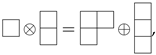
 , which stands for one state in an octet, can be identified with or a proton. This two-fold role of the Weyl tableaux turns out to be very useful. In order to obtain the table, we also identify, say, the
  , where a flavor vacuum
  is prepended to the tableaux. The ISFs in Ref. [8] adopt the baryon-first convention in the above table, such as, .
 ↔
↔  or equivalently, , the CGCs change like or , which is neither symmetric nor anti-symmetric. However, additional rotation between the last two row vectors will solve this issue:
 . Please note that one isospin channel in Table 4 corresponds to several charged channels in Table 3; for example, and belong to the family .