


Strong Decays of the ϕ(2170) as a Fully Strange Tetraquark State

Abstract
1. Introduction
2. Currents and Fierz Identities
2.1. Diquark–Antidiquark Currents and Their Mixing
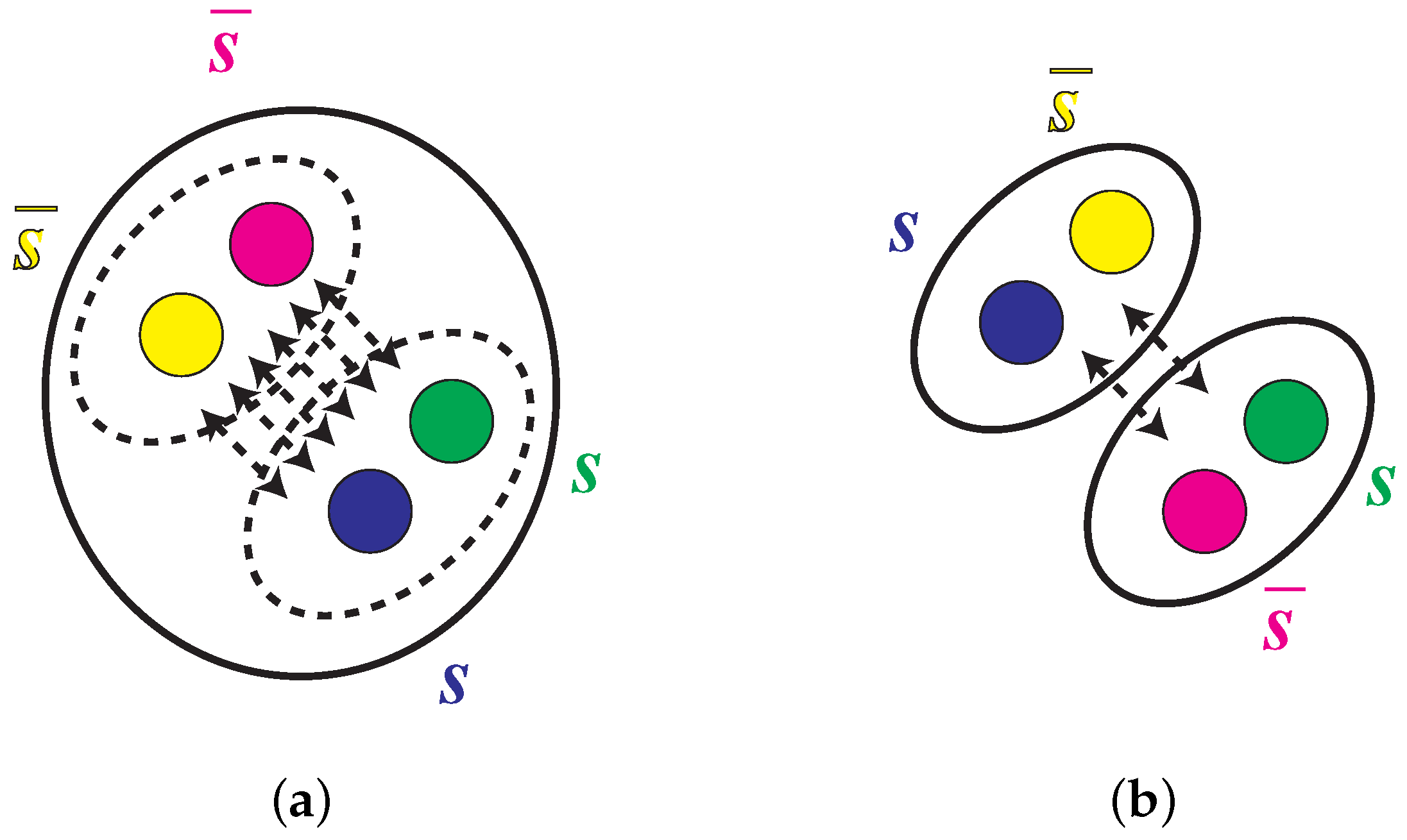
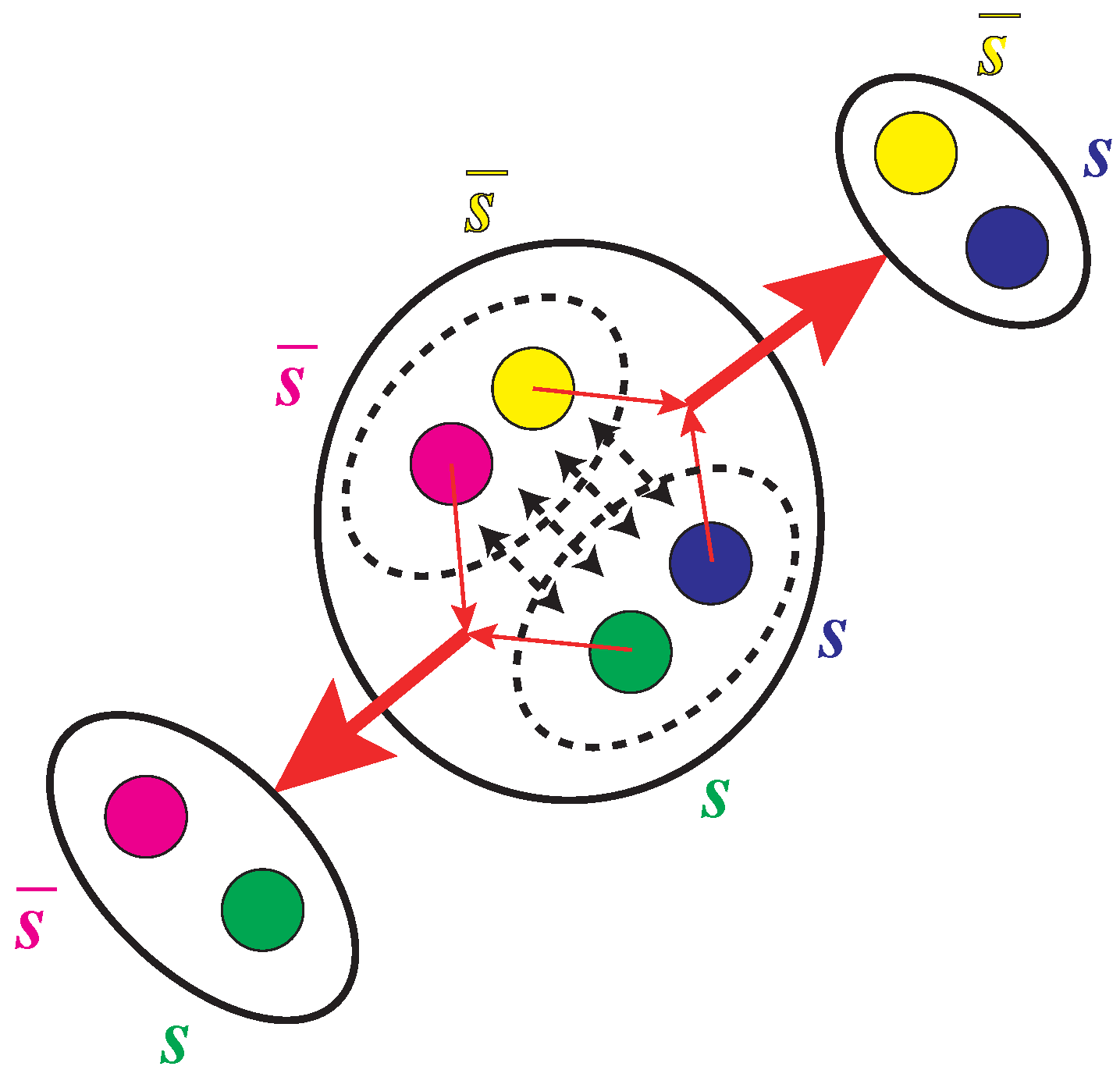
2.2. Meson–Meson Currents and Fierz Rearrangement
2.3. Strangeonium Operators and Decay Constants
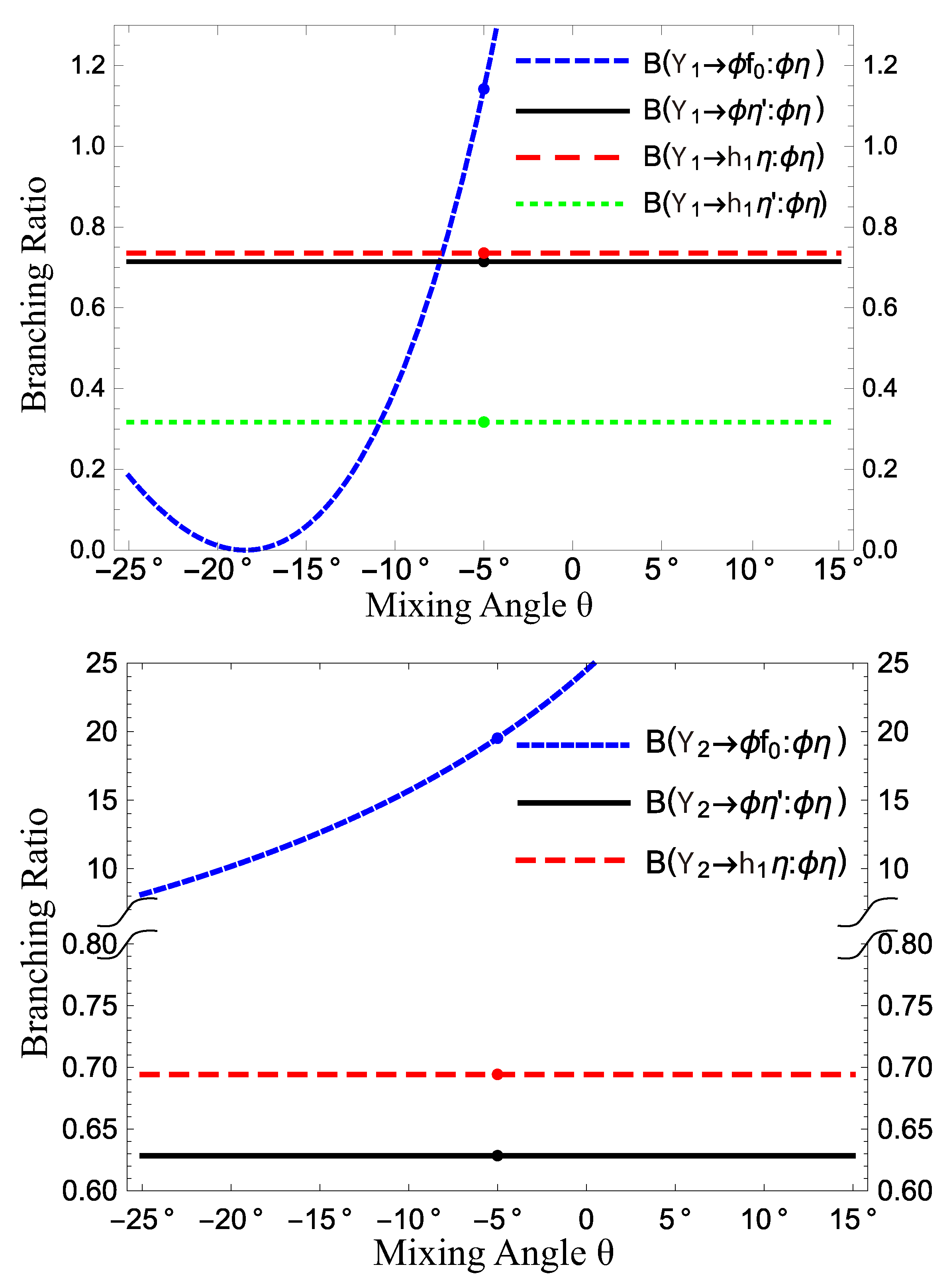
3. Relative Branching Ratios
4. Summary and Discussion
Author Contributions
Funding
Data Availability Statement
Conflicts of Interest
References
- Workman, R.L.; Workman, V.D.B.; Crede, V.; Klempt, E.; Thoma, U.; Tiator, L.; Agashe, K.; Aielli, G.; Allanach, B.C.; Amsler, C.M.; et al. Review of Particle Physics. Prog. Theor. Exp. Phys. 2022, 2022, 083C01. [Google Scholar] [CrossRef]
- Chen, H.X.; Chen, W.; Liu, X.; Zhu, S.L. The hidden-charm pentaquark and tetraquark states. Phys. Rept. 2016, 639, 1–121. [Google Scholar] [CrossRef]
- Liu, Y.R.; Chen, H.X.; Chen, W.; Liu, X.; Zhu, S.L. Pentaquark and Tetraquark States. Prog. Part. Nucl. Phys. 2019, 107, 237–320. [Google Scholar] [CrossRef]
- Chen, H.X.; Chen, W.; Liu, X.; Liu, Y.R.; Zhu, S.L. An updated review of the new hadron states. arXiv 2022, arXiv:2204.02649. [Google Scholar] [CrossRef] [PubMed]
- Lebed, R.F.; Mitchell, R.E.; Swanson, E.S. Heavy-quark QCD exotica. Prog. Part. Nucl. Phys. 2017, 93, 143–194. [Google Scholar] [CrossRef]
- Esposito, A.; Pilloni, A.; Polosa, A.D. Multiquark resonances. Phys. Rept. 2017, 668, 1–97. [Google Scholar] [CrossRef]
- Hosaka, A.; Iijima, T.; Miyabayashi, K.; Sakai, Y.; Yasui, S. Exotic hadrons with heavy flavors: X, Y, Z, and related states. Prog. Theor. Exp. Phys. 2016, 2016, 062C01. [Google Scholar] [CrossRef]
- Guo, F.K.; Hanhart, C.; Meißner, U.G.; Wang, Q.; Zhao, Q.; Zou, B.S. Hadronic molecules. Rev. Mod. Phys. 2018, 90, 015004. [Google Scholar] [CrossRef]
- Ali, A.; Lange, J.S.; Stone, S. Exotics: Heavy pentaquarks and tetraquarks. Prog. Part. Nucl. Phys. 2017, 97, 123–198. [Google Scholar] [CrossRef]
- Olsen, S.L.; Skwarnicki, T.; Zieminska, D. Nonstandard heavy mesons and baryons: Experimental evidence. Rev. Mod. Phys. 2018, 90, 015003. [Google Scholar] [CrossRef]
- Karliner, M.; Rosner, J.L.; Skwarnicki, T. Multiquark States. Ann. Rev. Nucl. Part. Sci. 2018, 68, 17–44. [Google Scholar] [CrossRef]
- Bass, S.D.; Moskal, P. and mesons with connection to anomalous glue. Rev. Mod. Phys. 2019, 91, 015003. [Google Scholar] [CrossRef]
- Brambilla, N.; Eidelman, S.; Hanhart, C.; Nefediev, A.; Shen, C.P.; Thomas, C.E.; Vairo, A.; Yuan, C.Z. The states: Experimental and theoretical status and perspectives. Phys. Rept. 2020, 873, 1–154. [Google Scholar] [CrossRef]
- Guo, F.K.; Liu, X.H.; Sakai, S. Threshold cusps and triangle singularities in hadronic reactions. Prog. Part. Nucl. Phys. 2020, 112, 103757. [Google Scholar] [CrossRef]
- Ketzer, B.; Grube, B.; Ryabchikov, D. Light-Meson Spectroscopy with COMPASS. Prog. Part. Nucl. Phys. 2020, 113, 103755. [Google Scholar] [CrossRef]
- Yang, G.; Ping, J.; Segovia, J. Tetra- and penta-quark structures in the constituent quark model. Symmetry 2020, 12, 1869. [Google Scholar] [CrossRef]
- Fang, S.s.; Kubis, B.; Kupsc, A. What can we learn about light-meson interactions at electron–positron colliders? Prog. Part. Nucl. Phys. 2021, 120, 103884. [Google Scholar] [CrossRef]
- Jin, S.; Shen, X. Highlights of light meson spectroscopy at the BESIII experiment. Natl. Sci. Rev. 2021, 8, nwab198. [Google Scholar] [CrossRef]
- Albaladejo, M.; Bibrzycki, Ł.; Dawid, S.M.; Fernáez-Ramirez, C.; Gonzalez-Solis, S.; Blin, A.N.; Jackura, A.W.; Mathieu, V.; Mikhasenko, M.; Mokeev, V.I.; et al. Novel approaches in hadron spectroscopy. Prog. Part. Nucl. Phys. 2022, 127, 103981. [Google Scholar] [CrossRef]
- Meng, L.; Wang, B.; Wang, G.J.; Zhu, S.L. Chiral perturbation theory for heavy hadrons and chiral effective field theory for heavy hadronic molecules. Phys. Rept. 2023, 1019, 1–149. [Google Scholar] [CrossRef]
- Brambilla, N.; Chen, H.X.; Esposito, A.; Ferretti, J.; Francis, A.; Guo, F.K.; Hanhart, C.; Hosaka, A.; Jaffe, R.L.; Karliner, M.; et al. Substructure of Multiquark Hadrons (Snowmass 2021 White Paper). arXiv 2022, arXiv:2203.16583. [Google Scholar]
- Choi, S.K.; Olsen, S.L.; Abe, K.; Abe, T.; Adachi, I.; Ahn, B.S.; Aihara, H.; Akai, K.; Akatsu, M.; Akemoto, M.; et al. Observation of a Narrow Charmoniumlike State in Exclusive Decays. Phys. Rev. Lett. 2003, 91, 262001. [Google Scholar] [CrossRef] [PubMed]
- Aubert, B.; Barate, R.; Boutigny, D.; Couderc, F.; Karyotakis, Y.; Lees, J.P.; Poireau, V.; Tisserand, V.; Zghiche, A.; Grauges, E.; et al. Observation of a broad structure in the mass spectrum around 4.26-GeV/c2. Phys. Rev. Lett. 2005, 95, 142001. [Google Scholar] [CrossRef] [PubMed]
- Ablikim, M.; Achasov, M.N.; Ahmed, S.; Ai, X.C.; Albayrak, O.; Albrecht, M.; Ambrose, D.J.; Amoroso, A.; An, F.F.; An, Q.; et al. Precise measurement of the cross section at center-of-mass energies from 3.77 to 4.60 GeV. Phys. Rev. Lett. 2017, 118, 092001. [Google Scholar] [CrossRef] [PubMed]
- Ablikim, M.; Achasov, M.N.; Albayrak, O.; Ambrose, D.J.; An, F.F.; An, Q.; Bai, J.Z.; Baldini Ferroli, R.; Ban, Y.; Becker, J.; et al. Observation of a Charged Charmoniumlike Structure (4020) and Search for the (3900) in . Phys. Rev. Lett. 2013, 111, 242001. [Google Scholar] [CrossRef] [PubMed]
- Liu, Z.Q.; Shen, C.P.; Yuan, C.Z.; Adachi, I.; Aihara, H.; Asner, D.M.; Aulchenko, V.; Aushev, T.; Aziz, T.; Bakich, A.M.; et al. Study of and Observation of a Charged Charmoniumlike State at Belle. Phys. Rev. Lett. 2013, 110, 252002, Erratum in Phys. Rev. Lett. 2013, 111, 019901. [Google Scholar] [CrossRef] [PubMed]
- Aubert, B.; Bona, M.; Boutigny, D.; Couderc, F.; Karyotakis, Y.; Lees, J.P.; Poireau, V.; Tisser, V.; Zghiche, A.; Grauges, E.; et al. A Structure at 2175-MeV in (980) Observed via Initial-State Radiation. Phys. Rev. D 2006, 74, 091103. [Google Scholar] [CrossRef]
- Aubert, B.; Bona, M.; Boutigny, D.; Karyotakis, Y.; Lees, J.P.; Poireau, V.; Prudent, X.; Tisserand, V.; Zghiche, A.; Tico, J.G.; et al. The , and cross-sections measured with initial-state radiation. Phys. Rev. D 2007, 76, 012008. [Google Scholar] [CrossRef]
- Aubert, B.; Bona, M.; Boutigny, D.; Karyotakis, Y.; Lees, J.P.; Poireau, V.; Prudent, X.; Tisserand, V.; Zghiche, A.; Tico, J.G.; et al. Measurements of , and cross- sections using initial state radiation events. Phys. Rev. D 2008, 77, 092002. [Google Scholar] [CrossRef]
- Lees, J.P.; Poireau, V.; Prencipe, E.; Tisser, V.; Garra Tico, J.; Grauges, E.; Martinelli, M.; Milanes, D.A.; Palano, A.; Pappagallo, M.; et al. Cross Sections for the Reactions , and Measured Using Initial-State Radiation Events. Phys. Rev. D 2012, 86, 012008. [Google Scholar] [CrossRef]
- Shen, C.P.; Yuan, C.Z.; Wang, P.; Wang, X.L.; Adachi, I.; Aihara, H.; Arinstein, K.; Aulchenko, V.; Bakich, A.M.; Barberio, E.; et al. Observation of the and the Y(2175) in . Phys. Rev. D 2009, 80, 031101. [Google Scholar] [CrossRef]
- Ablikim, M.; Bai, J.Z.; Bai, Y.; Ban, Y.; Cai, X.; Chen, H.F.; Chen, H.S.; Chen, H.X.; Chen, J.C.; Chen, J.; et al. Observation of in . Phys. Rev. Lett. 2008, 100, 102003. [Google Scholar] [CrossRef] [PubMed]
- Ablikim, M.; Achasov, M.N.; Ai, X.C.; Albayrak, O.; Albrecht, M.; Ambrose, D.J.; Amoroso, A.; An, F.F.; An, Q.; Bai, J.Z.; et al. Study of at BESIII. Phys. Rev. D 2015, 91, 052017. [Google Scholar] [CrossRef]
- Ablikim, M.; Achasov, M.N.; Ahmed, S.; Ai, X.C.; Albayrak, O.; Albrecht, M.; Ambrose, D.J.; Amoroso, A.; An, F.F.; An, Q.; et al. Observation of at center-of-mass energies above 3.7 GeV. Phys. Rev. D 2019, 99, 012014. [Google Scholar] [CrossRef]
- Ablikim, M.; Achasov, M.N.; Adlarson, P.; Ahmed, S.; Albrecht, M.; Aliberti, R.; Amoroso, A.; An, M.R.; An, Q.; Bai, X.H.; et al. Study of the process at center-of-mass energies between 2.00 and 3.08 GeV. Phys. Rev. D 2021, 104, 032007. [Google Scholar] [CrossRef]
- Ablikim, M.; Achasov, M.N.; Adlarson, P.; Ahmed, S.; Albrecht, M.; Amoroso, A.; An, Q.; Anita; Bai, Y.; Bakina, O.; et al. Observation of a structure in at from 2.05 to 3.08 GeV. Phys. Rev. D 2020, 102, 012008. [Google Scholar] [CrossRef]
- Ablikim, M.; Achasov, M.N.; Adlarson, P.; Ahmed, S.; Albrecht, M.; Alekseev, M.; Amoroso, A.; An, F.F.; An, Q.; Bai, Y.; et al. Cross section measurements of and at center-of-mass energies from 2.10 to 3.08 GeV. Phys. Rev. D 2019, 100, 032009. [Google Scholar] [CrossRef]
- Ablikim, M.; Achasov, M.N.; Ahmed, S.; Albrecht, M.; Alekseev, M.; Amoroso, A.; An, F.F.; An, Q.; Bai, J.Z.; Bai, Y.; et al. Measurement of cross section at GeV. Phys. Rev. D 2019, 99, 032001. [Google Scholar] [CrossRef]
- Ablikim, M.; Achasov, M.N.; Adlarson, P.; Ahmed, S.; Albrecht, M.; Amoroso, A.; An, Q.; Bai, Y.; Bakina, O.; Ferroli, R.B.; et al. Observation of a resonant structure in and another in at center-of-mass energies between 2.00 and 3.08 GeV. Phys. Lett. B 2021, 813, 136059. [Google Scholar] [CrossRef]
- Ablikim, M.; Achasov, M.N.; Adlarson, P.; Ahmed, S.; Albrecht, M.; Amoroso, A.; An, Q.; Bai, Y.; Bakina, O.; Ferroli, R.B.; et al. Cross section measurement of at GeV. Phys. Rev. D 2021, 104, 092014. [Google Scholar] [CrossRef]
- Ablikim, M.; Achasov, M.N.; Adlarson, P.; Aliberti, R.; Amoroso, A.; An, M.R.; An, Q.; Bai, Y.; Bakina, O.; Balossino, I.; et al. Measurement of cross sections at center-of-mass energies from 2.00 to 3.08 GeV. Phys. Rev. D 2023, 108, 032011. [Google Scholar] [CrossRef]
- Ablikim, M.; Achasov, M.N.; Adlarson, P.; Ahmed, S.; Albrecht, M.; Amoroso, A.; An, Q.; Anita; Bai, Y.; Bakina, O.; et al. Observation of a Resonant Structure in . Phys. Rev. Lett. 2020, 124, 112001. [Google Scholar] [CrossRef] [PubMed]
- Ding, G.J.; Yan, M.L. Y(2175): Distinguish Hybrid State from Higher Quarkonium. Phys. Lett. B 2007, 657, 49–54. [Google Scholar] [CrossRef][Green Version]
- Wang, X.; Sun, Z.F.; Chen, D.Y.; Liu, X.; Matsuki, T. Non-strange partner of strangeonium-like state Y(2175). Phys. Rev. D 2012, 85, 074024. [Google Scholar] [CrossRef]
- Afonin, S.S.; Pusenkov, I.V. Universal description of radially excited heavy and light vector mesons. Phys. Rev. D 2014, 90, 094020. [Google Scholar] [CrossRef]
- Pang, C.Q. Excited states of ϕ meson. Phys. Rev. D 2019, 99, 074015. [Google Scholar] [CrossRef]
- Zhao, C.G.; Wang, G.Y.; Li, G.N.; Wang, E.; Li, D.M. (2170) production in the process . Phys. Rev. D 2019, 99, 114014. [Google Scholar] [CrossRef]
- Li, Q.; Gui, L.C.; Liu, M.S.; Lü, Q.F.; Zhong, X.H. Mass spectrum and strong decays of strangeonium in a constituent quark model. Chin. Phys. C 2021, 45, 023116. [Google Scholar] [CrossRef]
- Ding, G.J.; Yan, M.L. A Candidate for 1−− strangeonium hybrid. Phys. Lett. B 2007, 650, 390–400. [Google Scholar] [CrossRef][Green Version]
- Ho, J.; Berg, R.; Steele, T.G.; Chen, W.; Harnett, D. Is the Y(2175) a Strangeonium Hybrid Meson? Phys. Rev. D 2019, 100, 034012. [Google Scholar] [CrossRef]
- Wang, Z.G. Analysis of the Y(2175) as a tetraquark state with QCD sum rules. Nucl. Phys. A 2007, 791, 106–116. [Google Scholar] [CrossRef]
- Chen, H.X.; Liu, X.; Hosaka, A.; Zhu, S.L. Y(2175) state in the QCD sum rule. Phys. Rev. D 2008, 78, 034012. [Google Scholar] [CrossRef]
- Drenska, N.V.; Faccini, R.; Polosa, A.D. Higher Tetraquark Particles. Phys. Lett. B 2008, 669, 160–166. [Google Scholar] [CrossRef]
- Deng, C.; Ping, J.; Wang, F.; Goldman, T. Tetraquark state and multibody interaction. Phys. Rev. D 2010, 82, 074001. [Google Scholar] [CrossRef]
- Chen, H.X.; Shen, C.P.; Zhu, S.L. Possible partner state of the Y(2175). Phys. Rev. D 2018, 98, 014011. [Google Scholar] [CrossRef]
- Ke, H.W.; Li, X.Q. Study of the strong decays of ϕ(2170) and the future charm-tau factory. Phys. Rev. D 2019, 99, 036014. [Google Scholar] [CrossRef]
- Agaev, S.S.; Azizi, K.; Sundu, H. Nature of the vector resonance Y(2175). Phys. Rev. D 2020, 101, 074012. [Google Scholar] [CrossRef]
- Liu, F.X.; Liu, M.S.; Zhong, X.H.; Zhao, Q. Fully-strange tetraquark spectrum and possible experimental evidence. Phys. Rev. D 2021, 103, 016016. [Google Scholar] [CrossRef]
- Abud, M.; Buccella, F.; Tramontano, F. Hints for the existence of hexaquark states in the baryon-antibaryon sector. Phys. Rev. D 2010, 81, 074018. [Google Scholar] [CrossRef]
- Klempt, E.; Zaitsev, A. Glueballs, hybrids, multiquarks: Experimental facts versus QCD inspired concepts. Phys. Rept. 2007, 454, 1–202. [Google Scholar] [CrossRef]
- Zhao, L.; Li, N.; Zhu, S.L.; Zou, B.S. Meson-exchange model for the interaction. Phys. Rev. D 2013, 87, 054034. [Google Scholar] [CrossRef]
- Deng, C.; Ping, J.; Yang, Y.; Wang, F. Baryonia and near-threshold enhancements. Phys. Rev. D 2013, 88, 074007. [Google Scholar] [CrossRef]
- Dong, Y.; Faessler, A.; Gutsche, T.; Lü, Q.; Lyubovitskij, V.E. Selected strong decays of and as bound states. Phys. Rev. D 2017, 96, 074027. [Google Scholar] [CrossRef]
- Yang, Y.; Chen, D.Y.; Lu, Z. Electromagnetic form factors of Λ hyperon in the vector meson dominance model. Phys. Rev. D 2019, 100, 073007. [Google Scholar] [CrossRef]
- Napsuciale, M.; Oset, E.; Sasaki, K.; Vaquera-Araujo, C.A. Electron-positron annihilation into and clues for a new resonance. Phys. Rev. D 2007, 76, 074012. [Google Scholar] [CrossRef]
- Gomez-Avila, S.; Napsuciale, M.; Oset, E. production in electron-positron annihilation. Phys. Rev. D 2009, 79, 034018. [Google Scholar] [CrossRef]
- Martinez Torres, A.; Khemchandani, K.P.; Geng, L.S.; Napsuciale, M.; Oset, E. The X(2175) as a resonant state of the system. Phys. Rev. D 2008, 78, 074031. [Google Scholar] [CrossRef]
- Alvarez-Ruso, L.; Oller, J.A.; Alarcon, J.M. On the (980) S-wave scattering and the Y(2175) resonance. Phys. Rev. D 2009, 80, 054011. [Google Scholar] [CrossRef]
- Coito, S.; Rupp, G.; van Beveren, E. Multichannel calculation of excited vector resonances and the (2170). Phys. Rev. D 2009, 80, 094011. [Google Scholar] [CrossRef]
- Dudek, J.J. The lightest hybrid meson supermultiplet in QCD. Phys. Rev. D 2011, 84, 074023. [Google Scholar] [CrossRef]
- Bystritskiy, Y.M.; Volkov, M.K.; Kuraev, E.A.; Bartos, E.; Secansky, M. The Decay and the process . Phys. Rev. D 2008, 77, 054008. [Google Scholar] [CrossRef]
- Ali, A.; Wang, W. Production of the Exotic Hadrons , X(4260) and at the LHC and Tevatron via the Drell-Yan Mechanism. Phys. Rev. Lett. 2011, 106, 192001. [Google Scholar] [CrossRef] [PubMed]
- Chen, D.Y.; Liu, X.; Matsuki, T. Two Charged Strangeonium-Like Structures Observable in the Process. Eur. Phys. J. C 2012, 72, 2008. [Google Scholar] [CrossRef]
- Chen, Y.H. (2170) Decaying to and . Universe 2023, 9, 325. [Google Scholar] [CrossRef]
- Malabarba, B.B.; Ren, X.L.; Khemchandani, K.P.; Martinez Torres, A. Partial decay widths of ϕ(2170) to kaonic resonances. Phys. Rev. D 2021, 103, 016018. [Google Scholar] [CrossRef]
- Malabarba, B.B.; Khemchandani, K.P.; Martinez Torres, A. (2170) decaying to and ′. Phys. Rev. D 2023, 108, 036010. [Google Scholar] [CrossRef]
- Feng, J.C.; Kang, X.W.; Lü, Q.F.; Zhang, F.S. Possible assignment of excited light S31 vector mesons. Phys. Rev. D 2021, 104, 054027. [Google Scholar] [CrossRef]
- Shen, C.P.; Yuan, C.Z. Combined fit to BaBar and Belle Data on and . Chin. Phys. C 2010, 34, 1045–1051. [Google Scholar] [CrossRef][Green Version]
- The Belle Collaboration. Study of via Initial State Radiation at Belle. arXiv 2021, arXiv:2209.00810. [Google Scholar]
- Chen, H.X. Decay properties of the through the Fierz rearrangement. Chin. Phys. C 2020, 44, 114003. [Google Scholar] [CrossRef]
- Chen, H.X. Decay properties of the X(3872) through the Fierz rearrangement. Commun. Theor. Phys. 2022, 74, 025201. [Google Scholar] [CrossRef]
- Chen, H.X. Decay properties of states through the Fierz rearrangement. Eur. Phys. J. C 2020, 80, 945. [Google Scholar] [CrossRef]
- Cheng, S.; Shen, J.M. form factors and the width effect from light-cone sum rules. Eur. Phys. J. C 2020, 80, 554. [Google Scholar] [CrossRef]
- Bijnens, J.; Gosdzinsky, P. Electromagnetic contributions to vector meson masses and mixings. Phys. Lett. B 1996, 388, 203–210. [Google Scholar] [CrossRef][Green Version]
- Becirevic, D.; Lubicz, V.; Mescia, F.; Tarantino, C. Coupling of the light vector meson to the vector and to the tensor current. J. High Energy Phys. 2003, 5, 7. [Google Scholar] [CrossRef]
- Yang, K.C. Light-cone distribution amplitudes of axial-vector mesons. Nucl. Phys. B 2007, 776, 187–257. [Google Scholar] [CrossRef]
- Allton, C.; Antonio, D.J.; Aoki, Y.; Blum, T.; Boyle, P.A.; Christ, N.H.; Clark, M.A.; Cohen, S.D.; Dawson, C.; Donnellan, M.A.; et al. Physical Results from 2 + 1 Flavor Domain Wall QCD and SU(2) Chiral Perturbation Theory. Phys. Rev. D 2008, 78, 114509. [Google Scholar] [CrossRef]
- Ball, P.; Braun, V.M. The Rho meson light cone distribution amplitudes of leading twist revisited. Phys. Rev. D 1996, 54, 2182–2193. [Google Scholar] [CrossRef]
- Leutwyler, H. On the 1/N-expansion in chiral perturbation theory. Nucl. Phys. B Proc. Suppl. 1998, 64, 223–231. [Google Scholar] [CrossRef]
- Kaiser, R.; Leutwyler, H. Pseudoscalar decay constants at large Nc. In Proceedings of the Workshop on Methods of Nonperturbative Quantum Field Theory, Adelaide, Australia, 6 February 1998; pp. 15–29. [Google Scholar]
- Escribano, R.; Frere, J.M. Study of the - system in the two mixing angle scheme. J. High Energy Phys. 2005, 6, 029. [Google Scholar] [CrossRef]
- Escribano, R.; Masjuan, P.; Sanchez-Puertas, P. The η transition form factor from space- and time-like experimental data. Eur. Phys. J. C 2015, 75, 414. [Google Scholar] [CrossRef] [PubMed]
- Escribano, R.; Gonzàlez-Solís, S.; Masjuan, P.; Sanchez-Puertas, P. transition form factor from space- and timelike experimental data. Phys. Rev. D 2016, 94, 054033. [Google Scholar] [CrossRef]
- Schechter, J.; Subbaraman, A.; Weigel, H. Effective hadron dynamics: From meson masses to the proton spin puzzle. Phys. Rev. D 1993, 48, 339–355. [Google Scholar] [CrossRef]
- Kiselev, A.V.; Petrov, V.A. Two schemes of --mixing. Z. Phys. C 1993, 58, 595–600. [Google Scholar] [CrossRef]
- Herrera-Siklody, P.; Latorre, J.I.; Pascual, P.; Taron, J. - mixing from chiral perturbation theory. Phys. Lett. B 1998, 419, 326–332. [Google Scholar] [CrossRef]
- Bali, G.S.; Braun, V.; Collins, S.; Schäfer, A.; Simeth, J. Masses and decay constants of the and mesons from lattice QCD. J. High Energy Phys. 2021, 8, 137. [Google Scholar] [CrossRef]
- Ali, A.; Chay, J.; Greub, C.; Ko, P. Contribution of through the QCD anomaly in exclusive decays and . Phys. Lett. B 1998, 424, 161–174. [Google Scholar] [CrossRef]
- Feldmann, T.; Kroll, P. Flavor symmetry breaking and mixing effects in the and transition form factors. Eur. Phys. J. C 1998, 5, 327–335. [Google Scholar] [CrossRef]
- Beneke, M.; Buchalla, G.; Neubert, M.; Sachrajda, C.T. QCD factorization for decays: Strong phases and CP violation in the heavy quark limit. Phys. Rev. Lett. 1999, 83, 1914–1917. [Google Scholar] [CrossRef]
- Beneke, M.; Buchalla, G.; Neubert, M.; Sachrajda, C.T. QCD factorization for exclusive, nonleptonic B meson decays: General arguments and the case of heavy light final states. Nucl. Phys. B 2000, 591, 313–418. [Google Scholar] [CrossRef]
- Beneke, M.; Buchalla, G.; Neubert, M.; Sachrajda, C.T. QCD factorization in decays and extraction of Wolfenstein parameters. Nucl. Phys. B 2001, 606, 245–321. [Google Scholar] [CrossRef]

Disclaimer/Publisher’s Note: The statements, opinions and data contained in all publications are solely those of the individual author(s) and contributor(s) and not of MDPI and/or the editor(s). MDPI and/or the editor(s) disclaim responsibility for any injury to people or property resulting from any ideas, methods, instructions or products referred to in the content. |
© 2024 by the authors. Licensee MDPI, Basel, Switzerland. This article is an open access article distributed under the terms and conditions of the Creative Commons Attribution (CC BY) license (https://creativecommons.org/licenses/by/4.0/).
Share and Cite
Jiang, Y.-W.; Tan, W.-H.; Chen, H.-X.; Cui, E.-L. Strong Decays of the ϕ(2170) as a Fully Strange Tetraquark State. Symmetry 2024, 16, 1021. https://doi.org/10.3390/sym16081021
Jiang Y-W, Tan W-H, Chen H-X, Cui E-L. Strong Decays of the ϕ(2170) as a Fully Strange Tetraquark State. Symmetry. 2024; 16(8):1021. https://doi.org/10.3390/sym16081021
Chicago/Turabian StyleJiang, Yi-Wei, Wei-Han Tan, Hua-Xing Chen, and Er-Liang Cui. 2024. "Strong Decays of the ϕ(2170) as a Fully Strange Tetraquark State" Symmetry 16, no. 8: 1021. https://doi.org/10.3390/sym16081021
APA StyleJiang, Y.-W., Tan, W.-H., Chen, H.-X., & Cui, E.-L. (2024). Strong Decays of the ϕ(2170) as a Fully Strange Tetraquark State. Symmetry, 16(8), 1021. https://doi.org/10.3390/sym16081021

