Article

Levamisole Potentiation via Thymol and Cinnamaldehyde: Assessment of Pharmacological Interactions in Sheep


by
María Victoria Miró
1,2,
Paula Ichinose
1,2,
Mercedes Lloberas
3,
Carlos Lanusse
1,2,
Guillermo Virkel
1,2 and
Adrián Lifschitz
1,2,*
1
Laboratorio de Farmacología, Centro de Investigación Veterinaria de Tandil (CIVETAN), Universidad Nacional del Centro de la Provincia de Buenos Aires, Comisión de Investigaciones Científicas de la Provincia de Buenos Aires, Consejo Nacional de Investigaciones Científicas y Técnicas (UNCPBA-CICPBA-CONICET), Campus Universitario, Tandil B7000, Buenos Aires, Argentina
2
Facultad de Ciencias Veterinarias, Universidad Nacional del Centro de la Provincia de Buenos Aires (UNCPBA), Campus Universitario, Tandil B7000, Buenos Aires, Argentina
3
Laboratorio de Parasitología, Instituto Nacional de Tecnología Agropecuaria (INTA), Estación Experimental, Balcarce B7620, Buenos Aires, Argentina
*
Author to whom correspondence should be addressed.
Drugs Drug Candidates 2026, 5(1), 11; https://doi.org/10.3390/ddc5010011
Submission received: 11 December 2025 / Revised: 21 January 2026 / Accepted: 29 January 2026 / Published: 31 January 2026
(This article belongs to the Collection Anti-Parasite Drug Discovery)

Abstract

Background/Objectives: The widespread development of anthelmintic resistance in gastrointestinal nematodes constitutes a major production-limiting factor in grazing ruminants. Resistance mechanisms often involve drug efflux transporters like P-glycoprotein (P-gp). This study aimed to evaluate the potential of the phytochemicals cinnamaldehyde (CNM) and thymol (TML) to modulate P-gp activity and enhance the pharmacokinetic profile and efficacy of levamisole (LVM) in lambs. Methods: An ex vivo diffusion assay using sheep ileum was conducted to assess the influence of CNM, TML, and LVM on the transport of the P-gp substrate Rhodamine 123 (Rho123). Subsequently, a clinical trial was performed in lambs naturally infected with resistant nematodes. Animals received LVM (3.75 mg/kg) subcutaneously, either alone or co-administered with CNM or TML (80 mg/kg). Plasma LVM concentrations were analyzed by HPLC, and anthelmintic efficacy was determined via the Fecal Egg Count Reduction (FECR) test. Results: Ex vivo assays demonstrated that CNM, TML and LVM significantly reduced the efflux ratio of Rho123, confirming P-gp inhibition. The pharmacokinetic parameters of LVM did not differ significantly in the co-administered groups. However, the combination of LVM + TML tended to increase the total systemic exposure of LVM. Although all experimental groups showed a significant reduction in EPG between day 0 and day 7 (FECR 50–58%), the magnitude of this reduction did not differ significantly among treatments. Conclusions: While CNM and TML effectively inhibited P-gp activity ex vivo and slightly modified LVM pharmacokinetics, these effects were insufficient to yield clinically meaningful improvements in its efficacy against nematodes under the tested conditions. Future strategies should focus on optimizing delivery systems to maximize phytochemical–drug interactions.

1. Introduction

For decades, the control of gastrointestinal parasite infections in grazing ruminants has relied on the application of synthetic anthelmintic drugs, such as benzimidazoles and macrocyclic lactones [1]. Unfortunately, the overreliance and often indiscriminate administration of these compounds have significantly accelerated the widespread development of anthelmintic resistance in parasite populations [2], frequently leading to therapeutic failures. Consequently, this resistance now exacerbates the status of gastrointestinal parasitism as one of the most significant production-limiting diseases worldwide [3]. Given the high cost and long development timeline associated with new drug discovery [4], the search for alternative pharmacological strategies that can optimize the efficacy and extend the lifespan of existing therapeutic compounds is crucial. One leading pharmacological strategy to counter anthelmintic resistance is the combination of two or more compounds with multiple target pathways [5]. Historically, phytochemicals have played a relevant role in drug discovery, and a wide variety of plant-derived compounds have demonstrated anthelmintic effects [6,7,8]. While many show activities in vitro, their pharmacological properties remain a challenge to characterize in vivo.
Levamisole (LVM), an imidazothiazole, is a conventional anthelmintic whose mechanism of action involves the activation of the nicotinic acetylcholine receptors (L-AChR) [9]. Furthermore, resistance mechanisms often involve pharmacokinetic-related defense pathways, such as those regulated by efflux membrane transporters like P-glycoprotein (P-gp). P-gp, an ATP-binding cassette (ABC) transporter, is located on the apical surface of enterocytes and is widely recognized for pumping a broad range of compounds out of the cell (efflux process), contributing to multidrug resistance phenotypes [10]. Overexpression of P-gp is implicated in resistance. Studies indicate that exposure to LVM can lead to the upregulation of certain P-gp genes in resistant Haemonchus contortus larvae, suggesting an ability to rapidly initiate protective pathways in resistant strains [11]. In this context, bioactive phytochemicals present a promising complementary approach as they can interfere with these resistance mechanisms [12]. Terpenoids and phenylpropanoids are known to enhance the efficacy of synthetic compounds, often by increasing membrane permeability or interacting with efflux transporters [12]. Thymol (TML), a phenolic monoterpene found in plants like Thymus vulgaris, and cinnamaldehyde (CNM), a phenylpropanoid component of Cinnamomum verum, have shown intrinsic anthelmintic activity [13,14]. In addition, TML and CNM both demonstrate efficacy by acting as inhibitors of nematode neurotransmitter receptors crucial for locomotion, specifically the L-AChR and the GABA-activated chloride channel in Caenorhabditis elegans [15,16]. Additionally, CNM has been demonstrated to enhance the paralyzing effects of LVM in a synergistic manner in C. elegans [16].
To thoroughly evaluate the potential therapeutic benefit of combining LVM with these phytochemicals, an integrated pharmacological study was conducted. This approach included both the ex vivo assessment and a subsequent in vivo clinical trial designed to evaluate the combination effect of CNM and TML on LVM pharmacokinetics and anthelmintic efficacy against resistant gastrointestinal nematodes in lambs.

2. Results

2.1. Ex Vivo Assessment of P-Glycoprotein Interaction

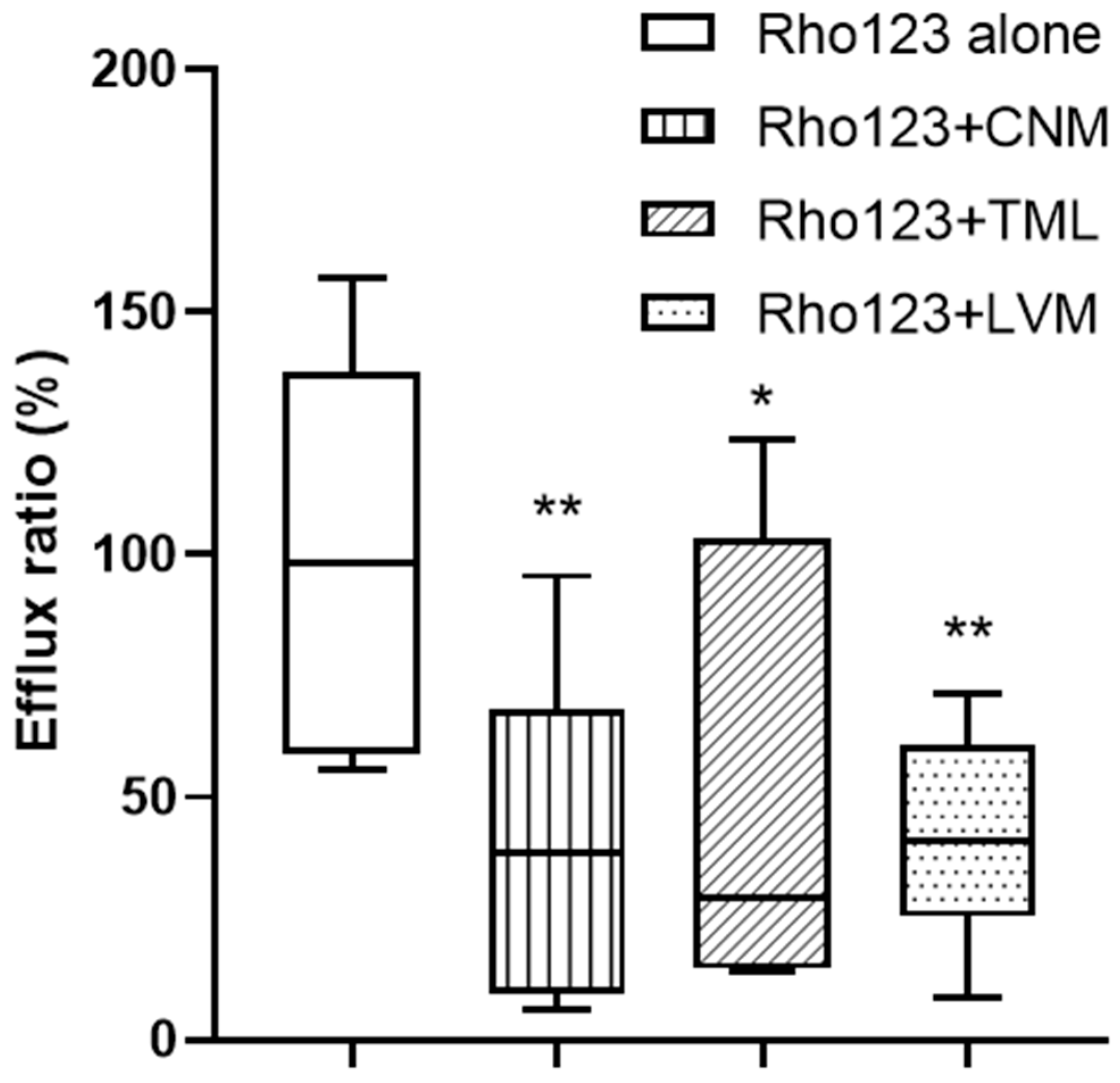
The ex vivo diffusion assay across sheep ileum revealed a marked asymmetry in the transport of the efflux of Rhodamine 123 (Rho123). Under control conditions, the unidirectional transepithelial effective permeability (Peff) in the serosal-to-mucosal direction (S–M) was nearly 9-fold higher than the Peff in the mucosal-to-serosal (M–S), confirming predominant secretory transport. Incubation with CNM, TML, or LVM modified this pattern by increasing the absorptive transport of Rho123. Specifically, the absorption permeability (Peff M–S) was significantly increased in the presence of CNM (5.93 × 10⁻⁶ ± 3.84 × 10⁻⁶ cm/s) (p = 0.0132), TML (6.24 × 10⁻⁶ ± 7.17 × 10⁻⁶ cm/s) (p = 0.0481) and tended to be higher for LVM (3.77 × 10⁻⁶ ± 3.03 × 10⁻⁶ cm/s) (p = 0.0617) compared with the control incubated with Rho123 alone (1.59 × 10⁻⁶ ± 1.09 × 10⁻⁶ cm/s). The intestinal secretion of Rho123 measured as Peff S–M was not significantly modified in the presence of modulators. Nevertheless, all modulators reduced the intestinal efflux of Rho123, as reflected by a marked decrease in the efflux ratio (ER). The mean ERs obtained after the incubation of Rho123 either alone or in the presence of CNM, TML and LVM were 8.93 ± 3.76; 3.55 ± 2.96; 5.10 ± 4.18 and 3.65 ± 1.93, respectively. Comparative ERs relative to the control are shown in Figure 1.

2.2. In Vivo Trial: Pharmacokinetics and Anthelmintic Efficacy

Following subcutaneous administration of TML or CNM into the medial thigh region of the lambs, a localized inflammatory reaction was observed at the injection site in the animals that received CNM. The swelling was mild to moderate, non-ulcerative, and resolved spontaneously within 3–4 days post-administration. No systemic adverse effects or behavioral changes were detected in any animal.
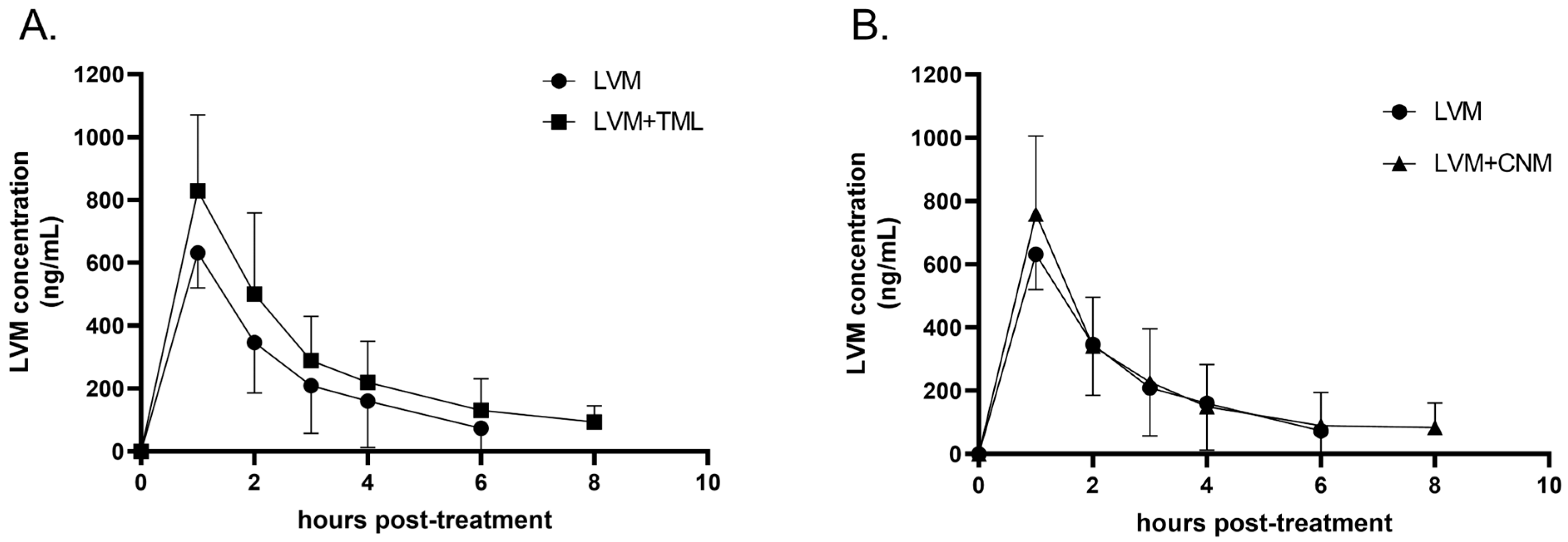
After a single subcutaneous administration of LVM alone, the drug was rapidly absorbed, reaching a maximum plasma concentration (Cmax) of 631.8 ± 111.8 ng/mL at 1 h post-administration (Tmax). The total systemic exposure, expressed as the area under the concentration vs. time curve (AUC0–8h) was 1501 ± 687 ng/h/mL. The pharmacokinetic parameters of LVM did not differ significantly among the three treatment groups. However, the combination of LVM + TML tended to increase the total systemic exposure of LVM (2275 ± 1058 ng/h/mL) (p = 0.119). In the LVM-alone group, the drug was detected in plasma up to 6 h post-administration, whereas plasma detection extended to 8 h in both co-administered groups (LVM + TML and LVM + CNM). The plasma concentration profiles of LVM are shown in Figure 2, and the main pharmacokinetic parameters are summarized in Table 1.
The results of the fecal egg count reduction (FECR) test are presented in Table 2. Before treatment, the predominant parasitic genera identified were Haemonchus spp. (40%), Ostertagia spp. (36%), Oesophagostomum spp. (14%), Cooperia spp. (6%) and Trichostrongylus spp. (4%). The relative proportions of these genera did not change significantly following any treatment. In the LVM-alone group, the mean fecal worm egg counts (EPG) decreased from 958 ± 446 on day 0 to 427 ± 294 on day 7, corresponding to an efficacy of 55%. This level of efficacy is consistent with either limited susceptibility of Ostertagia spp. to LVM and also the presence of LVM-resistant nematode populations. Although all experimental groups showed a significant reduction in EPG between day 0 and day 7, the magnitude of this reduction did not differ significantly among treatments. The FECR for LVM + CNM, and LVM + TML groups was 51.4%, and 57.8%, respectively.

3. Discussion

The ex vivo and in vivo findings of this study demonstrate that CNM, TML and LVM interact at intestinal level modifying the permeability of the model substrate Rho123 and slightly altering the pharmacokinetic behavior of LVM in sheep. The strong asymmetry observed in Rho123 transport across untreated ovine ileum confirms a predominance of secretory flux, with Peff (S–M) approximately nine times higher than Peff (M–S). This directional transport pattern is consistent with those previously observed with Ussing and diffusion chambers for sheep intestine [17,18] and confirms the well-characterized expression of P-gp in the apical membrane of enterocytes in ruminants [19,20]. Despite the high variability observed in the ex vivo intestinal assay (coefficients of variation ranging from 40 to 80%), which is consistent with previous reports [18], a significant effect on intestinal transport of Rho123 was observed following co-incubation with the different modulators. The presence of TML, CNM and LVM primarily enhanced the absorption of Rho123, as reflected by increased Peff (M–S) values, without significantly affecting the secretion process (Peff S–M). All three compounds markedly reduced the ER, demonstrating effective—though variable—P-gp inhibition. These findings align with reports that numerous plant-derived compounds, such as TML and CNM, interfere with protein-transporters through direct transporter blockade, downregulation, or membrane-fluidity modification [18,21,22,23]. Such interactions have been proposed as a mechanism through which phytochemicals enhance the absorption of co-administered drugs in human and animal species.
Available evidence indicates that mammalian P-gp is a major determinant of the disposition of highly lipophilic anthelmintics such as the macrocyclic lactones [24,25]. In contrast, the contribution of these transporters to the systemic pharmacokinetics of LVM remains largely unknown. Given its rapid clearance, modulation of host P-gp activity is expected to have only a minor influence on LVM exposure. However, P-gp at the parasite level may be of greater relevance, as parasite ABC transporters could reduce drug accumulation in parasites and contribute to decreased sensitivity or early phases of anthelmintic resistance. A biphasic pattern of drug resistance has been demonstrated in H. contortus larvae, in which an initial, low-level resistance phase is mediated by non-specific P-gp–related efflux mechanisms, whereas higher-level resistance arises from alterations in the composition or function of the L-AChR subunits targeted by LVM [26]. Furthermore, exposure to LVM for just 3 h induced a significant upregulation of several H. contortus P-gp genes in the resistant isolate, whereas no such transcriptional response was observed in the susceptible strain [11]. Therefore, modulation of parasite P-gp activity by phytochemicals may represent a useful pharmacological strategy to enhance the efficacy of LVM, particularly in populations where efflux-mediated resistance contributes to reduced drug susceptibility.
The present trial intentionally employed a reduced LVM dose (3.75 mg/kg) to increase the likelihood of detecting subtle pharmacokinetic or pharmacodynamic interactions with the co-administered phytochemicals. Notably, this dosage is comparable to that approved for gastrointestinal nematode control in cattle in some countries, such as Brazil. The pharmacokinetic profile observed here is consistent with previous descriptions of LVM in ruminants, characterized by rapid absorption, early Tmax and short plasma persistence [27]. Earlier studies reported mean Cmax values of 2000 ng/mL following its subcutaneous administration at 8 mg/kg, which aligns well with the Cmax of 632 ng/mL obtained in the present study using half that dose. This proportionality further supports the reliability of the pharmacokinetic data generated.
The current experiment provides the first report of subcutaneous administration of phytochemicals such as TML and CNM in lambs. This administration route was selected to enhance their systemic availability and thereby increase the likelihood of interaction with LVM at the pharmacokinetic and parasite levels. Previous work has shown that oral administration of monoterpenes, such as TML at a high dose of 150 mg/kg, results in low systemic exposure and rapid clearance [28], highlighting the limitations of the oral route for achieving sustained plasma concentrations. In our trial, subcutaneous administration of CNM produced a localized inflammatory response, consistent with the well-documented irritant and sensitizing properties of CNM [29]. Conversely, TML administered subcutaneously produced no detectable adverse reactions, suggesting a more favorable local tolerability profile. Overall, these findings underscore that the parenteral use of phytochemicals is highly compound-specific and requires careful safety evaluation before adoption as an alternative delivery strategy in ruminants.
Co-administration of LVM with CNM or TML produced modest increases in LVM exposure, most notably around 50% rise in AUC with TML, although differences remained statistically non-significant. This pattern mirrors the ex vivo reduction in the efflux at the intestinal level. Nevertheless, the magnitude of these changes appears insufficient to produce a clinically relevant improvement. Given LVM short half-life, minor increases in LVM exposure may not translate into substantial pharmacodynamic benefit unless Cmax is clearly elevated. In this study, Cmax remained similar across all treatment groups, which likely explains the absence of improved therapeutic outcomes.
Multiple studies have demonstrated that LVM often exhibits reduced and inconsistent efficacy against Ostertagia spp., particularly when infections include substantial numbers of developing fourth-stage larvae or inhibited (hypobiotic) larvae [30]. LVM is a relatively short-acting nicotinic cholinergic agonist whose anthelmintic effect relies on achieving sufficient peak concentrations at the parasite neuromuscular junction to induce paralysis. When parasite burdens include large mucosal populations or physiologically less responsive larval stages, even increases in systemic exposure, such as those potentially generated by co-administration with phytochemicals, may fail to produce meaningful improvements in efficacy. In the present trial, FECRT results confirmed reduced LVM efficacy, with values ranging from 50–58% across treatments. A substantial proportion of the parasite population consisted of Ostertagia spp. The co-administration of TML or CNM did not alter the relative proportions of nematode genera or improve the reduction in EPG counts. This reduced efficacy may partly reflect the lower LVM dose used in the trial, but it is also consistent with the presence of resistant gastrointestinal nematodes within the flock. Critically, the absence of differences between LVM alone and LVM combined with phytochemicals indicates that the modest pharmacokinetic modifications produced by P-gp modulation were insufficient to translate into detectable improvements in pharmacodynamic effect. Several factors may explain these findings. A central possibility is that systemic exposure to the phytochemicals was insufficient at the parasite site to produce robust P-gp inhibition or other modulatory effects capable of enhancing LVM action as was observed after the co-administration of ivermectin with the monoterpene carvone [12]. As a short-acting molecule, LVM requires substantial increases in tissue concentration to augment efficacy, conditions that were not achieved under the dosing regimen tested.
The effects of CNM on the nematode model C. elegans were recently evaluated [16]. These results showed that CNM activity is mediated through the inhibition of two key receptors involved in nematode neuromuscular function: the levamisole-sensitive acetylcholine receptor (L-AChR) and the GABA-activated chloride channel. In vitro, CNM exhibited a strong synergistic interaction with levamisole, producing significantly greater paralysis than the additive effects of each compound alone [16]. However, this synergism was not replicated in vivo following the coadministration of both compounds to sheep. Multiple factors may influence drug interactions under in vivo conditions and could account for the absence of synergism, underscoring the importance of validating in vitro pharmacological interactions through in vivo studies.
This study has some limitations that should be acknowledged. The sample size for the pharmacokinetic component was calculated using AUC as the primary pharmacokinetic parameter, considering a difference of approximately 40% between treatments as biologically relevant. Based on an assumed inter-individual coefficient of variation of 30–35% for AUC, a significance level of 0.05, and a statistical power of 80%, a minimum of 7–8 animals per group was required for a parallel design including three treatment groups. However, these assumptions are not directly transferable to the parasitological efficacy assessment. EPG counts are characterized by substantial inter-animal variability, frequently exceeding 50%, which markedly reduces statistical power for detecting low or moderate differences between treatments. Although FECRT was conducted using 10 animals per group, meeting the minimum recommendations for exploratory efficacy studies aimed at detecting large treatment effects, larger group sizes (≥15 animals per group) would be preferable to reliably detect low to moderate efficacy differences with adequate statistical power. Practical and logistical constraints precluded the inclusion of additional animals. In addition, the efficacy evaluation relied on a single parasitological endpoint (FECR) and was not complemented by direct measurements of adult worm burden, which may have provided greater sensitivity for detecting treatment-related effects. Another limitation relates to the field infestation, which included a relevant proportion of Ostertagia spp. This parasite composition may have limited the efficacy of LVM as well as that of the phytochemical. Previous evaluations with CNM and pink grapefruit essential oil have reported greater activity against Haemonchus spp. than against Ostertagia spp. [18]. However, the present study provides new experimental evidence demonstrating the capacity of natural phytochemicals and synthetic anthelmintics to interact with intestinal P-gp in sheep, and it also represents the first evaluation of subcutaneous co-administration of these compounds in vivo. However, under the conditions tested, phytochemical-mediated modulation produced only limited enhancement of LVM pharmacokinetics, insufficient to yield clinically meaningful improvements in its efficacy. These results underscore the need for more comprehensive investigations aimed at optimizing the pharmacological integration of phytochemicals with conventional anthelmintics. To fully exploit the modulatory potential of phytochemicals, future studies should focus on optimizing their pharmaceutical formulations. Advances in delivery systems may enhance the exposure of these compounds and strengthen their interaction with synthetic drugs at parasite level.

4. Materials and Methods

4.1. Ex Vivo Assessment of P-Glycoprotein Interaction

The inhibitory effect of CNM, TML and LVM on drug transport was assessed using an established diffusion-chamber model with lamb ileum tissue. Rho123, a known substrate of P-gp, was used to evaluate its transport from the M to the S side, and vice versa. Intestinal tissues for this assay were obtained from a local slaughterhouse (Ayacucho, Argentina). Specifically, ileum segments were harvested from Corriedale lambs weighing approximately 35 kg. Immediately following collection, tissue samples were gently rinsed with a chilled 1.15% KCl solution to remove residual debris and blood. Subsequently, the samples were immersed in Euro-Collins preservation solution (0.19 M glucose, 15.43 mM KH2PO4, 42.48 mM K2HPO4, 15.02 mM KCl, and 10 mM NaHCO3) (J.T Baker-Avantor Phillipsburg, NJ, USA) and maintained at 4 °C during transport to the laboratory. Upon arrival, incubation procedures were initiated without delay, with all subsequent handling, preparation, and mounting steps conducted under continuous hypothermic conditions (0–4 °C) to preserve tissue integrity.
The tissue was mounted vertically in a diffusion chamber with an internal surface area of 0.8 cm2. The bathing medium consisted of Krebs buffer (118 mM NaCl, 4.7 mM KCl, 2.5 mM CaCl2·2H2O, 1.2 mM MgCl2·6H2O, 1 mM NaH2PO4·H2O, 25 mM Na2CO3, 11.1 mM glucose, 0.004 mM EDTA, and 0.11 mM ascorbic acid) (J.T Baker-Avantor (Phillipsburg, NJ, USA). To ensure adequate oxygenation and mixing, the M and S chambers were filled with 7 mL and 5 mL of pre-warmed, oxygenated Krebs buffer, respectively. The chambers were maintained in an orbital shaker (Ferca, Buenos Aires, Argentina) operating at 60 rpm and 37 °C under a humidified gas phase of 95% O2 and 5% CO2. During the pre-incubation period, the chambers were used to promote tissue stabilization and to facilitate the removal of desquamated or non-viable epithelial cells. Following this equilibration phase, CNM and TML (each at 1.5 mM) or LVM (5 µM) were added to the mucosal compartment to evaluate their potential modulatory effects on tissue. After a 20 min equilibration period, the Krebs buffer was completely replaced with fresh medium containing 0.5 µM Rho123 as a model substrate. The compound was added to either the M or S side of the chamber to evaluate absorptive and secretory transport, respectively. Rho123 was incubated alone (control assays) or in combination with CNM, TML, or LVM. The tissues were maintained under these conditions for 4 h, during which 1-mL aliquots were collected from the receptor compartment at hourly intervals and immediately replaced with an equal volume of fresh, pre-warmed Krebs buffer. Each experimental condition was evaluated in seven to nine independent replicates.

4.2. In Vivo Trial: Pharmacokinetics and Anthelmintic Efficacy

A clinical trial was conducted to evaluate the in vivo effects of combining phytochemicals—CNM and TML—with LVM on drug pharmacokinetics and anthelmintic efficacy against resistant gastrointestinal nematodes in lambs. The study was carried out at the sheep experimental unit of Estación Experimental INTA (Balcarce, Argentina), where long-term intensive use of antiparasitic drugs has led to established anthelmintic resistance to macrocyclic lactones and benzimidazoles. Thirty (30) female Corriedale × Texel sheep, with a mean body weight of 25.7 ± 2.9 kg, were selected based on individual EPG, with an average measurement of 928 ± 426. Animals were housed in paddocks, provided hay and water ad libitum, and supplemented with commercial concentrate feed. Lambs were individually weighed and assigned to three experimental groups of 10 animals each, stratified by EPG count: Group A (LVM): received a single subcutaneous dose of LVM at 3.75 mg/kg; Group B (LVM + CNM) which received LVM (3.75 mg/kg) combined with CNM (80 mg/kg) that was administered subcutaneously at time 0 and repeated 3 h later and Group C (LVM + TML) that received LVM (3.75 mg/kg) combined with TML (80 mg/kg), following the same administration schedule as Group B. While all 10 animals per group were included in the efficacy assessment using FECR, the pharmacokinetic analysis was conducted in the 8 animals per group with the highest pre-treatment EPG counts. The LVM dose used was half the recommended dose in Argentina (7.5 mg/kg by subcutaneous route) and matched the dose commonly used in Brazil [31], selected to enhance the sensitivity of the trial for detecting pharmacological interactions. The phytochemical doses were based on previous in vivo studies demonstrating safety in lambs at similar dose ranges (100–150 mg/kg) [12,28]. Phytochemical formulations were prepared at a final concentration of 50% (w/v) by dissolving each compound in a mixture of sesame oil and sunflower oil. Briefly, a sesame/sunflower oil mixture (9:1, v/v) was added to 60 g of TML or CNM to obtain a final volume of 120 mL. The formulation was stirred continuously for 6 h until a visually homogeneous solution was obtained, ensuring complete solubilization of the phytochemicals in the oil vehicle. The formulation was subsequently transferred to amber glass containers and stored at room temperature until use. Both phytochemical formulations were prepared one day prior to the start of the experiment. The final injection volume for both phytochemical formulations ranged between 3 and 5 mL. To assess LVM pharmacokinetics, blood samples (2 mL) were collected from the jugular vein of each lamb at 1, 2, 3, 4, 6, 8, and 24 h post-treatment. Samples were centrifuged at 2000× g for 10 min, and plasma was harvested and stored at −20 °C until analysis. Plasma LVM concentrations were quantified. Anthelmintic efficacy was evaluated via FECR. For it, individual fecal samples were collected directly from the rectum on days −1 and 7 post-treatments. Additionally, coprocultures were prepared from 10 g of pooled feces per group. Third-stage larvae recovered from these cultures were identified to genus and species level following MAFF guidelines [32].

4.3. Analytical Procedures

4.3.1. Chromatographic Analysis

Plasma concentrations of LVM were determined using a solid-phase extraction (SPE) protocol adapted from Luque et al. [27]. Briefly, 1.1 mL of plasma was homogenized and transferred to an Eppendorf tube, followed by centrifugation at 12,000 rpm for 15 min at 4 °C. Subsequently, 1 mL of the supernatant was loaded onto SPE cartridges (Strata, Phenomenex, Torrance, CA, USA) pre-conditioned with 1 mL of methanol and 1 mL of water. After washing with 2 mL of water, LVM was eluted using 1.5 mL of methanol. The eluate was evaporated to dryness under a nitrogen stream at 56 °C. The resulting residue was reconstituted in 250 µL of mobile phase, vortexed for 5 min, and sonicated for an additional 5 min before transfer to a clean Eppendorf tube. Quantification of LVM was performed using high-performance liquid chromatography (HPLC) with UV detection at 235 nm, employing a Shimadzu HPLC system with autosampler (Shimadzu Corporation, Kyoto, Japan). Chromatographic separation was achieved using a Kromasil C18 reverse-phase column (5 µm, 4.6 mm × 250 mm; Eka Chemicals, Brewster, NY, USA). The mobile phase consisted of phosphoric acid 85% in triethylamine, methanol, acetonitrile, and water (0.32:0.5:15.5:83.36), adjusted to pH 3.5. The flow rate was set at 1.2 mL/min, with an injection volume of 100 µL. The method’s limit of quantification (LOQ) was 25 ng/mL, and the limit of detection (LOD) was 10 ng/mL.

4.3.2. Intestinal Efflux Analysis

Aliquots (1 mL) collected from the receptor compartment of the diffusion chamber were diluted with 2 mL of distilled water to obtain a final volume of 3 mL. Rho123 concentrations were quantified using a Shimadzu RF-5301PC fluorescence spectrophotometer (Shimadzu Corporation, Kyoto, Japan), with excitation and emission wavelengths set at 485 nm and 520 nm, respectively, as described by Ballent et al. [17]. Quantification was performed using a calibration curve established over a range 0.008 to 35 ng/mL.

4.4. Data Analysis

Intestinal absorption was assessed ex vivo by measuring the unidirectional permeability of Rho123 in the M–S direction, while intestinal secretion was evaluated in the S–M direction. A higher permeability in the S–M direction compared to the M–S direction is indicative of carrier-mediated transport. Specifically, substrates of efflux transporters such as Rho123—expressed on the apical surface of enterocytes—are preferentially transported in the S–M direction, resulting in ER greater than 2 [33].
The unidirectional transepithelial effective permeability (Peff) (cm.s−1) of Rho123 across the intestinal tissue was calculated using the following equation:
P e f f = ( d C d T ) ( 1 A . C 0 )
where dC/dT is the transport rate of Rho123 (in nmol/min); A is the exposed surface area of the tissue (0.8 cm2); and C0 is the initial Rho123 concentration (in nmol/mL) in the donor compartment. The ERs were calculated by dividing the Peff value obtained in the S–M direction by that obtained in the M–S direction.
In vivo plasma concentrations of LVM were analyzed to determine pharmacokinetic parameters. Individual plasma concentration–time profiles were fitted using PK Solutions 2.0 software (Summit Research Services, Ashland, OH, USA). Pharmacokinetic parameters were calculated using a non-compartmental analysis model, as described by Gibaldi and Perrier [34]. The evaluation of the FECR was calculated according to the following formula [35]:
F E C R   % = 100   ×   ( 1 T 2 T 1 )
where T1 and T2 are the arithmetic mean epg counts in the treated group on days 0 and 7, respectively. The 90% confidence intervals were calculated following Kaplan et al. [36]. The criteria used to classify drug efficacy was performed according to Kaplan et al. [36] and Coles et al. [37].

4.5. Statistical Analysis

Data are presented as mean ± standard deviation (SD) or median with range as appropriate. Statistical comparisons of pharmacokinetic parameters were performed using one-way ANOVA or the Kruskal–Wallis test, as appropriate. Post hoc correction for multiple comparisons was conducted using Tukey’s or Dunnett’s tests for parametric data, and Dunn’s test for non-parametric data. The egg counts obtained for each treatment on day 7 were compared with the corresponding baseline counts on day 0 using the Wilcoxon matched-pairs signed rank test. Differences in egg counts on day 7 among treatment groups were analyzed using the Kruskal–Wallis test. All statistical analyses were performed using GraphPad Prism version 8.0 (GraphPad Software Inc., San Diego, CA, USA), with differences considered statistically significant at p < 0.05.

5. Conclusions

This integrated study successfully confirmed that LVM, TML and CNM all exhibit P-gp modulation in sheep ileum. However, the kinetic modification observed after the in vivo coadministration was insufficient to yield clinically meaningful improvements against gastrointestinal nematodes. These results highlight a critical gap where ex vivo or in vitro models do not automatically represent a clinical benefit. Future research should focus on optimizing the formulation and delivery systems of these phytochemicals to maximize their interaction at the site of parasite location.

Author Contributions

Conceptualization, M.V.M., G.V., C.L. and A.L.; methodology, M.V.M., P.I. and M.L.; validation, M.V.M.; formal analysis, M.V.M.; investigation, M.V.M., P.I., M.L., G.V. and A.L.; writing—original draft, M.V.M. and A.L.; writing—review and editing, M.V.M., C.L., P.I., M.L., G.V. and A.L.; supervision, G.V. and A.L.; project administration, A.L.; funding acquisition, A.L. All authors have read and agreed to the published version of the manuscript.

Funding

This research was supported by CONICET (PIP 11220200101380CO), Argentina.

Institutional Review Board Statement

All procedures were agreed with the Animal Welfare Policy (Academic Council Resolution 087/02) of the Faculty of Veterinary Sciences, Universidad Nacional del Centro de la Provincia de Buenos Aires (UNCPBA), Tandil, Argentina (Internal Protocol 01/2025; approval date: 13 March 2025).

Informed Consent Statement

Not applicable.

Data Availability Statement

The raw data supporting the conclusions of this article will be made available by the authors upon request.

Acknowledgments

The authors thank Germán Fonzo, Laureano Schofs, Lucila Moriones, and Juan Manuel Torres for their collaboration during in vivo experiments.

Conflicts of Interest

The authors declare no conflicts of interest.

Abbreviations

The following abbreviations are used in this manuscript:
LVMLevamisole
TMLThymol
CNMCinnamaldehyde
L-AChRNicotinic acetylcholine receptor
P-gpP-glycoprotein
ABCATP-binding cassette
Mmucosal
Sserosal
Rho123Rhodamine 123
PeffUnidirectional transepithelial effective permeability
EREfflux ratio
T ½ abAbsorption half-life
CmaxPeak plasma concentration
TmaxTime to peak plasma concentration
T ½ elElimination half-life
AUC0–tArea under concentration vs. time curve from time 0 to the last concentration detected
FECRFecal egg count reduction
EPGEgg per gram

References

  1. Sutherland, I.A.; Leathwick, D.M. Anthelmintic resistance in nematode parasites of cattle: A global issue? Trends Parasitol. 2011, 27, 176–181. [Google Scholar] [CrossRef] [PubMed]
  2. Charlier, J.; Bartley, D.J.; Sotiraki, S.; Martinez-Valladares, M.; Claerebout, E.; von Samson-Himmelstjerna, G.; Thamsborg, S.M.; Hoste, H.; Morgan, E.R.; Rinaldi, L. Anthelmintic resistance in ruminants: Challenges and solutions. Adv. Parasitol. 2022, 115, 171–227. [Google Scholar] [CrossRef] [PubMed]
  3. Charlier, J.; van der Voort, M.; Kenyon, F.; Skuce, P.; Vercruysse, J. Chasing helminths and their economic impact on farmed ruminants. Trends Parasitol. 2014, 30, 361–367. [Google Scholar] [CrossRef] [PubMed]
  4. Deore, A.B.; Dhumane, J.R.; Wagh, H.V.; Sonawane, R.B. The Stages of Drug Discovery and Development Process. Asian J. Pharm. Res. Dev. 2019, 7, 62–67. [Google Scholar] [CrossRef]
  5. van Hasselt, J.G.C.; Iyengar, R. Systems pharmacology: Defining the interactions of drug combinations. Annu. Rev. Pharmacol. Toxicol. 2019, 59, 21–40. [Google Scholar] [CrossRef]
  6. Mengistu, G.; Hoste, H.; Karonen, M.; Salminen, J.P.; Hendriks, W.H.; Pellikaan, W.F. The in vitro anthelmintic properties of browse plant species against Haemonchus contortus is determined by the polyphenol content and composition. Vet. Parasitol. 2017, 237, 110–116. [Google Scholar] [CrossRef]
  7. Oliveira, A.F.; Costa Junior, L.M.; Lima, A.S.; Silva, C.R.; Ribeiro, M.N.S.; Mesquista, J.W.C.; Rocha, C.Q.; Tangerina, M.M.P.; Vilegas, W. Anthelmintic activity of plant extracts from Brazilian savanna. Vet. Parasitol. 2017, 236, 121–127. [Google Scholar] [CrossRef]
  8. Marjanovic, S.D.; Bogunovic, D.; Milovanovic, M.; Marinkovic, D.; Zdravkovic, N.; Magas, V.; Trailović, S. Antihelmintic activity of carvacrol, thymol, cinnamaldehyde and p-cymen against the free-living nematode Caenorhabditis elegans and rat pinworm Syphacia muris. Acta Vet. Belgrade 2018, 68, 445–456. [Google Scholar] [CrossRef]
  9. Rayes, D.; De Rosa, M.J.; Bartos, M.; Bouzat, C. Molecular basis of the differential sensitivity of nematode and mammalian muscle to the anthelmintic agent levamisole. J. Biol. Chem. 2004, 279, 36372–36381. [Google Scholar] [CrossRef]
  10. Vaalburg, W.; Hendrikse, N.H.; Elsinga, P.H.; Bart, J.; van Waarde, A. P-glycoprotein activity and biological response. Toxicol. Appl. Pharmacol. 2005, 207, 257–260. [Google Scholar] [CrossRef]
  11. Raza, A.; Kopp, S.R.; Bagnall, N.H.; Jabbar, A.; Kotze, A.C. Effects of in vitro exposure to ivermectin and levamisole on the expression patterns of ABC transporters in Haemonchus contortus larvae. Int. J. Parasitol. Drugs Drug Resist. 2016, 6, 103–115. [Google Scholar] [CrossRef] [PubMed]
  12. Miró, M.V.; Costa-Júnior, L.M.; Lloberas, M.; Cardozo, P.; Lanusse, C.; Virkel, G.; Lifschitz, A. Phytochemicals in Gastrointestinal Nematode Control: Pharmacokinetic–Pharmacodynamic Evaluation of the Ivermectin plus Carvone Combination. Animals 2023, 13, 1287. [Google Scholar] [CrossRef] [PubMed]
  13. André, W.P.P.; Cavalcante, G.S.; Ribeiro, W.L.C.; Santos, J.M.L.D.; Macedo, I.T.F.; Paula, H.C.B.; Morais, S.M.; Melo, J.V.; Bevilaqua, C.M.L. Anthelmintic effect of thymol and thymol acetate on sheep gastrointestinal nematodes and their toxicity in mice. Rev. Bras. Parasitol. Vet. 2017, 26, 323–330. [Google Scholar] [CrossRef] [PubMed]
  14. Frota, G.A.; Santos, V.O.; Rodrigues, J.F.V.; Oliveira, B.R.; Albuquerque, L.B.; Vasconcelos, F.R.C.; Silva, A.C.; Teixeira, M.; Brito, E.S.; Santos, J.M.L.D.; et al. Biological activity of cinnamaldehyde, citronellal, geraniol and anacardic acid on Haemonchus contortus isolates susceptible and resistant to synthetic anthelmintics. Braz. J. Vet. Parasitol. 2023, 32, e006023. [Google Scholar] [CrossRef]
  15. De Oliveira, M.S.; Da Silva Souza Filho, A.P. (Eds.) Terpenoids: Recent Advances in Extraction, Biochemistry and Biotechnology; Bentham Science Publishers Pte. Ltd.: Singapore, 2022. [Google Scholar]
  16. Hernando, G.; Turani, O.; Rodriguez Araujo, N.; Pulido Carrasquero, A.; Bouzat, C. Unraveling anthelmintic targets and mechanisms of action of trans-cinnamaldehyde from cinnamon essential oil. Sci. Rep. 2025, 15, 5422. [Google Scholar] [CrossRef]
  17. Ballent, M.; Lifschitz, A.; Virkel, G.; Sallovitz, J.; Maté, L.; Lanusse, C. In vivo and ex vivo assessment of the interaction between ivermectin and danofloxacin in sheep. Vet. J. 2012, 192, 422–427. [Google Scholar] [CrossRef]
  18. Miró, M.V.; Ichinose, P.; Lloberas, M.; Moriones, L.; Lanusse, C.; Virkel, G.; Lifschitz, A. Phytochemical-Mediated Modulation of Doramectin Pharmacology in Sheep: Exploring the Cinnamaldehyde-Pink Grapefruit Combination. Animals 2025, 15, 2539. [Google Scholar] [CrossRef]
  19. Takano, M.; Yumoto, R.; Murakami, T. Expression and function of efflux drug transporters in the intestine. Pharmacol. Ther. 2006, 109, 137–161. [Google Scholar] [CrossRef]
  20. Margier, M.; Collet, X.; le May, C.; Desmarchelier, C.; André, F.; Lebrun, C.; Defoort, C.; Bluteau, A.; Borel, P.; Lespine, A.; et al. ABCB1 (P-glycoprotein) regulates vitamin D absorption and contributes to its transintestinal efflux. FASEB J. 2019, 33, 2084–2094. [Google Scholar] [CrossRef]
  21. Dewanjee, S.; Dua, T.K.; Bhattacharjee, N.; Das, A.; Gangopadhyay, M.; Khanra, R.; Joardar, S.; Riaz, M.; Feo, V.; Zia-Ul-Haq, M. Natural Products as Alternative Choices for P-Glycoprotein (P-gp) Inhibition. Molecules 2017, 22, 871. [Google Scholar] [CrossRef]
  22. Shankar Das, B.; Sarangi, A.; Pahuja, I.; Singh, V.; Ojha, S.; Giri, S.; Bhaskar, A.; Bhattacharya, D. Thymol as Biofilm and Efflux Pump Inhibitor: A Dual-Action Approach to Combat Mycobacterium tuberculosis. Cell Biochem. Funct. 2024, 42, e70030. [Google Scholar] [CrossRef] [PubMed]
  23. Wang, S.; Liu, Y.; Cui, M.; Zou, X.; Pan, M.; Jiang, D.; Chang, T.; Xu, H.; Wu, D.; Chu, X. Cinnamaldehyde enhances the intervention effect of puerarin on stroke from the perspectives of pharmacokinetics and pharmacodynamics. Eur. J. Pharmacol. 2025, 1000, 177732. [Google Scholar] [CrossRef] [PubMed]
  24. Lespine, A.; Martin, S.; Dupuy, J.; Roulet, A.; Pineau, T.; Orlowski, S.; Alvinerie, M. Interaction of macrocyclic lactones with P-glycoprotein: Structure-affinity relationship. Eur. J. Pharm. Sci. 2007, 30, 84–94. [Google Scholar] [CrossRef] [PubMed]
  25. Lespine, A.; Blancfuney, C.; Prichard, R.; Alberich, M. P-glycoproteins in anthelmintic safety, efficacy, and resistance. Trends Parasitol. 2024, 40, 896–913. [Google Scholar] [CrossRef]
  26. Sarai, R.S.; Kopp, S.R.; Coleman, G.T.; Kotze, A.C. Drug-efflux and target-site gene expression patterns in Haemonchus contortus larvae able to survive increasing concentrations of levamisole in vitro. Int. J. Parasitol. Drugs Drug Resist. 2014, 4, 77–84. [Google Scholar] [CrossRef]
  27. Luque, S.; Lloberas, M.; Cardozo, P.; Virkel, G.; Farias, C.; Viviani, P.; Lanusse, C.; Alvarez, L.; Lifschitz, A. Combined moxidectin-levamisole treatment against multidrug-resistant gastrointestinal nematodes: A four-year efficacy monitoring in lambs. Vet. Parasitol. 2021, 290, 109362. [Google Scholar] [CrossRef]
  28. Miró, M.V.; E Silva, C.R.; Viviani, P.; Luque, S.; Lloberas, M.; Costa-Júnior, L.M.; Lanusse, C.; Virkel, G.; Lifschitz, A. Combination of bioactive phytochemicals and synthetic anthelmintics: In vivo and in vitro assessment of the albendazole-thymol association. Vet. Parasitol. 2020, 281, 109121. [Google Scholar] [CrossRef]
  29. Patel, S.K.; Vikram, A.; Pathania, D.; Chugh, R.; Gaur, P.; Prajapati, G.; Kotian, S.Y.; Satyanarayana, G.N.V.; Yadav, A.K.; Upadhyay, A.K.; et al. Allergic potential & molecular mechanism of skin sensitization of cinnamaldehyde under environmental UVB exposure. Chemosphere 2024, 368, 143508. [Google Scholar] [CrossRef]
  30. Williams, J.C.; Knox, J.W.; Marbury, K.S.; Swalley, R.A.; Eddi, C.S. Efficacy of levamisole against Ostertagia ostertagi in Louisiana cattle during maturation of inhibited larvae (September) and during minimal inhibition (December/January). Vet. Parasitol. 1991, 40, 73–85. [Google Scholar] [CrossRef]
  31. Ramos, F.; Portella, L.P.; Rodrigues, F.S.; Reginato, C.Z.; Pötter, L.; Cezar, A.S.; Sangioni, L.A.; Vogel, F.S.F. Anthelmintic resistance in gastrointestinal nematodes of beef cattle in the state of Rio Grande do Sul, Brazil. Int. J. Parasitol. Drugs Drug Resist. 2016, 6, 93–101. [Google Scholar] [CrossRef]
  32. MAFF (Ministry of Agriculture, Fisheries and Food). Manual of Veterinary Parasitological Laboratory Techniques, 3rd ed.; Her Majesty’s Stationery Office: London, UK, 1986.
  33. Lennernäs, H. Human jejunal effective permeability and its correlation with preclinical drug absorption models. J. Pharm. Pharmacol. 1997, 49, 627–638. [Google Scholar] [CrossRef]
  34. Gibaldi, M.; Perrier, D. Pharmacokinetics, 2nd ed.; Marcel Dekker: New York, NY, USA, 1982; pp. 45–109. [Google Scholar]
  35. McKenna, P. The detection of anthelmintic resistance by the faecal egg count reduction test: An examination of some of the factors affecting performance and interpretation. N. Z. Vet. J. 1990, 38, 142–147. [Google Scholar] [CrossRef]
  36. Kaplan, R.M.; Denwood, M.J.; Nielsen, M.K.; Thamsborg, S.M.; Torgerson, P.R.; Gilleard, J.S.; Dobson, R.J.; Vercruysse, J.; Levecke, B. World Association for the Advancement of Veterinary Parasitology (WAAVP) guideline for diagnosing anthelmintic resistance using the faecal egg count reduction test in ruminants, horses and swine. Vet. Parasitol. 2023, 318, 109936. [Google Scholar] [CrossRef]
  37. Coles, G.C.; Bauer, C.; Borgsteede, F.H.M.; Geerts, S.; Klei, T.R.; Taylor, M.A.; Waller, P.J. World Association for the Advancement of Veterinary Parasitology (WAAVP) methods for the detection of anthelmintic resistance in nematodes of veterinary importance. Vet. Parasitol. 1992, 44, 35–44. [Google Scholar] [CrossRef]
Figure 1. Comparative efflux ratio (%) (Peff S–M/Peff M-S) of rhodamine 123 (Rho123, 0.5 µM) across sheep ileum following its incubation either alone or in the presence of cinnamaldehyde (CNM), thymol (TML) (each at 1.5 mM) and levamisole (LVM, 5 µM). Values are expressed as percentage (%) relative to the control and showed the median (min–max) (n = 8–9 determinations). One-way ANOVA followed by Dunnett’s test was used to compare incubation with Rho123 alone against incubations with Rho123 in the presence of the modulators. Statistical differences relative to Rho123 alone were considered significant at * p < 0.05 and ** p < 0.01.
Ddc 05 00011 g001
Figure 2. Comparative plasma concentration profiles obtained after a subcutaneous administration of levamisole (LVM, 3.75 mg/kg), alone or co-administered with (A) thymol (TML, 80 mg/kg at 0 and 3 h) or (B) cinnamaldehyde (CNM, 80 mg/kg at 0 and 3 h), to lambs (n = 8). Values are expressed as mean ± SD.
Ddc 05 00011 g002
Table 1. Plasma pharmacokinetic parameters of levamisole (LVM, 3.75 mg/kg) in plasma (mean ± SD) obtained after its subcutaneous administration, either alone or co-administered with thymol (TML, 80 mg/kg at 0 and 3 h) or cinnamaldehyde (CNM, 80 mg/kg at 0 and 3 h), to sheep (n = 8).
Kinetic
Parameters
LVMLVM + TMLLVM + CNM
T ½ ab (h)0.55 ± 0.45 a0.91 ± 1.09 a0.69 ± 0.36 a
Cmax (ng/mL)632 ± 111 a829 ± 241 a759 ± 246 a
Tmax (h)1.00 ± 0.00 a1.00 ± 0.00 a1.00 ± 0.00 a
T ½ el (h)1.65 ± 0.75 a2.10 ± 0.82 a2.37 ± 1.81 a
AUC0-t (ng h/mL)1501 ± 687 a2275 ± 1058 a1763 ± 1027 a
T ½ ab, absorption half-life; Cmax, peak plasma concentration; Tmax, time to peak plasma concentration; T ½ el, elimination half-life; AUC0–t, area under concentration vs. time curve from time 0 to the last concentration detected. Different letters between treatments for kinetic parameters indicate statistically different values at p > 0.05.
Table 2. Mean egg per gram (EPG) counts (±SD) and fecal egg count reduction percentage (FECR) obtained at 0 and 7 days after the administration of levamisole (LVM, 3.75 mg/kg) alone or co-administered with thymol (TML, 80 mg/kg at 0 and 3 h) or cinnamaldehyde (CNM, 80 mg/kg at 0 and 3 h), to sheep (n = 8) naturally infected with resistant gastrointestinal nematodes.
TreatmentDay 0 Day 7p Value
EPGEPGFECRT (%)
(CI)
LVM958 ± 446 a427 ± 294 a55.5
(21.4–74.8)
0.0020
LVM + CNM875 ± 368 a425 ± 218 a51.4
(23.5–69.1)
0.0059
LVM + TML950 ± 495 a401 ± 190 a57.8
(31.8–73.9)
0.0098
CI: lower and upper confidence intervals. Different letters between treatments at different sampling days indicate statistical differences. The p value in column 5 represents a pairwise Wilcoxon test performed between day 0 and day 7 within each treatment group.
Disclaimer/Publisher’s Note: The statements, opinions and data contained in all publications are solely those of the individual author(s) and contributor(s) and not of MDPI and/or the editor(s). MDPI and/or the editor(s) disclaim responsibility for any injury to people or property resulting from any ideas, methods, instructions or products referred to in the content.