Article

Antischistosomal Activity of 1,4-Dihydropyridines

by
Thaís A. S. Oliveira
1,†,
Matheus H. M. Zago
2,†,
Larissa G. Maciel
3,
Yan R. Robles
1,
Lizandra G. Magalhães
2,* and
Antônio E. M. Crotti
1,*
1
Department of Chemistry, Faculty of Philosophy, Sciences, and Letters at Ribeirão Preto, University of São Paulo, Ribeirão Preto 14900-001, SP, Brazil
2
Laboratory of Parasitology, University of Franca, Franca 14404-600, SP, Brazil
3
Department of Fundamental Chemistry, Federal University of Pernambuco, Recife 50740-560, PE, Brazil
*
Authors to whom correspondence should be addressed.
These authors contributed equally to this work.
Drugs Drug Candidates 2026, 5(1), 8; https://doi.org/10.3390/ddc5010008
Submission received: 16 December 2025 / Revised: 4 January 2026 / Accepted: 6 January 2026 / Published: 13 January 2026
(This article belongs to the Collection Anti-Parasite Drug Discovery)

Abstract

Background/Objectives: Recent reports have demonstrated the antiparasitic activity of 1,4-dihydropyridine (1,4-DHPs). This study aimed to assess the in vitro antischistosomal activity of 24 1,4-DHPs against Schistosoma mansoni adult worms. Methods: Sixteen hexahydroquinolines (116) and eight Hantzsch esters (1724) previously obtained through a multicomponent Hantzsch reaction were tested in vitro against Schistosoma mansoni adult worms. In silico studies with the most active compounds were also carried out. Results: Among the tested compounds, the Hantzsch esters 20 (diethyl 4-(4-bromophenyl)-2,6-dimethyl-1,4-dihydropyridine-3,5-dicarboxylate) and 21 (diethyl 4-(3-fluorophenyl)-2,6-dimethyl-1,4-dihydropyridine-3,5-dicarboxylate) provided the lowest IC50 (15.2 and 13.1 µM, respectively) and the highest selectivity for this parasite (SI = 2.31 and >4.59, respectively). Conclusions: Docking studies revealed that compound 21 has a high affinity for the S. mansoni target (PDB ID: 6UY4). Furthermore, ADMET predictions indicated that compound 21 meets the drug-likeness criteria without violating any Lipinski, Veber, or Egan’s rules.

1. Introduction

Schistosomiasis, a neglected tropical disease (NTD) that causes over 24,000 deaths annually, is a parasitic infection endemic in 78 countries [1]. The disease is contracted through contact with contaminated water, which is common in poor regions of developing countries in Asia, Africa, and South America, where access to potable water and/or sanitation is limited [2]. The life cycle of Schistosoma, the parasite causative of schistosomiasis, begins with the waste of infected individuals: eggs that are transported through urine or feces can contaminate freshwater and infect snails, which act as intermediate hosts. The hosts then release cercaria (the infective form of Schistosoma) to the water, which can then penetrate human skin and travel to the human liver, where the cercaria lose their tails and reach adult form [3]. Acute schistosomiasis (also known as Katayama fever) is rarer and often asymptomatic, even though some symptoms such as abdominal pain, diarrhea, fever, cough, and lymphadenomegaly have been described. Chronic schistosomiasis manifests differently regarding the intensity, duration, and symptoms according to genetics, age, or ethnicity: complicated and uncomplicated intestinal or urogenital schistosomiasis are all different manifestations of the disease [4].
The main current strategy adopted by the World Health Organization (WHO) to eradicate schistosomiasis in all countries where the disease is considered endemic is the mass drug administration (MDA) of praziquantel (PZQ). People living in risk areas are annually treated with PZQ or, in some cases, twice a year. However, reinfection rates—especially in some infection hotspots—have been reported to be increasing, potentially due to the resistance development of the Schistosoma parasite towards praziquantel [5,6].
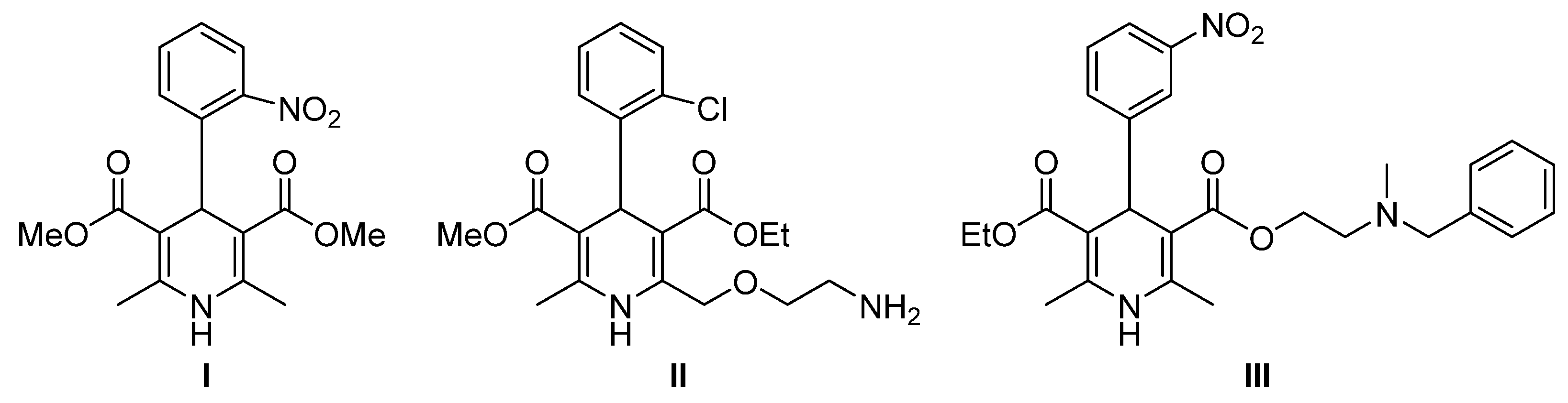
1,4-Dihydropyridines (1,4-DHPs) are N-heterocyclic compounds that are most known for their ability to block calcium channels [7]. For example, nifedipine (I), amlodipine (II), and nicardipine (III, Figure 1) are commercially available drugs used to treat hypertension and angina [8]. Nifedipine, amlodipine, nicardipine, and other 1,4-DHPs can be obtained through the classical Hantzsch reaction, a multicomponent reaction that allows for obtaining a library of 1,4-DHPs derivatives by varying the aldehydes, the β-dicarbonyl compounds, and the nitrogen source [9]. Many of these derivatives have displayed a wide diversity of biological and pharmacological activities, such as antibacterial [10], antileishmanial [11,12,13], anti-trypanosomal [12,13], anticancer [14], anticonvulsant [15], antihypertensive [16], and analgesic activities [17]. However, the antischistosomal activity of 1,4-DHPs has not been reported to date.
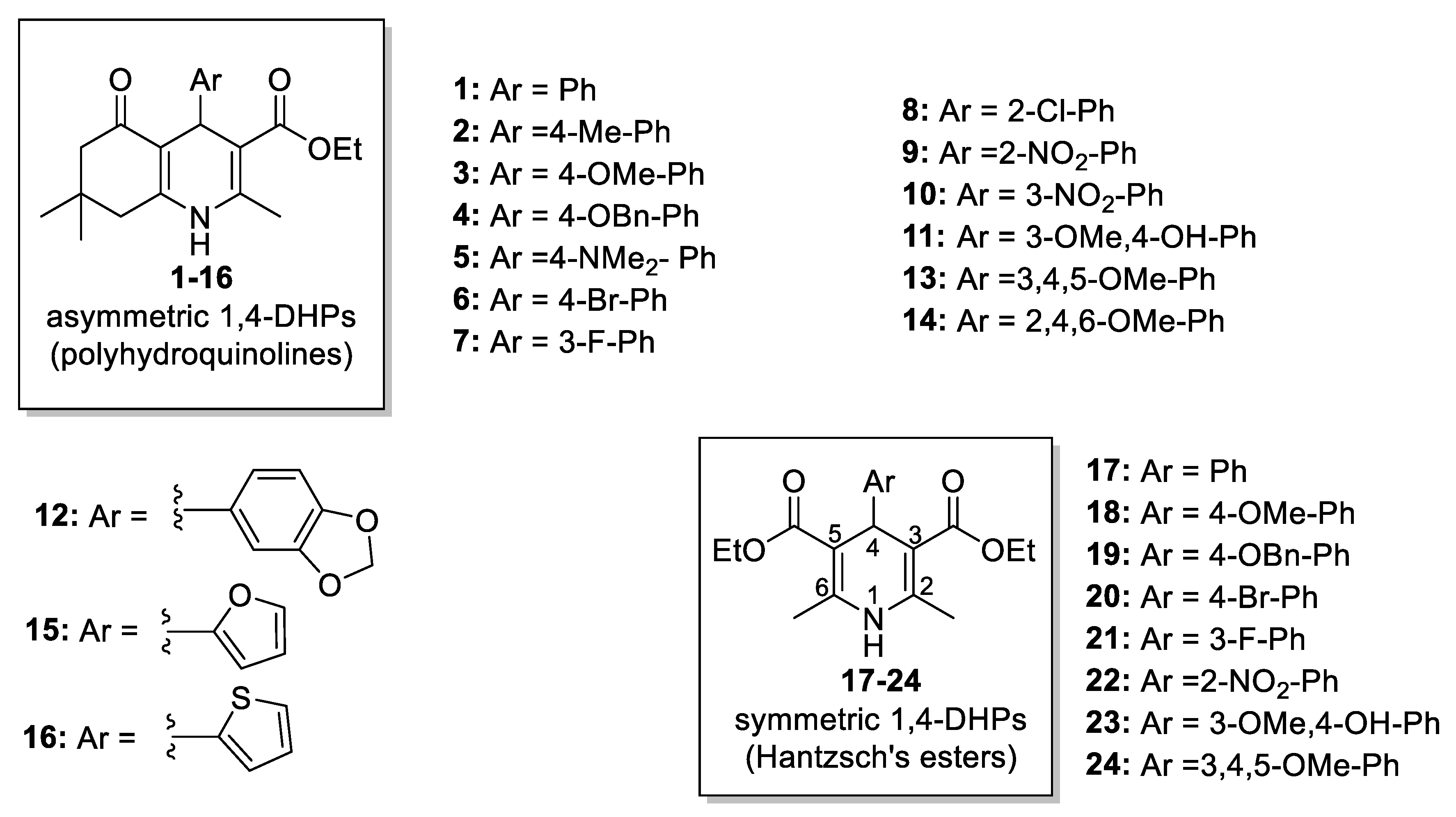
In recent years, the 1,4-DHPs 124 (Figure 2) have been investigated for their antiparasitic activity. The Hantzsch ester 20 was reported to display anti-trypanosomal activity against Trypanosoma cruzi [12]. On the other hand, the hexahydroquinolides 7, 9, and 13 exhibit antileishmanial activity against L. amazonensis promastigotes (13) and amastigotes (7 and 9) [10]. More recently, the antitoxoplasmal activity of the hexahydroquinolines 4 against Toxoplasma gondii, and the antileishmanial activity of 12 against Leishmania major were reported [18]. Thus, based on these previous results, and as part of our interest in the antiparasitic activity of natural [19] and synthetic products [20,21], we have assessed the antischistosomal activity of 1,4-DHPs 124 against S. mansoni adult worms. In silico studies with the most active compounds were also carried out and gave us insights into the potential molecular target for these antischistosomal molecules, the enzyme dihydroorotate dehydrogenase from Schistosoma mansoni (SmDHODH).

2. Results

2.1. Antischistosomal Activity of Compounds 124 Against S. mansoni Adult Worms

Compounds 124 were initially tested in vitro against S. mansoni adult worms at a concentration of 50 µM. At this screening concentration, only the hexahydroquinolines 2, 3, 4, 6, 9, 10, and 12, and the Hantzsch esters 20 and 21 caused inhibition percentages higher than 50%. Next, these compounds were tested in lower concentrations to calculate the IC50 values. Table 1 depicts the IC50 values of antischistosomal activity of compounds 2, 3, 4, 6, 9, 10, 12, 20, and 21 against S. mansoni adult worms after 24, 48, and 72 h of treatment. Praziquantel (PZQ), used as the positive control at a concentration of 1.6 µM, killed (i.e., caused 100% inhibition) all the treated worms within 24 h of treatment.
Compound 21 displayed the lowest IC50 values after 24, 48, and 72 h (13.1, 10.1, and 7.7 µM, respectively), followed by compounds 20 (15.2, 16.7, and 14.0 µM, respectively) and 12 (40.0, 27.0, and 22.2 µM, respectively). On the other hand, the in vitro activity of compounds 2, 3, 4, 6, 9, and 12 against S. mansoni adult worms varied according to the period of treatment. For example, compounds 2, 3, 4, and 10 displayed IC50 values lower than 50 µM. After 72 h of treatment, all the compounds had IC50 values lower than 50 µM.
To calculate the selectivity index (i.e., the ratio between the IC50 values of normal cells and S. mansoni cells, which measures the window between cytotoxicity and biological activity), the IC50 values of compounds 2, 3, 4, 6, 9, 12, 20, and 21 to Vero cells recently published by our group were used [18]. As shown in Table 1, compounds 20 and 21 had the highest SI values (2.31 and >4.39, respectively) after 24 h of treatment.

2.2. Drug-Likeness and ADMET Predictions

2.2.1. Physicochemical and Drug-Likeness Predictions

To assess the physicochemical properties of the nine 1,4-DHPs with antischistosomal activity, the data regarding the surface area, molecular weight, lipophilicity, number of rotatable bonds, H-bonding acceptor and donors, as well as drug-likeness data (Lipinski, Veber, and Egan rules) are described in Table 2. The ideal threshold for each parameter is described right below the column title.

2.2.2. ADMET Properties

The pharmacokinetics parameters regarding ADMET properties of compounds 2, 3, 4, 6, 9, 10, 12, 20, and 21 were simulated using pkCSM webserver (https://biosig.lab.uq.edu.au/pkcsm//—accessed on 21 October 2025). The data were selected as follows: Percentage of human intestinal absorption (HIA%) for absorption, logarithm ratio of brain to plasma drug concentration (logBB) for distribution, CYP enzymes substrate and inhibition for metabolism, total clearance (hepatic and renal clearance) for excretion, and AMES toxicity and hepatotoxicity for toxicity parameters (Table 3).

2.3. Docking Studies

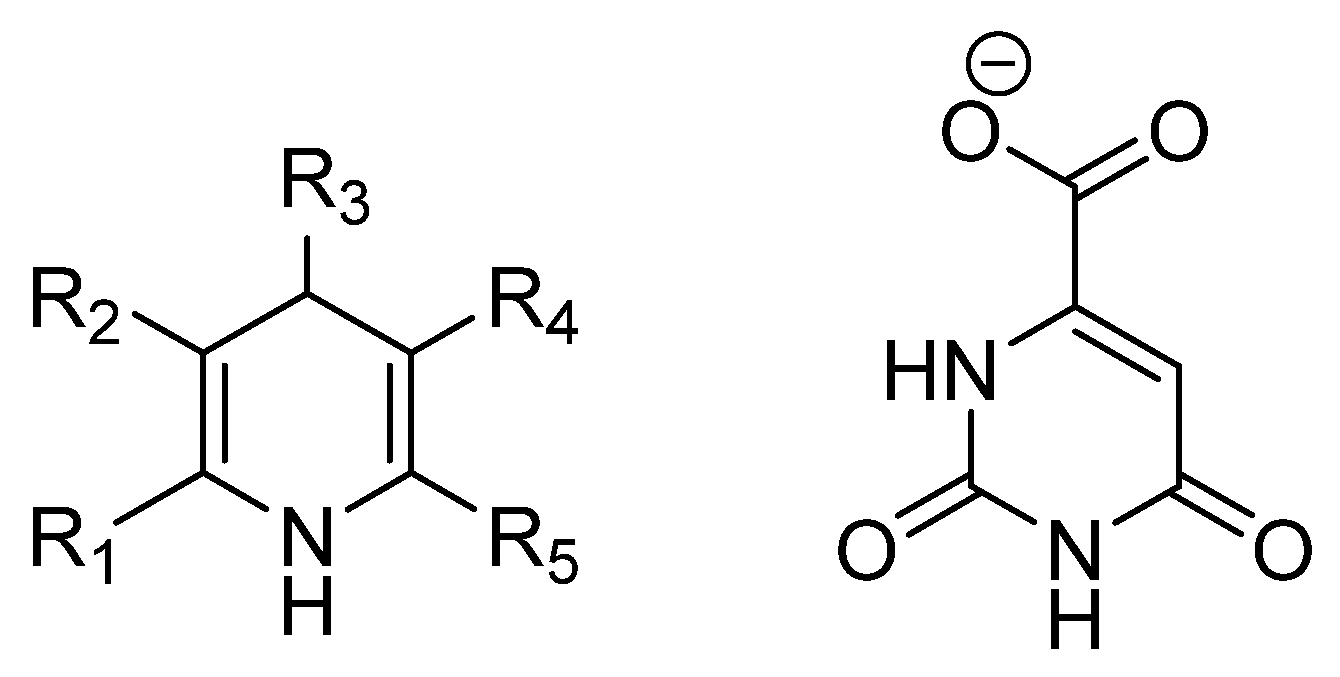
The enzyme dihydroorotate dehydrogenase from Schistosoma mansoni (SmDHODH) belongs to the de novo biosynthesis pathway of pyrimidines, which are essential for cell survival and parasite proliferation [22]. SmDHODH catalyzes the oxidation of dihydroorotate to orotate (ORO) using quinone as an electron-acceptor species and flavone mononucleotide (FMN) as cofactor [23]. Thus, a potential inhibitor could bind to either of the active sites, depending on the affinity to the residues located therein (ORO or QLA active sites for orotate or quinone, respectively). 1,4-DHPs are chemically and structurally similar to orotate, since both molecules are 6-membered N-heterocycles (Figure 3). Therefore, this similarity encouraged us to investigate the role of SmDHODH as a potential molecular target for the 1,4-DHP derivatives with the antischistosomal activity presented in this work.
Some researchers have been dedicated to discovering new SmDHODH inhibitors as probable drugs against schistosomiasis, both in in vivo and in silico approaches [24,25,26,27]. It is important to notice that most of the previously reported inhibitors are quinone derivatives, so the 1,4-DHP derivatives have the potential to be a new series of SmDHODH inhibitors.
Molecular docking simulations were performed to evaluate the potential of SmDHODH as a molecular target of the 1,4-DHPs 2, 3, 4, 6, 9, 10, 12, 20, and 21. Thus, the tridimensional structure of SmDHODH was retrieved from PDB (PDB ID 6UY4), and redocking studies were performed in both active sites: orotate and quinone. For the quinone active site, the conformation of QLA (cocrystallized ligand in 6UY4) was used for redocking, and the box center for docking simulations. For the orotate active site, the cocrystallized orotate in the tridimensional structure of human DHODH (PDB ID 4IGH) was used as a reference. Redocking simulations were performed with all score functions available in GOLD software v 5.3. For each score function, the score value and prediction of experimental conformation were considered to choose the most suitable score function for the studied system. Therefore, ChemPLP score function was chosen due to its good ability to predict orotate experimental conformation and reasonable score value (see Supplementary Materials).
After the docking methodology was validated, compounds 2, 3, 4, 6, 9, 10, 12, 20, and 21 were submitted to the docking simulation into orotate (ORO) active site and showed comparable to better score values than orotate (Table 4). The same protocol was applied to the quinone (QLA) active site, and the score values were compared to the QLA score value (Table 4).
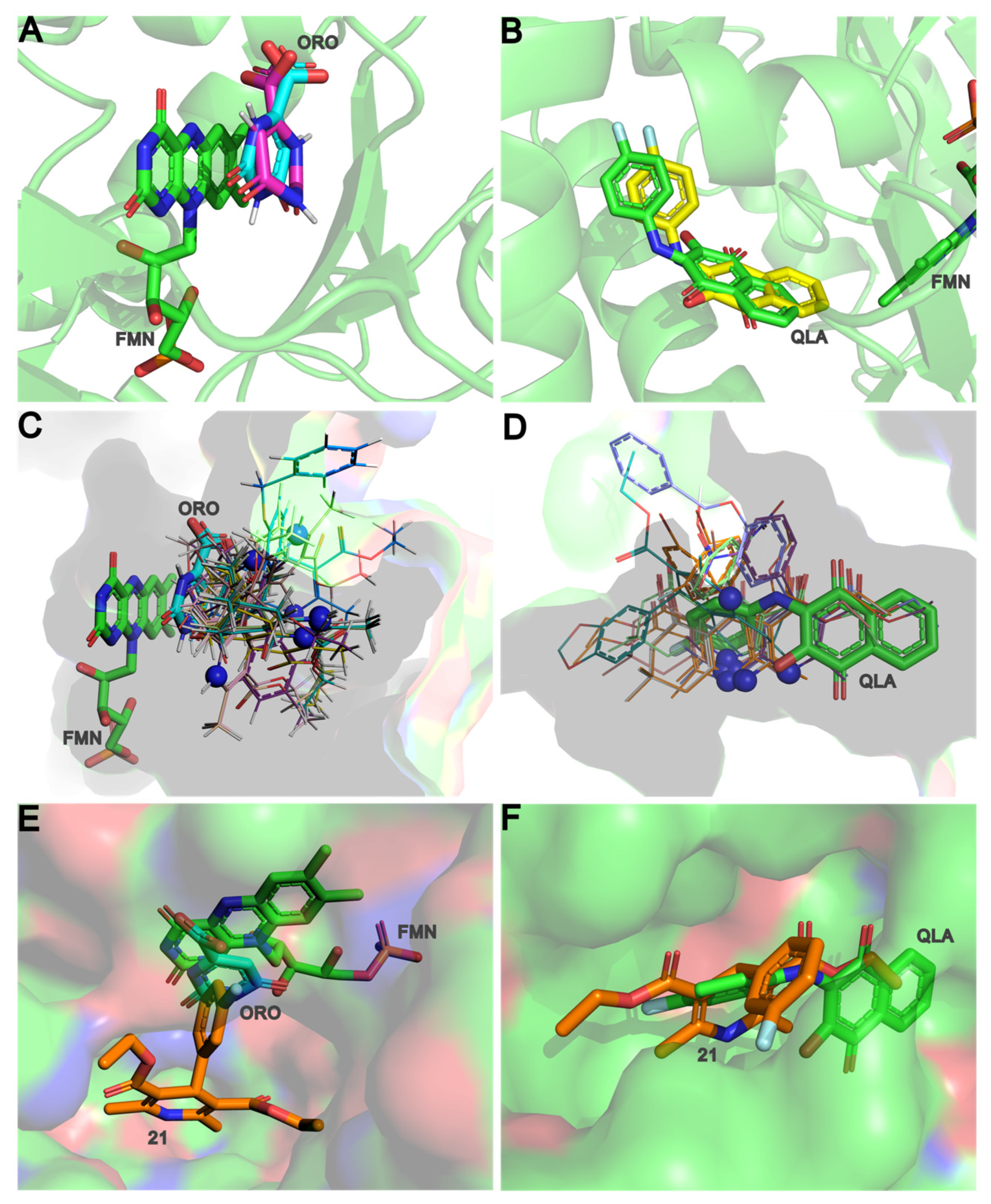
In addition to the score values, each conformation of reference molecules (ORO and QLA) extracted from molecular docking simulations was compared to experimental data to evaluate the success of redocking assays. Regarding the ORO active site, orotate showed an RMSD value of 2.56 Å and excellent superposition to orotate extracted from PDB ID 4IGH (Figure 4A). The best conformation (highest score) of 50 runs for each ligand is presented in Figure 4C. Due to the high volume of this pocket, each compound adopts a different conformation inside of ORO active site, which can be tracked by the N1 atom of the 1,4-DHP ring shown as blue spheres in Figure 4C. However, all compounds displayed at least 2 strong interactions with residues of this pocket—some of them involving the N1 atom from the 1,4-DHP ring. Also, compounds 4, 6, 9, 20, and 21 displayed strong interactions with the cofactor flavin mononucleotide (FMN), as orotate in redocking simulations (Table 4). In terms of weak interactions, all compounds showed at least 5 times more interactions than orotate, which agrees with the higher score values for all compounds in comparison to orotate (Table 4).
Since most of the known SmDHODH inhibitors were designed or experimentally found in the quinone active site (also called QLA active site in this work), molecular docking simulations of 1,4-DHPs were also performed in the QLA active site. Redocking simulation was performed using cocrystallized ligand QLA, and it showed RMSD of 2.73 Å and good superposition to the experimental conformation observed in PDB ID 6UY4 (Figure 4B). Unlike the ORO active site, the 1,4-DHPs displayed more consistent conformations after molecular docking simulations in the QLA active site, which can be tracked by the N1 atom of the 1,4-DHP ring shown as blue spheres (Figure 4D). In terms of score values, the 1,4-DHPs did not perform better than QLA, except for compound 3, which showed a very close score value to QLA (Table 4). On the other hand, all 1,4-DHPs showed a higher number of weak interactions than QLA, and only three of nine compounds did not show any strong interaction (Table 4). The best conformation for the most active compound in antischistosomal assay (compound 21) is shown in Figure 4E (for ORO active site) and Figure 2F (for QLA active site). 2D diagrams for each compound reported herein for each active site are available in the Supplementary Information.

3. Discussion

3.1. Antischistosomal Activity of Compounds 124 Against S. mansoni Adult Worms

The antiparasitic activity of 1,4-DHPs has been extensively exploited. For example, compound 20 was very active against intracellular Trypanosoma cruzi (IC50 = 5.44 µM) with an SI = 20.91 compared to THP-1 cell lines [12]. Compound 12 was active against extracellular L. major promastigotes (IC50 = 47.5 µM), whereas compound 4 displayed good activity (IC50 = 3.1 µM) and selectivity (SI = 5.57) against Toxoplasma gondii [18]. However, the antischistosomal activity of 1,4-DHPs 124 has not been reported to date.
According to the literature, compounds with IC50 lower than 10 µM, between 10 and 50 µM, between 50 and 100 µM, and higher than 100 µM are considered very active, active, moderately active, and inactive, respectively [28]. Based on these criteria, we found that, after 24 h of treatment, compounds 2, 3, 4, 6, and 10 were moderately active, whereas compounds 12 (IC50 = 40.0 µM), 20 (IC50 = 15.2 µM), and 21 (IC50 = 13.1 µM) were active against S. mansoni adult worms. After 24 h, compounds 20 and 21 were the most selective to S. mansoni compared to Vero cells, with SI values of 2.31 and >4.59, respectively. Nevertheless, after 72 h of treatment, compounds 2, 3, 4, 6, 9, 10, 12, 20, and 21 were active (IC50 values between 10 and 50 µM). However, the SI values after 24 h were not calculated.
In general, most of the active and moderately active 1,4-DHPs display a halogen (a fluorine for 21, a chlorine for 12, and bromine for 6 and 20), or a nitro (for compounds 9 and 10). Recently, the role played by these groups in the antiparasitic activity of 1,4-DHPs against Leishmania major has been reported [18]. The presence of the bromophenyl groups has also been reported in the structure of other compounds that display antischistosomal activity (e.g., aryltriazole derivatives) [29].
In this study, hexahydroisoquinolines were found to display lower IC50 values as compared to most of Hantzsch’s esters. Indeed, differences between the antiparasitic activities of hexahydroisoquinolines and Hantzsch’s esters have been demonstrated [10]. However, the Hantzsch esters 20 (R = 4-Br) and 21 (R = 3-F) were the lowest IC50 values among the tested 1,4-DHPs. In principle, these results could indicate that the antischistosomal activity of compounds 124 is more strongly affected by the 4-Br and 3-F groups than by other substituents attached to the core structure of 1,4-DHPs. Nevertheless, the higher IC50 values of the hexahydroisoquinolines 6 (R = 4-Br) and 7 (R = 3-F) compared to those of the Hantzsch 20 and 21 revealed that the role played by the different structure features of these compounds cannot be evidenced based only on this group of compounds.
The selectivity index (SI) is a key parameter in the development of new chemotherapeutic agents: SI enables the toxicity of the compounds being tested to normal cells to be compared to the target cells, thus contributing to the prediction of their therapeutic effectiveness [18]. In the case of the antischistosomal activity, the IC50 of compounds 2, 3, 4, 6, 9, 10, and 12 against Vero cells is generally lower than the IC50 of these compounds against S. mansoni adult worms, except for compound 21. This gives SI lower than 1, which shows poor selectivity for S. mansoni adult worms over Vero cells.

3.2. Drug-Likeness and ADMET Predictions

Prediction of ADMET and physicochemical properties in early stages of drug development is considered good practice since it can filter through in silico, molecules that could be rejected in preclinical trials [30,31]. Parameters used in standalone or combined as “rules” (such as Lipinski, Veber’s rules) give us insights regarding the pharmacokinetics of the potential drug [31]. Therefore, all nine 1,4-DHPs showed physicochemical properties within the ideal limit and were accepted in all screened pharmacokinetic rules (Lipinski, Veber, and Egan’s rules).
Regarding ADMET properties, human intestinal absorption was selected since oral administration is preferred due to low invasiveness and patient convenience [32]. HIA% above 30% is already considered good absorption, so all compounds showed values from 91 to 97% [33]. Distribution as the logarithm of blood-brain permeability is directly linked to lipophilicity and thus, the ability to cross membranes and be well spread throughout the body. LogBB values between 0 and −1 are BBB-accessible and above 0, BBB-permeable [34]. Compounds 3, 4, 9, 10, 12, 20, and 21 showed negative logBB values, and compound 21 has the most negative for all series (logBB = −0.421), which is a good indicator, since these molecules should act as a drug outside the brain but must permeate S. mansoni worm membrane.
The estimation of potential CYP binding (substrate- or inhibitor-like) is also used as an indicator of drug metabolization [35,36]. CYP inhibition could lead to low metabolism of a drug, but only two compounds (3 and 21) have the potential to be CYP1A2 inhibitors. On the other hand, all compounds can act as CYP3A4 substrates and be metabolized by this enzyme, so the body can balance the bioavailability of these molecules.
Bioavailability, which is also linked to excretion parameters, can be interpreted through observation of the total clearance parameter (hepatic and renal clearance) [37]. To achieve good bioavailability, total clearance must be considered to calculate the ideal dose to maintain the expected blood concentration of a drug [37]. Compound 21 showed total clearance of 5.5 mL/min/kg, which is considered a moderate clearance rate [38]. Regarding the toxicity, all compounds tested negative for potential mutagenic behavior (AMES toxicity), but all of them seem to be hepatotoxic. However, taking into account that some marketed 1,4-dihydropyridines such as nifedipine and nicardipine prescribed for hypertension also displayed in silico hepatotoxicity despite the rare reports on their in vitro or in vivo hepatotoxicity [39], the hepatotoxicity of compounds 2, 3, 4, 6, 9, 10, 12, 20, and 21 needs to be confirmed in future in vitro and in vivo studies.

3.3. Docking Studies

Molecular docking simulations have been widely used as a cost- and user-friendly approach to predict a probable molecular target of biologically active molecules. The methodology of molecular docking simulation must be validated through redocking, preferably using a cocrystallized ligand. Since the enzyme dihydroorotate dehydrogenase from Schistosoma mansoni (SmDHODH) has two sites for substrate recognition (orotate and quinone active sites), redocking simulations were performed in both of them, but the orotate active site was decisive due to the chemical similarity between orotate and 1,4-DHPs.
In terms of score values, all 1,4-DHPs showed higher values than orotate. The highest score belongs to compound 4, although it is classified as moderately active against S. mansoni. The most active compound 21 showed a score of 62.52, which is still higher than orotate (score = 52.21). Although the orotate molecule displayed more strong interactions than any other molecule, it is a combination of strong and weak interactions that defines the score values in the ChemPLP score function, as described in the literature [40]. The identification of key residues in the ligand-protein complex is also important. Compound 21 displayed interactions involving flavin mononucleotide (FMN) and (N)H-bonding interactions involving the N atom of the heterocyclic ring on both molecules (1,4-DHPs and orotate), as well as orotate. Thus, these observations reveal that even though the score value for compound 21 is not very close to the score value for orotate, the former has the potential to inhibit SmDHODH into the ORO active site.
It is worth noting that 1,4-DHPs showed very diverse conformations within the series, regardless of the consistent number of strong and weak interactions. This fact can be due to the widely open pocket observed in the ORO active site of 6UY4 (Figure 4C,E). Compound 21 has the 1,4-DHP moiety placed in the solvent-accessible region, whereas the Ar moiety (3-F-Ph) is more closely related to the orotate binding region (Figure 4E). This conformational diversity provoked us to investigate the potential of 1,4-DHPs to bind into the QLA active site of 6UY4.
At the QLA active site, it was possible to observe more consistent conformations among the 1,4-DHP series, probably due to the previous occupation of this region by QLA (Figure 4D). However, none of the 1,4-DHPs displayed a higher score value than QLA. At this site, compound 21 showed no strong interactions, only van der Waals interactions, and it is more placed solvent-accessible region of this pocket (Figure 4F). Thus, compound 21 has more potential to bind the ORO active site than the QLA active site. Compounds 4 and 10, which are asymmetric 1,4-DHPs, showed the same number of strong interactions as QLA, in addition to (N)H-bonding interaction involving the N1 atom of the 1,4-DHP ring.
Since the discussion regarding the SmDHODH enzyme as a molecular target of antischistosomal active 1,4-DHPs is based on computational simulations, experiments of in vitro binding assays should be performed to validate the computational findings and to pave the path to rational drug development of 1,4-DHPs with improved antischistosomal activity and selectivity.

4. Materials and Methods

4.1. Synthesis of Compounds 124

The 1,4-DHPs 124 were synthesized as previously reported [10,14,18] and identified based on their NMR (1H, 13C, and DEPT 135) and mass spectra. Their minimal purity of 95% was checked using HPLC (see all the spectra and the experimental details in the Supporting Information). Compounds 116 were isolated and tested as mixtures of enantiomers.

4.2. Antischistosomal Activity

4.2.1. Maintenance of S. mansoni Life Cycle

The biological cycle of S. mansoni LE strain (Luiz Evangelista) is routinely maintained by serial passage in Biomphalaria glabrata snails (invertebrate host) and BALB/c mice (vertebrate host) at the University of Franca Animal Facility. S. mansoni eggs present in the livers of mice previously infected with the parasite are recovered as described by Lewis (2013) [41] and exposed to light for approximately 1 h to release miracidia. The miracidia were used to infect the intermediate host, which, after 45–50 days, released the infective form of the parasite, the cercariae, which in turn infect the vertebrate host. To maintain the life cycle, 200 ± 10 cercariae were inoculated subcutaneously into mice, and after 28 ± 1 and 49 ± 1 days, the juvenile or adult worms, respectively, were recovered from the portal-hepatic system and mesenteric veins by perfusion of the portal-hepatic system [41,42]. All procedures involving the maintenance of the life cycle of the parasite S. mansoni are in accordance with the Ethical Principles in Animal Experimentation, adopted by the Brazilian College of Animal Experimentation (COBEA) and approved by the Ethics Committee on the Use of Animals of the University of Franca (protocol number 6242260122).

4.2.2. In Vitro Antichistosomal Activity of Compounds 124

After perfusion of the portal and mesenteric veins, adult S. mansoni worms were transferred to a 24-well culture plate (2 worms per well) containing 2 mL of RPMI 1640 medium (Inlab, Campinas, São Paulo, Brazil) buffered with 20 μM HEPES, pH 7.5, and supplemented with penicillin (100 U/mL), streptomycin (100 μg/mL) (Gibco, Waltham, MA, USA), and 10% fetal bovine serum (Gibco) and incubated in a humidifying atmosphere at 37 °C in the presence of 5% CO2 for 24 h. For each compound, a sample size of 8 worms (2 worms per well) was used. After the incubation period, compounds 124 were solubilized with dimethyl sulfoxide (DMSO) (Sigma-Aldrich, St. Louis, MS, USA) and applied at concentrations of 50 μM. Praziquantel (PZQ) (Sigma-Aldrich) was previously solubilized in DMSO at a concentration of 1.6 μM and used as the positive control. RPMI 1640 medium supplemented with 0.1% DMSO was used as the negative control.
Compounds that caused inhibition higher than 50% at the concentration of 50 µM were also tested at concentrations of 50, 25, 12.5, 6.25, and 3.12 μM under the same conditions described above to calculate the IC50 (Inhibitory Concentration required to inhibit the viability of 50% of the parasites). Praziquantel (PZQ) (Sigma-Aldrich), previously solubilized in DMSO and added at a concentration of 1.6 μM (positive control), and RPMI 1640 medium supplemented with 0.1% DMSO (negative control) were used. Two independent assays were performed per sample.
The Selectivity Index (SI) values were expressed as the ratio between the IC50 of compounds 124 to normal host cells [10,14], previously published [18], and the IC50 against S. mansoni adult worms.

4.3. In Silico Studies on the Most Active 1,4-DHPs

4.3.1. Physicochemical and Drug-Likeness Predictions

1,4-DHPs were drawn in ChemDraw 12.0 software, and SMILES descriptors of each compound (2, 3, 4, 6, 9, 10, 12, 20, and 21) were submitted to the SwissADME webserver (https://www.swissadme.ch/—accessed on 21 October 2025) [43]

4.3.2. ADMET Properties

For the ADMET properties, the same abovementioned SMILES descriptors obtained from 1,4-DHP 2D structures were submitted to the pKCSM webserver (https://biosig.lab.uq.edu.au/pkcsm/—accessed on 21 October 2025) and amongst all data, at least one parameter was chosen for each pharmacokinetic process (absorption, distribution, metabolism, excretion, and toxicity) [44].

4.3.3. Docking Studies

Ligands were prepared as follows: First, all nine compounds (2, 3, 4, 6, 9, 10, 12, 20, and 21) as well as ORO and QLA molecules were drawn in Chem3D Pro 12.0, saved as .mol2 extension, and their energies were minimized using the UFF forcefield available in Avogadro 1.2.0 software [45]. SmDHODH coordinates were retrieved from the PDB Database (https://www.rcsb.org/structure/6UY4, accessed on 21 October 2025), and the tridimensional structure was submitted to energy minimization using Chimera 1.19 software [46]. Then, water and glycerol molecules were deleted, keeping only FMN and QLA coordinates as non-protein molecules. Molecular docking simulations were performed using GOLD software [47,48]. Hydrogens were added to the protein, and only QLA coordinates were extracted before simulation. For the ORO active site, the box center was set as x = 15.0500, y = 19.5400, and z = 54.5270, and a cavity of 10 Å. For each ligand, 50 GA runs were performed with a search efficiency of 200%, but only the best 10 docked structures were kept as output. These settings were applied to all four score functions (ChemPLP, GoldScore, ChemScore, and ASP), and the best score function was chosen based on the lowest RMSD to experimental orotate conformation (retrieved from PDB ID 4IGH and superimposed to PDB ID 6UY4) and a reasonable score value. After redocking, all nine 1,4-DHPs were docked in both ORO and QLA active sites using ChemPLP as a score function. For docking simulations in the QLA active site, the QLA molecule was set as the box center. The best conformation of each ligand (highest score value) was visualized using PyMOL software version 2.0.3 [49], and 2D diagram maps generated by Discovery Studio Visualizer [50] were used to retrieve information about complex ligand-enzyme interactions. All figures were generated using the PyMOL and Discovery Studio Visualizer software.

5. Conclusions

We have found that nine 1,4-dihydropyridines display good or moderate antischistosomal activity against S. mansoni adult worms, albeit without selectivity for these parasites over Vero cells. Compound 21 is the most active against S. mansoni adult worms and is more than four times more selective for the parasite cells than for Vero cells. Docking studies revealed that compound 21 has a strong affinity for the S. mansoni target (PDB ID: 6UY4) and seems to have more affinity to the orotate active site than to the quinone active site due to a higher score as compared to orotate and interactions with key residues (FMN cofactor and NH-bonding to Val201). Furthermore, ADMET predictions indicated that this compound meets the drug-likeness criteria without violating any of Lipinski, Veber, or Egan’s rules.
These results reinforce the antiparasitic potential of 1,4-DHPs. Future studies with the most active 1,4-DHPs must be undertaken to test these compounds in vitro against the SmDHOHDH enzyme and to assess their hepatotoxicity in vitro and in vivo. In addition, structural modification-based strategies should be addressed in future studies to improve the selectivity for S. mansoni and better understand the structure-antischistosomal activity relationships of these compounds, consequently enhancing their potential as future reasonable drug candidates to treat infections by S. mansoni.

Supplementary Materials

The following supporting information can be downloaded at https://www.mdpi.com/article/10.3390/ddc5010008/s1: Scheme S1: Synthesis of compounds 124 through a microwave-assisted one-pot Hantzsch multi-component reaction; Figures S1–S120: 1H and 13C NMR, and ESI-MS spectra, and HPLC chromatograms of compounds 124; Table S1: Score values of ORO and QLA tested in four score functions (ChemPLP, GoldScore, ChemScore, and ASP) in SmDHODH (PDB ID 6UY4) redocking experiments; Figures SI1–SI20: 2D diagram of ligand protein interactions, and ligand coordinates after docking.

Author Contributions

Conceptualization, A.E.M.C., investigation and formal analysis, T.A.S.O., Y.R.R., and M.H.M.Z.; data curation, L.G.M. (Lizandra G. Magalhães); validation and formal analysis, L.G.M. (Larissa G. Maciel); writing—original draft preparation, Y.R.R., and L.G.M. (Larissa G. Maciel); writing—review and editing, A.E.M.C. and L.G.M. (Lizandra G. Magalhães); All authors have read and agreed to the published version of the manuscript.

Funding

This research was funded by the National Council for Scientific and Technological Development (CNPq), grant numbers 310648/2022-0, 301417/2019-9 and 307980/2025-1).

Data Availability Statement

The original contributions presented in this study are included in the article/Supplementary Materials. Further inquiries can be directed to the corresponding authors.

Acknowledgments

Coordination for the Improvement of Higher Education Personnel (CAPES, proc. 88887.387972/2019-00) for the scholarship granted to T.A.S.O.

Conflicts of Interest

The authors declare no conflicts of interest.

References

  1. Olamiju, F.; Nebe, O.J.; Mogaji, H.; Marcus, A.; Amodu-Agbi, P.; Urude, R.O.; Apake, E.; Olamiju, O.; Okoronkwo, C.; Achu, I.; et al. Schistosomiasis outbreak during COVID-19 pandemic in Takum, Northeast Nigeria: Analysis of infection status and associated risk factors. PLoS ONE 2022, 17, e0262524. [Google Scholar] [CrossRef]
  2. Tabilin, E.J.; Gray, D.J.; Jiz, M.A.; Mationg, M.L.; Inobaya, M.; Avenido-Cervantes, E.; Sato, M.; Sato, M.O.; Sako, Y.; Mu, Y.; et al. Schistosomiasis in the Philippines: A comprehensive review of epidemiology and current control. Trop. Med. Infect. Dis. 2025, 10, 29. [Google Scholar] [CrossRef]
  3. McManus, D.P.; Dunne, D.W.; Sacko, M.; Utzinger, J.; Vennervald, B.J.; Zhou, X.N. Schistosomiasis. Nat. Rev. Dis. Primers 2018, 4, 13. [Google Scholar] [CrossRef]
  4. Essam Behiry, M. Katayama fever with rare presentation. MOJ Clin. Med. Case Rep. 2019, 9, 29–31. [Google Scholar] [CrossRef]
  5. Lim, R.M.; Arme, T.M.; Pedersen, A.B.; Webster, J.P.; Lamberton, P.H.L. Defining schistosomiasis hotspots based on literature and shareholder interviews. Trends Parasitol. 2023, 39, 1032–1049. [Google Scholar] [CrossRef]
  6. Jin, Y.; Lee, Y.H.; Cha, S.; Choi, I.U.; Ismail, H.; Elhag, M.S.; Hong, S.T. Transmission dynamics of Schistosoma haematobium among school-aged children: A cohort study on prevalence, reinfection and incidence after mass drug administration in the White Nile State of Sudan. Int. J. Environ. Res. Public Health 2021, 18, 11537. [Google Scholar] [CrossRef]
  7. Wang, J.G.; Kario, K.; Lau, T.; Wei, Y.Q.; Park, C.G.; Kim, C.H.; Huang, J.; Zhang, W.; Li, Y.; Yan, P.; et al. Use of dihydropyridine calcium channel blockers in the management of hypertension in Eastern Asians: A scientific statement from the Asian Pacific Heart Association. Hypertens. Res. 2011, 34, 423–430. [Google Scholar] [CrossRef] [PubMed]
  8. Lee, E.M. Calcium channel blockers for hypertension: Old, but still useful. Cardiovasc. Prev. Pharmacother. 2023, 5, 113–125. [Google Scholar] [CrossRef]
  9. Vanden Eynde, J.J.; Mayence, A. Synthesis and aromatization of Hantzsch 1,4-dihydropyridines under microwave irradiation. An overview. Molecules 2003, 8, 381–391. [Google Scholar] [CrossRef]
  10. Oliveira, T.A.S.; Silva, J.B.A.; Silva, N.B.S.; Félix, P.C.A.; Oliveira, A.M.; Martins, C.H.G.; Magalhães, L.G.; Crotti, A.E.M. Antibacterial and antileishmanial activity of 1,4-dihydropyridine derivatives. Chem. Biodivers. 2025, 22, e202401300. [Google Scholar] [CrossRef]
  11. Palit, P.; Ali, N. Oral therapy with amlodipine and lacidipine, 1,4-dihydropyridine derivatives showing activity against experimental visceral leishmaniasis. Antimicrob. Agents Chemother. 2008, 52, 374–377. [Google Scholar] [CrossRef] [PubMed]
  12. Pollo, L.A.E.; de Moraes, M.H.; Cisilotto, J.; Creczynski-Pasa, T.B.; Biavatti, M.W.; Steindel, M.; Sandjo, L.P. Synthesis and in vitro evaluation of Ca2+ channel blockers 1,4-dihydropyridines analogues against Trypanosoma cruzi and Leishmania amazonensis: SAR analysis. Parasitol. Int. 2017, 66, 789–797. [Google Scholar] [CrossRef]
  13. Reimao, J.Q.; Scotti, M.T.; Tempone, A.G. Anti-leishmanial and anti-trypanosomal activities of 1,4-dihydropyridines: In vitro evaluation and structure-activity relationship study. Bioorg. Med. Chem. 2010, 18, 8044–8053. [Google Scholar] [CrossRef]
  14. Oliveira, T.A.S.; Silva, J.B.A.; Esperandim, T.R.; Acésio, N.O.; Tavares, D.C.; Crotti, A.E.M. Anticancer activity of 4-aryl-1,4-dihydropyridines. Fut. Pharmacol. 2024, 4, 564–573. [Google Scholar] [CrossRef]
  15. Talwan, P.; Chaudhary, S.; Kumar, K.; Rawal, R. Chemical and Medicinal Versatility of Substituted 1,4-Dihydropyridines. Curr. Bioact. Compd. 2017, 13, 109–120. [Google Scholar] [CrossRef]
  16. Ogawa, T.; Nakazato, A.; Tsuchida, K.; Hatayama, K. Synthesis and antihypertensive activities of new 1,4-dihydropyridine derivatives containing nitrooxyalkylester moieties at the 3- and 5-positions. Chem. Pharm. Bull. 1993, 41, 1049–1054. [Google Scholar] [CrossRef]
  17. Akbar, I.; Radhakrishnan, S.; Meenakshisundaram, K.; Manilal, A.; Hatamleh, A.A.; Alnafisi, B.K.; Ahamed, A.; Balasubramani, R. Design of 1,4-dihydropyridine hybrid benzamide derivatives: Synthesis and evaluation of analgesic activity and their molecular docking studies. Drug Des. Devel. Ther. 2022, 16, 4021–4039. [Google Scholar] [CrossRef]
  18. Oliveira, T.A.S.; Robles, Y.R.; Al Nasr, I.S.; Koko, W.S.; Khan, T.A.; Daoud, I.; Rahali, S.; Amdouni, N.; Said, R.B.; Crotti, A.E.M. Antileishmanial and antitoxoplasmal activities of 1,4-dihydropyridines. ACS Omega 2025, 10, 31066–31076. [Google Scholar] [CrossRef] [PubMed]
  19. Pagotti, M.C.; Candido, A.; Marcal, M.G.; Vieira, T.M.; Groppo, M.; Silva, M.L.A.; Ferreira, D.S.; Esperandim, V.R.; Crotti, A.E.M.; Magalhaes, L.G. Trypanocidal activity of Dysphania ambrosioides, Lippia alba, and Tetradenia riparia essential oils against Trypanosoma cruzi. Chem. Biodivers. 2021, 18, e2100678. [Google Scholar] [CrossRef] [PubMed]
  20. Vieira, T.M.; Barco, J.G.; Paula, L.A.L.; Felix, P.C.A.; Bastos, J.K.; Magalhães, L.G.; Crotti, A.E.M. In vitro evaluation of the antileishmanial and antischistosomal activities of p-coumaric acid prenylated derivatives. Chem. Biodivers. 2024, 21, e202400491. [Google Scholar] [CrossRef]
  21. Pagotti, M.C.; Dias, H.J.; Candido, A.; Oliveira, T.A.S.; Borges, A.; Oliveira, N.D.; Lopes, C.D.; Orenha, R.P.; Parreira, R.L.T.; Crotti, A.E.M.; et al. Exploring synthetic dihydrobenzofuran and benzofuran neolignans as antiprotozoal agents against Trypanosoma cruzi. Pharmaceutics 2023, 15, 754. [Google Scholar] [CrossRef]
  22. Boschi, D.; Pippione, A.C.; Sainas, S.; Lolli, M.L. Dihydroorotate dehydrogenase inhibitors in anti-infective drug research. Eur. J. Med. Chem. 2019, 183, 111681. [Google Scholar] [CrossRef] [PubMed]
  23. Nonato, M.C.; de Padua, R.A.P.; David, J.S.; Reis, R.A.G.; Tomaleri, G.P.; D’Muniz Pereira, H.; Calil, F.A. Structural basis for the design of selective inhibitors for Schistosoma mansoni dihydroorotate dehydrogenase. Biochimie 2019, 158, 180–190. [Google Scholar] [CrossRef]
  24. Calil, F.A.; David, J.S.; Chiappetta, E.R.C.; Fumagalli, F.; Mello, R.B.; Leite, F.H.A.; Castilho, M.S.; Emery, F.S.; Nonato, M.C. Ligand-based design, synthesis and biochemical evaluation of potent and selective inhibitors of Schistosoma mansoni dihydroorotate dehydrogenase. Eur. J. Med. Chem. 2019, 167, 357–366. [Google Scholar] [CrossRef]
  25. de Mori, R.M.; Aleixo, M.A.A.; Zapata, L.C.C.; Calil, F.A.; Emery, F.S.; Nonato, M.C. Structural basis for the function and inhibition of dihydroorotate dehydrogenase from Schistosoma mansoni. FEBS J. 2021, 288, 930–944. [Google Scholar] [CrossRef]
  26. Ja’afaru, S.C.; Uzairu, A.; Hossain, S.; Ullah, M.H.; Sallau, M.S.; Ndukwe, G.I.; Ibrahim, M.T.; Bayil, I.; Moin, A.T. Computer-aided discovery of novel SmDHODH inhibitors for schistosomiasis therapy: Ligand-based drug design, molecular docking, molecular dynamic simulations, drug-likeness, and ADMET studies. PLoS Negl. Trop. Dis. 2024, 18, e0012453. [Google Scholar] [CrossRef]
  27. Ja’afaru, S.C.; Uzairu, A.; Mishra, V.K.; Sallau, M.S.; Ibrahim, M.T.; Dubey, A. Virtual screening and molecular dynamics studies of novel small molecules targeting Schistosoma mansoni DHODH: Identification of potential inhibitors. In Silico Pharmacol. 2024, 12, 113. [Google Scholar] [CrossRef]
  28. Pavani, T.F.A.; Cirino, M.E.; Teixeira, T.R.; de Moraes, J.; Rando, D.G.G. Targeting the Schistosoma mansoni nutritional mechanisms to design new antischistosomal compounds. Sci. Rep. 2023, 13, 19735. [Google Scholar] [CrossRef] [PubMed]
  29. Pereira, A.S.A.; Silveira, G.O.; Amaral, M.S.; Almeida, S.M.V.; Oliveira, J.F.; Lima, M.C.A.; Verjovski-Almeida, S. In vitro activity of aryl-thiazole derivatives against Schistosoma mansoni schistosomula and adult worms. PLoS ONE 2019, 14, e0225425. [Google Scholar] [CrossRef]
  30. Rowland, M.; Peck, C.; Tucker, G. Physiologically-based pharmacokinetics in drug development and regulatory science. Annu. Rev. Pharmacol. Toxicol. 2011, 51, 45–73. [Google Scholar] [CrossRef] [PubMed]
  31. Santos, L.G.A.; Jaiswal, S.; Chen, K.F.; Jones, H.M.; Templeton, I.E. Real-world application of physiologically based pharmacokinetic models in drug discovery. Drug Metab. Dispos. 2025, 53, 100015. [Google Scholar] [CrossRef]
  32. Alqahtani, M.S.; Kazi, M.; Alsenaidy, M.A.; Ahmad, M.Z. Advances in oral drug delivery. Front. Pharmacol. 2021, 12, 618411. [Google Scholar] [CrossRef]
  33. Subramanian, G.; Kitchen, D.B. Computational approaches for modeling human intestinal absorption and permeability. J. Mol. Model. 2006, 12, 577–589. [Google Scholar] [CrossRef] [PubMed]
  34. Geldenhuys, W.J.; Mohammad, A.S.; Adkins, C.E.; Lockman, P.R. Molecular determinants of blood-brain barrier permeation. Ther. Deliv. 2015, 6, 961–971. [Google Scholar] [CrossRef] [PubMed]
  35. Abdelwahab, A.A.; Elattar, M.A.; Fawzi, S.A. Advancing ADMET prediction for major CYP450 isoforms: Graph-based models, limitations, and future directions. Biomed. Eng. Online 2025, 24, 93. [Google Scholar] [CrossRef]
  36. Iacopetta, D.; Ceramella, J.; Catalano, A.; Scali, E.; Scumaci, D.; Pellegrino, M.; Aquaro, S.; Saturnino, C.; Sinicropi, M.S. Impact of cytochrome P450 enzymes on the phase I metabolism of drugs. Appl. Sci. 2023, 13, 6045. [Google Scholar] [CrossRef]
  37. Doogue, M.P.; Polasek, T.M. The ABCD of clinical pharmacokinetics. Ther. Adv. Drug Saf. 2013, 4, 5–7. [Google Scholar] [CrossRef]
  38. Hann, E.; Malagu, K.; Stott, A.; Vater, H. The importance of plasma protein and tissue binding in a drug discovery program to successfully deliver a preclinical candidate. Prog. Med. Chem. 2022, 61, 163–214. [Google Scholar] [CrossRef] [PubMed]
  39. Ur Rahman, M.; Hussain, H.R.; Akram, H.; Gulzar, F.; Nouman, M.; Farooq, H.; Ashfaq, A.; Kalsoom, Z. Nifedipine’s synergistic therapeutic potential: Overcoming challenges and embracing novel applications in pharmacotherapy. Prospect Pharm. Sci. 2025, 23, 101–115. [Google Scholar] [CrossRef]
  40. Korb, O.; Stutzle, T.; Exner, T.E. Empirical scoring functions for advanced protein-ligand docking with PLANTS. J. Chem. Inf. Model. 2009, 49, 84–96. [Google Scholar] [CrossRef]
  41. Tucker, M.S.; Karunaratne, L.B.; Lewis, F.A.; Freitas, T.C.; Liang, Y.S. Schistosomiasis. Curr. Protoc. Immunol. 2013, 103, 1911–19158. [Google Scholar] [CrossRef]
  42. Smithers, S.R.; Terry, R.J. The infection of laboratory hosts with cercariae of Schistosoma mansoni and the recovery of the adult worms. Parasitology 1965, 55, 695–700. [Google Scholar] [CrossRef] [PubMed]
  43. Daina, A.; Michielin, O.; Zoete, V. SwissADME: A free web tool to evaluate pharmacokinetics, drug-likeness and medicinal chemistry friendliness of small molecules. Sci. Rep. 2017, 7, 42717. [Google Scholar] [CrossRef] [PubMed]
  44. Pires, D.E.; Blundell, T.L.; Ascher, D.B. pkCSM: Predicting small-molecule pharmacokinetic and toxicity properties using graph-based signatures. J. Med. Chem. 2015, 58, 4066–4072. [Google Scholar] [CrossRef] [PubMed]
  45. Avogadro: An Open-Source Molecular Builder and Visualization Tool, version 1.2.0 (with ORCA Support); University of Pittsburgh: Pittsburgh, PA, USA, 2018. Available online: http://avogadro.cc/ (accessed on 21 October 2025).
  46. Pettersen, E.F.; Goddard, T.D.; Huang, C.C.; Couch, G.S.; Greenblatt, D.M.; Meng, E.C.; Ferrin, T.E. UCSF Chimera—A visualization system for exploratory research and analysis. J. Comput. Chem. 2004, 25, 1605–1612. [Google Scholar] [CrossRef]
  47. Jones, G.; Willett, P.; Glen, R.C.; Leach, A.R.; Taylor, R. Development and validation of a genetic algorithm for flexible docking. J. Mol. Biol. 1997, 267, 727–748. [Google Scholar] [CrossRef]
  48. Verdonk, M.L.; Cole, J.C.; Hartshorn, M.J.; Murray, C.W.; Taylor, R.D. Improved protein-ligand docking using GOLD. Proteins 2003, 52, 609–623. [Google Scholar] [CrossRef]
  49. The PyMOL Molecular Graphics System, version 2.0.3.; Schrödinger, LLC.: New York, NY, USA, 2017.
  50. BIOVIA, Dassault Systèmes. Discovery Studios Visualizer, v.25.1.0.24284; Dassault Systèmes: San Diego, CA, USA, 2025.
Figure 1. Chemical structure of nifedipine (I), amlodipine (II), and nicardipine (III).
Ddc 05 00008 g001
Figure 2. Chemical structures of 1,4-DHPs 124.
Ddc 05 00008 g002
Figure 3. Chemical structures of 1,4-dihydropyridines (left) and orotate (right).
Ddc 05 00008 g003
Figure 4. Best conformations for 1,4-DHPs in molecular docking simulations performed on ORO active site (left) and QLA active site (right). Orotate best conformation ((A)—pink) in comparison to reference ((A)—cyan) retrieved from redocking simulation; as well as QLA best conformation ((B)—yellow) in comparison to reference ((B)—green). Distribution of 1,4-DHPs best conformation (lines) for ORO active site (C) and QLA active site (D) with highlight to N1 atom of 1,4-DHP ring as blue spheres. Best conformation for the most active compound 21 in comparison to ORO (E) and QLA (F).
Ddc 05 00008 g004
Table 1. IC50 (in µM) values of compounds 2, 3, 4, 6, 9, 10, 12, 20, and 21 against S. mansoni adult worms, and to Vero cells, a and the corresponding Selectivity Index (SI) values to Vero cells b.
CompoundS. mansoni Adult WormsVero CellsSI b
24 h48 h72 h
261.345.029.452.9 ± 9.80.86
(38.5–85.7)(33.5–73.8)(22.4–39.4)
363.338.236.349.8 ± 8.90.79
(49.2–99.5)(34.6–42.3)(32.7–40.4)
479.335.733.117.5 ± 3.00.22
(61.1–97.5)(33.8–37.8)(29.59–37.42)
685.591.832.817.4 ± 2.90.20
(58.1–115.2)(58.5–125.1)(26.0–43.9)
9129.1105.142.04.5 ± 0.70.03
(60.1–179.7)(59.0–154.4)(32.2–63.4)
1079.344.244.210.7 ± 2.10.13
(54.9–185.4)(35.8–60.4)(35.8–60.4)
1240.027.822.214.9 ± 2.60.37
(35.4–45.9)(22.3–34.8)(18.8–26.2)
2015.216.714.0135.0 ± 5.92.31
(11.9–18.7)(12.9–21.4)(10.6–18.4)
2113.110.17.75>59.9>4.59
(6.9–22.7)(0.8–30.6)(3.4–13.5)
PZQ1.6
a Values previously published by Oliveira et al. [18]; b Calculated by dividing the IC50 to Vero cells by the IC50 value to S. mansoni. PZQ (praziquantel), used as the positive control at a concentration of 1.6 µM, killed all the adult worms in 24 h.
Table 2. Physicochemical and drug-likeness predictions for compounds 2, 3, 4, 6, 9, 10, 12, 20, and 21 a, as generated with the SwissADME webserver.
EntryTPSA
2)
n-ROTBMWM
LogP
W
LogP
n-ON
Acceptors
n-OHNH
Donors
Lipinski’s
Violations
Veber’s
Violations
Egan’s
Violations
<140<10<500≤4.15≤5.88<10<5≤1≤1≤1
255.404353.452.913.7831AcceptedAcceptedAccepted
364.635369.452.353.4841AcceptedAcceptedAccepted
464.637445.553.364.9041AcceptedAcceptedAccepted
655.404418.323.294.2431AcceptedAcceptedAccepted
9101.225384.431.733.3851AcceptedAcceptedAccepted
10101.225384.431.733.3851AcceptedAcceptedAccepted
1273.864383.442.213.2051AcceptedAcceptedAccepted
2064.637408.292.833.4341AcceptedAcceptedAccepted
2164.637347.382.613.2351AcceptedAcceptedAccepted
a: TPSA: topological polar surface area, n-ROTB: number of rotatable bonds, MW: molecular weight, MLogP: logarithm of partition coefficient of compound between n-octanol and water—threshold for Lipinski’s rule of five, WLogP: logarithm of partition coefficient of compound between n-octanol and water—threshold for Egan’s rule, n-ON acceptors: number of hydrogen bond acceptors, n−OHNH donors: number of hydrogen bond donors.
Table 3. Predicted absorption, distribution, metabolism, excretion, and toxicity parameters (ADMET) using pkCSM webserver for compounds 2, 3, 4, 6, 9, 10, 12, 20, and 21 a.
EntryHIA
(%)
BBB Permeant
(log BB)
CYP1A2 InhibitorCYP3A4 SubstrateTotal Clearance
(log mL/min/kg)
AMES ToxicityHepatotoxicity
295.9120.141NoYes1.119NoYes
397.015−0.113YesYes1.095NoYes
495.270−0.081NoYes0.514NoYes
694.3860.127NoYes−0.088NoYes
992.018−0.265NoYes1.112NoYes
1091.819−0.264NoYes1.087NoYes
1296.878−0.246NoYes0.756NoYes
2093.057−0.183NoYes0.2NoYes
2194.576−0.421YesYes0.744NoYes
a: HIA%: Percentage of human intestinal absorption, logBB: logarithm ratio of brain to plasma drug concentration, CYP1A2 inhibitor: potential inhibitor of CYP1A2 enzyme, CYP3A4 substrate: potential substrate of CYP3A4 enzyme, Total Clearance (log mL/min/kg): logarithm of total clearance (log(CLtot)), AMES toxicity: drug’s potential mutagenicity, hepatotoxicity: potential for disruption of normal liver function.
Table 4. Score values obtained from molecular docking simulations at both the orotate active site and quinone active site using the ChemPLP score function available in the GOLD Suite program.
EntryScore for ORO
Active Site
Number of Strong
Interactions a
Number of Weak
Interactions b
Score for QLA
Active Site
Number of Strong
Interactions a
Number of Weak
Interactions b
ORO52.218 c2
QLA74.62314 c
258.77222 c57.87120
363.403 d22 c55.21023
477.627 c1572.063 d20
659.194 c2056.10021
958.934 c1658.60220
1062.053 d19 c65.573 d17
1262.52319 c52.301 d20
2060.734 c,d1957.08120
2162.906 c,d1760.42022
a: Strong interactions: H-bonding, electrostatic, and π interactions, b: Weak interactions: van der Waals (including alkyl and halogen interactions), c: Involving SmDHODH cofactor, flavin mononucleotide (FMN), d: Involving N atom from 1,4-dihydropyridine ring.
Disclaimer/Publisher’s Note: The statements, opinions and data contained in all publications are solely those of the individual author(s) and contributor(s) and not of MDPI and/or the editor(s). MDPI and/or the editor(s) disclaim responsibility for any injury to people or property resulting from any ideas, methods, instructions or products referred to in the content.