Skip to Content
DDCDrugs and Drug Candidates
  • Article
  • Open Access

31 January 2026

Nanoencapsulated Cannabidiol–Cannabigerol Using Eudragit L100: In Vitro and In Vivo Evidence in Murine Colitis Model

,
,
,
,
,
,
,
and
1
Facultad de Medicina Veterinaria y Zootecnia, Universidad Autónoma de Nuevo León, Francisco I. Madero S/N, Ex Hacienda del Canadá, General Escobedo 66054, Nuevo León, Mexico
2
Facultad de Ciencias Biológicas, Universidad Autónoma de Nuevo León, Pedro de Alba S/N, Ciudad Universitaria, San Nicolás de los Garza 66455, Nuevo León, Mexico
3
Facultad de Agronomía, Universidad Autónoma de Nuevo León, Francisco I. Madero S/N, Ex Hacienda del Canadá, General Escobedo 66054, Nuevo León, Mexico
4
Facultad de Medicina, Universidad Autónoma de Nuevo León, Monterrey, Dr. Eduardo Aguirre Pequeño, Monterrey 64460, Nuevo León, Mexico
This article belongs to the Section Preclinical Research

Abstract

Background: Phytocannabinoids such as cannabidiol (CBD) and cannabigerol (CBG) have received increasing attention in the context of inflammatory and intestinal disorders. However, direct comparisons between their individual and combined effects, as well as the influence of delivery systems, remain limited. Objectives: This study evaluated the biological effects of free and nanoencapsulated CBD and CBG, including a cannabinoid–Eudragit L100 formulation, in an in vitro TNBS-treated intestinal cell model and an in vivo murine model of TNBS-induced colitis. Methods: Cytotoxicity and treatment-associated effects of CBD, CBG, their 1:1 combination, and a nanoencapsulated formulation were assessed in TNBS-exposed Caco-2 cells. In parallel, BALB/c mice with TNBS-induced colitis were evaluated for colonic damage and inflammatory markers. Results: CBD and CBG individually showed dose-dependent effects in Caco-2 cells, while their combined administration produced a greater effect than either compound alone at higher concentrations. The nanoencapsulated formulation preserved cellular metabolic activity following TNBS exposure. In vivo, both free combined and nanoencapsulated cannabinoids were associated with reduced epithelial damage and inflammatory alterations. Conclusions: Nanoencapsulation using Eudragit L100 modulated the biological effects of CBD and CBG in experimental models of TNBS-induced intestinal injury.

1. Introduction

Inflammatory bowel diseases (IBDs), including Crohn’s disease (CD) and ulcerative colitis (UC), are chronic, relapsing inflammatory disorders of the gastrointestinal tract with heterogeneous clinical presentation and uncertain etiology [1]. Although their precise cause remains unclear, IBDs are widely considered a result of dysregulation in immune response to intestinal microbiota in genetically susceptible individuals [2]. Clinical manifestations range from different grades of pain, blood in stools or diarrhea, severe complications such as hemorrhage, growth impairment in pediatric patients and damage to other organs such as eyes, skin, liver and joints, particularly in CD [3].
Accurate diagnosis of IBD relies on the integration of clinical evidence such as endoscopy, laboratory and imaging assessments [4]. Current pharmacological management includes aminosalicylates, immunomodulators, biologic agents, and antibiotics. Despite their clinical utility, these therapies are often limited by incomplete efficacy, adverse effects, or loss of response over time, underscoring the need for alternative of complementary therapeutic strategies [5].
Components of the endocannabinoid system and endocannabinoidome are expressed throughout the gastrointestinal tract and participate in the regulation of intestinal permeability, motility, immune responses and inflammatory processes [6].
Experimental evidence indicates that modulation of these systems influences intestinal inflammation, supporting the investigation of cannabinoids in models of inflammatory bowel disease. In this context, non-psychotropic phytocannabinoids such as cannabidiol (CBD) and cannabigerol (CBG) have been evaluated for their anti-inflammatory and immunomodulatory effects in experimental models of intestinal inflammation [7]. Preclinical studies suggest that these compounds can modulate inflammatory pathways through interactions with defined molecular targets, including cannabinoid receptors (CB1/CB2), peroxisome proliferator activated receptors (PPARs), NF-κβ and inhibition of endocannabinoid uptake/degradation [8,9,10,11,12].
While cannabinoids have shown favorable safety profiles in experimental settings [13,14,15] a major limitation in the pharmacological use of phytocannabinoids is their poor aqueous solubility, chemical instability and low oral bioavailability, largely due to their lipophilic nature and extensive first-pass metabolism [16,17,18].
Nanotechnology-based delivery systems (NDSs) have been explored to address these limitations by improving compound stability and modulating drug release. Eudragit L100, a pH responsive methacrylic acid-methyl methacrylate copolymer soluble at pH above 6, has been widely used in enteric formulations to enable colon-targeted drug delivery [19,20]. Although Eudragit-based systems have been applied to various therapeutic agents, limited studies have investigated their use for the delivery of cannabinoids, and available reports lack biological evaluation in cellular or animal models [21].
This study evaluates the effects of cannabidiol and cannabigerol administered individually and in combination, using both in vitro and in vivo models of intestinal inflammation. First, cytotoxic and protective effects of free cannabinoids were evaluated in Caco-2 cells under basal conditions and following inflammatory injury induced by 2,4,6-trinitrobenzenesulfonic acid (TNBS). Subsequently, cannabinoids were nanoencapsulated with the polymer Eudragit L100 to assess its impact on cellular metabolic activity. Finally, we examined the biological effects of free and nanoencapsulated cannabinoid formulation in a TNBS-induced murine model of colitis by evaluating histopathological alterations and inflammatory markers. This experimental approach was designed to determine whether Eudragit L100 nanoencapsulation modifies in vitro and in vivo biological response to cannabinoid administration under inflammatory conditions.

2. Results

2.1. Characteristics of Nanoparticles

The characteristics of the nanoparticles are summarized in Table 1. The mean particle sized obtained were within the nanometric range expected for Eudragit L100-based delivery systems, consistent with other similar reported formulations. A low polydispersity index (PDI) below 0.3 indicates a narrow size distribution, reflecting colloidal stability of the formulations [22]. Encapsulation efficiency (EE), defined as the proportion of the drug added during formulation that remains associated with the nanoparticle carrier after processing [23], was calculated by an indirect difference method; therefore, values are reported with conservative significant figures.
Table 1. Physicochemical characterization of Eudragit L100-based cannabinoid nanoformulations, including particle size, polydispersity index (PDI), and encapsulation efficiency (EE).

2.2. Cytotoxic Activity

2.2.1. Effect of CBD, CBG, and Formulations on Caco-2 Cell Activity

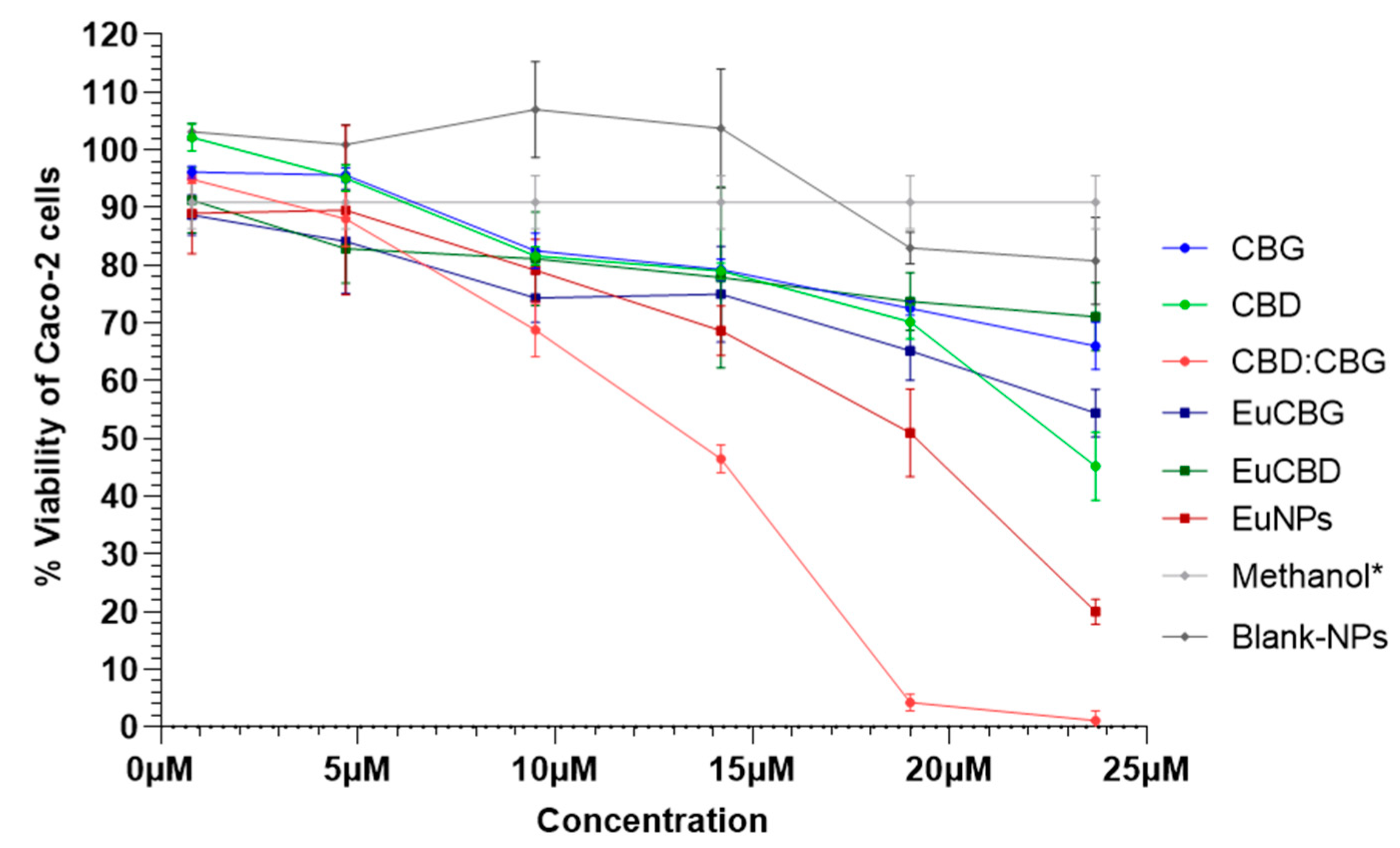
Caco-2 cells were treated with different concentrations of cannabidiol (CBD), cannabigerol (CBG), and a 1:1 combination of both cannabinoids in a 1:1 ratio. For combination treatments, the concentration reported in the figures corresponds to the total cannabinoid concentration, with each compound contributing half of the indicated value. The results of % of cell viability, as determined by the MTT assay, are shown in Figure 1.
Figure 1. Cannabidiol (CBD) and cannabigerol (CBG) alone, combined (CBD:CBG) and cannabinoid formulations effect on Caco-2 cell mitochondria-dependent metabolic activity %. * Used as free cannabinoid vehicle. CBD: Cannabidiol; CBG: Cannabigerol; CBD:CBG: Cannabidiol and Cannabigerol in a 1:1 combination; EuNPs: Cannabinoid-loaded Eudragit L100 nanoparticles; Blank-NPs: Empty Eudragit L100 nanoparticles; CBs: Cannabinoids.
Vehicle-treated cells (methanol) showed no significant differences compared to untreated controls. At the lowest concentration evaluated (0.79 μM), most treatments showed comparable effects, with no significant differences among CBD, CBG and the CBD:CBG combination (p > 0.05). However, CBD differed significantly from EuNPs (p = 0.0115). At intermediate concentrations (4.75–9.5 μM), statistically significant differences began to emerge with CBD and CBG differing from EuNPs (p = 0.0377 and p = 0.0023, respectively), and the CBD:CBG combination also differing from EuNPs (p = 0.0043). At higher concentrations (14.26–23.77 μM), the CBD:CBG combination consistently induced a significantly greater reduction in cell viability compared with CBD alone (0.0189–0.0043) and CBG alone (p = 0.0009–0.00001). In parallel, EuNPs differed significantly from Blank-NPs at the highest doses evaluated (p = 0.0363–0.0498), indicating a dose-dependent divergence among cannabinoid treatments and controls.
The IC50 values of the individual cannabinoids and the combination were calculated and are presented in Table 2. The IC50 value obtained for the CBD:CBG combination was lower than those observed for the individual cannabinoids. When interpreted in the context of the defined 1:1 total concentration, these values are consistent with an additive biological effect. IC50 values were subsequently determined for the different cannabinoid-loaded nanoparticle (NP) formulations (Table 2).
Table 2. IC50 of cannabinoids and formulations in Caco-2 cell lines at 24 h.

2.2.2. Effect of TNBS and CBD:CBG-EuNPs on Caco-2 Cell Activity

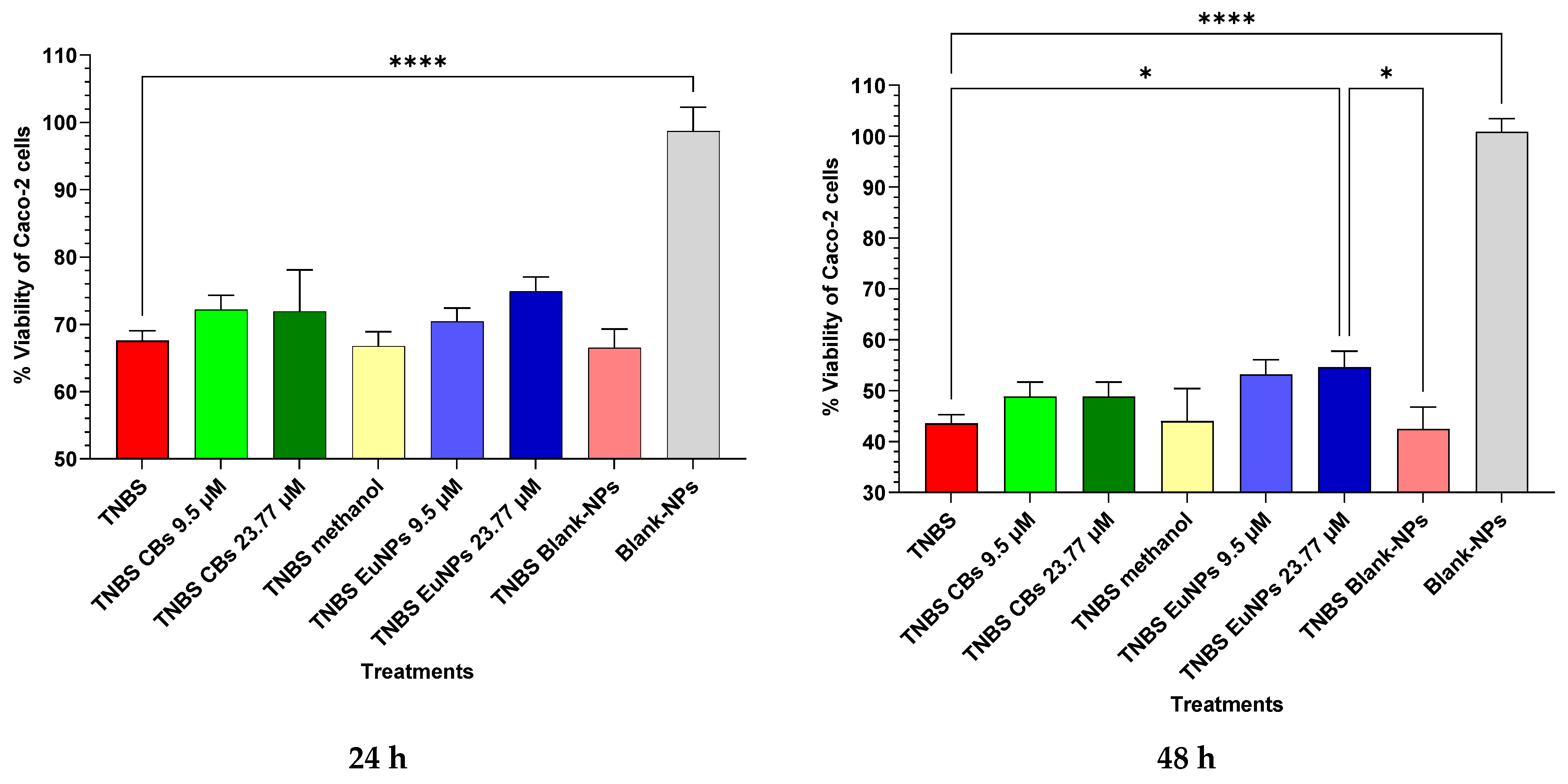
Given the reduced cytotoxic effect for cannabinoid-loaded Eudragit L199 nanoparticles (EuNPs) compared to free cannabinoids, the CBD:CBG (1:1) EuNPs formulation was further evaluated in vitro using Caco-2 cells exposed to TNBS (800 μg) for 24 and 48 h at concentrations of 9.5 μM and 23.77 μM.
All TNBS-treated groups exhibited a significant reduction in cell viability compared to cells treated with blank EuNPs (p < 0.05), which showed cell viability levels comparable to untreated control cells. At 24 h post-treatment, no significant diffferences in cell viability were observed among the TNBS-treated groups, regardless of wheter cannabinoids were administered in free of nanoecanpsulated form (p > 0.05).
In contrast, after 48 h of exposure, EuNPs loaded with CBD:CBG at a concentration of 23.77 μM significantly increased Caco-2 cell viability compared to cells treated with TNBS alone or TNBS plus empty nanoparticles (p < 0.05), indicating a protective effect against TNBS-induced celular damage (Figure 2).
Figure 2. Effect of the EuNP in the viability of Caco-2 cells stimulated with TNBS for 24 and 48 h, assessed through cellular metabolic activity. TNBS: 2,4,6-trinitrobenzenesulfonic acid; CBs: Cannabinoids CBD:CBG (1:1); EuNPs: Cannabinoid-loaded Eudragit L100 nanoparticles; Blank-NPs: Empty Eudragit L100 nanoparticles. * p < 0.05, **** p < 0.0001.

2.3. TNBS-Induced Murine Model of Colitis

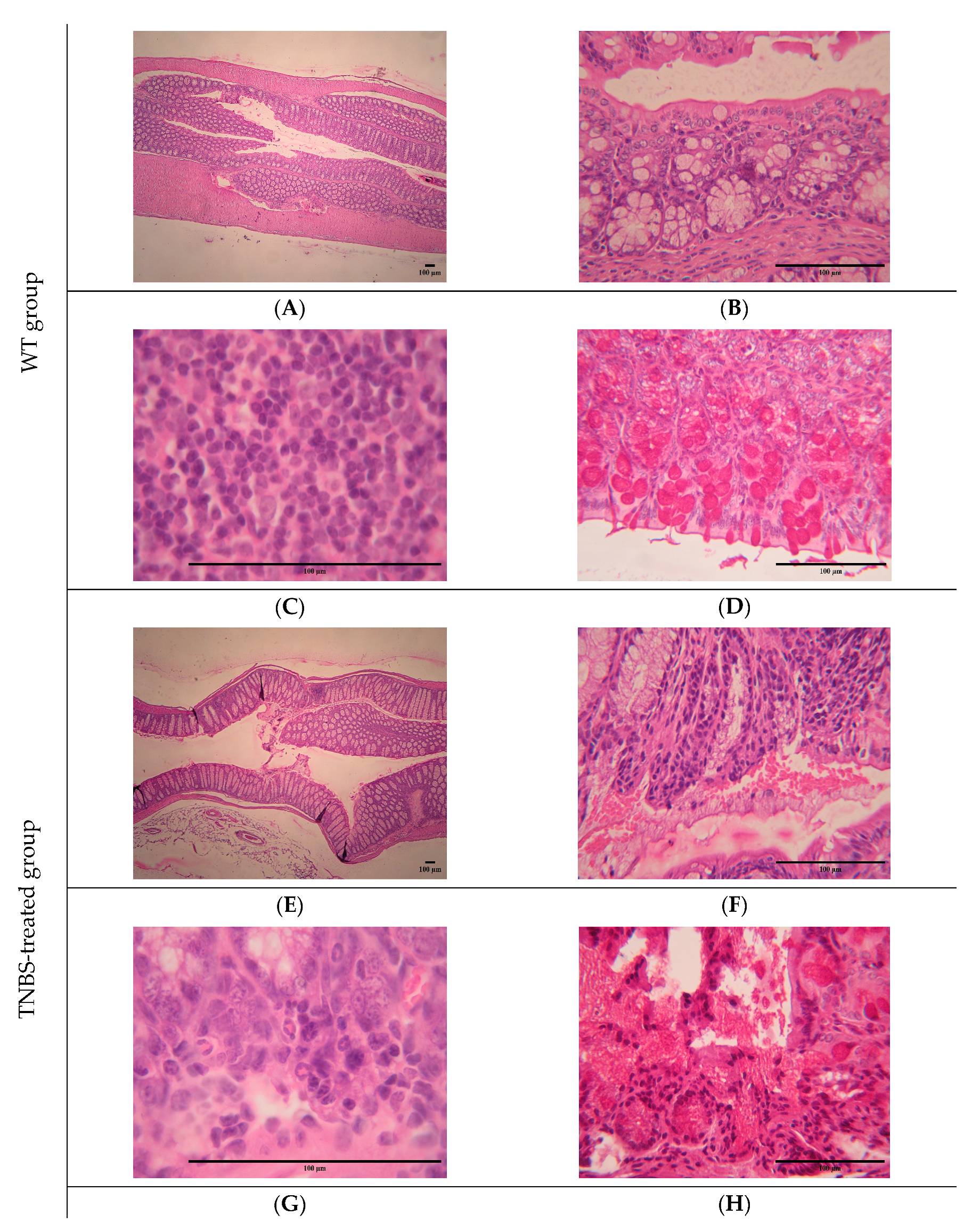
Colon samples were processed using standard histological techniques and stained with hematoxylin and eosin (H&E) and periodic acid-Schiff (PAS). Sections were examined by light microscopy, and representative images were obtained for comparative analysis using a descriptive qualitative approach. An early mortality rate of approximately 25% was observed in TNBS-treated groups, consistent with the severity of the colitis induction protocol. Animals euthanized prior to the experimental endpoint exhibited extensive intestinal damage, characterized by widespread epithelial erosion, hemorrhage, and marked vascular congestion throughout the colon (Supplementary Figures S1 and S2). PAS staining revealed a pronounced loss of mucin-associated positivity in eroded areas and a reduction in the apical epithelial mucous layer.
In animals that completed the experimental protocol, TNBS administration induced moderate to severe histopathological alterations, including focal epithelial erosion, hemorrhage, congestion and mixed inflammatory cell infiltrates within the mucosa and submucosa (Figure 3). These changes were consistently associated with decreased PAS reactivity in the apical epithelial region, indicative of mucin depletion.
Figure 3. Morphological changes in the colon of healthy BALB/c mice (WT group) and TNBS-treated mice (TNBS treated group). Panels (AC, EG), were processed using H&E staining; panels (D,H) were processed using PAS histochemistry. Scale bar = 100 μm.
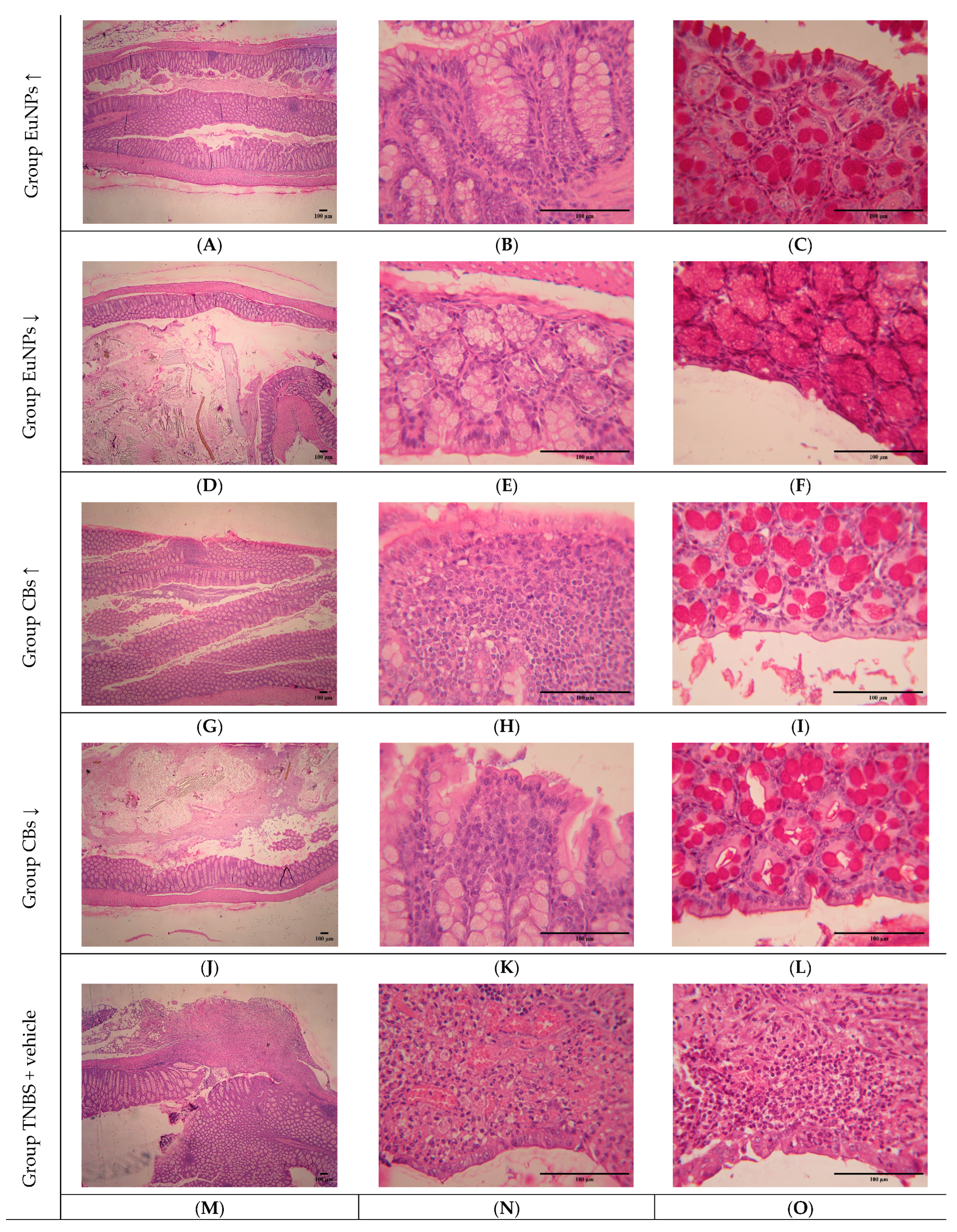
Compared with TNBS-treated animals, mice receiving cannabinoid treatments, either in free form or nanoencapsulated, exhibited a partial attenuation of histopathological damage (Figure 4). Treated groups showed reduced extent and severity of epithelial erosion and hemorrhage, preservation of epithelial architecture in focal areas, and a relative maintenance of PAS-positive mucin staining, particularly at lower inflammatory regions. Blank nanoparticles and vehicle-treated controls displayed histological features comparable to untreated control animals, confirming the absence of intrinsic tissue damage by the delivery system.
Figure 4. Morphological changes in colon sections from BALB/c mice with TNBS-induced colitis under different treatments. Panels (A,B,D,E,G,H,J,K,M,N) were processed with H&E staining; panels (C,F,I,L,O) were processed with PAS histochemistry. Scale bar = 100 μm. TNBS: trinitrobenzenosulfonic acid; EuNPs: Cannabinoid-loaded Eudragit L100 nanoparticles; CBs: Cannabinoids CBD:CBG (1:1); ↑: high dose (100 mg/kg); ↓: low dose (10 mg/kg).

2.4. Analysis of mRNA Expression in Colonic Tissue

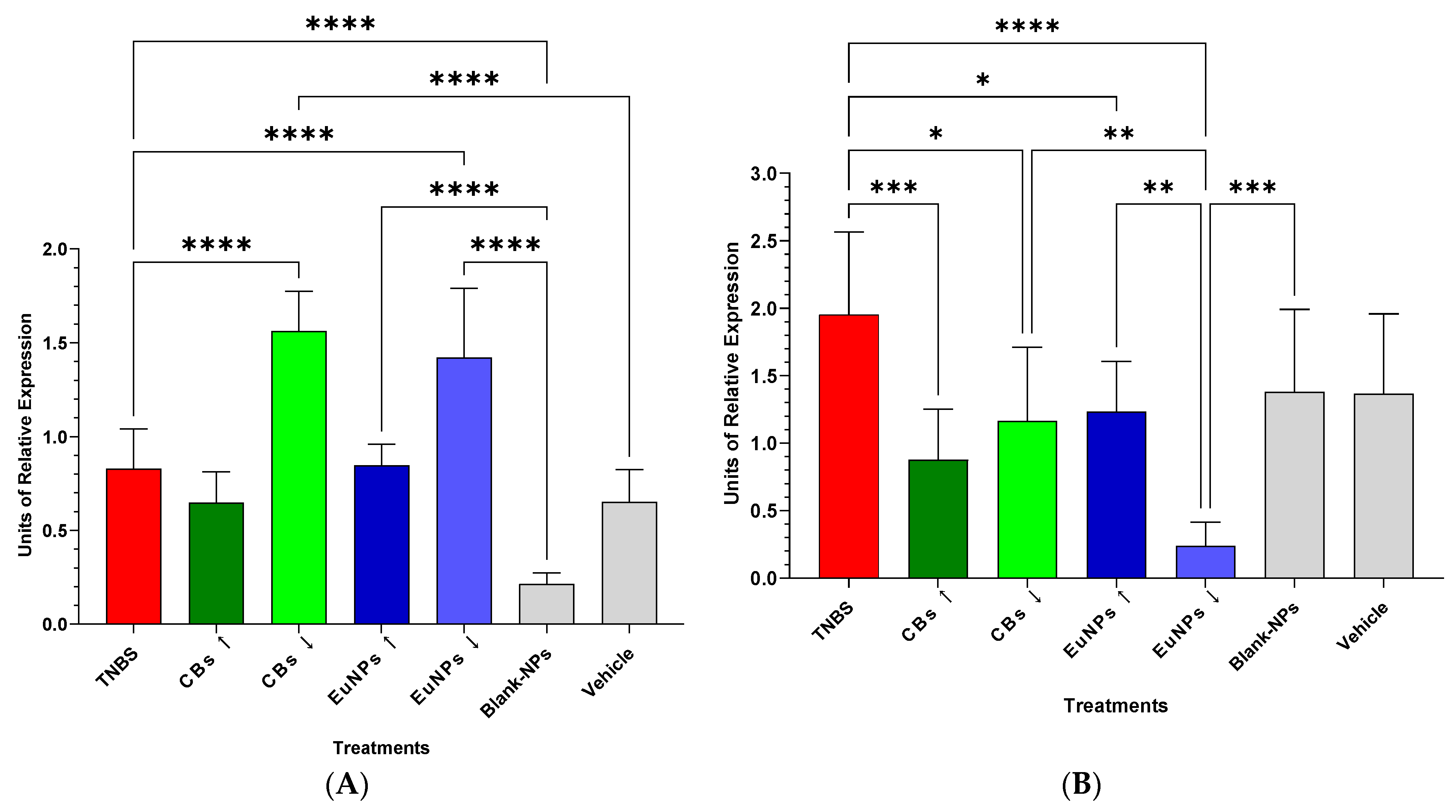
To further assess the inflammatory response in the TNBS-induced murine colitis model, the expression levels of the cytokines IL-4 and TNF-α were evaluated in colon tissue from experimental animals, using the 2−ΔΔCtmethod are summarized in Figure 5.
Figure 5. Effect of cannabinoids and EuNPs on IL-4 (A) and TNF-α (B) mRNA expression in the colon of a TNBS-induced colitis model. TNBS: trinitrobenzenesulfonic acid; EuNPs: Cannabinoid-loaded Eudragit L-100 nanoparticles; CBs: Cannabinoids CBD:CBG (1:1); ↑: high dose (100 mg/kg); ↓: low dose (10 mg/kg); Blank-NPs: Empty Eudragit L100 nanoparticles. * p < 0.05, ** p < 0.01, *** p < 0.005, **** p < 0.0001.
Treatment with cannabinoids and cannabinoid-loaded nanoparticles at a low dose significantly increased IL-4 expression in individuals with TNBS-induced colitis (Figure 5A). This increase was statistically higher than that observed in the positive colitis control group, as well as in the groups treated with empty nanoparticles and the vehicle (p < 0.0001). No significant differences were observed between the low-dose cannabinoid and nanoparticle treatments (p > 0.05), indicating that both treatments exerted a similar effect on IL-4 expression. In contrast, the high-dose nanoparticle treatment did not produce a significant increase in IL-4 compared with the positive control; however, it did show differences with respect to the empty-nanoparticle group (p < 0.0001), suggesting a moderate effect.
Regarding TNF-α expression (Figure 5B), a reduction was observed following treatment with cannabinoids and nanoparticles at both high and low doses. This decrease was significant for cannabinoids at both high and low doses (p < 0.05), as well as for nanoparticles at high (p < 0.05) and low (p < 0.0001) doses. Nevertheless, in most cases, these treatments did not differ significantly from their respective vehicle controls (p > 0.05), except for the low-dose cannabinoid-loaded nanoparticle treatment, which showed a significant reduction in TNF-α expression when compared with the empty-nanoparticle group (p < 0.005). This same treatment was also the most effective overall, exhibiting the greatest decrease in TNF-α relative to low-dose cannabinoids and high-dose nanoparticles (p < 0.01).
Taken together, these results indicate that the low-dose cannabinoid-loaded nanoparticle treatment is the most effective among those evaluated, as it simultaneously promotes a significant increase in IL-4—an anti-inflammatory cytokine—and a marked reduction in TNF-α, a key inflammatory mediator.

3. Discussion

In the present study, we evaluated the biological effects of cannabidiol and cannabigerol, administered individually and in combination, in both in vitro and in vivo models of intestinal inflammation. It should be noted that Caco-2 cells represent an epithelial model and do not recapitulate the immune complexity of intestinal inflammation. Therefore, the observed effects are interpreted in terms of epithelial protection and cytokine modulation rather than systemic immune responses. Our results demonstrate that the combined CBD and CBG exerted a greater cytotoxic effect on Caco-2 cells than either compound alone under basal conditions, while nanoencapsulation in Eudragit L100 attenuated TNBS-induced reductions in cellular metabolic activity. In a TNBS-induced murine colitis model, treatment with free and nanoencapsulated cannabinoids was associated with reduced epithelial damage and modulation of inflammatory markers.
Cell viability was assessed using the MTT assay, which reflects mitochondrial metabolic activity and is commonly employed as an indirect indicator of cell viability [24]. However, mitochondrial activity does not fully represent all aspects of cell viability or epithelial barrier integrity; therefore, the observed effects should be interpreted within this experimental scope. In this study, CBD and CBG individually exhibited dose-dependent reductions in cell viability, with IC50 values comparable to those previously reported for CBD in Caco-2 cells [25]. Notably, the combination of CBD:CBG yielded a lower IC50 value than either cannabinoid alone.
When interpreted based on the defined 1:1 total cannabinoid concentration, these findings are consistent with an additive biological effect. Importantly, this study was not designed to formally assess pharmacological synergy, and therefore the observed effects should not be interpreted as evidence of synergistic interaction without further dose–response analyses.
One of the major limitations in the pharmacological application of phytocannabinoids is their pool aqueous solubility, chemical instability and low oral bioavailability, particularly for highly lipophilic compounds such as CBD [16,17,18]. To address these limitations, nanotechnology-based delivery systems have been explored to improve cannabinoid stability and modulate their biological effects. In the present work, cannabinoids were encapsulated using the pH-responsive polymer Eudragit L100, which has been widely employed for drug delivery. Under TNBS-induced inflammatory conditions, nanoencapsulated cannabinoids attenuated the reduction in Caco-2 cell viability observed with free cannabinoids, suggesting that polymeric encapsulation alters the cellular response to inflammatory injury. Moreover, free cannabinoids reduced cell viability under basal conditions, whereas the nanoencapsulated formulation attenuated TNBS-induced loss of cell viability, reflecting a context-dependent biological response. This effect may reflect differences in release kinetics or cellular uptake associated with nanoencapsulation.
Previous studies have primarily focused on nanoparticle-based delivery of individual cannabinoids, particularly CBD, using polymeric or lipid-based systems, reporting reduced cytotoxicity and anti-inflammatory effects [26,27,28]. Compared to these reports, the present study extends existing knowledge by evaluating a combined CBD:CBG formulation delivered via a pH-responsive polymer and by assessing its biological effects using both in vitro and in vivo TNBS-induced colitis models. Histopathological evaluation of colonic tissue from TNBS-treated mice revealed epithelial erosion, hemorrhage, congestion, and inflammatory cell infiltration, consistent with established features of chemically induced colitis. In animals receiving cannabinoid treatments, these alterations were attenuated, with reduced epithelial damage and partial preservation of mucosal architecture. These histological findings were complemented by the analysis of inflammatory cytokine expression, which demonstrated modulation of TNF-α and IL-2 mRNA levels in colon tissue. TNF-α was evaluated as a central pro-inflammatory mediator in TNBS-induced colitis, while IL-4 was included as a complementary marker associated with immunomodulatory and tissue-repair-related responses [1,2].
Taken together, the results of this study demonstrate that combined cannabidiol and cannabigerol administration, particularly when delivered via Eudragit L100 nanoparticles, modifies cellular and tissue responses in experimental models of intestinal inflammation. While further studies are required to elucidate underlying molecular mechanisms and optimize dosing strategies, the present findings provide experimental evidence supporting the use of polymeric nanodelivery systems to modulate the biological effects of cannabinoids under inflammatory conditions.

4. Materials and Methods

4.1. Materials and Reagents

The Eudragit® L100 polymer was purchased from Helm México (©HELM AG, Hamburg, Germany). Cannabidiol (CBD) and cannabigerol (CBG) were obtained from Botican (ICAN Connect to Cannabis, Mexico City, Mexico) in powder form, along with their respective certificates of analysis (100% CBD and 99.08% CBG) (Supplementary Material).
Antibiotic/antimycotic solution (1% v/v of a commercial mixture of 100 U/mL penicillin and streptomycin), Dulbecco’s Modified Eagle Medium (DMEM culture medium), fetal bovine serum (FBS), and sodium bicarbonate (NaHCO3) were purchased from Gibco™ (Thermo Fisher Scientific Inc. Waltham, MA, USA). TRIzol™ Reagent was purchased from Invitrogen™ (Thermo Fisher Scientific Inc. Waltham, MA, USA).
2,4,6-trinitrobenzenesulfonic acid (TNBS), 3-(4,5-dimethylthiazol-2-yl)-2,5-diphenyltetrazolium bromide (MTT), dimethylsulfoxide (DMSO), polyethylene glicol (PEG), sodium hydroxide (NaOH), and Zein powder were procured from Sigma-Aldrich® (Merck KGaA, Darmstadt, Germany).
N-(2,6-Dimethylphenyl)-5,6-dihydro-4H-1,3-thiazin-2-amine (xylazine) was purchased from Supelco® (Merck KGaA, Darmstadt, Germany).
All other products, solvents, and reagents were of analytical grade and purchased from CTR Scientific® (Monterrey, NL, Mexico).

4.2. Culture Cells

To evaluate cell viability in vitro using the MTT assay at optical density (OD) of 570 nm [26], the human colon adenocarcinoma cell line (Caco-2, [Caco2] HTB-37™), obtained from the American Type Culture Collection (ATCC®, Manassas, VA, USA) was cultured in 75 cm2 flasks containing DMEM medium supplemented with 10% FBS and 1% penicillin/streptomycin. Cells were maintained in a sterile atmosphere at 37 °C in a humidified incubator with 95% air and 5% CO2, with passaging performed every 5 to 7 days. For the evaluation of biological activities and preparation of working solutions, cannabinoids were administered at concentrations of 0.8, 4.7, 9.5, 14.2, 19, and 23.7 µM, using 0.33% methanol as a vehicle.

4.3. Development of Formulations

In the present study, Eudragit L100 (Eu) formulations were developed and evaluated, as described below.

4.3.1. Eudragit L100 Formulations

For the development of these formulations, the nanoprecipitation technique was used, which consists of two phases: an aqueous phase and an organic phase [29].
The aqueous phase consisted of 10 mL of double-distilled water placed in a beaker. The organic phase was prepared by dissolving 80 mg of Eudragit L100 polymer and 20 mg of active compound (CBD or CBG) in 8 mL of methanol, which was sonicated for 1 min. The organic phase was then transferred into a syringe and immediately added by gravity into the aqueous phase, leading to the spontaneous formation of polymeric nanoparticles (EuNPs). Once formed, the solvent was removed using a rotary evaporator (Laborota 4003, Heidolph Instruments GmbH & Co. KG, Schwabach, Germany) at 120 rpm for 20 min at 25 °C in a water bath. The resulting EuNPs suspension was brought to a known final volume (10 mL) with double-distilled water. Blanks were prepared following the same methodology but without the addition of the active compound. For the preparation of experimental solutions, the suspensions were centrifuged at 20,000 rpm for 30 min and then adjusted to the desired volumes and concentrations with deionized water.

4.3.2. Characterization

All formulations were characterized based on their average size in nanometers (nm) and polydispersity index (PDI) using dynamic light scattering (DLS) with a Zetasizer Nano ZS system (Malvern Instruments Ltd., Malvern, Worcestershire, UK).). Encapsulation efficiency (EE%) was determined using an indirect method described in another study [30]. Absorbance readings were taken at 215 nm for CBD and 216 nm for CBG to determine the amount of unencapsulated active compound, using a calibration curve constructed from serial dilutions of the cannabinoids. Measurements were taken after aqueous dispersion of the formulations (in 1 mL of distilled water volume). Encapsulation efficiency was calculated using the following Equation (1):
E E % = C a n n a b i n o i d s I C a n n a b i n o i d s S C a n n a b i n o i d s I × 100
where Cannabinoids’I correspond to initial cannabinoids and Cannabinoids’S to remnant cannabinoids in the supernatant [31].

4.4. Biological Activity

4.4.1. Cell Activity Assay

The effect of treatments on Caco-2 was assessed using the MTT assay [32]. Cells were seeded in 96-well plates (Corning; Life Sciences Inc., Corning, NY, USA) at a density of 10,000 cells per well under the previously described culture conditions for 24 h. Afterwards, the culture medium was removed, cells were washed with 1× PBS, and the corresponding treatments were added.
The cannabinoids were evaluated at concentrations of 0.8 µM, 4.7 µM, 9.5 µM, 14.2 µM, 19 µM, and 23.7 µM, individually, in a 1:1 ratio, or in a nanoformulation with Eudragit L100. Free cannabinoids were dissolved in methanol and diluted in culture medium to reach the desired final concentrations. The final methanol concentration in all treatments did not exceed 0.33% (v/v) and showed no effect on cell viability. For combination treatments, cannabidiol and cannabigerol were mixed at a 1:1 molar ratio prior to cell exposure. Stock solutions were prepared such that the final concentration applied to the cells corresponded to equal molar amounts of each cannabinoid, with the total cannabinoid concentration representing the sum of both components. After the treatment period, the medium was discarded and replaced with fresh DMEM medium (phenol red-free and FBS-free) containing 0.33% (w/v) MTT. Plates were incubated at 37 °C in a humidified incubator with 95% air and 5% CO2 for 4 h. Subsequently, the medium was removed, and the resulting formazan crystals were dissolved by adding 100 µL of DMSO for 30 min. Mitochondrial-dependent cellular metabolism at 570 nm optical densities (OD) was evaluated using the following Formula (2):
C e l l   v i a b i l i t y % = O D 570 n m T r e a t e d   C e l l s O D 570 n m C o n t r o l   C e l l s × 100
This allowed for the quantification of viable cells based on their mitochondrial activity following treatment with the different formulations or controls.

4.4.2. In Vitro Colitis Model

An optimal formulation containing cannabinoids was selected to evaluate its effect on the metabolic activity of Caco-2 cells treated with TNBS [33]. Cells were exposed to 800 µg of TNBS and treated with either 9.5 or 23.7 µM of cannabinoids, administered in methanol or in Eudragit L100 (EuNps) formulations. Following the treatment period, the MTT assay was performed [31]. Additionally, blanks and vehicle controls were also evaluated in Caco-2 cell cultures.

4.4.3. In Vivo Model

Female BALB/c mice weighing 25–30 g were used in this study. Animals were acclimated for five days prior to experimentation in transparent polycarbonate cages with ad libitum access to purified water and laboratory rodent chow (Nutricubos, Agribrands Purina México S.A. de C.V., México City, Mexico). They were maintained under a 12 h/12 h light–dark cycle and kept in standard polycarbonate and wire cages with food and water ad libitum, and a relative humidity of 40–60% in the Department of Veterinary Immunology, Medicina Veterinaria y Zootecnia (FMVZ), Universidad Autónoma de Nuevo León (UANL).
All in vivo experimental procedures were conducted at the Department of Veterinary Immunology, Faculty of Veterinary Medicine and Animal Science, UANL. Following the methodology described by Mar-Solís et al. (2021) [34] and Schicho & Storr (2012) [35], a murine TNBS-induced colitis model performed.
Prior to colitis induction, animals underwent a 24 h fasting period. On day 1 of experimentation, mice were anesthetized with a cocktail consisting of xylazine (Xilasyn®, Virbac, Montmartre, Paris, France) and tiletamine/zolazepam (Zoletil®, Virbac, Carros, France), administered intraperitoneally at doses of 5 and 50 mg/kg, respectively, and placed in the Trendelenburg position [36]. Once anesthetized and exhibiting absence of the interdigital reflex a plastic catheter was carefully inserted intrarectally to a depth of 30 mm from the anus.
A volume of 100 µL of 50% ethanolic solution containing 4 mg of TNBS was administered, after which the catheter was carefully withdrawn. Before complete removal, an additional 50 µL of air—preloaded in the catheter—was delivered. The treatments used in the study are presented in Table 3.
Table 3. Experimental treatments.
For the assays, two cannabinoid doses were used: a high dose (100 mg/kg) and a low dose (10 mg/kg) of CBD:CBG in a 1:1 ratio, solubilized in polyethylene glycol (PEG). Additionally, the previously described cannabinoid formulations were prepared by suspending them in bidistilled water, along with their respective vehicles and controls. Treatments were administered daily for five consecutive days via intraperitoneal injection using a 30G × 13 mm insulin syringe, following the procedure described by Schicho & Storr (2012) [35]. Finally, the animals were euthanized 24 h after the last treatment administration.
Euthanasia and Sample Collection
The animals were continuously monitored throughout the entire experiment. Any individual that exhibited a sudden decrease in body weight (>20% BV) was removed from the study. The remaining animals were euthanized at the end of the experimental protocol by prolonged exposure to anhydrous ether followed by cardiac puncture, in accordance with the Mexican Official Standard NOM-033-SAG/ZOO-2014 [37].
After euthanasia, the entire large intestine—starting from the cecum—was collected. Samples were preserved in 4% paraformaldehyde (PFA) for histological analysis and in guanidinium thiocyanate (TRIzol) for gene expression analysis, following the procedures previously described by Mar-Solís et al. (2021) [34].
Histological Analysis
Colon samples were processed using standard histological techniques and stained with Hematoxylin and Eosin (H&E) to assess cellular morphological changes. Periodic Acid–Schiff (PAS) histochemistry was also performed to evaluate the presence of carbohydrate-rich compounds, such as those found in the apical layer of the intestinal epithelium and in mucus-producing goblet cells) [33].
The slides were examined under a light microscope, and representative micrographs were captured from three colon regions: proximal, medial, and distal.

4.5. Statistical Analysis

All values are expressed as mean ± standard deviation (SD), and each experiment was performed in triplicate. A p-value < 0.05 was considered statistically significant.
Prior to statistical analysis, data were assessed for normality using the Shapiro–Wilk test, and homogeneity of variances was evaluated using the Brown-Forsythe test. Data meeting parametric assumptions were analyzed using one-way and two-way analysis of variance (ANOVA), as appropriate, followed by Tukey’s post hoc test for multiple comparisons. The probit test was used to determine the mean cell inhibitory concentration (IC50). All statistical analyses were conducted using GraphPad Prism 9 software (GraphPad Software Inc., San Diego, CA, USA).

5. Conclusions

This study demonstrated that for CBD and CBG, when delivered using an Eudragit L100 nanoencapsulation system, the combined formulation preserved cellular metabolic activity in TNBS-treated Caco-2 cells, indicating a protective effect under inflammatory conditions. In a TNBS-induced murine colitis model, both free combined and nanoencapsulated cannabinoids attenuated epithelial and tissue damage. Together, these results show that enteric nanoencapsulation modifies the biological effects of cannabidiol and cannabigerol in vitro and in vivo.

Supplementary Materials

The following supporting information can be downloaded at: https://www.mdpi.com/article/10.3390/ddc5010010/s1, Figure S1: Morphological changes in severe TNBS colitis In animals euthanized before completion of the experimental protocol due to severe clinical deterioration; Figure S2: Comparative histological features of proximal, medial, and distal colon regions from TNBS-treated animals exhibiting severe disease.

Author Contributions

Conceptualization, L.E.R.-T.; methodology, L.E.R.-T. and U.C.-V.; software, D.G.Z.-T.; validation, J.H.E.-L., A.C.-M. and D.G.Z.-T.; formal analysis, M.A.F.-M., D.G.Z.-T. and R.A.P.-H.; investigation, K.A.C.-N. and A.S.-D.; resources, M.A.F.-M.; data curation, K.A.C.-N. and R.A.P.-H.; writing—original draft preparation, K.A.C.-N., A.C.-M., L.E.R.-T. and D.G.Z.-T.; writing—review and editing, J.H.E.-L., M.A.F.-M., A.S.-D. and U.C.-V.; visualization, A.S.-D. and U.C.-V.; supervision, A.C.-M. and R.A.P.-H.; project administration, A.S.-D. and U.C.-V.; funding acquisition, J.H.E.-L. and A.S.-D. All authors have read and agreed to the published version of the manuscript.

Funding

This research was funded by the grant CF-2023-I-1254 “Nanotecnología en Farmacia Verde Para Tratamiento Antineoplásico” under the program Ciencia Básica y de Frontera of the Secretaría de Ciencia, Humanidades, Tecnología e Innovación (Secihti), México. This research was also funded by the postdoctoral scholarship under the program Estancias Posdoctorales por México grant NO. MOD.ORD.11/2025; CVU 418935. The authors thank the funding received by the Mexican National System of Researchers (SNII), México.

Institutional Review Board Statement

All animal procedures complied with Mexican guidelines regarding animal experimentation for the protection and humane use of laboratory animals (Mexican Official Standard NOM-033-SAG/ZOO-2014;).The accredited Animal Experimentation Facilities of the Facultad de Medicina Veterinaria y Zootecnia (FMVZ) at Universidad Autónoma de Nuevo León (UANL) were used for these procedures. The UANL’s Ethics Committee approved the procedures used in this study (IACUC code 31/2022-33/2022). All efforts were made to minimize animal suffering. Animals were maintained in standard polycarbonate cages with a 12 h light-dark cycle, a temperature of 23–25 °C, and food and water ad libitum.

Data Availability Statement

The raw data supporting the conclusions of this article will be made available by the authors on request.

Acknowledgments

The authors thank the Department of Chemistry of the Faculty of Biological Sciences (FCB)—UANL for providing access to the analytical chemistry laboratory facilities for the development of nanoformulated systems, and the Department of Immunology of the FCB—UANL for their support in the management of cell cultures.

Conflicts of Interest

The authors declare no conflicts of interest.

Abbreviations

The following abbreviations are used in this manuscript:
µMMicromol
µgMicrogram
%Percent
hHour
CBDCannabidiol
CBGCannabigerol
DMSODimethylsulfoxide
EEEncapsulation efficiency
EuEudragit
IC50Mean inhibitory concentration
PDIPolydispersity index
NPsNanoparticles
NDSNanodelivery Systems
NDNot determined
nmNanometers
THC Tetrahydrocannabinol
TNBS2,4,6-Trinitrobenzenesulfonic acid
LVLive weight
PEGPolyethylene glycol
mmMilimeter
mgMiligram
KgKilogram
MTT3-(4,5-dimethylthiazol-2-yl)-2,5-diphenyltetrazolium bromide
gGram
w/vWeight/volume
ODOptical densities
PASPeriodic Acid-Schiff
H&EHematoxilyn & Eosine
IBDInflammable Bowel Disease
±Standard deviation of the mean

References

  1. Saez, A.; Herrero-Fernandez, B.; Gomez-Bris, R.; Sánchez-Martinez, H.; Gonzalez-Granado, J.M. Pathophysiology of Inflammatory Bowel Disease: Innate Immune System. Int. J. Mol. Sci. 2023, 24, 1526. [Google Scholar] [CrossRef]
  2. Lu, Q.; Yang, M.F.; Liang, Y.J.; Xu, J.; Xu, H.M.; Nie, Y.Q.; Wang, L.S.; Yao, J.; Li, D.F. Immunology of Inflammatory Bowel Disease: Molecular Mechanisms and Therapeutics. J. Inflamm. Res. 2022, 15, 1825–1844. [Google Scholar] [CrossRef]
  3. Seyedian, S.S.; Nokhostin, F.; Malamir, M.D. A Review of the Diagnosis, Prevention, and Treatment Methods of Inflammatory Bowel Disease. J. Med. Life 2019, 12, 113–122. [Google Scholar] [CrossRef] [PubMed]
  4. Yamamoto-Furusho, J.K.; Bosques-Padilla, F.; de-Paula, J.; Galiano, M.T.; Ibañez, P.; Juliao, F.; Kotze, P.G.; Rocha, J.L.; Steinwurz, F.; Veitia, G.; et al. Diagnosis and Treatment of Inflammatory Bowel Disease: First Latin American Consensus of the Pan American Crohn’s and Colitis Organisation. Rev. Gastroenterol. México (Engl. Ed.) 2017, 82, 46–84. [Google Scholar] [CrossRef]
  5. Cai, Z.; Wang, S.; Li, J. Treatment of Inflammatory Bowel Disease: A Comprehensive Review. Front. Med. 2021, 8, 765474. [Google Scholar] [CrossRef]
  6. Lian, J.; Casari, I.; Falasca, M. Modulatory Role of the Endocannabinoidome in the Pathophysiology of the Gastrointestinal Tract. Pharmacol. Res. 2022, 175, 106025. [Google Scholar] [CrossRef] [PubMed]
  7. Martínez, V.; Iriondo De-Hond, A.; Borrelli, F.; Capasso, R.; Del Castillo, M.D.; Abalo, R. Cannabidiol and Other Non-Psychoactive Cannabinoids for Prevention and Treatment of Gastrointestinal Disorders: Useful Nutraceuticals? Int. J. Mol. Sci. 2020, 21, 3067. [Google Scholar] [CrossRef]
  8. Kim, J.H.; Hong, M.; Han, J.H.; Ryu, B.R.; Lim, J.D.; Kim, K.C.; Kim, C.H.; Lee, S.U.; Kwon, T.H. Cannabigerol Exerts In Vivo and In Vitro Anti-Inflammatory Effects via Inhibition of the MAPK and NF-ΚB Pathways. J. Microbiol. Biotechnol. 2025, 35, e2509034. [Google Scholar] [CrossRef] [PubMed]
  9. Godbole, S.S.; Sun, D.; Coates, M.D.; Himmelberger, V.J.; Roopchand, D.E.; Raup-Konsavage, W.M. Orally Administered CBD/CBG Hemp Extract Reduces Severity of Ulcerative Colitis and Pain in a Murine Model. J. Clin. Med. 2025, 14, 6095. [Google Scholar] [CrossRef]
  10. Nduma, B.N.; Mofor, K.A.; Tatang, J.; Ekhator, C.; Ambe, S.; Fonkem, E. The Use of Cannabinoids in the Treatment of Inflammatory Bowel Disease (IBD): A Review of the Literature. Cureus 2023, 15, e36148. [Google Scholar] [CrossRef]
  11. Cocetta, V.; Governa, P.; Borgonetti, V.; Tinazzi, M.; Peron, G.; Catanzaro, D.; Berretta, M.; Biagi, M.; Manetti, F.; Dall’Acqua, S.; et al. Cannabidiol Isolated From Cannabis sativa L. Protects Intestinal Barrier From In Vitro Inflammation and Oxidative Stress. Front. Pharmacol. 2021, 12, 641210. [Google Scholar] [CrossRef]
  12. Morales, P.; Hurst, D.P.; Reggio, P.H. Molecular Targets of the Phytocannabinoids: A Complex Picture. Prog. Chem. Org. Nat. Prod. 2017, 103, 103–131. [Google Scholar] [CrossRef]
  13. Grill, M.; Hasenoehrl, C.; Storr, M.; Schicho, R. Medical Cannabis and Cannabinoids: An Option for the Treatment of Inflammatory Bowel Disease and Cancer of the Colon? Med. Cannabis Cannabinoids 2018, 1, 28–35. [Google Scholar] [CrossRef]
  14. Iffland, K.; Grotenhermen, F. An Update on Safety and Side Effects of Cannabidiol: A Review of Clinical Data and Relevant Animal Studies. Cannabis Cannabinoid Res. 2017, 2, 139–154. [Google Scholar] [CrossRef]
  15. Brierley, D.I.; Samuels, J.; Duncan, M.; Whalley, B.J.; Williams, C.M. Cannabigerol Is a Novel, Well-Tolerated Appetite Stimulant in Pre-Satiated Rats. Psychopharmacology 2016, 233, 3603–3613. [Google Scholar] [CrossRef]
  16. Reddy, T.S.; Zomer, R.; Mantri, N. Nanoformulations as a Strategy to Overcome the Delivery Limitations of Cannabinoids. Phytother. Res. 2023, 37, 1526–1538. [Google Scholar] [CrossRef] [PubMed]
  17. Grifoni, L.; Vanti, G.; Donato, R.; Sacco, C.; Bilia, A.R. Promising Nanocarriers to Enhance Solubility and Bioavailability of Cannabidiol for a Plethora of Therapeutic Opportunities. Molecules 2022, 27, 6070. [Google Scholar] [CrossRef] [PubMed]
  18. Kok, L.Y.; Bannigan, P.; Sanaee, F.; Evans, J.C.; Dunne, M.; Regenold, M.; Ahmed, L.; Dubins, D.; Allen, C. Development and Pharmacokinetic Evaluation of a Self-Nanoemulsifying Drug Delivery System for the Oral Delivery of Cannabidiol. Eur. J. Pharm. Sci. 2022, 168, 106058. [Google Scholar] [CrossRef] [PubMed]
  19. Mahdi, H.J. Eudragit L-100 for Enteric Coating of Hard Gelatine Capsules: Formulation and Evaluation. Issues Biol. Sci. Pharm. Res. 2015, 3, 14–20. [Google Scholar]
  20. Gunawan, M.; Ramadon, D.; Putri, K.S.S.; Iswandana, R. Considerations in Excipient Selection for Colon-Targeted Dosage Forms. J. Appl. Pharm. Sci. 2025, 15, 63–85. [Google Scholar] [CrossRef]
  21. Andriotis, E.G.; Chachlioutaki, K.; Monou, P.K.; Bouropoulos, N.; Tzetzis, D.; Barmpalexis, P.; Chang, M.W.; Ahmad, Z.; Fatouros, D.G. Development of Water-Soluble Electrospun Fibers for the Oral Delivery of Cannabinoids. AAPS PharmSciTech 2021, 22, 23. [Google Scholar] [CrossRef]
  22. Danaei, M.; Dehghankhold, M.; Ataei, S.; Hasanzadeh Davarani, F.; Javanmard, R.; Dokhani, A.; Khorasani, S.; Mozafari, M.R. Impact of Particle Size and Polydispersity Index on the Clinical Applications of Lipidic Nanocarrier Systems. Pharmaceutics 2018, 10, 57. [Google Scholar] [CrossRef]
  23. Wallace, S.J.; Li, J.; Nation, R.L.; Boyd, B.J. Drug Release from Nanomedicines: Selection of Appropriate Encapsulation and Release Methodology. Drug Deliv. Transl. Res. 2012, 2, 284–292. [Google Scholar] [CrossRef] [PubMed]
  24. Ghasemi, M.; Turnbull, T.; Sebastian, S.; Kempson, I. The Mtt Assay: Utility, Limitations, Pitfalls, and Interpretation in Bulk and Single-Cell Analysis. Int. J. Mol. Sci. 2021, 22, 12827. [Google Scholar] [CrossRef]
  25. Rožanc, J.; Kotnik, P.; Milojević, M.; Gradišnik, L.; Hrnčič, M.K.; Knez, Ž.; Maver, U. Different Cannabis sativa Extraction Methods Result in Different Biological Activities against a Colon Cancer Cell Line and Healthy Colon Cells. Plants 2021, 10, 566. [Google Scholar] [CrossRef]
  26. Alcantara, K.P.; Malabanan, J.W.T.; Nalinratana, N.; Thitikornpong, W.; Rojsitthisak, P.; Rojsitthisak, P. Cannabidiol-Loaded Solid Lipid Nanoparticles Ameliorate the Inhibition of Proinflammatory Cytokines and Free Radicals in an In Vitro Inflammation-Induced Cell Model. Int. J. Mol. Sci. 2024, 25, 4744. [Google Scholar] [CrossRef]
  27. Zhang, X.; Gao, X.; Yi, X.; Yu, H.; Shao, M.; Li, Y.; Shen, X. Multi-Targeting Inulin-Based Nanoparticles with Cannabidiol for Effective Prevention of Ulcerative Colitis. Mater. Today Bio. 2024, 25, 100965. [Google Scholar] [CrossRef]
  28. Navarro, L.M.; Cala, C.M.C.; González, M.D.H.; Fuentes, J.Á.; Banderas, L.M. Development of Selective Cannabinoid Nanoparticles to Target the Atheroma Plaque. Rev. Española Ciencias Farm. 2021, 2, 79–80. [Google Scholar]
  29. Elizondo-Luevano, J.H.; Castro-Ríos, R.; Parra-Saldívar, R.; Larqué-García, H.; Garza-Tapia, M.; Melchor-Martínez, E.M.; Chávez-Montes, A. Influence of the Polymer and Solvent Variables on the Nanoencapsulation of the Flavonoid Quercetin: Preliminary Study Based on Eudragit® Polymers. Appl. Sci. 2023, 13, 7816. [Google Scholar] [CrossRef]
  30. Chong-Cerda, R.; Levin, L.; Castro-Ríos, R.; Hernández-Luna, C.E.; González-Horta, A.; Gutiérrez-Soto, G.; Chávez-Montes, A. Nanoencapsulated Laccases Obtained by Double-Emulsion Technique. Effects on Enzyme Activity Ph-Dependence and Stability. Catalysts 2020, 9, 1085. [Google Scholar] [CrossRef]
  31. Rodríguez-Luis, O.; Verde-Star, J.; González-Horta, A.; Báez-González, G.; Castro-Ríos, R.; Sánchez-García, E.; Chávez-Montes, A. Preparation of Polymer Nanoparticles Loaded with Syzygium aromaticum Essential Oil: An Oral Potential Application. Bol. Latinoam. y del Caribe Plantas Med. y Aromat. 2020, 19, 65–76. [Google Scholar]
  32. Alvarez-Sandoval, J.; Guillen Melendez, G.A.; Pérez-Hernández, R.A.; Elizondo-Luevano, J.H.; Castro-Ríos, R.; Kačániová, M.; Montes de Oca-Saucedo, C.R.; Soto-Domínguez, A.; Chávez-Montes, A. Antiproliferative Effect of Methanolic Extract of Vernonia greggii (Asteraceae) on Human Tumoral HeLa Cells Nanoencapsulated into PLGA-Nanoparticles. Materials 2025, 18, 580. [Google Scholar] [CrossRef]
  33. Murugan, S.K.; Bethapudi, B.; Raghunandhakumar, S.; Purusothaman, D.; Nithyanantham, M.; Mundkinajeddu, D.; Talkad, M.S. A Flavonoid Rich Standardized Extract of Glycyrrhiza glabra Protects Intestinal Epithelial Barrier Function and Regulates the Tight-Junction Proteins Expression. BMC Complement. Med. Ther. 2022, 22, 38. [Google Scholar] [CrossRef]
  34. Mar-Solís, L.M.; Soto-Domínguez, A.; Rodríguez-Tovar, L.E.; Rodríguez-Rocha, H.; García-García, A.; Aguirre-Arzola, V.E.; Zamora-Ávila, D.E.; Garza-Arredondo, A.J.; Castillo-Velázquez, U. Analysis of the Anti-Inflammatory Capacity of Bone Broth in a Murine Model of Ulcerative Colitis. Medicina 2021, 57, 1138. [Google Scholar] [CrossRef]
  35. Schicho, R.; Storr, M. Topical and Systemic Cannabidiol Improves Trinitrobenzene Sulfonic Acid Colitis in Mice. Pharmacology 2012, 89, 149–155. [Google Scholar] [CrossRef] [PubMed]
  36. Zadini, F.; Newton, E.; Abdi, A.A.; Lenker, J.; Zadini, G.; Henderson, S.O. Use of the Trendelenburg Position in the Porcine Model Improves Carotid Flow during Cardiopulmonary Resuscitation. West. J. Emerg. Med. 2008, 9, 206–211. [Google Scholar] [PubMed]
  37. NOM-033-SAG/ZOO-2014; Methods for the Humane Killing of Domestic and Wild Animals. Secretaría de Agricultura, Ganadería, Desarrollo Rural, Pesca y Alimentación (SAGARPA): Mexico City, Mexico, 2014.
Disclaimer/Publisher’s Note: The statements, opinions and data contained in all publications are solely those of the individual author(s) and contributor(s) and not of MDPI and/or the editor(s). MDPI and/or the editor(s) disclaim responsibility for any injury to people or property resulting from any ideas, methods, instructions or products referred to in the content.

Article Metrics

Citations

Article Access Statistics

Multiple requests from the same IP address are counted as one view.