Review

A Global Review of Highly Pathogenic Avian Influenza (HPAI) and Control Strategies in Nepal

1
School of Life and Environmental Sciences, Faculty of Science, The University of Sydney, Sydney, NSW 2006, Australia
2
Poultry Research Foundation, The University of Sydney, Camden, NSW 2570, Australia
3
Animal Service Department, Dhangadhi Sub-Metropolitan City Office, Dhangadhi 10900, Nepal
4
Maxwell Harry Gluck Equine Research Center, Department of Veterinary Science, Martin-Gatton College of Agriculture, Food and Environment, University of Kentucky, Lexington, KY 40546, USA
5
Department of Livestock Services, Ministry of Agriculture and Livestock Development, Government of Nepal, Hariharbhawan, Lalitpur 44700, Nepal
6
Department of Diagnostic Medicine/Pathobiology (DMP), College of Veterinary Medicine, Kansas State University, Manhattan, KS 66502, USA
7
Department of Population Health, College of Veterinary Medicine, University of Georgia, Athens, GA 30602, USA
8
Department of Poultry Science, University of Georgia, Athens, GA 30602, USA
9
Emergency Centre for Transboundary Animal Diseases (ECTAD), Food and Agriculture Organization of the United Nations (FAO), Kathmandu 44600, Nepal
10
Department of Food Hygiene and Environmental Health, Faculty of Veterinary Medicine, University of Helsinki, 00014 Helsinki, Finland
11
Department of Health Management, Atlantic Veterinary College, University of Prince Edward Island, Charlottetown, PEI C1A 4P3, Canada
*
Author to whom correspondence should be addressed.
Zoonotic Dis. 2026, 6(2), 11; https://doi.org/10.3390/zoonoticdis6020011
Submission received: 22 January 2026 / Revised: 1 March 2026 / Accepted: 25 March 2026 / Published: 1 April 2026

Simple Summary

Highly pathogenic avian influenza (HPAI) remains one of the most significant viral diseases affecting poultry production in Nepal. Since 2009, the country has experienced repeated outbreaks, mainly due to high poultry density, migratory wild birds, and informal cross-border trade. These outbreaks have caused major economic losses and continue to threaten animal and public health. This review summarizes the global outbreak patterns of avian influenza and evaluates current surveillance, diagnostic capacity, and control measures in Nepal. It also identifies key gaps and highlights the need for stronger biosecurity, improved preparedness, and better coordination through a One Health approach to reduce the impact of avian influenza in Nepal.

Abstract

Highly pathogenic avian influenza (HPAI) is a transboundary and zoonotic viral disease affecting poultry and wild birds in many countries worldwide. Globally, HPAI outbreaks have led to the death or culling of hundreds of millions of birds over the past two decades and have caused nearly 1000 confirmed human H5N1 infections, with a case fatality rate of approximately 50%. Asia and Europe remain among the most affected regions, with recurrent outbreaks linked to intensive poultry production, live bird markets, and migratory bird pathways. In Nepal, HPAI has been reported since 2009, with more than 320 outbreaks recorded and over 2.7 million birds lost, alongside one confirmed human fatality. Control measures rely largely on stamping out, movement restrictions, and surveillance; however, gaps in farm-level biosecurity, informal cross-border poultry trade, and limited vaccination use continue to sustain vulnerability. Strengthened multisectoral coordination under a One Health framework, integrating veterinary and public health surveillance, molecular monitoring, community awareness, and risk-based biosecurity enforcement, is essential to reduce the impact of HPAI and mitigate future zoonotic and pandemic risks.

1. Introduction

Highly pathogenic avian influenza (HPAI) is a severe, highly contagious viral disease that can spill over to humans and other mammals, in addition to domesticated and wild birds. Their natural hosts include many aquatic species and wild birds [1]. In 1997, the H5N1 virus was first documented as causing human infection, reported from Hong Kong [2]. Following the re-emergence of HPAIV in 2003 [3], the virus reactivated its cycle and became endemic in Asia, Africa, the Pacific, Europe, and the Middle East [3,4]. There, it continues to trigger outbreaks in poultry populations. Between 2003 and 10 April 2025, a total of 972 human cases of avian influenza A(H5N1), including 470 fatalities (case fatality rate: 48.4%), were reported to the World Health Organization (WHO) from 24 countries [5]. Many of these infections were associated with direct or indirect exposure to infected live or dead birds or contaminated environments [5]. Sporadic infections of mammals with the H5N1 virus have been reported since the virus’s initial outbreaks in 2003–2004 [6]. Infections from these viruses are usually seen in mammals exposed to environments filled with a large amount of the virus or in those that eat infected poultry or wild birds. Notably, the dairy cows in Texas, USA, were infected with HPAI virus clade 2.3.4.4b H5N1 in March 2024, the first determined instance of an H5N1 clade 2.3.4.4b virus within cattle ever known [7]. Cows infected with the virus showed severe mastitis with high temperature, great losses in milk production and general decline in physical condition. Additionally, the virus has been linked to conjunctivitis and conjunctival hemorrhage in farm workers exposed to infected cattle or poultry [7].
HPAI is an important threat to poultry farming and public health globally, and the same holds true in Nepal [8]. The country’s first outbreak of HPAI H5N1 was reported on 16 January 2009, at a small, non-commercial poultry farm in Mechinagar municipality, Jhapa district of Eastern Nepal [9], leading to the culling of thousands of poultry to control the spread of the virus [10]. These outbreaks have had a profound impact on the economic life of farmers’ livelihoods across the poultry value chain, including backyard poultry farmers, and have led to disappointment with government compensation schemes [11]. Sporadic outbreaks have continued since affecting both commercial and backyard poultry farmers, with two big outbreaks in 2013 and 2022 [12]. On 2 February 2025, a new outbreak of highly pathogenic avian influenza (H5N1) was reported in domestic poultry in Koshi Rural Municipality-6, Sunsari district, Nepal [13]. The outbreak led to 520 poultry deaths, with an additional 4500 birds culled as part of control measures. The source was linked to contact with wild species and illegal animal movement [13]. Outbreaks of low-pathogenic avian influenza (LPAI) subtype H9 have been reported from Nepal [10,14], and economic losses from these outbreaks have been considerable, in both large poultry farms as well as in backyard poultry areas [10,14]. Control of AIVs, especially H5N1 and H9 subtypes, remains essential to minimizing their impact currently, and knowledge of their epidemiology is crucial to this goal. HPAI poses a significant threat to Nepal due to several unique risk factors. The country lies along critical migratory flyways for waterfowl, which are natural reservoirs of the virus. Furthermore, the open and poorly regulated border with India enables informal and unmonitored poultry movement, heightening the risk of cross-border HPAI transmission [15]. These ecological and geographical conditions, coupled with poor biosecurity infrastructure on farms, create a conducive environment for the spread of avian influenza.
Poultry farming plays a vital role in Nepal’s food security and rural livelihoods and is the most commercialized livestock sector of Nepal, contributing to the national and household economy. However, frequent outbreaks of HPAI and LPAI subtype H9 pose serious socio-economic and zoonotic threats. Limited biosecurity measures and the lack of an effective surveillance system to detect diseases early further complicate control efforts. Given the global importance of HPAI and Nepal’s increased vulnerability, this review provides a comprehensive overview of HPAI with particular emphasis on the Nepalese context. It summarizes the global epidemiology and zoonotic significance of HPAI, outlines outbreak patterns both worldwide and within Nepal, and critically evaluates current prevention and control strategies implemented in the country. Furthermore, this review offers recommendations to strengthen surveillance, biosecurity, and preparedness efforts in Nepal, thereby contributing to improved national and global HPAI control strategies.

2. Influenza A Viruses

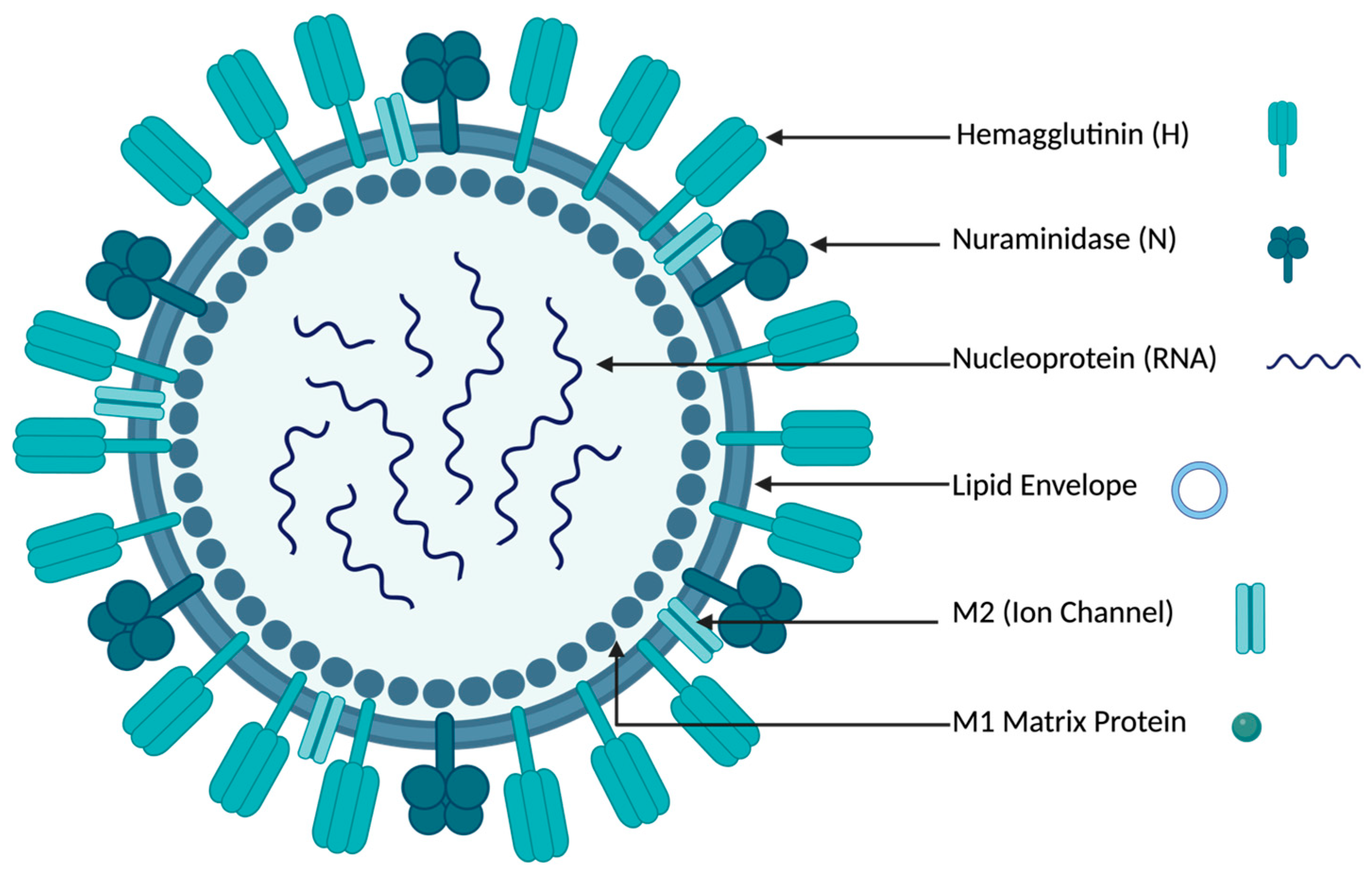
Influenza A viruses are pleomorphic particles that can exist in a spherical form with a diameter of approximately 80 to 120 nm or as filamentous structures with diameters ranging from 100 nm to 30 µm [16]. These viruses consist of three main subviral components: an envelope, a layer of matrix 1 (M1) proteins, and a viral ribonucleoprotein (vRNP) core (Figure 1). The envelope, derived from the host cell membrane, is a lipid bilayer that incorporates the haemagglutinin (HA) and neuraminidase (NA) glycoproteins, which form spike-like projections on the virus’s surface, as well as the transmembrane ion channel protein matrix 2 (M2) [17]. To date, 18 haemagglutinin (HA) subtypes (H1 to H18) and 11 neuraminidase (NA) subtypes (N1 to N11) have been identified, yielding approximately 198 potential combinations, with 16 HA and 9 NA subtypes found in birds and two additional subtypes, H17N10 and H18N11, identified in bats [18]. Similarly, a new study identified a novel influenza A virus subtype, H19, circulating in ducks, which uses major histocompatibility complex class II (MHC-II) proteins instead of the canonical sialic acid receptor for host cell entry [19]. Beneath the envelope, the matrix 1 (M1) protein plays a critical role in determining the virion morphology [20]. The influenza A virus genome comprises eight RNA segments encoding at least 12 proteins: PB2, PB1, PB1-F2, PA, PA-X, HA, NP, NA, M1, M2, NS1, and NEP/NS2. PB1-F2 and PA-X are important virulence factors; PB1-F2 modulates apoptosis and immune evasion, while PA-X contributes to host shutoff and pathogenicity. Among all avian influenza subtypes, H5 and H7 subtypes are of particular concern due to their ability to mutate into highly pathogenic forms, causing severe losses in poultry production and posing significant zoonotic risks to humans [21]. H9N2 viruses have zoonotic potential and play a critical role as internal gene donors for other reassortant influenza viruses, including H5 and H7 subtypes. Thus, H9N2 represents a persistent endemic and evolutionary reservoir risk rather than an acute high-mortality threat [22].
In Nepal, HPAI H5 viruses have been identified from multiple genetic clades, reflecting repeated introductions over time. The principal clades detected include clade 2.2, clade 2.3.2, and clade 2.3.2.1, with subclades 2.3.2.1a and 2.3.2.1c representing the predominant lineages in earlier outbreaks. More recently, viruses belonging to clade 2.3.4.4, particularly subclade 2.3.4.4b, have been reported [23]. Overall, clade 2.3.2.1 has historically dominated HPAI circulation in Nepal, whereas clade 2.3.4.4b represents more recent incursions, occasionally detected alongside reassortant H5N1 viruses [24].

3. Transmission of Avian Influenza Viruses

Wild birds are the primary reservoirs of the avian influenza virus (AIV), and it has been identified in more than 100 wild bird species. Mainly, birds belonging to the orders Anseriformes (ducks, geese, and swans) and Charadriiformes (gulls, terns, and waders) maintain AIVs in nature [25]. These natural reservoirs often contain low-pathogenic AIVs, causing asymptomatic infections. However, increasing evidence shows that highly pathogenic avian influenza (HPAI) H5 viruses can also cause severe disease and mass mortality in wild birds, not only in poultry. Recent outbreaks have affected a wide range of species, particularly colonial seabirds and marine-associated birds. For example, large die-offs have been reported in northern gannets (Morus bassanus) in Europe and in penguin species such as Humboldt penguins (Spheniscus humboldti) and gentoo penguins (Pygoscelis papua) in South America and the sub-Antarctic region. In addition, significant mortality has been recorded in cormorants (Phalacrocoracidae spp.), Peruvian boobies (Sula variegata), pelicans (Pelecanus spp.), terns (Thalasseus and Sterna spp.), gulls (Larinae spp.), albatrosses (e.g., black-browed albatross Thalassarche melanophris and wandering albatross Diomedea exulans), and skuas (Stercorarius spp.). These outbreaks have led to unprecedented mass die-offs in several regions, highlighting the expanding host range and severe ecological impact of HPAI H5 viruses in wild bird populations [26]. During migration, wild waterfowl can spread avian influenza viruses (AIVs) over long distances, with documented cases of transmission from Asia to North America and Europe [27].

3.1. Transmission to Domestic Birds

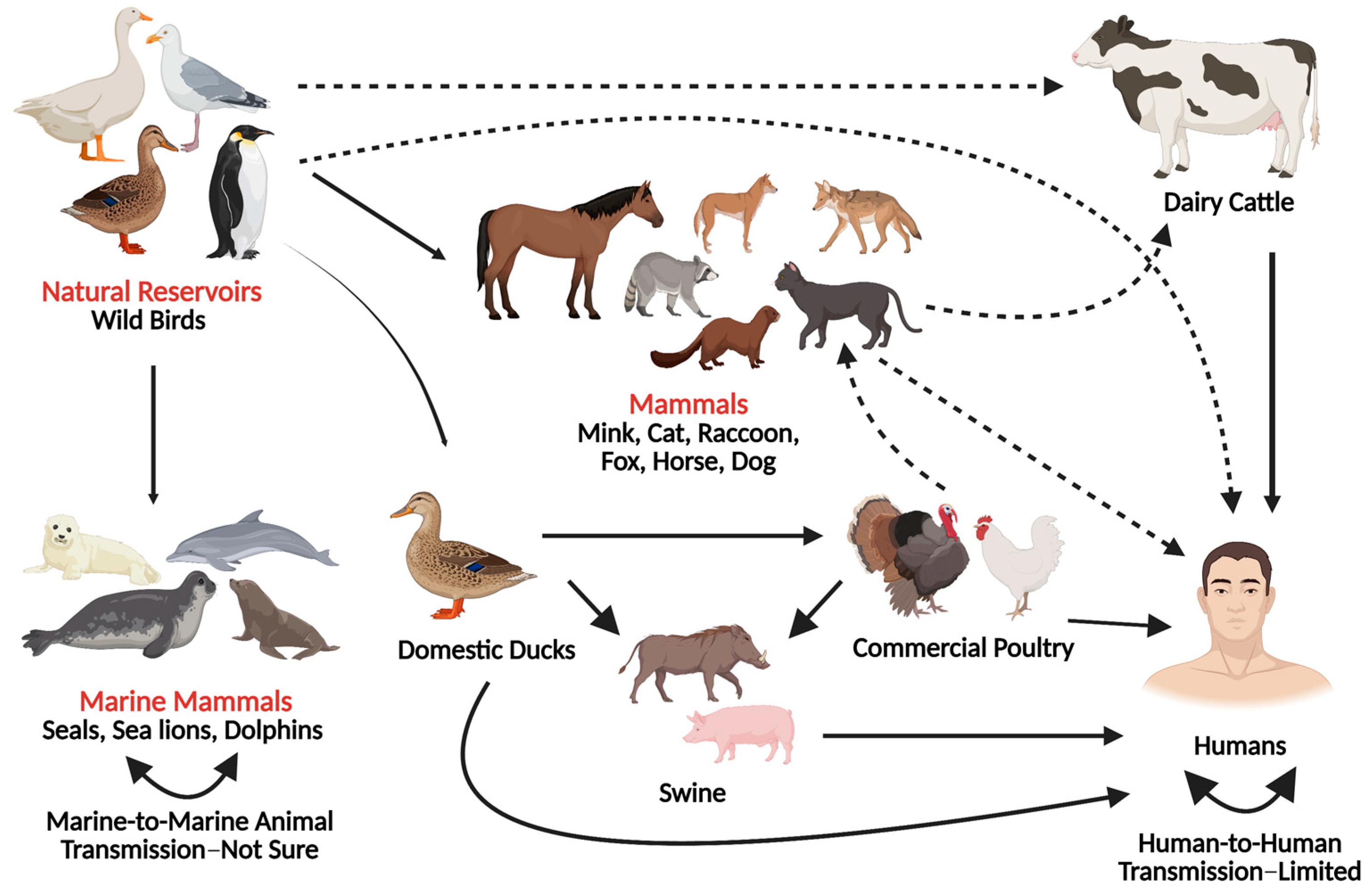
The primary mode of transmission of AIVs from wild birds to domestic birds is through fecal–oral or fecal–respiratory routes [28]. Domestic ducks are the major intermediaries between wild birds and other domestic birds (Figure 2). AIVs shed in the fecal material of wild birds are transmitted to the domestic ducks, where they share common water sources. Further, the transmission of AIVs in domestic poultry is facilitated through contaminated water sources, feed, and farm equipment. Backyard farming, where the poultry are raised in open spaces and/or multiple species are raised together, is one of the major factors for AIV transmission [29]. Domestic poultry comes into contact with the AIVs harbored by migratory wild birds and acquires the infection. Another method for AIV transmission in domestic poultry is through live poultry markets. This trade is common in different parts of Africa and Asia, facilitating the mixing of different subtypes of AIVs from different species of wild and domestic birds [30]. The outbreaks of AIVs in commercial poultry production facilities occur through the breach in biosecurity employed to prevent contact with pathogens. From these wild birds, both LPAI and HPAI viruses are transmitted in domestic birds and cause infections, with HPAI resulting in lethal outcomes.

3.2. Transmission to Other Animals

Mammals can become infected with avian influenza viruses through the consumption of infected birds, poultry, or other animals, or via exposure to virus-contaminated environments. Although transmission between mammals is considered rare, it remains a possible route of spread. Mammal-to-mammal transmission is evident by the transmission of H5N1 within the mink farm [33]. H5N1 caused both outbreaks in mink farms with the same reassortment, which also caused a mass die-off of black-headed gulls throughout Europe [34]. In Poland in 2023, approximately 34 domestic cats were confirmed to be infected with H5N1, of which 11 died and 14 were euthanized due to severe illness; contaminated raw-poultry-based pet food was investigated as a potential source of exposure, although the transmission route was not definitively established [35]. H5N1 caused havoc in marine mammals, causing significant death across the east coast of South America [36]. Additionally, in Denmark, the Netherlands, Germany, and New England, harbor seals were infected with AIVs [37]. In 2024, H5N1 infection in dairy cattle was documented, causing clinical manifestations such as a decrease in milk production [38]. Along with this, several wild birds and cat mortalities were found across the dairy farms of Texas. H5N1 of bovine origin was also detected in other species, such as cats, alpacas, foxes, raccoons, mice, and poultry [39]. Other marine animals that have shown the presence of marine mammal clade B3.2 viruses include the common dolphin, Chilean dolphin, porpoise, sea otter, fur seals, and elephant seals. However, the exact mechanisms of transmission between marine mammals have not been pinpointed.

3.3. Transmission to Humans

Most human infections with avian influenza virus (AIV) occur through direct or indirect exposure to infected poultry. AIV can spread to humans through direct contact with infected poultry, contaminated surfaces, or inhalation of virus-laden droplets or dust. Infection may occur by touching the virus and then the eyes, nose, or mouth, even without handling the birds directly [40]. The first incidence of human infection by AIVs was documented in 1997 in Hong Kong SAR, causing mortality of 6 out of 18 infected individuals [41]. As of 22 April 2025, a total of 973 confirmed human cases of avian influenza A(H5N1), including 470 deaths (a case fatality rate of approximately 48.3%), have been reported to the World Health Organization (WHO) since 2003 [42]. A total of 70 confirmed and probable human cases have been reported in the United States since 2024, including 41 linked to dairy herds, 24 to poultry operations, 2 to other animals, and 3 with unknown exposure sources. The first U.S. human death from H5N1 was reported in Louisiana [43]. The H7N9 subtype has caused 1568 human infections and 616 deaths globally, though no new cases have been reported since 2019. H9N2 infections total 117 globally, with two deaths, mainly from China [44].
The recent emergence of H5N1 in U.S. dairy herds marks a concerning expansion of host range and underscores the importance of monitoring bovine-to-human transmission. Although there is limited information on human-to-human transmission of AIVs, the possibility of this transmission cannot be neglected. Once the AIVs establish the mechanism of transmission between humans, the spread of the AIVs in this scenario would be so rapid. We recently saw the COVID-19 transmission between humans, which further emphasizes our preparedness for combatting the AIV outbreaks in humans [45]. Certain HPAIV strains have been found to cross the species barrier infecting humans and cause illnesses, from mild flu-like symptoms to severe, life-threatening conditions with severe mortality rates [46]. The adaptation of H5N1 to infect cattle raises concerns about a potential for further mammalian adaptations that could heighten its risk to infect humans [47]. Despite these developments, the most common HPAI viruses circulating in birds, including those that have infected mammals and humans, lack the ability to efficiently bind to receptors predominant in the human upper respiratory tract. This is a key reason that there is relatively low risk to the general public from influenza A (H5N1) viruses [48]. However, monitoring and research on this evolving threat should be continuing to curb this threat from further proceedings.

4. Symptoms of Avian Influenza

4.1. Poultry and Other Birds

Low-pathogenic avian influenza (LPAI) viruses generally cause mild or subclinical infections in poultry and other birds, but these infections can worsen due to co-infections, poor husbandry, or various stress factors. Since the haemagglutinin glycoprotein in LPAI viruses is activated only in specific body regions, such as the reproductive, gastrointestinal, and respiratory tracts, clinical signs are typically localized to these areas [49]. As a result, the most common manifestations in poultry include reproductive issues like reduced fertility, abnormal eggs, and decreased egg production, along with respiratory symptoms such as swelling of the infraorbital sinuses, nasal and ocular discharge, sneezing, and coughing, as well as gastrointestinal issues such as diarrhea [50,51,52,53,54,55]. While the overall mortality, morbidity, and clinical presentation of LPAI are generally consistent worldwide, there have been reports of high mortality with severe clinical signs in certain regions and experimental settings. For example, certain variants of H9N2 and H7N9 were found to be more virulent [56,57,58], with mortality rates reaching up to 75% in experimental settings in turkey birds, despite causing only mild infections in chickens [59]. Another study on H10N1 variant reported a 47% mortality rate, attributed to viremia and extensive viral replication in the kidneys [60]. Several studies suggest that LPAI tends to be asymptomatic or mildly symptomatic (sinusitis, reduced weight gain, behavioral changes, or temporary increases in body temperature) in wild birds, domestic ducks, and geese, compared to more-pronounced symptoms in domesticated chickens [61,62,63,64,65,66,67,68].
Highly pathogenic avian influenza (HPAI) viruses cause severe systemic disease with multiple organ failure and high mortality in chickens and turkeys. In peracute cases, birds may die suddenly without showing any clinical signs or gross lesions. In acute cases, common symptoms include severe depression, loss of appetite, greenish diarrhea, coughing, sneezing, sinusitis, blood-tinged oral and nasal discharge, neurological issues such as torticollis, opisthotonus, unsteady gait, paralysis, and drooping wings, along with subcutaneous hemorrhages on the shanks and feet, and edema along with cyanosis of the head, comb, wattle, and snood (turkeys) [69,70]. Similarly, reproductive clinical manifestation includes reduced fertility and hatchability, a sudden drop or cessation in egg production, and the production of deformed, shell-less, or depigmented eggs [71]. HPAI is distinguished by its broad host range, high transmissibility, and significant mortality in poultry populations. However, there have been instances where infected flocks display only mild clinical symptoms. For example, in 2004 in Texas, an H5N2 avian influenza virus with molecular characteristics typical of highly pathogenic strains presented clinical manifestations consistent with infection caused by a low-pathogenicity AIV in the affected flock [72]. Additionally, in most experimental studies, ducks inoculated intranasally with H5 or H7 HPAI viruses exhibited either very mild clinical signs or remained asymptomatic [73,74]. A study reported a 20% mortality rate among pelicans in Peru’s marine protected areas, where approximately 100,485 wild birds from 24 species died from HPAI over five months, with most exhibiting peracute clinical signs [36]. Clinical signs in ostriches infected with H5 and H7 HPAI seem to be variable. A case report on H7N1 in ostriches (Struthio camelus) identified clinical signs in young birds, including anorexia, depression, neurological, and enteric symptoms, leading to a 30% mortality rate in the affected population [75]. Several studies have reported severe, non-specific clinical signs, including diarrhea, neurological symptoms, and sudden death in gallinaceous game birds, while other studies have observed only mild or minimal clinical signs [76,77]. Gallinaceous poultry species, including bobwhite quail, ring-necked pheasants, and chukar partridges, tend to have a longer survival period and may exhibit more pronounced neurological symptoms compared to chickens [76]. Pigeons were traditionally considered resistant to HPAI; however, certain strains of HPAI viruses have been found to induce disease in these birds, manifesting as non-specific clinical signs, neurological symptoms, greenish diarrhea, or sudden death [78]. In 2004, the H5N1 GOZF viral strain, isolated from migratory waterfowl in China, caused 100% mortality with severe clinical signs in domestic chickens, 30% mortality with moderate signs in geese, and in mice, induced lethargy, weight loss, lymphopenia, neurological disorders, and death within 4 to 13 days [79]. Other studies have reported mild to moderate infections in both domestic and wild waterfowl, with domestic species showing more pronounced respiratory and neurological symptoms and exhibiting higher mortality rates [71,80,81,82]. Studies have shown that Asian H5N1 HPAI viruses are more pathogenic, with occasional reports of high mortality and a combination of non-specific signs, including neurological disease, respiratory symptoms, greenish diarrhea, and/or sudden death, even in some wild species that were asymptomatic to other viral strains [71,80,83,84].
There is very limited information on wild birds; neurological symptoms similar to those observed in chickens, such as head and neck tremors, torticollis, opisthotonus, and wing paralysis, have been reported in free-living wild birds infected with HPAI [81]. In experimental studies, species like the Wood Duck (Aix sponsa) and Laughing Gull exhibited severe symptoms, succumbing within two to three days after the onset of clinical signs, although some birds did recover. In contrast, species such as the Blue-Winged Teal were infected but showed no visible clinical signs [85]. Historically, the H5N3 HPAI virus was responsible for significant mortality in South Africa in 1960 [86]. Similarly, the H7N1 HPAI virus caused a severe outbreak in captive canaries (Serinus canaria), leading to symptoms such as conjunctivitis, lethargy, and anorexia, with a high fatality rate [87].

4.2. Humans

The incubation period for H5N1 HPAI and H7N9 HPAI/LPAI virus infections is generally short, typically lasting 7 days or less. In most cases, the average duration ranges from 2 to 5 days, with H7N9 infections exhibiting a range of 1 to 13 days, and H5N1 infections potentially extending up to 8 days, or in some instances, as long as 17 days [88,89]. HPAI has the potential to impact multiple organs and systems in humans, including the respiratory, digestive, and central nervous systems, as well as the liver (extensive hepatic central lobular necrosis), heart (degeneration of myocytes in the heart) and kidneys (extensive acute tubular necrosis in the kidney), often leading to multiorgan dysfunction in the later stages of infection [90,91]. The clinical manifestations of avian influenza virus infection vary depending on the viral subtype. Certain LPAI strains, such as H7N2, H7N3, and H9N2, and even some HPAI strains like H7N7, may result in asymptomatic or mild symptoms in humans, including conjunctivitis or mild influenza-like illness (e.g., fever, headache, dry cough and sore throat) [18,92]. Sometimes, variable symptoms, including severe respiratory conditions and multiorgan failure, made the diagnosis of the disease more difficult. HPAI H5N1 frequently impacts the lungs and pneumocytes were the primary target, resulting in widespread alveolar damage with interstitial fibrosis, hemorrhage, interstitial lymphoplasmacytic infiltration, bronchitis, squamous metaplasia and the development of hyaline membranes [88,93]. In some cases of infection with Asian lineage H5 HPAI viruses, lower respiratory symptoms such as chest pain, dyspnea, tachypnea, and occasionally blood-tinged sputum may develop [94]. However, upper respiratory symptoms and fever are not always prominent in cases of avian influenza and are often misdiagnosed as seasonal influenza [71]. Patients with lower respiratory involvement often present with more severe illness, as multiorgan dysfunction is commonly observed in the later stages of infection [71,95]. Numerous cases of HPAI H5N1 infection have been associated with acute respiratory distress syndrome (ARDS), often complicated by pulmonary hemorrhage and pneumothorax [88,96]. In addition to respiratory symptoms, individuals infected with HPAI H5N1 may present with a range of accompanying signs, including headache, muscle pain, sore throat, runny nose, conjunctivitis, and bleeding gums, as well as complications involving the central nervous and digestive systems [93]. On 20 January 2022, a previously healthy 6-year-old girl developed severe central nervous system (CNS) complications, including meningoencephalitis, encephalopathy, seizures, and coma, without respiratory symptoms, due to a novel reassortant avian-origin influenza A (H5N6) infection [97]. Influenza A viruses can cause various CNS disorders such as Reye’s syndrome, acute necrotizing encephalopathy, myelitis, and Guillain–Barré syndrome [98]. Influenza-associated encephalitis and encephalopathy (IAE), mainly linked to H3N2 and H1N1, are more common in children [98,99]. Gastrointestinal symptoms like nausea, vomiting, diarrhea, and abdominal pain are also observed, especially in H1N1 and H5N1 infections [71]. In pregnant women, H5N1 has led to viral presence in the brain, placenta, and fetus, and cases of spontaneous abortion have been reported [100,101]. Fatal HPAI H5N1 infections often present with leukopenia, lymphopenia, thrombocytopenia, hypoalbuminemia, and elevated aspartate aminotransferase (AST), lactate dehydrogenase (LDH) and creatine kinase (CK) levels [102,103].

5. Global Outbreaks

In a period of ten years (2013–2022), there were numerous outbreaks, counted as 21,249, affecting approximately half of WOAH member countries, induced by 34 AI subtypes [104]. Among them, 9498 outbreaks were caused by a variety of HPAIV subtypes, resulting in 24.8 million losses in the poultry industry just in the past five years (2019–2023) [105]. The subtypes H5N1 and H5N8 were the cause of the majority of HPAIV events during 2014–2024 in poultry [106]. The review of the past decade’s outbreaks has shown Europe as the most affected region, followed by Asia, Africa, America, and then Oceania [105].
HPAIVs, specifically the H5 and H7 subtypes, have induced several outbreaks severely affecting the poultry industry. Between 2005 and 2024, HPAI caused the mass slaughter and death of over 633 million chickens globally, reaching an all-time high of 146 million in 2022 [107]. In the 21st century, three waves of H5 subtypes have been reported, with the first wave starting in 2005–2010, the second wave in 2011–2019, and the third wave in 2020–2022, along with 389 million destructions and deaths of poultry resulting in 204 million losses by H5N1 alone, mostly in Europe [108].
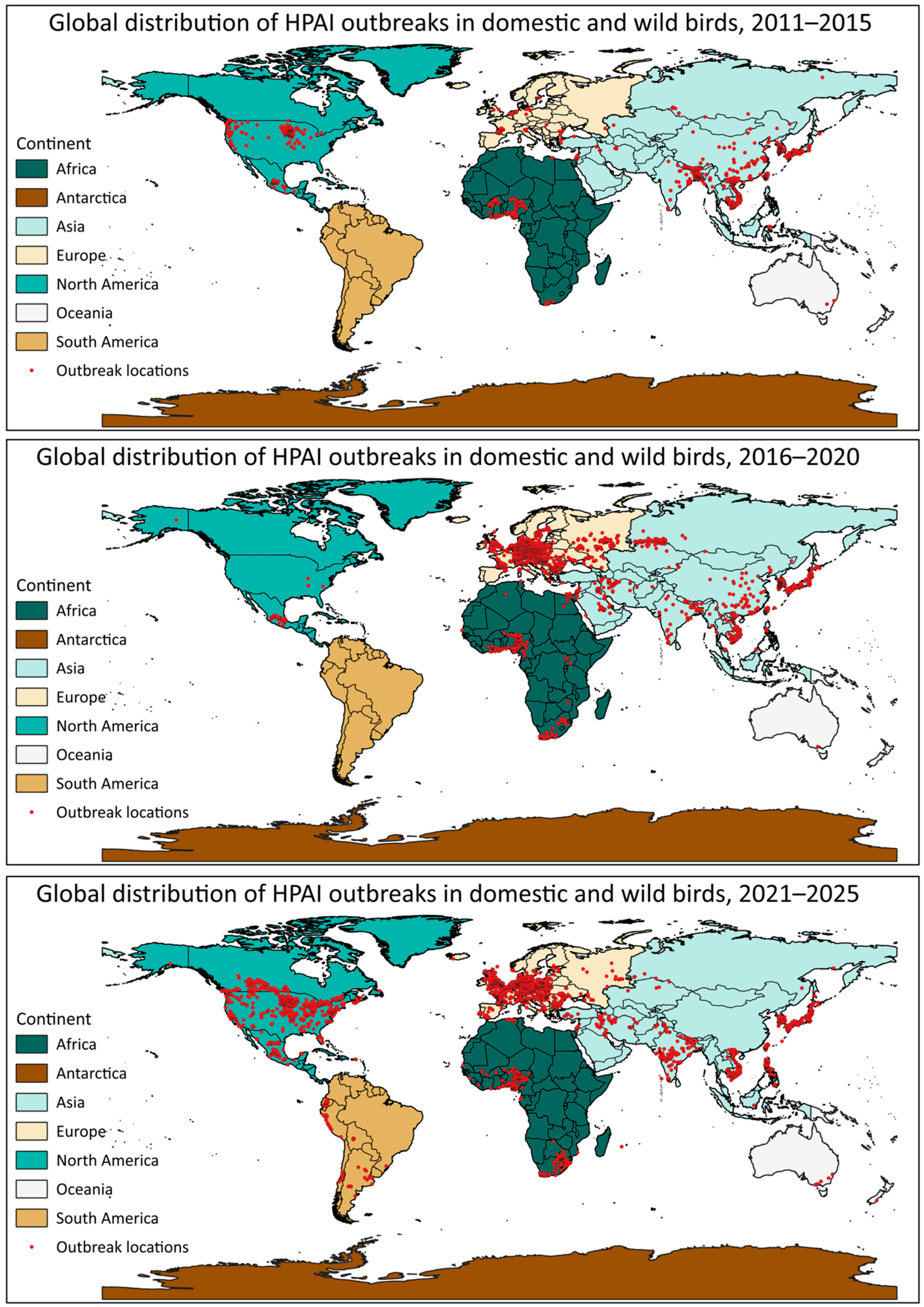
An increasing trend of HPAI-H5N1 occurrence is found from 2005 to 2023, which has shown a northwest–southeast spatial distribution primarily affecting Asia and parts of Africa from 2005 to 2019, followed by a clear shift to a west–east pattern with the emergence of outbreaks in Europe and the Americas in 2020 to 2023 [109]. Since 2021, the global spread of HPAI in domestic and wild birds has exceeded that of the previous decade (2011–2020), with outbreaks reported worldwide, including in South America, where outbreaks have occurred in areas that had not reported them previously (Figure 3). Globally, HPAI outbreaks usually peak during the northern hemisphere’s winter months, from October to February, while in the southern hemisphere, outbreaks are fewer and tend to peak in February and September [110].
The global H5N1 outbreak trend between 2005 and 2019 showed the spring season showing most of the outbreaks, followed by winter, summer, and finally autumn, accounting for 46.72%, 37.55%, 8.98%, and 6.75% [111]. However, during this period Africa has shown the highest number of outbreaks, followed by Asia, Europe and the Americas due to H5N1 [111]. Other H5 subtypes like H5N8 have made other remarkable contributions, as around 38 million chickens were killed or destroyed because of 2782 H5N8 outbreaks that were recorded in June 2021 across more than 25 nations [112]. Moreover, H7 subtypes have caused over 33 million losses of poultry from 2005 to November 2022, primarily affecting North America [108].
From 2011 to 22 August 2025, a total of 17,104 HPAI outbreak reports in domestic and wild birds were documented worldwide. Of these, 15,906 (93.0%) were from domestic birds, 1188 (6.9%) from wild birds, and 10 (0.1%) involved both domestic and wild birds. Among domestic bird outbreaks with complete information on start and end dates, Europe reported the highest number (6991), though with relatively short persistence (mean 58.16 days; median 38 days) (Table 1) [113]. Asia also recorded many outbreak reports (4890) but exhibited the longest average duration (mean 182.66 days; median 46 days). Africa (1573) and North America (1905) showed intermediate persistence, while Oceania (23) and South America (95) reported relatively few outbreaks yet with disproportionately long durations. Maximum durations ranged from 735 days in Europe to 2158 days in Africa, with Asia reaching 1127 days [113]. Overall, outbreak frequency was highest in Europe and Asia, but persistence was greatest in Asia, Oceania, and South America, reflecting regional differences in outbreak control capacity and surveillance effectiveness.

5.1. Europe

Several European countries experienced HPAI outbreaks from 2020 to 2023, indicating a shift in the disease’s global footprint, with France, the United Kingdom, and Germany being identified as high-risk areas [109]. Europe independently accounts for 92.6 million losses due to death and destruction of poultry due to H5 subtypes between 2000 and 2022 [108]. Other HPAIs, such as H7 subtypes, have caused around 17 million losses as reported in WAHIS-WOAH between January 2005 and November 2022, mostly in Italy due to H7N7. Europe has faced the largest HPAI epidemic to date in 2021–2022, with 2398 outbreaks of HPAIs in poultry, 46 million birds culled in affected establishments, 168 detections of the disease in captive birds, and 2733 HPAI events in wild birds across 36 European countries [114]. Research in the last five years (2019–2023) has revealed France as the most affected nation due to HPAI outbreaks among the European countries [105]. France has faced two catastrophic epidemics in 2020–2021 and 2021–2022, with 468 and 1375 documented outbreaks in the former and latter epidemics [115]. Several HPAI subtypes have been epidemic in other European nations like Germany since 2006, and it has faced over 600 H5N6 cases in both wild and domestic birds in 2017 [116]. The UK recorded the most devastating HPAI outbreak between October 2021 and March 2023, with 332 infected premises and over 7.1 million birds culled across England, Scotland, Wales, and Northern Ireland [117]. Meanwhile, DEFRA reported 298 outbreaks in England alone between October 2022 and March 2024, but self-declared zonal freedom from HPAI following the last outbreak on 28 March 2024, marking the transition from active outbreak management to recovery [118].

5.2. North and South America

North America has faced 54 million due to the death and destruction of poultry by H5 subtypes between 2000 and 2020 [108]. An HPAI outbreak led to over 50 million losses of domestic chickens in the United States alone, and about 3 billion USD loss on agriculture-related damages in 2015 [119]. In 2021–2022, North America independently accounted for the loss of more than 29 million birds, particularly in Mexico, due to H7N3 as reported on WOAH-WAHIS [108]. As of April 2024, over 11 million birds have been impacted due to HPAIVs in Canada [120]. Almost all provinces and territories of Canada have been affected by HPAIVs, with the detection of 12 taxonomic orders and 80 species in wild birds [121]. Apart from domestic birds, North America faced one of the deadliest HPAIV infections in wild birds in late 2022 [122]. The first confirmed case of HPAI H5N1 in U.S. commercial poultry during the recent epizootic occurred on 8 February 2022, in a turkey flock in Indiana. By June 2024, the outbreak had spread to 48 states, affecting 1149 flocks (495 commercial) and resulting in the loss of approximately 96.8 million birds. Federal response and indemnity costs exceeded one billion USD, highlighting the substantial economic and epidemiological impact on the U.S. poultry sector [123].
From North America, H5N1 has spread into Mexico, South and Central America, killing 22,000 seabirds of the coast of Peru [36]. Between 2022 and 2025, H5N1 clade 2.3.4.4b was reported in 11 South American countries, with no cases documented in French Guiana, Guyana, or Suriname [124]. In poultry, 100 outbreaks were recorded between 2022 and 2024 across five countries (Argentina, Bolivia, Chile, Ecuador, and Peru), involving more than 3 million confirmed cases and over 5.4 million birds culled. Updated data indicate that nearly 3 million domestic birds tested positive and more than 6 million died or were eliminated by May 2025, with Ecuador, Argentina, and Chile among the most severely affected. In 2025 (up to epidemiological week 45), four South American countries reported confirmed outbreaks of H5N1 in birds: Argentina reported 6 outbreaks, Bolivia 1 outbreak, Brazil 19 outbreaks, and Peru 22 outbreaks [125]. Wild birds were heavily impacted, with 771 outbreaks reported in 10 countries, affecting over 34,000 individuals and 104 identified species, particularly in Argentina, Peru, Ecuador, and Chile. Spillover into wild mammals was documented in six countries, with 1141 confirmed cases and 5772 deaths, mainly involving South American sea lions and southern elephant seals [124]. Additionally, two human cases were reported in the region (Ecuador and Chile) [126]. Overall, the outbreak demonstrates extensive geographic spread and substantial multi-species impact across South America.

5.3. Asia

Asia experienced the highest and most consistent occurrence of HPAI outbreaks between 2005 and 2023, with East Asia (China, Korea, and Japan) and Southeast Asia (Vietnam, Indonesia, Malaysia, and Thailand) reported as the most affected sub-regions in every 5-year phase [109]. Asia has faced 39.6 million losses due to death and destruction of poultry due to H5 subtypes between 2000 and 2022 [108]. Among Asian nations, Indonesia has been mostly affected by HPAI in the last five years (2019–2023) [105]. In Indonesia, most infections are caused by H5N1 subtypes that are endemic in the country, particularly circulating in backyard poultry populations, with cases typically peaking in January or February each year [127]. In the case of China, more than 10 subtypes of HPAI have been found, mostly dominated by H5N1, along with six waves of human infection with H7N9 subtypes that predominated in 2017 [128]. In South Asia, 1063 H5N1 outbreaks were reported in WOAH in both wild and domestic birds between 2006 and 2019, mostly in Bangladesh, followed by Nepal [24]. The H7 subtype has led to the loss of over 964,000 poultry in Asia, with significant outbreaks in 2005 and 2017–2018 in South Korea and China due to H7N7 and H7N9 subtypes, as reported by WOAH-WAHIS from January 2005 to November 2022 [129].

5.4. Africa and Others

In the case of Africa, around 7.7 million losses due to death and destruction of poultry have occurred mostly in South Africa, Nigeria, Mali, and Egypt due to H5 subtypes between 2000 and 2022 [108]. A systematic review over the previous 20 years (2000–2019) in sub-Saharan Africa has found an overall prevalence of 3.0% of AIV in birds, predominantly H5N1 subtypes, followed by H9N2, H5N2, H5N8, and H6N2 [130]. Africa was notably affected in several phases as initial HPAI cases appeared from 2005 to 2009, with Egypt becoming a major hotspot from 2010 onwards, which continued again from 2015 to 2019 with recurring outbreaks in the same regions [109]. Epidemic waves of HPAI occurred between 2006 and 2019, and the highest loss occurred in 2006 due to culling about 40 million birds with an estimated US$29,375,000 in costs [131]. Moreover, H5N8 led to a remarkable outbreak in 2017, affecting nine South African provinces, resulting in the death and culling of millions of commercially farmed birds, and it has also affected several species of wild birds [132]. From 2020 to 2023, Southeastern West Africa remained active in reported outbreaks, which were also identified as high-risk due to increased poultry production, population density, and limited biosecurity measures [109].
Oceania has shown the lowest number of HPAIV cases. From 2005 to 2020, three events of HPAI have occurred that have caused the loss of over 975 thousand poultry due to the H7Nx, H7N2, and H7N7 subtypes in Australia in 2012, 2013, and 2020, as reported in WAHIS-WOAH [106].

6. Highly Pathogenic Avian Influenza (HPAI) in Nepal

6.1. Historical Overview and Outbreak Magnitude (2009–2025)

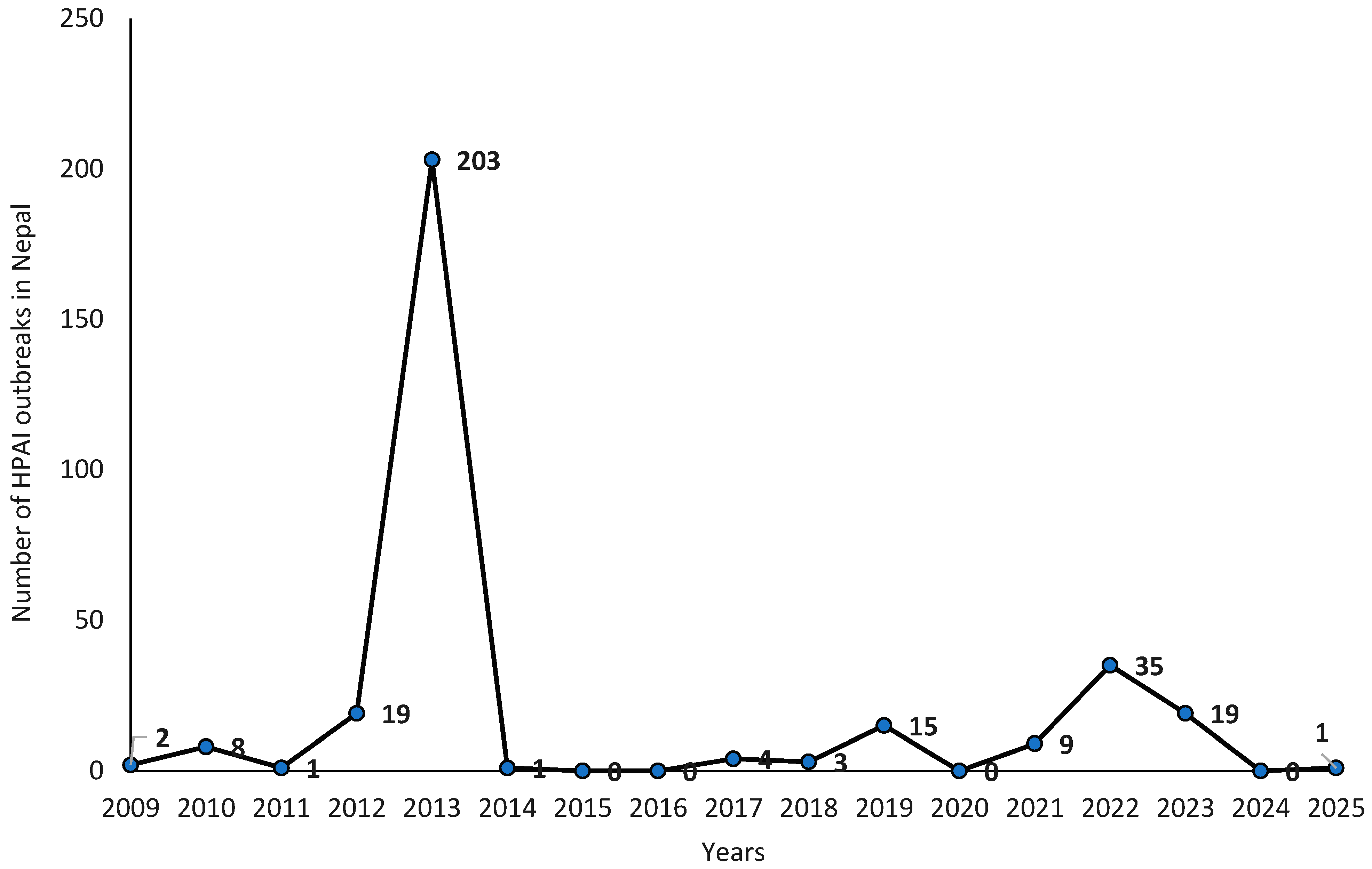
The first outbreak of highly pathogenic avian influenza (HPAI) in Nepal was reported in backyard poultry in the Mechinagar municipality of Jhapa district, located in the eastern region of Nepal, in January 2009 [12]. From 2009 to 2023, a total of 319 HPAI outbreaks have been recorded in Nepal. There was no outbreak in 2024. On February 2, 2025, a new outbreak of highly pathogenic avian influenza (H5N1) was reported in domestic poultry in Koshi Rural Municipality-6, Sunsari district [13]. As of 25 August 2025, Nepal has reported a total of 320 outbreaks of HPAI (Figure 4).
The highest number of outbreaks occurred in 2013, with 203 reported cases, followed by 2022 with 35 outbreaks. However, no outbreaks were reported in 2015, 2016, 2020, and 2024, and only one outbreak each was recorded in 2011 and 2014. During this period, Nepal reported a total of 335,184 confirmed bird deaths (domestic and wild). Additionally, 2,399,916 suspected birds were culled and disposed of, bringing the total number of dead birds to 2,735,100 [13].

6.2. Geographic Distribution and Spatial Clustering

Among Nepal’s seven provinces and 77 districts, Bagmati Province was the most affected, reporting 248 outbreaks. Kathmandu district alone accounted for 104 cases, followed by Bhaktapur and Lalitpur districts with 50 and 41 outbreaks, respectively. Koshi Province was the second most affected, with 40 outbreaks, including 22 in Jhapa district and 9 in Sunsari district. Other provinces experienced fewer outbreaks, with Gandaki and Lumbini each reporting 12 outbreaks, primarily in Kaski (11 outbreaks) and Rupandehi (6 outbreaks) districts, respectively. The provinces of Karnali (n = 3), Madesh Pradesh (n = 3), and Sudurpaschim (n = 2) had minimal outbreaks, with cases distributed across various districts within each province.
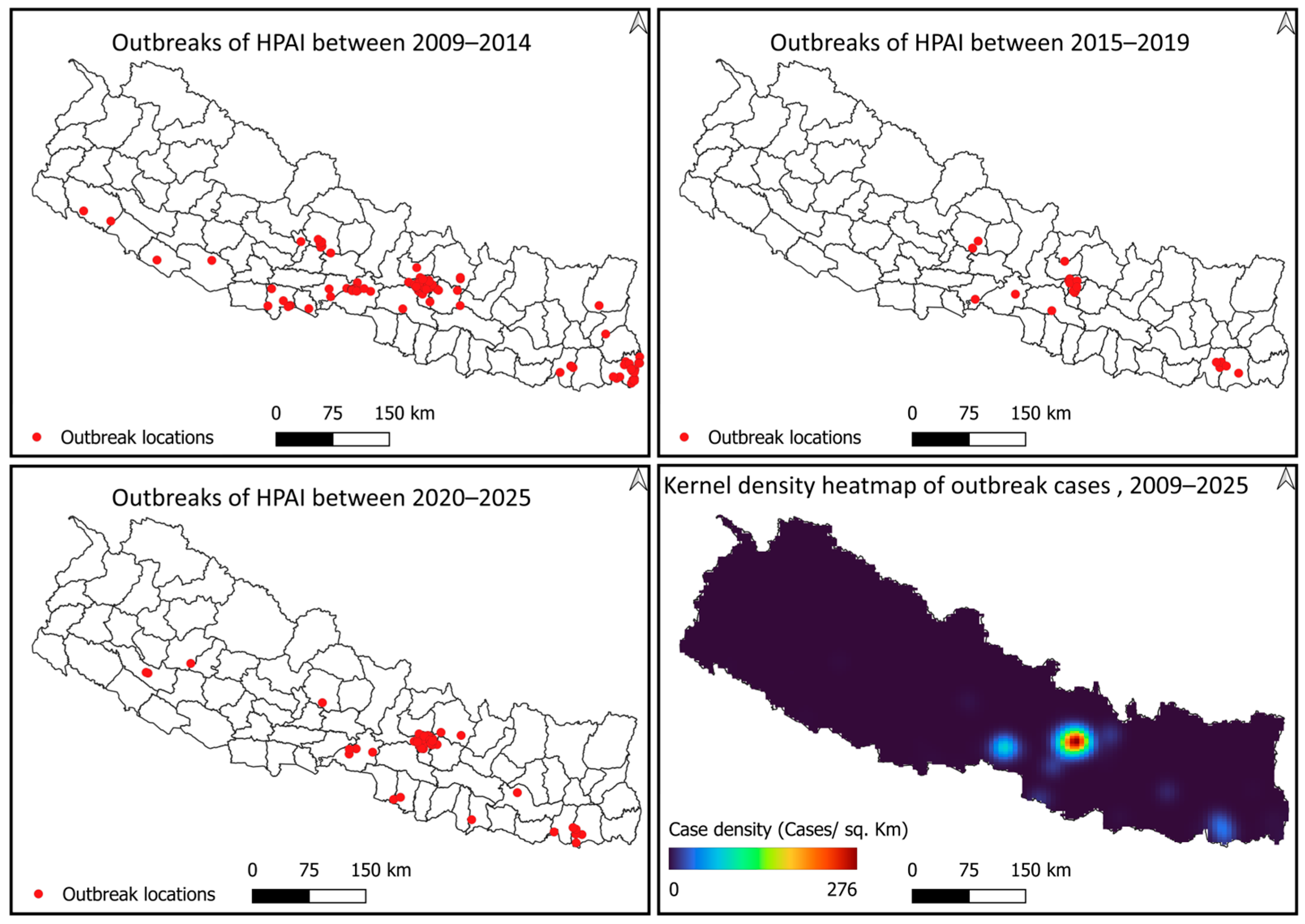
Between 2009 and 2014, outbreaks were widespread and particularly concentrated in high-density poultry production areas such as the Kathmandu Valley, Chitwan, and the southeastern Terai districts of Morang and Jhapa, reflecting the role of intensive farming and trade hubs in sustaining transmission [113]. The subsequent period of 2015–2019 was marked by a relative decline in outbreak frequency, with fewer and more-scattered cases, possibly linked to strengthened surveillance and control measures. However, from 2020 to 2025, outbreaks re-emerged with notable clustering in central Nepal and along the eastern border regions (Figure 5), suggesting ongoing vulnerability linked to poultry density, cross-border movement, and biosecurity gaps. Spatial analyses consistently identify the Kathmandu Valley and Chitwan as persistent hotspots, with additional clusters in eastern and western regions, highlighting that while outbreak intensity has varied over time, central Nepal remains the most at-risk area for recurrent HPAI activity.

6.3. Temporal and Seasonal Pattern

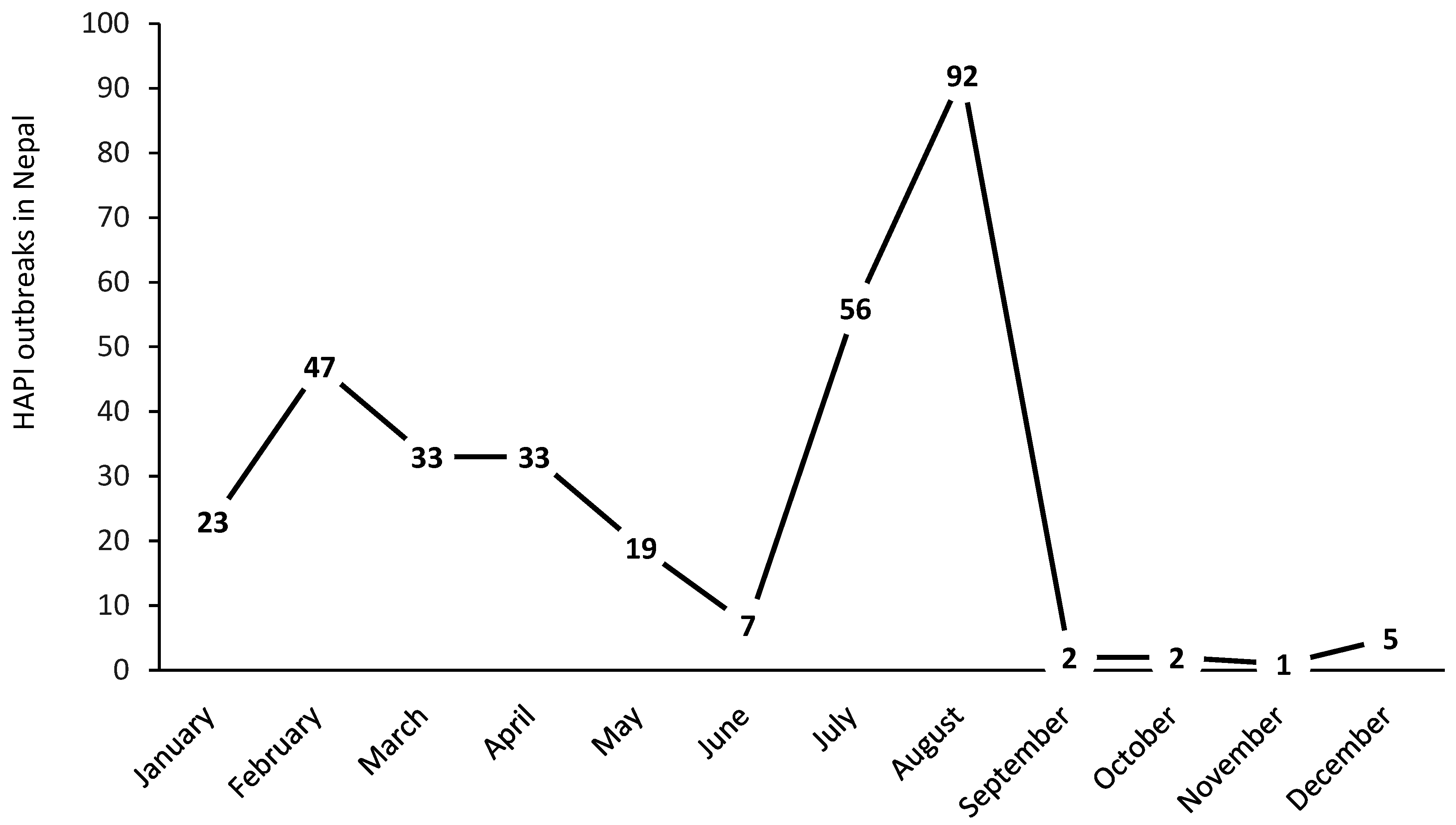
HPAI outbreaks in Nepal have shown clear temporal fluctuations over the past decade and a half. August recorded the highest number of outbreaks with 92, followed by July with 56 outbreaks. February and March also had significant numbers, with 46 and 33 outbreaks, respectively. The winter months of January (23 outbreaks) and December (5 outbreaks) had relatively fewer cases. September, October, and November had the fewest number of outbreaks, with just two cases each in September and October, and one in November (Figure 6).
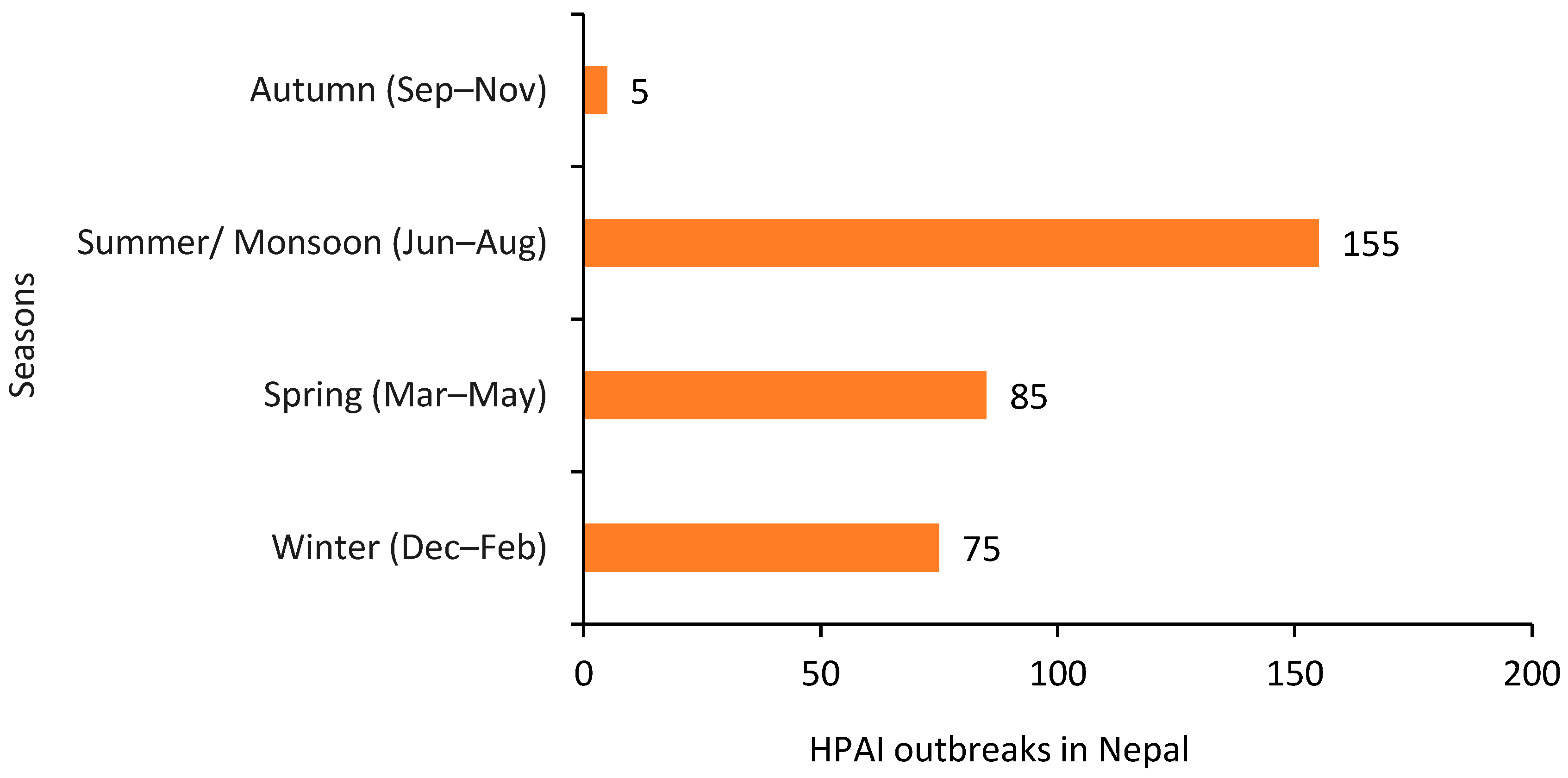
The seasonal distribution of HPAI outbreaks in Nepal from 2009 to August 2025 highlights a strong influence of the monsoon season. A total of 155 outbreaks occurred during the summer/monsoon period (June–August), which accounts for nearly half of the total outbreaks (Figure 7). Spring (March–May) experienced 85 outbreaks, followed by winter (December–February) with 75 outbreaks. Autumn (September–November) had the lowest number of outbreaks, with only five cases recorded over the 14-year period. This seasonal pattern indicates that the risk of avian influenza is higher during the monsoon season in Nepal.

6.4. HPAI in Wild Birds and Transmission Dynamics

Between 2009 and August 2025, Nepal recorded seven outbreaks of highly pathogenic avian influenza (HPAI) in wild birds, primarily affecting crows (Corvus splendens) in Kathmandu and Jhapa, with occasional cases in Asian openbills (Anastomus oscitans) and whooper swans (Cygnus cygnus). Outbreaks resulted in varying mortalities, ranging from single deaths to as many as 200 in Lainchaur, Kathmandu (2019), but no birds were reported as culled or disposed of during these outbreaks (Table 2).
The first outbreak of H5N1 in Nepal occurred in a district bordering India, raising suspicions that the virus might have entered the country through the illegal transport of poultry and poultry products across the porous border with India. Alternatively, migratory wild birds could have introduced the disease into Nepal. The highest number of H5N1 outbreaks was recorded in districts such as Kathmandu, Lalitpur, Bhaktapur, and Chitwan, likely due to the large concentration of poultry farms in these areas compared to other parts of the country [12]. From 2009 to 2012, only 30 outbreaks of H5N1 were recorded in Nepal. However, in 2013, a massive 203 outbreaks were reported. The large number of outbreaks in 2013 could have been due to poor biosecurity practices on farms and the movement of infected poultry and poultry products to previously unaffected areas [133]. Following 2013, the number of outbreaks significantly declined, with only eight outbreaks reported over the next five years (2014–2018). This decline suggests improvements in biosecurity measures and the effectiveness of interventions implemented after the 2013 outbreak spike.

6.5. Molecular Epidemiology and Genetic Diversity

Phylogenetic analysis revealed that HPAI H5 viruses detected in Nepal belong to multiple genetic clades, indicating repeated independent introductions rather than sustained endemic circulation. Earlier Nepalese isolates (2010–2013) clustered within clade 2.3.2.1c alongside viruses from Bangladesh, India, and Bhutan, reflecting regional circulation in South Asia [24]. In recent Nepal outbreaks (2019–2023), one Nepalese virus belonged to clade 2.3.4.4b and was highly similar to Bangladeshi strains from 2021 to 2022, while another was a reassortant virus genetically related to clade 2.3.2.1a and 2.3.4.4b viruses detected in poultry, wild birds, humans, and cats in South Asia, demonstrating transboundary and zoonotically relevant virus circulation [23]. No Nepal-specific lineage was observed, underscoring the importance of cross-border surveillance and regional cooperation for HPAI control. The most prevalent subtype of HPAI viruses in Nepal is H5N1, with clades 2.2, 2.3.2, 2.3.2.1, and 2.3.2.1(a) being the most common [24]. Additionally, the H5N8 subtype of clade 2.3.4.4 was reported in March 2017 at a layer farm in Koshi Province, where it caused the death of 3650 birds out of 6200 susceptible birds. Recent genomic surveillance in Nepal revealed the co-circulation of two distinct highly pathogenic avian influenza (HPAI) H5N1 viruses during poultry outbreaks in early 2023: one belonging to clade 2.3.4.4b and another reassortant virus combining genes from clades 2.3.2.1a and 2.3.4.4b [23]. The clade 2.3.4.4b virus showed close similarity to strains previously detected in Bangladesh, while the reassortant virus shared high genetic identity with H5N1 viruses recently associated with fatal human infections and feline cases in India and Bangladesh. Future studies should include screening for mammalian-adaptation markers such as PB2-E627K, PB2-D701N, and HA-Q226L, which are associated with enhanced replication in mammals and increased zoonotic potential [134]. Monitoring these markers will provide a direct assessment of cross-species transmission risk. Given Nepal’s reliance on stamping-out measures without vaccination, the detection of a reassortant virus linked to human cases highlights an urgent need for enhanced molecular surveillance, regional collaboration, and preparedness to mitigate both animal health and public health risks.

6.6. Zoonotic Implications

HPAI represents a significant zoonotic concern in Nepal, particularly for individuals with occupational exposure to poultry. Poultry farmers, farm workers, live-bird market vendors, cullers, and veterinarians are at elevated risk through direct handling of infected birds or contact with contaminated environments [135]. Nepal recorded its first human case of H5N1 on 24 March 2019, which resulted in the death of the infected person [14]. Clade 2.3.2.1(a) was detected in the infected human in Nepal, suggesting that viruses were commonly transmitted from poultry to humans [24]. Although human cases remain rare, recurrent poultry outbreaks maintain the risk of spillover events, particularly where biosecurity practices are inadequate.

7. Control Strategies of Avian Influenza in Nepal

Nepal has significantly refined its strategies for controlling HPAI since 2003, adapting to evolving disease risks and international guidelines over the past two decades. The foundation for current approaches originated with the National Contingency Plan for Prevention and Control of Avian Influenza, established in 2060 B.S. (2003/2004), which aimed to prevent HPAI entry into the country, control the disease at points of entry, and eliminate HPAI threats [136]. The Government of Nepal (GoN) subsequently introduced the National Avian Influenza and Influenza Pandemic Preparedness and Response Plan (NAIIPPRP) in 2006 and the Bird Flu Control Order in 2008 to mitigate the impact of avian influenza on the animal health sector, aiming both to reduce economic losses and protect public health. These initiatives emphasized mass awareness campaigns via media, sensitization of high-risk areas, epidemiological investigations, outbreak containment, capacity building of personnel, institutional strengthening, and intersectoral coordination [135,137,138]. The regulatory framework was further strengthened with the National Surveillance Plan for Highly Pathogenic Avian Influenza (July 2008) and the Standard Operating Procedures (2011) for HPAI control, while the Bird Flu Control Order was amended in 2017 to incorporate enhanced prevention and control measures [135]. The current surveillance system, operational since 2008 and enhanced through 2024, classifies all 77 administrative districts into high-, medium-, and low-risk categories based on multiple epidemiological factors. These include shared borders with India, informal poultry transport, commercial poultry populations, domestic duck and backyard bird populations, live market activity, proximity to national parks, wetlands and lakes frequented by migratory birds, road/highway access, and disease status in neighboring regions [139]. Bio-surveillance programs, launched in 2012 in collaboration with the FAO, currently operate in 10 high-risk districts, selected based on outbreak history, border proximity, highway access, wetlands, and duck density [140].
Through these measures, the GoN has successfully contained avian influenza outbreaks in the poultry sector by implementing stamping-out policies. These policies include culling infected and exposed birds, safely disposing of carcasses, thoroughly cleaning and disinfecting infected premises, and enforcing quarantine and movement restrictions in affected areas [135]. Outbreak management protocols, established in 2008 and refined through 2024 directives, use a tiered spatial-containment system with three control zones. The infection zone (0–3 km from an outbreak) undergoes immediate stamping-out operations, including rapid culling, safe disposal of carcasses, intensive cleaning and disinfection, mobilization of emergency disease investigation teams (EDIT), and weekly premises inspections for 90 days to enforce no-restocking policies [139]. In the high-risk zone (3–20 km), authorities conduct twice-weekly clinical surveillance of commercial poultry, enforce enhanced biosecurity, implement vaccination programs when applicable, restrict movement, and hold community dialogue sessions for 90 days [139]. The surveillance zone (beyond 20 km) maintains active monitoring, screening programs, and biosecurity enforcement to detect secondary transmission [140]. To further reduce transmission, the GoN reinforced farm-level biosecurity standards, intensified surveillance in outbreak zones, and strictly enforced quarantine measures. The operational backbone of Nepal’s HPAI control system comprises district-level rapid response teams (RRTs), established in all 75 districts (now 77) after the 2009 Jhapa outbreak, with protocols requiring deployment within 24–48 h of outbreak confirmation.
Laboratory capacity, a crucial component, began expanding in 2010 under the Avian Influenza Control Project (AICP) and has been continuously upgraded since then. Laboratories now meet Biosecurity Level 2 (BSL-2) and BSL-3 standards. The Central Veterinary Laboratory (CVL) functions as the national reference facility, performing real-time PCR for HPAI subtypes H5N1, H5N8, H7N9, and LPAI H9N2; conventional PCR for gene segments; rapid antigen testing; and hemagglutination/hemagglutination inhibition (HA/HI) assays [140]. In 2024, CVL processed approximately 1500 bio-surveillance samples annually, following protocols that require transporting samples to designated laboratories within 48 h and reporting results through electronic data management systems coordinated by the Veterinary Epidemiology Center (VEC) [140]. The GoN issued the Bird Flu Control Regulation, 2022, under the Animal Health and Livestock Services Act, 1998, to strengthen HPAI control. The regulation established a 10-member national Bird Flu Control Coordination Committee, led by the Director General of the Department of Livestock Services, to oversee planning, surveillance, emergency response, and intergovernmental coordination [141].
Nepal has increasingly embraced a One Health approach [142], recognizing the interconnections between animal, human, and environmental health. However, implementation challenges persist due to institutional barriers and coordination difficulties among government sectors. Ongoing challenges include managing porous borders with India, where informal poultry movement continues, limited quarantine capacity at border posts, and persistent gaps in biosecurity implementation.

8. Prospects for Avian Influenza Control in Nepal

Advancing avian influenza control in Nepal requires a comprehensive strategy grounded in the One Health approach, which emphasizes the interconnectedness of human health, animal health, and environmental health [143].
  • Strengthening year-round coordination among these sectors will enable integrated surveillance, risk assessment, and rapid response beyond outbreak periods. Risk-based surveillance should be implemented along poultry value chains and at domestic–wildlife interfaces, particularly in high-risk districts and migratory bird hotspots. This includes integrating veterinary bio-surveillance with human severe acute respiratory infection (SARI) and influenza-like illness (ILI) monitoring systems, while ensuring routine sharing of genetic sequences through global platforms such as the Global Influenza Surveillance and Response System (GISRS), the World Organisation for Animal Health (WOAH), and the Food and Agriculture Organization (FAO) network OFFLU [144].
  • Enforcing practical biosecurity standards across farms, transport networks, and live-bird markets, supported by farmer training and audit-linked incentives, will address persistent compliance gaps and reduce disease introduction. These measures should be complemented by antimicrobial resistance (AMR) stewardship to curb indiscriminate antibiotic use [145].
  • Expanding diagnostic capacity through Reverse Transcription Polymerase Chain Reaction (RT-PCR) testing at provincial laboratories and consolidating a national sequencing hub at the Central Veterinary Laboratory (CVL) will enable rapid detection, phylogenetic analysis, and evidence-based decision-making [135].
  • Future interventions should also include supervised vaccination pilots in longer-lived poultry such as layers and parent stocks, using Differentiating Infected from Vaccinated Animals (DIVA)-compatible vaccines and strict post-vaccination monitoring, while maintaining core biosecurity and culling protocols. Alignment with Nepal’s bird flu control regulations and European Union (EU) post-vaccination monitoring frameworks is essential. Lessons from international experience, including France’s successful duck vaccination program during 2023–2024, underscore the importance of rigorous governance and transparent monitoring to achieve outbreak reduction without compromising trade or surveillance integrity [146].
  • Targeted public awareness campaigns for farmers, market workers, and transporters will further strengthen compliance and reporting, particularly during periods of heightened trade and migratory bird activity.
  • Regional collaboration through the South Asian Association for Regional Cooperation (SAARC) chief veterinary officers’ forum and the Global Framework for the Progressive Control of Transboundary Animal Diseases (GF-TADs) will facilitate harmonized surveillance and information exchange, critical for managing transboundary risks along porous borders.
  • Sustainable financing mechanisms, combining domestic resources with global initiatives such as the FAO Emergency Centre for Transboundary Animal Diseases (ECTAD) and the pandemic fund, are essential to maintain laboratory systems, rapid response teams, and surveillance networks [147].
  • Finally, focused research on phylogenetic and spatiotemporal dynamics of circulating strains will inform vaccine updates and diagnostic refinement, ensuring Nepal’s control strategies remain adaptive and aligned with global trends.

9. Conclusions

Highly pathogenic avian influenza (HPAI) represents a significant zoonotic and transboundary threat to both the poultry industry and public health in Nepal. Recurrent outbreaks, particularly in backyard and small-scale poultry systems, have led to substantial economic losses through bird mortality and mass culling. The increasing incidence of HPAI virus spillover into mammals, including humans, further underscores its pandemic potential. Contributing factors such as inadequate farm-level biosecurity, limited diagnostic infrastructure, and insufficient disease surveillance have hindered effective control and containment efforts. Therefore, a coordinated and multisectoral response, grounded in the One Health approach, is imperative. Strengthening intersectoral collaboration among veterinary, public health, and environmental agencies, alongside targeted vaccination strategies, enhanced surveillance, and public awareness initiatives, will be crucial for sustainable HPAI prevention and control. Achieving long-term containment of HPAI in Nepal will be feasible only through the integrated and sustained efforts of all stakeholders.

Author Contributions

Conceptualization, D.S.; software, D.S. and S.J.; validation, D.S., S.T. and A.N.; formal analysis, D.S. and S.J.; data curation, D.S., S.T., M.P., P.G. and S.J.; writing—original draft preparation, D.S., S.T., M.P., P.G., S.K. (Sujan Kafle), S.B., A.N., H.M., M.K., S.K. (Surendra Karki), A.T. and S.J.; writing—review and editing, D.S., S.T., M.P., P.G., S.K. (Sujan Kafle), S.B., A.N., H.M., M.K., S.K. (Surendra Karki), A.T. and S.J.; visualization, D.S., S.T., A.N. and S.J.; supervision, D.S., S.K. (Surendra Karki) and A.T. All authors have read and agreed to the published version of the manuscript.

Funding

This research received no external funding.

Institutional Review Board Statement

Not applicable.

Informed Consent Statement

Not applicable.

Data Availability Statement

No new data were created or analyzed in this study.

Conflicts of Interest

The authors declare no conflicts of interest.

References

  1. Ducatez, M.F.; Webster, R.G.; Webby, R.J. Animal Influenza Epidemiology. Vaccine 2008, 26, D67–D69. [Google Scholar] [CrossRef] [PubMed]
  2. Chan, P.K.S. Outbreak of Avian Influenza A(H5N1) Virus Infection in Hong Kong in 1997. Clin. Infect. Dis. 2002, 34, S58–S64. [Google Scholar] [CrossRef]
  3. Chen, H.; Smith, G.J.D.; Zhang, S.Y.; Qin, K.; Wang, J.; Li, K.S.; Webster, R.G.; Peiris, J.S.M.; Guan, Y. H5N1 Virus Outbreak in Migratory Waterfowl. Nature 2005, 436, 191–192. [Google Scholar] [CrossRef]
  4. Krammer, F.; Schultz-Cherry, S. We Need to Keep an Eye on Avian Influenza. Nat. Rev. Immunol. 2023, 23, 267–268. [Google Scholar] [CrossRef] [PubMed]
  5. WHO. Disease Outbreak News Avian Influenza A(H5N1)—Mexico. Available online: https://www.who.int/emergencies/disease-outbreak-news/item/2025-DON564 (accessed on 16 May 2025).
  6. Harfoot, R.; Webby, R.J. H5 Influenza, a Global Update. J. Microbiol. 2017, 55, 196–203. [Google Scholar] [CrossRef]
  7. Halwe, N.J.; Cool, K.; Breithaupt, A.; Schön, J.; Trujillo, J.D.; Nooruzzaman, M.; Kwon, T.; Ahrens, A.K.; Britzke, T.; McDowell, C.D.; et al. H5N1 Clade 2.3.4.4b Dynamics in Experimentally Infected Calves and Cows. Nature 2024, 637, 903–912. [Google Scholar] [CrossRef]
  8. Paudel, M.; Acharya, B.; Adhikari, M. Social Determinants That Lead to Poor Knowledge about, and Inappropriate Precautionary Practices towards, Avian Influenza among Butchers in Kathmandu, Nepal. Infect. Dis. Poverty 2013, 2, 10. [Google Scholar] [CrossRef]
  9. Karki, S.; Lupiani, B.; Budke, C.M.; Manandhar, S.; Ivanek, R. Cross-Sectional Serosurvey of Avian Influenza Antibodies Presence in Domestic Ducks of Kathmandu, Nepal. Zoonoses Public Health 2014, 61, 442–448. [Google Scholar] [CrossRef]
  10. Gompo, T.R.; Shah, B.R.; Karki, S.; Koirala, P.; Maharjan, M.; Bhatt, D.D. Risk Factors Associated with Avian Influenza Subtype H9 Outbreaks in Poultry Farms in Kathmandu Valley, Nepal. PLoS ONE 2020, 15, e0223550. [Google Scholar] [CrossRef]
  11. Karki, S. Effects of Highly Pathogenic Avian Influenza H5N1 Outbreak in Nepal from Financial and Social Perspectives: A Case Study. Nepal. Vet. J. 2017, 34, 26–35. [Google Scholar] [CrossRef][Green Version]
  12. Subedi, D. Krishna Kaphle Highly Pathogenic Avian Influenza in Nepal. Int. J. Grad. Res. Rev. 2019, 5, 194–203. [Google Scholar]
  13. WAHIS. Nepal—High Pathogenicity Avian Influenza Viruses (Poultry) (Inf. with)—Immediate Notification. Available online: https://wahis.woah.org/#/in-review/6278?fromPage=event-dashboard-url (accessed on 16 May 2025).
  14. Subedi, D.; Phuyal, P.; Bhandari, S.; Kandel, M.; Shah, S.; Rawal, G.; Karki, S.; Dhakal, S. Risk Factors Associated with Avian Influenza Subtype H9 Outbreaks in Poultry Farms of Central Lowland Nepal. Infect. Dis. Rep. 2022, 14, 525–536. [Google Scholar] [CrossRef]
  15. Karmacharya, D.; Manandhar, S.; Sharma, A.; Bhatta, T.; Adhikari, P.; Sherchan, A.M.; Shrestha, B.; Bista, M.; Rajbhandari, R.; Oberoi, M.; et al. Surveillance of Influenza A Virus and Its Subtypes in Migratory Wild Birds of Nepal. PLoS ONE 2015, 10, e0218344. [Google Scholar] [CrossRef]
  16. Noda, T. Native Morphology of Influenza Virions. Front. Microbiol. 2012, 2, 269. [Google Scholar] [CrossRef] [PubMed]
  17. Marintcheva, B. Introduction to Viral Structure, Diversity and Biology. In Harnessing the Power of Viruses; Elsevier: Amsterdam, The Netherlands, 2018; pp. 1–26. [Google Scholar] [CrossRef]
  18. AbuBakar, U.; Amrani, L.; Kamarulzaman, F.A.; Karsani, S.A.; Hassandarvish, P.; Khairat, J.E. Avian Influenza Virus Tropism in Humans. Viruses 2023, 15, 833. [Google Scholar] [CrossRef] [PubMed]
  19. Karakus, U.; Mena, I.; Kottur, J.; El Zahed, S.S.; Seoane, R.; Yildiz, S.; Chen, L.; Plancarte, M.; Lindsay, L.A.; Halpin, R.; et al. H19 Influenza A Virus Exhibits Species-Specific MHC Class II Receptor Usage. Cell Host Microbe 2024, 32, 1089–1102.e10. [Google Scholar] [CrossRef]
  20. Elleman, C.J.; Barclay, W.S. The M1 Matrix Protein Controls the Filamentous Phenotype of Influenza A Virus. Virology 2004, 321, 144–153. [Google Scholar] [CrossRef]
  21. Monne, I.; Fusaro, A.; Nelson, M.I.; Bonfanti, L.; Mulatti, P.; Hughes, J.; Murcia, P.R.; Schivo, A.; Valastro, V.; Moreno, A.; et al. Emergence of a Highly Pathogenic Avian Influenza Virus from a Low-Pathogenic Progenitor. J. Virol. 2014, 88, 4375. [Google Scholar] [CrossRef] [PubMed]
  22. Chang, N.; Wang, H.; Aisaiti, K.; Guo, J.; Wu, T.; Zhang, C.; Du, H.; Du, F.; Bi, Y.; Ma, Z. Complex Reassortment Dynamics of H9N2 Avian Influenza Viruses in Xinjiang, China: Implications for Zoonotic Spillover. Influenza Other Respir. Viruses 2025, 19, e70170. [Google Scholar] [CrossRef]
  23. Koirala, P.; Maharjan, M.; Chapagain, S.; Sharma, B.K.; Settypalli, T.B.K.; Lamien, C.E.; Dundon, W.G. Zoonotic Implications of the Co-Circulation of Clade 2.3.4.4b and 2.3.2.1a H5N1 Avian Influenza Viruses in Nepal in 2023. Viruses 2025, 17, 1481. [Google Scholar] [CrossRef]
  24. Chowdhury, S.; Hossain, M.E.; Ghosh, P.K.; Ghosh, S.; Hossain, M.B.; Beard, C.; Rahman, M.; Rahman, M.Z. The Pattern of Highly Pathogenic Avian Influenza H5N1 Outbreaks in South Asia. Trop. Med. Infect. Dis. 2019, 4, 138. [Google Scholar] [CrossRef]
  25. Giacinti, J.A.; Jarvis-Cross, M.; Lewis, H.; Provencher, J.F.; Berhane, Y.; Kuchinski, K.; Jardine, C.M.; Signore, A.; Mansour, S.C.; Sadler, D.E.; et al. Transmission Dynamics of Highly Pathogenic Avian Influenza Virus at the Wildlife-Poultry-Environmental Interface: A Case Study. One Health 2024, 19, 100932. [Google Scholar] [CrossRef]
  26. Kuiken, T.; Vanstreels, R.E.T.; Banyard, A.; Begeman, L.; Breed, A.; Dewar, M.; Fijn, R.; Serafini, P.P.; Uhart, M.; Wille, M. Emergence, Spread, and Impact of High-Pathogenicity Avian Influenza H5 in Wild Birds and Mammals of South America and Antarctica. Conserv. Biol. 2025, 40, e70052. [Google Scholar] [CrossRef]
  27. Bi, Y.; Yang, J.; Wang, L.; Ran, L.; Gao, G.F. Ecology and Evolution of Avian Influenza Viruses. Curr. Biol. 2024, 34, R716–R721. [Google Scholar] [CrossRef] [PubMed]
  28. Krammer, F.; Smith, G.J.D.; Fouchier, R.A.M.; Peiris, M.; Kedzierska, K.; Doherty, P.C.; Palese, P.; Shaw, M.L.; Treanor, J.; Webster, R.G.; et al. Influenza. Nat. Rev. Dis. Primers 2018, 4, 3. [Google Scholar] [CrossRef]
  29. Das Gupta, S.; Barua, B.; Fournié, G.; Hoque, M.A.; Henning, J. Village and Farm-Level Risk Factors for Avian Influenza Infection on Backyard Chicken Farms in Bangladesh. Sci. Rep. 2022, 12, 13009. [Google Scholar] [CrossRef]
  30. Yang, Q.; Zhao, X.; Lemey, P.; Suchard, M.A.; Bi, Y.; Shi, W.; Liu, D.; Qi, W.; Zhang, G.; Stenseth, N.C.; et al. Assessing the Role of Live Poultry Trade in Community-Structured Transmission of Avian Influenza in China. Proc. Natl. Acad. Sci. USA 2020, 117, 5949–5954. [Google Scholar] [CrossRef] [PubMed]
  31. Belser, J.A.; Tumpey, T.M. H5N1 Pathogenesis Studies in Mammalian Models. Virus Res. 2013, 178, 168. [Google Scholar] [CrossRef] [PubMed]
  32. EFSA. Avian Influenza. Available online: https://www.efsa.europa.eu/en/topics/topic/avian-influenza (accessed on 15 December 2025).
  33. Kareinen, L.; Tammiranta, N.; Kauppinen, A.; Zecchin, B.; Pastori, A.; Monne, I.; Terregino, C.; Giussani, E.; Kaarto, R.; Karkamo, V.; et al. Highly Pathogenic Avian Influenza A(H5N1) Virus Infections on Fur Farms Connected to Mass Mortalities of Black-Headed Gulls, Finland, July to October 2023. Eurosurveillance 2024, 29, 2400063. [Google Scholar] [CrossRef]
  34. Peacock, T.; Moncla, L.; Dudas, G.; VanInsberghe, D.; Sukhova, K.; Lloyd-Smith, J.O.; Worobey, M.; Lowen, A.C.; Nelson, M.I. The Global H5N1 Influenza Panzootic in Mammals. Nature 2024, 2024, 304–313. [Google Scholar] [CrossRef]
  35. CDC. H5N1 Bird Flu Found in Polish Domestic Cats. Available online: https://www.cdc.gov/bird-flu/spotlights/bird-flu-polish-domestic-cats.html (accessed on 28 February 2026).
  36. Gamarra-Toledo, V.; Plaza, P.I.; Angulo, F.; Gutiérrez, R.; García-Tello, O.; Saravia-Guevara, P.; Mejía-Vargas, F.; Epiquién-Rivera, M.; Quiroz-Jiménez, G.; Martinez, P.; et al. Highly Pathogenic Avian Influenza (HPAI) Strongly Impacts Wild Birds in Peru. Biol. Conserv. 2023, 286, 110272. [Google Scholar] [CrossRef]
  37. Puryear, W.; Sawatzki, K.; Hill, N.; Foss, A.; Stone, J.J.; Doughty, L.; Walk, D.; Gilbert, K.; Murray, M.; Cox, E.; et al. Highly Pathogenic Avian Influenza A(H5N1) Virus Outbreak in New England Seals, United States. Emerg. Infect. Dis. 2023, 29, 786. [Google Scholar] [CrossRef] [PubMed]
  38. Burrough, E.R.; Magstadt, D.R.; Petersen, B.; Timmermans, S.J.; Gauger, P.C.; Zhang, J.; Siepker, C.; Mainenti, M.; Li, G.; Thompson, A.C.; et al. Highly Pathogenic Avian Influenza A(H5N1) Clade 2.3.4.4b Virus Infection in Domestic Dairy Cattle and Cats, United States, 2024. Emerg. Infect. Dis. 2024, 30, 1335–1343. [Google Scholar] [CrossRef] [PubMed]
  39. Mostafa, A.; Naguib, M.M.; Nogales, A.; Barre, R.S.; Stewart, J.P.; García-Sastre, A.; Martinez-Sobrido, L. Avian Influenza A (H5N1) Virus in Dairy Cattle: Origin, Evolution, and Cross-Species Transmission. mBio 2024, 15, e02542-24. [Google Scholar] [CrossRef]
  40. Bertran, K.; Balzli, C.; Kwon, Y.K.; Tumpey, T.M.; Clark, A.; Swayne, D.E. Airborne Transmission of Highly Pathogenic Influenza Virus during Processing of Infected Poultry. Emerg. Infect. Dis. 2017, 23, 1806. [Google Scholar] [CrossRef]
  41. Philippon, D.A.M.; Wu, P.; Cowling, B.J.; Lau, E.H.Y. Avian Influenza Human Infections at the Human-Animal Interface. J. Infect. Dis. 2020, 222, 528–537. [Google Scholar] [CrossRef]
  42. WHO. Cumulative Number of Confirmed Human Cases for Avian Influenza A(H5N1) Reported to WHO, 2003–2025, 19 March 2025. Available online: https://www.who.int/publications/m/item/cumulative-number-of-confirmed-human-cases-for-avian-influenza-a(h5n1)-reported-to-who--2003-2025--19-march-2025 (accessed on 16 May 2025).
  43. CDC. H5 Bird Flu: Current Situation. Available online: https://www.cdc.gov/bird-flu/situation-summary/index.html?cove-tab=1#cdc_situation_summary_current-current-situation (accessed on 16 May 2025).
  44. WHO. Avian Influenza Weekly Update # 996: 9 May 2025. Available online: https://www.who.int/westernpacific/publications/m/item/avian-influenza-weekly-update---996--9-may-2025 (accessed on 16 May 2025).
  45. Poudel, U.; Subedi, D.; Pantha, S.; Dhakal, S. Animal Coronaviruses and Coronavirus Disease 2019: Lesson for One Health Approach. Open Vet. J. 2020, 10, 239. [Google Scholar] [CrossRef]
  46. Scheibner, D.; Salaheldin, A.H.; Bagato, O.; Zaeck, L.M.; Mostafa, A.; Blohm, U.; Müller, C.; Eweas, A.F.; Franzke, K.; Karger, A.; et al. Phenotypic Effects of Mutations Observed in the Neuraminidase of Human Origin H5N1 Influenza A Viruses. PLoS Pathog. 2023, 19, e1011135. [Google Scholar] [CrossRef]
  47. Turnbull, M.L.; Zakaria, M.K.; Upfold, N.S.; Bakshi, S.; Magill, C.; Das, U.R.; Clarke, A.T.; Mojsiejczuk, L.; Herder, V.; Dee, K.; et al. The Potential of H5N1 Viruses to Adapt to Bovine Cells Varies throughout Evolution. Nat. Commun. 2025, 16, 11042. [Google Scholar] [CrossRef]
  48. CDC. Technical Report: June 2024 Highly Pathogenic Avian Influenza A(H5N1) Viruses. Available online: https://www.cdc.gov/bird-flu/php/technical-report/h5n1-06052024.html (accessed on 28 February 2026).
  49. Alexander, D.J. An Overview of the Epidemiology of Avian Influenza. Vaccine 2007, 25, 5637–5644. [Google Scholar] [CrossRef]
  50. Swayne, D.E. Principles for Vaccine Protection in Chickens and Domestic Waterfowl against Avian Influenza. Ann. N. Y. Acad. Sci. 2006, 1081, 174–181. [Google Scholar] [CrossRef]
  51. Bean, W.J.; Kawaoka, Y.; Wood, J.M.; Pearson, J.E.; Webster, R.G. Characterization of Virulent and Avirulent A/Chicken/Pennsylvania/83 Influenza A Viruses: Potential Role of Defective Interfering RNAs in Nature. J. Virol. 1985, 54, 151–160. [Google Scholar] [CrossRef]
  52. Johnson, D.C.; Maxfield, B.G. An Occurrence of Avian Influenza Virus Infection in Laying Chickens. Avian Dis. 1976, 20, 422–424. [Google Scholar] [CrossRef]
  53. Gonzales, J.L.; Elbers, A.R.W. Effective Thresholds for Reporting Suspicions and Improve Early Detection of Avian Influenza Outbreaks in Layer Chickens. Sci. Rep. 2018, 8, 8533. [Google Scholar] [CrossRef]
  54. Kim, J.A.; Cho, S.H.; Kim, H.S.; Seo, S.H. H9N2 Influenza Viruses Isolated from Poultry in Korean Live Bird Markets Continuously Evolve and Cause the Severe Clinical Signs in Layers. Vet. Microbiol. 2006, 118, 169–176. [Google Scholar] [CrossRef]
  55. Hooper, P.T.; Russell, G.W.; Selleck, P.W.; Stanislawek, W.L. Observations on the Relationship in Chickens between the Virulence of Some Avian Influenza Viruses and Their Pathogenicity for Various Organs. Avian Dis. 1995, 39, 458–464. [Google Scholar] [CrossRef]
  56. Nili, H.; Asasi, K. Natural Cases and an Experimental Study of H9N2 Avian Influenza in Commercial Broiler Chickens of Iran. Avian Pathol. 2002, 31, 247–252. [Google Scholar] [CrossRef]
  57. Iqbal, M.; Yaqub, T.; Mukhtar, N.; Shabbir, M.Z.; McCauley, J.W. Infectivity and Transmissibility of H9N2 Avian Influenza Virus in Chickens and Wild Terrestrial Birds. Vet. Res. 2013, 44, 100. [Google Scholar] [CrossRef]
  58. Peacock, T.P.; James, J.; Sealy, J.E.; Iqbal, M. A Global Perspective on H9N2 Avian Influenza Virus. Viruses 2019, 11, 620. [Google Scholar] [CrossRef]
  59. Slomka, M.J.; Seekings, A.H.; Mahmood, S.; Thomas, S.; Puranik, A.; Watson, S.; Byrne, A.M.P.; Hicks, D.; Nunez, A.; Brown, I.H.; et al. Unexpected Infection Outcomes of China-Origin H7N9 Low Pathogenicity Avian Influenza Virus in Turkeys. Sci. Rep. 2018, 8, 7322. [Google Scholar] [CrossRef]
  60. Bonfante, F.; Fusaro, A.; Zanardello, C.; Patrono, L.V.; De Nardi, R.; Maniero, S.; Terregino, C. Lethal Nephrotropism of an H10N1 Avian Influenza Virus Stands out as an Atypical Pathotype. Vet. Microbiol. 2014, 173, 189–200. [Google Scholar] [CrossRef]
  61. Fouchier, R.; Munster, V. Epidemiology of Low Pathogenic Avian Influenza Viruses in Wild Birds. Rev. Sci. Tech. L’oie 2009, 28, 49–58. [Google Scholar] [CrossRef]
  62. Lebarbenchon, C.; Sreevatsan, S.; Ramakrishnan, M.A.; Poulson, R.; Goekjian, V.; Di Matteo, J.J.; Wilcox, B.; Stallknecht, D.E. Influenza A Viruses in American White Pelican (Pelecanus erythrorhynchos). J. Wildl. Dis. 2010, 46, 1284–1289. [Google Scholar] [CrossRef]
  63. Siembieda, J.L.; Johnson, C.K.; Cardona, C.; Anchell, N.; Dao, N.; Reisen, W.; Boyce, W. Influenza A Viruses in Wild Birds of the Pacific Flyway, 2005–2008. Vector-Borne Zoonotic Dis. 2010, 10, 793–800. [Google Scholar] [CrossRef]
  64. Verhagen, J.H.; Majoor, F.; Lexmond, P.; Vuong, O.; Kasemir, G.; Lutterop, D.; Osterhaus, A.D.M.E.; Fouchier, R.A.M.; Kuiken, T. Epidemiology of Influenza A Virus among Black-Headed Gulls, the Netherlands, 2006–2010. Emerg. Infect. Dis. 2014, 20, 138–141. [Google Scholar] [CrossRef]
  65. Höfle, U.; Van de Bildt, M.W.G.; Leijten, L.M.; Van Amerongen, G.; Verhagen, J.H.; Fouchier, R.A.M.; Osterhaus, A.D.M.E.; Kuiken, T. Tissue Tropism and Pathology of Natural Influenza Virus Infection in Black-Headed Gulls ( Chroicocephalus ridibundus). Avian Pathol. 2012, 41, 547–553. [Google Scholar] [CrossRef] [PubMed]
  66. Krauss, S.; Webster, R.G. Avian Influenza Virus Surveillance and Wild Birds: Past and Present. Avian Dis. 2010, 54, 394–398. [Google Scholar] [CrossRef]
  67. Jourdain, E.; Gunnarsson, G.; Wahlgren, J.; Latorre-Margalef, N.; Bröjer, C.; Sahlin, S.; Svensson, L.; Waldenström, J.; Lundkvist, Å.; Olsen, B. Influenza Virus in a Natural Host, the Mallard: Experimental Infection Data. PLoS ONE 2010, 5, e8935. [Google Scholar] [CrossRef]
  68. Hoye, B.J.; Munster, V.J.; Huig, N.; de Vries, P.; Oosterbeek, K.; Tijsen, W.; Klaassen, M.; Fouchier, R.A.M.; van Gils, J.A. Hampered Performance of Migratory Swans: Intra- and Inter-Seasonal Effects of Avian Influenza Virus. Integr. Comp. Biol. 2016, 56, 317–329. [Google Scholar] [CrossRef] [PubMed]
  69. Swayne, D.E. Understanding the Complex Pathobiology of High Pathogenicity Avian Influenza Viruses in Birds. Avian Dis. 2007, 51, 242–249. [Google Scholar] [CrossRef] [PubMed]
  70. Tsukamoto, K.; Imada, T.; Tanimura, N.; Okamatsu, M.; Mase, M.; Mizuhara, T.; Swayne, D.; Yamaguchi, S. Impact of Different Husbandry Conditions on Contact and Airborne Transmission of H5N1 Highly Pathogenic Avian Influenza Virus to Chickens. Avian Dis. 2007, 51, 129–132. [Google Scholar] [CrossRef]
  71. European Food Safety Authority; European Centre for DiseasePrevention and Control; European Reference Laboratory for Avian Influenza; Adlhoch, C.; Fusaro, A.; Gonzales, J.L.; Kuiken, T.; Marangon, S.; Niqueux, É.; Staubach, C.; et al. Avian influenza overview June–September 2022. EFSA J. 2022, 20, 7597. [Google Scholar] [CrossRef]
  72. Lee, C.-W.; Swayne, D.E.; Linares, J.A.; Senne, D.A.; Suarez, D.L. H5N2 Avian Influenza Outbreak in Texas in 2004: The First Highly Pathogenic Strain in the United States in 20 Years? J. Virol. 2005, 79, 11412–11421. [Google Scholar] [CrossRef][Green Version]
  73. van der Goot, J.A.; van Boven, M.; Koch, G.; de Jong, M.C.M. Variable Effect of Vaccination against Highly Pathogenic Avian Influenza (H7N7) Virus on Disease and Transmission in Pheasants and Teals. Vaccine 2007, 25, 8318–8325. [Google Scholar] [CrossRef] [PubMed]
  74. Sá e Silva, M.; Mathieu-Benson, C.; Kwon, Y.; Pantin-Jackwood, M.; Swayne, D.E. Experimental Infection with Low and High Pathogenicity H7N3 Chilean Avian Influenza Viruses in Chiloe Wigeon (Anas sibilatrix) and Cinnamon Teal (Anas cyanoptera). Avian Dis. 2011, 55, 459–461. [Google Scholar] [CrossRef] [PubMed]
  75. Capua, I.; Mutinelli, F.; Bozza, M.A.; Terregino, C.; Cattoli, G. Avian Pathology Highly Pathogenic Avian Influenza (H7N1) in Ostriches (Struthio camelus). Avian Pathol. 2010, 29, 643–646. [Google Scholar] [CrossRef][Green Version]
  76. Crespo, R.; França, M.S.; Fenton, H.; Shivaprasad, H.L. Galliformes and Columbiformes. In Pathology of Wildlife and Zoo Animals; Academic Press: Cambridge, MA, USA, 2018; p. 747. [Google Scholar] [CrossRef]
  77. Jia, B.; Shi, J.; Li, Y.; Shinya, K.; Muramoto, Y.; Zeng, X.; Tian, G.; Kawaoka, Y.; Chen, H. Pathogenicity of Chinese H5N1 Highly Pathogenic Avian Influenza Viruses in Pigeons. Arch. Virol. 2008, 153, 1821–1826. [Google Scholar] [CrossRef]
  78. Mansour, S.M.G.; ElBakrey, R.M.; Ali, H.; Knudsen, D.E.B.; Eid, A.A.M. Natural Infection with Highly Pathogenic Avian Influenza Virus H5N1 in Domestic Pigeons (Columba livia) in Egypt. Avian Pathol. 2014, 43, 319–324. [Google Scholar] [CrossRef]
  79. Yu, Z.; Song, Y.; Zhou, H.; Xu, X.; Hu, Q.; Wu, H.; Zhang, A.; Zhou, Y.; Chen, J.; Dan, H.; et al. Avian Influenza (H5N1) Virus in Waterfowl and Chickens, Central China. Emerg. Infect. Dis. 2007, 13, 772. [Google Scholar] [CrossRef] [PubMed]
  80. Fenner, F.J.; Bachmann, P.A.; Gibbs, E.P.J. Veterinary Virology; Academic Press: Cambridge, MA, USA, 2014; p. 673. [Google Scholar]
  81. Liu, J.; Xiao, H.; Lei, F.; Zhu, Q.; Qin, K.; Zhang, X.W.; Zhang, X.L.; Zhao, D.; Wang, G.; Feng, Y.; et al. Highly Pathogenic H5N1 Influenza Virus Infection in Migratory Birds. Science 2005, 309, 1206. [Google Scholar] [CrossRef]
  82. Capua, I.; Mutinelli, F. Mortality in Muscovy Ducks (Cairina moschata) and Domestic Geese (Anser anser Var. Domestica) Associated with Natural Infection with a Highly Pathogenic Avian Influenza Virus of H7N1 Subtype. Avian Pathol. 2001, 30, 179–183. [Google Scholar] [CrossRef]
  83. Gaidet, N.; Cattoli, G.; Hammoumi, S.; Newman, S.H.; Hagemeijer, W.; Takekawa, J.Y.; Cappelle, J.; Dodman, T.; Joannis, T.; Gil, P.; et al. Evidence of Infection by H5N2 Highly Pathogenic Avian Influenza Viruses in Healthy Wild Waterfowl. PLoS Pathog. 2008, 4, e1000127. [Google Scholar] [CrossRef]
  84. Sturm-Ramirez, K.M.; Ellis, T.; Bousfield, B.; Bissett, L.; Dyrting, K.; Rehg, J.E.; Poon, L.; Guan, Y.; Peiris, M.; Webster, R.G. Reemerging H5N1 Influenza Viruses in Hong Kong in 2002 Are Highly Pathogenic to Ducks. J. Virol. 2004, 78, 4892. [Google Scholar] [CrossRef] [PubMed]
  85. Stallknecht, D.E.; Nagy, E.; Hunter, D.B.; Slemons, R.D. Avian Influenza. Infect. Dis. Wild Birds 2008, 108–130. [Google Scholar] [CrossRef]
  86. Becker, W.B. The Isolation and Classification of Tern Virus: Influenza A-Tern South Africa-1961. J. Hyg. 1966, 64, 309. [Google Scholar] [CrossRef] [PubMed]
  87. Kaleta, E.F.; Hönicke, A. A Retrospective Description of a Highly Pathogenic Avian Influenza A Virus (H7N1/Carduelis/Germany/72) in a Free-Living Siskin (Carduelis spinus Linnaeus, 1758) and Its Accidental Transmission to Yellow Canaries (Serinus canaria Linnaeus, 1758). Dtsch. Tierarztl. Wochenschr. 2005, 112, 17–19. [Google Scholar]
  88. Imperia, E.; Bazzani, L.; Scarpa, F.; Borsetti, A.; Petrosillo, N.; Giovanetti, M.; Ciccozzi, M. Avian Influenza: Could the H5N1 Virus Be a Potential Next Threat? Microbiol. Res. 2023, 14, 635–645. [Google Scholar] [CrossRef]
  89. Cowling, B.J.; Jin, L.; Lau, E.H.Y.; Liao, Q.; Wu, P.; Jiang, H.; Tsang, T.K.; Zheng, J.; Fang, V.J.; Chang, Z.; et al. Comparative Epidemiology of Human Infections with Avian Influenza A(H7N9) and A(H5N1) Viruses in China. Lancet 2013, 382, 129. [Google Scholar] [CrossRef]
  90. Dey, P.; Ahuja, A.; Panwar, J.; Choudhary, P.; Rani, S.; Kaur, M.; Sharma, A.; Kaur, J.; Yadav, A.K.; Sood, V.; et al. Immune Control of Avian Influenza Virus Infection and Its Vaccine Development. Vaccines 2023, 11, 593. [Google Scholar] [CrossRef]
  91. Gobbo, F.; Zanardello, C.; Bottinelli, M.; Budai, J.; Bruno, F.; De Nardi, R.; Patregnani, T.; Catania, S.; Terregino, C. Silent Infection of Highly Pathogenic Avian Influenza Virus (H5N1) Clade 2.3.4.4b in a Commercial Chicken Broiler Flock in Italy. Viruses 2022, 14, 1600. [Google Scholar] [CrossRef]
  92. Ostrowsky, B.; Huang, A.; Terry, W.; Anton, D.; Brunagel, B.; Traynor, L.; Abid, S.; Johnson, G.; Kacica, M.; Katz, J.; et al. Low Pathogenic Avian Influenza A (H7N2) Virus Infection in Immunocompromised Adult, New York, USA, 2003. Emerg. Infect. Dis. 2012, 18, 1128. [Google Scholar] [CrossRef]
  93. Charostad, J.; Rezaei Zadeh Rukerd, M.; Mahmoudvand, S.; Bashash, D.; Hashemi, S.M.A.; Nakhaie, M.; Zandi, K. A Comprehensive Review of Highly Pathogenic Avian Influenza (HPAI) H5N1: An Imminent Threat at Doorstep. Travel Med. Infect. Dis. 2023, 55, 102638. [Google Scholar] [CrossRef]
  94. Uyeki, T.M. Human Infection with Highly Pathogenic Avian Influenza A (H5N1) Virus: Review of Clinical Issues. Clin. Infect. Dis. 2009, 49, 279–290. [Google Scholar] [CrossRef]
  95. Liem, N.T.; Tung, C.V.; Hien, N.D.; Hien, T.T.; Chau, N.Q.; Long, H.T.; Hien, N.T.; Mai, L.Q.; Taylor, W.R.J.; Wertheim, H.; et al. Clinical Features of Human Influenza A (H5N1) Infection in Vietnam: 2004–2006. Clin. Infect. Dis. 2009, 48, 1639. [Google Scholar] [CrossRef]
  96. Lai, S.; Qin, Y.; Cowling, B.J.; Ren, X.; Wardrop, N.A.; Gilbert, M.; Tsang, T.K.; Wu, P.; Feng, L.; Jiang, H.; et al. Global Epidemiology of Avian Influenza A H5N1 Virus Infection in Humans, 1997–2015: A Systematic Review of Individual Case Data. Lancet Infect. Dis. 2016, 16, e108–e118. [Google Scholar] [CrossRef]
  97. Zhang, L.; Liu, K.; Su, Q.; Chen, X.; Wang, X.; Li, Q.; Wang, W.; Mao, X.; Xu, J.; Zhou, X.; et al. Clinical Features of the First Critical Case of Acute Encephalitis Caused by the Avian Influenza A (H5N6) Virus. Emerg. Microbes Infect. 2022, 11, 2437. [Google Scholar] [CrossRef]
  98. WHO. Avian Influenza A(H5N1)—United States of America. Available online: https://www.who.int/emergencies/disease-outbreak-news/item/2024-DON512 (accessed on 30 September 2024).
  99. Studahl, M. Influenza Virus and CNS Manifestations. J. Clin. Virol. 2003, 28, 225–232. [Google Scholar] [CrossRef] [PubMed]
  100. Shu, Y.; Yu, H.; Li, D. Lethal Avian Influenza A (H5N1) Infection in a Pregnant Woman in Anhui Province, China. N. Engl. J. Med. 2006, 354, 1421–1422. [Google Scholar] [CrossRef] [PubMed]
  101. Gu, J.; Xie, Z.; Gao, Z.; Liu, J.; Korteweg, C.; Ye, J.; Lau, L.T.; Lu, J.; Gao, Z.; Zhang, B.; et al. H5N1 Infection of the Respiratory Tract and beyond: A Molecular Pathology Study. Lancet 2007, 370, 1137–1145. [Google Scholar] [CrossRef]
  102. Shinde, V.; Hanshaoworakul, W.; Simmerman, J.M.; Narueponjirakul, U.; Sanasuttipun, W.; Kaewchana, S.; Areechokechai, D.; Ungchusak, K.; Fry, A.M. A Comparison of Clinical and Epidemiological Characteristics of Fatal Human Infections with H5N1 and Human Influenza Viruses in Thailand, 2004–2006. PLoS ONE 2011, 6, e14809. [Google Scholar] [CrossRef]
  103. Liu, Q.; Liu, D.Y.; Yang, Z.Q. Characteristics of Human Infection with Avian Influenza Viruses and Development of New Antiviral Agents. Acta Pharmacol. Sin. 2013, 34, 1257–1269. [Google Scholar] [CrossRef]
  104. Szablewski, C.M.; Iwamoto, C.; Olsen, S.J.; Greene, C.M.; Duca, L.M.; Davis, C.T.; Coggeshall, K.C.; Davis, W.W.; Emukule, G.O.; Gould, P.L. Reported Global Avian Influenza Detections among Humans and Animals during 2013–2022: Comprehensive Review and Analysis of Available Surveillance Data. JMIR Public Health Surveill. 2023, 9, e46383. [Google Scholar] [CrossRef]
  105. Zhang, Z.; Lei, Z. The Alarming Situation of Highly Pathogenic Avian Influenza Viruses in 2019–2023. Glob. Med. Genet. 2024, 11, 200–213. [Google Scholar]
  106. WAOH. World Animal Health Information System WAHIS. Available online: https://www.woah.org/en/what-we-do/animal-health-and-welfare/disease-data-collection/world-animal-health-information-system/ (accessed on 27 October 2024).
  107. WOAH. High Pathogenicity Avian Influenza (HPAI) Situation Report 68. Available online: https://www.woah.org/app/uploads/2025/03/hpai-report-68.pdf (accessed on 7 August 2025).
  108. Shi, J.; Zeng, X.; Cui, P.; Yan, C.; Chen, H. Alarming Situation of Emerging H5 and H7 Avian Influenza and Effective Control Strategies. Emerg. Microbes Infect. 2023, 12, 2155072. [Google Scholar] [CrossRef]
  109. Li, Y.; An, Q.; Sun, Z.; Gao, X.; Wang, H. Multifaceted Analysis of Temporal and Spatial Distribution and Risk Factors of Global Poultry HPAI-H5N1, 2005–2023. Animal 2024, 18, 101085. [Google Scholar] [CrossRef]
  110. Aurelio, L.A.; Murillo, C.; Hutchison, J.; Tizzani, P.; Weber-Vintzel, L. Animal Health Situation Worldwide; WOAH: Paris, France, 2024. [Google Scholar]
  111. Chen, W.; Zhang, X.; Zhao, W.; Yang, L.; Wang, Z.; Bi, H. Environmental Factors and Spatiotemporal Distribution Characteristics of the Global Outbreaks of the Highly Pathogenic Avian Influenza H5N1. Environ. Sci. Pollut. Res. 2022, 29, 44175–44185. [Google Scholar] [CrossRef] [PubMed]
  112. Cui, P.; Zeng, X.; Li, X.; Li, Y.; Shi, J.; Zhao, C.; Qu, Z.; Wang, Y.; Guo, J.; Gu, W. Genetic and Biological Characteristics of the Globally Circulating H5N8 Avian Influenza Viruses and the Protective Efficacy Offered by the Poultry Vaccine Currently Used in China. Sci. China Life Sci. 2022, 65, 795–808. [Google Scholar] [CrossRef] [PubMed]
  113. WOAH. WAHIS: World Animal Health Information System. Available online: https://wahis.woah.org/#/home (accessed on 17 August 2025).
  114. European Food Safety Authority; European Centre for Disease Prevention and Control; European Union Reference Laboratory for Avian Influenza; Adlhoch, C.; Fusaro, A.; Gonzales, J.L.; Kuiken, T.; Marangon, S.; Niqueux, É.; Staubach, C. Avian Influenza Overview March–June 2022. EFSA J. 2022, 20, e07415. [Google Scholar]
  115. Lambert, S.; Durand, B.; Andraud, M.; Delacourt, R.; Scoizec, A.; Le Bouquin, S.; Rautureau, S.; Bauzile, B.; Guinat, C.; Fourtune, L. Two Major Epidemics of Highly Pathogenic Avian Influenza Virus H5N8 and H5N1 in Domestic Poultry in France, 2020–2022. Transbound. Emerg. Dis. 2022, 69, 3160–3166. [Google Scholar] [CrossRef] [PubMed]
  116. King, J.; Harder, T.; Conraths, F.J.; Beer, M.; Pohlmann, A. The Genetics of Highly Pathogenic Avian Influenza Viruses of Subtype H5 in Germany, 2006–2020. Transbound. Emerg. Dis. 2021, 68, 1136–1150. [Google Scholar]
  117. McClaughlin, E.; Elliott, S.; Jewitt, S.; Smallman-Raynor, M.; Dunham, S.; Parnell, T.; Clark, M.; Tarlinton, R. UK Flockdown: A Survey of Smallscale Poultry Keepers and Their Understanding of Governmental Guidance on Highly Pathogenic Avian Influenza (HPAI). Prev. Vet. Med. 2024, 224, 106117. [Google Scholar] [CrossRef]
  118. DEFRA; APHA. Bird Flu (Avian influenza): Latest Situation in England—GOV.UK. Available online: https://www.gov.uk/government/news/bird-flu-avian-influenza-latest-situation-in-england (accessed on 27 October 2024).
  119. Ramey, A.M.; Hill, N.J.; Cline, T.; Plancarte, M.; De La Cruz, S.; Casazza, M.L.; Ackerman, J.T.; Fleskes, J.P.; Vickers, T.W.; Reeves, A.B. Surveillance for Highly Pathogenic Influenza A Viruses in California during 2014–2015 Provides Insights into Viral Evolutionary Pathways and the Spatiotemporal Extent of Viruses in the Pacific Americas Flyway: Influenza A Viruses in California during 2014–2015. Emerg. Microbes Infect. 2017, 6, 1–10. [Google Scholar]
  120. Canadian Food Inspection Agency (CFIA). Status of Ongoing Avian Influenza Response by Province—Inspection.Canada.Ca. Available online: https://inspection.canada.ca/en/animal-health/terrestrial-animals/diseases/reportable/avian-influenza/latest-bird-flu-situation/status-ongoing-avian-influenza-response (accessed on 27 October 2024).
  121. Giacinti, J.A.; Signore, A.V.; Jones, M.E.B.; Bourque, L.; Lair, S.; Jardine, C.; Stevens, B.; Bollinger, T.; Goldsmith, D.; British Columbia Wildlife AIV Surveillance Program (BC WASP). Avian Influenza Viruses in Wild Birds in Canada Following Incursions of Highly Pathogenic H5N1 Virus from Eurasia in 2021–2022. mBio 2024, 15, e03203-23. [Google Scholar]
  122. Ramey, A.M.; Hill, N.J.; DeLiberto, T.J.; Gibbs, S.E.J.; Camille Hopkins, M.; Lang, A.S.; Poulson, R.L.; Prosser, D.J.; Sleeman, J.M.; Stallknecht, D.E. Highly Pathogenic Avian Influenza Is an Emerging Disease Threat to Wild Birds in North America. J. Wildl. Manag. 2022, 86, e22171. [Google Scholar]
  123. Ssematimba, A.; Malladi, S.; Bonney, P.J.; Charles, K.M.S.; Hutchinson, H.C.; Schoenbaum, M.; Marusak, R.; Culhane, M.R.; Cardona, C.J. Estimating the Time of Highly Pathogenic Avian Influenza Virus Introduction into United States Poultry Flocks during the 2022/24 Epizootic. PLoS ONE 2024, 19, e0310733. [Google Scholar] [CrossRef]
  124. Sánchez-Rodríguez, F.; Diaz-Gavidia, C.; Ruíz, S.; Jimenez-Bluhm, P. Highly Pathogenic Avian Influenza (HPAI) in South America, 2022–2025: Temporality, Affected Species, and the Southwards Expansion to the Antarctic Region. bioRxiv 2025. [Google Scholar] [CrossRef]
  125. PAHO. Epidemiological Update Avian Influenza A(H5N1) in the Americas Region 24 November 2025 Global Context; PAHO: Washington, DC, USA, 2025. [Google Scholar]
  126. Bruno, A.; de Mora, D.; Olmedo, M.; Garcés, J.; Marzal, A.; Garcia-Bereguiain, M.A. Highly Pathogenic Avian Influenza A (H5N1) Virus Outbreaks in South America in 2022–2024: A Comprehensive Review of an Ongoing Panzootic. Virology 2025, 610, 110602. [Google Scholar] [CrossRef]
  127. Rehman, S.; Effendi, M.H.; Witaningruma, A.M.; Nnabuikeb, U.E.; Bilal, M.; Abbas, A.; Abbas, R.Z.; Hussain, K. Avian Influenza (H5N1) Virus, Epidemiology and Its Effects on Backyard Poultry in Indonesia: A Review. F1000Research 2022, 11, 1321. [Google Scholar] [CrossRef] [PubMed]
  128. Liu, S.; Zhuang, Q.; Wang, S.; Jiang, W.; Jin, J.; Peng, C.; Hou, G.; Li, J.; Yu, J.; Yu, X. Control of Avian Influenza in China: Strategies and Lessons. Transbound. Emerg. Dis. 2020, 67, 1463–1471. [Google Scholar] [CrossRef]
  129. WAOH. Avian Influenza—WOAH—World Organisation for Animal Health. Available online: https://www.woah.org/en/disease/avian-influenza/ (accessed on 6 November 2024).
  130. Kalonda, A.; Saasa, N.; Nkhoma, P.; Kajihara, M.; Sawa, H.; Takada, A.; Simulundu, E. Avian Influenza Viruses Detected in Birds in Sub-Saharan Africa: A Systematic Review. Viruses 2020, 12, 993. [Google Scholar] [CrossRef]
  131. Elsobky, Y.; El Afandi, G.; Salama, A.; Byomi, A.; Omar, M.; Eltholth, M. Spatiotemporal Analysis of Highly Pathogenic Avian Influenza (H5N1) Outbreaks in Poultry in Egypt (2006 to 2017). BMC Vet. Res. 2022, 18, 174. [Google Scholar] [CrossRef]
  132. Peyrot, B.M.; Abolnik, C.; Anthony, T.; Roberts, L.C. Evolutionary Dynamics of the Clade 2.3. 4.4 B H5N8 High-pathogenicity Avian Influenza Outbreaks in Coastal Seabirds and Other Species in Southern Africa from 2017 to 2019. Transbound. Emerg. Dis. 2022, 69, 3749–3760. [Google Scholar] [CrossRef]
  133. Pokharel, S.; Man Singh, U.; Karki, S. Epidemiology of Highly Pathogenic Avian Influenza in Nepal. Nepal. J. Agric. Sci. 2022, 22, 155. [Google Scholar]
  134. Nagoba, B.S.; Dhotre, S.V.; Sonar, M.N.; Gavkare, A.M.; Mumbre, S.S.; Dhotre, P.S. Recent Advances in Avian Influenza Virus: Molecular Pathogenesis, Emerging Strains, and next-Generation Therapeutics. World J. Virol. 2025, 14, 109161. [Google Scholar] [CrossRef]
  135. Acharya, K.P.; Acharya, N.; Phuyal, S.; Subramanya, S.H. Human Infection with Avian Influenza A Virus in Nepal: Requisite for Timely Management and Preparedness. Virusdisease 2020, 31, 244–248. [Google Scholar] [CrossRef] [PubMed]
  136. WOAH. National Contingency Plan for Prevention and Control of Avian Influenza in Nepal; WOAH: Paris, France, 2003. [Google Scholar]
  137. Lambrou, A.S.; Luitel, H.; Bhattarai, R.K.; Basnet, H.B.; Heaney, C.D. Informing Influenza Pandemic Preparedness Using Commercial Poultry Farmer Knowledge, Attitudes, and Practices (KAP) Surrounding Biosecurity and Self-Reported Avian Influenza Outbreaks in Nepal. One Health 2020, 11, 100189. [Google Scholar] [CrossRef]
  138. Neupane, D.; Khanal, V.; Ghimire, K.; Aro, A.R.; Leppin, A. Knowledge, Attitudes and Practices Related to Avian Influenza among Poultry Workers in Nepal: A Cross Sectional Study. BMC Infect. Dis. 2012, 12, 76. [Google Scholar] [CrossRef] [PubMed]
  139. Department of Livestock Services. National Surveillance Plan for Highly Pathogenic Avian Influenza (HPAI); Ministry of Agriculture and Cooperatives Department of Livestock Services: Lalitpur, Nepal, 2008.
  140. Yadav, R. National Prevention and Control Measures for Avian Diseases. In Proceedings of the Regional Workshop on Avian Disease Prevention and Control in Asia and the Pacific 2024; World Organisation for Animal Health: Seoul, Republic of Korea, 2024. [Google Scholar]
  141. Himalayan News Service Government Issues Bird Flu Control Regulation. Available online: https://thehimalayantimes.com/nepal/government-issues-bird-flu-control-regulation (accessed on 3 September 2025).
  142. Gautam, A.; Khanal, A.; Subedi, D.; Bhandari, S.; Kaphle, K. Contribution of Veterinary Sector to Control COVID-19 Pandemic in Nepal. World’s Vet. J. 2020, 10, 297–305. [Google Scholar] [CrossRef]
  143. FAO. One Health Approach to Avian Influenza: Protecting Food Security and Human Health. Available online: https://www.fao.org/one-health/highlights/one-health-approach-to-avian-influenza/en (accessed on 15 December 2025).
  144. WHO. Updated Joint FAO/WHO/WOAH Public Health Assessment of Recent Influenza A(H5) Virus Events in Animals and People. Available online: https://www.who.int/publications/m/item/updated-joint-fao-who-woah-public-health-assessment-of-recent-influenza-a%28h5%29-virus-events-in-animals-and-people-july2025 (accessed on 15 December 2025).
  145. Subedi, D.; Jyoti, S.; Thapa, B.; Paudel, S.; Shrestha, P.; Sapkota, D.; Bhatt, B.R.; Adhikari, H.; Poudel, U.; Gautam, A.; et al. Knowledge, Attitude, and Practice of Antibiotic Use and Resistance among Poultry Farmers in Nepal. Antibiotics 2023, 12, 1369. [Google Scholar] [CrossRef]
  146. Guinat, C.; Fourtune, L.; Lambert, S.; Martin, E.; Gerbier, G.; Pellicer, A.J.; Guérin, J.L.; Vergne, T. Promising Effects of Duck Vaccination against Highly Pathogenic Avian Influenza, France, 2023–2024. Emerg. Infect. Dis. 2025, 31, 1468–1471. [Google Scholar] [CrossRef] [PubMed]
  147. FAO. Emergency Centre for Transboundary Animal Diseases (ECTAD) Nepal|FAO|Food and Agriculture Organization of the United Nations. Available online: https://www.fao.org/ectad/asiapacific/about-us/where-we-work/ectad-in-nepal/en (accessed on 15 December 2025).
Figure 1. Structure of avian influenza virus. This picture was created with biorender.com (https://www.biorender.com/, accessed on 1 September 2025).
Zoonoticdis 06 00011 g001
Figure 2. Schematic representation of avian influenza transmission pathways. Wild aquatic birds act as natural reservoirs and primary sources of virus introduction into domestic and wild animals. Solid arrows indicate confirmed transmission routes supported by epidemiological or experimental evidence, whereas dashed arrows represent suspected or potential pathways based on surveillance and risk assessments. Domestic ducks and poultry serve as major amplifiers, with spillover reported in swine, dairy cattle, marine mammals, and other mammals (e.g., mink, cats, foxes, dogs). Human infections mainly occur through direct contact with infected poultry, and sustained human-to-human transmission remains limited. Adopted from Belser et al. (2013) [31] and EFSA (2025) [32] and created with biorender.com (https://www.biorender.com/, accessed on 1 September 2025).
Zoonoticdis 06 00011 g002
Figure 3. Worldwide distribution of highly pathogenic avian influenza (HPAI) outbreaks in poultry from 2011 to 2025 (as of 22 August 2025), based on World Organization for Animal Health (WOAH) data. The map was created using QGIS software version 3.30.1.
Zoonoticdis 06 00011 g003
Figure 4. Total number of outbreaks of highly pathogenic avian influenza (HPAI) in Nepal from 2009 to August 2025.
Zoonoticdis 06 00011 g004
Figure 5. Temporal and spatial distribution of highly pathogenic avian influenza (HPAI) outbreaks in poultry across Nepal from 2009 to August 2025. The map was created using QGIS software version 3.30.1.
Zoonoticdis 06 00011 g005
Figure 6. Outbreaks of highly pathogenic avian influenza (HPAI) in Nepal in different months from 2009 to August 2025.
Zoonoticdis 06 00011 g006
Figure 7. Outbreaks of highly pathogenic avian influenza (HPAI) in different seasons in Nepal from 2009 to August 2025.
Zoonoticdis 06 00011 g007
Table 1. Highly pathogenic avian influenza (HPAI) outbreak reports in domestic birds, with the average and median distribution of outbreak duration by continent, 2011–2025 (up to 22 August 2025). Outbreak reports with non-resolved status or missing end dates and those of wild birds (n = 1627) were excluded from the table. Data in this table is obtained from the World Organization for Animal Health (WOAH).
ContinentOutbreak
Reports
Outbreak Duration (in Days)
MeanMedianMinimumMaximum5th Percentile95th
Percentile
Africa157380.228021582279
Asia4890182.6646011271989
Europe699158.163807352168
North America190574.956807221161
Oceania23140.651311822099203
South America95119.55105935032266
Overall15,477102.3142021582344
Table 2. Outbreaks of highly pathogenic avian influenza (HPAI) among wild birds in Nepal from 2009 to August 2025.
YearLocationTotal
Outbreaks
DeathsKilled and Disposed OffBird Type
2012City hall, Kathmandu140Crow (Corvus splendens)
2013Mechinagar 10, Jhapa
(Nepal–India border)
110Crow (Corvus splendens)
2013Ravi Bhawan, Kathmandu110Crow (Corvus splendens)
2017Itahari1150Asian Openbill (Anastomus oscitans)-1
Whooper Swan (Cygnus cygnus)-14
2019Lainchaur, Kathmandu12000Crow (Corvus splendens)
2022Lainchaur, Kathmandu1150Crow (Corvus splendens)
2023Lainchaur, Kathmandu1200Crow (Corvus splendens)
Disclaimer/Publisher’s Note: The statements, opinions and data contained in all publications are solely those of the individual author(s) and contributor(s) and not of MDPI and/or the editor(s). MDPI and/or the editor(s) disclaim responsibility for any injury to people or property resulting from any ideas, methods, instructions or products referred to in the content.