Next Article in Journal
Orbital Parameters and Planetary Radius of 55 Cancri e from TESS Data
Previous Article in Journal
Jupiter Mass Binary Objects Show a Minimum Acceleration
 
 
Due to scheduled maintenance work on our servers, there may be short service disruptions on this website between 11:00 and 12:00 CEST on March 28th.
Article

Detailed Analysis of the Dynamics of Two Point Masses Under Gravitational Interaction

by
Luigi Sirignano
1,*,
Pierluigi Sirignano
2 and
Roberto Guarino
2
1
Faculty of Engineering and Informatics, Pegaso Online University, Piazza Trieste e Trento 48, 80126 Napoli, Italy
2
Independent Researcher, 83036 Mirabella Eclano, Italy
*
Author to whom correspondence should be addressed.
Astronomy 2026, 5(1), 2; https://doi.org/10.3390/astronomy5010002
Submission received: 28 July 2025 / Revised: 19 November 2025 / Accepted: 10 December 2025 / Published: 21 January 2026

Abstract

The dynamics of two point masses interacting in a gravitational field has been the object of several scientific works. However, the complete explicit solution of the two-body problem is, to the best of our knowledge, not always available in the scientific literature. In this work, we describe the dynamics of a two-body system with that of an equivalent single-body with a reduced mass. Then, we solve the specific problems for elliptical, circular and parabolic trajectories, starting from different initial conditions. Through detailed analytical calculations, we write the Cartesian equations of the trajectories and the equations of motion both in the reference system of the centre of mass and in the original reference system. The proposed methodology is a simple but rigorous way to analyse the two-body dynamics under gravitational interactions, and can be applied also to more complex cases, such as the motion in a perturbed Newtonian potential and/or precession problems. The treatment presented in this work is particularly suitable to undergraduate students.

1. Introduction

The dynamics of the isolated system consisting of two particles or point masses interacting with only a central gravitational force is well known and widely described in the literature [1,2,3,4]. Several authors have proposed detailed analyses with regards to stability [5], relativistic considerations [6,7], electromagnetics [8] and geometrodynamics [9]. For example, some authors have recently used a modified version of the Lagrange-Jacobi equation to study an n-body problem and to apply it to cluster of galaxies [10]. Gladkov, instead, has determined an analytical correction of the elliptical orbits of planets in order to take into account the Magnus effect [11]. Other authors have also studied the two-body problem in order to obtain the related restricted full three-body problem, and applied it to a binary asteroid system [12]. However, the complete explicit solution of the two-body problem is not always found when the initial conditions of the two material points are assigned.
In the initial part of this work, we demonstrate that the dynamics of the system can be traced back to that, in one dimension, of a single point mass with a mass equal to the reduced mass. Three specific problems are subsequently solved, i.e., for elliptical, circular and parabolic trajectories. It is precisely from the detailed solution of these problems (with assigned initial conditions) that the most significant aspects of the motion of the system emerge. In the first and third problem, the two material points, in the reference of the centre of mass, describe ellipses and parabolas, respectively. Through detailed calculations, the Cartesian equations of the trajectories and the equations of motion are found in parametric form, both in the reference system of the centre of mass and in the original reference system, together with the graphical representations of the trajectories. In the second problem, instead, the two point masses follow circular trajectories in the reference system of the centre of mass. We show that only in this case it is possible to write the equations of motion in closed form.
The Appendix A completes the work with an extension to a more complex case, represented by a perturbed Newtonian potential (i.e., an equivalent non-Newtonian potential), and an application to the angle of precession of the planet Mercury. We demonstrate that the analytical result is well in line with the experimental observations.
Due to the nature of the mathematical treatment, which follows a simple but rigorous methodology, this work is particularly addressed to undergraduate students. They can, on one side, deepen their understanding of the two-body problem, and, on the other side, to employ the derived tools to study more complex problems, such as the precession of the planet Mercury.

2. General Equations

2.1. From Two to One-Body Motion

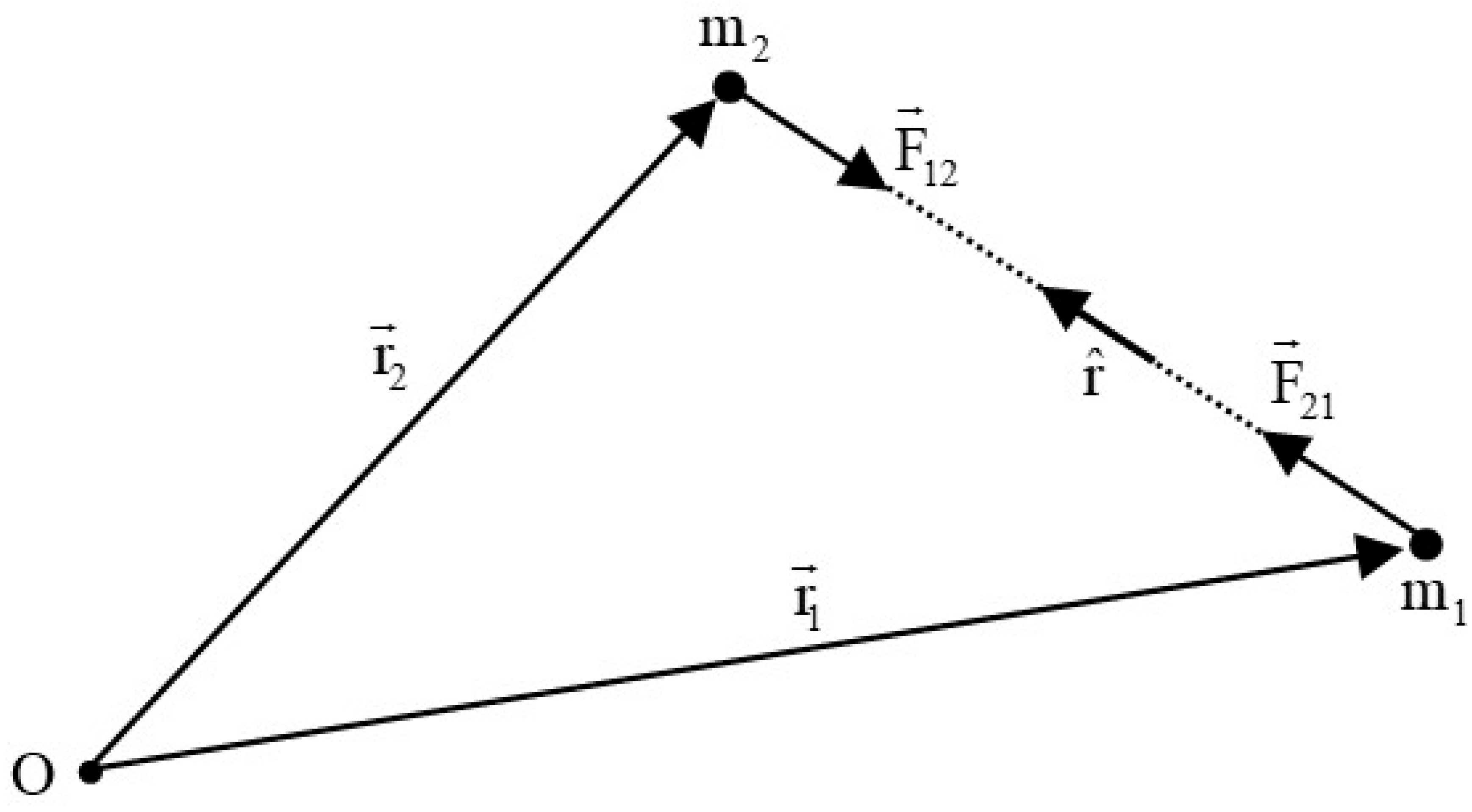
Let us consider two point masses m 1 and m 2 characterised by the position vectors r 1 e r 2 defined with respect to an origin O in an inertial reference system S, as displayed in Figure 1. The two point masses interact through an attractive central gravitational force, whose magnitude is:
F = G m 1 m 2 r 2 r 1 2
Let us assume that there are no external forces acting on the system, i.e., that the system is isolated. By assigning the initial conditions, the problem to be solved hereafter is to study the dynamics of the two point masses.
Let us now denote with S the inertial reference system with origin in the centre of mass CM. The position of the centre of mass of the system is defined by the vector:
r cm = m 1 r 1 + m 2 r 2 m 1 + m 2
The equation of translational dynamics of a system of point masses is F ( E x t ) = M tot a cm , where F ( E x t ) is the sum of the external forces, M tot the total mass and a cm the acceleration of the centre of mass CM. For isolated systems (i.e., when F ( E x t ) = 0 ), we obtain a cm = 0 . This means that the center of mass has a uniform motion with constant velocity V cm and its equation of motion is r c m = r 0 c m + V cm t , where r 0 cm is the position vector at the time t = 0 .
In the reference system of the CM, the position and velocity vectors of the two point masses m 1 and m 2 are, respectively:
r 1 = r 1 r cm = m 2 m 1 + m 2 r r 2 = r 2 r cm = m 1 m 1 + m 2 r         v 1 = m 2 m 1 + m 2 v r v 2 = m 1 m 1 + m 2 v r
where r = r 2 r 1 and v r = v 2 v 1 are, respectively, the relative position and velocity of the two point masses. Note that the vectors r 1 and r 2 are proportional to r , one with the same sign and one with an opposite sign, respectively. This means that, in the reference system of the centre of mass, at every time instant the two point masses are always aligned with the centre of mass itself, on opposite sides of the same.
In a next step, it is possible to demonstrate that the two-body problem is equivalent to a single-body problem. Specifically, denoted with M = m 1 + m 2 the total mass of the system, the single body has a mass:
μ = m 1 m 2 m 1 + m 2 = m 1 m 2 M
also known as reduced mass, which is located at a distance equal to r = r 2 r 1 from the centre of mass (i.e., exactly where the total mass M is located).
By solving the equation of motion of the reduced mass, one can write:
r = p 1 + e cos ϑ ϑ 0
which is the equation of a conic in polar coordinates, with the pole coincident with a focus, and with eccentricity e and parameter p that are given, respectively, by:
e = 1 + 2 E μ 3 L z G M 2
p = 1 G M L z μ 2
where E is the mechanical (i.e., kinetic and potential) energy of the two point masses m 1 and m 2 (or of the reduced mass μ only) in the reference S , whereas L z is the component of the angular moment perpendicular to the plane of the orbit of the two point masses m 1 and m 2 (or of the reduced mass μ only) with respect to the centre of mass. The complete derivation of Equations (5)–(7) is reported in Appendix A.
In Equation (5) the constant ϑ 0 can be calculated through the initial condition r ( 0 ) = R . Depending on the value of the eccentricity e, the trajectory of the reduced mass will be:
  • a circumference, if e = 0 ;
  • an ellipse, if 0 < e < 1 ;
  • a parabola, if e = 1 ;
  • a hyperbola, if e > 1 .
Let us denote the coordinates of the position of the reduced mass μ as x μ and y μ , which can be written as function of the angular parameter ϑ as:
x μ = r cos ϑ y μ = r sin ϑ
where r is given by Equation (5). It is comfortable to introduce here also the additional parameter ξ , which will be used to write the expressions of x μ , y μ and the time t. Only in the case the trajectory of the reduced mass is circular, the coordinates of its position can be written in closed form as function of time.
For ϑ 0 = 0 it is possible to demonstrate the resulting trajectories listed in Table 1.

2.2. Equations of Motion

The cartesian coordinates of the two masses m 1 and m 2 are, respectively:
x 1 = m 2 m 1 + m 2 x μ y 1 = m 2 m 1 + m 2 y μ
x 2 = m 1 m 1 + m 2 x μ y 2 = m 1 m 1 + m 2 y μ
These relations can be written, by employing Equation (8), as function of the parameter ϑ , which then leads to the cartesian equations of the trajectories. In order to write the equations of motion, it is necessary to use the expressions in Table 1, together with the corresponding parametric equations of time (or the closed-form solution for circular trajectories, if it is the case).
Finally, rearranging Equation (3), we get the position vectors of the two point masses in the original reference system, i.e.:
r 1 = r cm + r 1 r 2 = r cm + r 2         r 1 = r cm m 2 m 1 + m 2 r r 2 = r cm + m 1 m 1 + m 2 r         r 1 = r 0 cm + V cm t m 2 m 1 + m 2 r r 2 = r 0 cm + V cm t + m 1 m 1 + m 2 r

3. Practical Problems

3.1. Elliptical Trajectories in the Reference System of the Centre of Mass

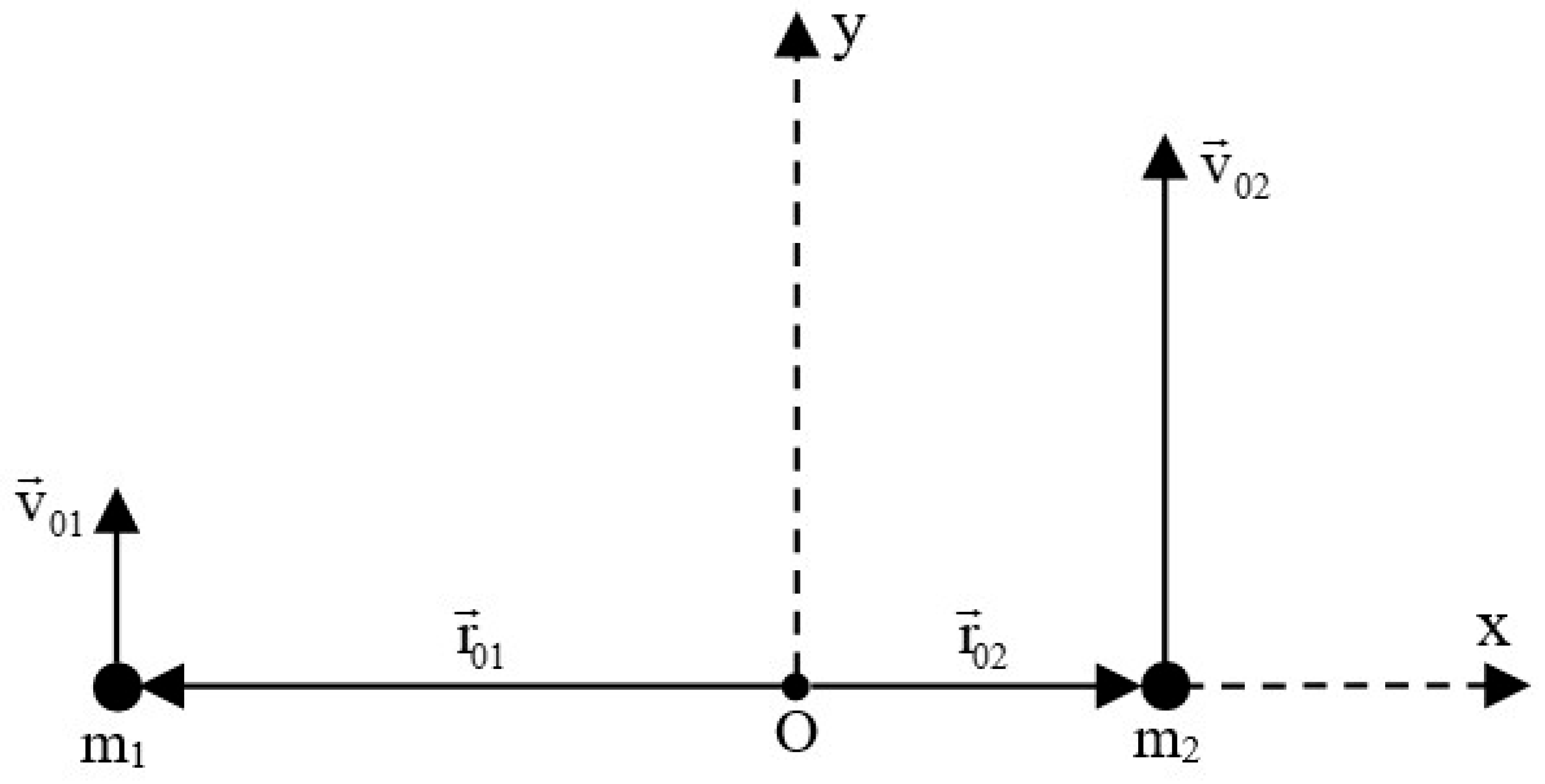
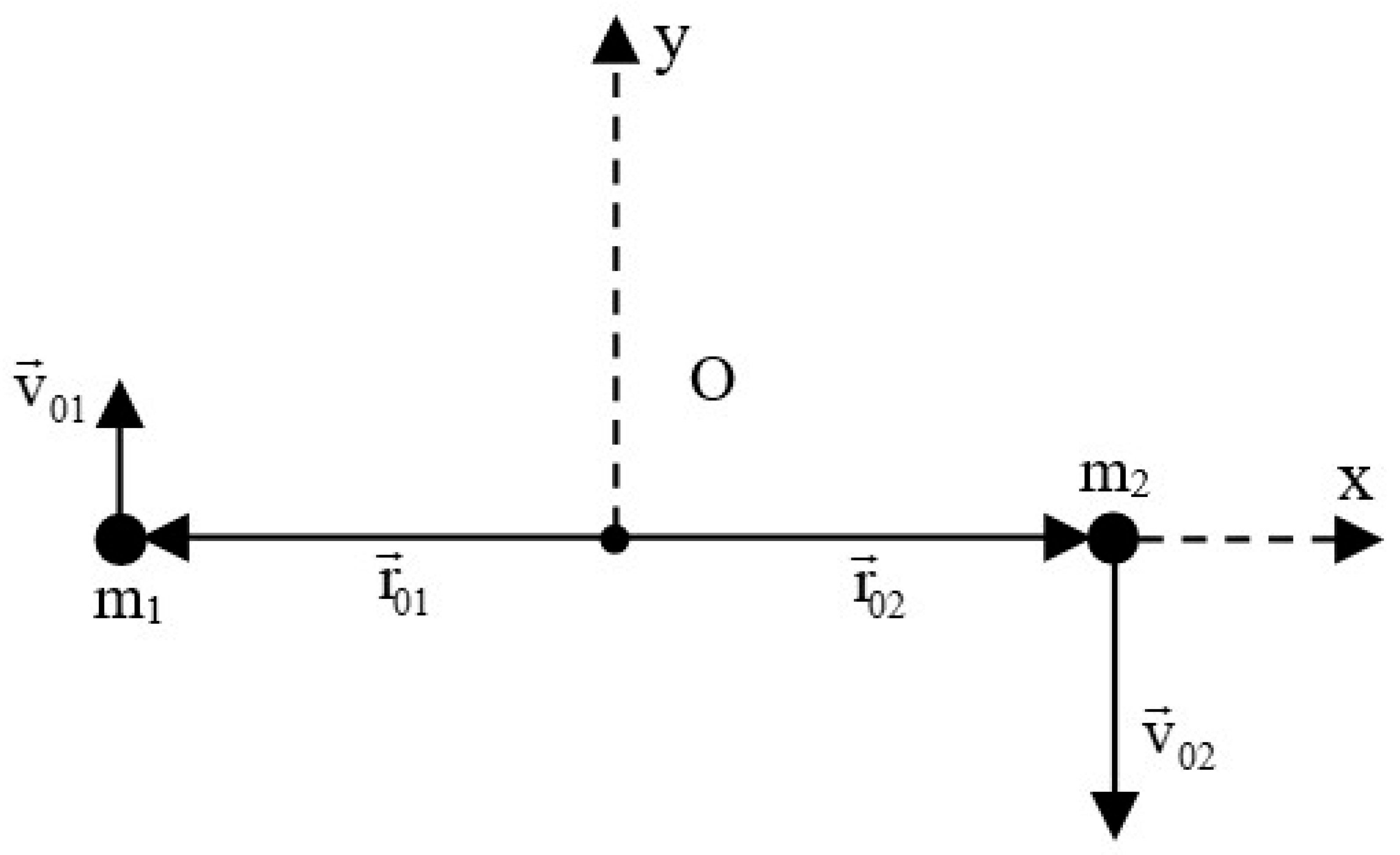
Let us consider an inertial reference system S with axes xyz and origin O, whose unit vectors are x ^ , y ^ and z ^ . The two point masses m 1 = m 0 and m 2 = 5 m 0 , at the time instant t = 0 , have the following initial positions and velocities:
r 01 = 2 r 0 , 0                   v 01 = 0 , v 0
r 02 = r 0 , 0                           v 02 = 0 , 3 v 0
with v 0 = 4 5 G m 0 r 0 , as depicted in Figure 2. Only two of the three parameters m 0 , r 0 and v 0 are independent. Therefore, hereinafter we write the results of the problem as function of only two parameters. In addition, we will attribute a unit value to these parameters, in order to allow for graphical and/or numerical comparisons.
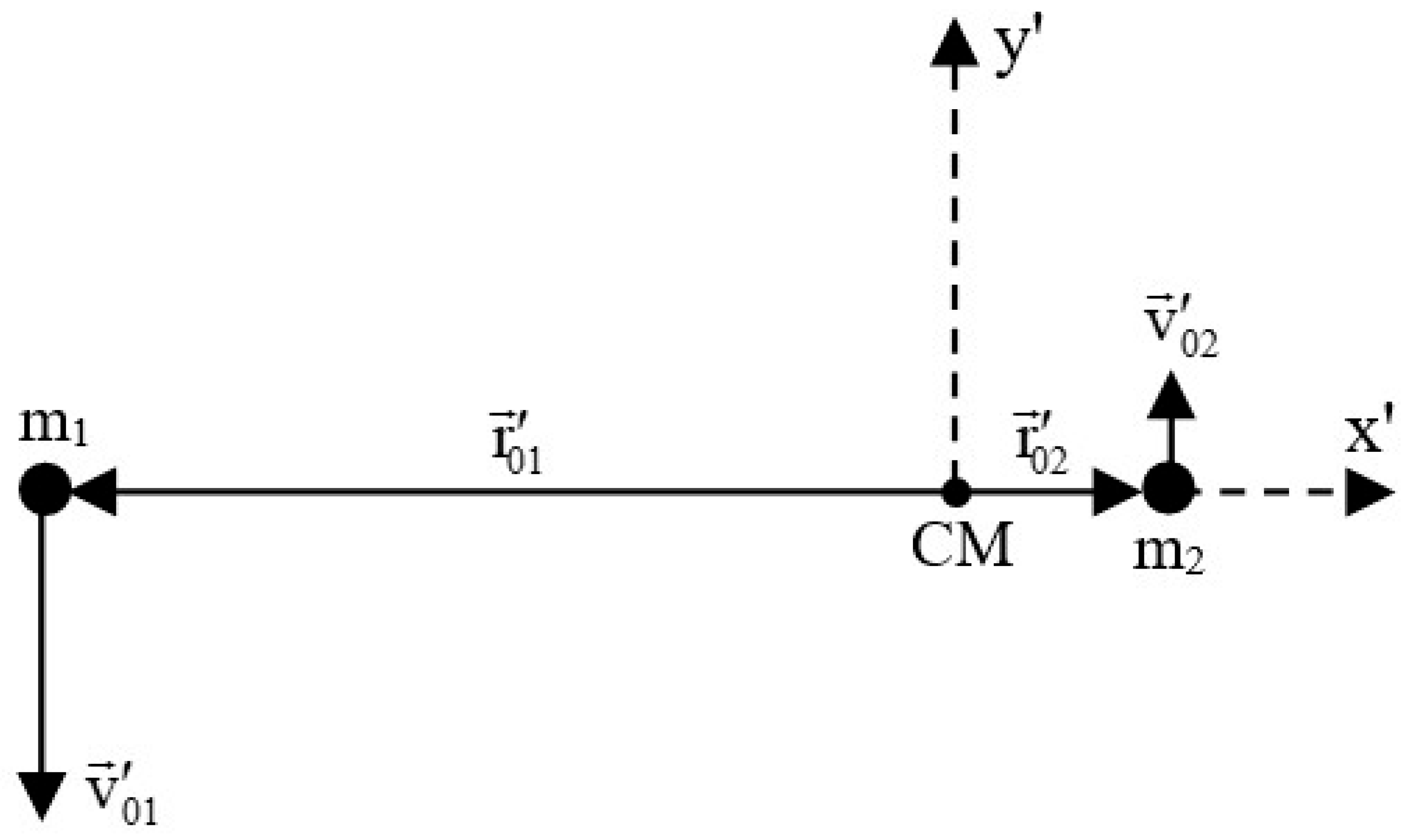
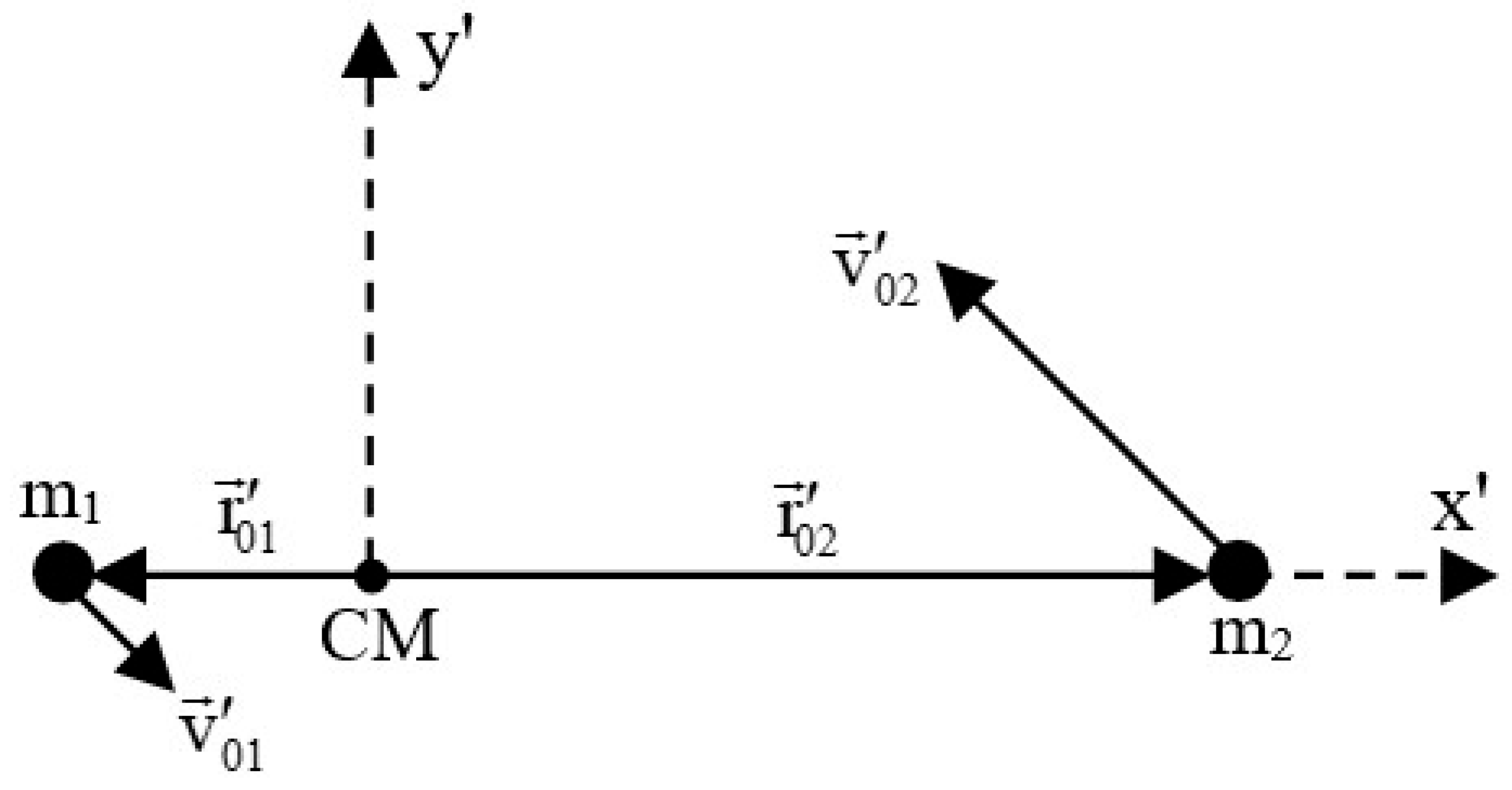
Note that the axes x , y and z of the reference system S are parallel to the axes x , y and z , respectively, of the reference system S. Figure 3 displays the initial positions and velocities of the two point masses, as reported in Table 2.
Table 2. lists the main characteristics of the considered systems, with regards to masses and initial conditions.
The initial mechanical energy and angular moment in the reference system S′ are given, respectively, by:
E = 1 2 m 1 v 01 2 + 1 2 m 2 v 02 2 G m 1 m 2 r = 1 2 · m 0 · 25 9 v 0 2 + 1 2 · 5 m 0 · v 0 2 9 G m 0 · 5 m 0 3 r 0 = 5 3 m 0 v 0 2 5 G m 0 2 3 r 0
L = r 01   m 1 v 01 + r 02   m 2 v 02 = 5 2 r 0 5 3 m 0 v 0 z ^ + r 0 2 5 3 m 0 v 0 z ^ = 5 r 0 m 0 v 0 z ^
and, substituting the expression of v 0 written above, we obtain:
E = 3 5 G m 0 2 r 0
L z = 4 m 0 G m 0 r 0
Starting from Equation (6), we can now substitute the values of E and L z into the eccentricity and obtain, considering the values of the two point masses m 1 = m 0 and m 2 = 5 m 0 , that e = 7 / 25 < 1 . Therefore, the trajectory is elliptical. The sign of the rotation (i.e., clockwise or counterclockwise) can be obtained from the right-hand rule considering the sign of L .
Considering the expression (7) of the parameter p = 1 G M L z μ 2 , we obtain, in this case, p = ( 96 / 25 ) r 0 . By inserting these values of e and p into Equation (5), we obtain the trajectory of the reduced mass as r = 96 / 25 r 0 1 + 7 / 25 cos ( ϑ ϑ 0 ) , where the constant ϑ 0 must be computed. Let us fix the polar axis of the trajectory coincident with the unit vector x ^ and with origin in CM. By applying the initial condition r ( 0 ) = R = 3 r 0 , we obtain cos ϑ 0 = 1 and thus ϑ 0 = 0 . Finally, the polar equation of the trajectory of the reduced mass is:
r = 96 / 25 r 0 1 + 7 / 25 cos ϑ
and the cartesian coordinates of the position of μ as function of ϑ are given by:
x μ = r cos ϑ = 96 / 25 r 0 cos ϑ 1 + 7 / 25 cos ϑ y μ = r sin ϑ = 96 / 25 r 0 sin ϑ 1 + 7 / 25 cos ϑ     r 0 = 1     x μ = 96 / 25 cos ϑ 1 + 7 / 25 cos ϑ y μ = 96 / 25 sin ϑ 1 + 7 / 25 cos ϑ
It is now possible to use Equation (14b) to obtain the cartesian equations of the trajectories of the point masses m 1 and m 2 in the reference system of the centre of mass, i.e., respectively:
  r 1 = m 2 m 1 + m 2 r           x 1 = 5 6 x μ y 1 = 5 6 y μ           x 1 = 16 / 5 cos ϑ 1 + 7 / 25 cos ϑ y 1 = 16 / 5 sin ϑ 1 + 7 / 25 cos ϑ
r 2 = m 1 m 1 + m 2 r           x 2 = 1 6 x μ y 2 = 1 6 y μ           x 2 = 16 / 25 cos ϑ 1 + 7 / 25 cos ϑ y 2 = 16 / 25 sin ϑ 1 + 7 / 25 cos ϑ
The corresponding cartesian equations of the elliptical trajectory can be obtained by eliminating the angle ϑ from Equation (15). By dividing the right side of the first of the Equation (15a) with the second one, we obtain tan ϑ = y 1 / x 1 and cos ϑ = x 1 / x 1 2 + y 1 2 . Therefore, for the two point masses we obtain finally:
576 x 1 2 + 625 y 1 2 1120 x 6400 = 0
576 x 2 2 + 625 y 2 2 + 224 x 2 256 = 0
which are the implicit equations of the two ellipses.
In order to obtain the equations of motion of the two point masses m 1 and m 2 in the reference system of the centre of mass, it is necessary to start from the expression of the semi-major axis of the ellipse reported in Table 1. In our case, we get a = 25 6 r 0 and, from the equations of the coordinates of μ listed in the same Table 1, we obtain:
x μ = a cos ξ e y μ = a 1 e 2 sin ξ         x μ = 25 6 r 0 cos ξ 7 25 y μ = 4 r 0 sin ξ     r 0 = 1     x μ = 25 6 cos ξ 7 25 y μ = 4 sin ξ
Consequently, the equations of motion of the two point masses are, respectively:
  r 1 = m 2 m 1 + m 2 r           x 1 = 5 6 x μ y 1 = 5 6 y μ           x 1 = 125 36 cos ξ 7 25 y 1 = 10 3 sin ξ
r 2 = m 1 m 1 + m 2 r           x 2 = 1 6 x μ y 2 = 1 6 y μ         x 2 = 25 36 cos ξ 7 25 y 2 = 2 3 sin ξ
The same Table 1 reports the value of t, which represents the parametric time equation. In the reference system of the centre of mass, the initial position of the point mass m 1 as function of the parameter ξ 0 is given by:
  x 1 ( 0 ) = 125 36 cos ξ 0 7 25 y 1 ( 0 ) = 10 3 sin ξ 0
but we know also the explicit value of the initial position of m 1 , i.e.,:
  x 1 ( 0 ) = ( 5 / 2 ) r 0 y 1 ( 0 ) = 0     r 0 = 1     x 1 ( 0 ) = 5 / 2 y 1 ( 0 ) = 0
By comparing Equation (19b) with Equation (19a), we obtain ξ 0 = 0 . Therefore, the parametric time equation simplifies into t = a 3 G M ξ e sin ξ . By substituting the values of a, e and M corresponding to the considered case and found above, we obtain finally:
t = 125 36 r 0 r 0 G m 0 ξ 7 25 sin ξ       r 0 = 1 ,   v 0 = 1     t = 25 9 ξ 7 25 sin ξ
where in the last step we have substituted the quantity r 0 G m 0 = 4 5 v 0 introduced above.
From Equation (10) it is possible to easily obtain the equations of motion of the two point masses m 1 and m 2 in the original reference system. By combining Equation (10) with Equation (18), in fact, we obtain, respectively:
r 1 = r cm + r 1         x 1 = x cm + x 1 y 1 = y cm + y 1           x 1 = 1 2 125 36 cos ξ 7 25 y 1 = 200 27 ξ 7 25 sin ξ 10 3 sin ξ
r 2 = r cm + r 2         x 2 = x cm + x 2 y 2 = y cm + y 2           x 2 = 1 2 + 25 36 cos ξ 7 25 y 2 = 200 27 ξ 7 25 sin ξ + 2 3 sin ξ
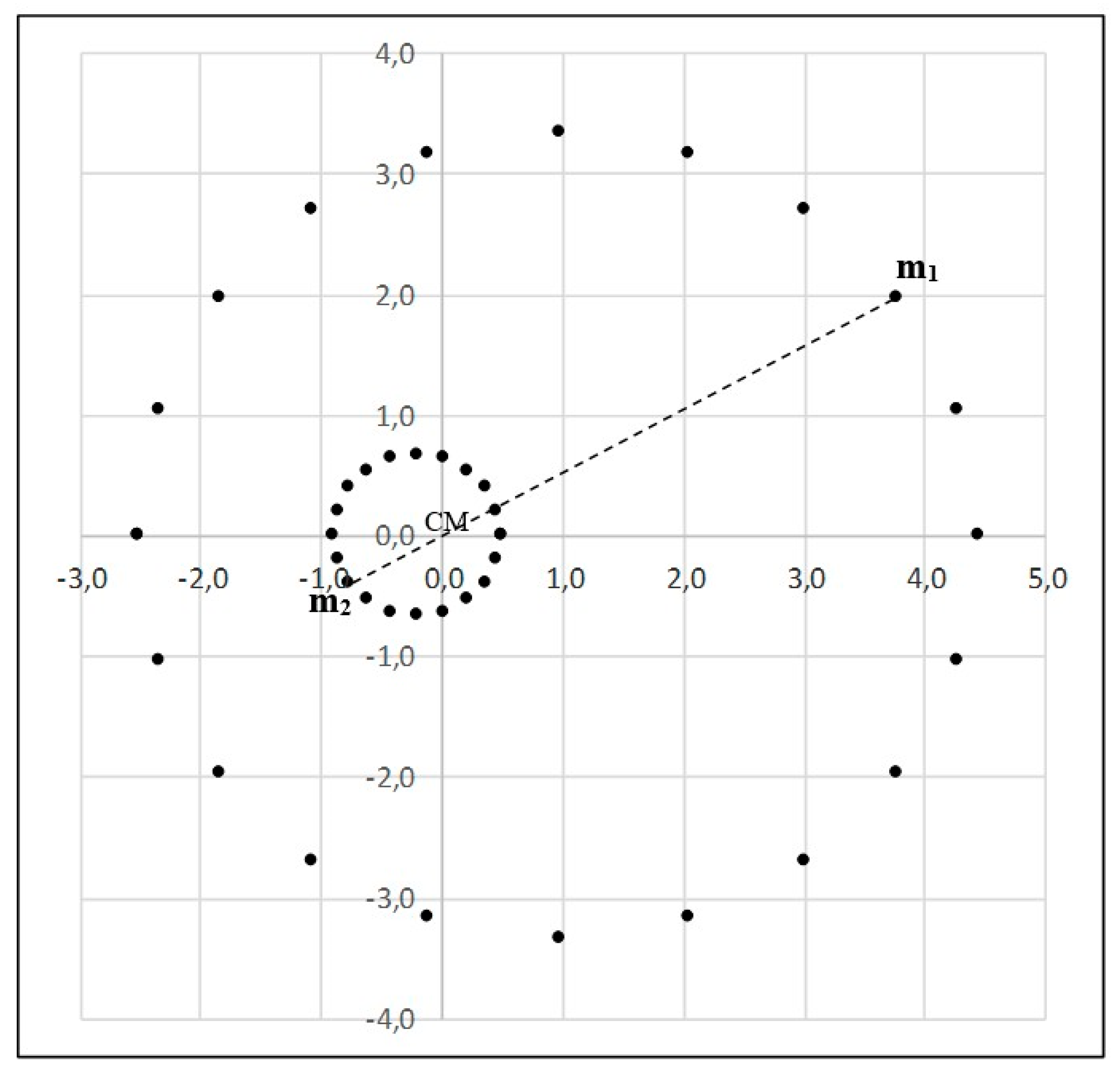
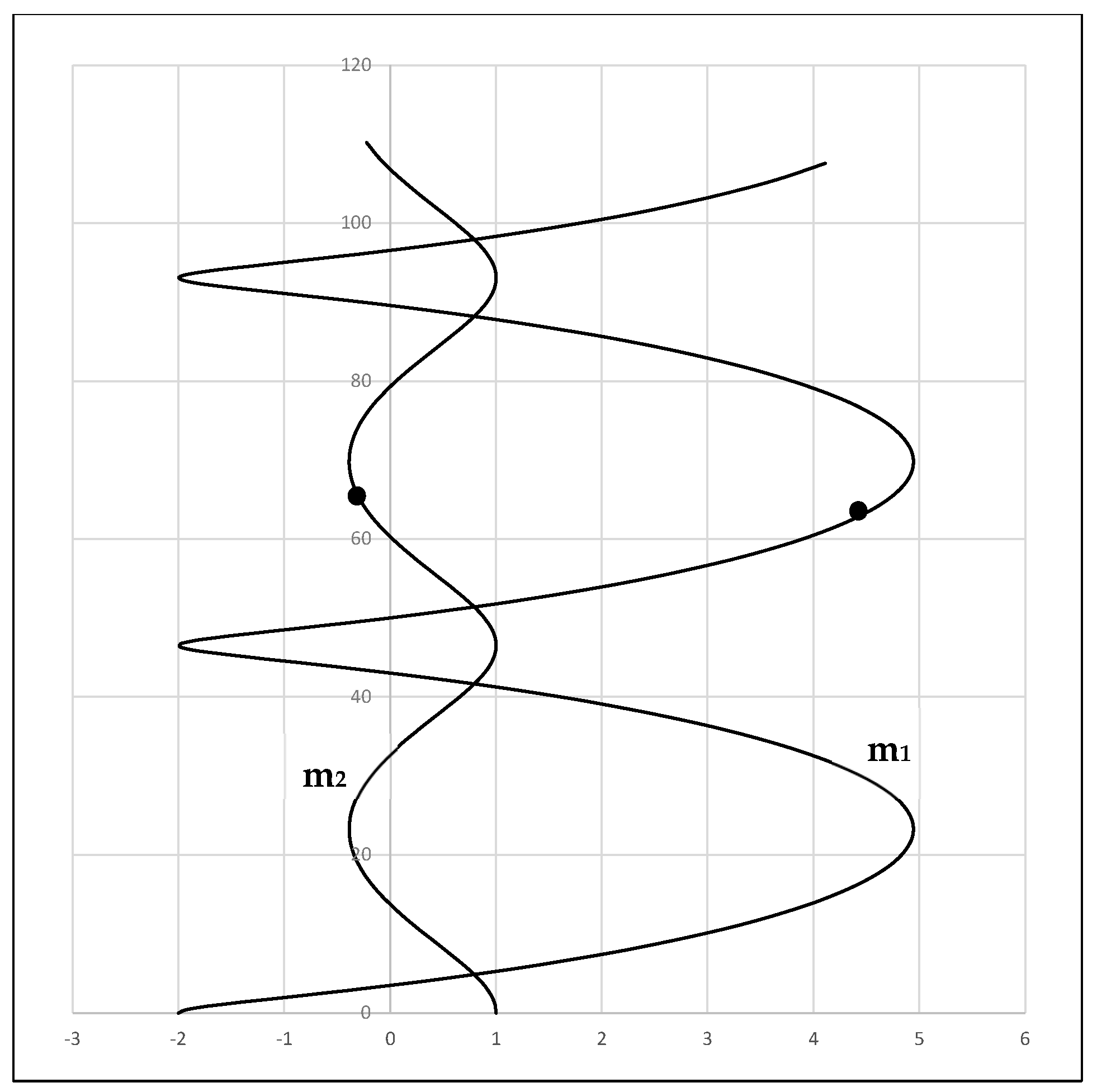
Since ξ 0 = 0 , the parameter ξ can assume values between 0 and 2 π (i.e., in the counterclockwise direction of the ellipses). Table 3 lists the values of ξ with a π / 10 step: for each value, the corresponding time instants and the coordinates of the two point masses in the reference of the CM are reported. Figure 4 displays the positions of the two point masses as function of time. It can be seen that, as expected, the two point masses in each time instant are aligned with the common centre of mass, on opposite sides of the same. Note also that, when ξ = 2 π , the two point masses reach again the initial positions.
From Table 3 we can also note that the period of the two ellipses is T = 17.4533   s . This value can be easily verified by applying the Kepler’s third law, i.e.,:
  T 2 = 4 π 2 G M a 3         T 2 = 4 π 2 G · 6 m 0 25 6 r 0 3         T = 125 π 18 r 0 r 0 G m 0
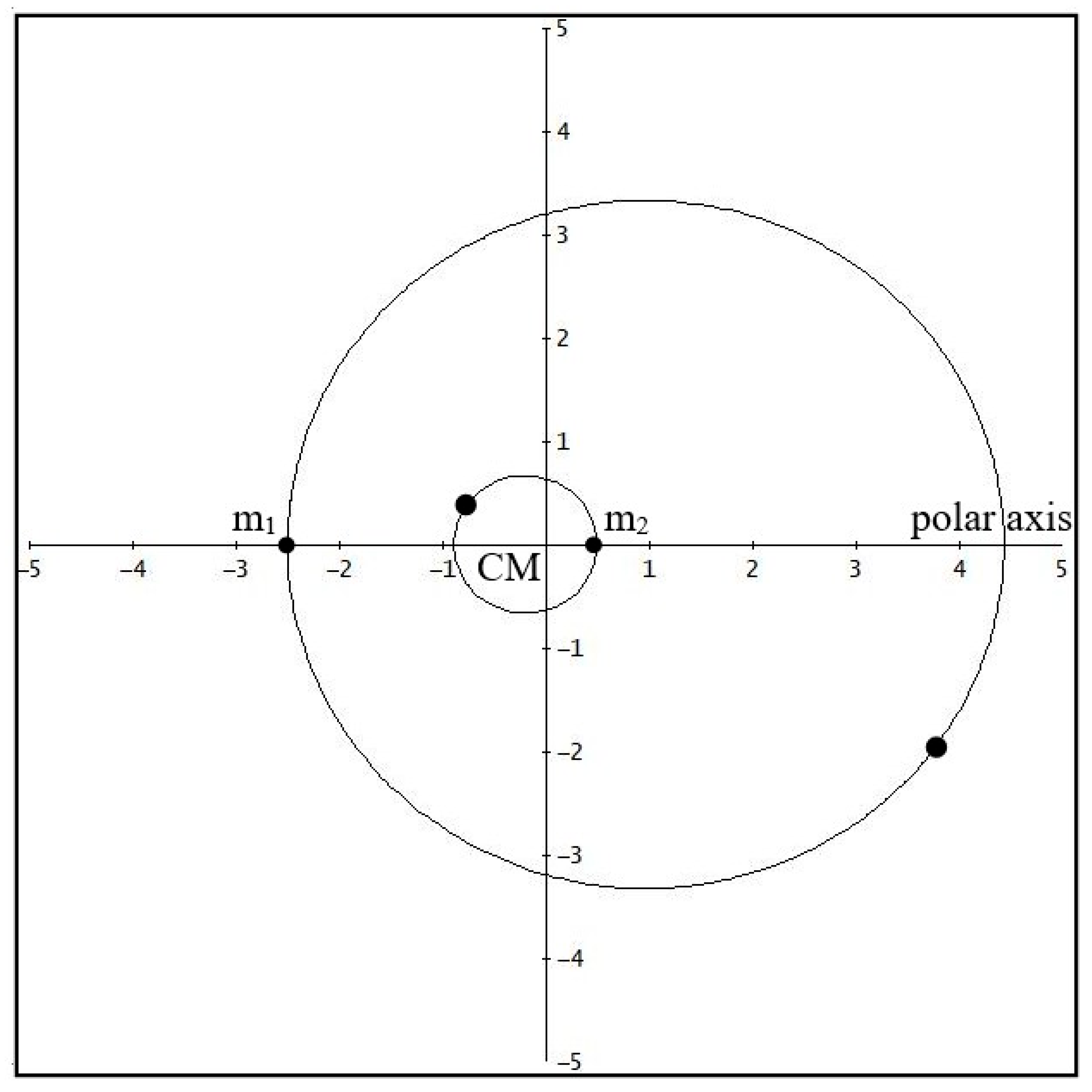
and, by substituting in Equation (22) the quantity r 0 G m 0 = 4 5 v 0 , we retrieve the mentioned numerical value. Figure 5 and Figure 6 display the trajectories of the two point masses in the reference system of the CM and in the original reference system, respectively.

In order to compute the coordinates of the two point masses m 1 and m 2 at any given time instant t ˜ , it is necessary to solve the parametric Equation (20) and to find the corresponding value ξ ˜ . The latter can be then inserted into Equation (21) for obtaining the coordinates.
In order to consider a practical application in the Solar System, we can take into consideration the Halley comet. As it is well known from experimental observations, the Halley comet follows an elliptical orbit around the Sun with a period of about T ≈ 75.4 years and an eccentricity e ≈ 0.967. We can apply Equation (22) to find the major semi-axis of its orbit, i.e., we get a ≈ 2.67⋅1012 m. By considering that the semi-focal distance of an ellipse is given by c = e × a = 2.58 ⋅ 1012 m, we can directly obtain the minimum (perihelion) and maximum distance (aphelion) of the Halley comet from the Sun, i.e., dmin = ac ≈ 0.6 au and dmax = a + c ≈ 35 au, respectively, where au = 1.496 ⋅ 1011 m (astronomical unit: average distance Earth-Sun).

3.2. Circular Trajectories in the Reference System of the Centre of Mass

Let us consider an inertial reference system S with axes xyz and origin O, whose unit vectors are x ^ , y ^ and z ^ . The two point masses m 1 = m 0 and m 2 = 2 m 0 , at the time instant t = 0 , have the following initial positions and velocities:
r 01 = r 0 , 0                         v 01 = 0 , v 0
r 02 = r 0 , 0                         v 02 = 0 , 2 v 0
with v 0 = 1 6 G m 0 r 0 , as depicted in Figure 7. Table 4 lists the main characteristics of the considered system, with regards to masses and initial conditions.
In analogy with Equations (12) and (13), in this case the initial mechanical energy and angular moment are given, respectively, by:
E = 1 2 m 1 v 01 2 + 1 2 m 2 v 02 2 G m 1 m 2 r = 1 2 · m 0 · 4 v 0 2 + 1 2 · 2 m 0 · v 0 2 G m 0 · 2 m 0 2 r 0 = 3 m 0 v 0 2 G m 0 2 r 0
L = r 01   m 1 v 01 + r 02   m 2 v 02 = 4 3 r 0 m 0 · 2 v 0 z ^ 2 3 r 0 2 m 0 · v 0 z ^ = 4 r 0 m 0 v 0 z ^
and, by substituting the expression of v 0 introduced above, we obtain:
E = G m 0 2 2 r 0
L z = 4 6 m 0 G m 0 r 0
Starting from Equation (6), we can now substitute the values of E and L z into the eccentricity and obtain, considering the values of the two point masses m 1 = m 0 and m 2 = 2 m 0 , that e = 0 . Therefore, the trajectory is circular. Again, the sign of the rotation (i.e., clockwise or counterclockwise) can be obtained from the right-hand rule considering the sign of L .
Considering the expression (7) of the parameter p = 1 G M L z μ 2 , we obtain, in this case, p = 2 r 0 . By inserting these values of e and p into Equation (5), we obtain that the trajectory of the reduced mass is a circumference with radius a = p = 2 r 0 .
Let us now compute the argument of the sine and cosine functions in Table 1, i.e., ϑ = L z μ a 2 t + ϑ 0 . Let us fix the polar axis of the trajectory coincident with the unit vector x ^ and with origin in CM. By applying the initial condition ϑ ( 0 ) = 0 , we obtain ϑ 0 = 0 . Considering Equation (25b), we get:
ϑ = L z μ a 2 t + ϑ 0         ϑ = 4 6 m 0 G m 0 r 0 2 3 m 0 · 2 r 0 2 t         ϑ = 3 2 v 0 r 0   t
where we have introduced the expression of v 0 introduced above. Finally, the cartesian coordinates of the position of μ as function of ϑ are given by:
x μ = a cos L z μ a 2 t + ϑ 0 y μ = a sin L z μ a 2 t + ϑ 0         x μ = 2 r 0 cos 3 2 v 0 r 0   t y μ = 2 r 0 sin 3 2 v 0 r 0   t     r 0 = 1 ,   v 0 = 1     x μ = 2 cos 3 2 t y μ = 2 sin 3 2 t
It is now possible to use Equation (27) to obtain the cartesian equations of the trajectories of the point masses m 1 and m 2 in the reference system of the centre of mass, i.e., respectively:
r 1 = m 2 m 1 + m 2 r         x 1 = 2 3 x μ y 1 = 2 3 y μ         x 1 = 4 3 cos 3 2 t y 1 = 4 3 sin 3 2 t
r 2 = m 1 m 1 + m 2 r         x 2 = 1 3 x μ y 2 = 1 3 y μ         x 2 = 2 3 cos 3 2 t y 2 = 2 3 sin 3 2 t
from which we can observe that the mass m 1 follows a circular trajectory with radius 4/3, whereas the mass m 2 a circular trajectory with radius 2/3.
From Equation (10) it is possible to directly obtain the equations of motion of the two point masses m 1 and m 2 in the original reference system. By combining Equation (10) with Equation (28), in fact, we obtain, respectively:
r 1 = r cm + r 1         x 1 = x cm + x 1 y 1 = y cm + y 1         x 1 = 1 3 4 3 cos 3 2 t y 1 = t + 4 3 sin 3 2 t
r 2 = r cm + r 2         x 2 = x cm + x 1 y 2 = y cm + y 2           x 2 = 1 3 + 2 3 cos 3 2 t y 2 = t 2 3 sin 3 2 t
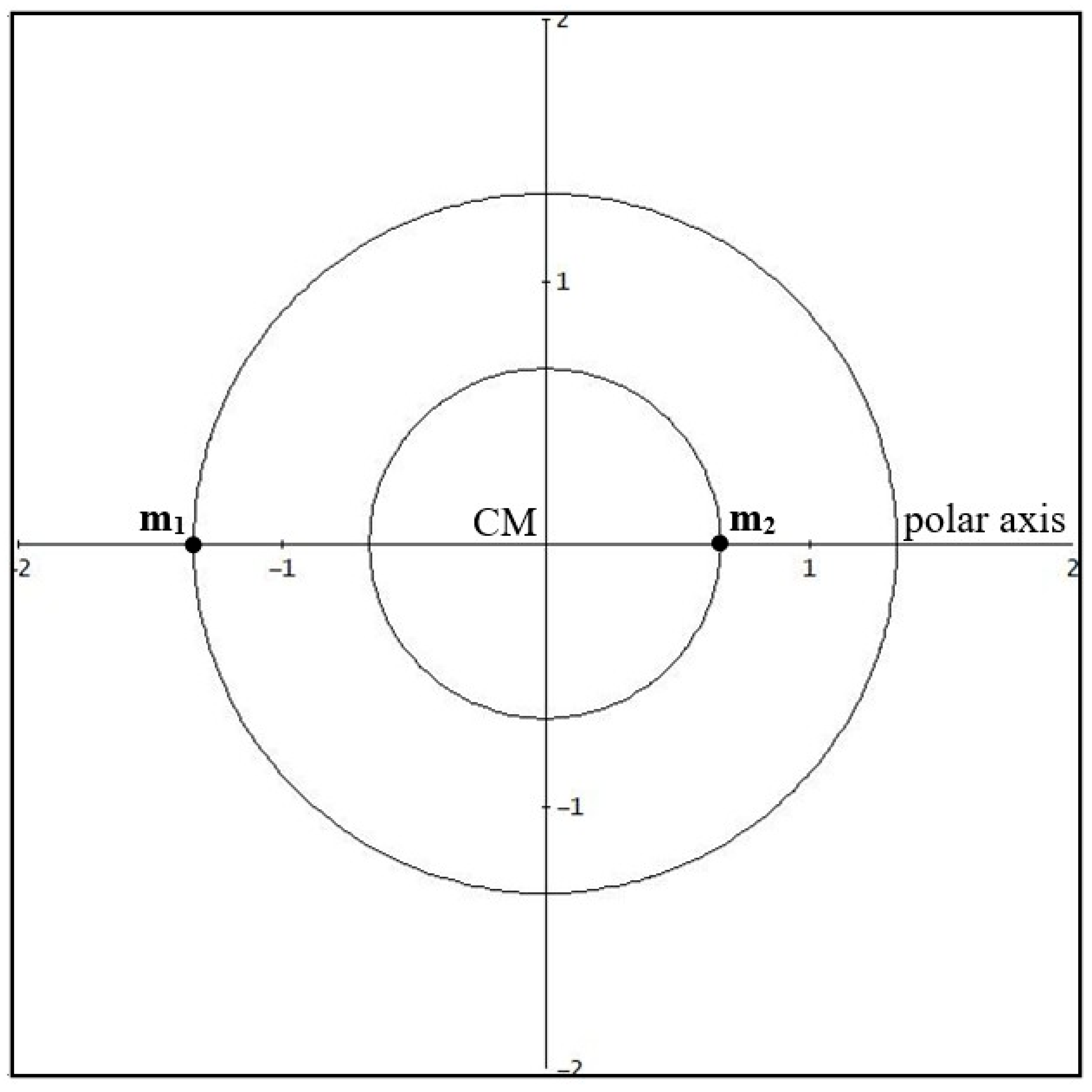
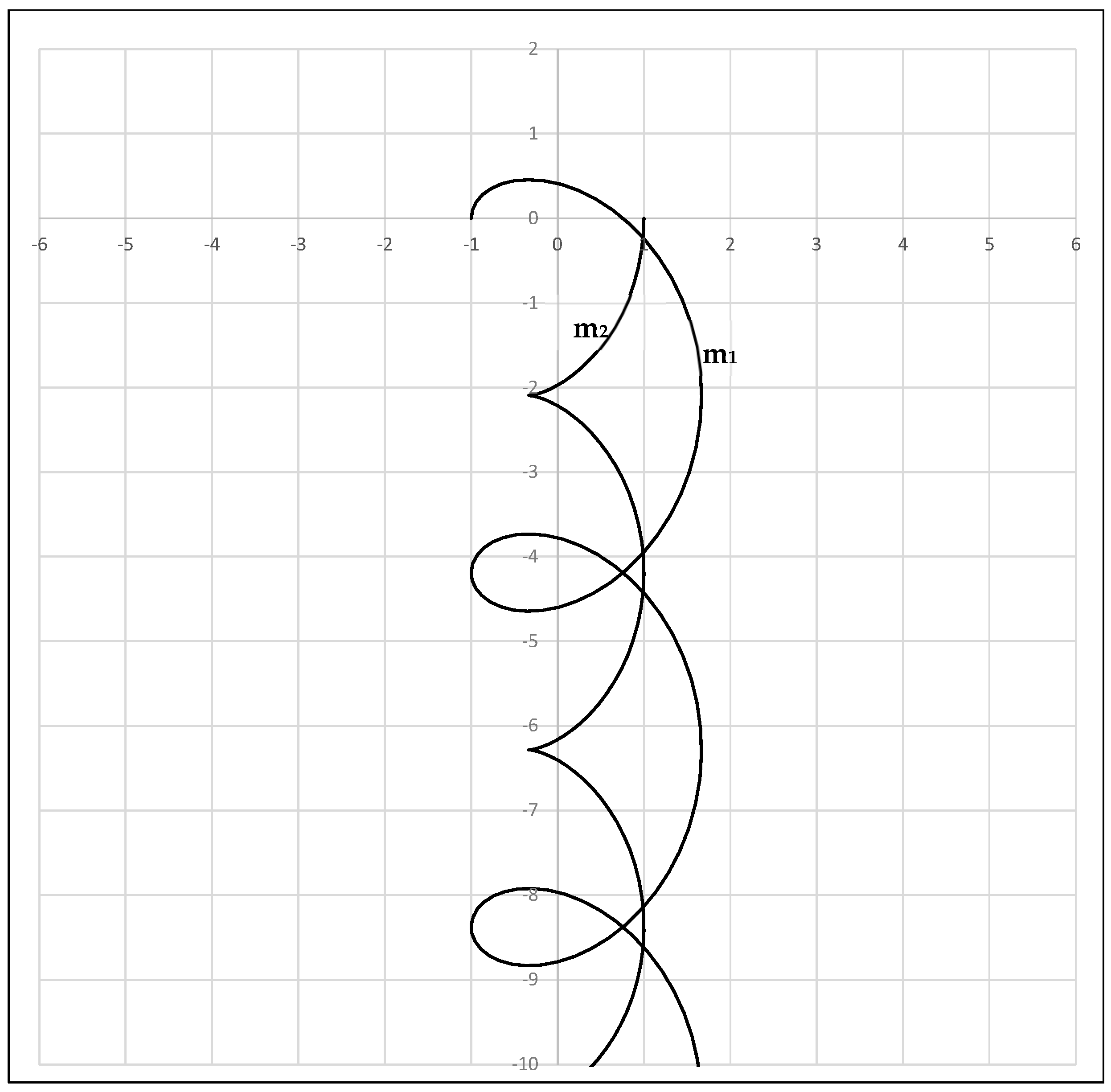
Figure 8 and Figure 9 display the trajectories of the two point masses in the reference system of the CM and in the original reference system, respectively. In the reference system of the CM the angular velocity of the two masses is ω = 3 / 2 . The period of rotation, therefore, is given by T = 2 π ω = 4 π 3 . It can be directly verified that the same value of the period can be obtained from the Kepler’s third law T 2 = 4 π 2 / G M a 3 , indeed:

T 2 = 4 π 2 G · 3 m 0 2 r 0 3         T = 4 π r 0 2 3 r 0 G m 0         T = 4 π 3 r 0 v 0     r 0 = 1 ,   v 0 = 1     T = 4 π 3
where we have substituted the quantity r 0 G m 0 = 1 6 v 0 .

3.3. Parabolic Trajectories in the Reference System of the Centre of Mass

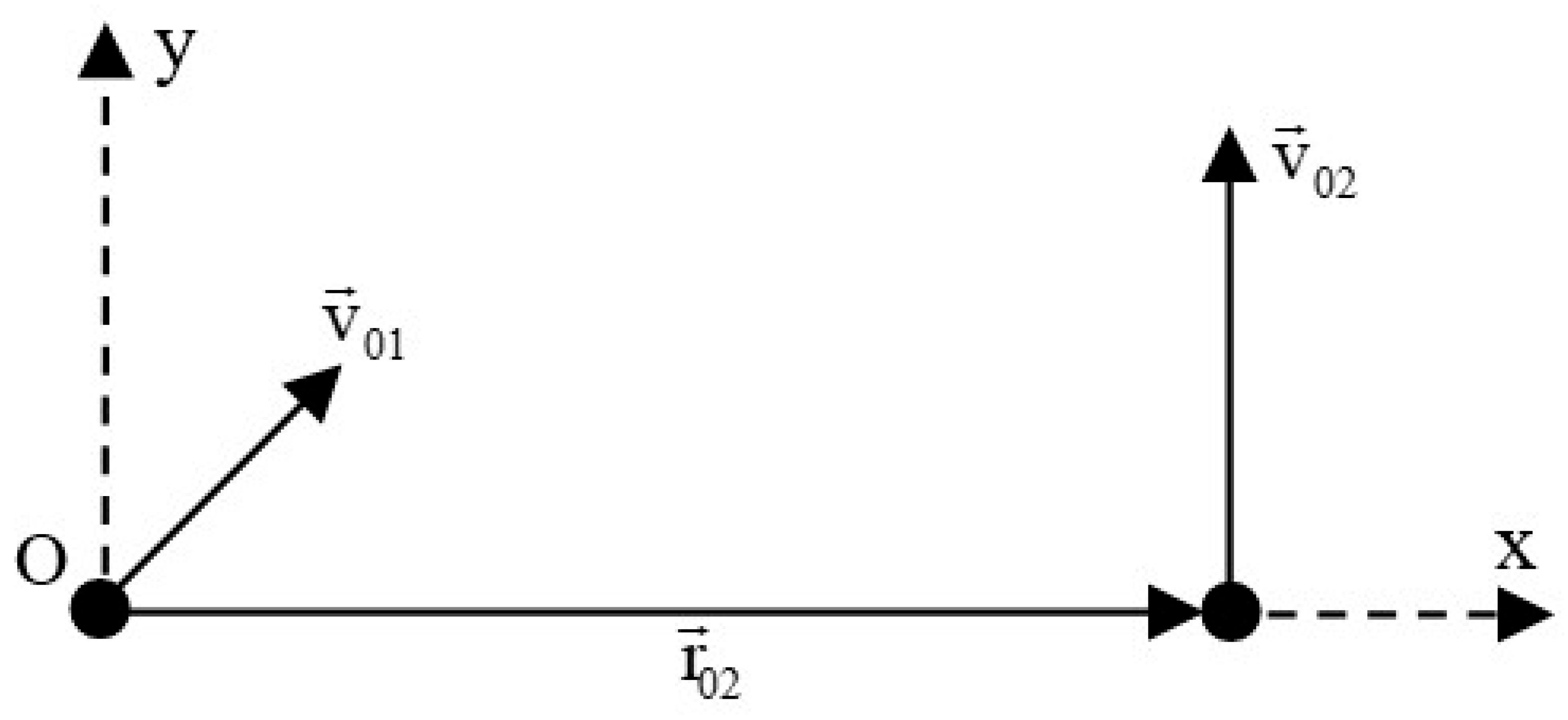
Let us consider an inertial reference system S with axes xyz and origin O, whose unit vectors are x ^ , y ^ and z ^ . The two point masses m 1 = m 0 and m 2 = 3 m 0 , at the time instant t = 0 , have the following initial positions and velocities:
r 01 = 0 , 0                     v 01 = v 0 , v 0
r 02 = r 0 , 0                     v 02 = 0 , 2 v 0
with v 0 = 2 G m 0 r 0 , as depicted in Figure 10. Table 5 lists the main characteristics of the considered system, with regards to masses and initial conditions, quantities related to the mass, position and velocity of the system.
In analogy with Equations (12), (13), (24) and (25), in this case the initial mechanical energy and angular moment are given, respectively, by:
E = 1 2 m 1 v 01 2 + 1 2 v 02 2 G m 1 m 2 r = 1 2 · 3 m 0 · v 0 2 8 + 1 2 · m 0 · 9 8 v 0 2 G 3 m 0 · m 0 r 0 = 3 4 m 0 v 0 2 3 G m 0 2 r 0
L = r 01   m 1 v 01 + r 02   m 2 v 02 = r 0 4 3 m 0 · v 0 4 z ^ + 3 4 r 0 m 0 · 3 4 v 0 z ^ = 3 4 r 0 m 0 v 0 z ^
and, by substituting the expression of v 0 introduced above, we obtain:
E = 0
L z = 3 2 m 0 G m 0 r 0
Starting from Equation (6), we can now substitute the values of E and L z into the eccentricity and obtain, considering the values of the two point masses m 1 = m 0 and m 2 = 2 m 0 , that e = 1 . Therefore, the trajectory is parabolic. Again, the sign of the rotation (i.e., clockwise or counterclockwise) can be obtained from the right-hand rule considering the sign of L .
Considering the expression (7) of the parameter p = 1 G M L z μ 2 , we obtain, in this case, p = r 0 . By inserting these values of e and p into Equation (5), we can estimate the constant ϑ 0 . Let us fix the polar axis along the unit vector x ^ , with origin in CM, and let us consider the initial condition r ( 0 ) = R , with R = r 0 . We obtain cos ϑ 0 = 0 , i.e., ϑ 0 = ± 1 .
Let us now find the proper sign of ϑ 0 . Let us consider, again, Equation (5). The radial component of the velocity of the reduced mass, taking into consideration the expression ϑ ˙ = L z μ r 2 , is given by:
v r = d r d t = d r d ϑ d ϑ d t = ϑ ˙ d r d ϑ         v r = L z μ r 2 d d r p 1 + e cos ϑ ϑ 0 = L z μ r 2 e p sin ϑ ϑ 0 1 + e cos ϑ ϑ 0 2
and, at the time t = 0 , i.e., when ϑ = 0 , we get:
v rad . ( 0 ) = L z μ r ( 0 ) 2 e p sin ( ϑ 0 ) 1 + e cos ( ϑ 0 ) 2         v rad . ( 0 ) = L z μ r ( 0 ) 2 e p sin ϑ 0 1 + e cos ϑ 0 2
Therefore, we have found that the sign of ϑ 0 depends on the signs of v rad . ( 0 ) and L z . We can write the following simple rule:
  • if v r ( 0 ) and L z have opposite signs, then sin ϑ 0 > 0 ;
  • if v r ( 0 ) and L z have the same sign, then sin ϑ 0 < 0 ;
From Figure 11 we observe that, at the initial time instant, the radial component of the velocity of m 2 relative to m 1 is v r ( 0 ) = 3 4 v 0 + v 0 4 = v 0 < 0 . We can compute also v rad . ( 0 ) in the original reference system S. From Figure 10 we get immediately: v r ( 0 ) = 0 + v 0 = v 0 < 0 ). Since v r 0 and L z have opposite signs, we must have sin ϑ 0 > 0 , and therefore sin ϑ 0 = 1 (i.e., ϑ 0 = π / 2 ). Finally, the polar equation of the trajectory of the reduced mass is:
r = r 0 1 + cos ϑ π / 2         r = r 0 1 + sin ϑ
and the cartesian coordinates of the position of μ as function of ϑ are given by:
x μ = r cos ϑ = r 0 cos ϑ 1 + sin ϑ y μ = r sin ϑ = r 0 sin ϑ 1 + sin ϑ     r 0 = 1     x μ = cos ϑ 1 + sin ϑ y μ = s i n ϑ 1 + sin ϑ
It is now possible to use Equation (35b) to obtain the cartesian equations of the trajectories of the point masses m 1 and m 2 in the reference system of the centre of mass, i.e., respectively:
  r 1 = m 2 m 1 + m 2 r           x 1 = 1 4 x μ y 1 = 1 4 y μ           x 1 = cos ϑ 4 1 + sin ϑ y 1 = s i n ϑ 4 1 + sin ϑ
  r 2 = m 1 m 1 + m 2 r           x 1 = 3 4 x μ y 2 = 3 4 y μ           x 1 = 3 cos ϑ 4 1 + sin ϑ y 1 = 3 s i n ϑ 4 1 + sin ϑ
From Equation (36a) it is possible to remove the parameter ϑ , obtaining y 1 = 2 x 1 2 ( 1 / 8 ) . The latter is the equation of a parabola with an axis of symmetry parallel to the y axis and its concavity is up. The relevant part of this parabola is the arc defined by the condition x 1 1 / 4 , which, starting from the initial position 1 / 4 , 0 , is described in counterclockwise direction.
In an analogous way, by removing the parameter ϑ from Equation (36b), we get y 2 = ( 2 / 3 ) x 2 2 + ( 3 / 8 ) . The latter is a parabola with an axis of symmetry parallel to the y axis and its concavity is down. The relevant part of this parabola is the arc defined by the condition x 2 3 / 4 , which, starting from the initial position 3 / 4 , 0 , is described in clockwise direction.
It is possible to write Equation (36) also in a parametric form, by starting from the equation of motion of the reduced mass. With respect to the considered polar axis defined by the angle ϑ 0 = π / 2 , the cartesian coordinates of the position of μ are given in Table 1, i.e.,:
  x μ * = p 2 1 ξ 2 y μ * = p ξ         x μ * = r 0 2 1 ξ 2 y μ * = r 0 ξ     r 0 = 1     x μ * = 1 2 1 ξ 2 y μ * = ξ
where we have introduced the * symbol to denote the coordinates in the reference system with origin in CM but rotated of the angle ϑ 0 . By considering that:
  x = x * cos ϑ 0 y * sin ϑ 0 y = x * sin ϑ 0 + y * cos ϑ 0     ϑ 0 = π / 2     x = y * y = x *
we obtain the coordinates of μ in the reference system x , y , i.e.,:
  x = y * y = x *         x μ = y μ * = ξ y μ = x μ * = 1 2 1 ξ 2
Therefore, the cartesian equations of the trajectories of the point masses m 1 and m 2 in the new parametric form can be written as:
r 1 = m 2 m 1 + m 2 r           x 1 = 1 4 x μ y 1 = 1 4 y μ         x 1 = ξ 4 y 1 = 1 8 1 ξ 2
  r 2 = m 1 m 1 + m 2 r           x 1 = 3 4 x μ y 2 = 3 4 y μ           x 1 = 3 4 ξ y 2 = 3 8 1 ξ 2
In order to find the parametric time equation, in the case of parabolic trajectories we have to consider that, for instance, the mass m 2 can move only in the area defined by the conditions x 2 3 / 4 and y 2 3 / 8 . From Equation (38), we get:
  3 4 ξ 3 4 3 8 1 ξ 2 3 8         ξ 1 ξ         ξ 1
thus, the value of the parameter ξ for t = 0 is ξ 0 = 1 . From the time equation in Table 1, we obtain:
t = 1 2 p 3 G M ξ + ξ 3 3 ξ 0 + ξ 0 3 3     t = 1 2 p 3 G M ξ + ξ 3 3 + 4 3     t = 1 4 r 0 r 0 G m 0 ξ + ξ 3 3 + 4 3
where we have substituted the values p = r 0 and M = 4 m 0 . Finally, by substituting the expression v 0 = 2 G m 0 r 0 , we obtain:
t = 1 4 r 0 2 v 0 ξ + ξ 3 3 + 4 3   r 0 = 1 , v 0 = 1   t = 1 2 ξ + ξ 3 3 + 4 3
From Equation (10) it is possible to directly obtain the equations of motion of the two point masses m 1 and m 2 in the original reference system. By combining Equations (10) and (40b) with Equation (38), in fact, we obtain, respectively:
r 1 = r cm + r 1         x 1 = x cm + x 1 y 1 = y cm + y 1         x 1 = 1 8 6 + 5 ξ + ξ 3 y 1 = 1 24 17 + 15 ξ + 3 ξ 2 + 5 ξ 3
r 2 = r cm + r 2         x 2 = x cm + x 2 y 2 = y cm + y 2         x 2 = 1 8 6 3 ξ + ξ 3 y 2 = 1 24 29 + 15 ξ 9 ξ 2 + 5 ξ 3
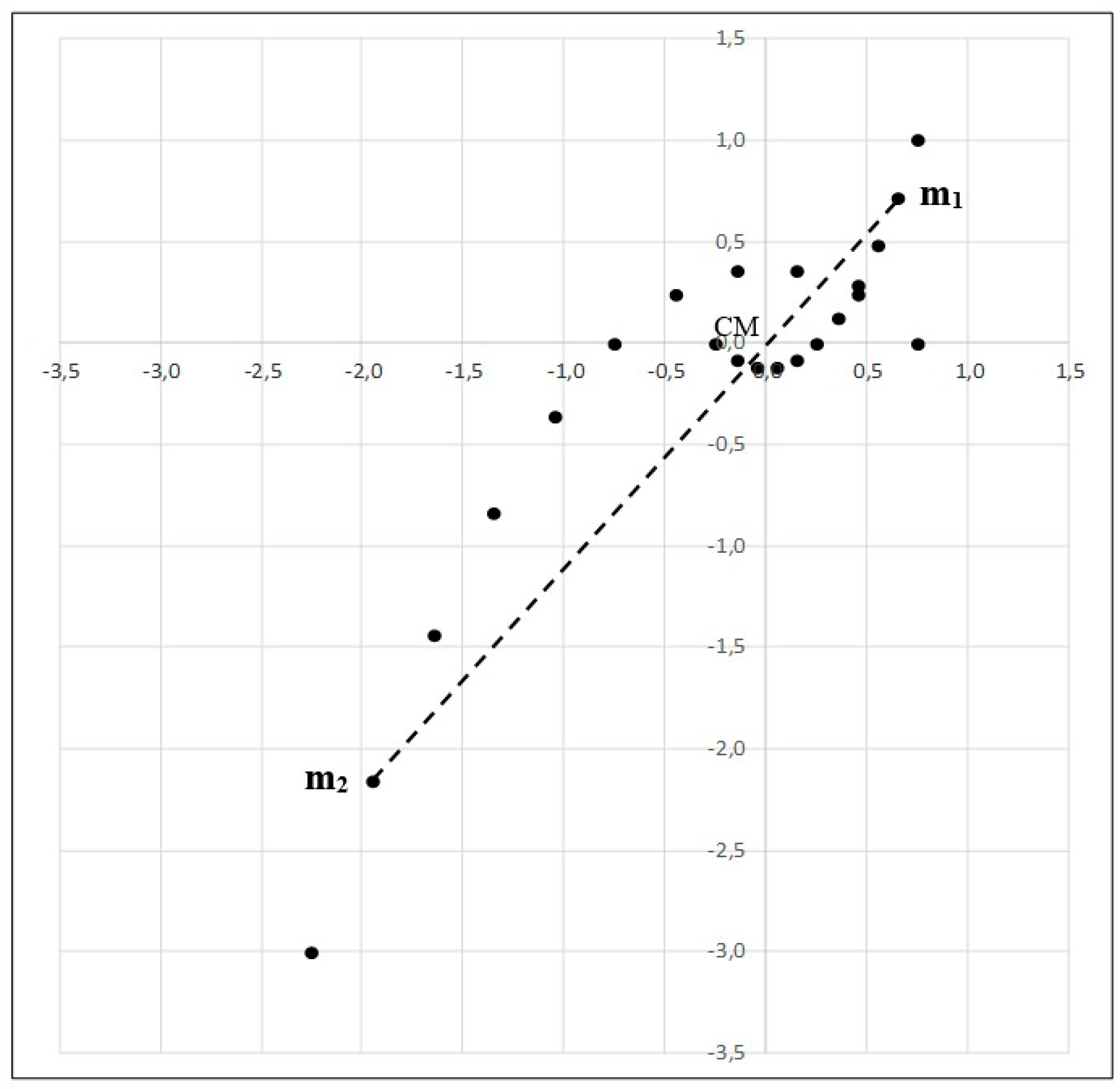
Table 6 reports the coordinates of the two point masses for values of the parameter ξ between −1 and 3 (please note that it must be ξ 1 ). Figure 12 displays the positions of the two point masses as function of time.
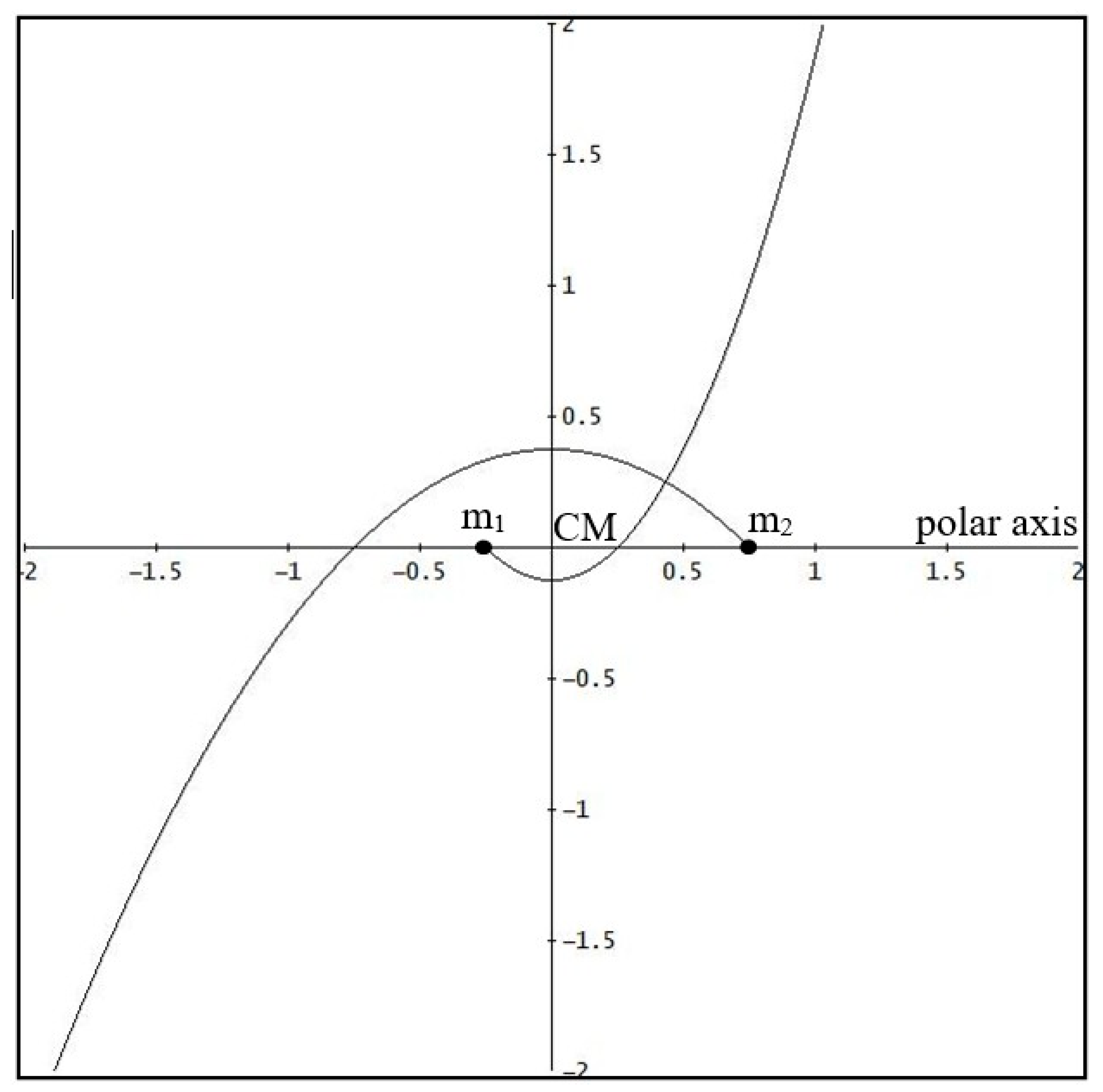
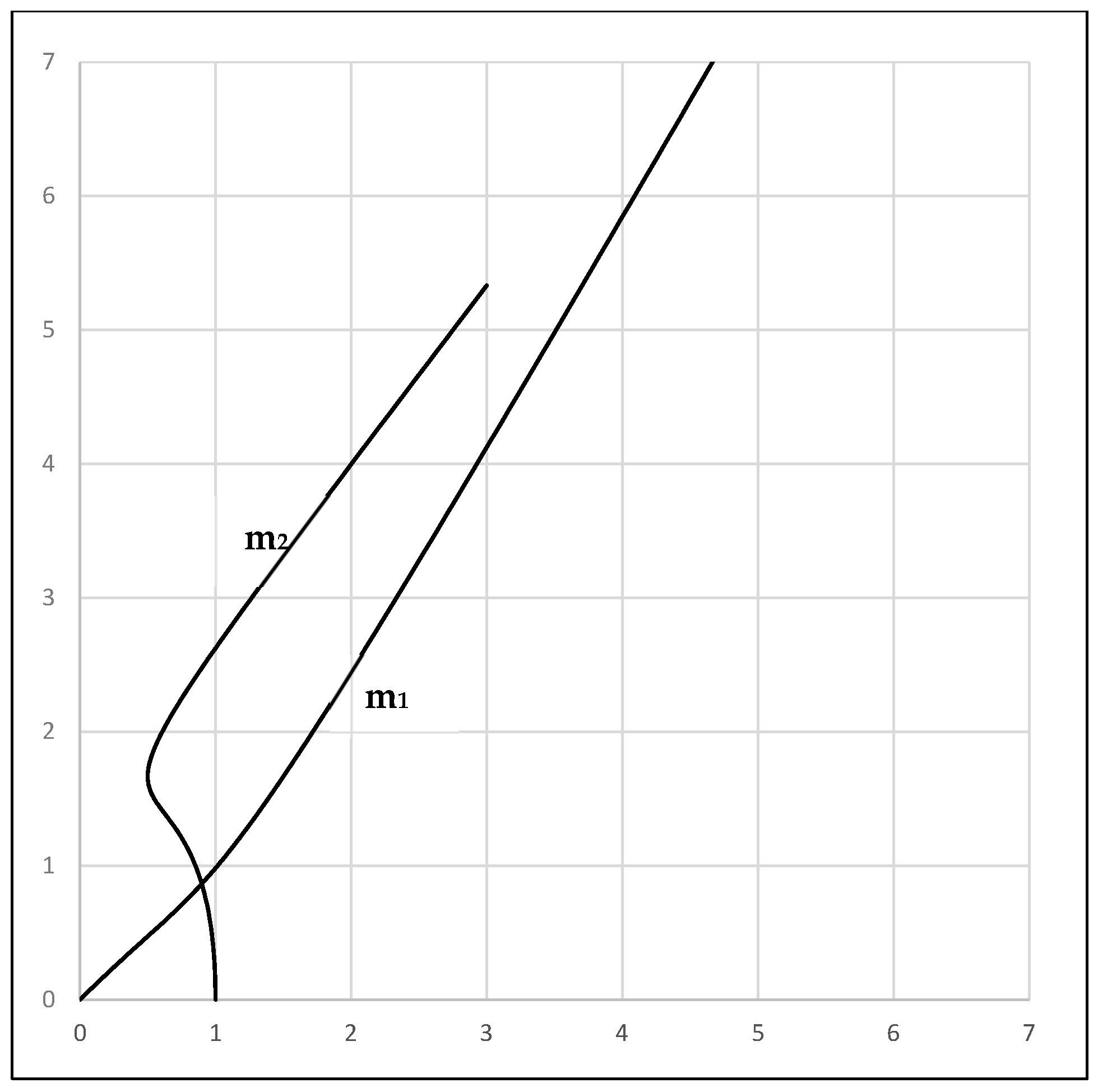
Figure 13 and Figure 14 display the trajectories of the two point masses in the reference system of the CM and in the original reference system, respectively.

4. Conclusions

Despite the two-body problem has been widely studied in the scientific literature, we have found a lack of the complete solution of the problem, once the initial conditions are assigned. It is in this direction that must be seen the originality of our work, thanks to the detailed solution of three different problems (i.e., elliptical, circular and parabolic trajectories).
It is important also to point out that the proposed approach is easily manageable by undergraduate students, i.e., no advanced mathematical knowledge is necessary for the solution of the problems. Therefore, this makes the methodology exhaustive and hopefully potential object of discussions between students and teachers.
By studying the dynamics of a two-body problem in a perturbed Newtonian potential (i.e., equivalent to a non-Newtonian potential), as reported in Appendix A, we demonstrate that the proposed methodology can be employed also for quite complex cases. The calculation of the angle of precession of the planet Mercury in the same Appendix A follows directly, and it provides a strong agreement with the experimental observations.
Future extensions of this work should be focused on the study of additional trajectories, starting from different initial conditions of the two point masses.

Author Contributions

Conceptualization, L.S.; methodology, L.S.; software, L.S. and P.S.; validation, L.S., P.S. and R.G.; formal analysis, L.S.; investigation, L.S. and R.G.; resources, L.S.; data curation, L.S.; writing—original draft preparation, L.S. and R.G.; writing—review and editing, L.S., P.S. and R.G.; visualization, L.S. and P.S.; supervision, L.S.; project administration, R.G.; funding acquisition, L.S. All authors have read and agreed to the published version of the manuscript.

Funding

This research received no external funding.

Data Availability Statement

Relevant data is included within the text.

Conflicts of Interest

The authors declare no conflict of interest.

Appendix A

Appendix A.1. Trajectory of the Reduced Mass in the Centre of Mass Reference System

In the CM reference system, the energy E of the system and the angular momentum L relative to the CM are respectively:
E = 1 2 m 1 v 1 2 + 1 2 m 1 v 2 2 G m 1 m 2 r = 1 2 μ v r 2 G μ M r
L = r 1 m 1 v 1 + r 2 m 2 v 2 = r μ v r
The relations just found give the energy and angular momentum of the reduced mass alone in the CM reference frame. That is why the equation:
G μ M r 2 r ^ = μ d 2 r d t 2
describes the motion of the reduced mass μ in the CM reference frame. Let us also place the point mass M = m 1 + m 2 in the CM. Rather than solving the above equation of motion, let us operate with the principles of conservation.
From the conservation of mechanical energy in the CM reference frame, we have
1 2 μ   v r 2 + v n 2 + U ( r ) = E           v r = 2 μ E U ( r ) v n 2
where v r and v n are the radial and normal (or tangential) components of the velocity of the reduced mass. Furthermore, from the conservation of angular momentum we obtain: L z = μ r v n   , from which: v n   = L z / μ r . Therefore:
d r d t = 2 μ E U L z μ r 2
Furthermore, since: v n = r d ϑ d t , we obtain: d ϑ d t = v n r = L z μ r 2 . From the last two equations, eliminating dt, we have:
d ϑ = L z μ r 2 2 μ E U L z μ r 2 d r
We introduce the Newtonian potential for U ( r ) : U ( r ) = G μ M r . We have:
d ϑ = L z r 2 2 μ E + 2 μ 2 G M r L z r 2 d r
For ease of calculation, let us set:
k 1 = 2 μ E           k 2 = μ 2 G M L z           x = L z r
Then:
d ϑ = 1 k 1 + 2 k 2 x x 2 d x
In the denominator, under the square root, we add and subtract the same quantity in order to complete the square of a binomial:
d ϑ = 1 k 1 + 2 k 2 x x 2 + k 2 2 k 2 2 d x         d ϑ = 1 k 1 + k 2 2 x k 2 2 d x
d ϑ = 1 k 1 + k 2 2 1 1 x k 2 k 1 + k 2 2 2 d x
Integrating, we have:
ϑ = arccos x k 2 k 1 + k 2 2 + ϑ 0         x = k 2 + k 1 + k 2 2 cos ϑ ϑ 0
x k 2 = 1 + 1 + k 1 k 2 2 cos ϑ ϑ 0
Recalling the values of the parameters k 1 ,   k 2 ,   x , we obtain:
r = p 1 + e cos ϑ ϑ 0
where:
p = 1 G M L z μ 2 , e = 1 + 2 E μ 3 L z G M 2

Appendix A.2. Perturbed Newtonian Potential

Let us now consider a perturbed Newtonian potential of δ U : U ( r ) = G μ M r + δ U . (A1) becomes:
d ϑ = L z r 2 2 μ E 2 μ δ U + 2 μ 2 G M r L z r 2 d r
which can be written in a more convenient form as follows:
d ϑ = L z 2 μ E 2 μ δ U + 2 μ 2 G M r L z r 2   d r
Assuming an elliptical orbit, integrating between r min and r max , we have:
Δ ϑ = 2 L z r min r max 2 μ E 2 μ δ U + 2 μ 2 G M r L z r 2   d r
(the factor 2 because it goes from r min to r max and back).
We transcribe the previous relationship as:
Δ ϑ = 2 L z r min r max Ψ δ U   d r
where:
Ψ ( δ U ) = 2 μ E 2 μ δ U + 2 μ 2 G M r L z r 2
We expand the function Ψ into a power series of δ U , stopping the expansion at the 1st order:
Ψ ( δ U ) = Ψ ( δ U ) δ U = 0 + Ψ δ U δ U = 0 δ U
from which:
Ψ ( δ U ) = 2 μ E + 2 μ 2 G M r L z r 2 + μ 2 μ E + 2 μ 2 G M r L z r 2 δ U
We therefore have two contributions. The first addend produces Δ ϑ 1 = 2 π (motion with unperturbed potential: elliptical trajectory). The second gives the effect Δ ϑ 2 of the perturbation (precession):
Δ ϑ 2 = 2 L z r min r max μ 2 μ E + 2 μ 2 G M r L z r 2 δ U   d r = 2 L z r min r max μ δ U 2 μ E + 2 μ 2 G M r L z r 2 d r
From (A2) we obtain:
d r = r 2 L z 2 μ E + 2 μ 2 G M r L z r 2   d ϑ
Substituting, we obtain:
Δ ϑ 2 = L z 2 μ L z 0 π r 2 δ U d ϑ
For example, if: δ U = C r 2 , where C is a constant, the angle of precession is:
Δ ϑ 2 = L z 2 μ L z 0 π r 2 C r 2 d ϑ = L z 2 μ L z C π = 2 π μ C L z 2

Appendix A.3. Precession of Mercury

Accurate experimental observations have made it possible to determine the angle of precession of the planet Mercury. The theoretical problem was to explain these results.
Well, considering the perturbative effects of the other planets in classical mechanics, a value was obtained that differs by 43 arc seconds per century from the measured value.
Einstein’s theory of general relativity allows this missing quantity to be evaluated. In fact, it can be shown that the angle of precession due to the curvature of space-time is given by the relation:
Δ ϑ = 6 π G M c 2 a 1 e 2
where M is the mass of the Sun: M = 1.989 · 10 30   kg (mass that generates the gravitational field), a is the semi-major axis of the planet’s orbit, and e is its eccentricity.
For the planet Mercury, we have the following values: a = 5.791 · 10 10   m, e = 0.2056 . We also recall that the period of revolution around the Sun is: T = 87.969 days .
Moving on to the numerical values, we obtain the angle of precession of Mercury in one revolution around the Sun:
Δ ϑ = 6 π · 6.67 · 1 0 11 · 1.989 · 10 30 3 · 1 0 8 2 · 5.791 · 1 0 10 1 0.205 6 2 = 5.01 · 1 0 7 r a d r e v . = 0.103 s e c o n d s r e v .
a year is: 365 / 87.969 = 4.15 . Therefore, in one Earth year, the angle of precession is:
Δ ϑ = 0.103 · 4.15 s e c o n d s y e a r = 0.427 s e c o n d s y e a r
In a century:
Δ ϑ = 0.427 · 100 s e c o n d s c e n t u r y 43 s e c o n d s c e n t u r y
The agreement with experimental facts is excellent.

References

  1. Landau, L.D.; Lifshitz, E.M. Mechanics—Volume 1 of Course of Theoretical Physics; Butterworth-Heinemann: Oxford, UK, 1976; Volume 1. [Google Scholar]
  2. Quartieri, J.M.; Sirignano, L. Elementi di Meccanica—Teoria ed Esercizi Svolti; CUES: Salerno, Italy, 2008. [Google Scholar]
  3. Goodyear, W.H. Completely general closed-form solution for coordinates and partial derivatives of the two-body problem. Astron. J. 1965, 70, 123–126. [Google Scholar]
  4. Duboshin, G.N. Celestial Mechanics—Basic Problems and Methods; Foreign Technology Division: Dayton, OH, USA, 1975. [Google Scholar]
  5. Scheeres, D.J. Stability in the full two-body problem. In Modern Celestial Mechanics: From Theory to Applications; Springer: Berlin/Heidelberg, Germany, 2002; Volume 83, pp. 155–169. [Google Scholar]
  6. Einstein, A.; Rosen, N. Two-body problem in general relativity theory. Phys. Rev. 1936, 49, 338–339. [Google Scholar] [CrossRef]
  7. Peters, P.C. Gravitational Radiation and the Motion of Two Point Masses. Ph.D. Thesis, California Institute of Technology, Pasadena, CA, USA, 1964. [Google Scholar]
  8. Schild, A. Electromagnetic two-body problem. Phys. Rev. 1963, 125, 2162–2166. [Google Scholar] [CrossRef]
  9. Cadez, A. Some remarks on the two-body problem in geometrodynamics. Ann. Phys. 1975, 91, 58–74. [Google Scholar] [CrossRef]
  10. Omarov, C.; Omarova, G. Modification of the Lagrange-Jacobi equation and its application. World J. Mech. 2023, 13, 127–134. [Google Scholar] [CrossRef]
  11. Gladkov, O. On the correction of the elliptical trajectory of the planets taking into account the Magnus effect associated with their periodic rotation around their axis. Dokl. Phys. 2025, 70, 11–12. [Google Scholar]
  12. Hou, X.; Xin, X. A note on the full two-body problem and related restricted full three-body problem. Astrodynamics 2018, 2, 39–52. [Google Scholar] [CrossRef]
Figure 1. Schematic view of the two point masses m 1 and m 2 interacting through a central gravitational force.
Astronomy 05 00002 g001
Figure 2. Initial positions and velocities (at the time instant t = 0 ) of the two point masses following elliptical trajectories in the inertial reference system S.
Astronomy 05 00002 g002
Figure 3. Initial positions and velocities of the two point masses following elliptical trajectories in the reference system of CM.
Astronomy 05 00002 g003
Figure 4. Positions of the two point masses in the reference system of the CM, at the time instants listed in Table 3. The dashed line connects the two point masses, which are always aligned with the centre of mass by opposite sides, at the time instant t = 10.9291 s.
Astronomy 05 00002 g004
Figure 5. Elliptical trajectories of the two point masses in the reference system of the CM (the centre of mass results to be the common focus of the two ellipses). The two point masses start at the perihelion of the respective trajectories and move in counterclockwise direction. The black dots represent the positions at the time instant t ˜ = 24   s .
Astronomy 05 00002 g005
Figure 6. Trajectories of the two point masses in the original reference system. The black dots represent the positions at the time instant t ˜ = 24   s (see Figure 5).
Astronomy 05 00002 g006
Figure 7. Initial positions and velocities (at the time instant t = 0 ) of the two point masses following circular trajectories in the inertial reference system S.
Astronomy 05 00002 g007
Figure 8. Circular trajectories of the two point masses in the reference system of the CM (the centre of mass results to be the common centre of the two circumferences). The two point masses move in clockwise direction. The black dots represent the initial positions.
Astronomy 05 00002 g008
Figure 9. Trajectories of the two point masses in the original reference system.
Astronomy 05 00002 g009
Figure 10. Initial positions and velocities (at the time instant t = 0 ) of the two point masses following parabolic trajectories in the inertial reference system S.
Astronomy 05 00002 g010
Figure 11. Initial positions and velocities of the two point masses following parabolic trajectories in the reference system of CM.
Astronomy 05 00002 g011
Figure 12. Positions of the two point masses in the reference system of the CM, at the time instants listed in Table 6. The dashed line connects the two point masses, which are always aligned with the centre of mass by opposite sides, at the time instant t = 4.8960 s.
Astronomy 05 00002 g012
Figure 13. Parabolic trajectories of the two point masses in the reference system of the CM (the centre of mass results to be the common focus of the two parabolas). The two point masses move in counterclockwise direction. The black dots represent the initial positions.
Astronomy 05 00002 g013
Figure 14. Trajectories of the two point masses in the original reference system.
Astronomy 05 00002 g014
Table 1. Equations of motion of the reduced mass in various trajectories.
CaseGeometrical DetailsCoordinates of μ Time
Circumference
( e = 0 )
Radius
a = p
x μ = a cos L z μ a 2 t + ϑ 0 y μ = a sin L z μ a 2 t + ϑ 0
Ellipse
( 0 < e < 1 )
Semi-major axis
a = p 1 e 2
x μ = a cos ξ e y μ = a 1 e 2 sin ξ
where ξ varies either between ξ 0 and ξ 0 + 2 π (counter-clockwise rotation) or between ξ 0 and ξ 0 2 π (clockwise rotation)
t = a 3 G M ξ e sin ξ ξ 0 e sin ξ 0
Parabola
( e = 1 )
x μ = p 2 1 + ξ 2 y μ = p ξ t = 1 2 p 3 G M ξ + ξ 3 3 ξ 0 + ξ 0 3 3
Hyperbola
( e > 1 )
Transverse semi-axis
a = p e 2 1
x μ = a e cosh ξ y μ = a e 2 1 sinh ξ t = a 3 G M e sinh ξ ξ e sinh ξ 0 ξ 0
Table 2. Considered initial conditions of the motion of two point masses following elliptical trajectories.
Total Mass Μ = m 1 + m 2 = 6 m 0
Reduced mass μ = m 1 m 2 m 1 + m 2 = 5 6 m 0
Initial position of the CM r 0 cm = m 1 r 01 + m 2 r 02 M = r 0 2 , 0
Initial velocity of the CM v 0 cm = m 1 v 01 + m 2 v 02 M = 0 , 8 3 v 0
Equation of motion of the CM r cm = r 0 cm + v 0 cm t         x cm = r 0 2 y cm = 8 3 v 0 t
Initial positions of m 1 and m 2 in the reference system of the CM r 01 = r 01 r 0 cm = 5 2 r 0 , 0
r 02 = r 02 r 0 cm = r 0 2 , 0
Initial velocities of m 1 and m 2 in the reference system of the CM v 01 = v 01 v 0 cm = 0 , 5 3 v 0
v 02 = v 02 v 0 cm = 0 , v 0 3
Table 4. Considered initial conditions of the motion of two point masses following circular trajectories.
Total Mass Μ = m 1 + m 2 = 3 m 0
Reduced mass μ = m 1 m 2 m 1 + m 2 = 2 3 m 0
Initial position of the CM r 0 cm = m 1 r 01 + m 2 r 02 M = r 0 3 , 0
Initial velocity of the CM v 0 cm = m 1 v 01 + m 2 v 02 M = 0 , v 0
Equation of motion of the CM r cm = r 0 cm + v 0 cm t         x cm = r 0 3 y cm = v 0 t
Initial positions of m 1 and m 2 in the reference system of the CM r 01 = r 01 r 0 cm = 4 3 r 0 , 0
r 02 = r 02 r 0 cm = 2 3 r 0 , 0
Initial velocities of m 1 and m 2 in the reference system of the CM v 01 = v 01 v 0 cm = 0 , 2 v 0
v 02 = v 02 v 0 cm = 0 , v 0
Table 5. Considered initial conditions of the motion of two point masses following parabolic trajectories.
Total Mass Μ = m 1 + m 2 = 4 m 0
Reduced mass μ = m 1 m 2 m 1 + m 2 = 3 4 m 0
Initial position of the CM r 0 cm = m 1 r 01 + m 2 r 02 M = r 0 4 , 0
Initial velocity of the CM v 0 cm = m 1 v 01 + m 2 v 02 M = 3 4 v 0 , 5 4 v 0
Equation of motion of the CM r cm = r 0 cm + v 0 cm t         x cm = r 0 4 + 3 4 v 0 t y cm = 5 4 v 0 t
Initial positions of m 1 and m 2 in the reference system of the CM r 01 = r 01 r 0 cm = r 0 4 , 0
r 02 = r 02 r 0 cm = 3 4 r 0 , 0
Initial velocities of m 1 and m 2 in the reference system of the CM v 01 = v 01 v 0 cm = v 0 4 , v 0 4
v 02 = v 02 v 0 cm = 3 4 v 0 , 3 4 v 0
Table 3. Numerical values of the positions of the two point masses following elliptical trajectories, in the reference system of the CM, as function of the parameter ξ .
ξt x 1 y 1 x 2 y 2
0.00000.0000−2.50000.00000.50000.0000
0.31420.6323−2.3301−1.03010.46600.2060
0.62831.2882−1.8369−1.95930.36740.3919
0.94251.9888−1.0687−2.69670.21370.5393
1.25662.7509−0.1008−3.17020.02020.6340
1.57083.58550.9722−3.3333−0.19440.6667
1.88504.49632.0452−3.1702−0.40900.6340
2.19915.47943.0131−2.6967−0.60260.5393
2.51336.52423.7813−1.9593−0.75630.3919
2.82747.61364.2745−1.0301−0.85490.2060
3.14168.72664.44440.0000−0.88890.0000
3.45589.83974.27451.0301−0.8549−0.2060
3.769910.92913.78131.9593−0.7563−0.3919
4.084111.97393.01312.6967−0.6026−0.5393
4.398212.95702.04523.1702−0.4090−0.6340
4.712413.86770.97223.3333−0.1944−0.6667
5.026514.7023−0.10083.17020.0202−0.6340
5.340715.4645−1.06872.69670.2137−0.5393
5.654916.1651−1.83691.95930.3674−0.3919
5.969016.8210−2.33011.03010.4660−0.2060
6.283217.4533−2.50000.00000.50000.0000
Table 6. Numerical values of the positions of the two point masses following parabolic trajectories, in the reference system of the CM, as function of the parameter ξ .
ξt x 1 y 1 x 2 y 2
−1.00000.0000−0.25000.00000.75000.0000
−0.60000.3307−0.1500−0.08000.45000.2400
−0.20000.5653−0.0500−0.12000.15000.3600
0.20000.76800.0500−0.1200−0.15000.3600
0.60001.00270.1500−0.0800−0.45000.2400
1.00001.33330.25000.0000−0.75000.0000
1.40001.82400.35000.1200−1.0500−0.3600
1.80002.53870.45000.2800−1.3500−0.8400
2.20003.54130.55000.4800−1.6500−1.4400
2.60004.89600.65000.7200−1.9500−2.1600
3.00006.66670.75001.0000−2.2500−3.0000
Disclaimer/Publisher’s Note: The statements, opinions and data contained in all publications are solely those of the individual author(s) and contributor(s) and not of MDPI and/or the editor(s). MDPI and/or the editor(s) disclaim responsibility for any injury to people or property resulting from any ideas, methods, instructions or products referred to in the content.