
Proceeding Paper

Quercetin Suppresses mRNA Expression of Fto and the TNF-α/NF-κB/NLRP3 Inflammasome Pathway in Hypothalamus of Diet-Induced Obese Rats †

by
Antonio Ávila-Guerrero
1,
Ángel Miliar-García
1,
Jorge Cornejo-Garrido
2,
Alexis Alejandro García Rivero
1,
Mercedes Uriyah Velázquez Romero
2 and
Aarón Domínguez López
1,*
1
Laboratory of Molecular Biology, Escuela Superior de Medicina “ESM”, Instituto Politécnico Nacional, Mexico City 11340, Mexico
2
Laboratory of Molecular Biology & Natural Products, Escuela Nacional de Medicina y Homeopatía “ENMH”, Instituto Politécnico Nacional, Mexico City 07320, Mexico
*
Author to whom correspondence should be addressed.
Presented at the 5th International Electronic Conference on Brain Sciences & 1st International Electronic Conference on Neurosciences, 9–11 March 2026; Available online: https://sciforum.net/event/IECBS-IECNS2026.
Med. Sci. Forum 2026, 46(1), 4; https://doi.org/10.3390/msf2026046004 (registering DOI)
Published: 25 June 2026

Abstract

Background: The NLRP3 inflammasome is a key driver of obesity-associated chronic low-grade inflammation, contributing to hypothalamic neuroinflammation and disruption of energy homeostasis. Quercetin, a bioactive flavonoid, has been proposed as a modulator of inflammatory and metabolic pathways, including the fat mass and obesity-associated gene (FTO). Objective: This study evaluated the effects of quercetin on hypothalamic mRNA expression of Fto and components of the TNF-α/NF-κB/NLRP3 pathway. Methodology: In a high-fat diet (HFD)-induced obesity model, male Wistar rats (n = 18) were divided into three groups: standard diet (SD), HFD, and HFD + Q (supplemented with quercetin 50 mg/kg/day for 12 weeks). Gene expression was analyzed by quantitative PCR using the 2−ΔΔCt method. Results: HFD significantly increased the expression of Fto and pro-inflammatory genes, including Tnf, Nlrp3, Casp1, Il1b, and Il18. Quercetin supplementation attenuated this upregulation, restoring expression levels toward baseline. Conclusions: These findings indicate that quercetin reduces hypothalamic neuroinflammation and modulates Fto expression, likely through inhibition of NF-κB signaling and suppression of NLRP3 inflammasome activation. Quercetin may represent a potential molecular modulator of obesity-associated neuroinflammatory processes.

1. Introduction

The NLRP3 inflammasome plays a critical role in obesity-associated chronic low-grade inflammation, contributing to systemic inflammation and hypothalamic neuroinflammation [1,2]. Activation of this pathway disrupts energy homeostasis and impairs central regulation of appetite.
Quercetin, a bioactive flavonoid abundant in fruits and vegetables, possesses potent anti-inflammatory and antioxidant properties. It has been shown to modulate inflammatory signaling pathways, including TNF-α/NF-κB signaling and NLRP3 inflammasome activation, as well as metabolic regulators such as the fat mass and obesity-associated gene (FTO), whose rodent ortholog is Fto [3,4].
FTO is a key metabolic regulator associated with obesity and body mass index. It is highly expressed in the hypothalamus, where it influences appetite and satiety, and emerging evidence suggests a role in inflammatory signaling [5,6]. Dysregulation of FTO expression has been associated with metabolic disorders and inflammation-related pathologies [7].
Previous studies in animal models have shown that quercetin attenuates hypothalamic inflammation induced by high-fat or high-fructose diets, primarily through suppression of NF-κB signaling and NLRP3 activation [3,4]. We hypothesized that quercetin inhibits Fto overexpression and inhibits activation of the TNF-α/NF-κB/NLRP3 inflammasome pathway in the hypothalamus of high-fat diet-fed Wistar rats.
The aim of this study was to evaluate hypothalamic mRNA expression of Fto and key components of the TNF-α/NF-κB/NLRP3 inflammasome pathway using quantitative real-time PCR (qPCR).

2. Materials and Methods

After a two-week acclimation period, male Wistar rats (initial body weight: 200 ± 20 g) were randomly assigned to three groups (n = 6 per group): (a) standard diet (SD), (b) high-fat diet (HFD), and (c) high-fat diet plus quercetin (HFD + Q). Quercetin (≥95% purity by HPLC; Sigma-Aldrich, Q4951, St. Louis, MO, USA) was administered intragastrically at a dose of 50 mg/kg/day for 12 weeks.
At the end of the experimental period, rats were euthanized, and hypothalamic tissue was rapidly dissected and stored at −80 °C until further analysis. Total RNA was extracted using the TRIzol reagent method according to the manufacturer’s instructions, followed by purification with isopropanol and 75% ethanol. RNA concentration and purity were assessed using a NanoDrop 2000 spectrophotometer (Thermo Fisher Scientific, Waltham, MA, USA).
First-strand cDNA was synthesized from 100 ng of total RNA using random primers. Quantitative PCR was performed to evaluate the mRNA expression of Fto, Tnf, Tnfrsf1a, Tradd, Ripk1, Map3k7, Ikbkb, Ikbkg, Nek7, Nfkbia, Nlrp3, Pycard, Casp1, Il1b, Il18 and Gsdmd. β-Actin was used as the housekeeping gene for normalization. Relative expression was calculated using the 2−ΔΔCt method.
Statistical analysis was performed using GraphPad Prism (version 10.1.2). Data are presented as mean ± standard deviation (SD). Differences between groups were analyzed using one-way ANOVA followed by Tukey’s post hoc test. A p-value < 0.05 was considered statistically significant.

3. Results and Discussion

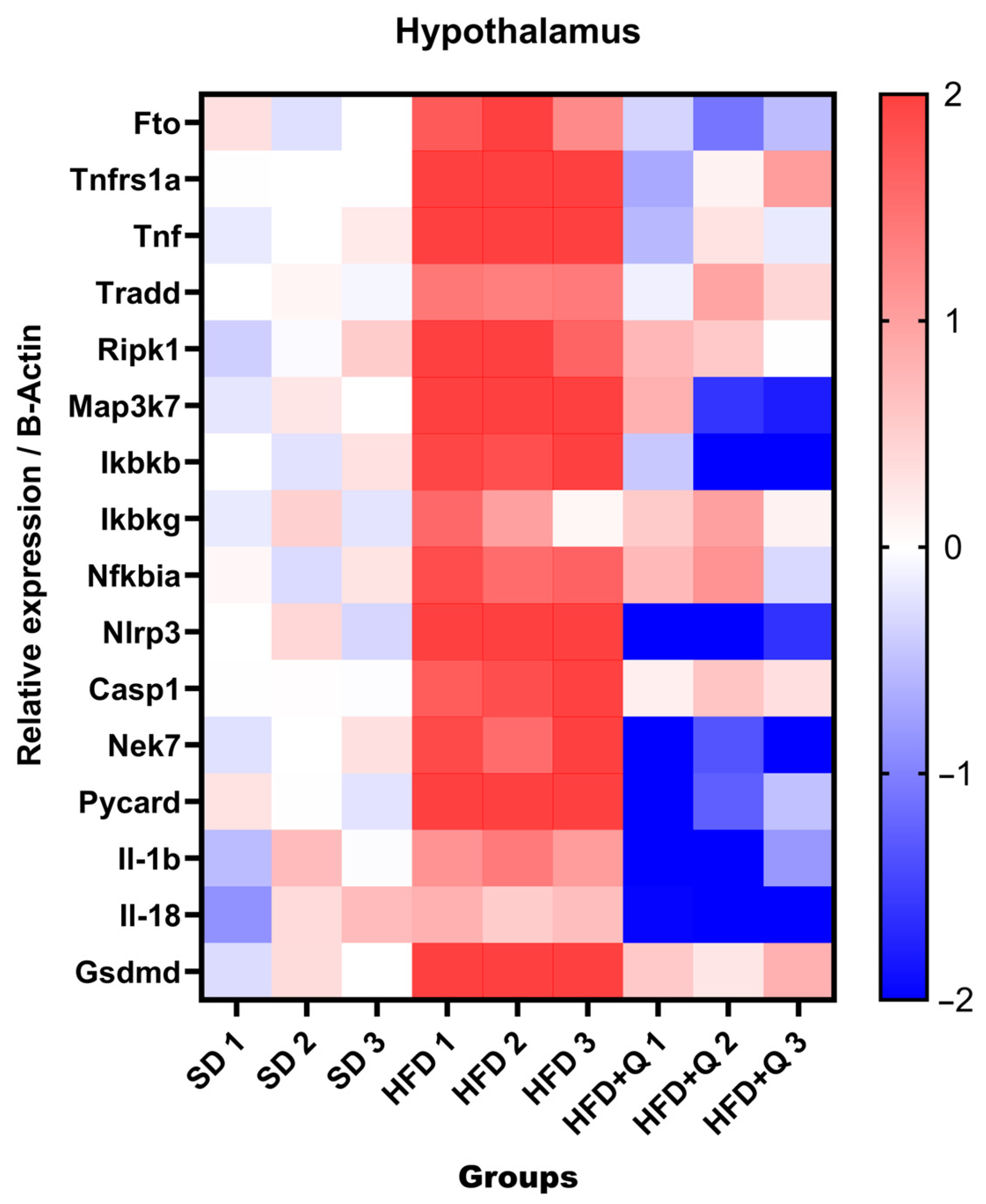
The high-fat diet (HFD) group exhibited significant upregulation of Fto and multiple pro-inflammatory genes associated with the TNF-α/NF-κB/NLRP3 inflammasome pathway compared to the standard diet (SD) group (p < 0.005) (Figure 1).
In contrast, quercetin supplementation (HFD + Q group) significantly downregulated Fto and key pro-inflammatory genes including Tnf, Tnfrsf1a, Tradd, Ripk1, Map3k7, Ikbkb, Ikbkg, Nek7, Nfkbia, Nlrp3, Pycard, Casp1, Il1b, and Il18 relative to the HFD group (p < 0.0001) (Figure 1).
These findings indicate that high-fat-diet-induced obesity promotes coordinated upregulation of Fto and inflammasome-related genes in the hypothalamus, supporting a mechanistic link between metabolic regulation and neuroinflammatory signaling, closely linking obesity-associated diseases, including neurodegenerative diseases, with systemic inflammation.
Our results demonstrate that chronic high-fat diet consumption induces overexpression of Fto and activates the TNF-α/NF-κB/NLRP3 inflammasome pathway in the rat hypothalamus, consistent with the role of neuroinflammation in obesity pathogenesis. Fto upregulation in the hypothalamus is consistent with previous studies [8].
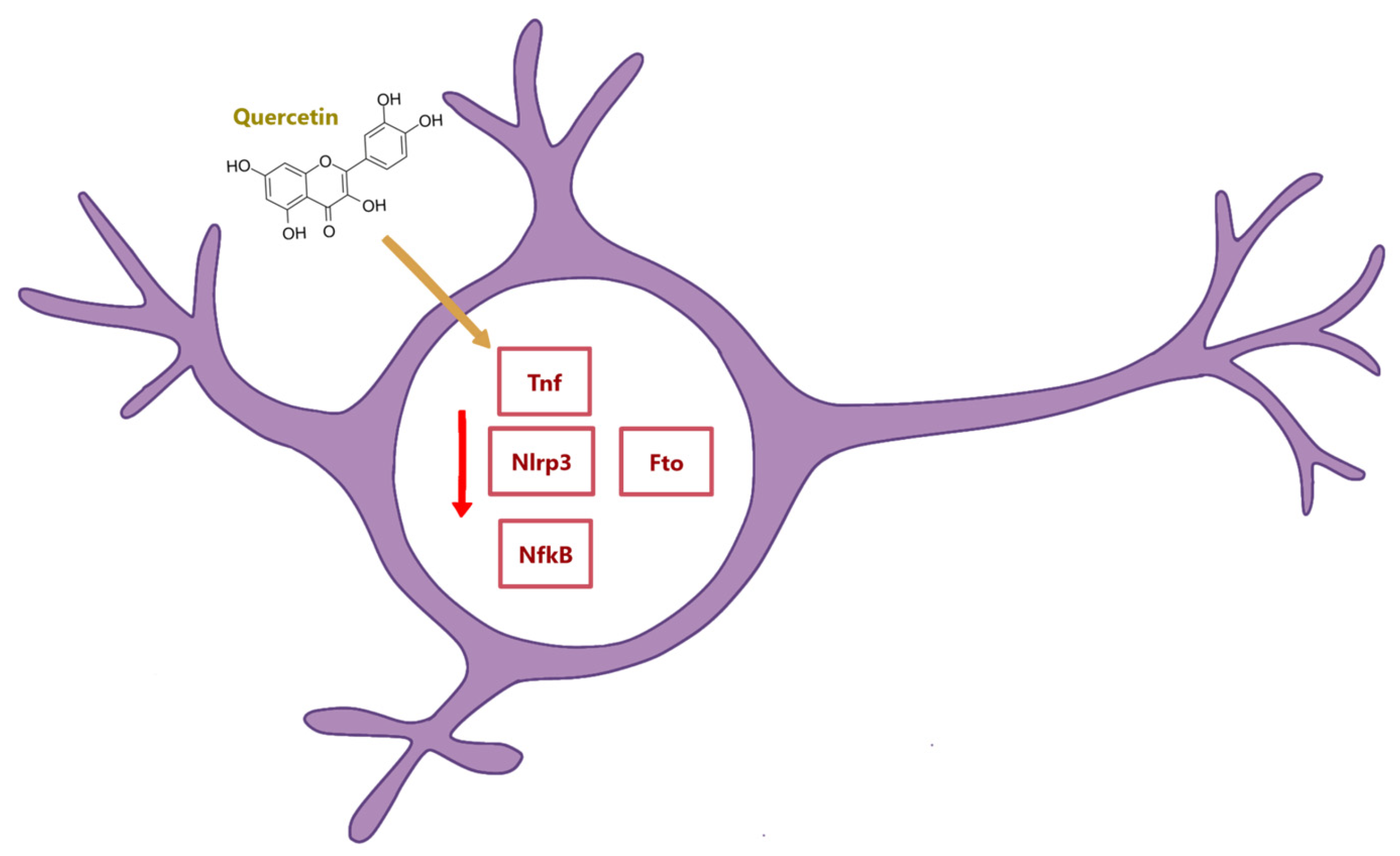
Quercetin supplementation effectively reversed these changes by significantly reducing the mRNA levels of Fto and key inflammasome components. These findings support the hypothesis that quercetin possesses anti-inflammatory and anti-obesity properties at the hypothalamic level, potentially through inhibition of NF-κB signaling and NLRP3 activation (Figure 2).

4. Conclusions

Quercetin downregulates mRNA expression of Fto and critical components of the TNF-α/NF-κB/NLRP3 inflammasome pathway in the hypothalamus of high-fat-diet-fed Wistar rats. These results highlight quercetin as a promising natural therapeutic candidate for targeting obesity-associated neuroinflammation and metabolic dysfunction.

Author Contributions

Conceptualization, A.D.L., J.C.-G. and Á.M.-G.; methodology, M.U.V.R. and A.Á.-G.; formal analysis, A.A.G.R. and A.Á.-G.; investigation, A.Á.-G. and A.A.G.R.; data curation, A.A.G.R.; resources, A.D.L., J.C.-G. and Á.M.-G.; writing—original draft preparation, A.Á.-G. and A.D.L.; writing—review and editing, A.D.L., Á.M.-G. and J.C.-G.; supervision, A.D.L.; project administration, J.C.-G.; funding acquisition, A.D.L., J.C.-G. and Á.M.-G. All authors have read and agreed to the published version of the manuscript.

Funding

This research was funded by INSTITUTO POLITÉCNICO NACIONAL grant SIP-20250095.

Institutional Review Board Statement

The animal study protocol was approved by the Institutional Ethics Committee of ENMH, CBE-007-2025 for studies involving animals.

Informed Consent Statement

Not applicable.

Data Availability Statement

The original contributions presented in this study are included in the article. Further inquiries can be directed to the corresponding author.

Conflicts of Interest

The authors declare no conflicts of interest.

Abbreviations

The following abbreviations are used in this manuscript:
FtoFat mass and obesity-associated gene (rat)
FTOFat mass and obesity-associated gene (human ortholog of Fto)
NLRP3NOD-like receptor protein 3
SDStandard diet
HFDHigh-fat diet
HFD + QHigh-fat diet plus quercetin

References

  1. Wu, K.K.L.; Cheung, S.W.; Cheng, K.K.Y. NLRP3 Inflammasome Activation in Adipose Tissues and Its Impact on Metabolic Diseases. Int. J. Mol. Sci. 2020, 21, 4184. [Google Scholar] [CrossRef] [PubMed]
  2. Marcos, J.L.; Olivares-Barraza, R.; Ceballo, K.; Wastavino, M.; Ortiz, V.; Riquelme, J.; Martínez-Pinto, J.; Muñoz, P.; Cruz, G.; Sotomayor-Zárate, R. Obesogenic Diet-Induced Neuroinflammation: A Pathological Link between Hedonic and Homeostatic Control of Food Intake. Int. J. Mol. Sci. 2023, 24, 1468. [Google Scholar] [CrossRef] [PubMed]
  3. Zhang, Q.Y.; Pang, Y.; Wang, R.; Kang, L.L.; Xue, Q.C.; Wang, X.N.; Kong, L.D. Quercetin inhibits AMPK/TXNIP activation and reduces inflammatory lesions to improve insulin signaling defect in the hypothalamus of high fructose-fed rats. J. Nutr. Biochem. 2014, 25, 420–428. [Google Scholar] [CrossRef] [PubMed]
  4. Jiang, W.; Huang, Y.; Han, N.; He, F.; Li, M.; Bian, Z.; Liu, J.; Sun, T.; Zhu, L. Quercetin suppresses NLRP3 inflammasome activation and attenuates histopathology in a rat model of spinal cord injury. Spinal Cord 2016, 54, 592–596. [Google Scholar] [CrossRef] [PubMed]
  5. Xu, Z.Y.; Jing, X.; Xiong, X.D. Emerging Role and Mechanism of the FTO Gene in Cardiovascular Diseases. Biomolecules 2023, 13, 850. [Google Scholar] [CrossRef] [PubMed]
  6. Olszewski, P.K.; Fredriksson, R.; Olszewska, A.M.; Stephansson, O.; Alsiö, J.; Radomska, K.J.; Levine, A.S.; Schiöth, H.B. Hypothalamic FTO is associated with the regulation of energy intake not feeding reward. BMC Neurosci. 2009, 10, 129. [Google Scholar] [CrossRef] [PubMed]
  7. Giri, S.; Kumar, V. FTO as an epigenetic regulator in metabolic and inflammatory diseases. INNOSC Theranostics Pharmacol. Sci. 2025, 8, 1–15. [Google Scholar] [CrossRef]
  8. Asuquo, E.A.; Nwodo, O.F.C.; Assumpta, A.C.; Orizu, U.N.; Oziamara, O.N.; Solomon, O.A. FTO gene expression in diet-induced obesity is downregulated by Solanum fruit supplementation. Open Life Sci. 2022, 17, 641–658. [Google Scholar] [CrossRef] [PubMed]
Figure 1. Heatmap showing the relative mRNA expression of Fto and TNF-α/NF-κB/NLRP3 inflammasome pathway-related genes in the hypothalamus. The color scale represents relative gene expression (red = upregulation, blue = downregulation and white = without change in expression). Columns correspond to individual animals from three experimental groups: standard diet (SD 1–3), high-fat diet (HFD 1–3), and high-fat diet supplemented with quercetin (HFD + Q 1–3). Rows display the genes analyzed: Fto, Tnfrsf1a, Tnf, Tradd, Ripk1, Map3k7, Ikbkb, Ikbkg, Nfkbia, Nlrp3, Casp1, Nek7, Pycard, Il1b, Il18, and Gsdmd. The heatmap clearly illustrates a marked upregulation of most genes in the HFD group compared to the SD group, while quercetin supplementation (HFD + Q) significantly attenuates this overexpression, particularly in Fto, Nlrp3, Casp1, Il1b, and Il18.
Msf 46 00004 g001
Figure 2. Schematic representation of the inhibitory effect of quercetin on the TNF-α/NF-κB/NLRP3 inflammasome pathway and Fto expression in hypothalamic neurons of high-fat-diet-fed rats.
Msf 46 00004 g002
Disclaimer/Publisher’s Note: The statements, opinions and data contained in all publications are solely those of the individual author(s) and contributor(s) and not of MDPI and/or the editor(s). MDPI and/or the editor(s) disclaim responsibility for any injury to people or property resulting from any ideas, methods, instructions or products referred to in the content.